
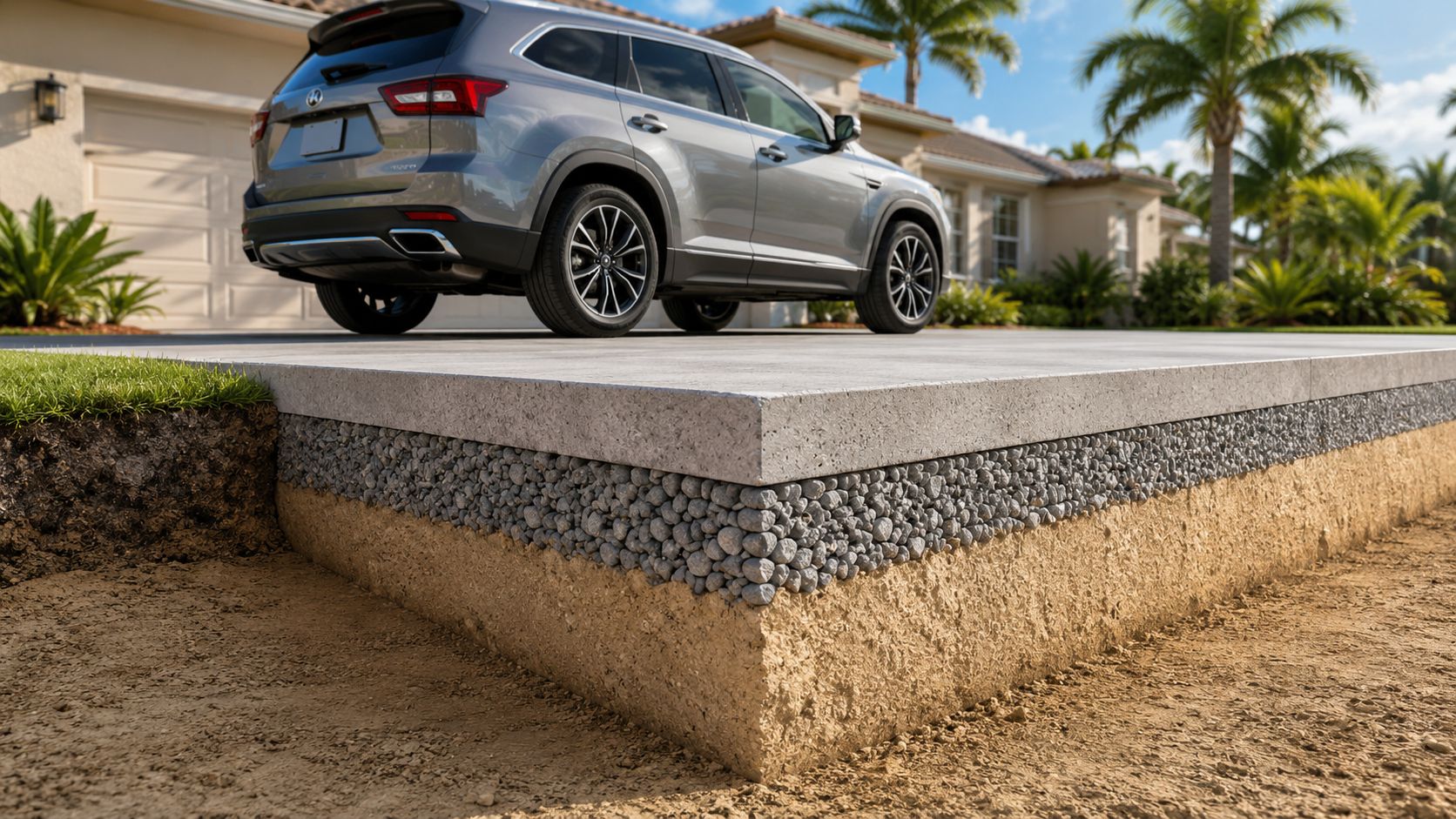
If you're planning a new driveway in Ocala, Summerfield, or The Villages, you're probably hearing the same short answer from different directions: make it 4 inches thick. That answer isn't wrong, but it leaves out the part that matters most. A driveway isn't just a slab you look at from the street. It's a structural surface that has to carry vehicle weight, handle water, and stay stable over soil that can shift, wash, and settle over time in Central Florida.
That matters in Marion County, FL and Citrus County, FL because homeowners here often replace driveways earlier than they expected for one simple reason. The original thickness, base prep, or jointing didn't match real use. A driveway that only sees sedans is one thing. A driveway in Belleview, Dunnellon, Crystal River, or Homosassa that gets pickups, trailers, service vans, or frequent deliveries is another.
The question isn't merely how thick concrete should be. It's how thick it should be for your property, your vehicles, and your soil conditions. Get that wrong, and the long-term cost shows up in cracks, edge failure, settlement, patching, and replacement work that could've been avoided.
Table of Contents
- Planning Your New Driveway in Central Florida
- Understanding Core Concrete Thickness Standards
- How Vehicle Weight Determines Driveway Thickness
- The Critical Role of Subbase and Compaction in Florida Soil
- Reinforcement and Jointing for Florida's Climate
- Common Driveway Failures and When to Hire an Expert
- Frequently Asked Questions About Concrete Driveways
- Your Next Steps for a Durable Driveway in Marion County
Planning Your New Driveway in Central Florida
A common situation goes like this. A homeowner in Ocala or The Villages gets ready to replace an aging driveway, starts comparing quotes, and sees different recommendations from different contractors. One says 4 inches is enough. Another says 5 inches would be smarter. Someone else focuses on finish and color but barely mentions the base.
That uncertainty is normal. From the street, most driveways look similar when they're new. The differences show up later, especially after wet seasons, heavy use, and a few years of sun and runoff.
In Central Florida, that long-term view matters more than commonly expected. Soil conditions can vary a lot between neighborhoods in Silver Springs, Inverness, Lecanto, Beverly Hills, Hernando, and nearby communities. Some lots drain well. Some hold water. Some have fill that wasn't compacted as well as it should've been before the house was built. That changes how a driveway performs.
Local rule of thumb: A driveway should be designed for the heaviest routine use it will actually see, not the lightest use you hope it gets.
Homeowners usually focus first on appearance, and that's understandable. A clean new concrete driveway adds curb appeal, brightens the front of the property, and fits well with patios, sidewalks, and entry walks. But thickness is where durability starts. If the slab is undersized or the base isn't right, the surface can look great on day one and still fail early.
For anyone comparing concrete driveway thickness standards in Central Florida, the best approach is simple. Start with the accepted minimums, then adjust for vehicles, soil, drainage, and the way the property is used in real life.
Understanding Core Concrete Thickness Standards
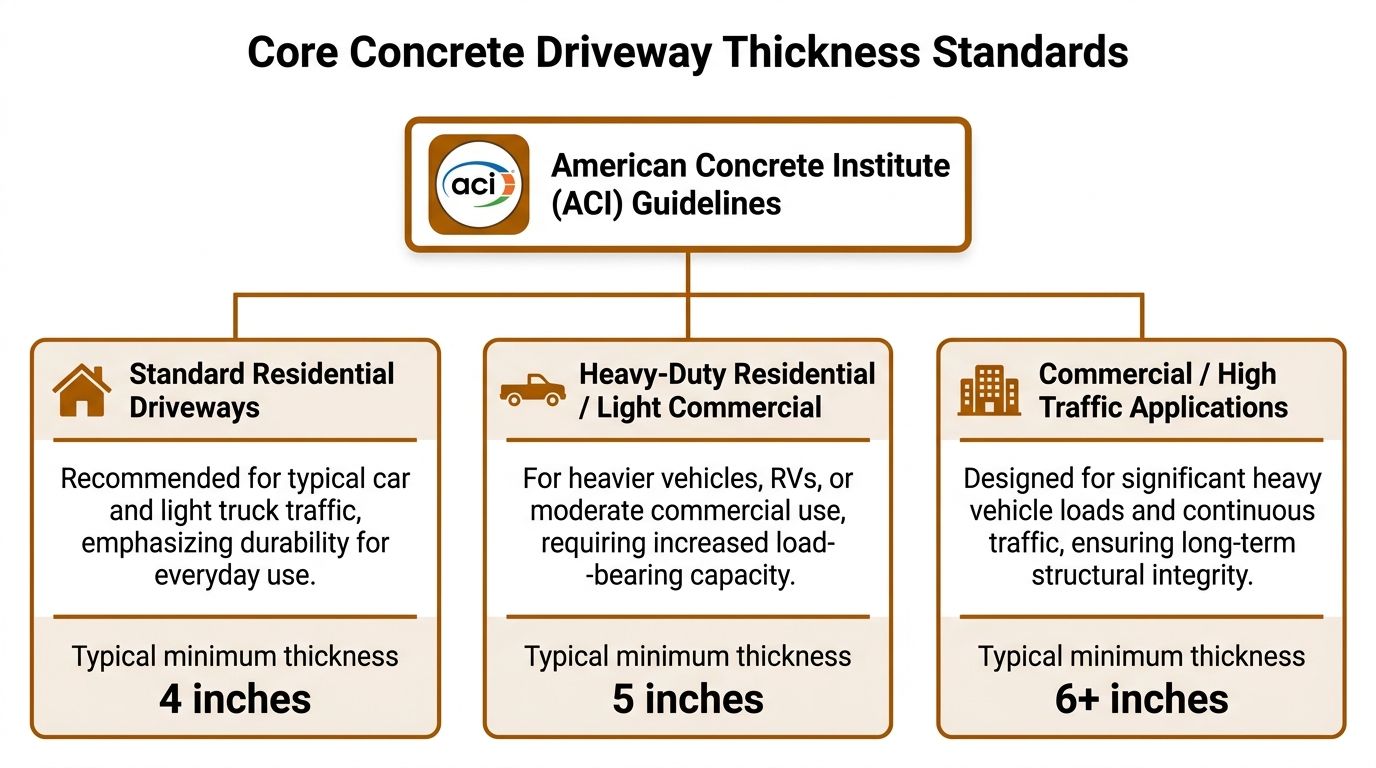
The baseline standard for residential driveways is straightforward. In the United States, the American Concrete Institute and many local codes recognize 4 inches as the minimum thickness for a residential concrete driveway under typical conditions, and guidance commonly moves to 5 to 6 inches in freeze-thaw climates or where heavier service is expected, as summarized by this overview of driveway thickness standards and ACI guidance.
Why the 4-inch standard exists
The 4-inch minimum didn't come out of guesswork. It became standard because it balances structural performance, constructability, and cost for typical residential traffic when the slab sits on a stable, properly prepared foundation.
A concrete driveway works by spreading wheel loads over a broader area. If that slab has enough depth and the support underneath is solid, normal passenger vehicles don't concentrate too much stress in one spot. That's why a properly built 4-inch driveway can perform well for many homes in Marion County and Citrus County.
This is also where a lot of confusion starts. People hear "minimum" and treat it like "best practice for every house." It isn't.
What the standard does not guarantee
A minimum standard only works when the rest of the system supports it. If the soil is weak, the base is thin, drainage is poor, or the driveway sees heavier traffic than expected, a minimum slab is more vulnerable.
The same body of guidance commonly pairs that slab with a compacted gravel base, and in many jurisdictions the combined depth of concrete plus base lands in the range homeowners would recognize as a substantial built-up section rather than a thin pour alone, as noted in the source above.
A few practical points matter here:
- Minimum isn't overbuilt: It covers typical residential service, not every vehicle mix.
- Thickness and support work together: A stronger slab can't fully compensate for poor ground prep.
- Load placement matters: Driveway edges, turning areas, and approach points often take more abuse than the middle.
- Local conditions still decide performance: A stable lot in one part of Summerfield may behave very differently from a disturbed or sandy lot in Dunnellon.
The driveway that lasts isn't always the thickest one. It's the one where thickness, base prep, drainage, and joint layout were matched to the site.
For homeowners comparing concrete work against other paving options, this is also why the conversation shouldn't stop at material alone. Concrete can be durable and long-lasting, while asphalt can be a smart fit in the right application when maintained with services like sealcoating or parking lot striping on commercial sites. The point is to match the system to the use.
How Vehicle Weight Determines Driveway Thickness
The fastest way to make a good driveway fail early is to build for cars when the property really serves trucks. That's common in Central Florida. A home in Belleview might have only two passenger vehicles today, but if a work truck, trailer, RV, or frequent service vehicle starts using the slab, the stress on the concrete changes.
Guidance for heavier residential traffic is clear. When pickups, work trucks, or RVs are expected, often in the 8,000 to 12,000 lb gross vehicle weight range, recommendations commonly increase slab thickness to 5 to 6 inches because thicker concrete reduces flexural stress and helps limit fatigue and edge cracking under repeated loads, according to this technical overview of optimal driveway thickness.
Minimums change when vehicle loads change
A driveway doesn't fail because a heavy vehicle touched it once. Trouble usually starts with repeated loading in the same track, especially near edges or where drivers turn in sharply.
That shows up in neighborhoods across Ocala, Inverness, and Crystal River where driveways double as parking pads, trailer staging areas, or work vehicle access. A slab built to the minimum for light residential use may hold up at first, then start showing stress where the tires land most often.
Recommended Driveway Thickness by Vehicle Load
| Vehicle Type | Common Examples | Recommended Minimum Thickness |
|---|---|---|
| Standard passenger vehicles | Sedans, compact SUVs, small crossovers | 4 inches |
| Heavier residential vehicles | Full-size pickups, larger SUVs, work trucks | 5 inches |
| Heavy-duty residential use | RVs, larger work vehicles, repeated heavier loading | 6 inches |
A practical way to choose the right thickness
A homeowner doesn't need to overcomplicate this decision. Ask what will use the driveway during the next several years, not just during the next several weeks.
Consider these real-world patterns:
- Daily household use: If the slab only carries normal passenger vehicles, the baseline may be appropriate when the site conditions are strong.
- Mixed-use households: If you have a pickup, larger SUV, or service traffic, moving up in thickness is usually the more durable choice.
- Heavy vehicle parking: If an RV, work truck, or trailer sits in one place for long periods, the slab should be sized for that use from the start.
- Frequent turning or edge loading: Thicker concrete pays off where vehicles don't enter and exit in straight, gentle lines.
The long-term trade-off is simple. Saving material on day one can create repair decisions later that cost more, look worse, and interrupt use of the driveway. That's why homeowners looking at concrete driveway thickness standards should think about lifestyle first, then price.
The Critical Role of Subbase and Compaction in Florida Soil
A driveway can have the right slab thickness and still fail if the ground underneath wasn't prepared correctly. That's especially important in Central Florida, where sandy soils, variable fill, and drainage issues can undermine concrete from below.
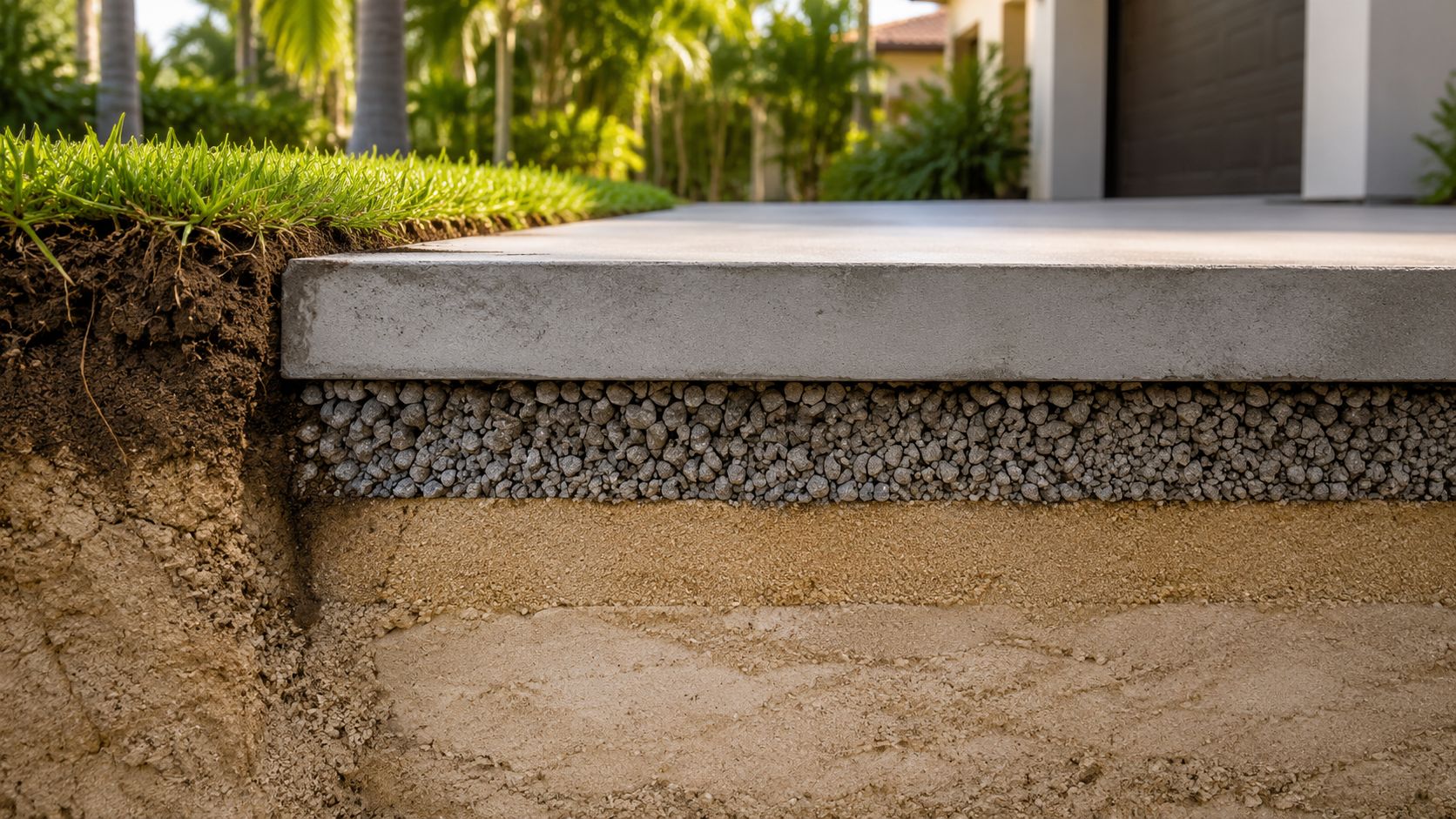
Why the soil underneath matters as much as the slab
Concrete is strong in compression, but it doesn't like unsupported voids. If water moves through the soil and carries fines away, or if loose fill compresses after the driveway is poured, the slab loses uniform support. That's when cracking, rocking, and settlement begin.
This is why technical guidance widely treats the driveway as a system made up of the slab plus a properly compacted, well-drained granular base. In many residential applications, code-oriented recommendations pair the concrete with a gravel or crushed stone base so the load can distribute more evenly and water can drain away instead of sitting under the slab.
In places like Dunnellon and Silver Springs, soil conditions can look fine on the surface and still need correction once excavation starts. A driveway over disturbed ground needs a different level of preparation than one over firm, undisturbed soil.
Practical check: If a contractor talks only about concrete thickness and not about base preparation, you're not hearing the full design.
What proper preparation looks like
Good base work is not decorative. It's the part that keeps the driveway from sinking at the garage apron, cracking near the street, or breaking along the edges.
The process usually includes:
- Excavation to stable grade: Soft spots, organic material, and weak fill need to come out.
- Granular base installation: Gravel or crushed stone creates drainage and support.
- Compaction in lifts: The material has to be compacted methodically, not just spread and flattened.
- Drainage awareness: Water needs a path away from the slab, not under it.
Homeowners who want a better sense of what quality prep involves can review this guide on how to prepare ground for a concrete slab.
This visual gives a useful overview of how the layers work together in the field.
Florida doesn't deal with freeze-thaw the way northern states do, but heavy rain can be just as punishing in a different way. Water intrusion, erosion beneath edges, and soft subgrade conditions can shorten the life of an otherwise decent-looking driveway. That's why subbase work is one of the biggest dividing lines between a driveway that stays flat and one that starts moving.
Reinforcement and Jointing for Florida's Climate
Thickness and base support do most of the structural work, but reinforcement and joints help the slab survive normal movement without falling apart cosmetically or structurally. In Central Florida, heat, rain, and soil moisture swings create enough stress that these details matter.
Reinforcement helps the slab stay together
Steel reinforcement doesn't make weak concrete strong by itself. What it does is help the slab hold together when stress builds from shrinkage, minor movement, or localized loading.
That matters on driveways in Homosassa, Lecanto, and Beverly Hills where hot weather can accelerate moisture loss during curing and where repeated wet-dry cycles affect the ground below. Reinforcement helps limit the separation that can happen after a crack forms. It doesn't prevent every crack, but it can keep small problems from becoming broken sections.
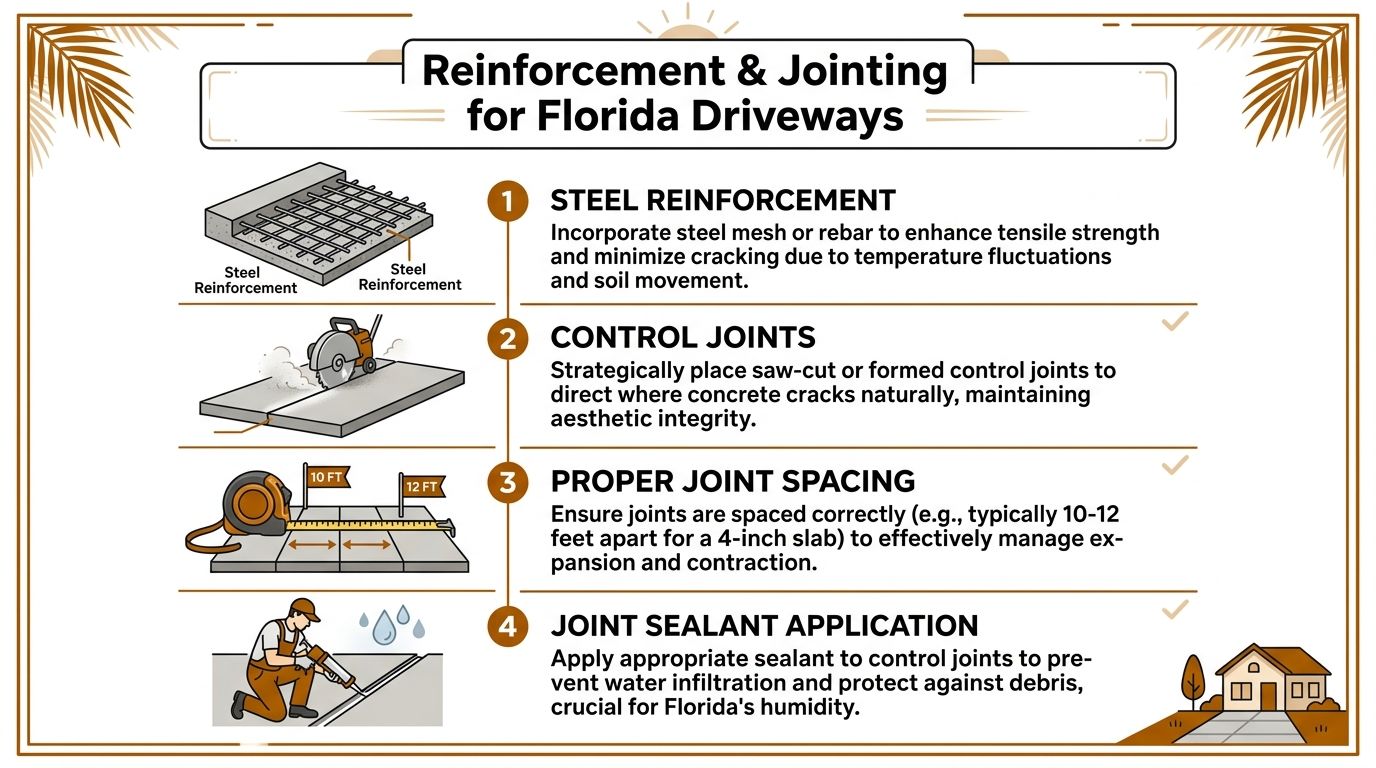
Common reinforcement choices may include wire mesh or rebar, depending on the slab design and expected use. The important point is placement. Steel that ends up too low in the slab or buried in the dirt won't do the job it was supposed to do.
Joints control where cracking happens
Concrete will crack. The goal is to control where it cracks. That's what joints are for.
Control joints create planned weak points so shrinkage and movement happen in straighter, less visible locations instead of random patterns across the driveway. Expansion details also matter where the driveway meets structures, curbs, or other fixed surfaces.
A few signs that jointing was handled well:
- The pattern fits the slab shape: Large unbroken panels usually invite random cracking.
- Cuts are made at the right time: Waiting too long can let cracks start before the saw does.
- Transitions are isolated properly: Garage slabs, sidewalks, and aprons need room to move independently.
- Water entry is considered: Open joints can collect debris and allow infiltration if neglected.
Homeowners who want a plain-language explanation can review what a concrete expansion joint does and why it matters.
Good jointing is one of the least noticed parts of a new driveway and one of the most important parts of an old one.
This is also where local expertise shows. Florida heat isn't theoretical. It affects curing speed, finishing timing, and joint cutting decisions in the field. Crews that understand local conditions usually make better calls than crews working from a generic template.
Common Driveway Failures and When to Hire an Expert
Most driveway failures don't start as dramatic collapses. They start as little signs homeowners try to ignore. A hairline crack near the edge. A low spot that holds water after rain. Flaking near the surface. A corner that sounds hollow when a tire rolls over it.
What failure looks like in the real world
Three problems show up again and again.
Settlement happens when the support underneath the slab wasn't prepared well enough or loses stability over time. You see one section sink lower than the next, often near the garage, street connection, or wheel paths.
Edge cracking is common where vehicles drive too close to the side of the slab, especially if the base washed out or the thickness wasn't enough for the load. Once an edge breaks, water gets in more easily and the damage usually spreads.
Surface spalling or flaking can come from multiple causes, but poor installation practices and ongoing moisture issues make it worse. The driveway starts looking tired much earlier than it should.
A driveway rarely fails because of one bad day. It usually fails because a weak design meets repeated use.
Why cheaper installation usually costs more later
The long-term cost question becomes tangible at this point. Homeowners often compare a lower bid against a more comprehensive recommendation and assume the savings are straightforward. They usually aren't.
Independent engineering and infrastructure studies suggest that, for thin residential slabs, each additional inch of thickness can delay the onset of cracking and spalling by several years in high-traffic or marginal-subgrade conditions, as summarized in this discussion of thicker driveway design and durability trade-offs. That doesn't mean every driveway needs the maximum possible slab. It means undersizing has a predictable price.
The hidden costs of getting thickness wrong include:
- Patching that never blends well: Repairs often remain visible and may not solve the underlying support issue.
- Drainage corrections after the fact: Fixing water flow is harder once concrete is already down.
- Partial replacement: Removing failed panels is disruptive and usually less cohesive than full planned construction.
- Reduced curb appeal: A cracked driveway affects the look of the whole front elevation.
Hiring an expert makes sense when the site has soft soil, drainage concerns, mixed vehicle use, or an existing driveway that's already showing movement. It also makes sense when you're replacing concrete that failed early, because early failure usually means the original build missed something important.
For homeowners in Marion County, FL and Citrus County, FL, that local judgment matters. The right answer for a quiet residential street in Summerfield may not be the right answer for a rural property outside Hernando or a busier home near The Villages with heavier daily traffic. A professional evaluation should account for use, soil condition, drainage, slab layout, and the transitions to sidewalks, aprons, or patio areas.
Frequently Asked Questions About Concrete Driveways
Is 4 inches enough for a driveway in Central Florida
Sometimes, yes. A 4-inch slab is the accepted minimum for typical residential service when conditions are right, but that doesn't automatically make it the best choice for every home. If the driveway will only carry normal passenger vehicles and the foundation work is strong, that baseline can be appropriate. If heavier vehicles are part of the picture, the slab should be sized accordingly.
Is a 5-inch driveway worth it
For many homeowners, it is. The decision usually makes sense when the driveway will see pickups, larger SUVs, work vans, trailers, or repeated delivery traffic. The value isn't just added concrete. It's reduced stress on the slab and a better margin against cracking where real-world use is tougher than the minimum standard assumes.
Do I need rebar or wire mesh in Florida
Many driveways benefit from reinforcement, especially where soil conditions are less predictable or where slab panels are larger and traffic is heavier. Reinforcement doesn't replace thickness or base prep, but it helps the slab stay intact when movement happens. The better question isn't "Do I need steel?" It's "What reinforcement fits this driveway design and this site?"
Can you pour new concrete over an old driveway
Sometimes people ask for an overlay because it seems faster and cheaper. The problem is that new concrete placed over a failing base or cracked slab usually inherits the same movement. If the old driveway has settlement, widespread cracking, or drainage trouble, covering it doesn't solve the root cause.
What matters more, slab thickness or base preparation
That's the wrong fight because both matter. Thickness gives the driveway structural capacity. Base preparation gives it support. One without the other is where trouble starts.
A simple way to evaluate proposals is to ask these questions:
- What vehicles is this driveway being designed for
- How will the subbase be installed and compacted
- What reinforcement is being used
- How will joints be laid out
- How will drainage move away from the slab
How does Florida weather affect concrete compared with asphalt
Concrete and asphalt each perform differently here. Concrete offers a clean, durable surface for driveways, patios, and sidewalks. Asphalt performs well too, especially when maintained properly on private roads and parking lots with sealcoating and striping. For many commercial properties in Ocala, Dunnellon, and Crystal River, both materials may be used on the same site for different purposes.
Your Next Steps for a Durable Driveway in Marion County
A durable driveway isn't just a pour. It's a system. Concrete driveway thickness standards give you the starting point, but the final decision should reflect the vehicles using the slab, the strength of the subbase, site drainage, reinforcement, and joint layout.
For a Central Florida homeowner, the checklist is practical:
- Match thickness to actual use: Don't design for sedans if the driveway will carry trucks.
- Insist on subbase preparation: The ground underneath decides whether the slab stays supported.
- Account for Florida weather: Rain, heat, and runoff all affect performance.
- Look past the low bid: The cheapest installation often becomes the most expensive driveway over time.
If you're comparing options in Ocala, Belleview, Inverness, Lecanto, or anywhere across Marion County or Citrus County, it helps to start with a local site review instead of a generic phone estimate. A contractor who understands Central Florida conditions can usually spot risk factors before the concrete truck ever arrives.
For homeowners researching who to call next, this guide to finding the best concrete driveway contractors near you is a useful place to start.
If you want a driveway built for real Central Florida conditions, Riverside Sealing & Striping, LLC offers free estimates and no-pressure consultations for homeowners and property managers across Marion County, FL, Citrus County, FL, and surrounding areas. As Concrete and Asphalt Experts in Marion and Citrus County, the team handles concrete driveways, patios, sidewalks, asphalt sealcoating, and parking lot striping with local experience, reliable scheduling, and high-quality workmanship. If you're in Ocala, Dunnellon, Summerfield, Crystal River, Homosassa, Inverness, or nearby communities, a professional on-site evaluation can help you choose the right thickness, the right base prep, and the right long-term plan before work begins.