
TL;DR: In Central Florida, a practical starting point for a typical 4-inch concrete slab is often about $7 to $13 per square foot for planning purposes. That’s only a starting number. The actual price depends on thickness, reinforcement, site prep, drainage, removal, access, and finish, which is why homeowners and property managers in Marion and Citrus County need an on-site quote, not a calculator.
You’re probably here because you need a real number before you call anyone. Maybe it’s a driveway replacement in Ocala, a patio in Crystal River, a sidewalk in Inverness, or a slab for a small commercial upgrade in Dunnellon. You don’t want a vague answer, and you definitely don’t want a low-ball number that changes after the crew shows up.
That’s the problem with most concrete slab cost per square foot advice online. It gives you a narrow material-and-labor number, but it skips the job conditions that decide whether the slab lasts or starts giving you trouble early. In Central Florida, that missing detail matters. Soil movement, drainage, humidity, traffic load, and proper base prep all show up in the final result.
A good quote should answer two questions at the same time. What does it cost to install the slab, and what does it take to build it so it holds up.
Understanding Concrete Slab Costs in Central Florida
If you want the shortest honest answer, here it is. National projections for plain concrete slabs in 2026 run about $6.50 to $10.50 per square foot with materials and labor, and the same source notes that Central Florida contractors need to quote complete packages that include items like compaction, rebar, and moisture barriers because those details affect durability in the field, according to Concrete Network’s concrete price guide.
That’s why a local planning range around $7 to $13 per square foot is a fair place to start for many basic Central Florida slab discussions. It reflects what happens when a simple national range meets actual site conditions, local labor realities, and the kind of prep work that keeps a slab from failing early.
Why the square foot number is only the beginning
A concrete slab isn’t just concrete. It’s base prep, grade control, forms, reinforcement, thickness, finishing, joint layout, curing, and access. If one of those gets treated like an afterthought, the slab may still look fine on pour day and still become a headache later.
For homeowners in Belleview, Silver Springs, Summerfield, or The Villages, the biggest mistake is comparing quotes only by the surface number. Two contractors can both say they’re pouring a slab, while one is allowing for compaction and reinforcement and the other is not.
Practical rule: If a quote sounds cheap, ask what thickness, what reinforcement, what base prep, and what drainage work are actually included.
The local conditions that change the price
Marion and Citrus County properties aren’t all the same. A backyard patio in Homosassa with easy access is one kind of job. A driveway replacement in Ocala with existing broken concrete, edge tie-ins, and drainage issues is another.
The number also changes based on intended use. A patio slab and a driveway slab are not the same job, even if the footprint is similar. Once vehicles, turning tires, garage approaches, or commercial traffic enter the picture, the design usually needs to change with them.
What a useful quote should tell you
Before anyone talks finish color or scheduling, the basics should be clear:
- Thickness matters: A lighter-use patio or walkway usually doesn’t need the same slab as a driveway.
- Reinforcement matters: Florida moisture and movement expose weak work.
- Prep matters: Soft spots, poor grading, and weak compaction don’t fix themselves after the pour.
- Scope matters: Demo, haul-off, transitions, and drainage often decide the final invoice.
If you understand those four points, you’re already ahead of most online slab calculators.
The Key Factors Driving Your Concrete Project Price
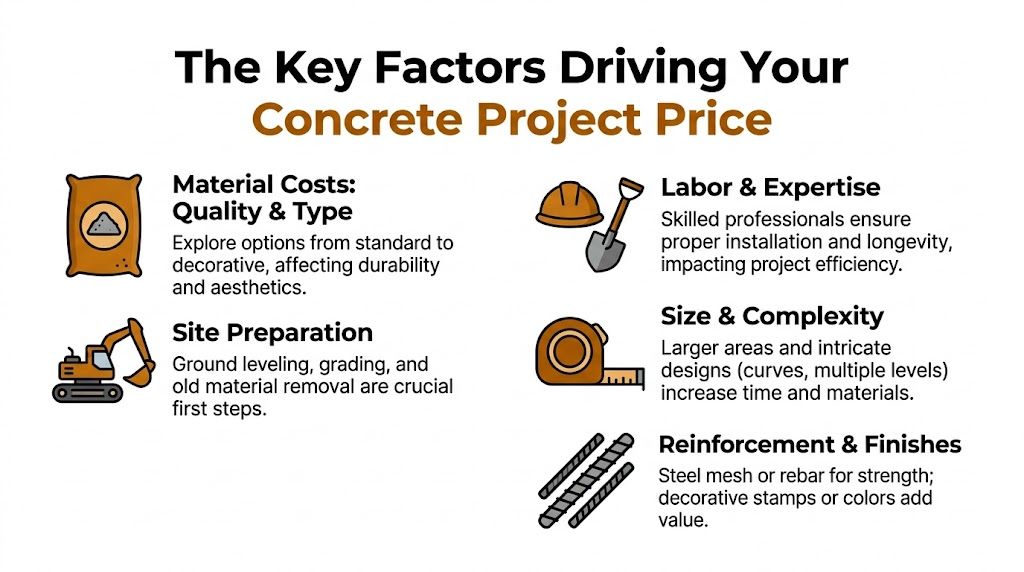
A homeowner in Ocala may call about a 20-by-20 slab and expect one clean number. On site, the critical questions start fast. Is this for patio furniture or vehicle traffic? Are we pouring over stable ground or old fill that needs to be cut out and compacted? Is there enough access for ready-mix and wheelbarrows, or is the crew hauling material through a side gate in July heat? Those job conditions drive the price more than the raw square footage does.
Thickness changes material cost and risk
Thickness has to match the use. A patio, shed pad, driveway, and dumpster approach should not all be priced or built the same way.
More thickness means more concrete, a deeper excavation in many cases, and a base that can carry the load without settling. It also changes finishing time and joint planning. On Central Florida properties, I pay close attention to what will roll or sit on that slab five years from now, not just what the owner plans on day one.
A slab that is too thin for the traffic usually costs less only once.
Reinforcement affects durability, but it is not one-size-fits-all
Reinforcement choices separate a serious quote from a stripped-down one. Fiber, wire mesh, rebar, or a combination can all make sense depending on slab use, thickness, joint layout, and subgrade conditions.
Analysts at CostFlowAI’s 2026 slab cost analysis found that fiber reinforcement adds cost by the cubic yard, and reinforced slabs generally price higher per square foot than plain slabs. That matches what happens in the field. Steel and fiber are added material, added labor, and part of a slab design that is built for service, not just for inspection day.
Reinforcement helps control cracking. It does not fix poor soil, standing water, or weak compaction.
Ground preparation usually decides whether the slab holds up
This is the line item homeowners miss most often because it is hard to see after the pour. Cutting out soft spots, bringing the grade to the right elevation, compacting properly, and shaping drainage all take time and equipment. Skip that work, and the slab may settle, crack, or trap water against the house.
For a plain-English look at that process, this guide to preparing ground for a concrete slab covers the steps property owners should understand before comparing bids.
Here are a few site conditions that raise the total project price fast:
- Removal of existing concrete: Saw cutting, breaking, loading, and haul-off add labor, disposal cost, and equipment time.
- Poor drainage: Low spots, downspout discharge, and runoff from nearby grades often have to be corrected before the pour.
- Limited access: Tight gates, fenced yards, septic locations, and long travel paths slow production.
- Tie-ins and elevations: Garage floors, sidewalks, door thresholds, and curbs need the slab height set correctly the first time.
Shape, finish, and edges change labor hours
A plain broom-finish rectangle is usually the most efficient slab to build. Curves, decorative borders, tighter control-joint layouts, stamped finishes, thicker edges, and detailed tie-ins all add form work and finishing labor.
That does not mean decorative work is a bad idea. It means the price should reflect the extra hands, extra time, and higher expectation for appearance.
Job size affects unit price, but not as much as online calculators suggest
Larger pours can spread setup and mobilization costs across more square footage. Smaller slabs often look expensive per foot because the truck coordination, crew time, form setup, and cleanup still happen either way.
That is why the all-in number matters more than a teaser rate. A low per-square-foot quote can still become the higher final invoice if it leaves out removal, base repair, drainage work, or access problems common on Marion and Citrus County properties.
| Cost driver | Why it changes price | Why it matters long term |
|---|---|---|
| Thickness | Uses more concrete and may require deeper prep | Matches the slab to the actual load |
| Reinforcement | Adds material and labor | Helps control cracking under normal stress |
| Site prep | Requires excavation, grading, and compaction | Reduces settlement and drainage problems |
| Access | Slows placement and increases labor time | Affects production quality and cleanup |
| Finish and layout | Requires more forming and detail work | Changes appearance, traction, and maintenance |
What Is Not Included in a Per-Square-Foot Quote
Most budget surprises originate with this misunderstanding. A lot of online pricing advice talks about slab cost per square foot as if that’s the full project cost. It isn’t. It’s often only the slab itself, not the work needed to make that slab successful on your property.
Verified data shows that many online sources use $4 to $12 per square foot as a general range, but they often leave out demolition, drainage work, and ADA-related upgrades. The same source notes that a homeowner planning a 400 square foot patio from that range may budget $2,400 to $4,800 and still get hit with major added costs once the actual site conditions are known, according to Angi’s discussion of slab pricing gaps.
What commonly gets left out
A phone quote or online calculator usually won’t capture the parts of the job that matter most:
- Demolition and haul-off: Old driveway or patio removal is real work, not a side note.
- Grading and compaction: If the ground isn’t ready, the slab isn’t ready.
- Drainage fixes: Water control is part of the job, especially in Florida.
- Transitions and tie-ins: Garage entries, sidewalks, curbs, and doors need proper elevation.
- ADA items: Commercial and public-facing properties may need compliant slopes, access paths, and markings.
- Permit coordination: Depending on the property and scope, local requirements can affect the job.
Why low quotes often cost more later
A low number feels good on the front end. Then the change orders start. Or worse, the contractor pours the slab without handling the conditions that caused the original damage in the first place.
That’s how owners end up paying twice. First for the “cheap” slab, then for the repair, replacement, drainage fix, or trip hazard correction that should’ve been addressed from day one.
A square-foot price without a clear scope is not a firm budget. It’s a placeholder.
What to ask before you approve the work
Don’t ask only for the number. Ask for the scope in writing.
- What prep is included
- What reinforcement is included
- Whether removal and disposal are included
- How water will drain off the finished surface
- Whether the quote covers final thickness and finish
- What isn’t included
If a contractor can’t answer those directly, the price probably isn’t complete.
Our Concrete Services in Marion and Citrus County
A homeowner in Ocala may need a driveway that handles daily traffic and Florida rain. A church in Crystal River may need walkways that stay safe, drain right, and hold up under steady foot traffic. The square-foot number might look similar at first glance, but the actual job is different.
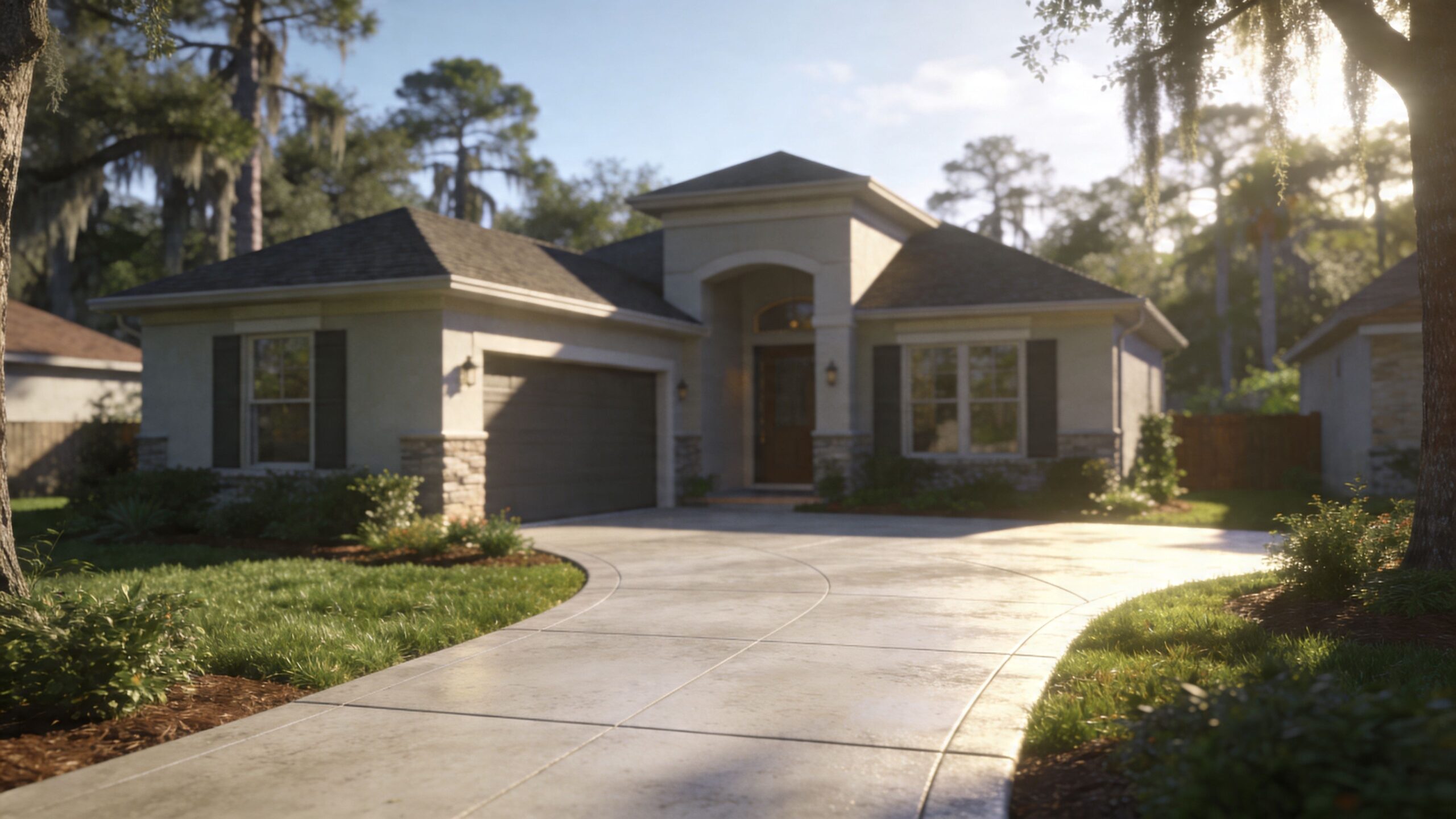
We handle concrete work for homeowners, HOAs, churches, retail properties, and commercial sites across Marion and Citrus County. The goal is simple. Build the slab for the way the property gets used, spell out the full scope, and avoid the surprises that show up after the pour.
Driveway installation and replacement
Driveways fail for predictable reasons. Vehicle weight matters, but turning tires, weak edges, poor runoff, and years of daily use usually do more damage than people expect.
For that reason, driveway work needs to be priced and built as a traffic surface, not as a basic backyard slab. On many Central Florida properties, the all-in cost includes more than forming and pouring. It can include tear-out, base correction, apron work, tie-ins to the garage or sidewalk, and finish details that keep water moving away from the house.
That is the part online calculators miss.
A low square-foot number may leave out the work that decides whether the driveway lasts. If you are comparing outdoor surface budgets across the property, it also helps to review current asphalt sealcoating cost per square foot so the concrete and asphalt sides of the job are planned together instead of piecemeal.
Patios and slabs for everyday use
A good patio is easy to live with. Chairs sit flat. Water runs off. The surface feels right underfoot, and it stays that way through heat, rain, and regular use.
Homeowners in Homosassa, Beverly Hills, Lecanto, and Summerfield often do best with a clean layout and solid construction rather than extra decorative features that add cost without fixing the basics. Finish, slope, and placement matter more than flashy add-ons if the goal is long-term value.
Patio and utility slab work usually comes down to a few practical decisions:
- How the space will be used: Grills, furniture, foot traffic, and storage all change the layout.
- Surface finish: Smooth enough to clean, textured enough to walk safely when wet.
- Drainage direction: Water needs a clear path off the slab and away from doors.
- Spacing and access: The slab should fit the house, yard, and normal traffic pattern.
A quick visual overview helps if you’re comparing options for your property.
Sidewalks walkways and ADA-minded work
Walkways have a simple job, but the tolerances are tighter than people think. They need to guide foot traffic, stay safe in wet weather, and connect entries without awkward grade changes.
For churches, schools, HOAs, retail centers, and other public-facing properties, that also means paying attention to accessibility from the start. Slopes, transitions, width, and surface consistency affect how the space works day to day. A walkway can look fine from the street and still create ponding, rough joints, or trip points that become a problem later.
Demolition and replacement
Replacement work shows whether a contractor is solving the problem or just covering it up. If an old slab cracked, settled, or held water, the new slab has to address the cause of that failure.
That is why we treat demolition and replacement as a full project scope, not just removal plus new concrete. On a residential driveway in Belleview or a commercial walkway in Ocala, the value is in getting the site back to sound conditions before the new surface goes down. That approach usually costs more upfront than a quick patch job, but it is the cheaper route compared with tearing it out again in a few years.
Protect Your Investment with Asphalt Sealing and Striping
Concrete and asphalt usually live on the same property. A homeowner may replace a driveway apron or sidewalk while the asphalt areas age nearby. A shopping center or church may upgrade concrete access points while trying to protect the parking lot from further wear. Treating those surfaces as separate problems often leads to uneven maintenance and missed issues.
That’s why full-site pavement planning matters. Once the concrete is handled, the asphalt needs attention too. If it doesn’t get it, sun, rain, traffic, oil, and oxidation keep working on the surface.
Seal coating protects the surface you already paid for
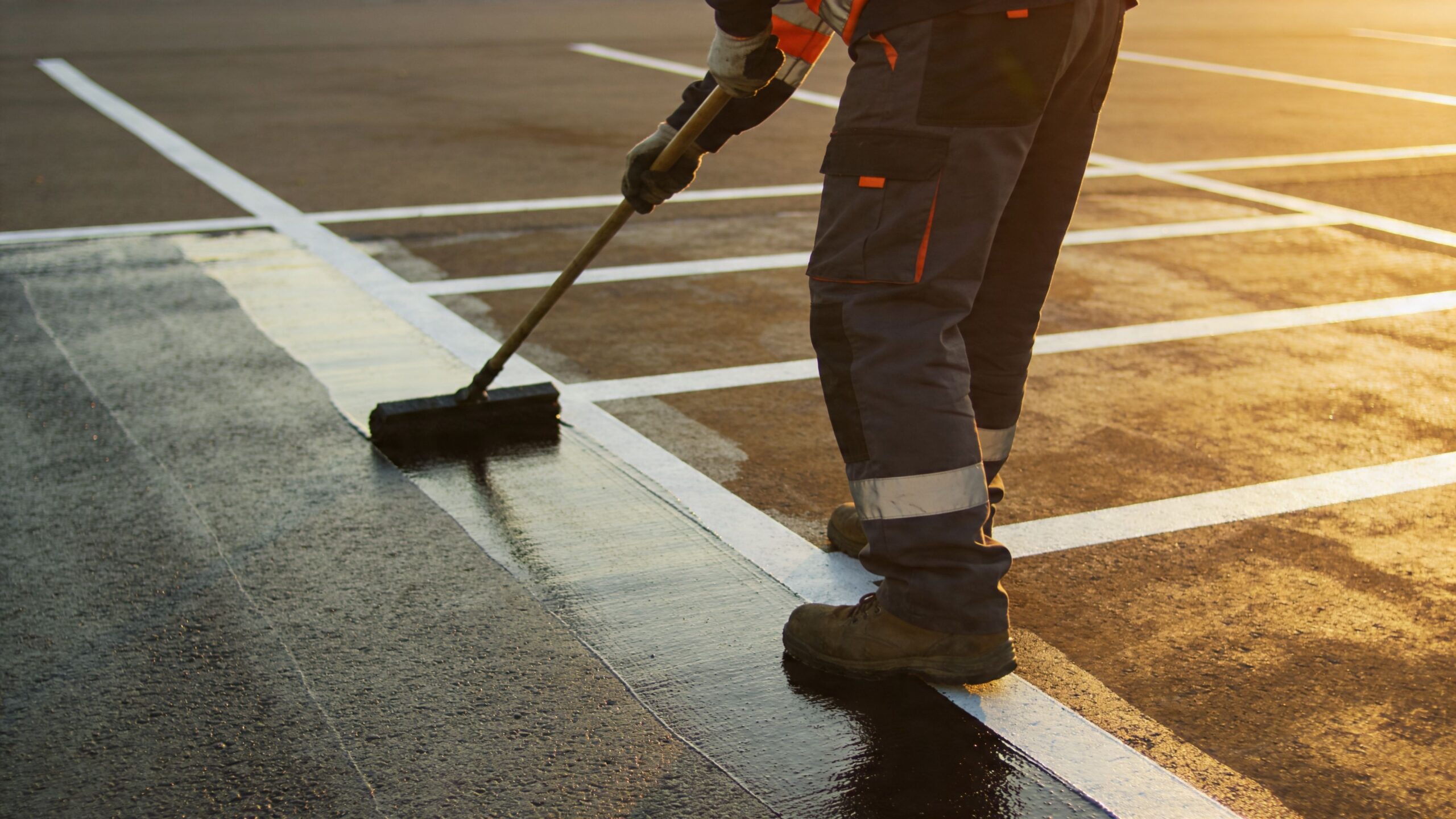
Seal coating is maintenance, not decoration. It helps protect asphalt from weather exposure, surface drying, fuel drips, and the steady wear that turns a solid parking area into a rough one. For commercial sites in Ocala, Dunnellon, Crystal River, or Inverness, that matters because the parking lot is one of the first things tenants, customers, and visitors see.
A worn lot doesn’t just look tired. It can start shedding aggregate, losing definition, and becoming harder to maintain. If you’re comparing budgeting options for that side of the property, this overview of asphalt sealcoating cost per square foot is a useful companion to slab planning.
Striping is a safety and organization issue
Fresh striping does more than improve curb appeal. It defines traffic flow, parking order, fire lanes, access aisles, and ADA spaces. On commercial properties, poor markings create confusion fast. Cars park crooked, access lanes get blocked, and pedestrian movement becomes less predictable.
Good striping work helps with:
- Traffic flow: Drivers understand where to enter, turn, and park.
- Safety: Pedestrian areas become clearer.
- Compliance: ADA-related markings need to be visible and laid out correctly.
- Appearance: A maintained lot signals that the property is actively managed.
Commercial owners need one pavement strategy
Property managers, HOAs, retail plazas, churches, and schools rarely benefit from treating concrete and asphalt as separate conversations. The smartest approach is usually to evaluate entrances, walks, ramps, parking surfaces, markings, and drainage together.
That makes scheduling cleaner, budgeting clearer, and the finished property more professional.
When concrete access points are sound and asphalt maintenance is kept current, the whole site works better and looks cared for.
Why Local Central Florida Expertise Matters
A slab that works well in one region can fail early in another if the builder ignores local conditions. Central Florida isn’t a place where you can treat drainage, sun exposure, and ground prep like small details. They drive performance.
The combination of heat, heavy rain, humidity, and daily traffic punishes shortcuts. Concrete that isn’t placed over a stable base can move. Asphalt that goes unprotected can dry out and wear faster. Slopes that looked close enough on paper can show their problems after the first strong storm.
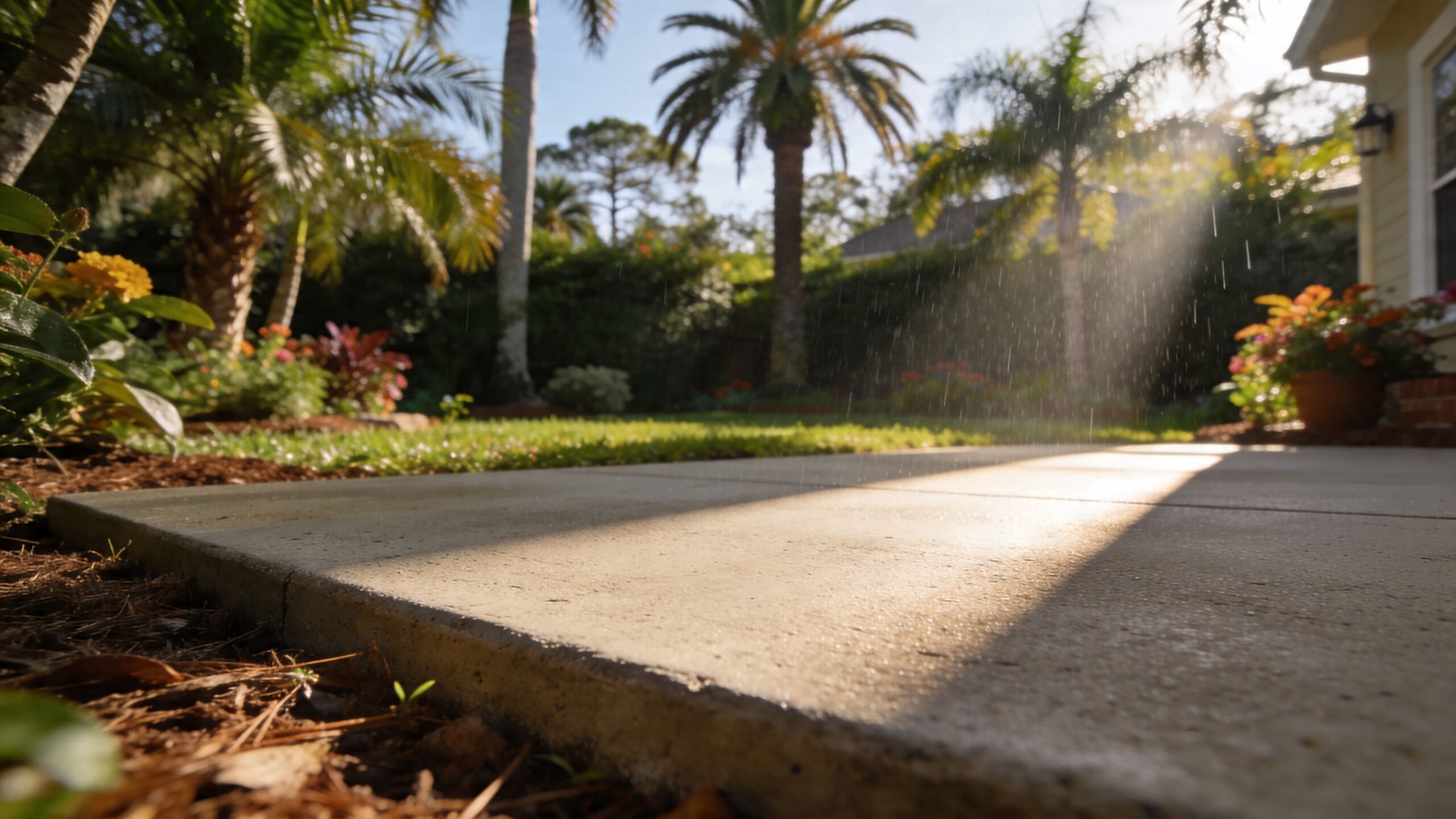
Florida weather exposes weak workmanship fast
In this part of the state, water management is never optional. If runoff collects where it shouldn’t, the slab, adjacent base, and nearby pavement all pay for it. The same goes for jointing. Expansion and movement have to be planned for, not guessed at. If you want a closer look at that part of the work, this explanation of what a concrete expansion joint does is worth reviewing.
Contractors who work locally understand that surface appearance on day one is only part of the job. A true test comes after weather, use, and time start doing their part.
Local knowledge changes the quote for the better
A local contractor usually asks better questions up front. How does water move across the lot now? Has this driveway cracked in the same place before? Is the existing sidewalk out of compliance because of settlement or because it was never poured correctly to begin with? Can the truck access the backyard directly, or will the crew need another placement plan?
Those are not sales questions. They’re build questions.
Reliability matters almost as much as the mix
Homeowners and commercial clients in Marion County and Citrus County usually want the same basic things. Show up when you say you will. Explain the scope clearly. Build it right. Don’t disappear when details matter.
That’s especially important on replacement work, HOA projects, retail centers, schools, and churches, where timing, access, and clean scheduling affect more than one household. The crew doesn’t just need technical skill. They need operational discipline.
| Local challenge | What experienced crews account for |
|---|---|
| Heavy rain | Drainage, slope, and water movement |
| Heat and UV | Appropriate materials and timing |
| Variable soil conditions | Better prep and compaction decisions |
| Commercial access needs | Safer layout and scheduling coordination |
Frequently Asked Questions About Florida Pavement
How long does a concrete driveway last in Florida
A properly built concrete driveway can last a long time in Florida, but longevity depends on base prep, thickness, reinforcement, drainage, joint placement, and use. A driveway poured too thin or over poor subgrade may look acceptable at first and still fail early. The best way to extend service life is to build the slab for the actual traffic it will carry.
Can damaged concrete be repaired or does it need replacement
Sometimes isolated issues can be addressed, but replacement is often the better answer when the slab has widespread cracking, settlement, drainage problems, or surface failure tied to a bad base. If the root cause stays in place, surface-level fixes usually don’t hold up as well as owners hope.
Do you handle removal before new concrete is installed
A complete replacement project should include evaluation of the existing slab, removal where needed, haul-off planning, and correction of the conditions below it before the new pour. That’s especially important on old driveways and walkways where prior damage may point to grading or support problems.
Do you offer ADA-compliant walkways and parking lot striping
Yes. ADA-related work matters on sidewalks, access routes, handicap spaces, access aisles, and parking lot markings. Commercial properties, churches, schools, HOAs, and retail centers usually need that work handled carefully so the finished site is safe, organized, and professionally laid out.
What areas do you serve around Marion and Citrus County
Projects commonly come from Ocala, Dunnellon, Belleview, Silver Springs, Summerfield, Crystal River, Homosassa, Inverness, Lecanto, Beverly Hills, Hernando, and nearby Central Florida communities. Residential and commercial properties both need the same core thing. A crew that understands local conditions and gives a clear, on-site scope.
How should I compare two slab quotes
Compare the details, not just the final number. Check thickness, reinforcement, base preparation, drainage approach, removal, finish, transitions, and what exclusions are listed. If one quote is lower, find out which part of the scope got smaller.
Get Your Free On-Site Concrete or Asphalt Estimate
If you’re pricing a driveway, patio, sidewalk, commercial slab, seal coating job, or parking lot striping project, the smartest next step is an on-site visit. That’s how you get past generic square-foot numbers and into the specific conditions that control price and performance.
A proper estimate should look at access, drainage, grade, existing damage, intended use, finish, and whether the work involves replacement, new installation, or compliance-related upgrades. That’s how you avoid surprise costs and get a number you can plan around.
For homeowners in Ocala, Crystal River, Inverness, Dunnellon, and surrounding areas, that means a clearer answer before work starts. For property managers, HOAs, churches, schools, and retail centers, it means cleaner scheduling and a scope built around how the site is used.
The right contractor won’t rush you into a one-size-fits-all number. They’ll walk the property, answer direct questions, explain the trade-offs, and give you a quote that matches the job.
If you need a clear, no-pressure quote for concrete or asphalt work in Central Florida, contact Riverside Sealing & Striping, LLC. They serve Marion County, Citrus County, and surrounding areas with concrete driveways, patios, slabs, sidewalks, demolition and replacement, asphalt seal coating, parking lot striping, and ADA-focused pavement upgrades. Free on-site estimates, reliable scheduling, and practical guidance are available for residential and commercial properties alike.