
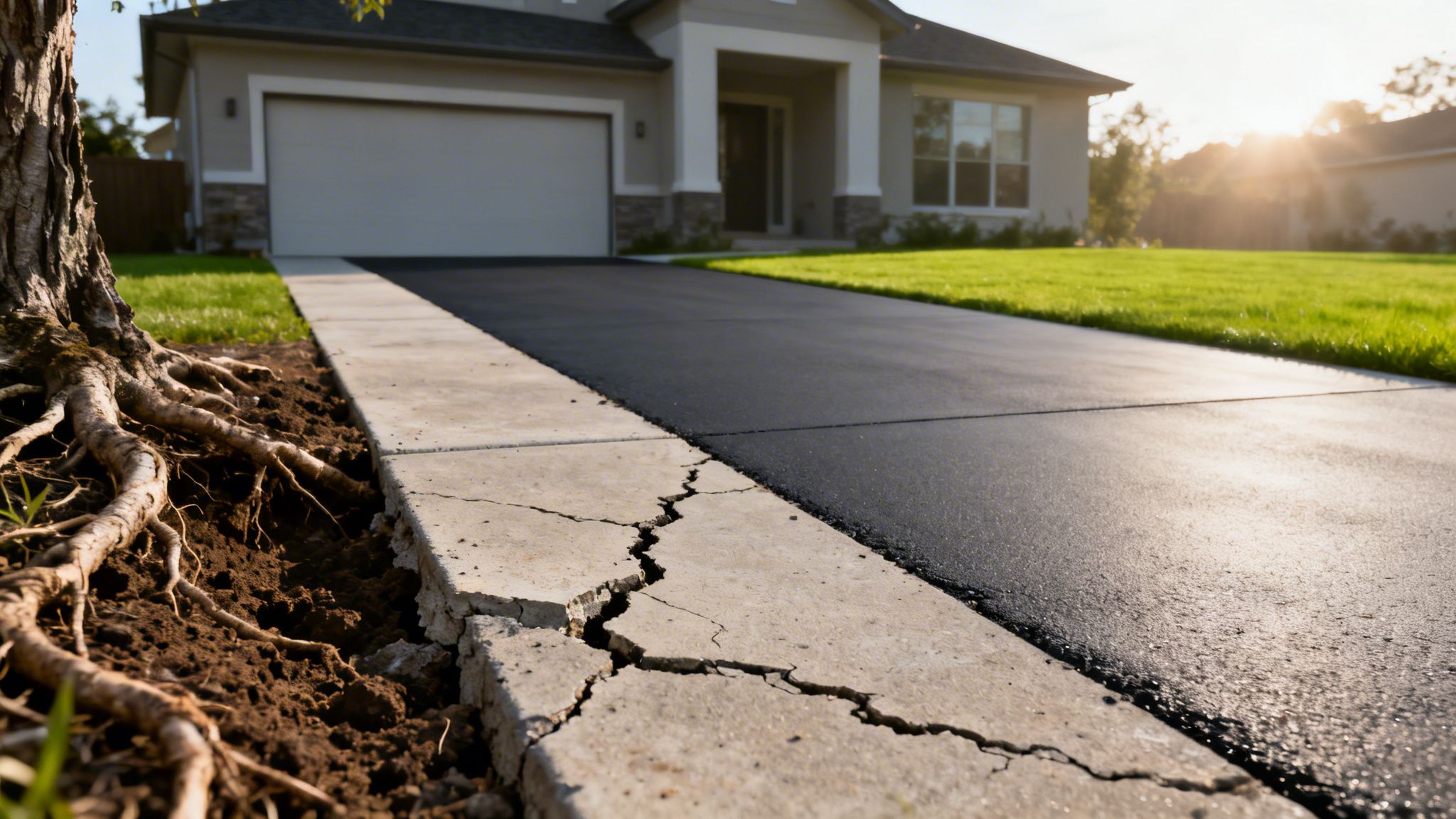
A small crack in a driveway usually gets ignored at first.
Then the rainy season hits Marion County or Citrus County, the crack darkens, the edges start to spread, and now you are wondering the same thing many homeowners and property managers ask: why is my driveway cracking, and is this something simple or something expensive?
That question matters because a crack is rarely just a surface flaw. Concrete and asphalt usually crack because something underneath, around, or within the surface has changed. In Central Florida, that often means water, soil movement, tree roots, heavy vehicles, aging materials, or a driveway that was never built with the right base and joint layout in the first place.
If you own a home in Ocala, Dunnellon, Belleview, Crystal River, Inverness, Homosassa, Lecanto, Beverly Hills, Hernando, Summerfield, Silver Springs, or The Villages, the local conditions matter. A driveway in this part of Florida does not fail for the same reasons as one in a dry climate or a northern freeze zone. Summer rains, humid conditions, sun exposure, soft or shifting soils, and drainage issues all play a role.
Some cracks can be repaired early. Some can be managed for a while. Others are warning signs that replacement is the smarter move.
Your Guide to Concrete and Asphalt Solutions in Marion & Citrus County
Driveway damage is often first noticed in ordinary moments. Pulling in after work. Walking to the mailbox. Washing the car and seeing water collect in one corner. What looked like a harmless line now has width, movement, or crumbling edges.
Then the primary question starts. Not just why is my driveway cracking, but what caused it and what should happen next.
In Marion and Citrus counties, the answer depends on the surface type, the soil under it, the way water moves across the property, and the age and construction quality of the driveway itself. A concrete driveway with random cracking usually tells a different story than an asphalt surface with soft edges or fatigue cracking. The fix has to match the cause.
What driveway cracks usually mean
A crack is a symptom. It can point to:
- Base failure under the slab or pavement
- Poor drainage that lets water work its way below the surface
- Root pressure from mature trees
- Load stress from heavier vehicles than the driveway was built to carry
- Weather exposure that weakens materials over time
If the wrong fix gets applied, the crack often returns. That is why store-bought patch products disappoint so many property owners. They cover the line, but they do not solve the reason the line formed.
Full-service help for concrete and asphalt
Many people get steered wrong at this stage. They call an asphalt-only company for a concrete problem, or a general handyman for a structural issue. The result is usually a cosmetic patch on top of an active failure.
For homes and commercial properties in Ocala, Dunnellon, Inverness, and surrounding Central Florida communities, the right solution may be concrete driveway installation, selective concrete replacement, sidewalk work, slab work, asphalt crack filling, sealcoating, striping, or drainage correction. Sometimes it is a combination.
Practical rule: If the crack keeps widening, returns after patching, or sits where water pools, treat it as a structural or drainage issue first and a surface issue second.
The 5 Main Culprits Behind Driveway Cracks in Central Florida
You pull into the driveway after one hard summer storm and notice a crack that was not there last month. In Marion and Citrus counties, that usually traces back to what is happening under the surface, not just on top of it.
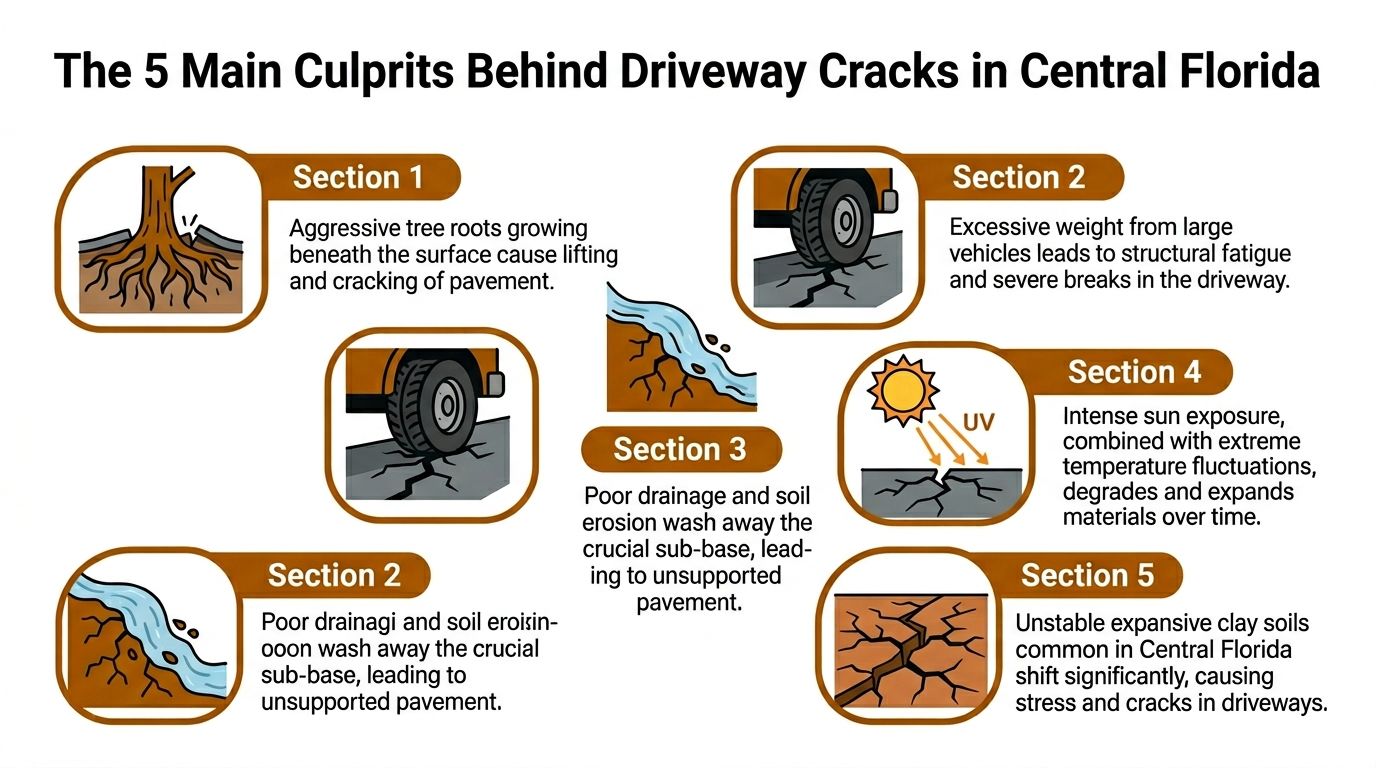
Weak base and unstable soil
This is the starting point on a lot of Central Florida failures. Our soils can look firm during construction and still shift later, especially where sandy material, pockets of clay, and incomplete compaction all meet in the same driveway.
Analysts cited in this driveway cracking analysis focused on subgrade and soil movement note that poor subgrade preparation and soil instability account for a large share of driveway cracking. The same source states that expansive clay soils can swell 5 to 15% when saturated and that 25% of new driveways can crack within 3 years if the base is not professionally compacted. That lines up with what shows up in this area. A slab or asphalt surface is only as good as the support under it.
Good concrete work also depends on letting the slab move where it is supposed to move. Concrete expansion joints help control stress, but they cannot rescue a driveway built over a weak or poorly compacted base.
Water intrusion and poor drainage
Summer rain is hard on driveways here. Water gets along the edges, slips through small openings, softens the soil, and carries fines out from underneath the slab or asphalt. That is how voids start.
Once support is lost, cracking usually follows in the same trouble spots. Near the garage. Along one outside edge. At the low corner where runoff collects.
The warning signs are usually easy to spot:
- Standing water after rain
- Soil washout along slab edges
- Settling near garage entrances
- Erosion beside driveways or sidewalks
Tree roots pushing upward
Older neighborhoods around Dunnellon, Ocala, Inverness, and surrounding areas have another common issue. Mature roots from oaks and other established trees push from below and force one section higher than the next.
This kind of crack rarely stays flat and clean. One panel lifts, another drops, and the break follows that pressure line. I also see delayed problems after tree removal, because decaying roots can leave soft areas under the slab years later.
Heavy vehicles and repeated load stress
A standard residential driveway is not automatically built for every load a property owner puts on it. RVs, work trucks, loaded trailers, and delivery traffic put much more stress on concrete and asphalt than passenger cars.
The pattern matters. If the cracking shows up where a truck turns, where a trailer tongue sits, or where the same wheels track every day, load stress is a strong suspect. On asphalt, repeated loading often shows up first near the edges or in thin areas. On concrete, it tends to expose weak spots in the base, joints, or slab thickness.
Heat, sun, humidity, and occasional cold snaps
Central Florida weather wears pavement down in its own way. Intense UV exposure dries and oxidizes asphalt. Heat expands materials. Humidity keeps moisture in play. Then a cold snap hits and the driveway moves again.
Water inside concrete makes that worse. The Portland Cement Association explains that water expands by about 9% upon freezing in its discussion of freeze-thaw damage in concrete. We do not get the long winter cycles seen up north, but we do get enough temperature swing, moisture, and sun exposure to open up weak areas and speed up deterioration.
Local takeaway: In Central Florida, driveway cracks usually come from a combination of poor base prep, water, and weather exposure. The right fix depends on which of those is active on your property.
A Visual Guide to Identifying Driveway Crack Types
The pattern of the crack usually tells you more than the crack itself.
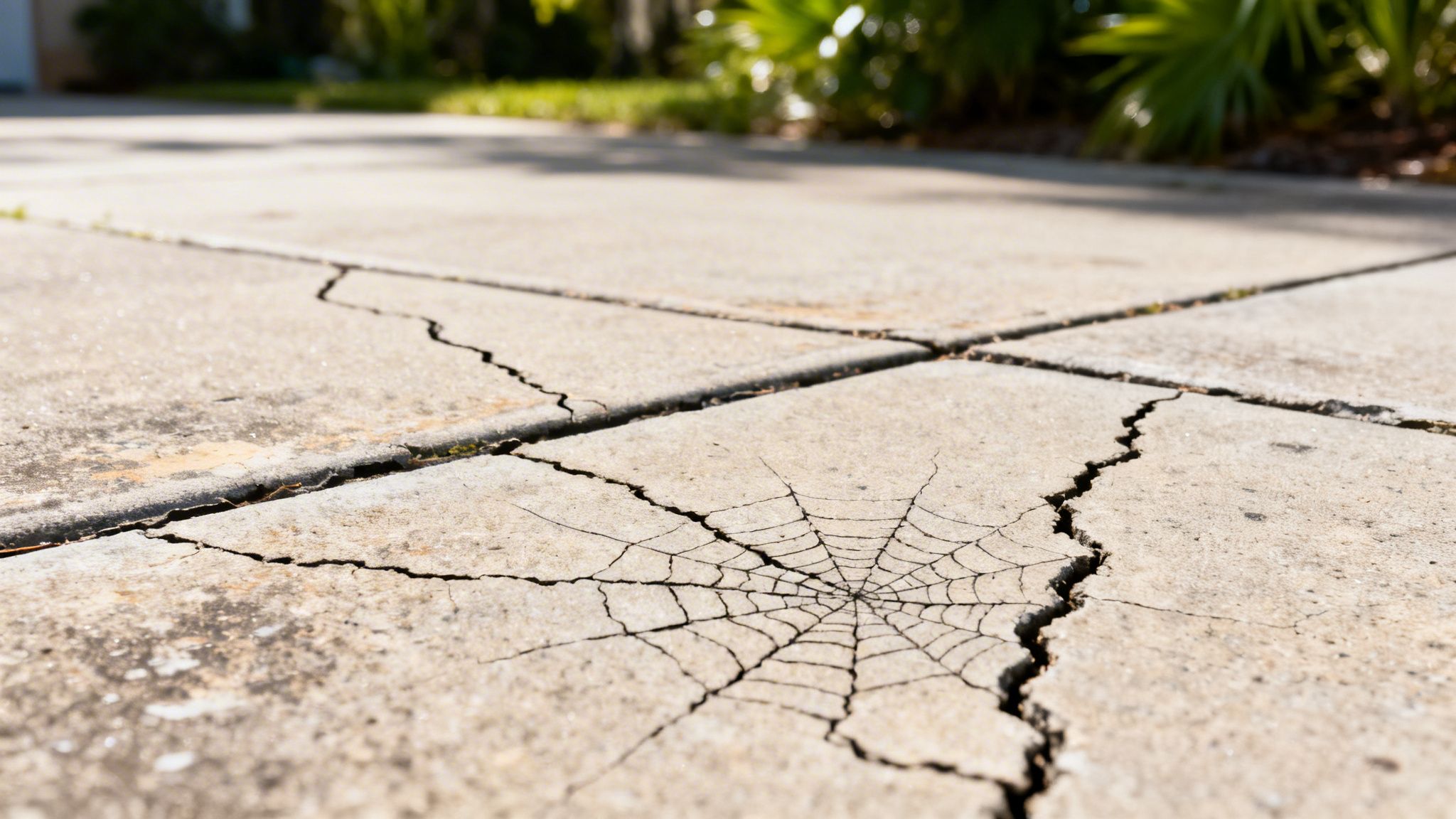
A long straight line can point to one issue. A web of connected cracks suggests something very different. If you are trying to judge whether you need a simple repair or a serious consultation, start with the shape.
Common crack patterns to watch
Alligator or fatigue cracking looks like a network of connected small cracks. On asphalt, it usually means the surface is failing from repeated load stress or loss of support below. On concrete, a similar spiderweb look can signal surface distress and broader weakness.
Linear cracking appears as one or more long, fairly straight breaks. These often follow stress lines caused by movement, shrinkage, poor joint placement, or settlement under one section.
Shrinkage cracks are usually thinner and more uniform. They often show up when concrete cures and contracts. Some are cosmetic. Others become entry points for water and later deterioration.
Upheaval or displacement cracks do not stay flat. One side sits higher than the other. That points toward roots, heaving soil, or movement below the slab.
Driveway Crack Diagnosis Chart
| Crack Type | Appearance | Common Florida Cause | Severity Level |
|---|---|---|---|
| Alligator or fatigue cracking | Webbed, interconnected pattern | Weak support below surface, repeated vehicle stress, aging asphalt | High |
| Linear cracks | Long, straight, or slightly wandering line | Settlement, poor joint layout, slab movement | Moderate to high |
| Shrinkage cracks | Thin, narrow surface cracks | Concrete curing movement, surface stress | Low to moderate |
| Upheaval | One slab edge lifted above another | Tree roots, saturated soil movement, heaving base | High |
What deserves quick attention
Not every crack means immediate replacement. Some surfaces can be sealed, filled, or monitored. Others are already telling you the base or slab has lost integrity.
Watch for these warning signs:
- Vertical movement between crack edges
- Pooling water near the damaged area
- Multiple cracks forming a pattern
- Cracked corners breaking away from slab sections
- Repeated patch failure
Field rule: Flat and isolated is usually more manageable. Wide, spreading, sunken, or lifted cracks usually point to a deeper issue.
If you are walking a property in Ocala, Belleview, Inverness, or Crystal River, bring a simple question to each crack: is this just a split, or is the driveway moving? Movement changes the repair conversation fast.
Repair vs Replacement Deciding Your Next Steps
A lot of driveway money gets wasted on the wrong fix.
Some owners replace too soon when a targeted repair would have bought them useful time. Others keep patching a failed driveway because the patch is cheaper today, even though the surface has already crossed the point where repairs make sense.
When repair is the practical move
Repair usually makes sense when the problem is localized and the surrounding surface is still stable. That includes isolated cracks, small sections of deterioration, or early-stage issues where the base still appears sound.
For asphalt, crack filling can help keep water out of the subgrade. For concrete, sealing or patching may be appropriate if the damage is limited and there is no major displacement.
A temporary fix still has value when applied thoughtfully. It can slow water entry, reduce trip risk, and buy time while you plan a larger project.
When replacement is the smarter investment
Replacement becomes the better move when the driveway is failing as a system, not just in one spot.
That usually means:
- Widespread cracking
- Uneven panels or settled sections
- Recurring cracks after earlier repairs
- Drainage problems tied to slab elevation
- Root damage or base failure below multiple areas
If you are dealing with uneven sections, this guide on how to fix uneven concrete slabs helps explain why surface patching alone often falls short.
What does not work well
DIY patch kits have their place, but people expect too much from them. They do not rebuild a washed-out base. They do not stop roots. They do not regrade drainage. They do not correct a slab that was poured too thin or jointed poorly.
The trade-off is simple. A cheap fix is useful when the underlying structure is still serviceable. It is frustrating when the structure has already failed.
Straight answer: If the driveway is moving, sinking, lifting, or cracking in multiple directions, replacement usually costs less in the long run than repeat repairs.
For homeowners in Summerfield, Homosassa, and Lecanto, the right choice often comes down to this. Are you trying to improve appearance for now, or are you trying to solve the cause for years to come?
The Permanent Solution Professional Concrete Driveway Installation
A driveway that keeps splitting, settling, or holding water usually needs more than another repair. In Marion and Citrus County, I see the same pattern all the time. The surface gets the blame, but the underlying failure starts below it. Sandy subgrade shifts, summer rain washes support out at the edges, and Florida sun keeps stressing a slab that was never jointed or drained correctly to begin with.
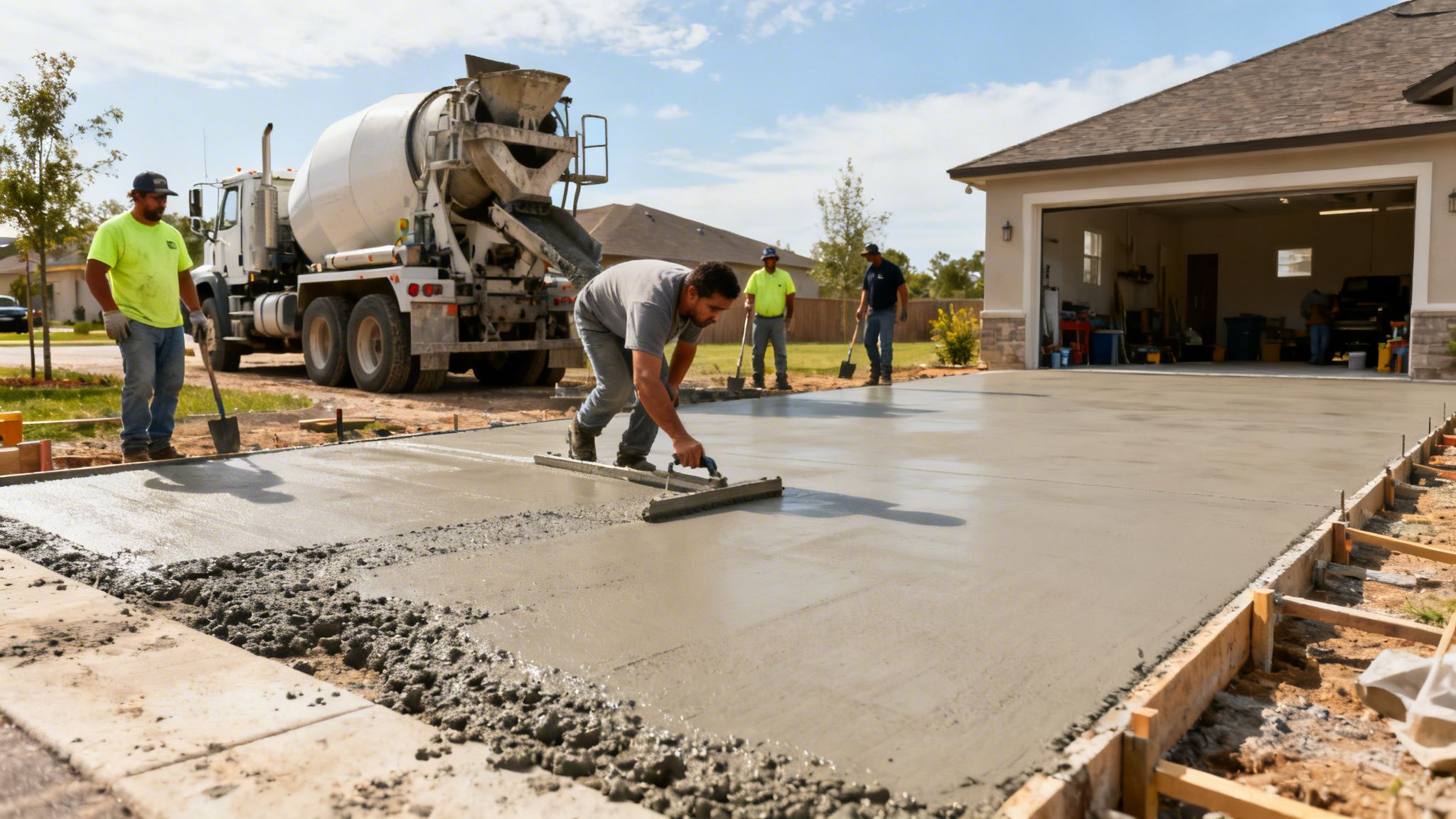
What a professional replacement should include
A lasting replacement starts with removal of what failed and an honest look at why it failed.
That usually includes:
- Removal and demolition of broken concrete and any weak sections around it
- Subgrade correction where soft, sandy, or washed-out areas have lost support
- Base installation and compaction so the slab bears weight evenly
- Forming and grading to direct water away from the house, garage, and walkways
- Concrete placement and finishing based on how the driveway is used
- Joint layout that gives the slab planned places to relieve stress
The trade-off is cost versus service life. Skipping base work or drainage correction saves money on day one and creates expensive callbacks later. Good concrete is not just a clean finish. It is stable support underneath and layout that fits the site.
Why joints and layout matter
Concrete will crack. The job is to guide that movement into planned lines instead of random breaks across the panel. The American Concrete Institute recommends spacing contraction joints at intervals of about 24 to 30 times the slab thickness (ACI 302.1R guide overview), which is why joint layout has to match slab thickness and panel shape.
That matters even more in Central Florida. Long unbroken panels, poor runoff, and intense heat on exposed concrete create stress fast. If the slab was poured without enough attention to joint placement, thickness transitions, or drainage, cracks usually show up where the concrete was forced to make its own decision.
A clean driveway should also be a controlled one.
Here is a look at the process in action:
Where this applies beyond driveways
The same installation standards apply to more than the area where you park.
That includes:
- Concrete patio installation in Ocala FL
- Sidewalk installation in Ocala Florida
- Concrete replacement in Marion County
- Concrete contractors in Citrus County FL handling walkways, slabs, and access paths
- ADA-compliant sidewalks and walkways for commercial and public-facing properties
On commercial sites, churches, HOAs, and retail properties, flatwork has to do more than look straight. It has to drain properly, stay accessible, and hold up under daily traffic. For property owners in Central Florida, Riverside Sealing & Striping, LLC handles both concrete removal and replacement along with related pavement work across Marion County, Citrus County, and nearby areas. If the property also includes asphalt, planning concrete work alongside the best time to seal an asphalt driveway can help you stage the whole project more efficiently.
Why replacement often wins
Replacement gives you one opportunity to correct the original weak points. You can improve slope at the garage, strengthen the apron near the street, clean up transitions to sidewalks, and choose a finish that fits the home.
That is why replacement often lasts longer than repeated patching on older driveways in Dunnellon, Ocala, Beverly Hills, and Inverness. When the base, drainage, thickness, and joints are handled correctly from the start, the slab has a fair chance to perform the way it should.
Protect Your Pavement with Asphalt Sealcoating and Striping
Concrete replacement solves failure. Asphalt maintenance prevents it.
If your property has an asphalt driveway or parking area, the goal is not to wait for obvious damage. The goal is to protect the surface before water, sun, oil, and traffic wear open it up.
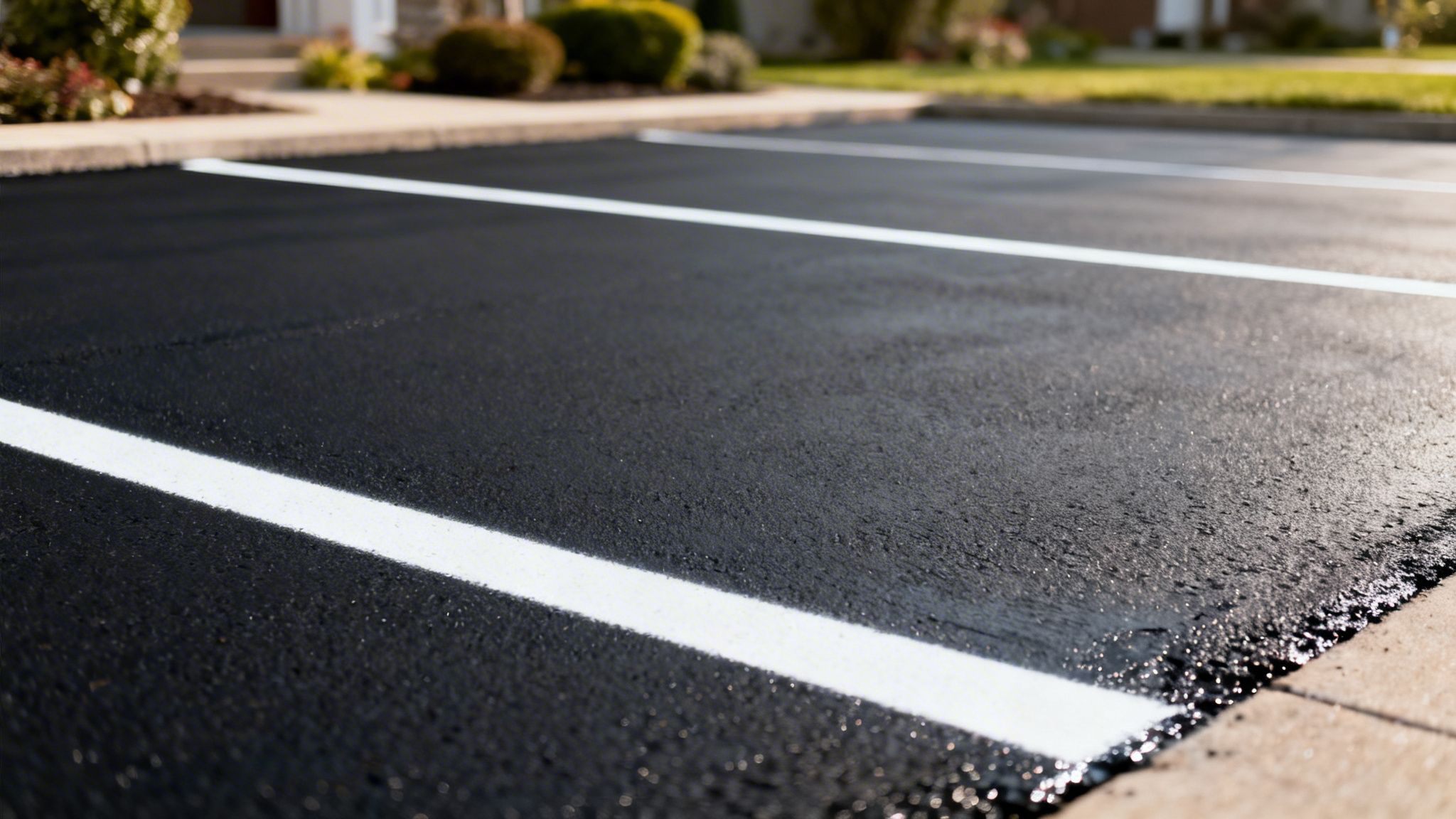
What sealcoating does
Sealcoating is a protective layer applied to asphalt. It helps reduce exposure to weather and slows the aging that comes from Florida sun, moisture, and vehicle fluids.
For residential owners, that means an asphalt driveway that keeps its surface integrity longer and presents better from the street. For commercial properties, it supports a cleaner, safer lot that is simple to maintain.
If timing is part of your planning, this guide on the best time to seal an asphalt driveway is useful because weather and surface condition both affect results.
Why striping matters on commercial properties
Parking lot striping is not just paint. It is traffic organization, visibility, and safety.
Clear striping helps:
- Direct vehicle flow through busy lots
- Define parking stalls for customers, staff, or tenants
- Support ADA-compliant markings and handicap spaces
- Improve first impressions for retail centers, churches, schools, and HOAs
Faded lines make a property look neglected. Fresh lines make it look managed.
Good maintenance beats late-stage repair
Owners often think of maintenance as optional because the lot still functions. Then the surface starts raveling, water gets in, cracking spreads, and the repair bill jumps.
A better approach is simple:
- Inspect the surface regularly for open cracks, faded areas, and drainage issues.
- Seal and fill early before water gets below the asphalt.
- Refresh striping when visibility drops so the property remains orderly and compliant.
- Schedule work with minimal disruption so tenants, residents, or customers are not fighting the project.
For shopping centers in Ocala, churches in Dunnellon, or HOA common areas in Citrus County, an asphalt maintenance company in Central Florida adds value. This is achieved not by waiting for failure, but by helping surfaces last longer and look better while they do it.
Why Marion and Citrus County Businesses Trust Riverside
A property manager in Ocala or Inverness usually calls after the pavement starts affecting business. Tenants are complaining about a broken walkway, parking stalls have faded, water is holding in the lot, or a delivery route is beating up an area that was never built for that load. At that point, the job is not just pavement work. It is access, safety, scheduling, and liability.
That is why commercial owners across Marion County and Citrus County tend to stick with a contractor who can read the site, explain the trade-offs, and get the work done without turning the property into a mess for customers, residents, or staff.
One crew that can handle the full scope
On a commercial property, problems rarely show up one at a time. A church in Dunnellon may need sidewalk replacement at the entrance, restriping in the parking area, and asphalt maintenance in drive lanes that take full sun all day. An HOA in Citrus County may have aging concrete in one section and drainage-related asphalt wear in another.
Riverside Sealing & Striping, LLC handles both concrete and asphalt work, which helps owners avoid juggling multiple contractors and conflicting schedules.
That can include:
- Commercial concrete contractors in Florida for sidewalks, pads, slabs, and replacement sections
- Parking lot striping in Marion County FL
- ADA parking lot striping in Florida
- Commercial asphalt maintenance in Citrus County
- Concrete demolition and replacement where damaged access paths or entries need to be rebuilt
Local conditions matter more here than many owners expect
Central Florida pavement takes a different beating than pavement in cooler, drier areas. In Marion and Citrus counties, sandy subgrade can shift, heavy summer rain can expose drainage mistakes fast, and year-round sun dries out asphalt and stresses surface materials. A repair that looks fine on day one can fail early if the base is weak or water is still getting underneath.
That is why local experience matters. The right answer depends on traffic, drainage, soil movement, and whether the surface problem is isolated or a sign of broader failure.
Preventive asphalt maintenance also has a clear role on commercial sites. Sealcoating on a proper schedule can help slow water intrusion and surface wear. In one cited discussion, sealcoating was noted to reduce water absorption by up to 85% (discussion of sealcoating and water intrusion prevention).
What commercial clients usually care about
Price matters. So does everything that comes with the job.
Owners, HOAs, schools, churches, and site managers usually want:
- Reliable scheduling so access stays manageable during the project
- Clear timelines with realistic expectations
- Licensed and insured crews
- ADA knowledge for stalls, access aisles, and compliant markings
- Straight answers during the estimate about repair limits, replacement needs, and expected service life
In Ocala, Crystal River, Inverness, The Villages, and the smaller communities between them, that practical approach is what keeps commercial work on track.
What earns repeat business: Sound pavement work solves the surface problem. Good planning keeps the property functioning while it gets done.
Frequently Asked Questions About Driveway Services
How long does concrete last in Florida
A properly installed concrete driveway can provide long service, but lifespan depends on site prep, drainage, load demands, and maintenance. In Central Florida, the work under the slab often matters as much as the concrete itself.
If the base is stable and water is managed well, concrete performs far better than a driveway poured over weak or shifting ground.
How often should asphalt be seal coated
For many properties, periodic sealcoating is part of normal asphalt maintenance. The exact timing depends on surface condition, traffic, sun exposure, and how much water the pavement takes on.
If an asphalt driveway or parking area is fading, drying out, or beginning to open up, it is worth scheduling an inspection before the damage spreads.
Do you offer ADA-compliant striping
Yes. Commercial parking lot striping can include ADA-compliant markings, handicap spaces, access aisles, directional markings, and layout updates for existing lots.
That is especially important for churches, schools, retail centers, offices, and HOAs that need their lots clearly organized and simple to use.
Can damaged concrete be repaired or does it need replacement
Both are possible. The right answer depends on whether the damage is isolated or part of a bigger failure.
Minor cracks and limited deterioration may be repairable. Widespread cracking, slab movement, repeated patch failure, or drainage-related settlement often point toward replacement.
Do you only handle residential driveways
No. Many property owners need more than a driveway repair company. Concrete and asphalt work often overlaps across residential and commercial properties.
That can include driveways, patios, slabs, sidewalks, commercial flatwork, parking lot striping, asphalt sealcoating, ADA upgrades, and ongoing maintenance work.
What areas do you serve in Marion and Citrus County
Service commonly extends across Marion County, Citrus County, and nearby Central Florida communities, including Ocala, Dunnellon, Belleview, Silver Springs, Summerfield, Crystal River, Homosassa, Inverness, Lecanto, Beverly Hills, Hernando, and The Villages.
What happens during an estimate
A good estimate should include a site review, discussion of the visible damage, likely causes, and practical options. That may mean repair, replacement, maintenance, or a phased plan depending on the property and budget.
The most useful consultations are straightforward. No pressure. No guesswork. Just an honest read on what the surface needs.
If you are dealing with cracks, sinking sections, worn asphalt, or a parking lot that needs a sharper and safer layout, contact Riverside Sealing & Striping, LLC for a free, no-pressure estimate. The company serves Marion County, Citrus County, and surrounding Central Florida areas with concrete driveway installation, concrete replacement, patios, sidewalks, asphalt sealcoating, and professional striping for residential and commercial properties.