
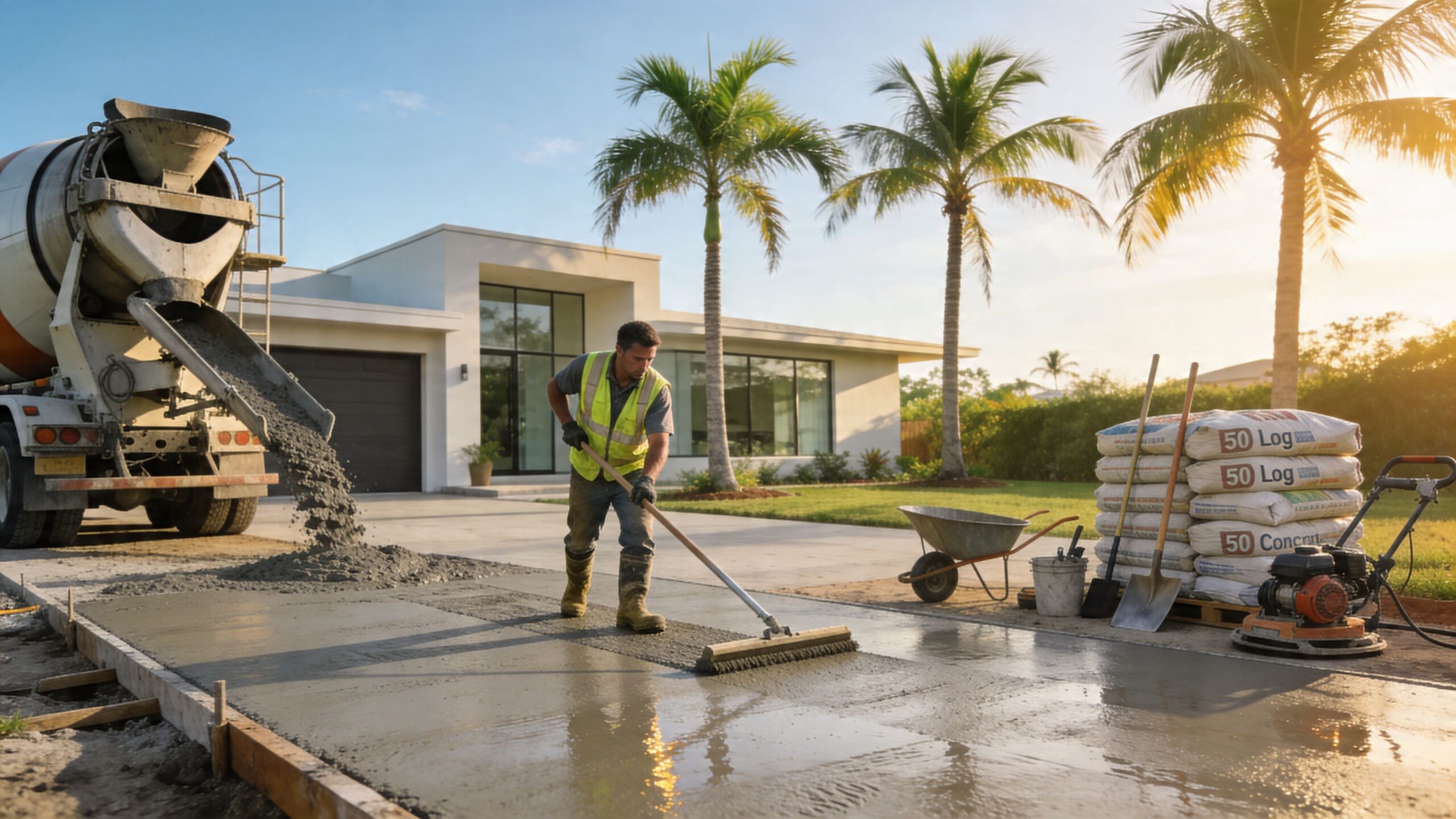
A new driveway looks great the day it’s poured. The color is even, the edges are clean, and the surface makes the whole front of the house look sharper. Then a few Florida seasons pass, and the wrong mix starts telling on itself. Hairline cracks open up, the surface gets dusty or pitted, and low spots start holding water after every hard rain.
That’s the part many homeowners in Marion County, FL and Citrus County, FL don’t hear enough about. The best concrete mix for driveways isn’t just about ordering “concrete.” It’s about choosing a mix that fits the way Central Florida behaves. In places like Ocala, Dunnellon, Belleview, Summerfield, Crystal River, Homosassa, Inverness, Lecanto, Beverly Hills, Hernando, Silver Springs, and The Villages, the mix has to deal with sandy subgrades, humidity, strong sun, and regular downpours.
A national blog might tell you to ask for a certain PSI and leave it there. That’s not enough. A driveway in Central Florida needs the right strength, the right water content, the right aggregate, and the right installation practices if you want it to stay solid and look good for the long haul.
Choosing the Right Concrete for Your Central Florida Driveway
A homeowner usually starts with the same question. “What concrete should I use so I don’t have to do this again too soon?” That’s the right question, because most driveway problems don’t start at the visible crack. They start with a mix or install choice that didn’t match the site.
In Central Florida, that mismatch shows up fast. A driveway in Ocala or Belleview might sit on sandy soil that drains quickly but shifts if the base isn’t prepared correctly. A driveway closer to Crystal River or Homosassa may deal with more moisture in the ground and more frequent saturation after storms. Add intense sun and heat on the surface, and weak concrete gets exposed.
Early on, it helps to compare the main choices side by side.
| Driveway factor | Better choice for most Central Florida homes | Why it matters |
|---|---|---|
| Strength level | 3,500 to 4,500 psi, with 4,000 psi or higher preferred for longevity | Handles vehicle loads better and holds up longer |
| Basic mix ratio | 1 part cement, 2 parts sand, 3 parts gravel | Proven balance of workability and strength |
| Water content | Water-to-cement ratio of 0.45 to 0.50 | Too much water weakens the slab and increases porosity |
| Aggregate size | Up to 1 inch | Helps the mix place and consolidate properly |
| Slab thickness | Match thickness to vehicle use | The mix can’t make up for a slab that’s too thin |
| Delivery method | Ready-mix for full driveway pours | Better consistency on larger jobs |
A driveway doesn’t fail from one thing alone. Mix design, base prep, thickness, joint layout, weather, and curing all work together.
For most homes in Marion County and Citrus County, the safe move is a professionally placed ready-mix designed for driveway use, not a generic mix picked because it was easy to get. If you’re comparing options for a new driveway, replacement slab, or a wider parking pad, the details below are the ones that affect how that concrete performs.
The Foundation of a Strong Driveway Concrete Strength (PSI)
A driveway in Central Florida can look solid on pour day and still start failing early if the strength spec is too low for the site. I see that happen most often on slabs poured over sandy subgrade, exposed to hard sun, then loaded by pickups, SUVs, and delivery trucks week after week.
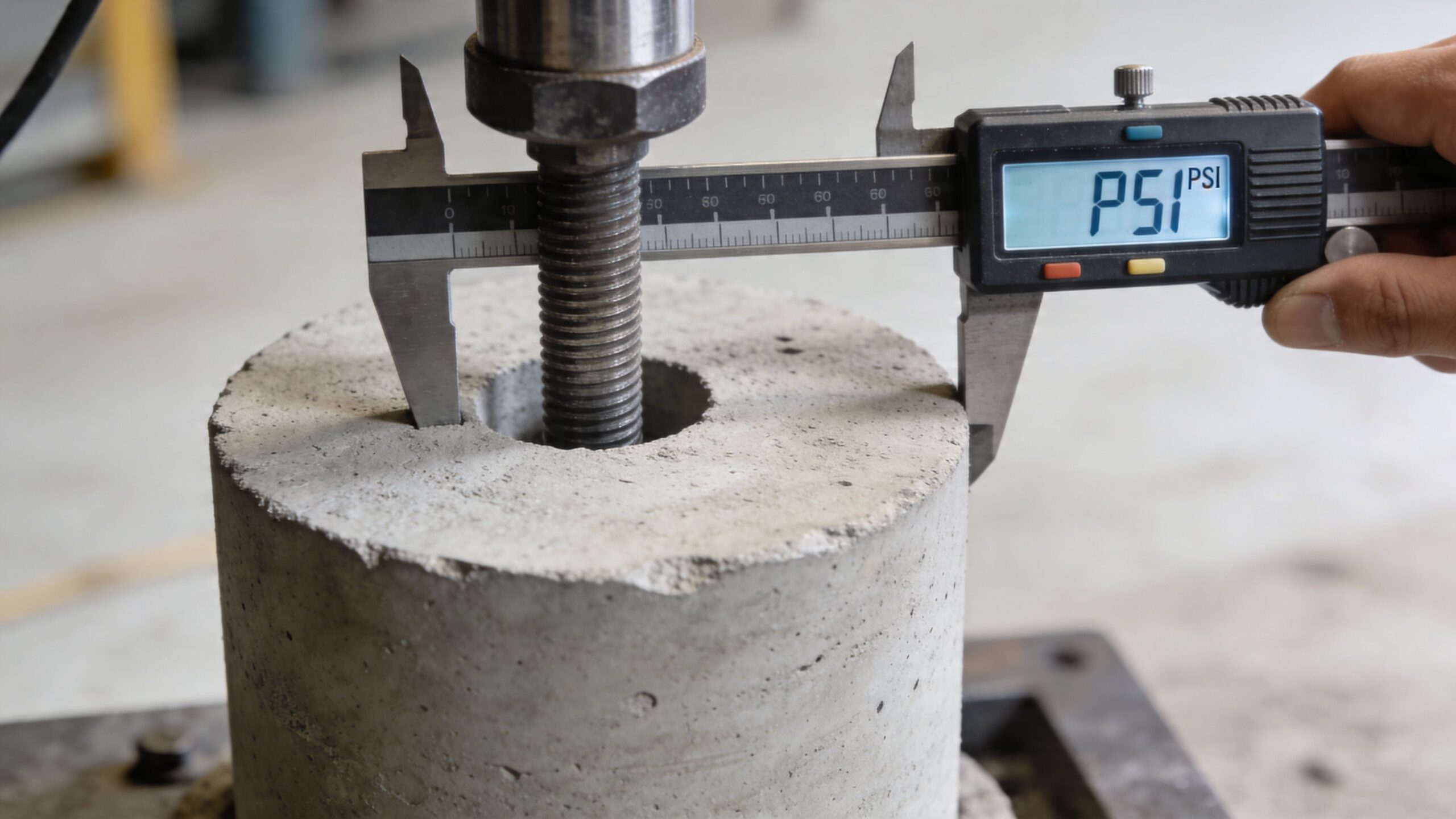
PSI is the concrete’s compressive strength. In plain terms, it tells you how much load the hardened slab can take before it starts to crush under pressure. For a driveway, that matters because the stress is not spread evenly. Tire paths, parked vehicle locations, and turning points near the apron take the hardest abuse.
What strength level works for a driveway
For most residential driveways in Central Florida, 4,000 psi is the spec I would treat as the baseline, not the upgrade. The Portland Cement Association’s guidance on concrete quality and durability supports the broader point that concrete performance depends heavily on proper proportioning, controlled water content, and matching the mix to service conditions.
A basic driveway mix often uses 1 part cement, 2 parts sand, and 3 parts gravel with a water-to-cement ratio around 0.45 to 0.50. That general range can produce driveway-grade concrete, but the key factor is how the batch is designed for your site. In Central Florida, sandy soil can shift if the base is not compacted well, and high surface temperatures can speed up set time enough to tempt crews to add water on site. That shortcut costs strength.
Lower PSI mixes may hold up for very light use. They are a poor fit for driveways that see heavier vehicles, frequent parking in the same spots, or tight turning movements. If the house has multiple drivers, a work truck, boat trailer, or regular package and service traffic, higher strength is money well spent.
Why PSI alone still isn’t enough
A stronger mix does not rescue weak preparation. If the base is loose, wet in some areas, or poorly compacted, the slab can crack even when the ticket shows the right PSI. Homeowners who want to understand that part before the pour should read this guide on how to prepare ground for a concrete slab.
The same goes for water added at the jobsite. Extra water makes the concrete easier to place and finish in the moment, but it also increases porosity and reduces the strength you paid for. In Florida heat, that trade-off shows up fast.
Practical rule: For a residential driveway in Central Florida, 4,000 psi is the smart starting point, then build from there based on vehicle load, slab thickness, base preparation, and weather conditions during placement.
The right PSI gives the slab a fighting chance. Good prep, controlled water, and proper curing are what let that strength last.
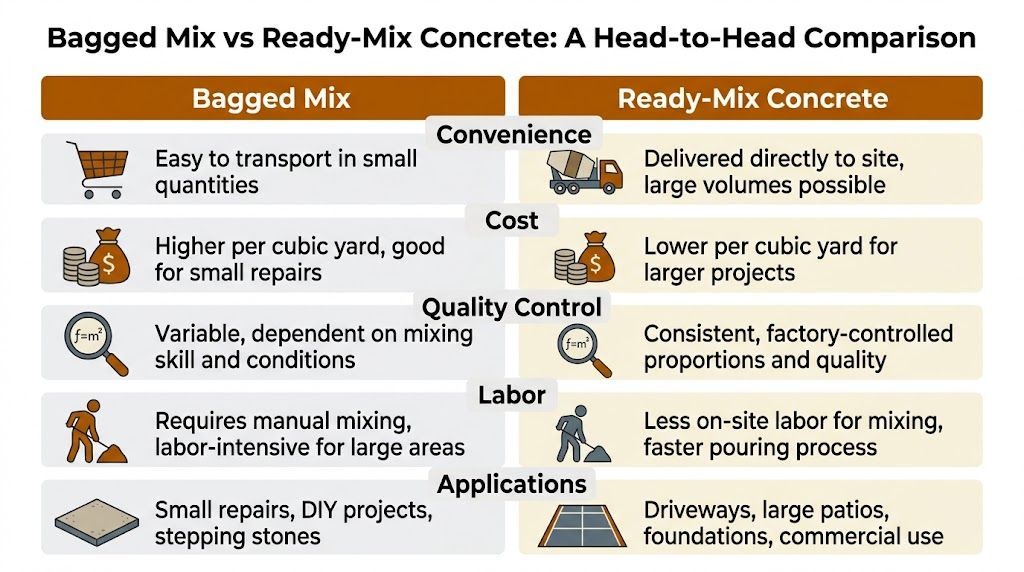
Bagged Mix vs Ready-Mix Concrete A Head-to-Head Comparison
Homeowners often compare store-bought bagged concrete with truck-delivered ready-mix because the choice sounds simple. One seems convenient. The other sounds more “commercial.” For a full driveway, the difference is much bigger than convenience.
Side-by-side comparison
| Category | Bagged mix | Ready-mix concrete | Better fit for a driveway |
|---|---|---|---|
| Quantity | Small batches mixed on site | Large volume delivered in one controlled load | Ready-mix |
| Consistency | Depends on who mixes it and how much water gets added | Batched to a specified design | Ready-mix |
| Labor | Heavy manual mixing and hauling | Less mixing labor on site | Ready-mix |
| Best use | Small repairs, posts, stepping stones | Full driveways, slabs, larger flatwork | Ready-mix |
| Risk on hot days | Higher, because batch-to-batch variation shows up fast | Lower, because the mix is controlled before delivery | Ready-mix |
Where bagged mix makes sense
Bagged concrete has a place. If you’re setting a mailbox post, patching a very small area, or pouring a tiny pad, it can work fine. It’s easy to buy, easy to transport in small quantities, and practical for isolated repair work.
That said, a driveway is not a series of small repairs. It’s one slab system. When you try to build a full driveway from bags, you create too many opportunities for inconsistency. One batch gets a little more water. The next batch sits too long. The next one is mixed slightly drier. Those differences don’t always show up on day one, but they often show up later in color variation, weak spots, poor finishing, and uneven performance.
Why ready-mix wins on full driveway projects
For a driveway in Dunnellon, Summerfield, or Inverness, ready-mix is usually the right answer because it gives you controlled proportions across the whole pour. That matters for finish quality, strength, and timing.
A driveway pour has to move at a steady pace. The crew needs enough material on site to keep placement, screeding, edging, jointing, and finishing coordinated. With bagged mix, the job can bog down fast. While one area is being mixed, another area may already be setting. In Florida heat, that gap gets more dangerous.
Here’s the simple breakdown:
- Use bagged mix when the job is small enough that slight variation won’t ruin the result.
- Use ready-mix when the slab needs uniform strength, appearance, and placement speed.
- Don’t use bagged mix for a full driveway unless you’re willing to accept a lower standard of consistency and a much harder pour.
For a full residential driveway, ready-mix isn’t just faster. It gives the crew a much better chance of producing one uniform slab instead of a patchwork of separate batches.
The hidden trade-off homeowners miss
Some people choose bagged mix because it feels cheaper or more manageable. On a true driveway replacement, that decision often shifts cost into labor, delays, and quality risk. You may save on delivery and lose on the slab itself.
Ready-mix also lets you order a specific driveway design, including the strength and performance characteristics needed for local conditions. That’s hard to replicate consistently with a pallet of bags and a hose.
For homeowners in Marion County, FL and Citrus County, FL, the most practical line is this. If the project is big enough to park on every day, it’s big enough to justify ready-mix.
Essential Concrete Additives for Florida's Climate
A Central Florida driveway can be poured with the right PSI and still crack early if the mix is wrong for the weather. I see that happen when a slab goes down in hot sun, the crew adds water to loosen it up, and the concrete dries too fast at the surface. The result is often shallow cracking, a weaker wear surface, and a driveway that starts showing age long before it should.
Water reducers and controlled water content
The first additive I look at in Florida is a water reducer. In heat and humidity, concrete can feel harder to place than crews expect, especially on a wide driveway pour. The wrong fix is adding extra water on site. That makes finishing easier for a few minutes, but it raises the water-cement ratio and increases shrinkage risk.
The American Concrete Institute explains that excess mixing water is a major cause of lower strength, more permeability, and more shrinkage in concrete, which is exactly the wrong direction for a driveway slab in our climate. A water-reducing admixture helps the crew keep the mix workable without watering it down. See ACI’s explanation of how water-cement ratio affects concrete quality.
That choice matters in Central Florida because intense sun can push the crew to move faster, while humidity can fool homeowners into thinking the slab is curing slowly and safely. Surface moisture in the air does not cancel out the damage from too much mix water.
Air entrainment and mix stability
Air entrainment is not usually the first thing homeowners ask about in Florida, and that makes sense. Freeze-thaw is not the main concern here. Still, entrained air can help concrete handle weathering and improve the mix during placement when it is specified correctly for the job.
The trade-off is simple. Air is not a default upgrade for every driveway. Too much can reduce compressive strength, so it needs to match the mix design instead of being treated like a catch-all add-on. For a standard residential driveway in Central Florida, I put more weight on proper water control, curing, and finishing than on chasing air content targets from colder regions.
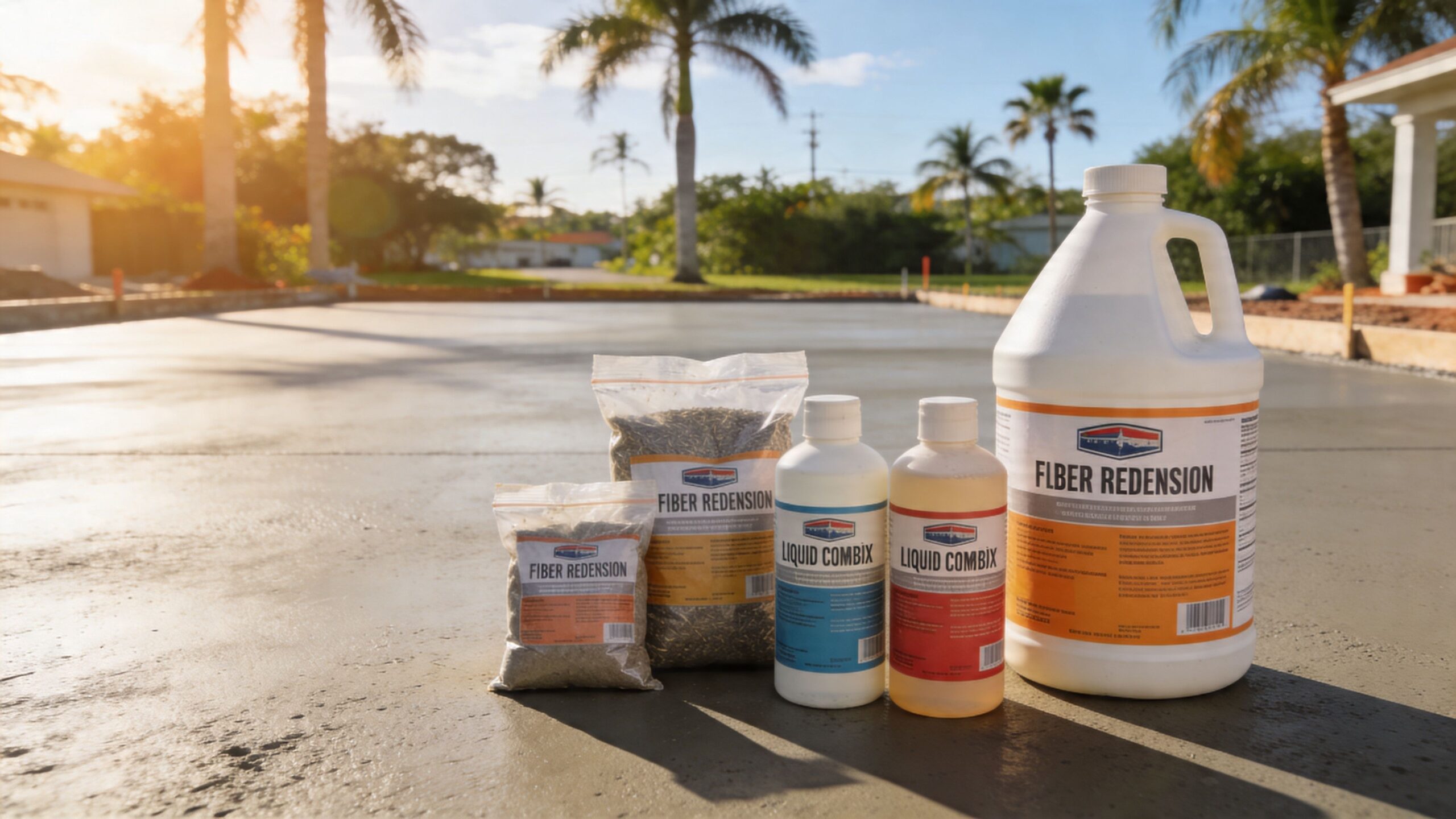
Fiber reinforcement and crack control
Fibers are useful, especially on residential driveways that get full sun and daily vehicle traffic. They help control plastic shrinkage and small surface cracks while the concrete is curing. They do not replace steel, thickness, proper joint spacing, or a compacted base.
That distinction matters. Homeowners sometimes hear "fiber mesh" and assume it means the slab will not crack. Concrete can still crack. Fibers help limit the size and spread of certain cracks, which is different. If you want a better sense of what causes driveway cracking in the first place, this guide on why concrete driveways crack breaks down the common failure points.
Additives for heavier vehicles and harsh exposure
Some driveways need more than a standard residential mix. If the slab will carry work trucks, trailers, RVs, or repeated parking in the same spot, I usually look at the whole design together. Mix strength, reinforcement, slab thickness, joint layout, and curing all need to match the load.
For Florida exposure, supplementary cementitious materials can also help in the right design. The Portland Cement Association notes that fly ash and slag can reduce permeability and improve long-term durability when they are used properly in concrete mixtures. That can be helpful where frequent rain, wet soil, and strong sun all work against the slab over time. See the Portland Cement Association guide to supplementary cementitious materials.
The best concrete mix for driveways in Central Florida is usually a controlled, ready-mix design with the right admixtures for placement and curing conditions. Generic advice from national blogs misses that point. In Marion County and Citrus County, the mix has to suit the site, the weather, and the vehicles that will sit on it every day.
Local Soil and Weather Considerations for Central Florida
A strong mix can still fail on weak ground. That’s why local conditions matter so much in Marion County, FL and Citrus County, FL. The slab you see on top is only part of the system. The support under it decides a lot about whether that driveway stays flat and crack-resistant.
Sandy soil changes the prep
Much of Central Florida sits on sandy soil. That can be helpful for drainage, but it also means the subgrade can shift, rut, or settle if it isn’t compacted and supported correctly. In areas like Ocala, Silver Springs, and Belleview, crews need to pay close attention to how the base is graded and compacted before any concrete gets placed.
A weak base doesn’t usually announce itself right away. The driveway may look fine after the pour and then start showing stress after vehicles begin loading the slab. Cracks that homeowners blame on the concrete often trace back to movement below the slab.
Moisture and rain affect more than curing
In Crystal River, Homosassa, and nearby parts of Citrus County, ground moisture and frequent rainfall can complicate base stability and timing. Wet subgrade conditions can soften support under the slab. Surface water can also interfere with finishing and early curing if the pour is timed poorly.
That’s one reason local driveway work needs more than a generic mix recommendation. The crew has to judge site moisture, drainage flow, and weather timing. Pouring on an unstable base or rushing a slab ahead of a storm creates problems that no PSI upgrade can fully fix.
If your current slab is already showing trouble, this breakdown of why a driveway starts cracking lines up with what many homeowners in this region see.
In Central Florida, the same rain that helps landscaping can undermine driveway performance if water isn’t managed under and around the slab.
Sun and humidity change jobsite decisions
Hot weather speeds surface drying. Humidity slows some parts of the cure while afternoon storms can interrupt finishing altogether. In places like Dunnellon, Summerfield, and Lecanto, crews have to work around weather windows, not just calendar dates.
That affects practical choices like pour timing, finishing pace, curing protection, and whether the slab is ready for the next step. A driveway in this region should be planned around local conditions, not treated like a standard flatwork job copied from another state.
Why Expert Installation is Just as Crucial as the Mix
A Central Florida driveway can start losing ground before the first car ever touches it. I’ve seen slabs poured with decent concrete crack early because the crew missed the base, cut joints late, or pushed the finish too hard in heat and humidity. Mix design matters. Installation decides whether that mix gets a fair chance to perform.
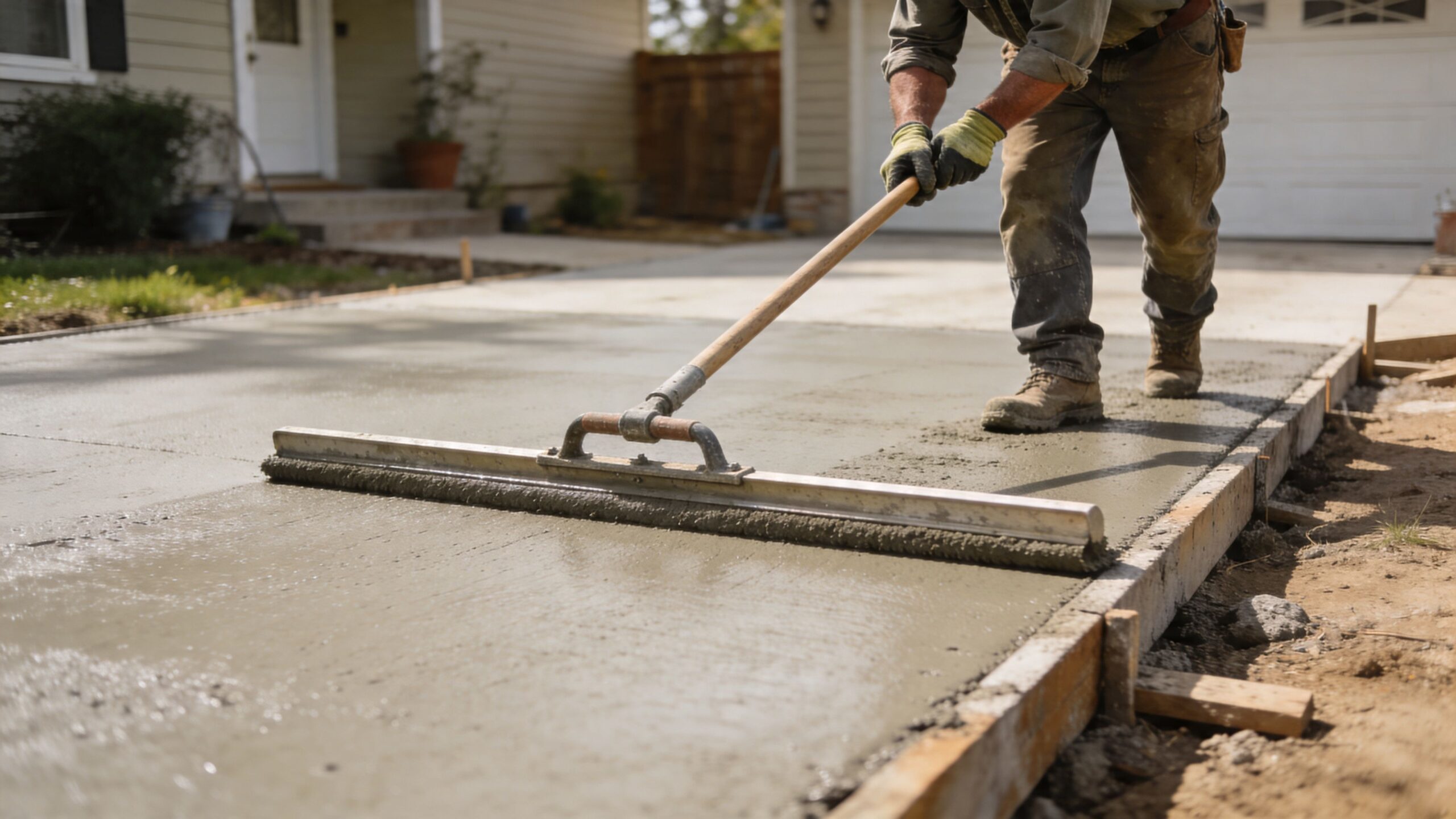
Thickness and base work have to be right
For a residential driveway, slab thickness needs to match actual use and stay consistent across the pour. Thin areas near the apron, edges, or turning points often become the first failure spots. That problem shows up fast when sandy soil underneath was never compacted well enough to support the load.
In Central Florida, that base work matters even more because the native soil can shift, wash, or loosen more easily than tighter clay-based ground. A slab can only perform as well as the support under it. If the subgrade is soft, uneven, or still holding too much moisture, stronger concrete will not make up for it.
Jointing, finishing, and curing separate good crews from sloppy ones
Concrete will crack. The job is to guide that movement into planned joints instead of letting it split wherever stress builds. Good joint layout starts before the truck arrives, especially on wider driveways, long runs, and areas where the slab changes shape. If you want a clearer picture of how that works, read this guide on what a concrete expansion joint does.
Finishing mistakes cause a different set of problems. In hot sun, the surface can dry faster than the slab below it. Crews who add water on top, overwork the paste, or seal the surface too early often leave behind scaling, dusting, or weak top layers that wear out long before the rest of the slab should.
Curing is just as important. Florida heat, wind, and sudden rain can all interfere with early strength gain if the crew is not protecting the slab and timing each step properly.
Here’s a useful visual on finishing technique and placement flow:
Better installation changes long-term cost
A lower bid does not always mean a lower-cost driveway. According to Concrete Network’s driveway mix guidance, higher-strength driveway concrete often costs more upfront than a basic residential mix, but better mix design paired with professional placement can reduce major repair issues over the life of the slab.
That’s the fundamental reason to hire an experienced, licensed, and insured contractor. The value is in execution. The crew has to control grade, compaction, thickness, reinforcement placement, joint timing, finish quality, and curing discipline while working around Central Florida weather.
- Base preparation: Stable support comes before forms and concrete.
- Consistent thickness: Thin spots turn into weak spots.
- Joint layout and timing: Cracks should form where the slab was designed to move.
- Curing discipline: Concrete needs time and protection to develop the strength you paid for.
A driveway is built in layers and steps. If one part gets rushed, the slab usually shows it early.
For homeowners in Marion County and Citrus County, expert installation is part of the driveway itself, not an add-on.
FAQ About Concrete Driveways in Central Florida
Is 4,000 psi concrete worth it for a residential driveway
For most homeowners, yes. It’s a solid target if you want a durable driveway instead of a minimum-spec slab. If the driveway sees regular vehicle traffic every day, higher strength is usually the smarter long-term choice.
Can I use bagged concrete for a full driveway
For a full driveway, that’s usually not the best route. Bagged mix is better for small repairs or small standalone pours. A driveway needs consistent batching, steady placement, and better quality control than most site-mixed bag jobs can deliver.
Do I need a thicker slab if I have a truck or RV
If you park heavier vehicles on the slab regularly, thickness and reinforcement become more important. That’s especially true for RV storage, work vans, or large pickups parked in the same area over and over. A contractor should match the slab design to actual vehicle use, not assume every driveway sees only light passenger cars.
Why do some new driveways crack so quickly in Florida
Usually it comes back to one or more of these issues: poor base prep, too much water added on site, weak joint layout, thin areas in the slab, or bad curing practices. Florida weather can expose those mistakes faster because heat and rain create a narrow margin for sloppy work.
How soon can a new concrete driveway be used
The answer depends on the mix, weather, and how the slab cures. Some commercial products can reach 1,500 psi at 3 days and allow walk-on times of 10–12 hours, as noted in the earlier driveway mix reference. Vehicle traffic is a separate question and should follow the installer’s job-specific guidance rather than a one-size-fits-all timeline.
If you're planning a new or replacement driveway in Marion County, FL or Citrus County, FL, Riverside Sealing & Striping, LLC offers free, no-pressure consultations for homeowners who want straight answers about concrete mix selection, site prep, and long-term durability. As licensed and insured Concrete and Asphalt Experts in Marion and Citrus County, the team serves communities including Ocala, Dunnellon, Belleview, Summerfield, Crystal River, Homosassa, Inverness, Lecanto, Beverly Hills, Hernando, Silver Springs, and The Villages with reliable scheduling, quality workmanship, and practical recommendations that fit Central Florida conditions.