
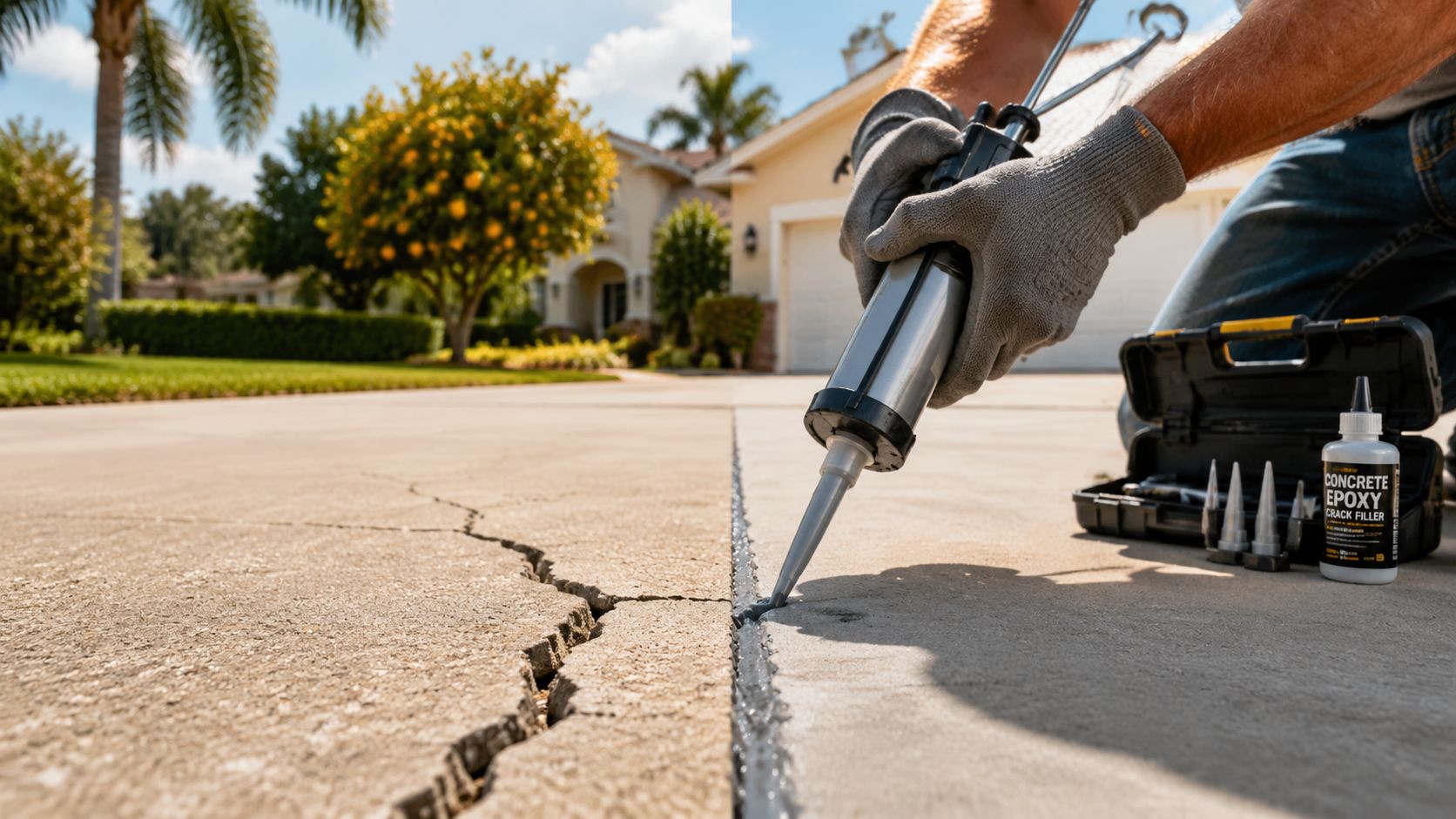
A lot of homeowners notice the same thing the same way. You pull into the driveway after a hard Florida rain, or you're washing off the patio in Ocala, Homosassa, or The Villages, and suddenly a crack stands out that you swear wasn't there last month. Then the questions start. Is it just surface shrinkage? Is the slab moving? Do you seal it now, patch it, or leave it alone?
That uncertainty is what usually costs people money. Small, non-structural cracks can often be handled with the right prep and the right repair material. Bigger cracks, moving cracks, or cracks tied to settlement are different. In Marion County, FL and Citrus County, FL, that distinction matters because heat, rain, runoff, and local soil conditions can turn a minor-looking crack into a repeat problem if the root cause isn't addressed.
Homeowners in Belleview, Inverness, Dunnellon, Crystal River, Summerfield, Lecanto, and Silver Springs don't need more generic internet advice. They need a practical way to decide what kind of crack they're dealing with, what concrete crack repair method fits it, and when a professional evaluation isn't optional.
Table of Contents
- Introduction A Homeowner's Guide to Concrete Cracks
- Why Concrete Cracks in Florida and What to Look For
- Your Step-by-Step Guide to DIY Concrete Crack Repair
- Understanding Advanced and Professional Repair Methods
- When to Call a Professional in Marion or Citrus County
- Frequently Asked Questions About Concrete Crack Repair
Introduction A Homeowner's Guide to Concrete Cracks
Concrete cracks. That by itself doesn't always mean failure.
A driveway in Ocala might show a thin line from normal curing and still perform fine for years. A patio in Crystal River might crack because the slab moved after repeated wet-dry cycles. A sidewalk panel in Beverly Hills or Hernando might be less about the visible crack and more about one side sitting higher than the other, which turns it into both a repair issue and a trip hazard.
Practical rule: The crack you can see is only half the job. The real question is why it opened and whether the slab is still stable.
Good concrete crack repair starts with classification. Some cracks are cosmetic. Some need a flexible sealant because they still move with temperature changes. Some are structural enough that filling the surface won't solve anything. And some cracks shouldn't be repaired at all until the slab layout, drainage pattern, or sub-base problem is addressed.
That's especially true in Central Florida. In Marion County, FL and Citrus County, FL, intense sun dries slabs fast, heavy rain can wash out support under edges, and poor drainage around driveways or walkways can keep feeding the same damage. Around places like Inverness, Homosassa, and Dunnellon, homeowners also run into slabs that look repairable from the top but tell a different story once you check for movement, depression, or edge settlement.
This guide is built for that real-world decision. It covers what usually causes cracks, what you can repair yourself, what tends to fail, and when it's smarter to get a professional opinion before you spend time and money on a fix that won't last.
Why Concrete Cracks in Florida and What to Look For
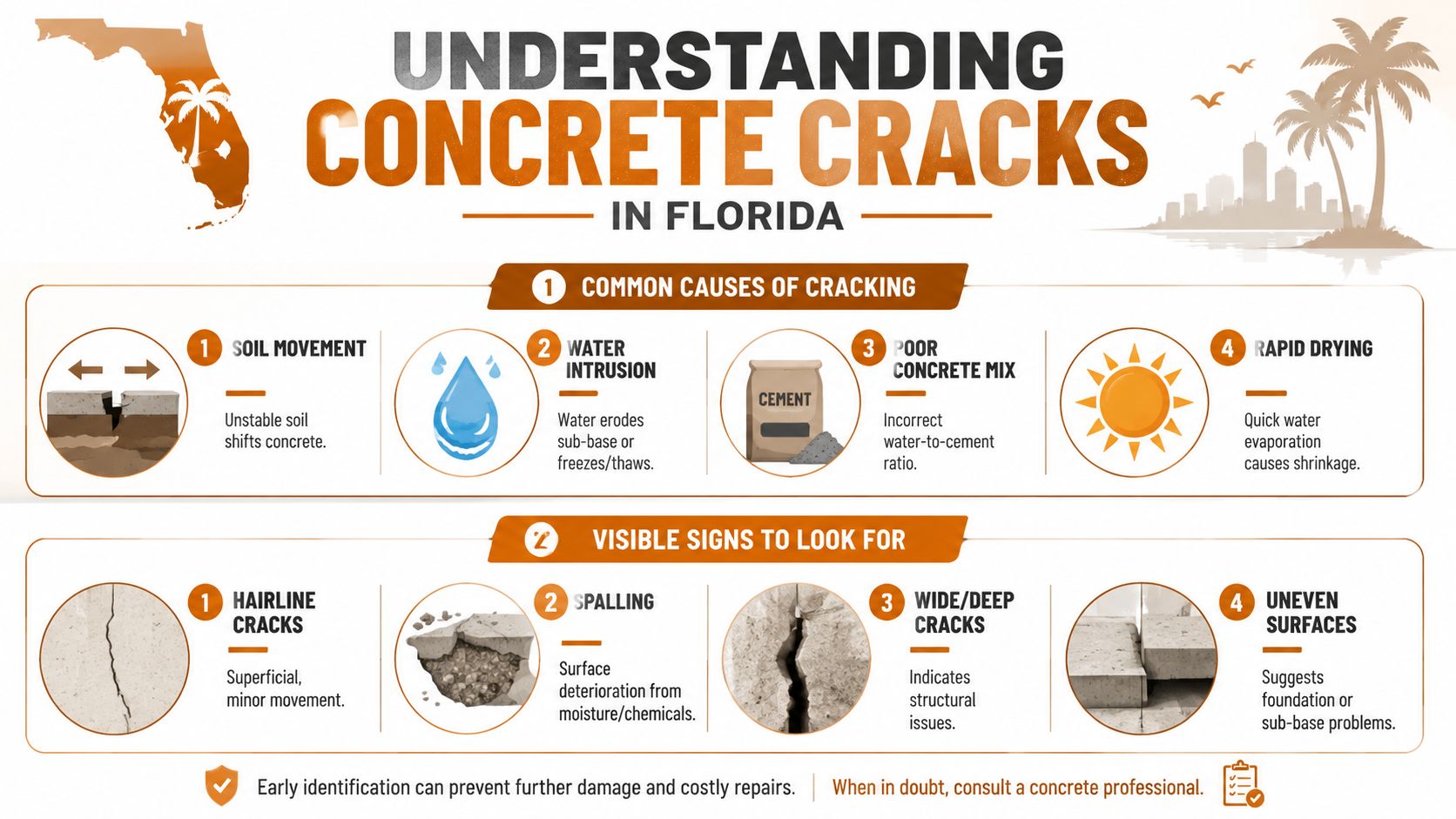
What causes cracks in Central Florida slabs
Concrete develops cracks for several common reasons. Industry guidance points to shrinkage, thermal movement, settlement, overloading, poor curing, and improper mix design as major causes, and it identifies control joints, proper curing, and solid subgrade preparation as key preventive steps. The same guidance also notes that evaporation retarders, fogging, plastic sheeting, wind breaks, sunshades, nighttime placement, and microfibers are used to reduce plastic shrinkage cracking, while repair choices should differ depending on whether a crack is structural, dormant, or moving, as explained in this overview of crack causes, prevention, and repair.
In Florida, those causes show up in familiar ways. Summer heat pushes slabs through expansion and contraction. Fast drying during placement can contribute to early shrinkage cracks. Hard rains can soften or wash out support at slab edges, especially near downspouts, driveway aprons, and walkways where runoff stays concentrated.
Control joints matter here too. If you've ever wondered why some slabs crack neatly in planned lines and others split randomly, joint layout is a big part of the answer. If you're not sure how those planned separations work, this guide on what a concrete expansion joint is gives useful context.
How to sort cracks by risk
A simple field check helps most homeowners decide what category they're looking at.
| Crack type | What it looks like | Typical concern |
|---|---|---|
| Hairline crack | Very thin, little to no edge movement, often random | Usually cosmetic or minor shrinkage related |
| Working crack | Opens and closes slightly with weather or keeps reappearing | Needs a flexible repair, not a rigid patch |
| Structural or settlement crack | Wider, deeper, growing, depressed, or one side sits higher | Needs evaluation before repair |
If one side of the slab is higher than the other, don't treat it like a simple cosmetic crack. If the crack keeps opening back up, don't use a rigid filler and expect it to stay put. If the slab is settling, the patch may bond for a short time and still fail because the support under the concrete hasn't been corrected.
Mainstream how-to content often treats cracks as cosmetic, but settlement cracks may only be repairable if minor and not depressed, while significant structural damage often requires professional intervention or even replacement. Generic patching compounds for these deeper issues frequently fail within weeks or months.
That warning comes straight out of this crack repair discussion from SUNDEK, and it matches what homeowners in places like Summerfield, Lecanto, and Belleview often run into. The crack filler wasn't always the problem. The slab movement was.
Your Step-by-Step Guide to DIY Concrete Crack Repair
Minor cracks in a stable slab can often be repaired by a careful homeowner. The work isn't complicated, but most failures come from rushing the prep. Dirt in the crack, loose edges, or the wrong repair material will ruin the bond before weather and traffic even get a chance.
Start with proper crack preparation
If the crack is non-structural and you're handling it yourself, begin with the surface.
Use a chisel, grinder, or similar tool to expose fresh concrete at the crack edges. Remove weak or friable material. Then vacuum the crack and the surrounding area thoroughly. Repair guidance for floors and slabs emphasizes exactly that sequence: expose fresh concrete, clean and vacuum, apply repair mortar or quick-setting cement, and drive the material firmly into the crack before smoothing. Poor cleaning and poor consolidation leave voids and reduce bond, as described in this floor and slab repair guide.
For many surface repairs, widening the crack slightly helps more than it hurts. You're creating a shape the repair material can grip instead of trying to bridge a dusty, razor-thin opening. If you're working on newer concrete nearby, it also helps to understand how long concrete takes to cure before sealing or patching adjacent areas.
Basic prep tools that usually make sense
- Angle grinder or cold chisel: Opens the crack and removes weak edges.
- Shop vacuum: Pulls out dust that would otherwise block adhesion.
- Wire brush: Helps loosen embedded debris before final cleaning.
- Margin trowel or putty knife: Packs repair material tightly into the void.
The repair only lasts as long as the preparation is clean.
Routing and sealing for moving non-structural cracks
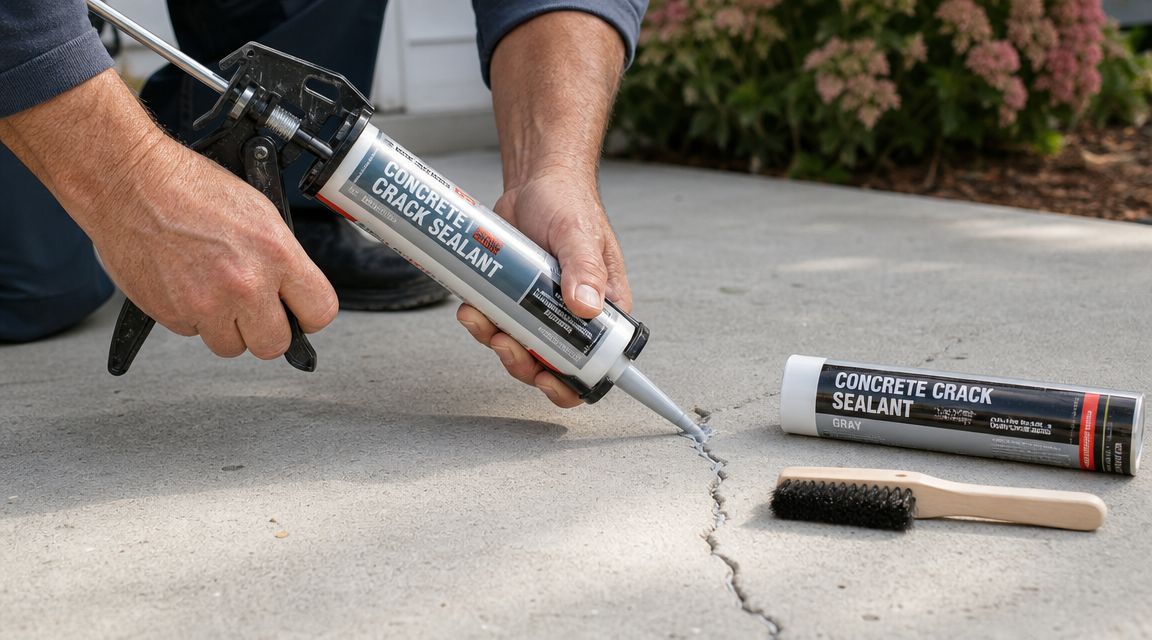
This method fits non-structural cracks that may still move a little with temperature or slab movement.
For cracks wider than about 1/4 inch, a sound workflow is to mechanically open the crack to a vertical or beveled inverted-V profile, remove all loose material, and then apply a compatible sealant. For cracks or joints over 1/4 inch, use a backer rod before sealing so the sealant doesn't bond on three sides and can handle movement better. If the crack is deeper or wider than 1/4 inch, some repair sealants are applied in multiple applications with 24-hour intervals, based on QUIKRETE's crack repair guidance.
That sounds technical, but the field version is simple:
- Open the crack enough to create a clean sealing reservoir.
- Vacuum it clean. Dust left behind is a bond breaker.
- Insert backer rod if the crack is over 1/4 inch and deep enough to need it.
- Apply elastomeric sealant with a caulk gun.
- Tool the sealant so it contacts the sidewalls evenly.
Use this approach on cracks that aren't carrying structural load and don't have vertical displacement. It's a practical choice for many driveways, patios, and sidewalks in Ocala, Inverness, and Homosassa where the slab is basically stable but the crack needs weather protection and a cleaner appearance.
A short visual helps if you've never seen the process in the field.
Patching for wider dormant voids
Patching is different from sealing. You patch a dormant, non-moving void or surface loss. You don't patch an active crack and expect the slab to stop moving.
A basic sequence looks like this:
- Cut back to sound concrete: Don't feather a repair over weak edges.
- Clean until the crack is dust-free: Vacuuming matters more than it might seem.
- Pack in fast-setting repair mortar or quick-setting cement: Press it in firmly so you're not leaving hidden voids.
- Finish flush with a trowel or rubber grout float: Smooth is fine. Overworking it usually isn't.
This method makes sense for chipped edges, pitted slab areas, and wider dormant cracks in older patios or sidewalks around Crystal River, Beverly Hills, or Silver Springs. It can tidy up a surface and stop ongoing deterioration at the edges.
What doesn't work well is using a hard cement patch in a crack that still moves. That repair often breaks at the bond line or cracks right through the middle. If you know the crack opens seasonally, use a flexible system instead of trying to force a rigid one to do the wrong job.
Understanding Advanced and Professional Repair Methods
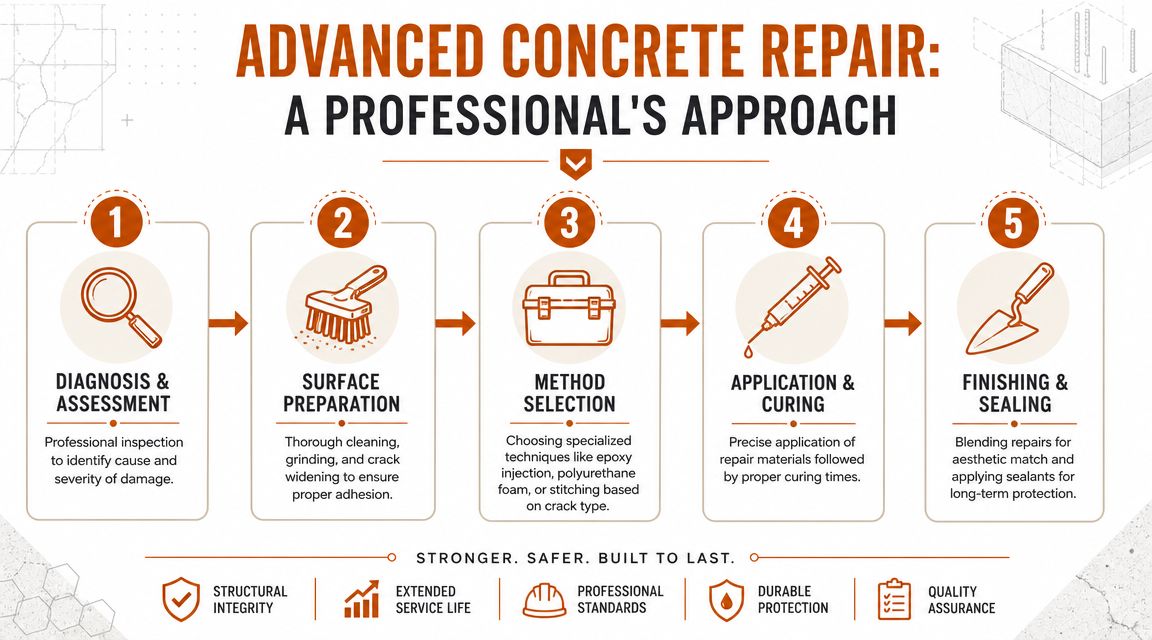
DIY repair has limits. Once a crack suggests structural loss, repeated movement, or slab instability, the repair method changes from surface treatment to full-depth correction.
Epoxy and polyurethane injection
The most important advanced method for structural crack repair is epoxy injection. The American Concrete Institute's crack-repair guidance describes it as a method for bonding cracks as narrow as 0.002 in. (0.05 mm), using closely spaced entry and venting ports, sealing the crack on exposed surfaces, and injecting epoxy under pressure. That process has been successfully used on buildings, bridges, dams, and other structures, according to ACI crack repair guidance.
The practical takeaway is this. Epoxy injection doesn't just hide a crack. It fills the crack internally and can restore continuity across a dormant structural crack.
Polyurethane-based approaches are often considered when moisture conditions or movement make a different response necessary, but the method choice depends on what the crack is doing, not just what it looks like from the top.
A surface filler hides a line. Injection addresses the full depth of the crack.
Resurfacing versus partial replacement
Not every bad-looking slab needs injection. Some need a broader cosmetic and functional repair, and some need a section removed and repoured.
Resurfacing is usually the better fit when the slab is mostly sound but the top face is worn, patched in spots, or visually inconsistent. It gives the surface a fresh uniform finish, but it doesn't solve major movement underneath.
Partial replacement is the better fit when one area has broken down beyond reliable repair, when there's significant displacement, or when recurring cracking points to a localized failure. In those cases, a contractor may cut out the failed section, rebuild the base if needed, and place new concrete.
If the issue is settlement or one panel sitting off level, homeowners often need evaluation for slab movement first. A page like how to fix uneven concrete slabs gives a good overview of that problem from the homeowner side.
When to Call a Professional in Marion or Citrus County
There's a point where do-it-yourself concrete crack repair stops being practical and starts becoming a delay.
If the slab is moving, if the crack is returning, or if one side is no longer flush with the other, the risk isn't just appearance. It's failed repairs, trapped moisture, and in walk areas, a safety issue.
Red flags that change the decision
Use this as a homeowner checklist.
- The crack is wide or getting wider: That usually means the slab is still moving or losing support.
- One side sits higher than the other: Vertical displacement changes this from a sealing job to a stability problem.
- The slab is depressed near the crack: Settlement is likely involved.
- Several cracks form a pattern: Grid-like or recurring cracks can point to broader slab stress.
- Previous filler already failed: Repeating the same surface repair usually wastes time.
A second issue many homeowners miss is slab geometry. Cracks at corners and odd-shaped slab sections don't always happen because the concrete was “bad.” Guidance on unusual panel geometry notes that sharp angles, poor joint placement, and awkward slab shapes are specifically linked to cracking, and the durable solution may involve re-terminating joints, adding reinforcement, or changing the detailing rather than just filling the visible crack. That's covered in this discussion of crack control in unusual slab geometries.

Why local diagnosis matters
In Marion County, FL and Citrus County, FL, local conditions add another layer. Sandy soils can shift. Runoff can undermine slab edges. In some areas, subsurface conditions make a crack that looks cosmetic from above more complicated once you check for base loss or recurring movement.
That's why a local evaluation matters in places like Dunnellon, Summerfield, Lecanto, Hernando, and The Villages. A contractor who works these conditions regularly can tell the difference between a crack that needs routing and sealing, a panel that needs replacement, and a slab that won't stop cracking until the layout or support issue is fixed.
For homeowners comparing options, Riverside Sealing & Striping, LLC is one local company that handles concrete work as well as asphalt maintenance across Central Florida, including driveways, sidewalks, slabs, seal coating, and related site issues. The useful part for a homeowner isn't the label. It's getting a no-pressure evaluation that looks at the cause before anybody starts selling a filler.
Frequently Asked Questions About Concrete Crack Repair
Can I just paint over a concrete crack
You can, but it usually doesn't solve anything. Paint hides discoloration for a while. It doesn't bridge movement, rebuild lost edges, or stop water from getting into an open crack. If the crack is active, the line usually telegraphs back through.
How much does concrete crack repair cost
It depends on the crack type, depth, movement, location, and whether the slab itself is still stable. A small DIY repair kit is one thing. Structural repair, slab correction, or section replacement is another. The only reliable way to price it is with an on-site look at the crack and the surrounding slab condition.
If a price is given without checking whether the slab has moved, it's not a real diagnosis.
How do I help prevent cracks in new concrete
The biggest factors are proper site prep, good subgrade support, planned control joints, and good curing practices. Florida weather makes curing discipline important because hot sun and drying conditions can stress fresh concrete early. Prevention also includes managing runoff so water isn't constantly undermining slab edges after the pour.
Does HOA or managed community work require a cleaner finish
Usually, yes. In communities around The Villages and other managed properties in Central Florida, appearance, trip hazards, and consistency from panel to panel matter. That doesn't always mean full replacement, but it does mean repairs should be neat, compatible with the slab, and appropriate for the actual cause of the crack.
A visible patch that fails or stands proud of the surface can create a second problem. For sidewalks, shared walkways, and common-area slabs, cleaner work and better diagnosis matter just as much as the material itself.
Should I repair every crack I see
No. Some hairline cracks are mostly cosmetic and don't justify immediate repair. Others are early signs of movement that shouldn't be ignored. The decision should be based on whether the crack is stable, moving, widening, depressed, or creating a safety issue.
If you're dealing with a cracked driveway, patio, sidewalk, or slab in Ocala, Dunnellon, Belleview, Silver Springs, Crystal River, Homosassa, Inverness, Lecanto, Beverly Hills, Hernando, Summerfield, or The Villages, Riverside Sealing & Striping, LLC offers free, no-pressure evaluations for homeowners and property managers across Marion County, FL and Citrus County, FL. As Concrete and Asphalt Experts in Marion and Citrus County, the team can help you figure out whether the right fix is sealing, patching, replacement, or a deeper correction before you spend money on a repair that won't hold.