
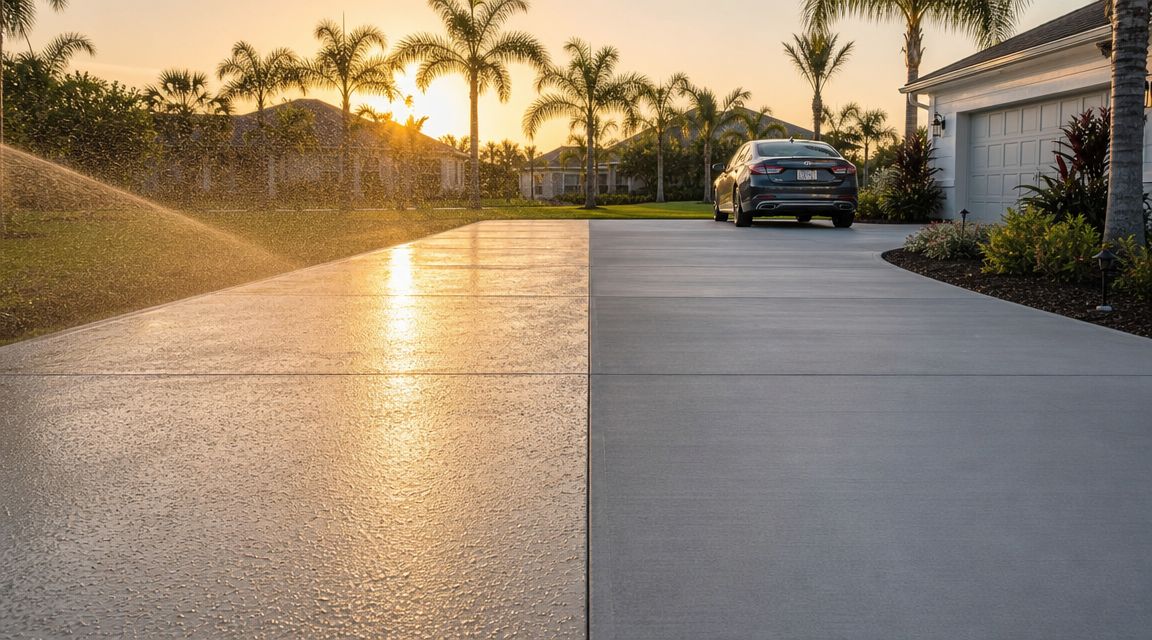
Concrete is usually safe for light foot traffic after 24 to 48 hours, many residential slabs can handle vehicle access in about 7 to 10 days, and the standard benchmark for design-age strength is 28 days. But those numbers are only starting points, especially in Central Florida, where heat, humidity, wind, and sudden rain can change how a slab cures.
If you've just had a new driveway, patio, or sidewalk poured in Ocala, Dunnellon, Belleview, Crystal River, Inverness, or nearby areas, you're probably looking at that fresh slab and wondering when normal life can start again. That's a fair question. The practical answer isn't just “wait 7 days” or “wait 28 days.” It's about what kind of use, what the weather did after the pour, and whether the concrete was cured correctly in the first place.
For homeowners and property managers across Marion County, FL and Citrus County, FL, this matters more than most national articles admit. A slab in dry wind and hard sun near Summerfield or The Villages doesn't behave the same way as one curing through humid, cloudy weather in Homosassa or Lecanto. Concrete and Asphalt Experts in Marion and Citrus County know that timing alone doesn't protect a slab. Good curing does.
Table of Contents
- Your New Concrete Driveway When Can You Use It
- Concrete Curing vs Drying What is the Difference
- The Standard Concrete Curing Timeline
- How Florida Weather Impacts Concrete Curing
- Proper Curing Methods for Central Florida Projects
- Your Local Concrete and Asphalt Experts
- Concrete Curing Frequently Asked Questions
Your New Concrete Driveway When Can You Use It
A new driveway always creates the same moment. The forms are gone, the finish looks clean, and now the homeowner wants to know if they can walk across it, park on it, move trash bins over it, or let the delivery truck use it.
For light foot traffic, the normal answer is simple. Most concrete is walkable after about 24 to 48 hours. For vehicles, many residential jobs are treated more cautiously, and contractors often use the practical 7 to 10 day window before driving on the slab. That's not because concrete suddenly changes on one exact day. It's because early loading can leave marks, create surface stress, or affect edges before the slab has built enough strength.
In places like Silver Springs, Beverly Hills, and Hernando, I've seen the same pattern. The slab may look firm fast, especially after a hot day, but appearance can fool people. A driveway can seem ready long before it's ready for turning tires, parked trailers, loaded dumpsters, or repeated traffic at the apron.
Practical rule: Treat a new slab like it's usable in stages, not all at once.
That staged mindset matters even before the pour starts. Good curing begins with proper base work, drainage, and thickness planning. If you're comparing timelines before a new slab goes in, it helps to understand how to prepare ground for a concrete slab, because weak support underneath and rushed use on top create the same result. A shorter service life.
Concrete Curing vs Drying What is the Difference
A lot of people ask how long concrete takes to dry when the better question is how long it takes to cure.
Those are not the same thing.
Curing builds strength
Curing is the chemical process where water reacts with cement. That reaction is called hydration. It's what turns a wet mix into a hard, durable slab with real structural strength.
A simple way to think about it is baking versus cooling. Baking is the process that changes the batter into a cake. Cooling happens afterward. Concrete works the same way. Curing is the part that creates the strength. Drying is just moisture leaving the slab.
Drying removes moisture
Drying is physical evaporation. Surface moisture leaves first, but internal moisture can stay much longer. That's why a slab can look ready and feel hard on top while still holding moisture deeper inside.
A key industry point is that concrete curing is mostly complete after 28 days, but moisture can continue to evaporate for months afterward, and the 28-day mark is a standard reference milestone, not a final dry date, as explained in this concrete moisture guidance from Wagner Meters.
That distinction matters for driveways, patios, and sidewalks in Ocala, Belleview, and Crystal River because surface hardness and internal moisture condition are not the same thing.
If concrete dries too fast, it doesn't “speed up” the job in a good way. It can lose the moisture needed for proper curing.
That's why experienced contractors don't chase fast surface drying. They manage moisture, temperature, and protection so the slab gains strength the way it should.
The Standard Concrete Curing Timeline
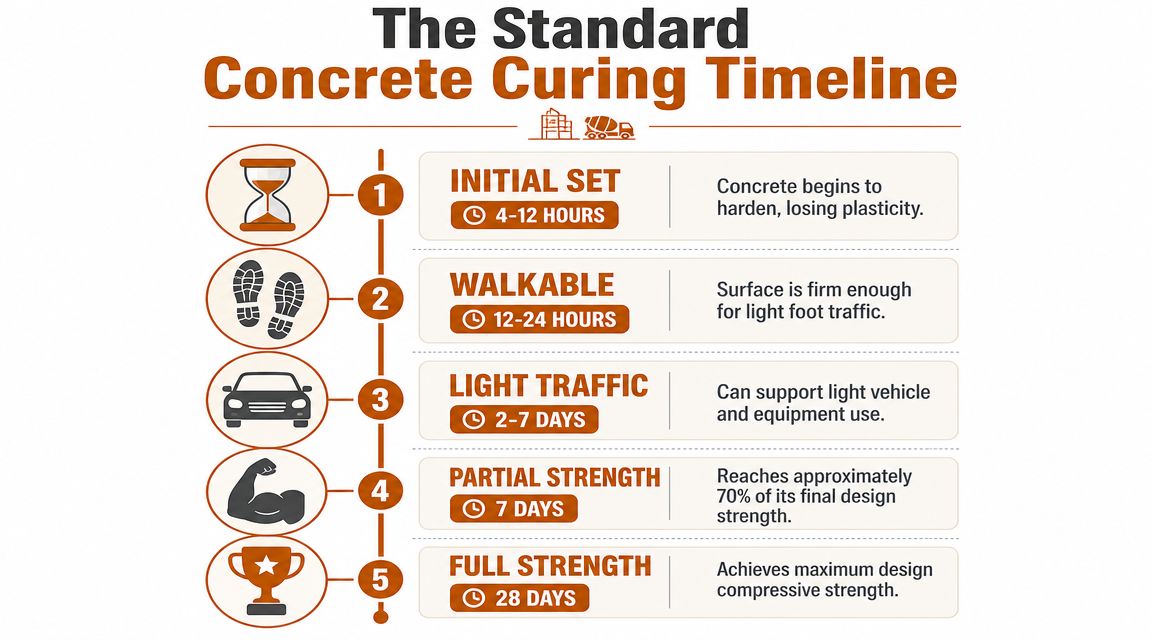
The reason homeowners keep searching how long does concrete take to cure is that they need a usable schedule. Fair enough. Here's the practical timeline to work from, with one important note. Every stage assumes the slab was placed, finished, and protected correctly.
What the first few days really mean
The first day is about protecting the surface. The next several days are about preventing early damage. The first month is about letting the slab reach its design-age benchmark.
Industry guidance notes that concrete is usually safe for light foot traffic after about 24 to 48 hours, a 7-day-old slab typically achieves roughly 50% to 70% of its design strength, and the common benchmark for near-full strength is 28 days, when concrete reaches about 90% to 100% of specified compressive strength, according to Concrete Network's curing guidance.
Concrete Curing Milestones
| Timeframe | Approx. Strength | What's Safe |
|---|---|---|
| 24 to 48 hours | Early surface set only | Light foot traffic if the slab is protected and not being scuffed or dragged across |
| 2 to 3 days | Strength is developing but still limited | Careful access for normal foot traffic and light placement of items, if the contractor approves |
| About 7 days | Roughly 50% to 70% of design strength | Many residential slabs can begin light vehicle use if conditions, mix, and slab details support it |
| 28 days | About 90% to 100% of specified compressive strength | Standard design-age benchmark for normal service and heavier loading decisions |
A few practical warnings matter more than the table itself:
- Turning tires too early: A parked car is one thing. Sharp turning, braking, or steering on a young slab is worse.
- Edges take abuse first: Driveway edges, sidewalk corners, and aprons chip before the main field does.
- “Looks dry” means nothing by itself: Surface color doesn't tell you whether the internal matrix is ready.
Field advice: If you wouldn't want a loaded trailer crossing the slab on day three, don't let a garbage truck climb the edge either.
For commercial properties in The Villages or retail sites near Inverness, staged access planning matters even more. Foot traffic, carts, striping crews, landscaping equipment, and service vehicles should all be scheduled around curing, not convenience.
How Florida Weather Impacts Concrete Curing
Central Florida changes the conversation. Generic cure charts don't account for the way a slab behaves through hot sun, high humidity, and a thunderstorm that shows up with no warning.
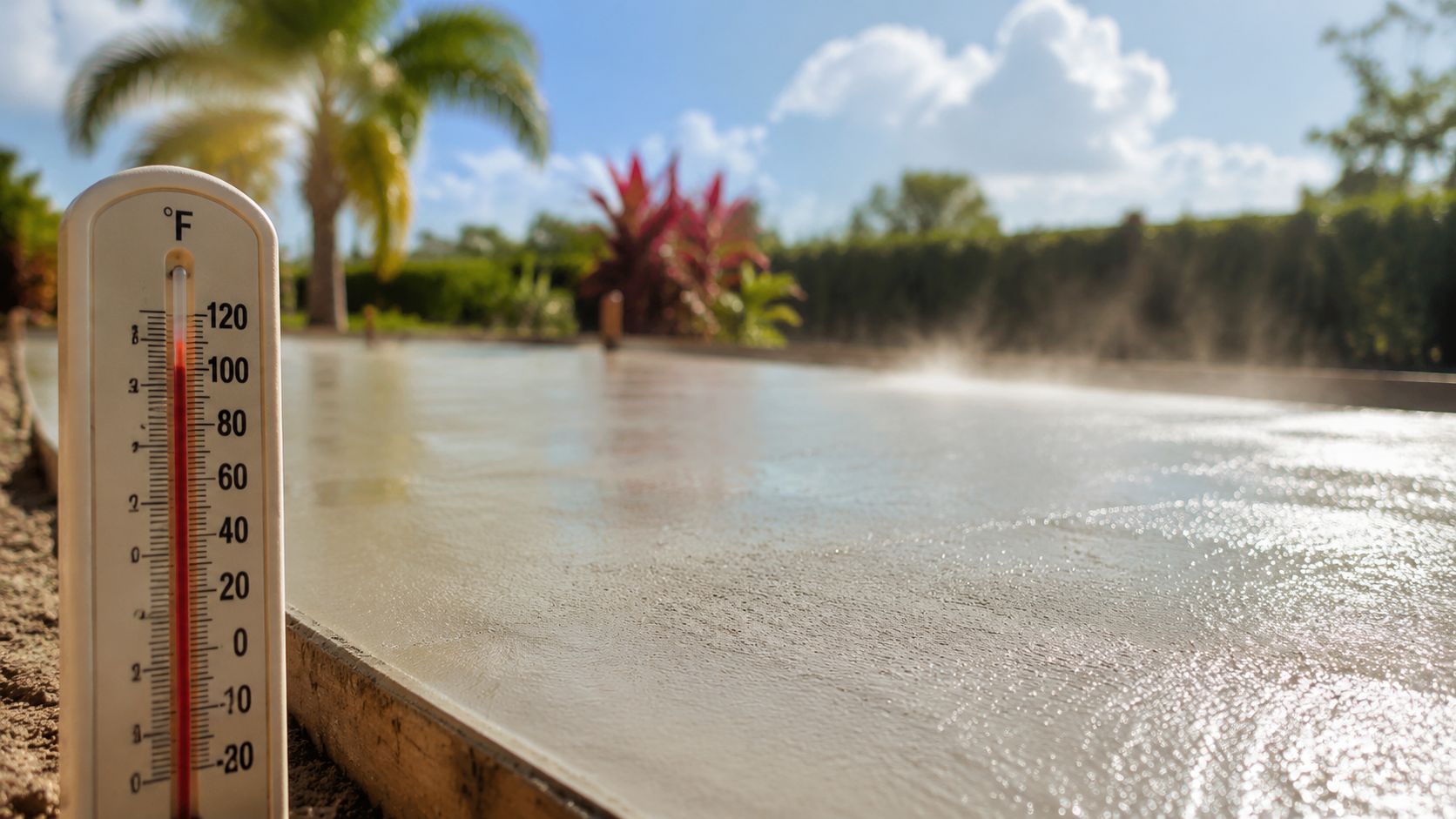
A practical guide for field conditions notes that an optimum pouring range is about 50-80°F, that hot, dry wind can make concrete cure too quickly and weaken it, and that high humidity slows drying, as explained in this weather-focused concrete curing guide.
Heat and sun create one problem
In Ocala, Summerfield, and Silver Springs, the biggest issue is often rapid moisture loss at the surface. Direct sun plus hot air plus breeze can pull moisture out before the slab has a chance to cure evenly.
That leads to problems such as:
- Surface shrinkage stress: The top dries faster than the body of the slab.
- Weak finishing window: Crews have less time to place and finish properly.
- Early cosmetic cracking: Hairline surface cracks can show up fast if the slab loses moisture too aggressively.
This is one reason experienced crews often pour early and keep curing materials ready before the truck even arrives.
Humidity and rain create another
Humidity helps in one sense because it slows evaporation. That can support curing. But Florida humidity doesn't solve everything. It can also slow drying, which affects the timing for later steps like sealing and finish work.
Rain is the bigger wild card. A sudden storm can damage a fresh surface, especially if it hits before the slab has set enough to resist marking or washout. If you've noticed surface defects on older pavement, some of the same weather and moisture issues also show up in common driveway cracking problems.
This short video gives a useful visual on what weather does to fresh concrete in the field.
For Marion County and Citrus County jobs, weather planning isn't extra. It's part of the pour. Contractors need a timing plan, protection plan, and cure plan before the first yard is placed.
Proper Curing Methods for Central Florida Projects
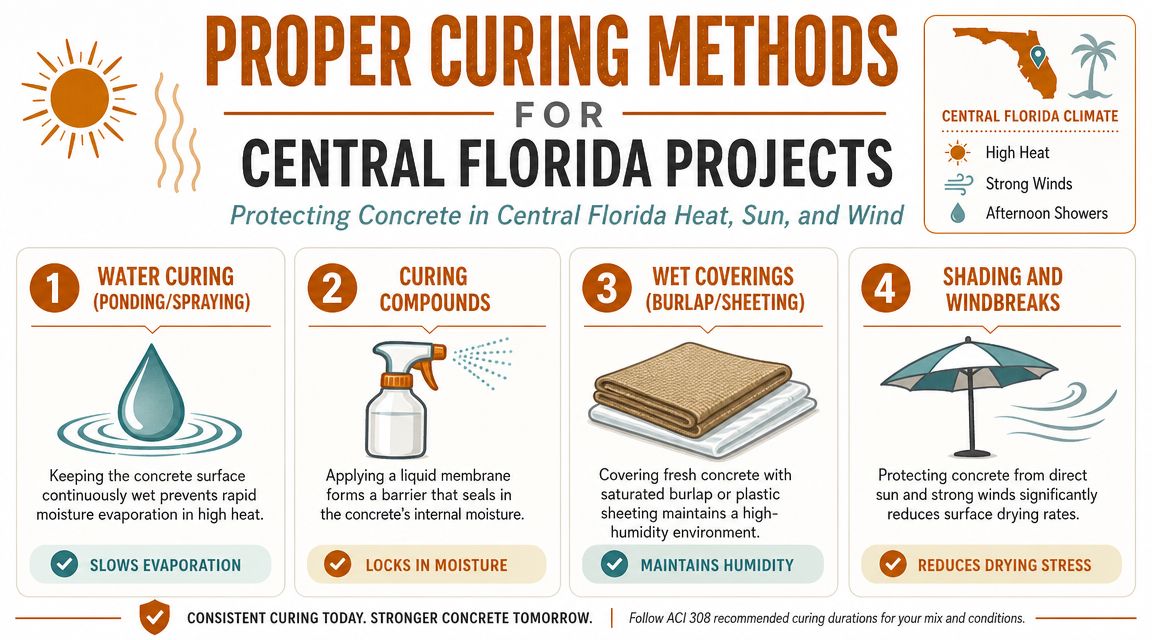
If the goal is a durable driveway or patio, the slab has to hold moisture long enough to cure properly. In Florida, the best methods are the ones that control moisture loss without damaging the finish.
Methods that work on residential slabs
Some curing methods are more practical than others on driveways, sidewalks, and patios around Dunnellon, Lecanto, and Homosassa.
- Water curing: Keeping the surface wet helps prevent rapid evaporation. This can work well, but it takes attention and timing. It's effective when done consistently.
- Wet coverings: Burlap or similar coverings can hold moisture at the surface. Plastic sheeting can also help trap moisture, but it has to be placed carefully so it doesn't mar the finish.
- Curing compounds: A membrane-forming curing compound is often a practical option for residential work because it seals in moisture without requiring constant rewetting.
- Shade and wind control: Temporary shading or windbreaks can make a noticeable difference on exposed pours.
Another factor is mix selection. Homeowners comparing durability options for driveways should also understand what goes into choosing the best concrete mix for driveways, because cure performance starts with the mix as much as the weather.
Good curing protects the slab from the weather it's poured in. It doesn't try to fight that weather after damage has already happened.
What usually doesn't work well
The methods that fail are usually the rushed ones.
A few examples:
- Letting the slab bake in direct sun with no protection
- Assuming humidity alone is enough
- Putting traffic on the concrete because it “feels hard”
- Skipping curing compound to save time
- Spraying water randomly instead of maintaining consistent moisture
For property owners, the main takeaway is simple. If a contractor can explain exactly how the slab will be cured after finishing, that's a good sign. If the answer is just “it'll be fine,” that's not much of a curing plan.
Your Local Concrete and Asphalt Experts
Concrete work in Central Florida is straightforward on paper and less forgiving in real life. The weather shifts fast. Subgrades vary. Drainage matters. Timing matters. Finishing and curing matter just as much as the pour itself.
Why local experience changes the outcome
A contractor working across Marion County, FL and Citrus County, FL needs to know how jobs behave in places like Ocala, Belleview, Crystal River, Inverness, Beverly Hills, and The Villages. The slab at a shaded residence won't cure the same way as a driveway apron in open sun or a commercial walk near standing water after a summer shower.
That's where local scheduling and field judgment make a difference. Licensed and insured crews with Central Florida experience usually plan around morning placement, weather windows, access restrictions, and post-pour protection instead of relying on generic timelines.
For owners comparing options, Riverside Sealing & Striping, LLC handles concrete driveway replacement, patios, slabs, sidewalks, asphalt sealcoating, and parking lot striping across the region. That matters because property improvements don't happen in isolation. A driveway, sidewalk connection, curb line, or parking area often needs coordinated concrete and asphalt work so traffic flow, appearance, and long-term maintenance all line up.
For homeowners, HOAs, churches, and property managers, the practical move is getting a no-pressure site visit before the pour. A good evaluation should cover access, drainage, weather timing, cure protection, and when the slab can realistically be put into service.
Concrete Curing Frequently Asked Questions
When is it safe to seal new concrete
Sealing is not the same thing as curing. A new slab may be hard enough to walk on long before it's ready for a sealer. The right timing depends on the sealer type, the slab's moisture condition, and how the concrete cured after placement.
In practice, sealing is usually treated as a later step after the slab has had time to develop and release enough moisture. For a driveway or patio in places like Dunnellon or Crystal River, that decision should come from the installer or sealer manufacturer, not guesswork.
What happens if it rains on fresh concrete
It depends on when the rain hits.
If the slab has already set enough, light rain may not do much damage. If rain arrives too soon, it can mark the surface, weaken the top layer, or wash away cement paste from the finish. That's why good crews watch the forecast closely and keep protection materials ready during Florida's rainy season.
Fresh rain on fresh concrete is a timing problem, not just a weather problem.
What mistakes ruin a new driveway fastest
A few mistakes show up again and again on residential jobs in Ocala, Summerfield, and nearby communities:
- Driving on it too early: Even if the slab supports the weight, turning tires can scar the surface and stress the edges.
- Dragging items across it: Dumpsters, ladders, toolboxes, and patio furniture legs can gouge young concrete.
- Ignoring curing instructions: If the installer says keep traffic off, avoid sprinklers, or protect an area, follow that.
- Assuming one timeline fits every slab: Thickness, mix, weather, and site exposure all matter.
- Parking heavy equipment at the edges: Edges and corners are more vulnerable than the center field.
How long until a parking lot can be striped
For commercial concrete, striping should wait until the slab is ready for that next finish step. The timing depends on cure condition, surface dryness, coating compatibility, and whether the markings are paint or another material.
This is one area where property managers in Inverness, Lecanto, and Homosassa often get into trouble by stacking trades too tightly. If the concrete crew, sealing schedule, and striping schedule aren't coordinated, the markings won't perform the way they should.
Does concrete really need 28 days
Yes and no.
The 28-day mark is the standard industry reference point for design-age strength testing, not a magical day when concrete suddenly becomes “done.” Industry guidance notes that the benchmark exists because specifications needed a consistent testing age, and concrete can reach about 75% of its 28-day strength in 7 days, while hydration can continue beyond 28 days depending on conditions, as discussed in this explanation of the 28-day benchmark.
That's why a slab can often be used in limited ways sooner, but still shouldn't be treated like fully matured concrete right away.
If you're planning a driveway, patio, sidewalk, slab, sealcoating, or striping project in Marion County, Citrus County, or nearby Central Florida communities, Riverside Sealing & Striping, LLC offers free, no-pressure consultations to help you sort out timing, site conditions, and the right approach for long-term durability.