
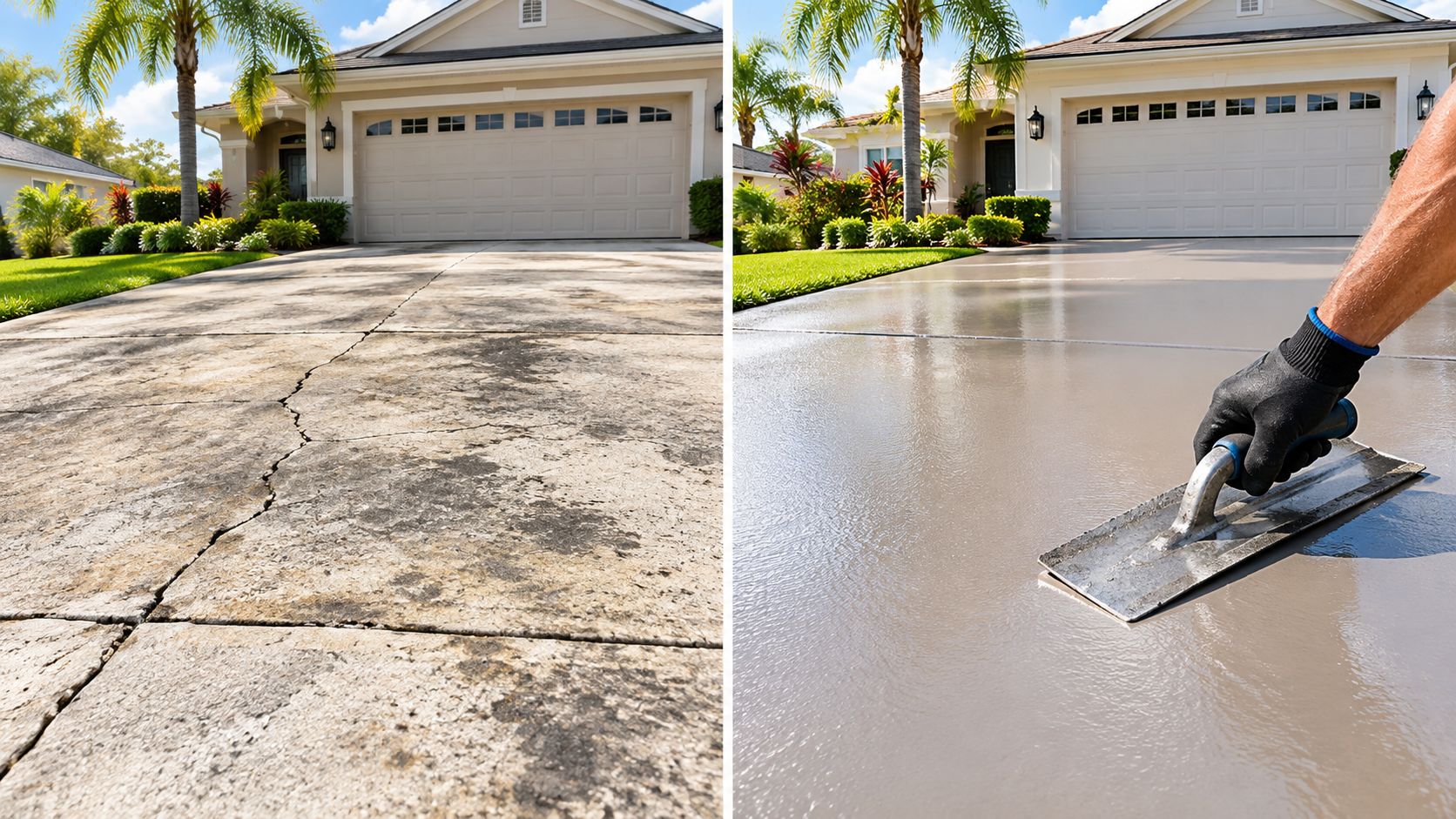
Concrete driveway repair cost in Central Florida typically starts at about $250 for a single crack fix and can reach several thousand dollars for resurfacing or full section replacement. The right budget depends on what's damaged, how much concrete is affected, and whether the base beneath the slab is still sound.
A crack that appears after a wet summer can turn a routine maintenance question into a budgeting headache. A neighbor's estimate may look nothing like the range you found online, and both figures can be legitimate if the proposed work differs. In Marion County, FL, and Citrus County, FL, the useful question isn't just what a repair costs today. It's how many usable years that work is likely to buy.
Table of Contents
- What Concrete Driveway Repair Cost Really Depends On
- Common Driveway Repairs and Their Price Ranges
- Repair vs Replacement and the Cost Per Year That Matters
- Reading a Real Estimate Line by Line
- How Central Florida Conditions Drive the Final Price
- Timeline Permits and Long-Term Maintenance Planning
- When to Call a Local Concrete and Asphalt Expert
- Concrete Driveway Repair Cost Questions Homeowners Ask
What Concrete Driveway Repair Cost Really Depends On
After heavy rain in Ocala, a homeowner spots a crack and needs to know whether it is a surface flaw or a sign of slab failure.
Start with the damage. A surface defect may need cleaning and patching. A moving crack, a sunken slab, or widespread spalling can indicate a problem that a surface treatment will not solve. The Federal Highway Administration distinguishes localized partial-depth repairs from full-depth replacement, which removes defective concrete and reconstructs the slab and joints (FHWA guidance on concrete pavement repair).
Then assess what is driving the damage. Water draining toward the driveway, loose or eroded base material, and repeated settlement can turn a small visible repair into a larger job. Access adds cost too. A narrow approach or nearby landscaping can make demolition, removal, and concrete placement more labor-intensive, even when the damaged area is limited.
Judge the repair by cost per usable year, not the lowest upfront figure. A cheap patch that leaves movement or drainage problems unresolved may need to be redone sooner. Ask what the estimate includes: demolition and disposal, base correction, reinforcement, joints, slab thickness, finish, curing, and drainage work. These line items show where the money goes, while national cost ranges offer only a broad reference. Driveway size, preparation, finish, and local labor affect the final price (HomeAdvisor's concrete repair and resurfacing cost guide).
Practical rule: If an estimate describes the patch but not the cause of failure, you cannot judge how long the repair is likely to last.
Common Driveway Repairs and Their Price Ranges
Two repairs with similar upfront prices can deliver very different value. General concrete repair runs approximately $300–$3,500, while crack repairs commonly cost $250–$800, according to HomeAdvisor's concrete resurfacing and repair estimates. Those national ranges are a starting point, not a local quote. Compare each repair by the usable years it should deliver, and check whether demolition, disposal, base work, and difficult access are included.
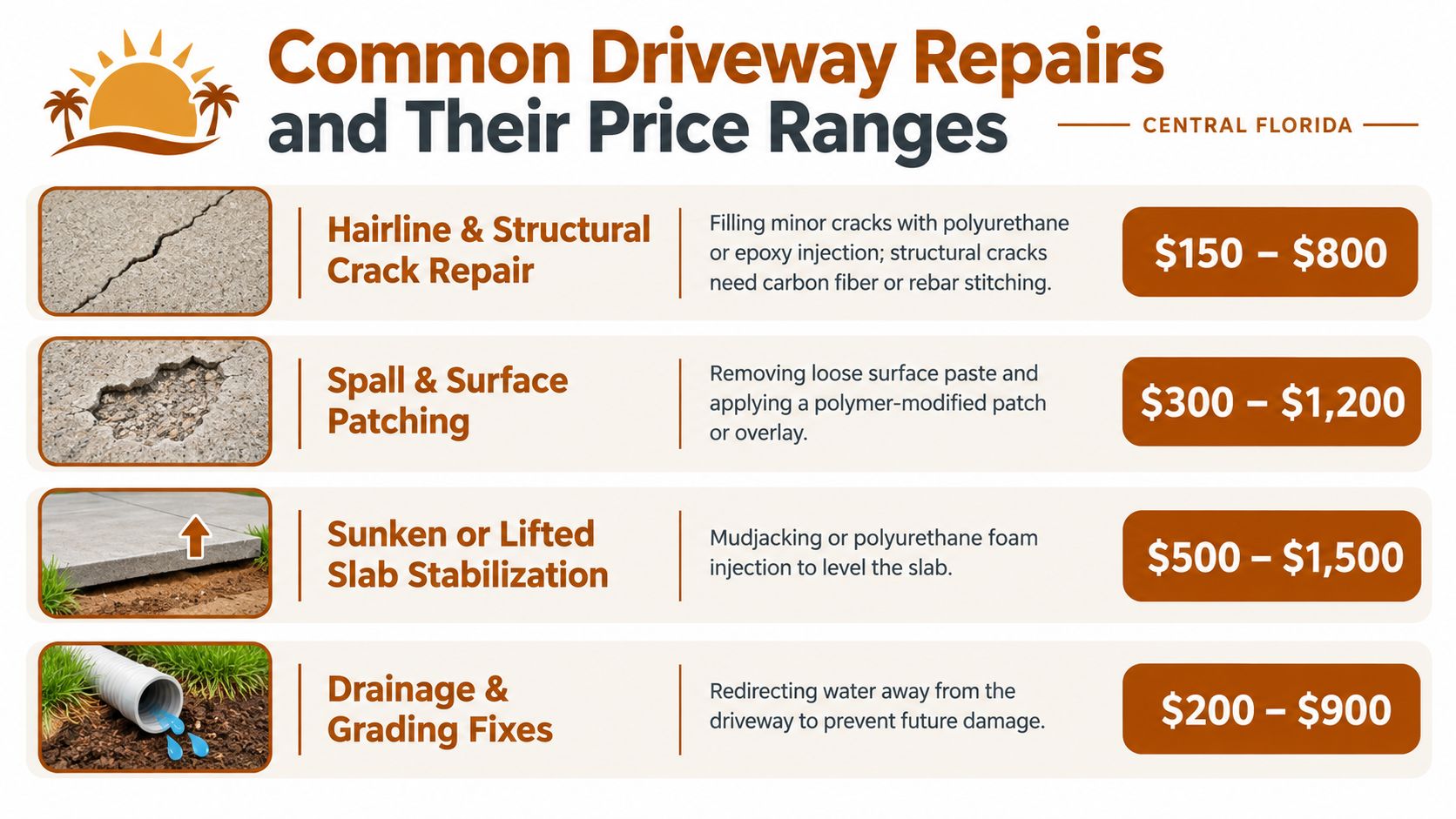
Cracks: A stable, isolated crack may need only sealing. Wider or recurring cracks, or cracks with vertical displacement, call for a closer assessment because filler cannot stop movement beneath the slab. Review these concrete driveway crack repair options to understand common approaches, then have the site assessed.
Spalling and surface damage: Pitting and flaking can be patched if the surrounding concrete remains sound. Resurfacing can refresh a stable slab, with reported costs around $3–$9 per square foot; surface preparation and existing conditions affect the final price.
Sunken or lifted areas: Leveling can work when the concrete is intact and the underlying cause can be corrected. Ask what caused the void or movement before approving the work. If the slab is broken or continues to shift over failed support, removal may be the better use of your money.
Partial panel replacement: Replacing a panel costs more than filling a crack. The estimate should account for demolition, disposal, access, base correction, and how the new section connects to nearby slabs. These line items can explain why two quotes for a similar repair differ.
Resurfacing only makes sense when the existing slab is structurally sound. Over active settlement or widespread failure, it is a cosmetic reset that is likely to fail within a few years.
Repair vs Replacement and the Cost Per Year That Matters
A low repair quote can cost more over time if the same area fails again. Compare each option by its upfront price, the usable years it is likely to deliver, and whether the work addresses the cause of the damage.
One industry estimate puts resurfacing life at 8–15 years and replacement life at 25–40 years (CostPrism's driveway cost discussion). Treat those as broad estimates, not promises. Slab condition, installation quality, drainage, and maintenance all affect how long a driveway lasts.
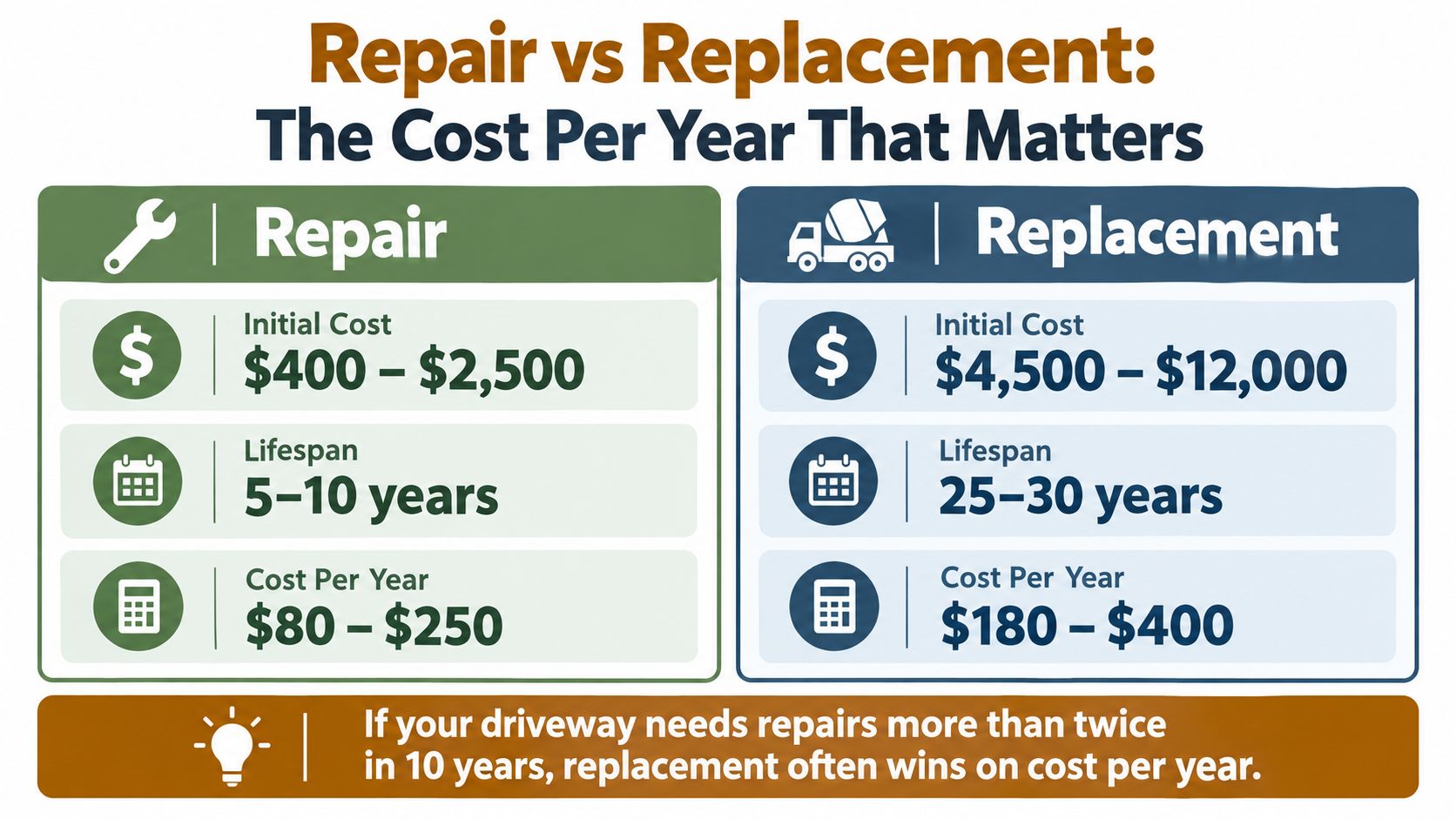
Use your actual quotes to calculate cost per usable year: divide each option's price by the years you reasonably expect it to last. A targeted repair can be good value when the slab is stable. Repeated patches on a settling driveway are a false economy if they leave the underlying failure untouched.
Replacement deserves serious consideration when cracks return, multiple areas have settled, drainage is washing out the support, or spalling covers much of the slab. A replacement can include new base preparation and drainage corrections, though those line items, along with demolition, disposal, and site access, affect the final bill. A new concrete driveway is commonly estimated at $2,500–$7,300; dimensions, preparation, removal, and finish change the quote. For a useful comparison, ask contractors to list those costs separately rather than relying on a national average.
Judge each option by its cost per usable year and by the failure risk that remains after the work is done.
To weigh the existing slab's remaining service life against replacement, read this guide to how long a concrete driveway lasts. Use it to prepare questions for an inspection, not to diagnose the driveway by age alone.
Reading a Real Estimate Line by Line
A low total can hide costs that decide whether the repair lasts. Compare each estimate by scope and cost per usable year, not just by its bottom line. The contractor should identify the work, materials, quantities, and exclusions clearly.
| Line item | What to confirm |
|---|---|
| Demolition and haul-off | Which panels will be removed, and are loading, disposal, and cleanup included? Angi lists concrete removal at $1–$6 per square foot, but the actual charge depends on the work and site. |
| Base correction | Does the price cover inspecting and correcting weak or uneven support, or only placing new concrete? |
| Access and mobilization | Are equipment access, setup, and crew mobilization included? Tight access or a small job can make these costs significant even when the repair area is limited. |
| Reinforcement | Does the estimate specify whether reinforcement is included and what type is proposed? |
| Joint work | Are joints included, and does the scope specify their placement and construction? |
Angi's published removal and resurfacing figures are benchmarks, not a quote for your property. Its concrete repair and removal cost information also gives resurfacing costs of $3–$9 per square foot. Treat that range as context only. A per-square-foot figure cannot tell you whether demolition, haul-off, base correction, or access costs are included.
For a 500-square-foot driveway, one contractor might quote less because tear-out, disposal, and base work are excluded. Another may include those items, plus concrete thickness, reinforcement, joints, finish, curing, and restoration of affected landscaping. The higher bid may deliver more usable years, but only if the scope addresses the actual failure. Ask each contractor to identify exclusions before comparing totals.
Ask direct questions: Which concrete is coming out, and who disposes of it? Will the subgrade be inspected and corrected where needed? What thickness, reinforcement, finish, and joint work are specified? When can people walk on the slab, and when can vehicles use it?
A sound proposal should state concrete volume and applicable performance requirements. The Florida DOT concrete pavement replacement specification addresses accepted concrete volume, joint construction, tie bars, dowels, testing, and incidental work for pavement replacement. Ask which details apply to your driveway. Do not pay for a road-pavement assembly your project does not need, and do not accept a vague scope that leaves base or joint work undefined.
How Central Florida Conditions Drive the Final Price
Central Florida weather and site conditions can turn a small surface issue into a larger repair. Heat and UV exposure wear on exposed surfaces, while heavy rain can find its way through open cracks and worsen problems in the supporting soil. The repair price depends on which condition is present and what work will correct it.
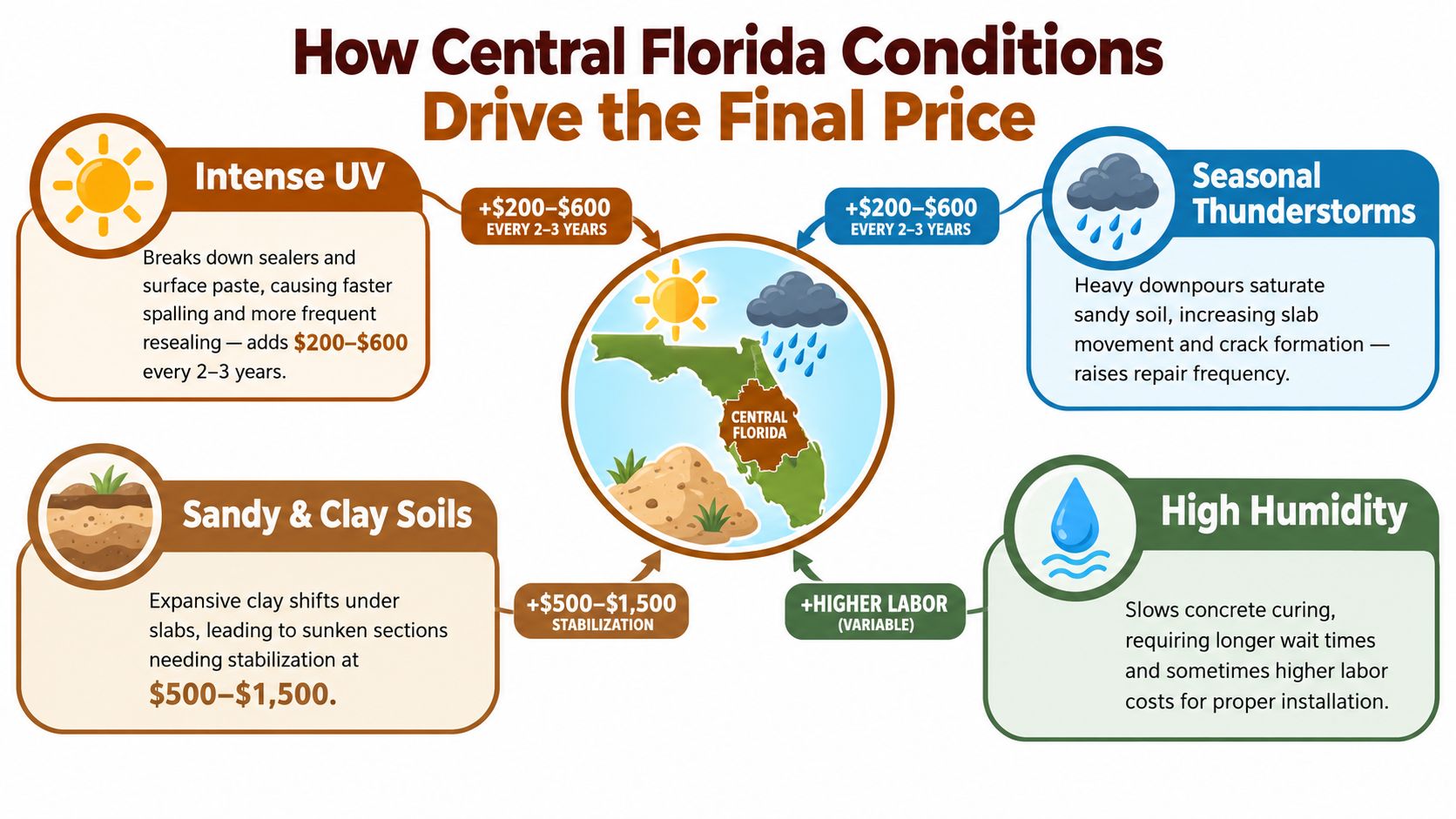
Rain and drainage: Water that pools beside a driveway or runs beneath its edge can weaken support. A contractor may need to correct grading or drainage before patching or replacing concrete. An estimate that ignores a recurring water path is likely to leave the cause in place.
Soil and settlement: Sandy ground, changing moisture, and poor compaction can contribute to slab movement, especially near garage approaches and curbs. If support has failed, leveling alone may not last; base correction and panel replacement may be more appropriate. For broader driveway pricing context, HomeAdvisor's concrete driveway installation guide also identifies site conditions and size as cost factors.
Trees and roots: Live oak and palm roots can lift or distort slabs. The fix may involve removing and replacing affected concrete and addressing the root conflict. Grinding down a raised edge alone may leave a trip hazard or drainage problem nearby.
Surface wear: Sun, traffic, and weather exposure can contribute to surface deterioration. Resurfacing may work when the slab remains stable, while deep or widespread damage can call for panel replacement. A contractor should check joints and drainage rather than treating the visible surface in isolation. Learn why concrete expansion joints matter when discussing crack control and replacement details.
These conditions vary between properties. A driveway in Dunnellon may need a different scope from one in Crystal River, Inverness, or Ocala, even when their visible cracks look alike.
Timeline Permits and Long-Term Maintenance Planning
Get approvals settled before reserving a crew. Permit requirements depend on the work and the authority responsible for the property. Contact the appropriate Marion or Citrus County building department, and confirm whether your HOA needs plans, photos, or written approval.
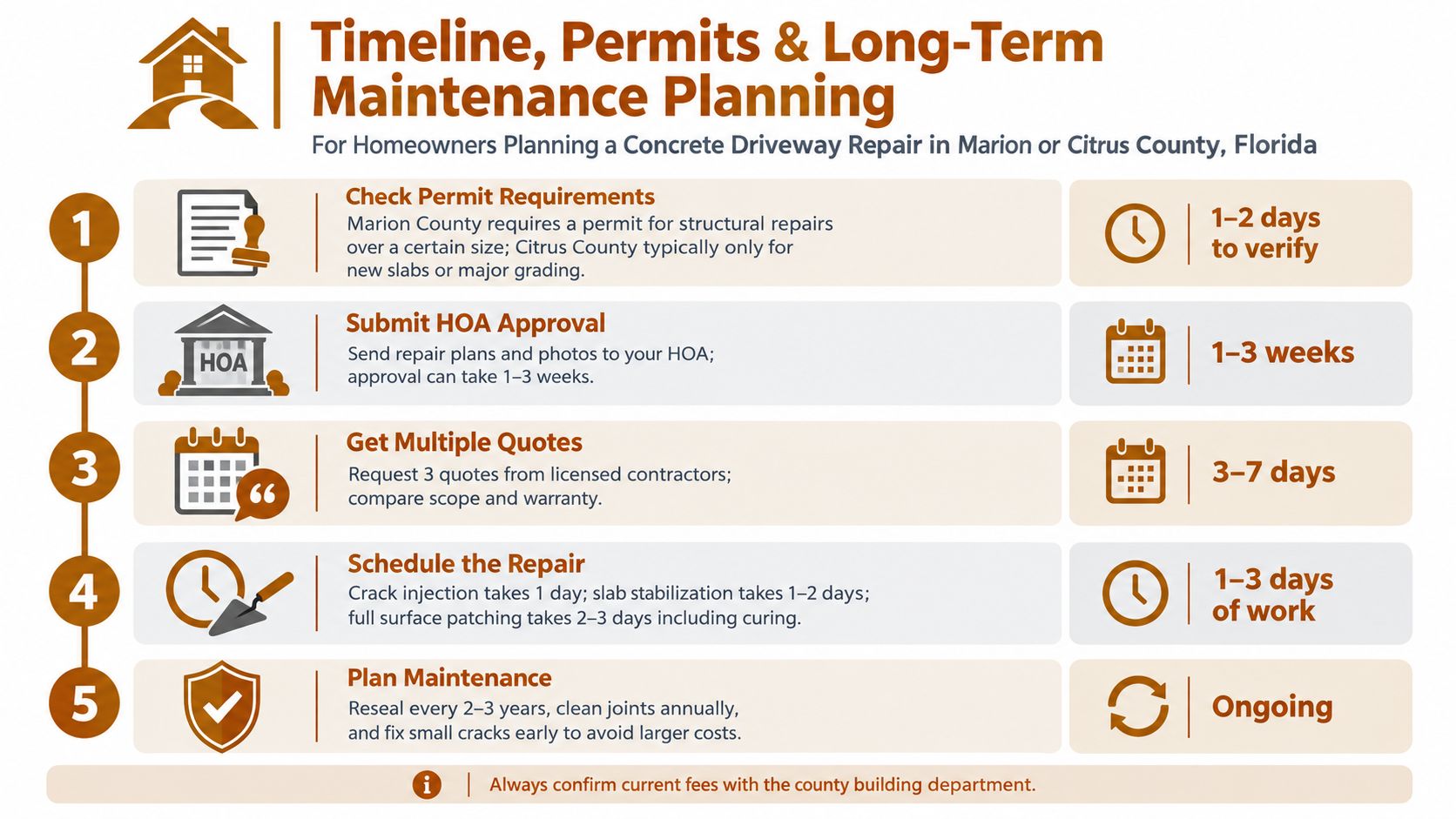
Weather, crew availability, repair method, and mix determine the schedule. FHWA concrete repair guidance distinguishes rapid-opening mixes with approximate traffic-opening times of 4–6 hours or 12–24 hours from conventional mixes requiring 24–72 hours. Those ranges are not permission to drive on your repair. Get the contractor's opening time for your specific mix and conditions in writing. A dry-looking surface does not establish readiness for vehicle loads.
Judge scheduling choices by cost per usable year. Rushing vehicle access can undermine the repair you paid for; ask whether accelerated opening adds cost before choosing it.
In Marion and Citrus counties, recheck drainage paths before summer downpours and after heavy rain. Clear blockages before water repeatedly collects along repaired edges.
Use this checklist to protect the work:
- Clear drainage paths: Remove soil, leaves, and debris that redirect runoff toward the driveway.
- Watch joints and cracks: Report recurring openings or new movement early, especially after heavy rain.
- Protect the surface: Clean oil and fertilizer spills promptly. Confirm any treatment suits the concrete and finish.
- Keep the paperwork: Save the scope, mix details, opening instructions, and warranty terms so future repairs can be evaluated against the original work.
When to Call a Local Concrete and Asphalt Expert
Get an on-site assessment when cracking is widespread, panels have shifted, drainage is poor, or earlier patches keep failing. A site visit is also sensible when a project involves utility cuts, tree roots, sidewalk restoration, or HOA coordination. A contractor can inspect the visible surface and discuss whether the likely scope is localized repair, resurfacing, or replacement.
A national average can't show whether your driveway has a stable base, where runoff travels, or how difficult it is to reach the work area. Those details affect both the price and whether the proposed repair is likely to hold.
Riverside Sealing & Striping, LLC is a third- and fourth-generation, family-owned contractor based in Dunnellon. The company handles concrete driveway removal and replacement, new concrete work, and asphalt maintenance across Marion County, FL, Citrus County, FL, and surrounding Central Florida communities. It offers free, no-pressure on-site estimates from 7am to 7pm, seven days a week.
For homeowners in Belleview, Silver Springs, Summerfield, Beverly Hills, Hernando, or The Villages, a written scope can clarify what the price includes before work begins. The company also serves commercial properties with asphalt sealcoating and parking lot striping, so it provides both concrete and asphalt services rather than asphalt maintenance alone.
Concrete Driveway Repair Cost Questions Homeowners Ask
Are small cracks worth repairing?
Seal stable, isolated cracks to limit water entry. That's money well spent when the surrounding slab is sound. A crack that returns, widens, or develops a height difference needs assessment before another surface patch.
How long can resurfacing or replacement last?
Use the 8–15 years for resurfacing and 25–40 years for replacement discussed earlier as planning ranges, not promises (CostPrism's driveway cost discussion). Slab condition, preparation, drainage, workmanship, and maintenance determine whether those expectations fit your driveway. Compare cost per usable year using an estimate suited to its condition.
Do Marion or Citrus County driveway repairs need a permit?
Confirm requirements with the county building department before construction, describing the actual repair scope. Check HOA approval separately. One does not replace the other.
How should I budget if financing is needed?
Get demolition, disposal, base work, drainage corrections, and access costs itemized before borrowing. Ask whether the contractor accepts milestone payments tied to tear-out and pouring, and get that schedule in writing.
For lender financing, request the interest rate, fees, monthly payment, and total repayment amount. Include financing charges when comparing cost per usable year.
Riverside Sealing & Striping, LLC offers free, no-pressure on-site estimates across Marion and Citrus counties. Contact Riverside Sealing & Striping, LLC for a repair-versus-replacement assessment based on your driveway's condition.