
A lot of homeowners notice the same pattern. One small crack shows up in the driveway, it doesn't seem urgent, then a Florida rainy season passes and the crack looks wider, darker, and harder to ignore.
In Central Florida, driveway cracks aren't just a cosmetic issue. From Ocala and Belleview to Crystal River and Homosassa, the right repair depends on why the concrete cracked in the first place. A cheap filler can work well on a stable surface crack. The same filler can fail fast if the slab is moving, the base is washing out, or roots are pushing from below.
This guide breaks down practical concrete driveway crack repair options for homeowners in Marion County, FL and Citrus County, FL. The goal is simple. Choose the repair that fits the actual problem, not the one that only hides it for a few months.
Table of Contents
- Understanding Why Concrete Driveways Crack in Florida
- A Homeowner's Overview of Driveway Repair Solutions
- Comparing Driveway Crack Repair Methods Cost Lifespan and Use Case
- The Florida Factor How Sun Rain and Soil Affect Your Driveway
- Your Decision Guide When to DIY Patch or Call a Professional
- When to Contact Riverside Sealing and Striping for an Evaluation
- Frequently Asked Questions About Driveway Repair
Understanding Why Concrete Driveways Crack in Florida
Before choosing between filler, patching, resurfacing, or replacement, look at the crack itself. In Marion County, FL and Citrus County, FL, the cause often matters more than the appearance.
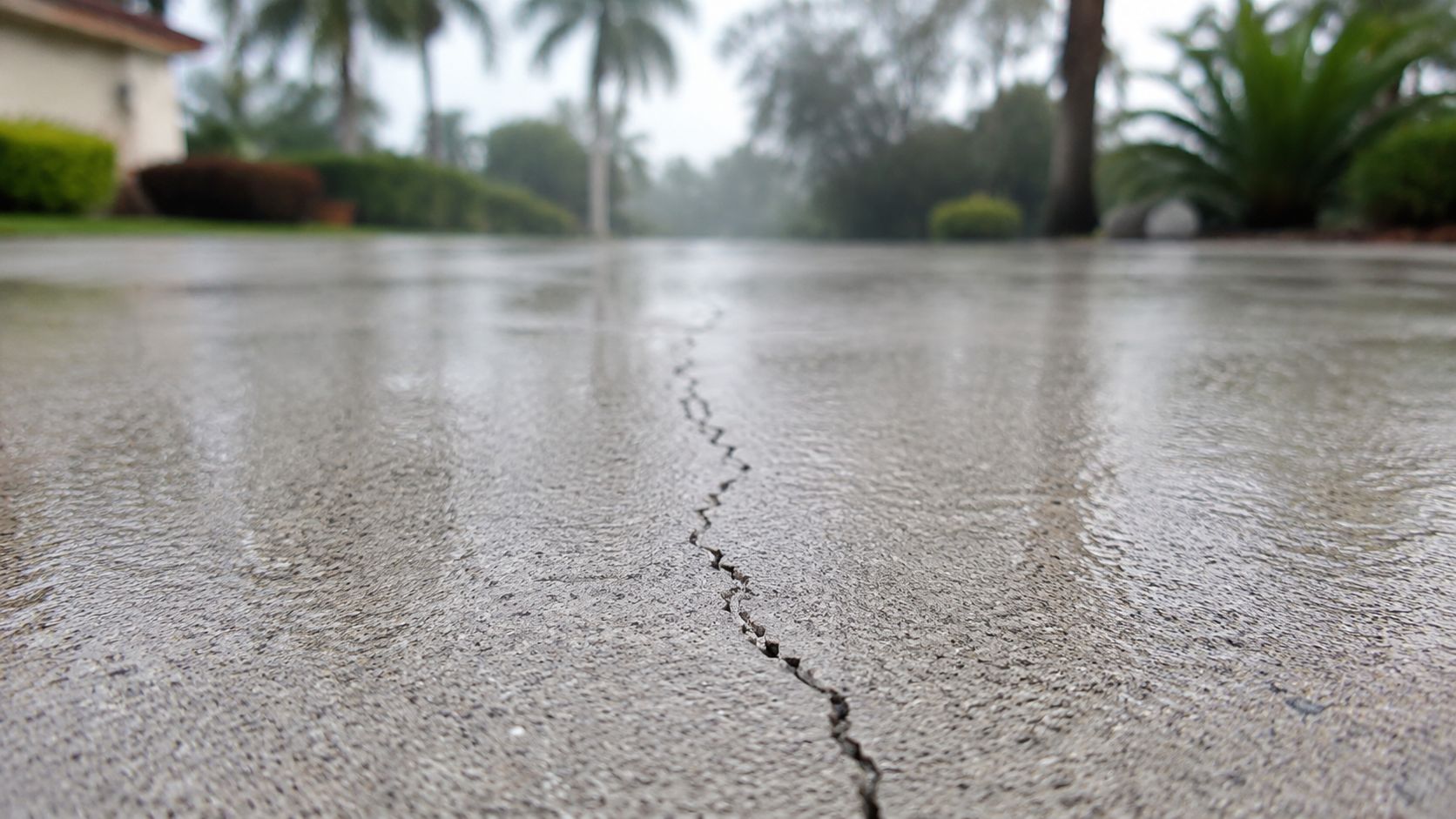
Hairline cracks are usually the least serious. They often come from normal curing, minor shrinkage, or surface stress. These are the cracks many homeowners in Summerfield, Silver Springs, and The Villages can seal early and manage without major work.
Wider cracks are different. Once a crack starts opening up, collecting dirt, holding water, or repeating after repair, the problem may not be the concrete surface anymore. It may be movement under the slab.
For a closer look at common causes, this guide on why a driveway starts cracking is useful because it helps separate surface wear from deeper slab movement.
The first question is whether the crack is stable or active
A stable crack usually stays about the same width and doesn't create uneven edges. A moving crack changes over time, often because the slab is expanding, contracting, or settling.
Common local causes include:
- Sandy subgrade movement that leaves parts of the slab less supported
- Heavy rain and water intrusion that wash into cracks and weaken the base
- Tree root pressure that lifts one section higher than another
- Sun exposure and thermal cycling that keep opening and closing the same weak point
A crack that keeps returning after it's been filled is usually telling you the repair targeted the symptom, not the cause.
What homeowners in Central Florida should look for
The most practical DIY repair window is for cracks about 1/4 to 1/2 inch wide, where cleaning the crack, using sand as a backer if it's deep, and leaving about 1/4 inch at the top for sealant helps block water intrusion, based on guidance from Boots on Enterprises.
If the crack is larger, shows vertical displacement, or looks tied to settlement, a simple patch usually won't hold well.
Watch for these red flags:
- One side sits higher than the other. That suggests uplift or settlement.
- Water pools near the crack. That points to drainage or base issues.
- The crack branches into multiple directions. That can mean slab stress is spreading.
- The area sounds hollow or feels loose nearby. That can suggest loss of support below.
In places like Dunnellon, Inverness, Lecanto, and Hernando, I'd pay especially close attention to nearby roots and drainage patterns. Concrete rarely cracks without a reason. The repair lasts longer when that reason is identified first.
A Homeowner's Overview of Driveway Repair Solutions
You notice a crack after a week of hard rain, fill it on Saturday, and by summer the same line has opened again. That usually means the repair choice did not match the reason the slab cracked in the first place.
For Central Florida homeowners, the right fix depends on two things. How much the concrete is moving, and whether the slab underneath is still sound. Heat, heavy rain, sandy soil, and nearby roots all affect that decision. A repair that works on a dry, stable slab can fail early if water is getting under the driveway or one section is shifting.
The main repair options, from light repair to major correction
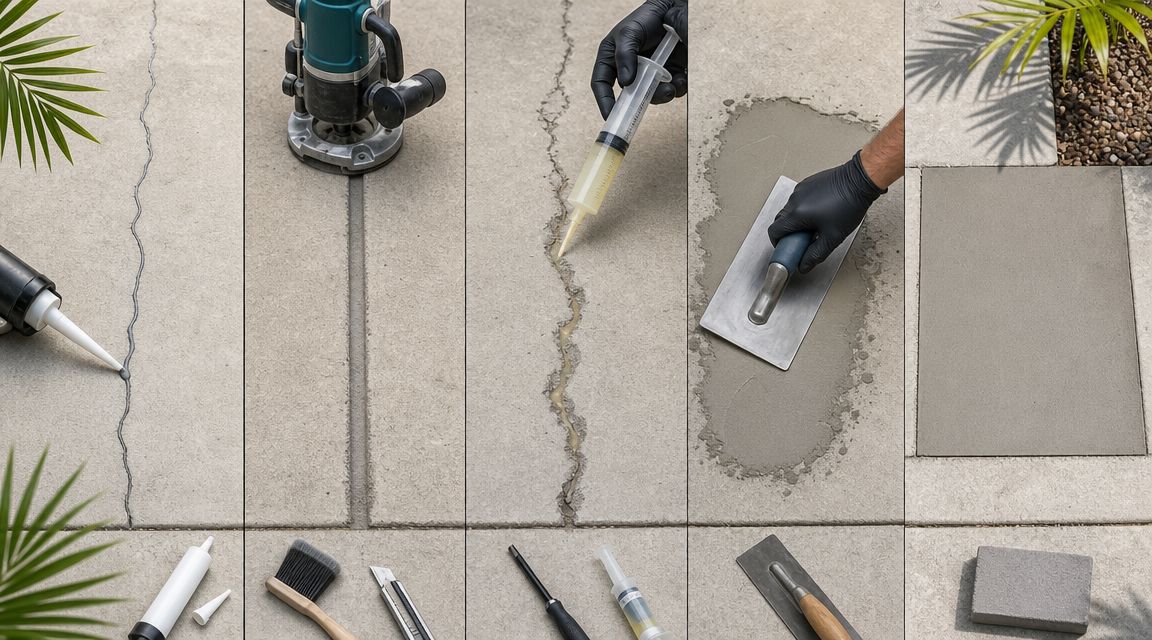
Small surface cracks often respond well to crack filler or sealant. This is the basic water-blocking repair. It makes sense for narrow cracks that are not lifting, spreading, or showing signs of base failure.
If a crack has some seasonal movement, routing and sealing is usually a better fit. Opening the crack slightly and installing a flexible sealant gives the material a cleaner bond and more room to handle expansion and contraction. In Florida sun, that flexibility matters.
For chipped edges, shallow breakouts, or areas of surface loss, patching compound can work if the surrounding concrete is still solid. The trade-off is appearance and longevity. A patch can stand out in color and texture, and it will not last if the slab keeps moving underneath.
Epoxy or other structural repair products have a narrower use. They are meant for cracks where bonding strength matters more than flexibility. On a stable slab, they can perform well. On a driveway that is still moving from soil washout, root pressure, or settlement, a rigid repair often cracks again.
If the slab is structurally sound but worn, stained, or rough across a wider area, resurfacing may be the better value than spot repairs. Homeowners comparing cosmetic improvement with deeper repair can look at how concrete driveway resurfacing works to see where resurfacing helps and where it does not.
Once you see broken sections, repeated crack failure, sinking, or one panel sitting higher than the next, the conversation shifts to partial or full replacement. At that point, patch materials are usually buying time, not solving the problem.
Quick comparison of common options
| Repair option | Best fit | Usually a DIY job | Main limitation |
|---|---|---|---|
| Crack filler or sealant | Small, stable surface cracks | Often, yes | Won't fix movement below the slab |
| Routing and sealing | Active cracks that need flexibility | Sometimes | Prep quality matters a lot |
| Epoxy or structural repair material | Cracks needing bond strength in the right application | Usually not for homeowners | Wrong product choice can fail on moving cracks |
| Patching compound | Localized breakouts or wider damaged areas | Sometimes | Can look obvious and may re-crack if movement continues |
| Resurfacing or replacement | Widespread wear, larger failures, or broken sections | Usually no | Only works if the base and remaining slab are sound |
The practical takeaway is simple. Use filler for minor, stable cracks. Use patching or resurfacing only when the slab can still support it. Bring in a professional when the crack points to movement, drainage trouble, or slab failure, because those are the repairs that get expensive when the first choice is the wrong one.
Comparing Driveway Crack Repair Methods Cost Lifespan and Use Case
Homeowners usually ask three things here. What repair matches the crack, how long will it last, and is it worth fixing or better to replace.
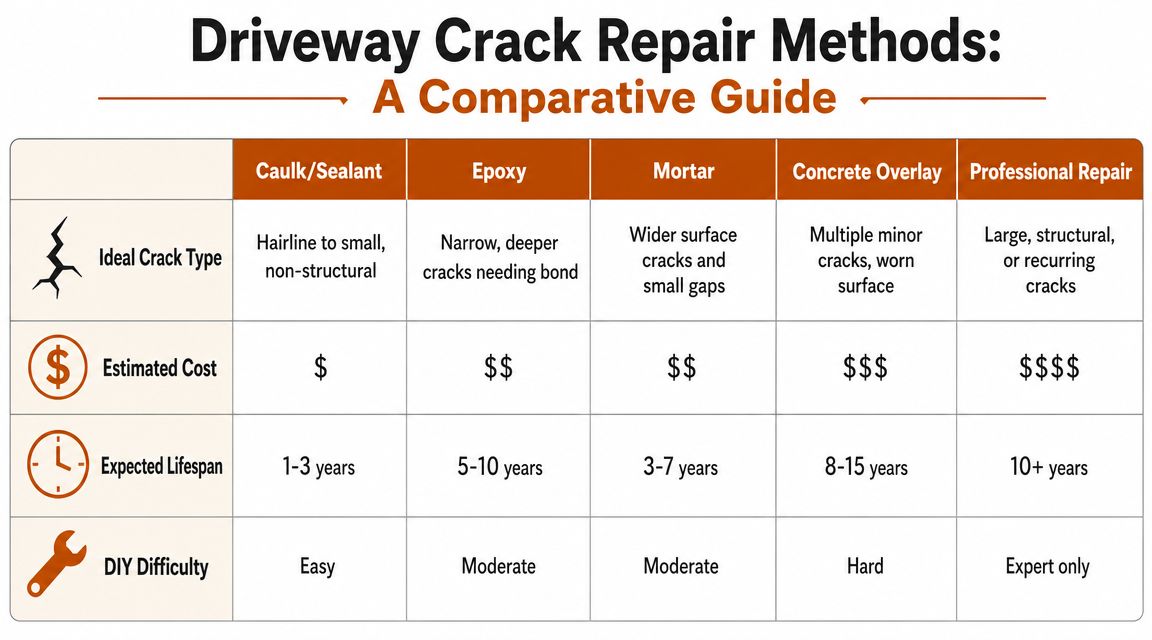
In Central Florida, those answers depend less on the crack alone and more on why it opened. A narrow crack from surface shrinkage is a different job than a crack above a washed-out area, a root, or a slab edge that keeps shifting in summer heat and heavy rain.
How each repair method fits a different problem
| Method | Best use case | Typical cost range | DIY or pro | Florida-specific note |
|---|---|---|---|---|
| Flexible crack filler or caulk | Hairline to small cracks with minor movement | Low material cost for small DIY repairs | Often DIY | Usually the better pick for outdoor cracks that expand and contract |
| Professional crack filling | Small to moderate cracks where prep and finish matter | Moderate service cost, depending on crack length and condition | Pro | Better choice when the crack is dirty, deep, or exposed to repeated water intrusion |
| Sealing or resealing surface | Surface protection after repairs, minor weathering | Lower-cost maintenance compared with major repair | DIY or pro | Helps slow water entry, but it will not stop an active crack from reopening |
| Patching compound | Chipped edges, spalls, wider surface damage, localized breakouts | Moderate cost, depends on prep and patch size | DIY for small areas, pro for better color match and bond | Works best where the slab is stable underneath |
| Partial slab replacement | One failed section, severe crack pattern, broken corners, or isolated settlement | Higher cost, but often better value than repeated patching | Pro | Often the right answer if one panel failed and the rest of the driveway is still sound |
What usually works and what usually disappoints
The most important factor in choosing a material is movement.
If the slab still shifts a little, a flexible repair usually lasts longer than a hard one. If the concrete needs to be bonded back together in a controlled structural application, rigid products have a place. Home Depot's concrete crack repair guidance makes that distinction clearly, and it matches what we see on residential driveways.
Homeowners lose money when they buy the strongest product on the shelf instead of the right product for the crack.
A driveway in Ocala, Beverly Hills, or anywhere around Central Florida gets heat, rain, and soil movement. That combination can reopen a rigid repair if the slab keeps flexing. Flexible sealant is usually the safer choice for small outdoor cracks. Patching compound makes more sense when the edges are broken and you need to rebuild missing surface. Neither one solves a sinking panel.
Preparation decides whether the repair has a fair chance. Open the crack enough to remove weak material. Clean out dust and debris. Use backer rod where the crack is deep enough to need depth control. Keep water and loose sand out of the repair area. Skip those steps and even a good product can let go early.
A few practical calls homeowners can use:
- Choose flexible sealant for narrow cracks that are outside, exposed to weather, and likely to move a little.
- Choose patch material for chipped or widened areas where shape and surface need to be rebuilt.
- Choose partial replacement when one section is broken, rocking, or separating from the rest.
- Choose evaluation before repair if the crack is widening, one side sits higher, or water drains into the opening.
If you are weighing repeated repairs against starting over, this guide on the cost to replace a concrete driveway helps put that decision in dollars instead of guesswork.
Cheap material is not usually the main problem. Wrong repair choice for Florida conditions is.
The Florida Factor How Sun Rain and Soil Affect Your Driveway
Florida changes the repair conversation. The same product that looks fine in a mild climate can struggle on a driveway in Marion County, FL or Citrus County, FL after months of UV, stormwater, and heat.
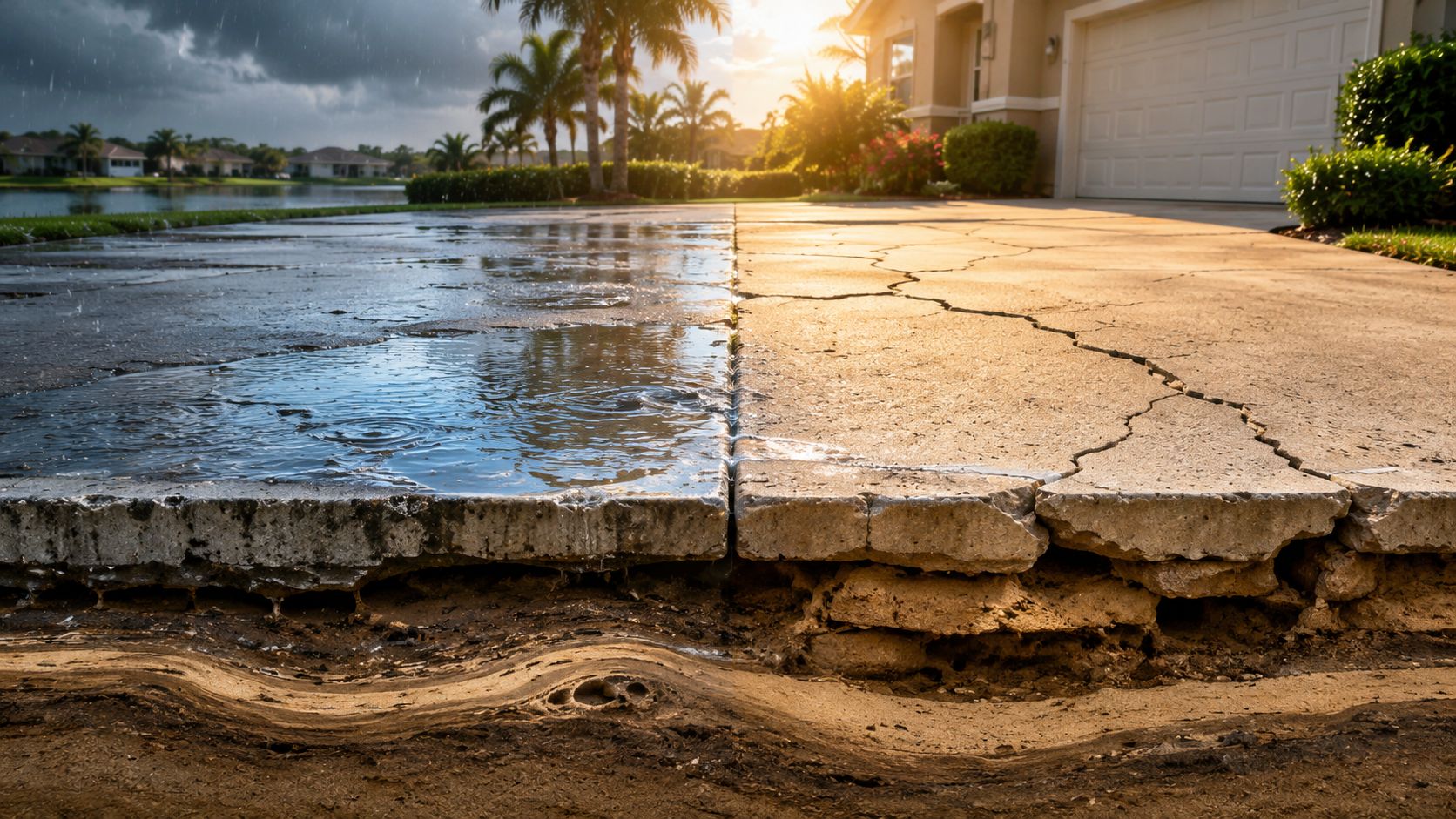
The durability of any repair is heavily affected by weather, and one of the biggest gaps in generic online advice is that it rarely answers which option minimizes maintenance over the next five years of thermal cycling and moisture intrusion in places like Florida, as noted by ICS 50.
Heat and UV change how repair materials behave
In Central Florida, driveways in full sun bake for long stretches. That matters in places like Summerfield, Belleview, and The Villages where driveways often face direct afternoon exposure.
Low-grade or poorly matched fillers can dry out, lose flexibility, or separate from the crack edges faster than expected. Even a good product won't perform well if it's installed into a dirty crack, over moisture, or without enough depth control.
For sun-exposed repairs, the practical goal is not just filling the opening. It's choosing a repair that can tolerate repeated expansion and contraction without turning brittle.
Rain and sandy soil can turn a crack into a slab problem
Heavy rain creates a second problem. Water enters through open cracks, reaches the base, and can keep undermining support in sandy conditions common around Dunnellon, Silver Springs, Crystal River, and Homosassa.
That's where a surface crack becomes a structural concern. If water keeps moving below the slab, patching the top may improve appearance but not stability.
This short video helps show why base support matters as much as the crack itself.
A few local troublemakers show up again and again:
- Poor drainage that sends roof runoff or yard runoff across the slab
- Roots from mature oaks and other trees that slowly lift sections
- Soil washout around slab edges
- Repeated wet-dry cycles that keep stressing the same crack line
In Florida, the longest-lasting repair is usually the one that addresses water first and concrete second.
That's why repair advice for homeowners in Lecanto, Inverness, and Hernando has to be local. Climate isn't background information here. It's part of the diagnosis.
Your Decision Guide When to DIY Patch or Call a Professional
A lot of driveway cracks can be sorted quickly with a few honest questions. The goal isn't to avoid professional help at all costs. It's to avoid wasting money on a repair that was never going to hold.
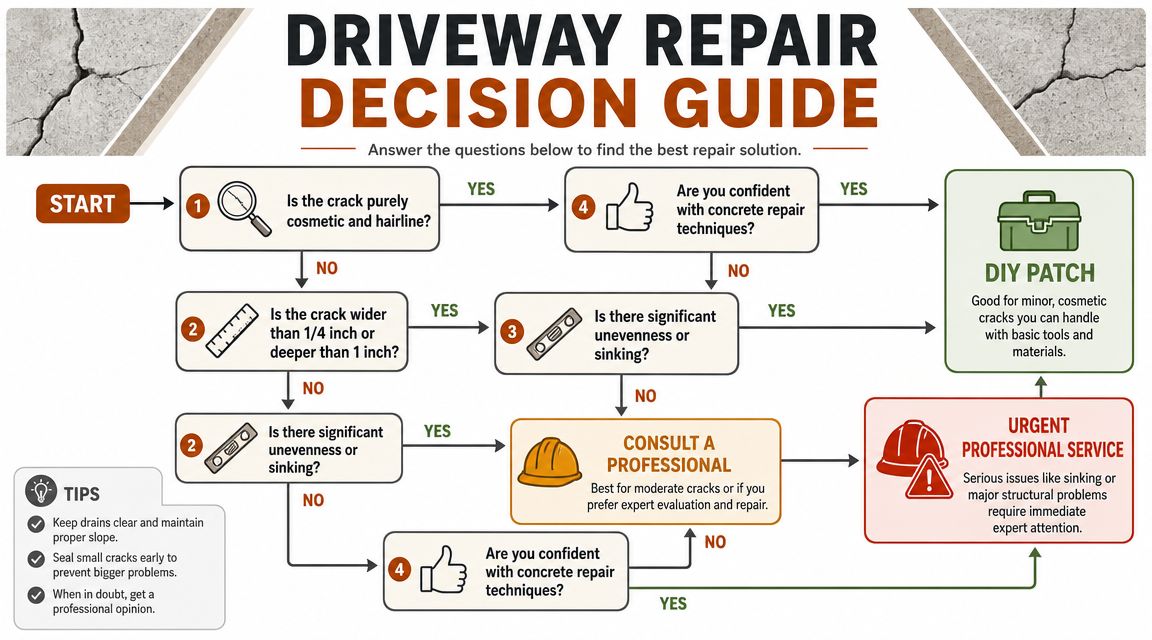
A simple way to sort your repair choice
Start with the crack itself.
Is it narrow and mostly cosmetic?
If the crack is small, stable, and not causing edge movement, a careful DIY sealant repair can make sense.Is it in the practical repair window?
For small driveway cracks, the common workable range is about 1/4 to 1/2 inch wide when properly cleaned and backed if deep, as covered earlier from Boot's guidance.Are the edges even?
If both sides stay level, you may still be dealing with a surface repair. If one side is higher, that's different.Does water collect there?
If yes, the problem may involve drainage or base erosion, not just a crack.
Signs the crack is bigger than a patch job
The biggest warning sign most homeowners miss is whether the crack points to slab failure instead of surface damage. Uneven slabs, recurring cracks, vertical displacement, and active water intrusion often signal settlement or base failure, which means a cosmetic patch is likely to fail because the underlying issue wasn't corrected, as explained by VF Paving.
Call for a professional evaluation when you see any of these:
- Vertical displacement. One side is higher and creates a trip edge.
- Recurring cracks in the same line. You've filled it before and it came back.
- Multiple connected cracks. The slab may be breaking into sections.
- Sinking corners or rocking panels. Support below may be compromised.
- Water intrusion that won't stop. The base may keep washing out.
Field judgment: If you can describe the problem as sinking, lifting, spreading, or coming back, you're usually beyond a simple patch.
A homeowner with a few clean, shallow cracks can often handle prep, backer material, and sealant application. But if the slab is moving, the money-saving choice is often getting it properly evaluated before doing another round of cosmetic work.
When to Contact Riverside Sealing and Striping for an Evaluation
Some driveways are straightforward. Others need someone to look at the slab, the surrounding grade, and the pattern of cracking together.
Situations that deserve a site visit
It's time to bring in a pro when the crack is tied to one of these conditions:
- The slab has dropped or lifted
- Cracks keep reopening after repair
- A section near the garage, sidewalk tie-in, or apron is breaking apart
- The crack pattern suggests more than isolated shrinkage
- You're deciding between partial replacement and full replacement
For homeowners in Ocala, Dunnellon, Beverly Hills, and nearby communities, that evaluation should focus on the root cause. That may mean drainage, base support, tree-root pressure, or a slab section that has reached the point where replacement is more sensible than repeated patching.
Why diagnosis matters more than the first repair
Riverside Sealing & Striping, LLC is one local option for homeowners who need a site evaluation from Concrete and Asphalt Experts in Marion and Citrus County, especially when the issue may involve removal and replacement rather than surface patching alone.
The honest approach is to match the fix to the slab condition. Sometimes that's a professional crack repair. Sometimes it's a partial slab replacement. Sometimes the most cost-effective move is to stop patching and rebuild the damaged section correctly for Florida conditions.
Licensed and insured local contractors should also be able to explain what they see in plain language. You should know whether the crack is cosmetic, active, drainage-related, or a sign of slab failure before any work starts.
Frequently Asked Questions About Driveway Repair
What time of year is best for driveway crack repair in Central Florida
A dry stretch with a predictable forecast is usually the best window. In Central Florida, that often matters more than the month on the calendar.
Repair materials need a clean, dry crack to bond well. If afternoon rain keeps wetting the slab or moisture is trapped in the joint, the repair may fail early even if the crack was filled correctly.
Will a repaired crack disappear completely
Usually no. A proper repair should seal the crack, improve the appearance, and stop water from getting deeper into the slab.
On older driveways, some color difference is normal because the surrounding concrete has already faded, stained, and worn under years of sun and rain. If a contractor promises the crack will be invisible, ask exactly what product they plan to use and what the finished surface will really look like after curing.
How long do I need to stay off the driveway after repair
It depends on the repair method. Flexible crack fillers can cure fairly quickly, while patching materials, resurfacing products, and replaced concrete sections need more time before they can handle foot traffic or vehicle weight.
Ask for a specific timeline before the job starts. That matters even more in Florida, where heat can speed surface curing but rain and humidity can still affect the full cure.
What should I look for in a driveway repair warranty
Look at the scope, not just the length. A one-year warranty that clearly covers adhesion failure or workmanship is often more useful than a longer promise with a lot of exclusions.
Ask whether the warranty covers reopening cracks, patch separation, or only the material itself. Also ask what conditions can void it, especially drainage problems, root pressure, or slab movement. Those details tell you whether the contractor is addressing the actual cause or only the visible crack.
When is repair a better value than replacement
Repair is usually the better value when the crack is isolated, the slab is still level, and the surrounding concrete is in decent shape. That is the kind of driveway where sealing or patching can buy good service life without putting money into a full tear-out too early.
Replacement starts to make more sense when one repair leads to another, sections are settling, or the crack pattern points to base failure, drainage trouble, or root pressure. In Central Florida, that distinction matters. A cheap patch over moving sand, washout, or active roots often turns into repeat spending.
If your driveway in Marion County, FL or Citrus County, FL has cracking, sinking, or repeated patch failures, Riverside Sealing & Striping, LLC offers free, no-pressure evaluations for homeowners across Central Florida. If you're in Ocala, Dunnellon, Belleview, Summerfield, Crystal River, Homosassa, Inverness, Lecanto, Beverly Hills, Hernando, Silver Springs, or The Villages, an on-site review can help you decide whether a simple repair will hold or whether a longer-term concrete solution makes more sense.