
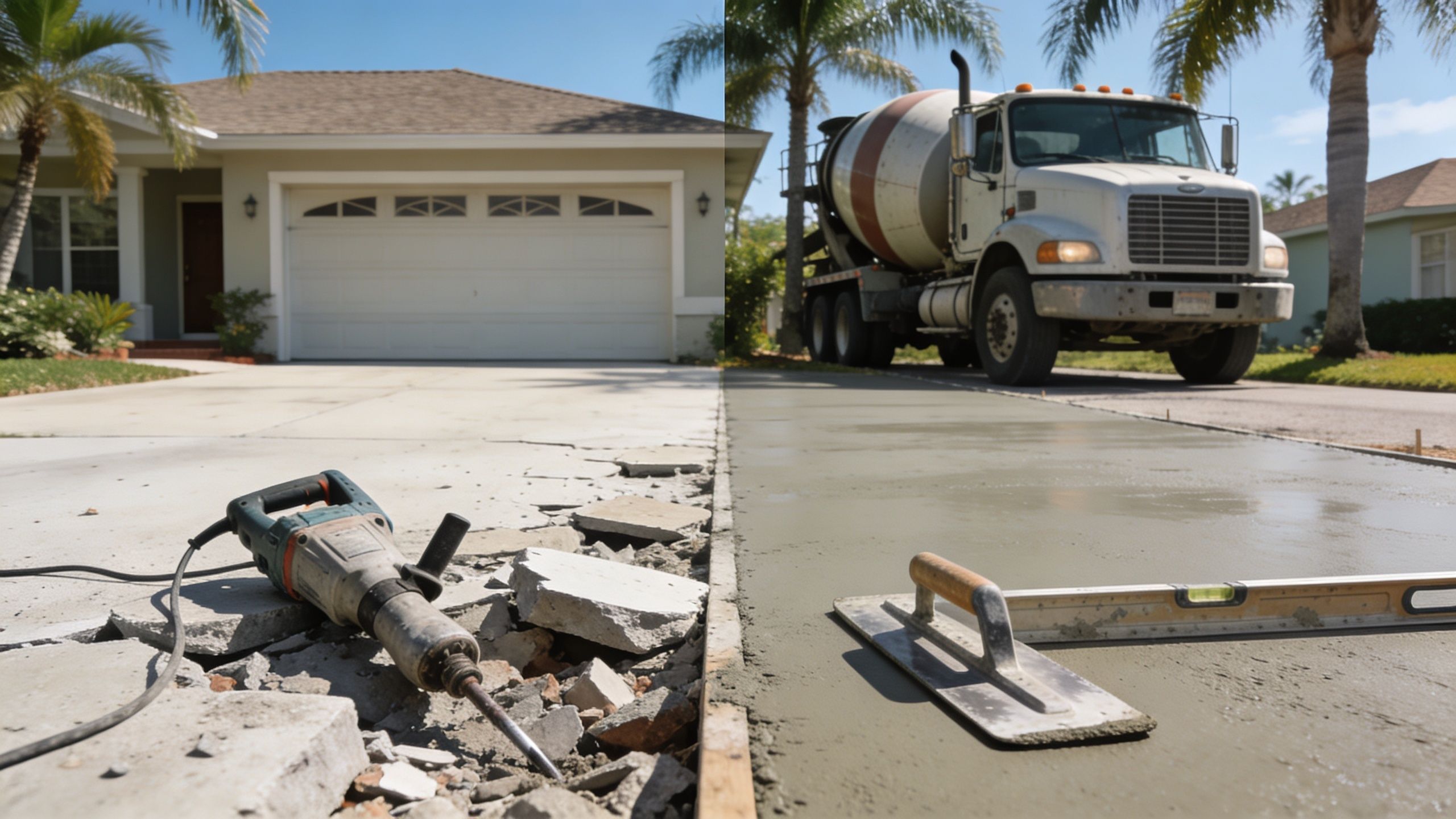
In Central Florida, the cost to replace a concrete driveway usually falls between $5 and $18 per square foot, and a standard two-car driveway often lands around $5,400 to $8,600 based on national replacement data from Concrete Network's driveway cost guide. In Marion County, FL and Citrus County, FL, many homeowners see practical project ranges around $4,000 to $12,000+ depending on access, site conditions, finish choices, and how much prep the old slab and soil need.
If you're reading this, there's a good chance your driveway already told you it's time. Maybe the slab in Ocala is cracked across multiple sections. Maybe the drive in Crystal River has settled near the garage, or roots in a shaded Homosassa lot are pushing panels up enough to create a trip hazard. At that point, the main question isn't whether the driveway looks rough. It's whether you're spending money wisely by repairing it again or replacing it correctly once.
National price guides are useful, but they often miss what changes the job in places like Dunnellon, Belleview, Inverness, Lecanto, Beverly Hills, Hernando, Silver Springs, Summerfield, and The Villages. Central Florida soil can shift. Drainage can be inconsistent from one neighborhood to the next. Tree roots, storm runoff, and access limitations can change labor and prep in a hurry.
Homeowners also tend to focus on the concrete itself, when the final price is often driven by what happens before the pour. Removal, hauling, grading, compacting, forms, reinforcement, drainage corrections, and curing discipline are what separate a driveway that lasts from one that starts failing early.
A Detailed Breakdown of Concrete Driveway Replacement Costs
A homeowner in Ocala might look at a driveway quote and see one number at the bottom. What matters is how that number was built. In Marion and Citrus County, the difference between a fair replacement price and a cheap-looking quote usually comes down to demolition, base work, and whether the contractor is pricing the job to last in Florida conditions.
As mentioned earlier, the national benchmark for replacement in 2026 is $5 to $18 per square foot, with plain gray concrete often falling around $5 to $8 per square foot and decorative work running higher. In this area, that range is only a starting point. A straightforward tear-out and repour in a dry, accessible subdivision lot prices very differently than a driveway in Crystal River with drainage issues or an older Ocala property where the base has been washing out for years.
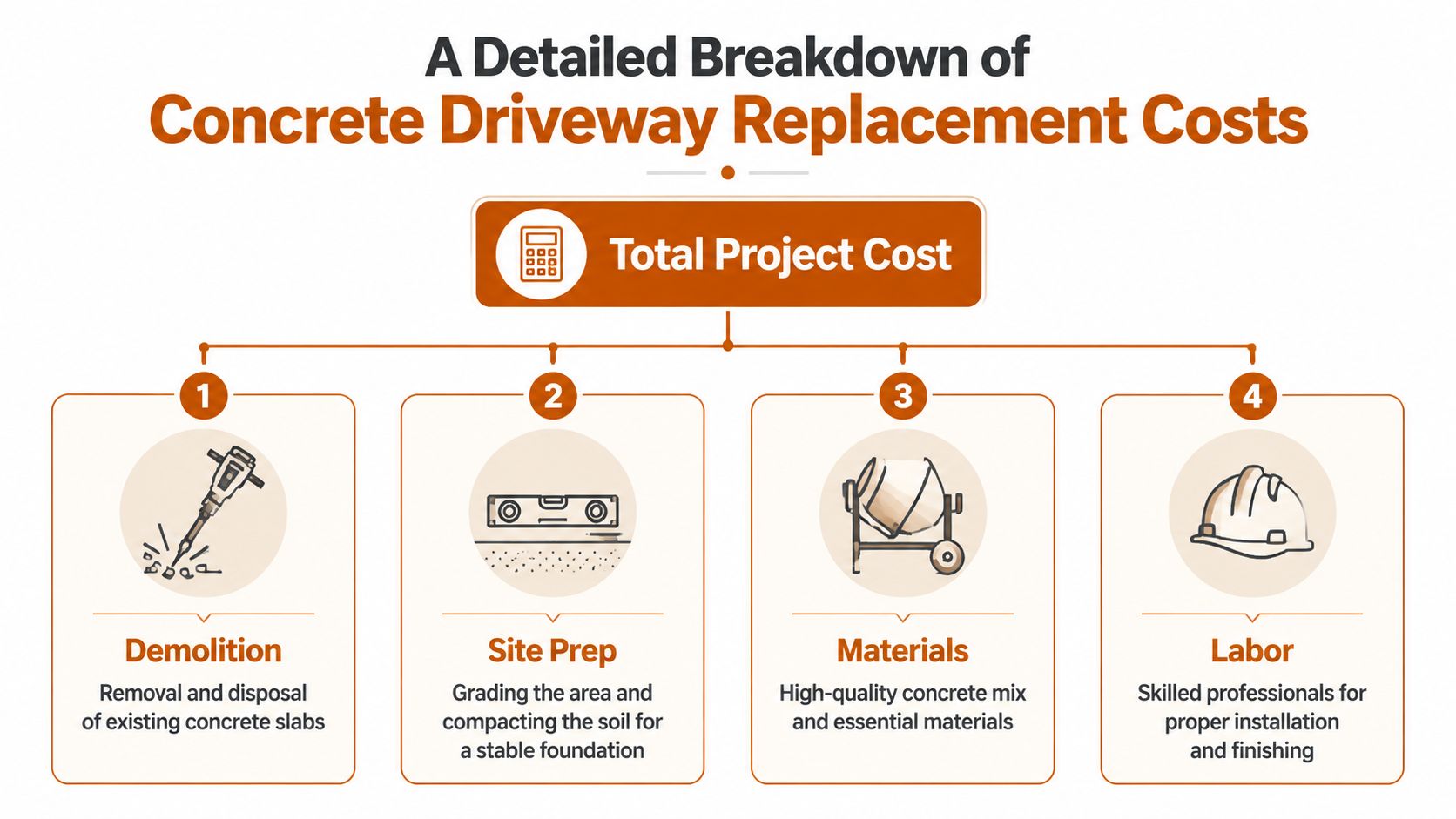
Where the money goes
A proper replacement quote usually breaks into four cost groups.
- Demolition and haul-off. This covers saw cutting if needed, breaking up the old slab, loading debris, and hauling concrete off-site. On some Marion County jobs, disposal is simple. On others, access and truck turnaround add time fast.
- Base prep and grading. A lot of Central Florida jobs are won or lost during this phase. If the soil under the old driveway is loose, washed out, or uneven, the crew has to regrade, compact, and sometimes bring in base material before new concrete goes down.
- Concrete and reinforcement. Mix design, slab thickness, fiber, wire mesh, or rebar all affect price. A basic residential driveway and a driveway that sees trailers or heavier vehicles should not be priced the same way.
- Placement and finishing labor. Forms, pour day labor, screeding, joint layout, broom finish, edging, cleanup, and curing protection all belong here.
Cheap quotes usually leave something out.
Sometimes it is haul-off. Sometimes it is proper base repair. Sometimes the reinforcement is lighter than it should be, or the finish work is priced as if the crew can move faster than the site really allows. That is how two bids for the same square footage end up far apart.
Costs homeowners often miss
The slab itself is only part of the job. The hidden cost is often under the slab or along the edges.
In Citrus County, I see this around low spots where water sits after heavy rain. In Marion County, it often shows up as edge failure, settlement near the garage, or roots lifting sections just enough to crack them. Those are replacement cost issues, not cosmetic issues.
Common add-ons include:
- Soft subgrade repair where the old driveway has lost support
- Drainage correction if runoff is moving toward the house or under the slab
- Root cutting and removal around mature oaks, palms, and overgrown garden beds
- Extra labor for tight access in fenced lots or narrower residential layouts
- Permits and inspection requirements depending on the city or county scope
- Apron or tie-in work where the driveway meets the garage, sidewalk, or street
If you want a side-by-side comparison of base material, concrete, and prep pricing, this breakdown of concrete slab cost per square foot helps before you add driveway-specific demolition and site conditions.
One practical rule applies to almost every replacement job in this area. If a bid is far below the others, ask exactly what happens if the crew finds bad base, standing water, buried roots, or thicker old concrete than expected. A good quote answers that before the job starts, not after your driveway is already torn out.
Key Factors That Influence Your Final Price in Central Florida
Two driveways can have the same square footage and end up with very different replacement prices. That's normal. In Central Florida, site conditions matter almost as much as size.
Size is the starting point, not the whole price
The first part of any quote is straightforward. More square footage means more material, more labor, and more removal. A long rural driveway outside Dunnellon or a wide front approach in The Villages will naturally cost more than a compact straight drive in Beverly Hills.
Thickness and reinforcement also matter. A driveway serving heavier vehicles, trailers, or frequent delivery traffic may need a stronger build than a lightly used residential slab.
Soil, water, and roots change the job fast
Local pricing differs significantly from generic national advice. Across Ocala, Summerfield, Crystal River, and Inverness, crews run into sandy areas, soft edges, runoff patterns, and root pressure that don't show up in an online estimate form.
A few common local price drivers:
- Sandy or unstable subgrade. Concrete performs best on a properly prepared base. If the ground is loose or uneven, prep gets deeper and slower.
- Poor drainage. If water has been ponding, washing under the slab, or draining back toward the home, the replacement may need additional grading adjustments.
- Tree roots. Mature live oaks and other large trees can lift slabs or break edges. Removing the old concrete is one step. Dealing with what caused the movement is the primary issue.
- Tight access. In packed neighborhoods, crews may have less room for saws, skid steers, dump trailers, and concrete delivery.
A driveway doesn't fail for no reason. If the original cause stays in place, the new slab inherits the same problem.
Finish choices affect both look and budget
Plain broom-finished concrete is usually the most practical option for homeowners who want a clean, durable surface without adding decorative cost. Decorative work can make sense for curb appeal, but it raises the price and usually demands more labor and tighter finish control.
That choice is easier to make once you understand the mix and performance side. This overview of the best concrete mix for driveways is useful if you're comparing basic residential pours to heavier-duty driveway builds.
Local permitting and neighborhood rules
Some jobs move fast. Others get delayed by approvals, HOA requirements, or municipal permit checks. That's especially common in planned communities and higher-regulation neighborhoods around The Villages, Ocala, and parts of Citrus County.
Before work starts, homeowners should confirm:
- Whether a permit is required
- Whether apron work at the street is included
- Whether HOA approval is needed for finish, color, or timing
- Whether utility markings or access restrictions apply
Sample Driveway Replacement Estimates in Marion and Citrus County
Most homeowners don't need an exact price on the first read. They need a realistic ballpark. The table below gives a planning range for common residential driveway sizes in Marion County, FL and Citrus County, FL using the verified replacement range of $5 to $18 per square foot from the earlier cost benchmark.
Sample Concrete Driveway Replacement Costs in Marion & Citrus County (2026)
| Driveway Size | Typical Dimensions | Total Square Feet | Estimated Cost Range |
|---|---|---|---|
| Small single-car | 12 x 30 ft | 360 sq ft | $1,800 to $6,480 |
| Standard two-car | 24 x 24 ft | 576 sq ft | $2,880 to $10,368 |
| Larger residential | 24 x 36 ft | 864 sq ft | $4,320 to $15,552 |
Those numbers are planning ranges, not fixed quotes. A plain replacement in Lecanto with easy access and minimal base correction may stay toward the lower end. A larger replacement in Silver Springs or Homosassa with removal complications, drainage work, decorative finish upgrades, or difficult access may climb well past the middle of the range.
How to use these numbers without fooling yourself
The biggest mistake homeowners make is assuming square footage alone gives the final answer. It doesn't. These examples help with budget planning, but they don't account for site-specific issues like root intrusion, settlement, broken edges near the road, or a driveway that needs regrading before new concrete goes in.
Use the table this way:
- Budgeting early. If you're comparing concrete to other property improvements, this gives you a realistic place to start.
- Comparing rough scenarios. A small straight driveway in Belleview won't price like a wide custom approach in Crystal River.
- Testing quote ranges. If a proposal falls far outside the likely range, ask why.
In this area, the square footage gets you close. The soil and prep tell you what the job actually costs.
When to Repair vs When to Fully Replace Your Driveway
Homeowners usually ask this after they've already paid for one or two smaller fixes. The honest answer depends on how much of the slab has failed and why it failed.
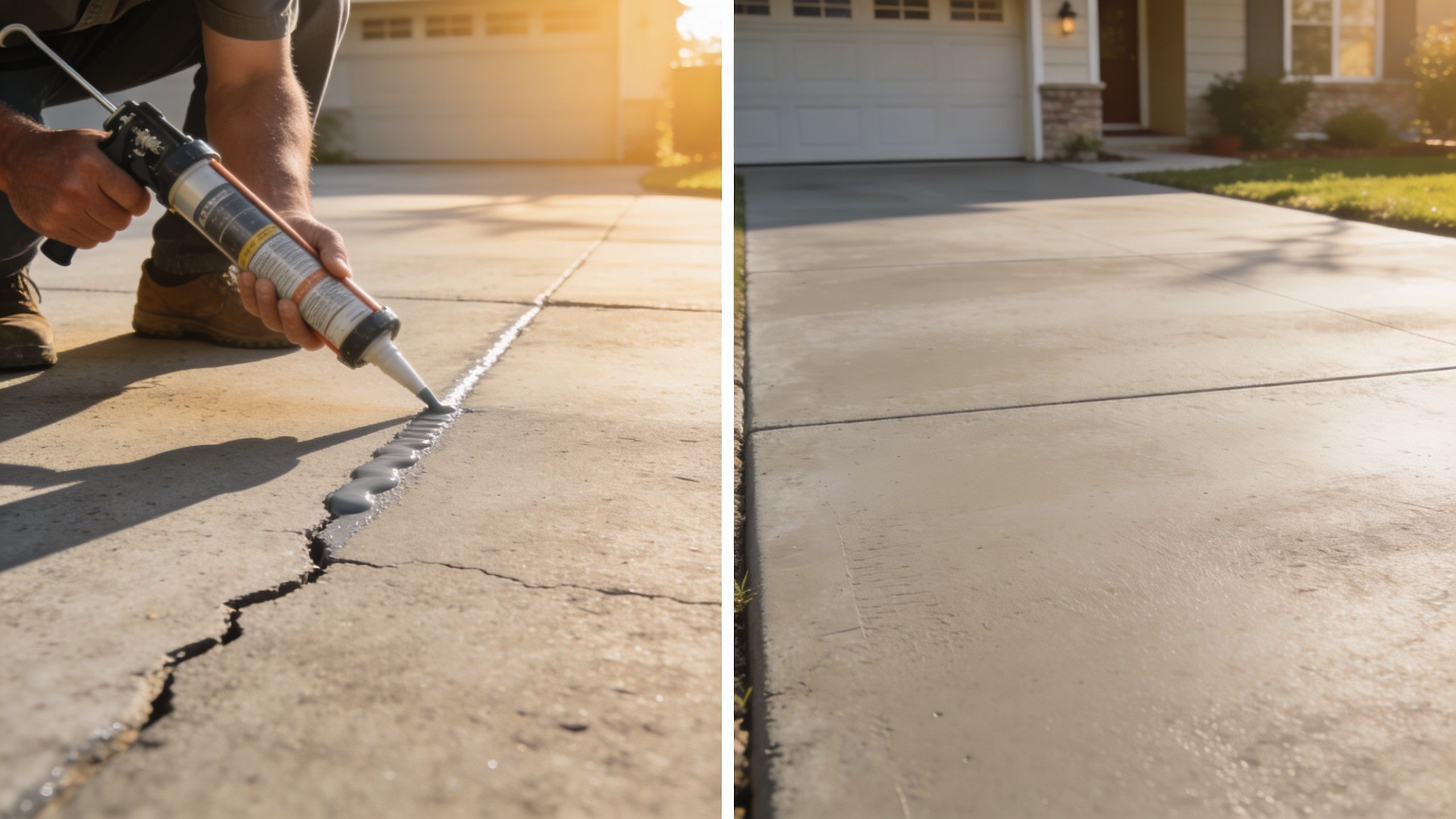
For extensively damaged slabs, replacement is usually the smarter long-term call once damage reaches 20 to 30 percent of the surface area, because minor fixes only buy time. The same guide reports that 60 percent of U.S. homeowners choose replacement over repair for heavily damaged slabs, and that replacement can return around 70 percent at resale according to A1 Concrete's driveway repair and replacement cost guide.
When repair still makes sense
Repairs can still be reasonable when the slab is mostly sound and the issue is limited. Examples include one isolated crack, minor surface wear, or a small area that hasn't started moving.
Repair is usually worth considering when:
- The damage is localized and the surrounding panels are stable.
- The slab is still draining properly and not pitching water toward the home.
- There isn't widespread settlement across multiple sections.
- The problem is cosmetic, not structural.
When replacement is the better decision
Once the slab shows repeated cracking, edge breakdown, multiple sunken sections, root heave, or broad surface deterioration, patching becomes expensive procrastination. It can make the driveway look slightly better for a while, but it won't reset the structural life of the slab.
Replacement is usually the practical answer when you see:
- Multiple broken panels
- Trip hazards from lifted or settled sections
- Crumbling edges
- Chronic drainage issues
- Recurring cracks after previous repairs
Repair works when the slab is still fundamentally sound. Replacement makes sense when the concrete and the base under it are both telling you the same story.
For homeowners trying to weigh longevity, this article on how long a concrete driveway lasts helps frame replacement as a long-term property decision, not just a short-term expense.
The Driveway Replacement Timeline From Demolition to Curing
Most homeowners want to know two things before work starts. How disruptive will this be, and when can I use my driveway again?
The answer depends on weather, access, and job complexity, but the sequence itself is usually consistent. Good contractors don't rush the important parts. They stage the work so the new slab has a proper base, clean finish, and enough curing time to hold up.
What happens first on site
The project starts with measurement, layout, and marking the work area. Crews identify edges, transitions, drainage direction, and any problem areas that need to be addressed before demolition begins.
After that, the old driveway is removed and hauled off. If the existing slab comes out cleanly and the base below it is solid, the project moves faster. If the crew finds soft spots, washed-out areas, or root damage, site prep takes longer because those issues have to be corrected before concrete goes back.
Prep and pour are the most important phases
This is the part homeowners don't always see as value, but it's where durable work begins. The sub-base is shaped and compacted, forms are set, and reinforcement is installed if the build calls for it.
Once the site is ready, the concrete is poured, spread, screeded, edged, jointed, and finished. For most residential work, a broom finish remains the most practical choice because it gives reliable traction and a clean appearance without adding decorative complexity.
A normal sequence often looks like this:
- Site visit and quote approval
- Demolition and debris removal
- Base correction, grading, and compaction
- Form setup and reinforcement
- Concrete placement and finishing
- Initial set and protected curing
- Return to service once the slab is ready
Curing is not the part to shortcut
Fresh concrete can look finished long before it's ready for traffic. That's where a lot of homeowner frustration starts. The slab may appear hard on top, but the curing process is still doing the essential strength-building work.
A driveway isn't ready because it looks dry. It's ready when the curing period has done its job.
That means planning for temporary parking, especially in neighborhoods around Hernando, Summerfield, and The Villages where street parking may be limited or regulated. A reliable contractor should explain access restrictions up front so you're not guessing once the pour is complete.
How to Get a Reliable Quote from a Local Concrete Expert
A homeowner in Ocala or Crystal River can get two quotes for the same driveway and see a big gap in price. Usually, the difference is not the concrete itself. It is what each contractor expects to find once the old slab is out, how much prep is included, and whether drainage or soft ground has already been accounted for.

In Marion and Citrus counties, a reliable quote starts with a site visit. The contractor should measure the driveway, check slope, look for low spots that hold water, and ask whether the area gets soft after heavy rain. Those local conditions matter. A driveway on stable ground in one part of Ocala is a different job from a replacement near the Gulf side where moisture and soil movement can create more prep work.
What should be included in the quote
The quote should tell you exactly what is included before you approve anything. If the price is just a square-foot number with no scope, there is too much room for change orders later.
Look for these items:
- Demolition and haul-off
- Base correction, grading, and compaction
- Concrete thickness
- Finish type
- Reinforcement, if included
- Tie-ins at the garage, sidewalk, or street connection
- Cleanup
- Permit handling, if needed
Riverside Sealing & Striping, LLC handles driveway removal and replacement in Central Florida and offers on-site estimates. That is the level of quote process homeowners should expect from any contractor they are seriously considering.
Red flags that deserve a closer look
Low bids are not always bad. Some crews run lean and work efficiently. But if a quote skips the hard parts of the job, the savings usually disappear once the project starts.
Be careful with quotes that:
- Do not describe site prep
- Leave out debris disposal
- Avoid drainage questions
- Offer a firm price without seeing the property
- Give no plan for soft spots or edge failure
- Do not explain what happens if the base is worse than expected
A good estimator should also be willing to explain allowances and unknowns in plain language. In Central Florida, that matters because one driveway may come out clean while the next one reveals washed-out edges, root intrusion, or weak subgrade near the apron.
This walkthrough gives a helpful visual of the consultation side of the process:
The best quote identifies the costly parts of the job before demolition starts, not after the old driveway is already broken out.
Frequently Asked Questions About Concrete Driveway Replacement
Is concrete worth the higher upfront cost compared to asphalt
For many homeowners, yes. Concrete usually costs more upfront, but it can make sense when you want a longer-lasting residential surface and cleaner curb appeal. The right answer depends on traffic, maintenance expectations, and whether you want a surface that's primarily built for home use rather than a pavement system that may need different upkeep over time.
Can I lower the cost without cutting quality
Yes, but the smart savings are selective. The simplest way is to stay with a plain broom finish instead of decorative upgrades and make sure the project scope matches how you use the driveway. What you shouldn't cut is base prep, removal quality, or proper finishing. Those are the parts that protect the slab.
Do I need a permit to replace a driveway in Marion County or Citrus County
Sometimes. Permit requirements can vary by municipality, neighborhood, and the exact scope of work. If the project affects the apron, drainage, sidewalk connection, or right-of-way, the review process may be different than a straight replacement on private property. Ask the contractor before scheduling work.
How long will a new driveway last in Florida
Lifespan depends on installation quality, drainage, traffic, and ongoing care. In Florida, sun, heavy rain, and shifting ground make proper site prep especially important. A well-installed concrete driveway generally holds up far better than one poured over weak base conditions.
What should I do before asking for estimates
Walk the driveway and note every problem area. Take photos after rain if water sits anywhere. Make a list of vehicle use, drainage concerns, and whether you want basic or decorative concrete. That gives the estimator better information and helps you compare proposals more clearly.
If your driveway in Ocala, Dunnellon, Belleview, Silver Springs, Summerfield, Crystal River, Homosassa, Inverness, Lecanto, Beverly Hills, Hernando, or The Villages is showing signs of failure, a professional site visit is the fastest way to get a real number and a realistic plan. Riverside Sealing & Striping, LLC offers free, no-pressure estimates for homeowners in Marion County, FL and Citrus County, FL who need honest guidance on concrete driveway replacement, along with help on related concrete work and asphalt maintenance needs.