Homeowners in Central Florida typically pay $1.45 to $1.71 per square foot for professional concrete driveway sealing, with total project costs averaging $700 to $1,900 for a two-car driveway based on local factors. If you're standing in your driveway in Ocala, Dunnellon, or Inverness wondering why one quote seems reasonable and another feels high, the answer usually comes down to prep work, sealer type, and how Florida weather punishes concrete.
A common story in Marion County, FL starts the same way. A homeowner notices the driveway color looking chalky, a few stains not washing out, and small surface wear where rainwater sits after a summer storm. In Citrus County, FL, the pattern is similar, especially in places like Crystal River, Homosassa, Lecanto, and Beverly Hills where moisture and sun exposure work together year-round.
Concrete looks tough because it is tough. But it's still porous. Water, oil, UV exposure, and daily traffic slowly wear down the surface. Sealing adds a protective layer or penetrating barrier that helps the slab resist staining, moisture intrusion, and surface breakdown. That matters in Central Florida, where heat, rain, humidity, and strong sunlight don't give driveways much of a break.
The part that confuses most homeowners is simple. Sealing itself isn't always the expensive part. The hidden costs usually show up before the first gallon goes down.
Table of Contents
- Introduction to concrete driveway sealing cost
- National and Central Florida price ranges
- Cost breakdown of materials labor and preparation
- Factors that affect sealing cost
- DIY versus professional pros and cons
- Sample cost estimate scenarios
- Timeline and maintenance schedule
- Conclusion and frequently asked questions
Introduction to concrete driveway sealing cost
In Belleview, a homeowner sees light surface fading and thinks, "It probably just needs a fresh coat." In Summerfield or Silver Springs, another homeowner gets a quote and wonders why the contractor is talking about cleaning, crack repair, and sealer chemistry instead of just spraying something on and leaving. That's where concrete driveway sealing cost starts to make more sense.
Sealing isn't paint. A proper job depends on how the slab was built, how much moisture it holds, how dirty or worn the surface is, and what kind of protection the owner wants. A newer driveway in The Villages might need only light prep and a standard sealer. An older driveway in Hernando or Dunnellon may need cleaning, spot repair, and a more durable product because the surface has already opened up.
Practical rule: If your driveway has fading, dark moisture spots, oil staining, or rough texture, the quote should include a discussion about prep, not just a price per square foot.
That's why two driveways that look similar from the street can price very differently once a contractor inspects them up close.
Homeowners also mix up concrete sealing and asphalt sealcoating. They aren't the same service. Concrete needs different products and often more careful surface prep. For a company serving both surfaces, that distinction matters. The right team should understand both sides of the work as Concrete and Asphalt Experts in Marion and Citrus County, not treat every driveway like the same material.
For property owners in Ocala, Inverness, Crystal River, and nearby communities, the smartest starting point is understanding what part of the bill reflects protection, what part reflects repairs, and what part reflects Florida itself.
National and Central Florida price ranges
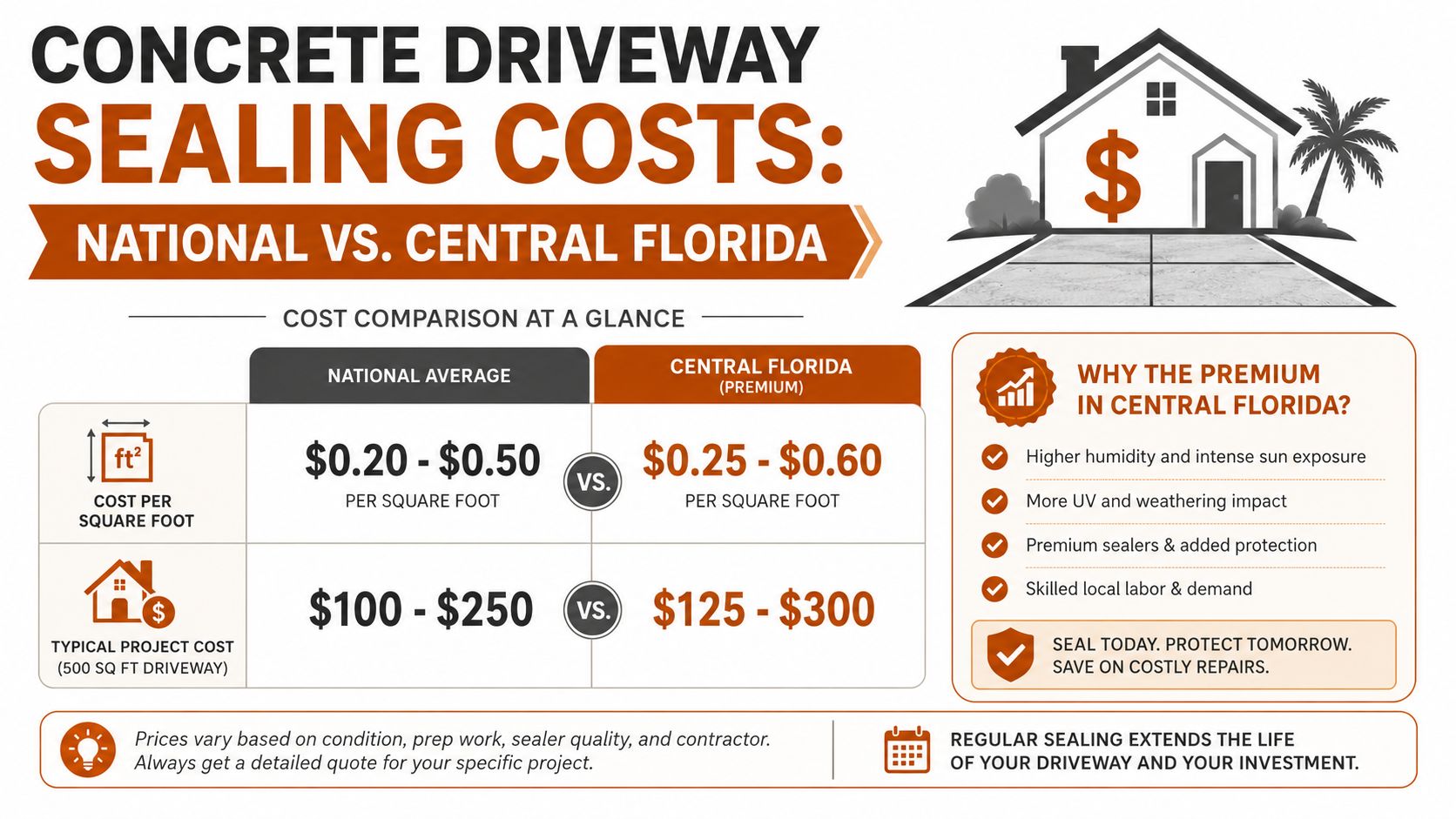
A national average is a good starting point, but it works more like a thermostat setting than the actual temperature on your porch. It gives you direction, not a final answer for a driveway in Ocala, Inverness, or Crystal River.
Nationally, professional concrete sealing often falls around $1 to $3 per square foot, while many standard two-car driveways land somewhere in the mid-hundreds to low thousands depending on size and condition, as noted earlier. For homeowners, that broad range is useful because it sets the guardrails. If a quote comes in far below it, the contractor may be skipping cleaning, crack attention, or the second coat that many Florida slabs need. If it comes in high, there should be a clear reason tied to the slab, the product, or the prep.
A simple way to read pricing is by separating baseline cost from Florida adjustment. Baseline cost starts with square footage. Florida adjustment comes from climate, scheduling, and surface condition. In Central Florida, those adjustments show up more often than national guides admit.
Why Central Florida often prices differently
Central Florida quotes often sit above the national midpoint for reasons that are easy to miss from a generic online calculator. Humidity is one of the big ones. A sealer needs the surface to be dry enough to bond well. In summer, a driveway can look ready in the morning and still hold moisture in the pores, especially after overnight rain or heavy dew. That slows production, increases the chance of return visits, and can push labor cost higher.
Sun exposure matters too. A driveway in Marion County that gets full afternoon sun may need a product with better UV resistance than a shaded slab in another region. Analysts at Homewyse's polyurethane concrete sealer cost page show that polyurethane systems can run higher than basic sealing options, which helps explain why premium Florida quotes climb fast when a contractor recommends a tougher finish.
Local labor is another overlooked factor. Central Florida is not one flat market. Rates can shift between busier growth areas and smaller towns, especially during rainy months when contractors have fewer clean application windows and tighter scheduling. That means two homes with similar driveways can still get different quotes because one crew has to build in more weather risk and travel time.
A few Central Florida conditions regularly nudge prices up:
- High humidity and pop-up storms: crews may need a narrower application window or an extra trip
- Organic staining: shaded driveways often collect mildew, algae, and leaf tannin that require more prep
- Old sealer failure: peeling or patchy previous coatings can add stripping or aggressive cleaning
- Heat and UV exposure: hotter slabs may call for a better sealer, not just a cheaper acrylic
- Local labor variability: pricing in active service areas can differ from quieter rural routes
That is why a national chart helps, but only to a point.
Homeowners comparing maintenance against replacement often want a quick sanity check. If sealing costs are creeping close to the value of a worn-out slab, it helps to compare them with new concrete installation costs in Florida before deciding whether to preserve the existing driveway or start over.
A fair Central Florida quote should reflect the slab in front of the contractor, the local weather window, and the product needed to hold up in that climate.
Cost breakdown of materials labor and preparation
A sealing quote gets easier to read once you separate it into three parts: the product that goes on the concrete, the crew time needed to apply it, and the work required before any sealer can touch the slab.
For standard concrete surfaces in Florida, a common breakdown is labor at $0.75 to $1.25 per square foot, materials at $0.50 to $1.00 per square foot, and cleaning or preparation at $0.25 to $0.75 per square foot, for a typical total of $1.50 to $3.00 per square foot, according to Daytona Beach Concrete Contractors' Florida sealing cost guide.
That sounds simple on paper. On an actual driveway in Central Florida, those buckets shift around more than homeowners expect.
Materials change the price fast
Material cost starts with the type of sealer, but coverage matters just as much. A cheaper product that soaks in unevenly or needs extra coats can erase its apparent savings.
Concrete sealers commonly cost $30 to $80 per gallon, and some penetrating sealers run about $0.30 to $0.50 per square foot, according to Builds and Buys' sealing cost guide. As noted earlier, concrete often costs more to seal than asphalt because the surface may need a penetrating sealer for pore protection or a film-forming product for appearance and stain resistance.
In Central Florida, product choice is rarely just about gloss. A driveway in Ocala or The Villages may stay damp longer after a humid morning, especially if it sits under shade or near irrigation overspray. That can push a contractor toward a sealer with better moisture tolerance or a different cure profile. The bucket price is only part of the material cost. The local conditions help decide which bucket belongs on the slab.
Labor is where experience shows up
Labor covers far more than rolling on sealer. It includes staging the job, protecting edges, cleaning joints, working around garage doors and sidewalks, and applying the product at the right spread rate so it bonds instead of sitting on the surface.
As noted earlier, professional labor often falls in the range of about $0.70 to $1.25 per square foot. The higher end usually reflects more hands-on work, not just a higher markup.
A clean, newer driveway in a sunny subdivision is usually straightforward. An older slab in Beverly Hills or Lecanto with tire marks, mildew, rust stains, and a rough surface takes longer. Crews may need to scrub oil spots, treat organic growth, or revisit areas where the concrete absorbed cleaner unevenly. In humid weather, they may also have to wait longer between prep and application so trapped moisture does not interfere with the finish.
That extra time is labor cost. It is also insurance against a callback.
A sealer job often fails before the sealer is applied. It fails during rushed cleaning, incomplete drying, or missed surface defects.
Concrete Sealing Cost Components
| Component | Cost per sq ft |
|---|---|
| Labor | $0.75–$1.25 |
| Materials | $0.50–$1.00 |
| Cleaning and preparation | $0.25–$0.75 |
Preparation is the part homeowners overlook
Preparation works like paint prep on a house. The final coat gets the attention, but the surface underneath decides how long that coat lasts.
Older driveways often need more than a quick rinse. Cleaning may include pressure washing, degreasing, mildew treatment, removal of loose debris from expansion joints, and spot attention where old sealer has turned patchy or started to peel. In Central Florida, this step can expand in scope because humidity slows drying and shaded slabs collect more algae and tannin staining than many national cost guides account for.
That is why two quotes for similar square footage can be far apart. One may include real preparation. The other may assume the slab is ready when it is not.
A homeowner comparing estimates should ask a simple question: what prep is included before sealing starts? That answer often explains the price difference faster than the square-foot rate does.
Factors that affect sealing cost
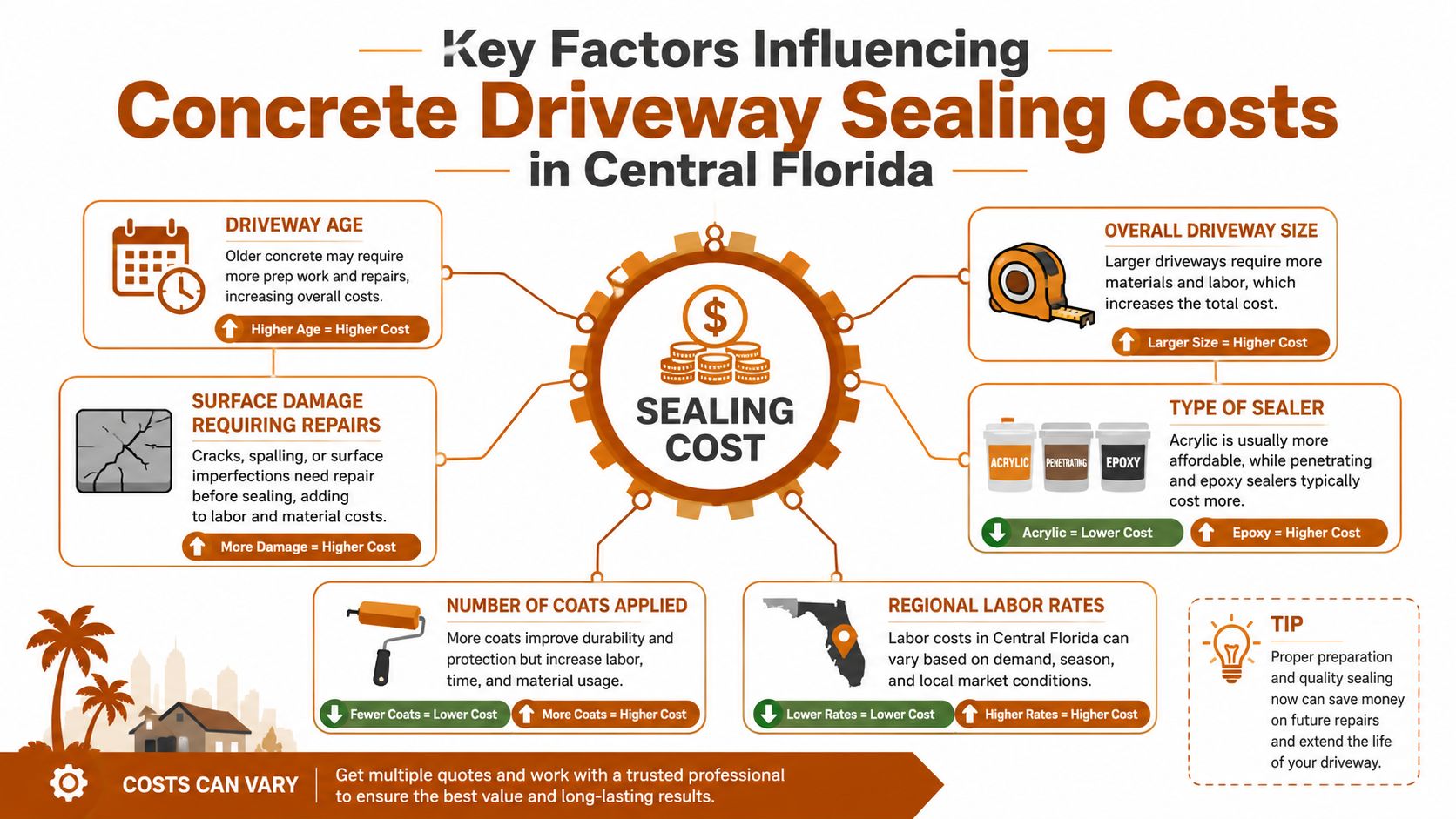
A contractor can price two driveways with the same square footage very differently. That usually comes down to what the slab needs, how Central Florida weather affects the job, and which sealer makes sense for that specific driveway.
The driveway itself
Condition sets the pace. A newer driveway with a tight surface and light wear is usually straightforward. An older slab with cracks, pitting, rust stains, tire marks, or flaking areas takes more labor before anyone opens a sealer bucket.
That is where homeowners often get surprised. Sealing sounds like a simple topcoat, but concrete works more like a sponge than a sheet of glass. If the surface is dirty, soft, or uneven, the sealer does not hide those problems. It locks them in or fails over them.
Angi notes that cleaning and repair add-ons can add a meaningful amount to the project cost before sealing starts, especially when the slab needs more than routine washing and minor prep in its concrete sealing cost guide.
A good estimate should separate sealing from repair-related work. If you want a practical checklist for vetting bids, these questions to ask a concrete contractor before hiring help you spot whether a quote includes real surface evaluation or just a low number on paper.
The Central Florida setting
Central Florida adds cost in ways national guides often miss.
Humidity is the big one. In Ocala, Dunnellon, Inverness, or The Villages, the slab may look dry on top while still holding moisture below the surface. That matters because many sealers need a dry, stable surface to bond well. If a contractor has to wait for the slab to dry out after afternoon rain or heavy overnight humidity, that affects scheduling and labor efficiency.
Tree cover changes pricing too. A shaded driveway in Silver Springs may collect algae, leaf tannin staining, and mildew faster than a driveway in full sun. A wide-open driveway in Belleview may have less biological growth but more UV wear and surface chalking. Same concrete. Different prep path.
Near the Gulf side of Citrus County, salt air can also influence product choice. It does not turn every driveway into a coastal failure case, but it can push a contractor toward a sealer with better water resistance and longer-term surface protection.
Product choice and local labor
Sealer type changes both material cost and application time. A simple penetrating sealer is often the least complicated option for a sound driveway that mainly needs water resistance. Film-forming products can change appearance more and may require more careful application to avoid lap marks, uneven sheen, or peeling later if the slab was not prepped well.
Local labor availability also moves pricing more than many homeowners expect. In busy seasons, some contractors in Marion and Citrus counties build weather delays, travel time, or smaller-job minimums into the quote. That does not always mean the price is inflated. It can mean the crew is accounting for Florida's stop-and-start weather and the time required to do the work under good conditions.
The simplest way to read a quote is to ask what problem the sealer is solving. Water absorption? Fading? Light staining? A tired-looking surface? Once that is clear, the price makes more sense because you are comparing the right product and prep level for your driveway, not just the lowest number.
DIY versus professional pros and cons
A homeowner in Ocala buys a few gallons of sealer on Saturday, planning to finish the driveway before dinner. By noon, the slab still feels damp from the morning air, a few oil spots are showing through the wash, and the forecast now calls for a late thunderstorm. That is the fork in the road with driveway sealing in Central Florida. The liquid is only one part of the job. Timing, surface condition, and local weather control a lot of the result.
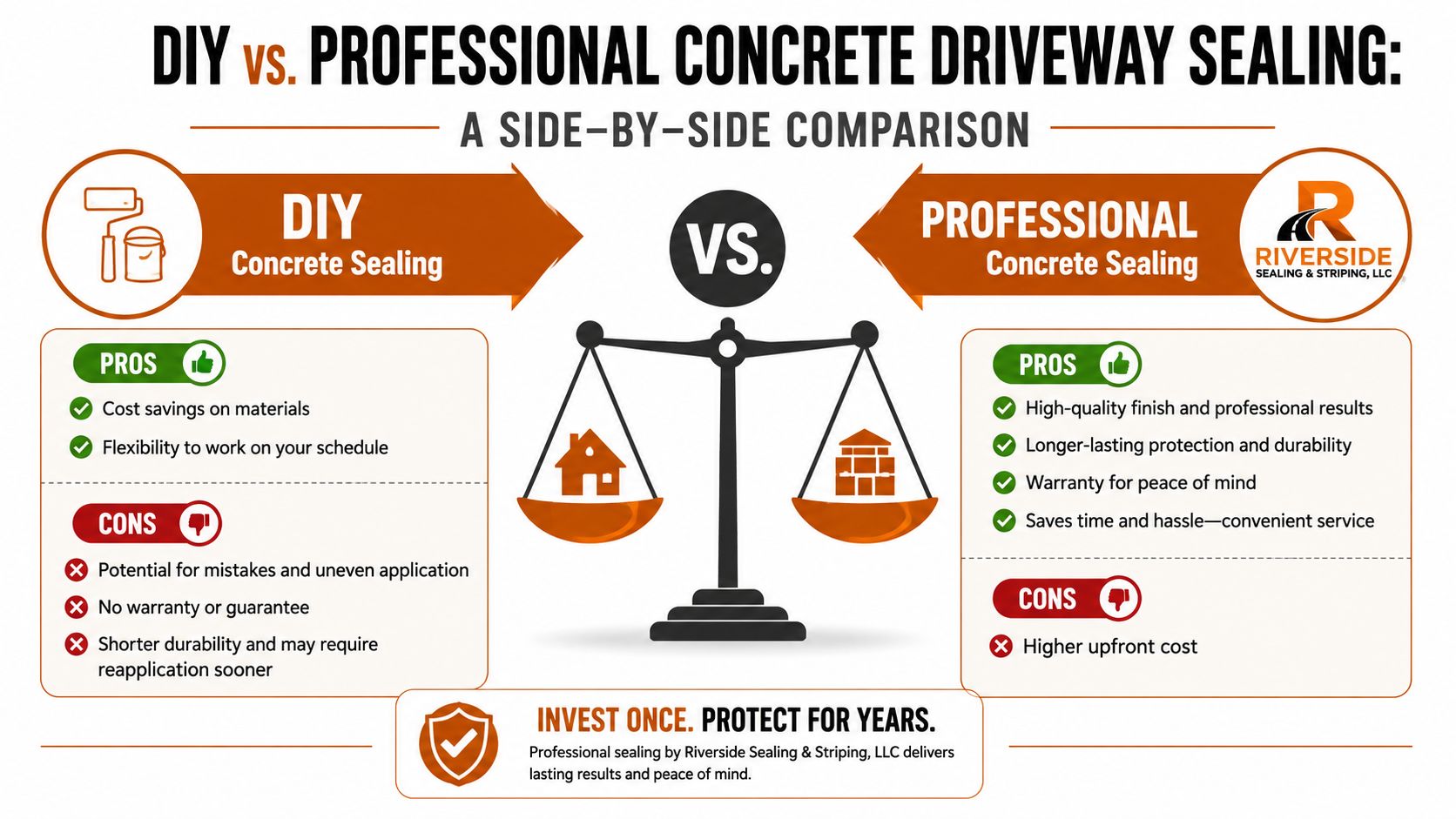
The DIY appeal is easy to understand. Material cost is usually lower, and for a small, simple slab, that can be enough reason to handle it yourself. A short front walk or a clean patio pad is more forgiving than a full driveway that sees hot tires, sprinkler overspray, mildew, and daily traffic.
When DIY can make sense
DIY works best when the concrete is in good shape and the goal is modest. You are not trying to rescue a worn-out surface. You are protecting a sound one.
A manageable DIY project usually has a few traits in common:
- Small square footage: Less area makes it easier to keep a wet edge and avoid uneven coverage.
- Minimal staining: Light dirt is one thing. Oil, rust, and organic growth are another.
- No failing old coating: If the previous sealer is peeling or patchy, prep gets harder fast.
- A stable weather window: In Central Florida, that means more than checking for rain. High humidity can slow drying and make application timing trickier than homeowners expect.
The main advantage is control over your upfront spending. You can buy the sealer, roller covers, sprayer, cleaner, and masking supplies yourself and work at your own pace.
The tradeoff is prep. Sealing concrete is a lot like painting over a dusty wall. The coating may go on, but it will only hold as well as the surface underneath. Many DIY problems start before the sealer bucket is even opened. The slab may still have moisture in the pores, leftover cleaner residue, tire oils near the garage, or mildew in shaded edges that keeps the sealer from bonding evenly.
A good contractor interview helps you compare that prep process, not just the final price. These questions to ask a concrete contractor are a useful checklist for understanding who handles cleaning, stain treatment, repairs, and weather delays.
When professional work usually pays off
Professional sealing makes more sense on full driveways, older slabs, decorative concrete, or any surface with mixed wear patterns. That is common in places like Summerfield, Crystal River, and Homosassa, where one section of the driveway may stay shaded and damp while another bakes in direct sun.
That uneven exposure creates hidden cost and performance issues that many general guides skip over. A contractor is not just charging to spread sealer. The crew is pricing the time it takes to clean consistently, test problem areas, protect nearby surfaces, and apply the product under conditions that give it a fair chance to cure well.
Professional work usually offers clear advantages:
- Stronger preparation: Crews can degrease, pressure wash, spot-treat mildew, and address small surface defects before sealing.
- Better product matching: Some driveways need a penetrating sealer for protection with little appearance change. Others need a film-forming product, and that takes more careful application.
- Fewer application mistakes: Lap marks, cloudy areas, and uneven sheen are common on large DIY driveways.
- More realistic scheduling: Local crews know how quickly afternoon storms, humid mornings, and slow drying conditions can disrupt a job in Marion and Citrus County.
Labor also varies more than homeowners expect. One company may price a driveway higher because the slab needs two visits, extra drying time after cleaning, or a smaller-job minimum to cover travel and setup. In Central Florida, weather delays and crew availability are real cost factors, not just sales language.
Here's a useful visual walkthrough before you decide which route fits your project.
Professional sealing often costs more upfront because you're paying for prep discipline, not just for liquid in a bucket.
For homeowners and property managers looking for Concrete and Asphalt Experts in Marion and Citrus County, that difference matters even more. Teams that work on both concrete and asphalt know the surfaces behave differently and should not be priced or treated the same way.
Sample cost estimate scenarios
A homeowner in Ocala might get one quote for a quick clean-and-seal job, then a much higher quote for a driveway that looks about the same size on paper. The difference usually comes from the slab condition, the sealer system, and a few Central Florida issues that do not show up in a simple price-per-square-foot rule.
Small slab with basic sealing
A small 100-square-foot slab often lands at the lower end of the budget because the material use is modest, but small jobs can still carry a minimum service charge. That is common for a front entry slab, a short walk, or a side pad in places like Beverly Hills or Hernando.
If the concrete is newer, dry, and free of old coating residue, the price usually stays fairly controlled. If the crew has to remove mildew shading, treat rust marks, or wait for moisture trapped by humid weather to clear out, the total can rise fast. In Central Florida, that drying issue catches homeowners off guard because the slab can look ready while still holding enough moisture to affect how the sealer bonds.
Typical two car driveway with upgraded protection
A standard two-car driveway is where estimates start to spread out. One contractor may quote a basic penetrating sealer with light prep, while another prices in heavier cleaning, joint touch-up, stain treatment, and a second coat for a more even finish.
That range is common in Ocala, Belleview, Inverness, and Lecanto, where many driveways have a mix of sun exposure, sprinkler overspray, algae at the shaded edges, and tire-wear near the garage. Those details matter because sealing works a lot like painting a wall. The visible top coat gets attention, but the final result depends on how clean, dry, and stable the surface is underneath.
Homeowners comparing bids should also pay attention to what the estimate is really buying. A lower quote may cover only wash-and-apply work. A higher quote may include prep steps that help the slab last longer, especially if you are already thinking about how long a concrete driveway lasts in Florida conditions.
Large driveway with premium system
Large driveways and decorative finishes move into a different category. At that point, you may not be pricing a basic sealer anymore. You may be pricing a coating system with stronger build, more surface correction, and more labor control during application.
For custom homes in Marion County or larger layouts in The Villages, costs can climb when the owner wants color enhancement, higher gloss, crack repair, grinding, or multiple layers with tighter cure timing. Local humidity plays a bigger role here than many online guides mention. A premium coating can be less forgiving than a simple penetrating sealer, so crews may need a narrower weather window and more time on site to get a clean result without haze or uneven sheen.
Labor availability also changes these bigger estimates. A contractor may need to block out more crew time, make a second visit, or build in weather delay risk during the summer rainy season. That is one reason two large driveways with similar square footage can end up with very different numbers.
The best estimate matches the slab in front of your house, not just the square footage on a measuring tape.
Timeline and maintenance schedule
Driveway sealing moves faster than replacement, but it still depends on prep, weather, and cure time. Homeowners often think of the job as a one-visit spray application. In reality, the schedule usually starts with surface cleaning, then drying time, then sealer application, and then a period where the driveway needs to stay clear.
What the job timeline usually looks like
For a straightforward project in Marion County or Citrus County, the sequence often follows this pattern:
- Inspection and surface review: The contractor checks staining, cracks, surface wear, and whether old sealer is still present.
- Cleaning and prep: Pressure washing, degreasing, spot treatment, and minor repairs happen first.
- Drying window: The slab has to be ready for product application. That part depends heavily on local humidity and recent rain.
- Sealer application: The product is applied once the surface condition is right.
- Cure and return to service: Foot traffic often returns before vehicle traffic, but the exact timing depends on weather and product choice.
In Central Florida, summer rain can disrupt the plan even when the forecast looks decent in the morning. That's one reason reliable scheduling matters.
A practical maintenance rhythm for Central Florida
A sealed driveway lasts longer when the owner treats it like a maintained surface instead of a one-time project. Homeowners in Dunnellon, Silver Springs, Crystal River, and Summerfield can keep things simple with a steady routine:
- Inspect before the rainy season: Look for worn spots, moisture-darkened areas, or new stains.
- Clean spills early: Oil, fertilizer, and automotive fluids are easier to manage when they don't sit.
- Watch turning areas: Tire pivot points near garages tend to show wear earlier.
- Address cracks promptly: Small surface issues are easier to manage before water gets deeper into the slab.
If you're also weighing the long-term condition of the driveway itself, this guide on how long a concrete driveway lasts gives useful context on when maintenance still makes sense and when replacement becomes the better investment.
For local owners, a simple habit works well. Check the driveway after peak summer weather and again after cooler-season use. That timing catches most visible wear before it grows into a bigger surface problem.
Conclusion and frequently asked questions
Concrete driveway sealing cost in Central Florida isn't just about square footage. It's shaped by the slab's condition, the product selected, and how much prep the surface needs before sealing starts. That's why homeowners in Marion County, FL and Citrus County, FL can see very different quotes for driveways that seem similar at first glance.
The useful baseline is this: Central Florida homeowners commonly see professional pricing around $1.45 to $1.71 per square foot for upgraded local conditions, while many standard Florida projects fall within broader statewide professional ranges already discussed earlier. If a quote feels high, look first at prep, repairs, and sealer chemistry. Those are usually the primary factors.
For homeowners in Ocala, Dunnellon, Belleview, Summerfield, Crystal River, Homosassa, Inverness, Lecanto, Beverly Hills, Hernando, Silver Springs, and The Villages, the best results come from hiring a licensed and insured contractor who explains the surface condition clearly, outlines what prep is included, and schedules the job around Florida weather instead of fighting it.
Frequently asked questions
How does weather affect cure time for driveway sealer in Central Florida?
Humidity, rain risk, and strong heat can all slow or complicate curing. Contractors usually watch the forecast closely because applying sealer on a slab that's still holding moisture can lead to poor bonding or uneven finish.
Is sealing worth it on an older concrete driveway?
It can be, if the slab is still structurally sound. Older concrete often needs more prep first, and that's where many quotes rise. If the surface is badly deteriorated, replacement may make more sense than sealing.
Can sealed concrete improve curb appeal?
Yes. A freshly sealed driveway usually looks cleaner, more uniform, and better maintained. That visual improvement matters for homeowners and for commercial properties trying to keep entrances looking professional.
What about sidewalks and ADA areas?
Walkways and access routes need careful product selection so the finish stays appropriate for safe foot traffic. That matters for homes, HOAs, churches, schools, and commercial properties where appearance and usability both count.
For property owners who want practical guidance from Concrete and Asphalt Experts in Marion and Citrus County, a site visit is usually the quickest way to sort out whether the slab needs basic maintenance, heavier prep, or a more substantial repair plan.
If you need a no-pressure opinion on your driveway, patio, sidewalk, or parking area, Riverside Sealing & Striping, LLC offers free estimates and consultations across Marion County, FL, Citrus County, FL, and surrounding Central Florida communities. As a licensed and insured local contractor with experience in both concrete work and asphalt maintenance, the team can help you compare sealing, repair, and replacement options without pushing you into work you don't need.