
In Florida, a professionally installed concrete project typically costs between $6 and $12 per square foot. For homeowners in Central Florida, that's the right starting range, but the final number depends on details most online calculators miss, including delivery minimums, demolition, site prep, access, and the concrete mix itself.
If you're pricing a new patio in Summerfield, replacing a cracked driveway in Ocala, or planning a sidewalk in Inverness, the biggest mistake is looking at the concrete itself as if that's the whole job. It isn't. The ready-mix is only one part of the bill, and on many jobs it's not even the part that surprises people most.
That matters in Marion County, FL and Citrus County, FL, where heat, heavy rain, sandy soils, and long travel routes between batch plants and job sites can change what a project really costs. Homeowners in Dunnellon, Belleview, Silver Springs, Crystal River, Homosassa, Lecanto, Beverly Hills, Hernando, and The Villages all deal with the same basic issue. Two concrete jobs can look similar from the street and still price very differently once the crew sees the property.
A good budget starts with the right assumptions. Solid site prep, the right mix design, and clear access usually save money later. If you're still at the planning stage, this guide on how to prepare ground for a concrete slab is worth reviewing before you start comparing quotes.
Table of Contents
- Planning Your Project and Understanding the Numbers
- Breaking Down the Price Tag Material Labor and Prep
- The 6 Key Factors That Determine Your Final Concrete Cost
- Size affects price, but not in a straight line
- Mix design changes cost and performance
- Demolition is a separate job, and it should be priced that way
- Site conditions decide how much prep the slab really needs
- Reinforcement and finish both move the number
- Access, equipment, and scheduling can raise the total
- Example Project Costs in Marion and Citrus County
- Concrete vs Asphalt in Central Florida A Long-Term Cost Analysis
- Get a Clear Honest Estimate for Your Central Florida Project
- Questions worth asking before you sign
- FAQ
- How much does concrete cost per square foot in Florida
- Why do small concrete jobs seem expensive
- Is replacing a driveway more expensive than installing a new one
- Is concrete or asphalt better in Central Florida
- When should I hire a professional instead of trying to price it myself
Planning Your Project and Understanding the Numbers
Your old driveway is breaking apart, water sits where the new patio should go, or a front walk has turned into a trip hazard. That is usually the point where rough online averages stop helping and real job costs start mattering.
In Central Florida, the number that catches homeowners off guard is rarely the concrete itself. It is the work around it. A basic new pour costs one thing. A replacement costs more because somebody has to saw-cut the old slab, break it out, load it, haul it off, and pay to dump it. Small jobs can also get hit with short-load fees from the ready-mix plant, which is one of the most common reasons a simple pad ends up costing more per square foot than a larger driveway.
Florida adds its own pressure to the budget. Summer rain can wreck a schedule. Soft or poorly drained soil may need more base work. Heat changes how fast crews have to place and finish the mix. In areas with drainage problems, the slab may also need extra grading so water moves away from the house instead of toward it.
Practical rule: A cheap quote is often a partial quote. Check whether it includes tear-out, haul-off, grading, reinforcement, form work, and cleanup before you compare totals.
A realistic budget in Marion County or Citrus County starts with the full scope, not just square footage. Before the truck ever arrives, the site has to be laid out, excavated to the right depth, and compacted properly. Homeowners who want to see what that stage involves can review the basic steps for preparing the ground for a concrete slab.
Here are the costs that are often missed early:
- Demolition and disposal: Replacement work includes tear-out, haul-off, dump fees, and more labor.
- Short-load charges: Small pours often carry added delivery fees that online calculators ignore.
- Site prep: Grading, excavation, fill, and compaction depend on what the soil and drainage look like.
- Access limits: Fences, narrow gates, long wheelbarrow runs, and pump needs raise labor and equipment costs.
- Florida weather planning: Rain delays, hot-weather placement, and drainage corrections affect both schedule and price.
- Thickness and edge detail: Driveways, aprons, and areas carrying vehicles may need stronger support than a simple walkway.
Two estimates can describe the same project in a few words and still be priced very differently. In my experience, that gap usually comes from what is included on paper and what gets left for a change order later.
A good estimate should read clearly enough that you can see the actual job, not just the final number.
Breaking Down the Price Tag Material Labor and Prep
A homeowner in Ocala sees a low per-yard number online, then gets an estimate that is thousands higher. Usually, the difference is not markup. It is everything required to turn wet concrete into a slab that holds up in Florida heat, rain, and soft spots in the subgrade.
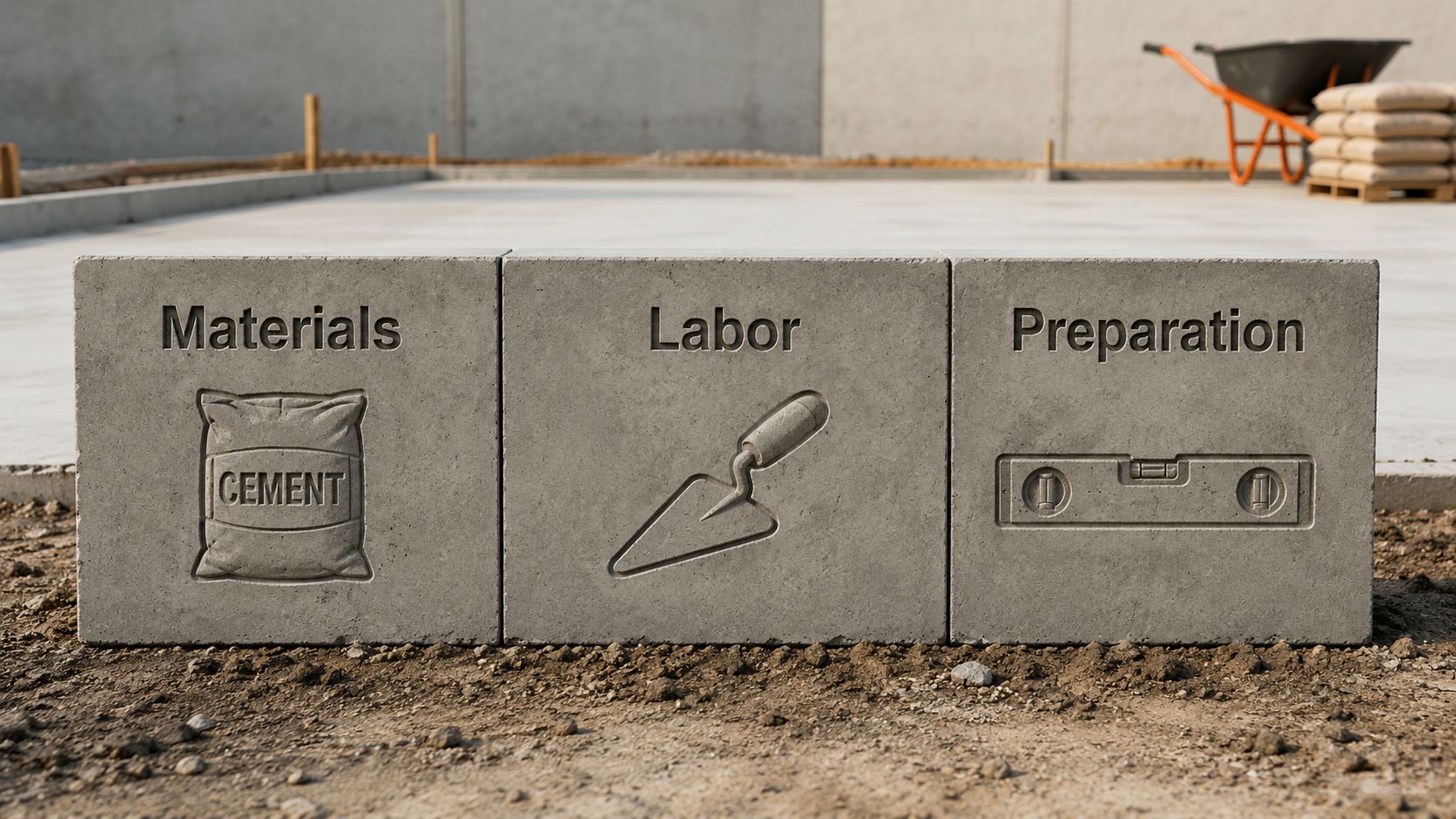
Material is only one part of the bill. The full installed price also includes forming, grade work, base prep, reinforcement, placement, finishing, joints, cleanup, and sometimes removal of old concrete before the new pour can even start. On replacement jobs in Central Florida, tear-out and haul-off can change the budget more than the new concrete itself.
Material cost is only the first line item
Ready-mix pricing matters because it sets the starting point, but it does not tell a homeowner what the finished project will cost. The final number changes with the mix design, how much concrete the job needs, how far the plant is from the site, and whether the order is large enough to avoid extra delivery charges.
Florida conditions can affect the mix choice too. A driveway, apron, or slab that sees vehicle traffic may need a stronger mix or added reinforcement than a basic walkway. For a practical breakdown of what holds up best under traffic and weather, see this guide to the best concrete mix for driveways.
Small jobs are where people get tripped up. A short sidewalk or patio may use less concrete, but the truck still has to roll, the crew still has to show up, and the forms still have to be built. That is where short-load fees and minimum charges start to matter.
Labor and prep are where estimates separate
Labor changes fast from one job to the next. A plain broom-finish patio on open ground is straightforward. A replacement driveway behind a fence, with demolition, root removal, base correction, and a long wheelbarrow run, is not.
Here is where the money usually goes:
| Cost area | What it covers | Why it changes price |
|---|---|---|
| Material | Ready-mix concrete, delivery, mix upgrades | Order size, PSI, fiber or reinforcement needs, plant distance |
| Labor | Layout, forming, pouring, finishing, saw cuts, cleanup | Crew size, access, finish detail, weather timing |
| Prep | Excavation, grading, compaction, base stone, removal | Soil condition, drainage issues, existing concrete, disposal fees |
The prep line is where generic calculators fall short. In Homosassa, Crystal River, and other low-lying areas, wet ground can mean more base work and more time getting the subgrade stable. In older Ocala and Belleview neighborhoods, replacing an existing slab often includes broken edges, buried debris, or tied-in sections that need careful removal. Those are real costs, and they should be on the estimate up front.
Good concrete work starts below the surface. A slab can look fine on pour day and still fail early if the base is soft, water is trapped under it, or the thickness changes because the grade was never corrected. That is why the cheapest estimate on paper is often the most expensive one to live with later.
The 6 Key Factors That Determine Your Final Concrete Cost
A homeowner sees a 300 square foot patio and expects a simple number. Then the quote shows delivery charges, base repair, haul-off, reinforcement, and sometimes a pump. That gap between the slab you picture and the job it takes to build it is where concrete budgets usually go sideways in Central Florida.
Size affects price, but not in a straight line
Bigger slabs use more concrete. Small slabs often cost more per square foot.
The reason is simple. The truck still has to roll. The crew still has to form, pour, finish, and clean up. On smaller pours, fixed costs take up a bigger share of the job. That is why a small patio or walkway can look expensive on paper even though the total yardage is low.
Short-load fees are one of the most common surprises. Ready-mix plants charge extra when the order does not fill enough of the truck, and that fee can change the economics of a small project fast. It is a real charge, not a contractor trick.
Mix design changes cost and performance
Concrete is not one product. The mix should match the job.
A basic patio and a driveway carrying pickups do not always need the same mix design. In Florida, water exposure, heat, and long wet periods also affect what makes sense. A cheaper mix can save money up front and cost more later if the slab scales, cracks early, or does not hold up to the use it gets.
That is why a good estimate should spell out the intended strength, thickness, and any mix upgrades such as fiber. Homeowners deserve to know whether they are pricing a durable slab or just a low number.
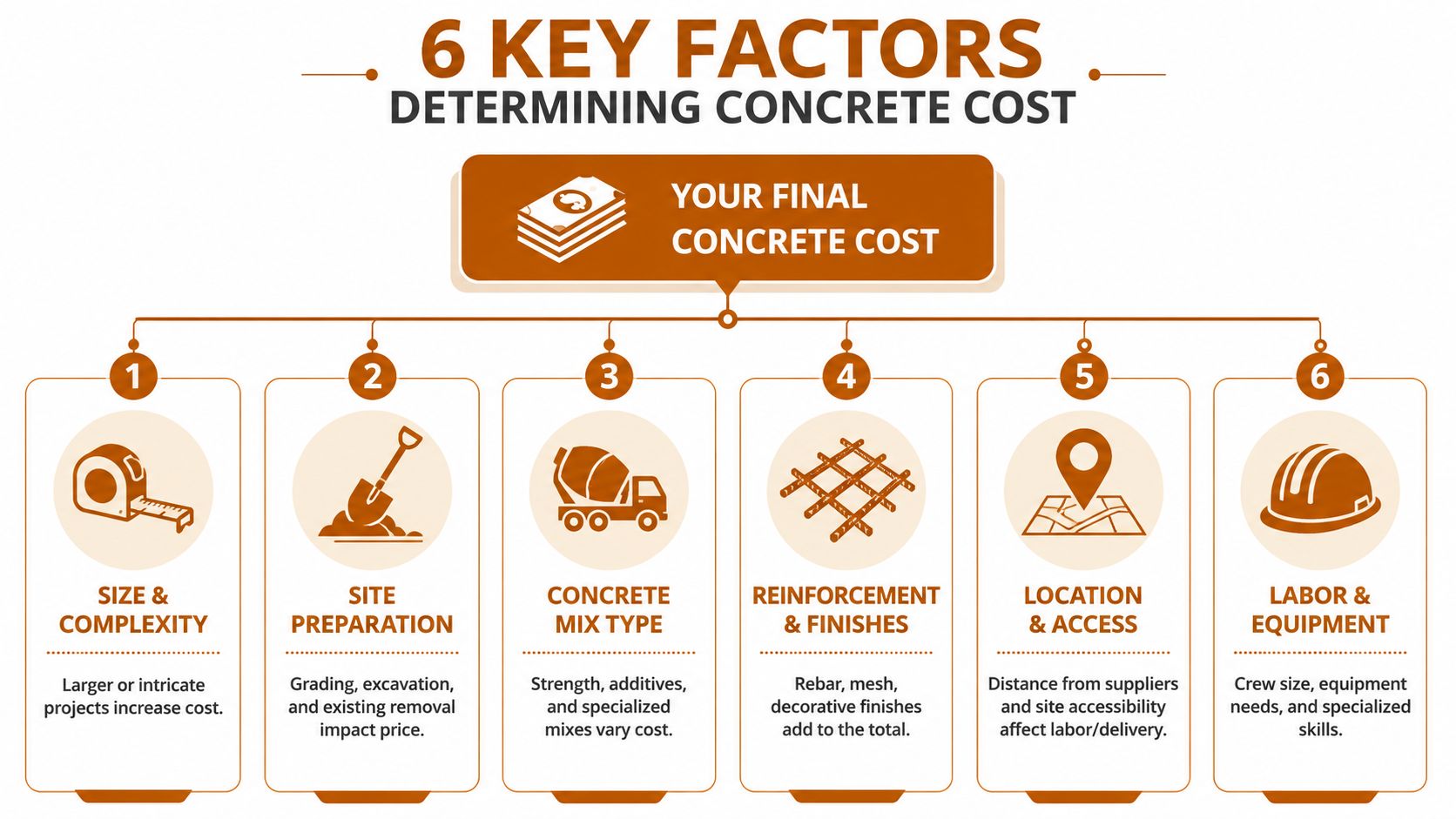
A quick visual helps show how these variables stack together.
Demolition is a separate job, and it should be priced that way
Replacement work costs more because it includes more work.
Old concrete has to be broken, loaded, hauled off, and dumped. Sometimes the base underneath is still solid. Sometimes it is washed out, full of roots, or soft from years of drainage problems. I have seen plenty of driveways that looked like a simple tear-out until the slab came up and exposed the actual problem underneath.
That is one reason online calculators miss the mark. They price a new pour. They do not price the removal, disposal, or subgrade correction that often comes with an older driveway in Ocala, Belleview, Crystal River, or Inverness.
Site conditions decide how much prep the slab really needs
Two jobs with the same square footage can have very different prep costs.
Flat, dry, open ground is cheaper to build on. Soft soil, poor runoff, buried debris, tree roots, or a low area that holds water takes more labor and more base material to correct. In parts of Citrus County, wet conditions can force extra grading and compaction just to get a stable pad. In older Marion County neighborhoods, settled edges and hidden patchwork are common on replacement jobs.
The slab only performs as well as the support under it. Saving money on prep is one of the fastest ways to buy cracks and settlement later.
Reinforcement and finish both move the number
A plain broom finish is usually the most economical option. Decorative edges, color, stamping, exposed aggregate, or tighter finish tolerances add labor and timing pressure.
Reinforcement matters too. Some slabs need wire mesh, some call for rebar, and some benefit from fiber in the mix depending on use, span, and crack-control goals. Those choices are not cosmetic. They affect labor, material, and long-term durability.
Here, honest trade-offs matter. A homeowner may decide a standard finish is the better place to save, while keeping the base and reinforcement right. That is usually smarter than cutting the structural parts nobody sees.
Access, equipment, and scheduling can raise the total
Access is a cost factor many homeowners do not think about until they see the estimate.
An open driveway is straightforward. A backyard slab behind a fence, around a pool cage, or far from the street may require wheelbarrow runs, smaller equipment, extra crew time, or a concrete pump. Weather can affect scheduling too. In Florida, crews sometimes have to pour around afternoon rain patterns or protect the finish during hot, fast-setting conditions. That takes planning, and sometimes it takes more labor on pour day.
Here are the six factors that shape the final number:
Project size
Small jobs often carry higher per-square-foot costs because of delivery minimums, setup time, and short-load charges.Demolition and removal
Replacement work can include tear-out, haul-off, dump fees, and repair of the base under the old slab.Site preparation
Grading, excavation, drainage correction, root removal, and compaction all affect what the slab needs before concrete arrives.Mix design and slab specification
Strength, thickness, fiber, and exposure conditions change both material cost and long-term performance.Reinforcement and finish
Rebar, mesh, decorative work, and finish level all add labor and material.Access, equipment, and timing
Distance from the truck, tight access, pumps, weather planning, and crew demands can all change the quote.
A low bid usually means something was left out, glossed over, or assumed to be easy. The best estimate is the one that shows these costs clearly before the truck is on the way.
Example Project Costs in Marion and Citrus County
A homeowner in Ocala might budget one number for a new driveway, then find out the price changes once the crew sees an old cracked slab, soft base near the garage, or a tight side yard that the truck cannot reach. That happens all the time.
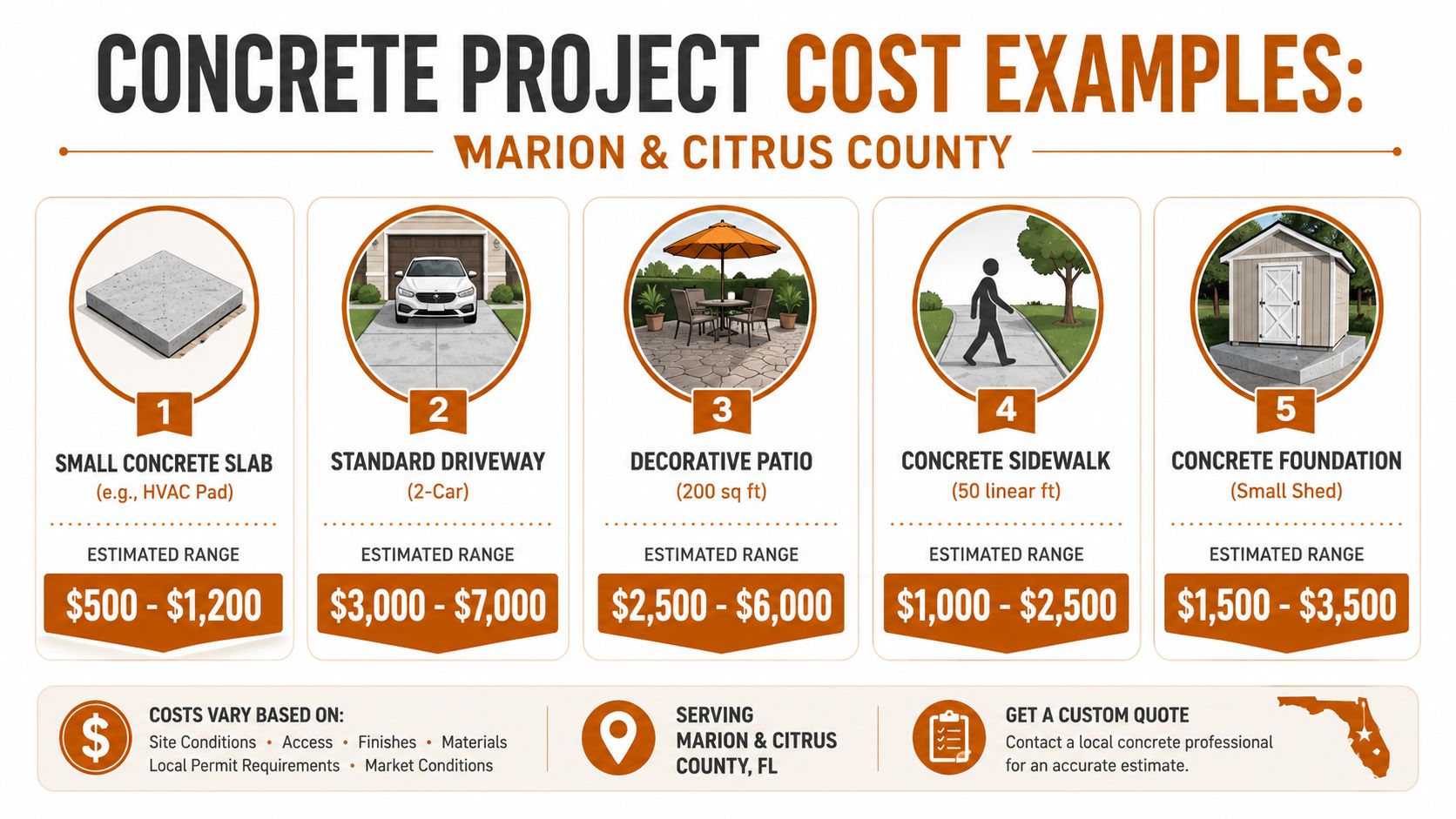
Local examples help, but they only help if they include the parts generic calculators skip. In Marion and Citrus County, the hidden costs are usually small-load delivery fees, demolition and haul-off on replacement work, extra labor for poor access, and Florida-specific prep tied to drainage, heat, and wet soil conditions.
For a plain gray concrete driveway, a new pour usually lands toward the lower end of the range discussed earlier when the site is open and the base is ready. Replacement work usually lands higher because old concrete has to come out first, and that part is messy, labor-heavy, and easy to underestimate.
What common jobs look like in the field
Here is a practical way to size up the kind of work homeowners ask about most in this area:
| Project type | Typical assumption | Budget direction |
|---|---|---|
| Small patio | Plain finish, simple shape, easy access | Often costs more per square foot because delivery minimums and short-load charges still apply |
| Sidewalk | Straight run, basic finish | Forming, grade changes, and root conflicts can add labor fast |
| New driveway | Open access, standard broom finish | Usually the cleanest estimate if drainage and base are already in good shape |
| Driveway replacement | Existing slab removed and hauled off | Demo, disposal, and base repair push the total up |
A small patio in Summerfield is a good example. The total job cost may look reasonable, but the per-square-foot price often surprises people. The truck still has to roll. The crew still has to form it, pour it, finish it, and clean up. On a small load, those fixed costs do not spread out very far.
Replacement jobs are where homeowners get caught off guard. In Dunnellon, Homosassa, and Beverly Hills, an old driveway often has more going on underneath than what shows from the street. We regularly see edge washout, root lift, low spots that hold water, and base failure near the apron or garage. If that underlying problem is not corrected, new concrete can start showing the same trouble sooner than it should.
A solid replacement quote should clearly separate removal, disposal, base repair, and new installation. If those items are bundled into one vague number, ask questions.
Florida conditions matter here too. Afternoon rain, high heat, and sandy soils change how crews schedule, prep, and finish a slab. In some spots, better drainage work matters more than a decorative upgrade. In others, access drives the price because the truck cannot back close enough and the crew needs extra equipment or more hand work.
For homeowners in Marion County and Citrus County, the best use of example pricing is as a starting point, not a final answer. The same square footage in Silver Springs and Crystal River can price out very differently once the site is inspected. For a broader side-by-side look at paving choices, this guide to concrete driveway vs asphalt cost helps put the numbers in context.
Concrete vs Asphalt in Central Florida A Long-Term Cost Analysis
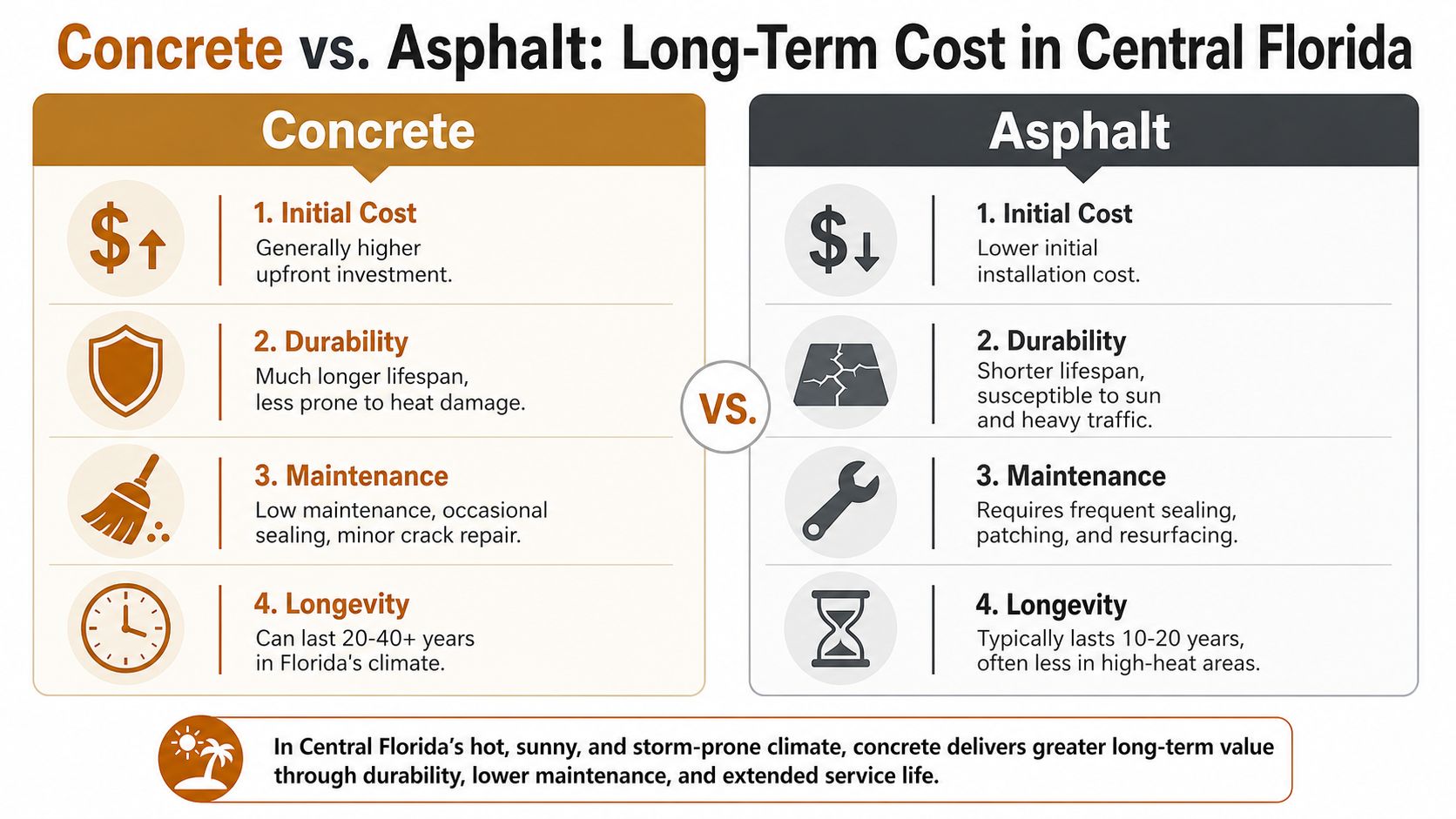
Concrete isn't always the right answer. Asphalt has a real place, especially when upfront budget matters or when a property needs a different maintenance strategy. The smart choice depends on how long you plan to keep the surface and how much maintenance you want to deal with.
Upfront cost versus lifespan
In Florida, concrete driveways typically last 25 to 40 years, while asphalt driveways last 12 to 18 years in the hot sun before resurfacing is needed. Upfront pricing also differs, with asphalt at $4 to $8 per square foot compared with concrete at $6.50 to $10 per square foot, based on Florida driveway lifespan and paving cost comparisons.
That makes the decision less about which material is cheaper today and more about what kind of ownership cost you want over time.
If you want a deeper side-by-side breakdown, this comparison of concrete driveway vs asphalt cost covers the decision from a local property-owner perspective.
What works better in Florida conditions
Central Florida weather changes the conversation. Heat and UV exposure are hard on asphalt. Long rainy stretches punish poor drainage on both surfaces. Heavy vehicle turning movements can also wear materials differently depending on the layout.
For homeowners in The Villages, Silver Springs, and Citrus County neighborhoods, concrete often makes sense when the priority is a long-lasting driveway, patio, or walkway with lower day-to-day upkeep. For some parking areas and maintenance-focused commercial properties, asphalt can still be the practical fit because repair strategy and surface management matter just as much as initial installation.
A simple comparison helps:
| Issue | Concrete | Asphalt |
|---|---|---|
| Initial cost | Higher | Lower |
| Florida heat | Handles heat well | More vulnerable to sun and surface aging |
| Lifespan | Longer | Shorter |
| Maintenance style | Less frequent, more structural when needed | More ongoing preventive maintenance |
| Appearance | Clean, bright, durable curb appeal | Darker surface, practical for many lots |
For residential driveways in hot Central Florida conditions, paying more upfront for concrete often buys a surface that stays useful much longer.
The role of Concrete and Asphalt Experts in Marion and Citrus County is important. The right contractor shouldn't force every property into the same material. A driveway in Ocala, a church parking area in Inverness, and an HOA common space in Lecanto don't always need the same solution. Good planning means matching the surface to the use, the climate, and the long-term budget.
Get a Clear Honest Estimate for Your Central Florida Project
The best answer to how much does concrete cost is still this. It depends on what's under the slab, what has to be removed, how easy the site is to access, and what kind of finish and strength the job requires.
Online calculators can give you a rough range. They can't see standing water by the garage, a narrow gate behind the house, or the failed base under an old driveway. That's why homeowners in Ocala, Crystal River, Dunnellon, Homosassa, and surrounding Central Florida communities get the clearest numbers from an on-site visit, not from a generic estimate tool.
Questions worth asking before you sign
Before approving any concrete quote, ask these questions:
- What exactly is included: Make sure removal, disposal, base prep, forming, pouring, finishing, and cleanup are spelled out.
- What finish is being priced: Plain broom finish and decorative work shouldn't be blended together in one vague line.
- How is drainage being handled: Florida slabs fail early when water control gets ignored.
- What access issues affect the quote: Backyard pours and tight sites often need more labor or equipment.
- Is the contractor licensed and insured: That protects you when equipment, scheduling, and workmanship all matter.
FAQ
How much does concrete cost per square foot in Florida
For professional installation in Florida, concrete projects commonly fall between $6 and $12 per square foot, depending on whether the work is a new pour or a replacement and how much prep the site needs. New driveway pours generally run lower than replacement work because demolition isn't included.
Why do small concrete jobs seem expensive
Small jobs often trigger short-load charges and still require setup, delivery coordination, forming, and finishing. That means a small patio or sidewalk can cost more per square foot than a larger slab.
Is replacing a driveway more expensive than installing a new one
Yes. Replacement includes breaking out and hauling away the old slab, plus disposal and base correction if needed. That added work is why replacement pricing is higher than a new pour on a clear site.
Is concrete or asphalt better in Central Florida
It depends on the property and your priorities. Concrete usually offers longer life in Florida heat, while asphalt can make sense where lower upfront cost or a specific maintenance plan is the better fit.
When should I hire a professional instead of trying to price it myself
As soon as the project involves drainage issues, demolition, driveway replacement, thicker slabs, access problems, or any finish beyond a basic small pad, a professional evaluation is the safest way to budget it correctly.
If you want a straight answer for your property, Riverside Sealing & Striping, LLC offers free, no-pressure estimates for concrete and asphalt projects across Marion County, Citrus County, and surrounding Central Florida areas. They're licensed and insured, locally experienced, and known for reliable scheduling, clear timelines, and high-quality workmanship. Whether you need a new driveway, patio, sidewalk, asphalt sealcoating, or parking lot striping, their team brings the perspective of real Concrete and Asphalt Experts in Marion and Citrus County.