
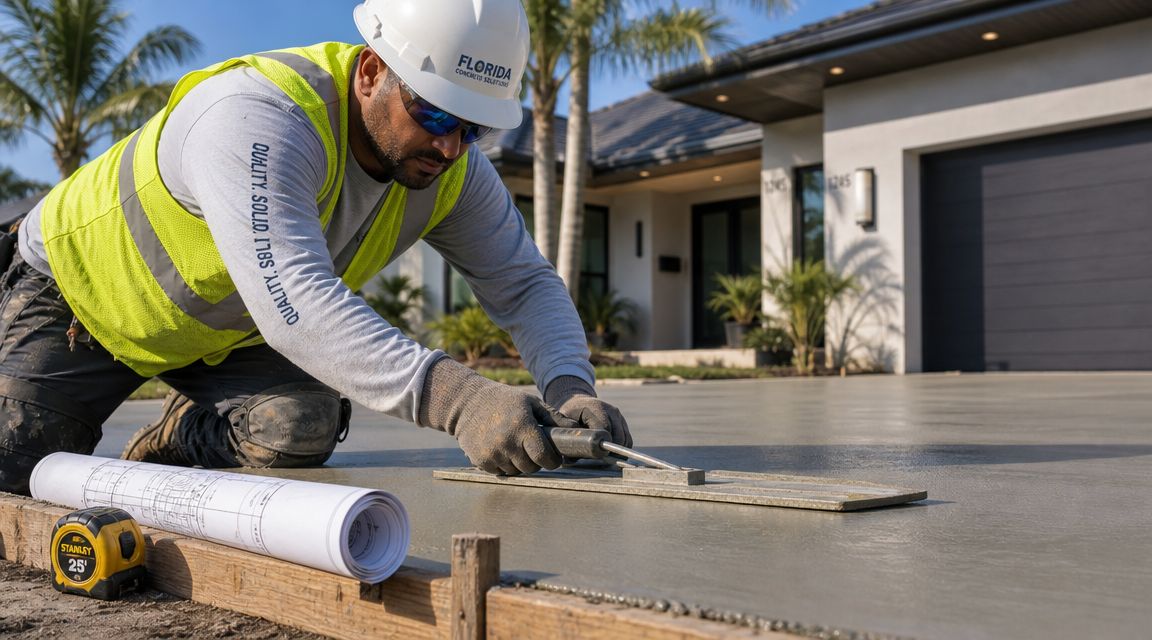
If you're searching for concrete slab installation near me, you're probably not looking for theory. You're looking at a real project right now. Maybe it's a new patio in Ocala, a driveway replacement in Belleview, or a slab for a shed or workshop in Dunnellon. You want it poured right, priced fairly, and built to last in Central Florida weather.
That's where many homeowners in Marion County, FL and Citrus County, FL get stuck. One quote looks cheap. Another seems high. One contractor talks about thickness and reinforcement. Another just gives a square-foot price and says they can start tomorrow. If you don't know what's included, it's hard to compare anything fairly.
A good slab isn't just concrete on the ground. It's site prep, grading, base, forms, reinforcement, finishing, joints, and curing. In places like The Villages, Summerfield, Silver Springs, Crystal River, Homosassa, Inverness, Lecanto, Beverly Hills, and Hernando, local soil, drainage, heat, and rain all affect how that slab should be installed.
Table of Contents
- Understanding Concrete Slabs for Your Florida Home
- The Professional Slab Installation Process Explained
- Budgeting Your Project: Concrete Slab Costs in Marion and Citrus County
- Permits, Control Joints, and Avoiding Installation Pitfalls
- Choosing the Right Concrete and Asphalt Expert in Florida
- Your Concrete Slab Questions Answered
Understanding Concrete Slabs for Your Florida Home
Homeowners usually call about slabs for three reasons. They need a surface that stays stable, they want something easier to maintain than loose gravel or pavers, and they don't want to redo the work in a few years. That applies whether the project is a patio in Summerfield, a sidewalk in Inverness, or a driveway approach in Crystal River.
A concrete slab is a flat, poured section of concrete designed to support traffic, structures, or outdoor living space. The basic idea is simple. The work underneath it is what determines whether it performs well.
What a concrete slab really is
For residential projects, slabs show up in a few common forms:
- Patio slabs for outdoor seating, grilling areas, and poolside space.
- Driveway slabs that need to carry regular vehicle weight and hold up to daily use.
- Sidewalk slabs that guide foot traffic and need clean, safe transitions.
- Foundation or utility slabs for sheds, detached garages, and similar structures.
The slab itself may look similar from the top, but the intended use changes the build. A backyard patio doesn't get treated the same way as a driveway where vehicles turn, stop, and load weight in the same spots.
A slab should match the job it's doing. If the use changes, the prep, reinforcement, and finish usually change too.
Common slab types for residential projects
In plain terms, homeowners around Ocala and The Villages usually run into these categories:
- Floating slabs: Common for sheds and smaller detached structures. These sit on prepared ground and depend heavily on solid support below.
- Reinforced slabs: Used where added strength matters more, such as driveways and work areas.
- Monolithic slabs: Often discussed in foundation work where slab and edge details are formed and poured as one system.
You don't need to memorize the terminology. You do need to ask the right question: What is this slab expected to support, and how is it being built for that purpose?
That's the difference between a surface that looks good on pour day and one that still performs after Florida rain, sun, and daily use.
The Professional Slab Installation Process Explained
A professional slab job is won or lost before the finish broom ever touches the surface.
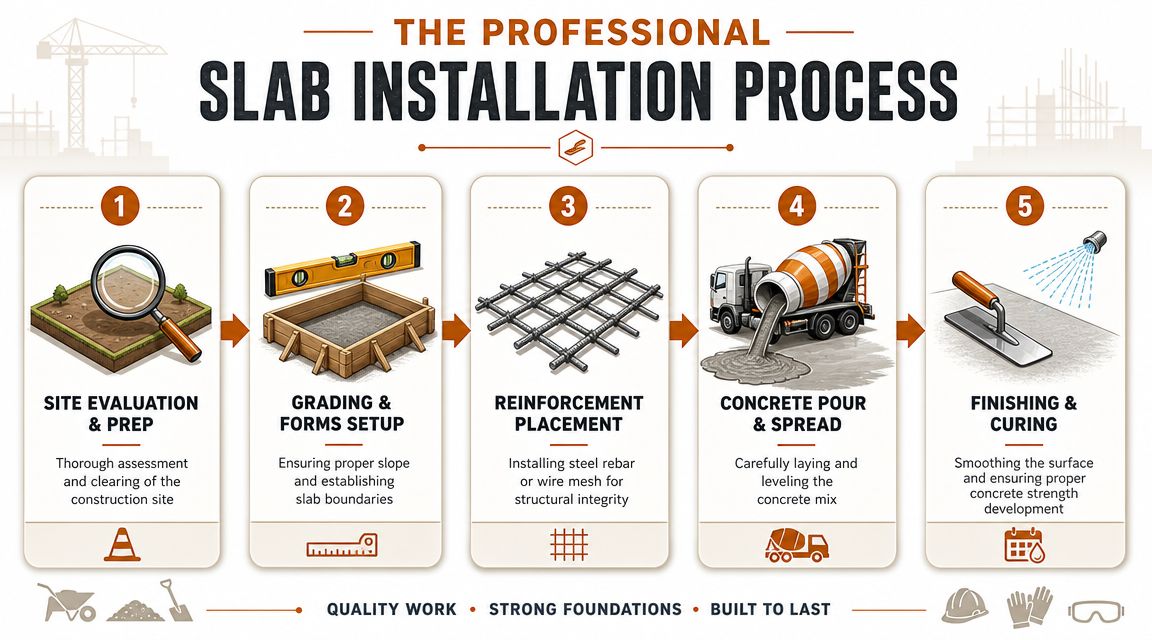
To visualize the sequence, here's the process homeowners should expect to see on a properly managed project.
What happens before the concrete truck arrives
The first step is site evaluation. That includes checking access, drainage, slope, nearby structures, and what's currently on the ground. Grass, roots, soft soil, old debris, and unstable fill need to be dealt with before forms go in.
Then comes grading and base preparation. This is not decorative work. For slab installation, a properly compacted, uniform support layer reduces differential settlement, which is a primary driver of slab cracking and corner or edge movement, as outlined in this concrete slab installation guidance.
If a contractor is vague about excavation depth, base material, or compaction, that's a warning sign. Homeowners who want a clearer picture of this stage can review the basics of how to prepare ground for concrete slab.
After that, crews set forms. Good forms stay rigid and hold the intended shape, elevation, and slope. If forms move, the slab edges and thickness can end up inconsistent, and that creates problems before the concrete even cures.
What a proper pour and finish looks like
Reinforcement goes in before the pour, and placement matters. Steel that ends up lying in the wrong position doesn't do its job the way it should. Crews should place reinforcement where the design calls for it, not just toss it in and hope it helps.
A useful visual helps here too.
Once concrete arrives, the crew places, spreads, and levels it quickly and consistently. They also need to compact the concrete itself enough to remove trapped air pockets. Then they apply the finish that fits the use. For outdoor flatwork in Central Florida, a broom finish is a common practical choice because it improves traction.
Good curing is the last big step, and cheap jobs often rush it. Concrete needs time and controlled moisture conditions to gain strength properly. A slab can look finished long before it's ready for service.
Practical rule: Homeowners tend to focus on the pour day. Contractors who know the trade focus just as hard on the base, the forms, and the curing.
Budgeting Your Project: Concrete Slab Costs in Marion and Citrus County
Cost matters, but the square-foot price by itself rarely tells the whole story.
National guides give a useful starting point. A projected 2026 national average for a new concrete slab is about $5,400, with a common range of $3,600 to $7,200 for a basic project, and larger home foundation work can climb much higher depending on size, thickness, reinforcement, and finish, according to Angi's concrete slab cost guide. The same source notes that a standard poured-in-place slab often runs about $4 to $12 per square foot, with labor alone often around $2 to $3 per square foot and roughly one-third to one-half of total project cost.
What slab pricing usually starts with
Another pricing reference puts ready-mix concrete at a 2024 nationwide average of $179.89 per cubic yard, with a broader national range of about $160 to $195 or more per cubic yard, while plain concrete slab installation is commonly estimated at $6.50 to $10.50 per square foot for materials and labor. That same guide says regional pricing can run about $5.35 per square foot in the middle of the country and as high as $8.50 per square foot in coastal states such as California and New York, which helps explain why local conditions matter so much in Florida markets, as noted by Concrete Network's concrete pricing overview.
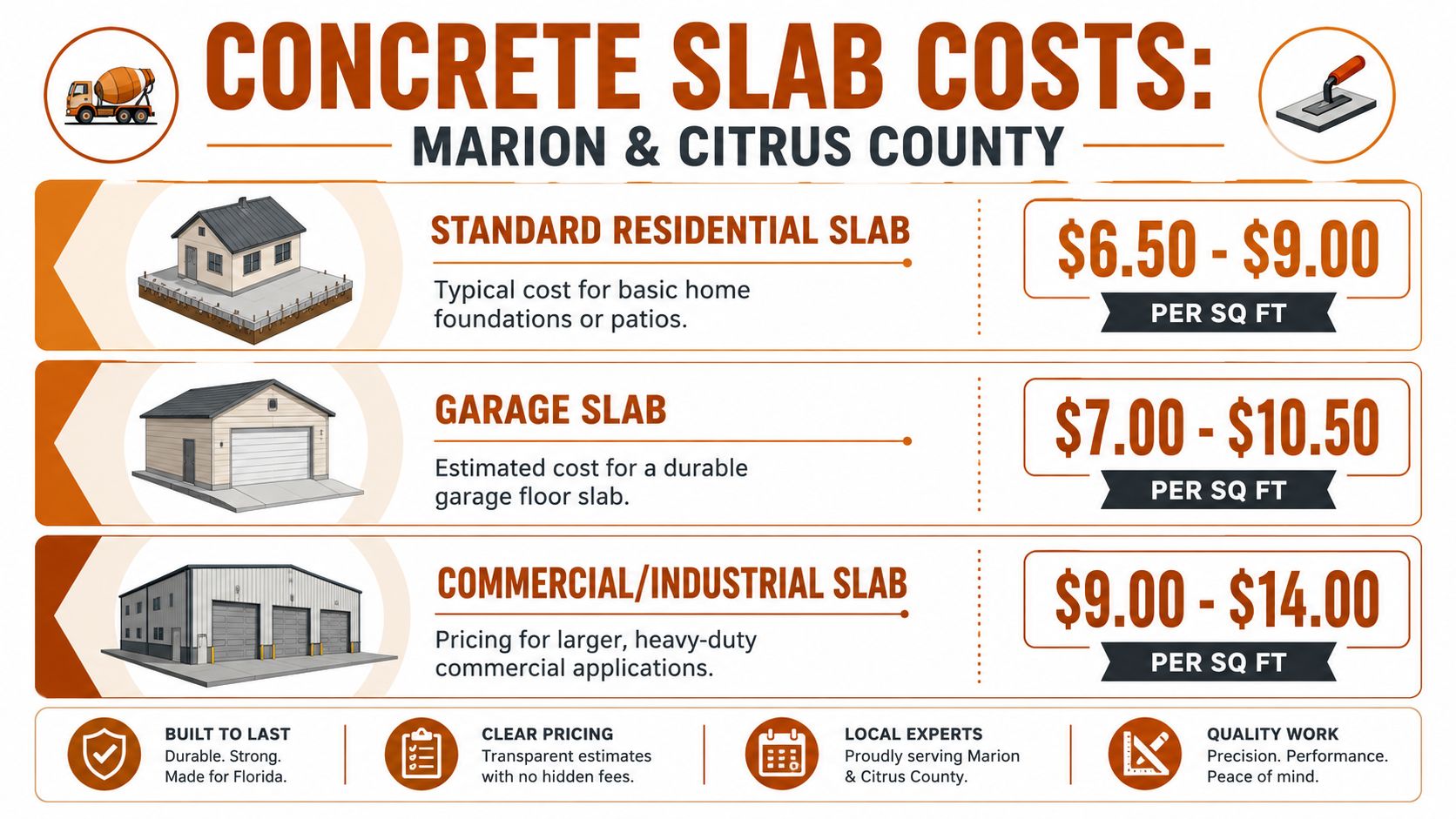
Those numbers are helpful, but homeowners in Marion County and Citrus County should treat them as a starting framework, not a final bid. A slab in Lecanto with easy truck access and minimal grading is a different project than a slab in Homosassa with drainage concerns or a replacement slab in Belleview that requires demolition and haul-off first.
Estimated Concrete Slab Cost Factors in Central Florida Per Sq. Ft.
| Slab Type / Feature | Typical Thickness | Estimated Cost Range per Sq. Ft. |
|---|---|---|
| Basic patio slab | 4-inch class residential slab | $6.50 to $10.50 |
| Driveway slab with heavier use | Greater thickness or added reinforcement as specified | Higher than a basic patio slab |
| Slab with difficult site prep | Varies by conditions | Higher than a clean, level site |
| Decorative or upgraded finish | Varies by finish selected | Higher than a basic broom finish |
For homeowners comparing bids, this breakdown of concrete slab cost per square foot helps frame the conversation.
Why Central Florida conditions affect the final number
Florida weather changes the work, even when the slab design looks simple on paper.
- Rain exposure: Crews have to manage timing, drainage, and subgrade moisture carefully.
- Heat and sun: Surface finishing and curing conditions can move fast in hot weather.
- Soft or inconsistent ground: Some sites need more prep to create uniform support.
- Access issues: Tight lots, fences, trees, and long travel paths can complicate placement.
That's why a low number with no explanation usually isn't a bargain. It's often an incomplete scope.
Permits, Control Joints, and Avoiding Installation Pitfalls
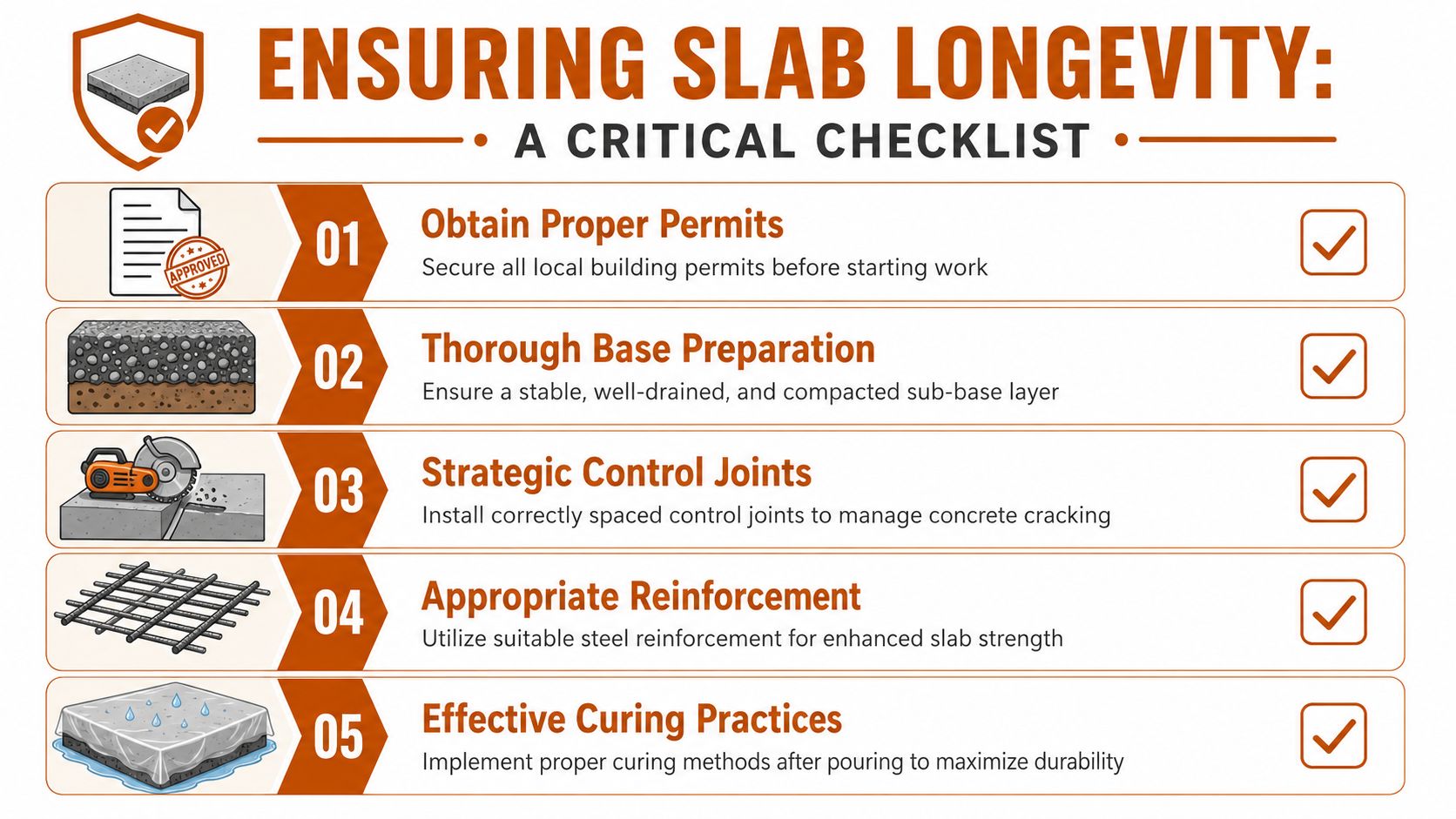
Permits aren't the exciting part of a slab project, but they matter. Depending on the use, size, and location of the slab, local requirements may apply in Marion County or Citrus County. If the slab is tied to a structure, affects access, or changes drainage, the permit side becomes even more important. A contractor should be able to tell you clearly whether permitting is needed and who is handling it.
The bigger issue for most homeowners is workmanship. A slab can be flat on day one and still be headed for trouble if the details were skipped.
What low quotes often leave out
One of the most common problems with bargain pricing is scope omission. A widely used cost guide points out that generic slab ranges often fail to explain what “cheap” quotes leave out, especially grading, base material, reinforcement, thickness differences, and use-specific requirements, in this homeowner guide to concrete slab contractor pricing.
That's where change orders and short-lived slabs come from.
Ask these questions before you sign anything:
- What site prep is included: Is the quote covering clearing, grading, excavation, and compaction?
- What base is included: Is there actual base material, or are they pouring over whatever is already there?
- What reinforcement is included: Rebar, mesh, fiber, or none?
- What finish is included: Basic broom finish, smoother finish, edges, cleanup?
- What happens after the pour: Curing steps, saw cutting, debris removal, and final cleanup?
If the answer is vague, the quote is vague.
Why control joints matter more than most homeowners think
Concrete cracks. The question is whether the slab is given a controlled place to crack.
A practical benchmark for crack-control joints is to space them at no more than 2 to 3 times the slab thickness in feet, with a 4-inch slab using joints every 8 to 12 feet, and joints cut or grooved to a sufficient depth to help manage shrinkage stress, according to this control joint best-practices guide.
That's not cosmetic saw work. It's part of the slab design.
If you want more context on movement-related joint details, this overview of what is a concrete expansion joint is worth reviewing.
If a slab has no thoughtful joint layout, don't be surprised when it creates its own.
Other common failure points are rushed curing, weak edges, poor drainage around the slab, and reinforcement that wasn't positioned properly before the pour. Homeowners in Silver Springs, Hernando, and Beverly Hills should pay close attention to those details because the local weather won't forgive shortcuts.
Choosing the Right Concrete and Asphalt Expert in Florida
Finding the right contractor gets easier once you know what a proper slab requires. You're no longer comparing only price. You're comparing process, communication, and accountability.
What to check before hiring anyone
Start with the basics:
- Licensed and insured: Don't take verbal assurance at face value.
- Local experience: A crew that regularly works in Ocala, Dunnellon, Crystal River, and surrounding areas usually understands access, drainage, and scheduling realities better than an out-of-area outfit.
- Clear scope of work: The estimate should spell out prep, reinforcement, finish, jointing, and cleanup.
- Reliable scheduling: You want a crew that shows up when promised and communicates if conditions change.
- Relevant service mix: It helps when the company understands both hardscape construction and ongoing pavement performance.
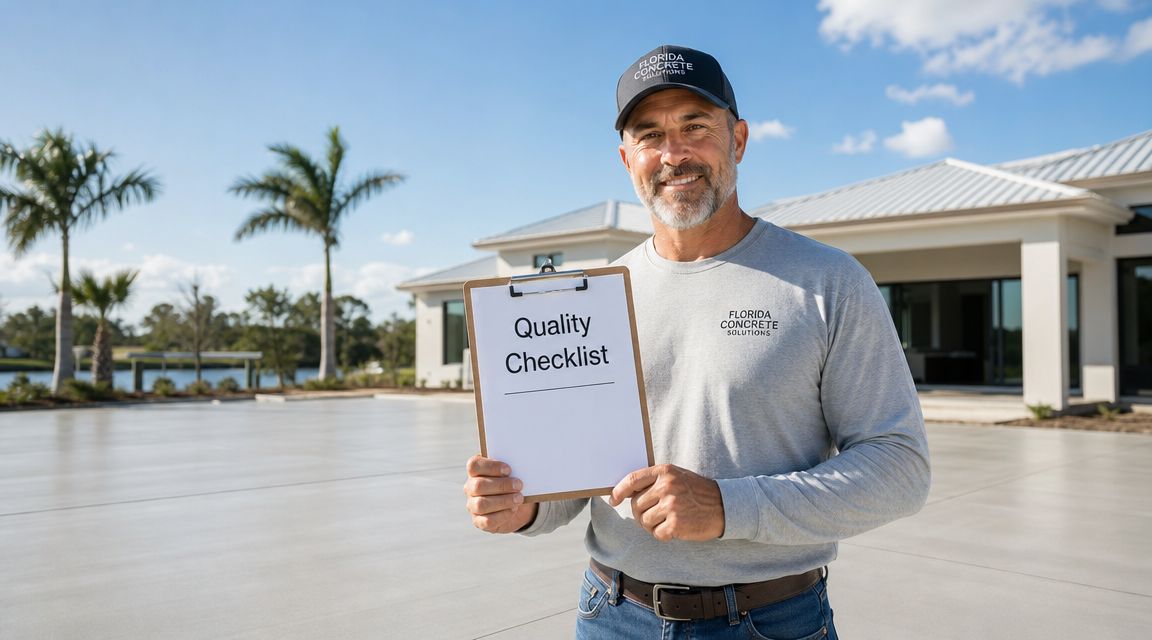
A practical local standard
The strongest contractors don't hide behind a low square-foot number. They explain what the work includes and why it's needed.
That's especially important because, as noted earlier in the article, generic online slab pricing often doesn't account for the details that determine performance. For homeowners and property managers who need both site concrete and pavement maintenance support, Riverside Sealing & Striping, LLC is one local option serving Central Florida as Concrete and Asphalt Experts in Marion and Citrus County. The company handles concrete driveways, patios, slabs, and sidewalks along with asphalt sealcoating and parking lot striping, which is useful for owners who want one contractor familiar with both surfaces.
A dependable estimate should answer questions before the job starts, not create more of them after the pour.
Your Concrete Slab Questions Answered
How long should a new slab cure before use
Concrete needs time to gain strength. Exact timing depends on the mix, weather, slab use, and site conditions. The safe move is to follow the installer's use recommendations instead of assuming the surface is ready just because it looks hard.
How do you maintain a slab in Florida weather
Keep the surface clean, watch drainage, and don't let water sit against slab edges longer than it has to. If a slab develops small issues at joints or edges, deal with them early. Florida sun and rain will magnify neglect.
Can you pour new concrete over old concrete
Sometimes, but not automatically. If the existing slab is moving, badly cracked, or unstable underneath, covering it usually won't solve the underlying problem. In many cases, removal and replacement is the more durable route.
What decorative options make sense for a patio or walkway
For many homes in The Villages, Summerfield, and Lecanto, a broom finish is the practical standard because it adds traction outdoors. Depending on the project, homeowners may also consider different edge treatments, layout choices, or upgraded finishes that fit the use and maintenance expectations.
What should I ask when getting estimates for concrete slab installation near me
Ask what's included in site prep, base work, reinforcement, finish, joints, cleanup, and curing guidance. Then ask what isn't included. That second question usually tells you more than the first.
A long-lasting slab comes from good prep, sound installation, and honest scope. If you're comparing quotes in Marion County, Citrus County, Ocala, Inverness, Crystal River, or nearby Central Florida communities, focus on what the contractor is building, not just the number at the bottom of the page.
If you'd like a no-pressure on-site evaluation, Riverside Sealing & Striping, LLC provides free estimates for concrete driveways, patios, slabs, sidewalks, asphalt sealcoating, and parking lot striping throughout Marion County, Citrus County, and surrounding Central Florida areas.