
A lot of Central Florida property owners call when the surface has started talking back. A driveway in Ocala shows spider cracking and edge break. A church lot in Inverness has faded handicap spaces and puddles after every hard rain. An HOA road near Dunnellon starts raveling where water sits too long.
This is when people search for florida asphalt repair, but the answer is often bigger than one patch or one pour.
In Marion County and Citrus County, concrete and asphalt work together. A failed sidewalk can push drainage into a parking lot. Bad lot grades can dump water against a slab. A clean new driveway improves curb appeal, but so does striping, sealcoating, and a parking layout that makes sense. Property owners in Ocala, Belleview, Summerfield, Crystal River, Homosassa, Lecanto, Hernando, Beverly Hills, and The Villages need a contractor who understands that pavement is a system, not a single line item.
That is how a third and fourth generation paving family looks at it in Dunnellon. The work is not just about replacing what broke. It is about building or maintaining surfaces that hold up under Florida sun, repeated rain, traffic, and daily use with fewer callbacks and fewer surprises.
Your Complete Guide to Pavement Solutions in Central Florida
The most common mistake property owners make is treating pavement problems as isolated issues.
A cracked driveway seems like a concrete problem. A faded parking lot seems like a striping problem. A pothole looks like an asphalt problem. In practice, each one ties back to drainage, base condition, traffic, or delayed maintenance.
For homeowners, that may mean deciding whether to replace a broken slab or start fresh with a well-prepared concrete driveway. For commercial owners, it means balancing appearance, liability, ADA access, and budget without shutting down operations longer than necessary.
What Central Florida owners usually need
Some jobs call for new concrete construction. Others call for preservation.
Common needs include:
- Concrete driveway installation in Marion County FL for homes where old slabs have cracked, settled, or lost curb appeal.
- Concrete patios and slabs for backyards, outdoor seating areas, equipment pads, and utility spaces.
- Sidewalk installation in Ocala Florida and surrounding towns, including routes that need safe transitions and ADA-conscious layout.
- Asphalt seal coating in Marion County FL to protect parking lots and private roads from sun, rain, oil, and traffic wear.
- Parking lot striping in Ocala FL and Citrus County commercial sites where line visibility and circulation have slipped.
- Commercial concrete contractors in Florida for churches, schools, retail centers, HOAs, and managed properties that need a contractor who can schedule around real-world operations.
What works and what does not
Quick cosmetic fixes have their place, but only when the underlying structure is still sound.
What works in this region:
- Replacing failed concrete instead of skimming over it
- Crack filling and sealcoating before water gets below the surface
- Restriping with ADA upgrades during planned maintenance
- Matching repair methods to traffic level and drainage reality
What fails early:
- Feathered asphalt patches
- Concrete placed on poorly prepared ground
- Lot striping done without checking accessible spaces and traffic flow
- Waiting until rainy season damage turns into base failure
Good pavement management in Central Florida starts with one question. Is the problem cosmetic, surface-level, or structural? The right answer saves money. The wrong one usually doubles the work later.
Durable Concrete Driveways, Patios, and Sidewalks
A driveway in Central Florida can look fine at first and be headed for trouble. The slab may be clean, the edges may look straight, and the finish may photograph well. Then the first long rainy stretch sends water under one corner, the sandy base shifts, and cracks start showing where the work should have been strongest.
That is why concrete work cannot be separated from the rest of a property’s pavement plan. A driveway, patio, or sidewalk has to fit the site’s drainage, traffic, and connection points to nearby asphalt. Owners who treat concrete and asphalt as one system get longer service life and fewer repair cycles.
Concrete driveways that hold grade and finish clean
A good driveway starts below the surface. Removal of failed sections, correct grading, compacted support, and water control matter more than decorative touches ever will. In Belleview, Summerfield, Ocala, and nearby communities, weak prep shows up fast because heavy rain finds every soft spot.
For that reason, replacement is often the better value when an older slab has widespread cracking, edge breakage, or settlement. Chasing one crack after another leaves the owner with a patched-looking surface and the same base problems underneath.
For homeowners searching for concrete driveway installation Marion County FL, the decision looks like this:
| Condition | Better option |
|---|---|
| Isolated surface blemishes but slab still stable | Targeted repair may be possible |
| Multiple cracks, settlement, broken edges | Full replacement usually makes more sense |
| Drainage pushing water under slab | Regrade and replace affected section |
| Old driveway widened or reconfigured | New pour with proper layout |
Finish work matters. Broom texture affects traction. Joint layout affects cracking. Edge work and transitions affect both appearance and durability.
Movement also has to be planned for from the start. Concrete will expand, shrink, and shift with temperature and moisture changes. Proper joint placement gives that movement a controlled place to happen, which is why concrete expansion joint planning belongs in the conversation before the pour, not after cracks appear.
Patios, slabs, and functional flatwork
Patios and small slabs fail for the same reasons driveways fail. Poor subgrade prep, trapped water, rushed finishing, and the wrong thickness for the job all shorten service life.
The right design depends on how the slab will be used. A backyard patio needs drainage that moves water away without leaving the surface slick. A shed slab or equipment pad needs support matched to the load. A replacement pad should fit current use, not just copy the footprint that happened to be there before.
This is also where the concrete side of the job connects to asphalt maintenance. If runoff from a patio spills toward a driveway or parking area, the concrete may stay intact while the adjacent asphalt starts to soften, crack, or ravel sooner than it should. Good pavement management looks at both surfaces together.
Sidewalks and ADA-conscious walkways
Sidewalk work often gets underestimated. On paper, it looks simple. On site, it involves slope, drainage, trip-hazard prevention, tie-ins, and in many commercial settings, accessibility requirements that cannot be guessed at.
For a residence, a new walkway often solves safety and appearance issues at the same time. For churches, schools, retail properties, HOAs, and multifamily sites, sidewalk replacement affects pedestrian flow, entry points, and ADA-conscious access routes. Straight forms alone do not produce a walkway that works. The finished path has to land cleanly at doors, curbs, and existing pavement.
Owners looking for concrete contractors in Citrus County FL or sidewalk installation Ocala Florida need one of two scopes:
- Demolition and replacement where old panels are broken, settled, or unsafe
- New installation where the site needs a better pedestrian route or improved accessibility
If several panels are failing for the same underlying reason, piecemeal patching seldom leaves a clean or durable result. Removal, base correction, and replacement cost more up front and less over time.
Long-life pavement work follows the same principle whether the material is concrete or asphalt. The Federal Highway Administration notes that FDOT’s use of Highly Modified Asphalt included over 500,000 tons across at least 40 projects statewide since 2015, with some sections still performing after six years and prompting cancellation of planned reconstruction in one case, as detailed in the FHWA case study on Florida HiMA pavement performance. The lesson applies to local flatwork too. Material choice matters, but lasting performance comes from sound preparation, correct application, and matching the pavement to real service conditions.
Asphalt Sealcoating and Parking Lot Striping Solutions
A lot in Ocala or Dunnellon can look serviceable from the street and be losing ground. The surface fades, fine cracks open, water gets below the top layer, and traffic keeps pumping that moisture deeper. Once potholes show up, owners are choosing among more expensive fixes instead of lower-cost maintenance.
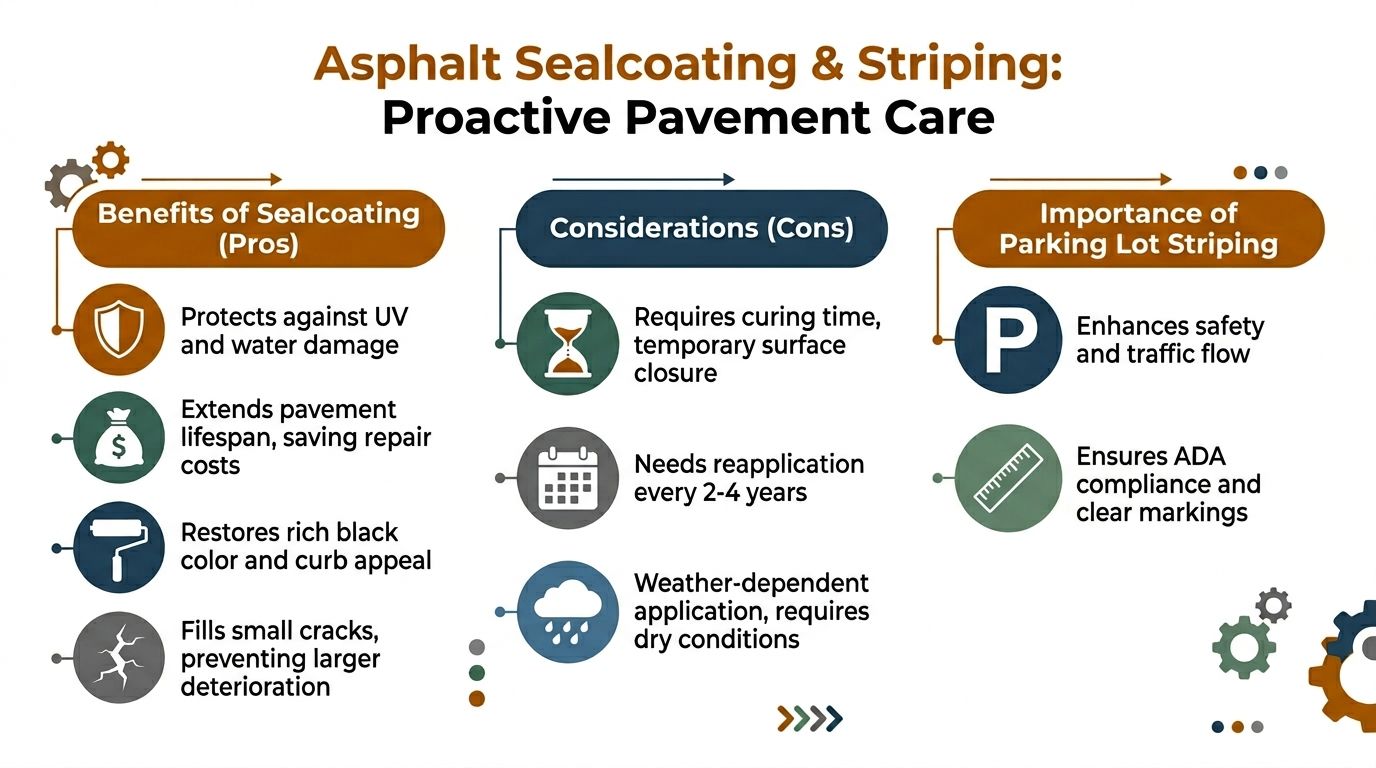
Sealcoating works best on pavement that still has structure left. It protects the surface, slows oxidation, and buys time for a lot that is wearing from weather and traffic but has not started failing from the base up. If the asphalt is alligator cracked, badly settled, or breaking apart under load, sealcoat will not solve the problem. That is where a property owner needs repair, replacement, or, in some cases, coordinated concrete work at aprons, dumpster pads, or high-turn areas so the whole site performs as one pavement system.
What sealcoating does
Central Florida is hard on asphalt. UV exposure dries out the binder. Summer rain finds every small opening. Fuel drips at drive lanes and parking stalls soften the surface in spots. That wear pattern is why timing matters. Sealcoating late leaves owners paying for repairs that preventive work might have delayed.
A properly timed sealcoat helps by:
- Reducing direct exposure to sun and water at the surface
- Improving appearance on lots that have turned gray, dry, or uneven in color
- Supporting crack maintenance after cleaning and prep work are done
- Extending service life on pavement that is still structurally sound
Budget matters, but timing matters more. Owners comparing options can use this guide to asphalt sealcoating cost per square foot to frame the discussion, then match the budget to the actual condition of the lot.
Application conditions decide whether sealcoating holds up or peels early. The pavement has to be clean. Oil spots need treatment. Cracks and failed sections should be addressed before coating starts. Cure time has to be protected, even when a busy site wants the lot reopened fast. I have seen more than a few rushed jobs scarred by early traffic because the schedule was driving the work instead of the pavement condition.
Striping is part of site function
Parking lot striping is not cosmetic trim at the end of the job. It controls movement, parking count, ADA access, and day-to-day usability.
When markings fade, the problems show up. Cars crowd lines. Accessible spaces get used wrong. Delivery drivers improvise turning paths. Pedestrian areas lose definition. For commercial properties, that creates both appearance issues and avoidable liability.
Typical striping work includes:
- Standard parking stalls for order and count
- ADA-compliant markings for accessible and van-accessible spaces
- Directional arrows at entrances and internal lanes
- Fire lanes, curbs, and no-parking zones where access has to stay clear
- Layout revisions when traffic flow or building use has changed
For many commercial sites, restriping after sealcoating is the cleanest sequence. The surface is renewed first, then the layout goes back in with crisp lines and current spacing. If a property needs concrete sidewalk replacement, curb work, or ramp corrections, planning those items together avoids mismatched elevations and striping that has to be redone after other trades finish.
What separates durable asphalt repair from short-lived patching
Florida asphalt repair fails early for predictable reasons. Poor edge prep, weak bonding between old and new material, bad timing, and soft compaction all shorten patch life.
Proper milling, tack coat application within 24 hours, and precise compaction are mandatory to prevent delamination and cracking, as outlined in the North Port pavement repair and restoration specifications. That standard lines up with what experienced paving crews already know in the field. A patch can look smooth on day one and break down early if the repair edges were not cut clean, the surface was dirty, or density was never achieved.
The repairs that last have the same traits:
- Saw-cut or cleanly prepared boundaries
- Proper tack application at the right time
- Lift thickness matched to the repair
- Compaction that seals the patch and protects the edges
The repairs that fail early show the same shortcuts:
- Throw-and-go pothole filling
- Feathered edges that unravel under traffic
- Placement over wet, dirty, or contaminated surfaces
- Layout changes without updated striping
This is a significant trade-off. Quick patching costs less today, but it often leaves the owner paying twice. Planned maintenance, sound repairs, and coordinated concrete and asphalt decisions produce the better long-term result for Central Florida properties.
Commercial Concrete and Asphalt Services for Property Managers
A property manager in Central Florida gets the call after the complaint. A tenant reports a trip edge at the storefront, a delivery driver clips a broken curb, or residents start asking why the accessible spaces no longer match the posted layout. By that point, the issue is seldom just asphalt or just concrete. It is a site management problem that affects safety, compliance, drainage, appearance, and how much disruption the property can tolerate.
That is why commercial work has to be planned as one pavement system.
A retail center in Ocala does not operate like a church in Lecanto or an HOA entrance in The Villages, but the pressure points stay about the same. Managers have to protect access, control cost, avoid liability, and keep the site presentable while business continues. Splitting concrete, asphalt, and striping into separate decisions creates rework. One trade changes grades, another leaves traffic control gaps, and the final layout still reflects the old conditions.
The four pressures commercial sites deal with
Commercial pavement decisions come down to four recurring concerns.
Budget control matters every quarter. Delaying repairs can preserve cash for the moment, but it turns a maintenance item into a replacement item.
Liability reduction starts with the obvious problems. Trip hazards, potholes, ponding, broken curbs, and faded directional markings all raise exposure.
Scheduling shapes the work as much as the repair itself. Schools, churches, medical offices, retail centers, and HOAs all need phased access, clean staging, and realistic cure times.
Site appearance affects tenant retention and customer confidence. A worn lot or patched-up walkway sends a message long before anyone walks inside.
One site plan beats disconnected fixes
Property managers get better results when concrete work, asphalt maintenance, and pavement markings are coordinated under one scope.
If a storefront walk needs replacement, that decision can affect drainage at the curb line and the final striping layout in front of the building. If a lot is due for sealcoating, it makes sense to review traffic flow, loading zones, and accessible parking before paint goes down. We see this frequently in Marion and Citrus County. The owners who spend smarter are the ones who treat pavement as an ongoing asset, not a series of isolated repairs. In many cases, early surface distress is tied to larger site conditions, which is why property managers benefit from understanding the common causes of driveway and pavement cracking in Florida.
A coordinated approach includes work like this:
| Property need | Typical solution |
|---|---|
| Broken walkways and curb-adjacent flatwork | Concrete demolition and replacement |
| Parking areas that are worn but still structurally serviceable | Sealcoating and crack sealing |
| Faded or confusing traffic layout | Full restripe and traffic marking update |
| Occupied sites with limited access windows | Phased work during off-peak hours |
ADA upgrades need to be handled during maintenance planning
Accessible parking errors are common on older sites, where lots have been restriped several times without checking current layout requirements.
For Florida commercial properties, non-compliance fines can range from $500 to $5,000 per violation, and accessible parking updates may include 8-ft van-accessible spaces, as described in this guidance on ADA upgrades for parking lots and houses of worship. The practical lesson is straightforward. If a lot is already scheduled for sealcoating or restriping, that is the right time to correct accessible spaces, access aisles, and route markings.
The cost difference matters.
Fixing ADA striping during planned maintenance is cheaper than returning later with separate traffic control, new layout work, and another round of site disruption. For HOAs, schools, churches, and retail properties, that integrated planning keeps budgets cleaner and reduces the chances of handling concrete, asphalt, and compliance as three separate emergencies.
Why Asphalt and Concrete Fail in the Florida Sun and Rain
A driveway can look fine in April, then show new cracks, edge break, or low spots by the end of summer after a few heavy storms. That pattern is common in Central Florida. The surface takes the blame, but the underlying problem is a mix of sun, water movement, soil behavior, and earlier construction shortcuts.
Florida pavement fails differently than pavement up north. We do not fight freeze-thaw here. We fight oxidation, saturated base layers, fast afternoon downpours, and subgrade that can drain well in one part of a site and stay soft in another. That applies to both asphalt and concrete, which is why owners get better long-term results when they treat new concrete work and asphalt maintenance as connected parts of one pavement plan.
One short visual helps explain what property owners are up against.
What the sun does to asphalt
Florida sun hardens asphalt from the top down.
As the binder oxidizes, the surface loses flexibility and starts to dry out. Fine cracks form first. Then those cracks widen under traffic, especially in turning areas, entrances, and places where delivery trucks stop or pivot. Experts at All American Asphalt Paving note that Florida HOA roads and parking lots frequently need resealing every 2 to 3 years under normal traffic, and that proactive maintenance can extend asphalt life to 20 to 30 years.
Heat alone does not create a full failure. Heat opens the door. Water and traffic finish the job.
What rain does below the surface
The most expensive failures start underneath.
Rain enters through open cracks, weak joints, utility cuts, and broken edges. Once water gets into the base, the pavement structure loses support. Asphalt begins to flex. Concrete slabs start rocking or settling. On sites with poor drainage, repeated saturation can turn a small repair into a larger patching or replacement area within one wet season.
I see owners focus on the visible crack, which makes sense. The visible crack is what you can point to. But the crack is only the symptom. The underlying issue may be trapped water, a failed edge, poor compaction, or movement in the soil. Property owners trying to sort out surface wear from structural movement can start with this guide on why a driveway starts cracking.
Why concrete fails too, even when the surface looks tougher
Concrete handles Florida weather differently, but it is not immune to the same site conditions.
A well-built slab can last a long time here. A poorly supported slab will crack, settle, or separate at joints. In Central Florida, concrete trouble shows up where runoff crosses the slab edge, where tree roots lift sections, or where water repeatedly washes out support near walkways, patios, and driveway aprons. That is why concrete replacement decisions should be made with the same drainage and grading review used for asphalt repairs.
This is the part many contractors skip. They treat concrete construction as one job and asphalt maintenance as another. On the ground, they affect each other. A new sidewalk can redirect runoff into a drive lane. A low asphalt edge can trap water against a slab. Lasting work comes from looking at the whole site, not one material at a time.
Why Florida repair methods need tighter standards
Shortcuts fail fast here.
Thin patch edges break down early. Poorly cut repair perimeters let water back into the seam. Delayed sealing gives summer storms more time to work into the pavement structure. For roadway and trench restoration, FDOT requires saw-cut edges, proper layer replacement, and repair dimensions that account for thin asphalt sections because Florida moisture and traffic punish weak edges.
That is the practical lesson in Marion and Citrus counties. Long pavement life depends on drainage, base support, edge quality, and timely maintenance, whether the surface is asphalt, concrete, or both on the same property.
Why Choose Riverside for Your Marion and Citrus County Project
A property owner in Dunnellon might need a driveway replacement, a short sidewalk pour, and asphalt repair near the garage apron at the same time. On a commercial site in Ocala or Crystal River, the mix may be different. Failed striping, broken concrete at entrances, and low asphalt spots that keep holding water after every storm. The right contractor has to read the whole site, not the one surface that looks worst today.
That is the difference local experience brings in Marion and Citrus counties. Soil movement, hard rain, tree roots, irrigation overspray, and heat all show up differently from one property to the next. A repair plan that ignores how the concrete and asphalt work together costs more later.
Family-honed methods matter on the ground
Third and fourth generation paving knowledge shows up in the decisions made before work starts.
It means tracing runoff before quoting a patch. It means knowing when a slab can be replaced in sections without creating a weak-looking result, and when full replacement will save the owner from repeat callbacks. It means understanding that a church lot, an HOA entrance, and a family driveway each have different traffic patterns, timing limits, and appearance standards.
For owners here, that leads to practical benefits:
- Clear recommendations on whether the site needs repair, replacement, sealcoating, striping, or a phased combination
- Scheduling that fits the property instead of disrupting residents, customers, or tenants more than necessary
- Methods chosen for Florida wear such as heat, rain exposure, turning traffic, and edge breakdown
- One contractor coordinating both materials so new concrete work does not create new asphalt problems, and asphalt maintenance does not ignore adjacent flatwork
Local service with a broader toolbox
Riverside Sealing & Striping, LLC is a Dunnellon-based company that handles concrete driveways, patios, slabs, sidewalks, seal coating, ADA-compliant striping, and parking lot markings across Marion, Citrus, and surrounding Central Florida areas.
That mix matters. A contractor who only pours concrete may not address how runoff will hit the parking area after the new work is done. A contractor who only handles asphalt may miss broken walks, uneven access routes, or layout issues that affect how the whole property functions. Central Florida owners need both sides handled as one pavement management plan.
Repair methods keep changing, and good field decisions depend on using the right one for the right failure. For example, infrared asphalt repair can reduce costs by up to 40% compared to traditional remove-and-replace methods for the right repair scenario, according to Ensley Inc.'s overview of infrared asphalt repair and maintenance. That does not make it the default answer. It is one option among several, and it works best when the pavement condition, depth of failure, and timing line up.
The value is straightforward. Owners get recommendations based on site conditions, drainage behavior, traffic, appearance goals, and budget, with concrete construction and asphalt maintenance treated as connected parts of the same job.
Your Florida Pavement Questions Answered
How often should asphalt be seal coated in Florida
For Florida conditions, a tighter maintenance interval is smart. The often cited recommendation for HOA roads and parking lots under normal traffic is a more frequent interval in this climate, because sun, heat, humidity, and frequent rain wear the surface faster than in many other regions. If a lot has open cracks, pooled water, or base movement, sealcoating alone is not the first step. Repairs come first.
What is the difference between florida asphalt repair and sealcoating
Sealcoating is a protective maintenance treatment. It helps shield sound asphalt from weather, surface wear, and contamination.
Florida asphalt repair is different. Repair addresses existing damage such as potholes, failed trench cuts, broken edges, cracking, or localized surface breakdown. If the structure has already failed, a sealer will not fix it.
When should concrete be repaired and when should it be replaced
Repair makes sense when the slab is structurally stable and the issue is limited. Replacement is the better move when you have multiple cracks, settlement, broken corners, drainage-related undermining, or mismatched older patchwork that will keep failing.
For many driveways and sidewalks, replacement gives a cleaner result and a longer service life than repeated small repairs.
Do you offer ADA-compliant striping
Yes. ADA-compliant striping and layout upgrades are a common part of commercial parking lot work for churches, schools, retail properties, HOAs, and managed sites. That can include accessible stalls, van-accessible spaces, directional markings, and related layout corrections that improve both compliance and daily usability.
Can sealcoating and striping be done together
Often, yes. In fact, that is the efficient way to handle a commercial lot that is structurally sound but worn at the surface.
The lot gets cleaned and protected first, then restriped so the markings sit on the renewed surface. This works well for shopping centers, office properties, and churches that need a visual reset without a full reconstruction project.
Do you handle both residential and commercial work
Yes. Homeowners often need driveways, patios, slabs, sidewalks, and replacement concrete. Commercial clients need sealcoating, parking lot striping, ADA updates, walkway replacement, and scheduled maintenance planning.
That dual capability matters because many properties need both hardscape construction and pavement maintenance over time.
What areas do you serve in Central Florida
Work serves Marion County and Citrus County, including Ocala, Dunnellon, Belleview, Silver Springs, Summerfield, Crystal River, Homosassa, Inverness, Lecanto, Beverly Hills, Hernando, and nearby communities such as The Villages.
How do you minimize disruption on commercial jobs
The main tools are planning and phasing.
A good contractor will evaluate traffic patterns, access points, delivery schedules, worship times, school movement, and tenant needs before the work starts. That allows sections to be completed in sequence instead of closing down the entire property at once.
What should I do if my parking lot has cracks after storm season
Do not ignore them until the next cycle.
Have the lot inspected for drainage issues, edge failure, and whether the cracks are isolated surface issues or signs of deeper movement. In Florida, post-storm water intrusion is what turns a manageable repair into a resurfacing discussion.
Do concrete and asphalt need to be planned together
On many properties, yes.
If you replace a sidewalk, widen a driveway, add a patio, or rework a curb line, those changes can affect runoff and traffic movement. The best long-term results come from treating concrete, asphalt, drainage, and striping as connected pieces of one site plan.
If you need a driveway replaced, a patio or sidewalk installed, a parking lot sealed and restriped, or a commercial site reviewed for ADA and maintenance issues, contact Riverside Sealing & Striping, LLC for a free, no-pressure estimate. The company serves Marion County, Citrus County, and surrounding Central Florida areas with reliable scheduling, practical recommendations, and long-lasting concrete and asphalt solutions.