
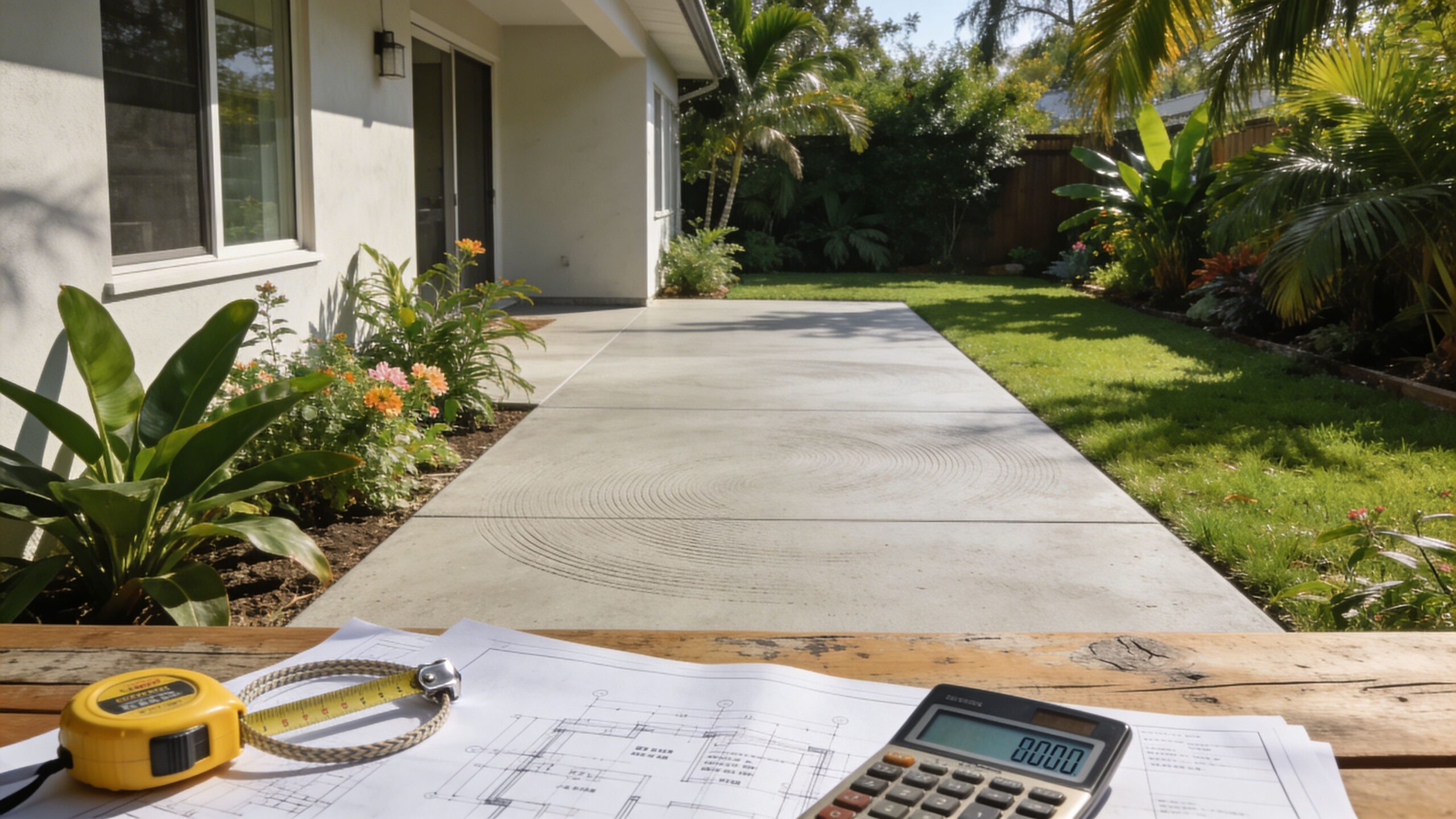
If you're pricing a new patio in Ocala, Crystal River, Inverness, or anywhere around Marion and Citrus County, you're probably seeing a wide spread of numbers online. That's normal. A basic backyard slab and a properly prepared patio built for Florida rain, heat, and soil movement are not the same job.
That’s also why “how much does a concrete patio cost” doesn’t have a one-price answer. The final cost depends on size, finish, drainage, access, and how much prep the site needs before concrete ever leaves the truck. For homeowners, HOAs, and property managers in Central Florida, the cheapest quote often skips the parts that matter most.
This page breaks the cost down the way a contractor looks at it. You’ll get realistic budget ranges, the main pricing variables, and the trade-offs between a plain broom finish and decorative concrete. It also keeps the bigger picture in view. In Marion and Citrus County, many properties need both durable concrete work and ongoing asphalt maintenance, from patios and sidewalks to parking lot striping and seal coating.
Planning Your Perfect Florida Patio
A patio usually starts with a simple need. You want a clean place for a grill, room for outdoor seating, or a durable surface that doesn’t turn into mud after a summer storm. For some owners, it’s a backyard upgrade. For others, it’s replacing a cracked slab that never drained right in the first place.
In Central Florida, that first planning step often has greater significance than anticipated. A patio in Ocala or Dunnellon might deal with intense sun and fast runoff. A project closer to Crystal River or Homosassa may raise more concerns about moisture, grading, and how water moves across the lot.
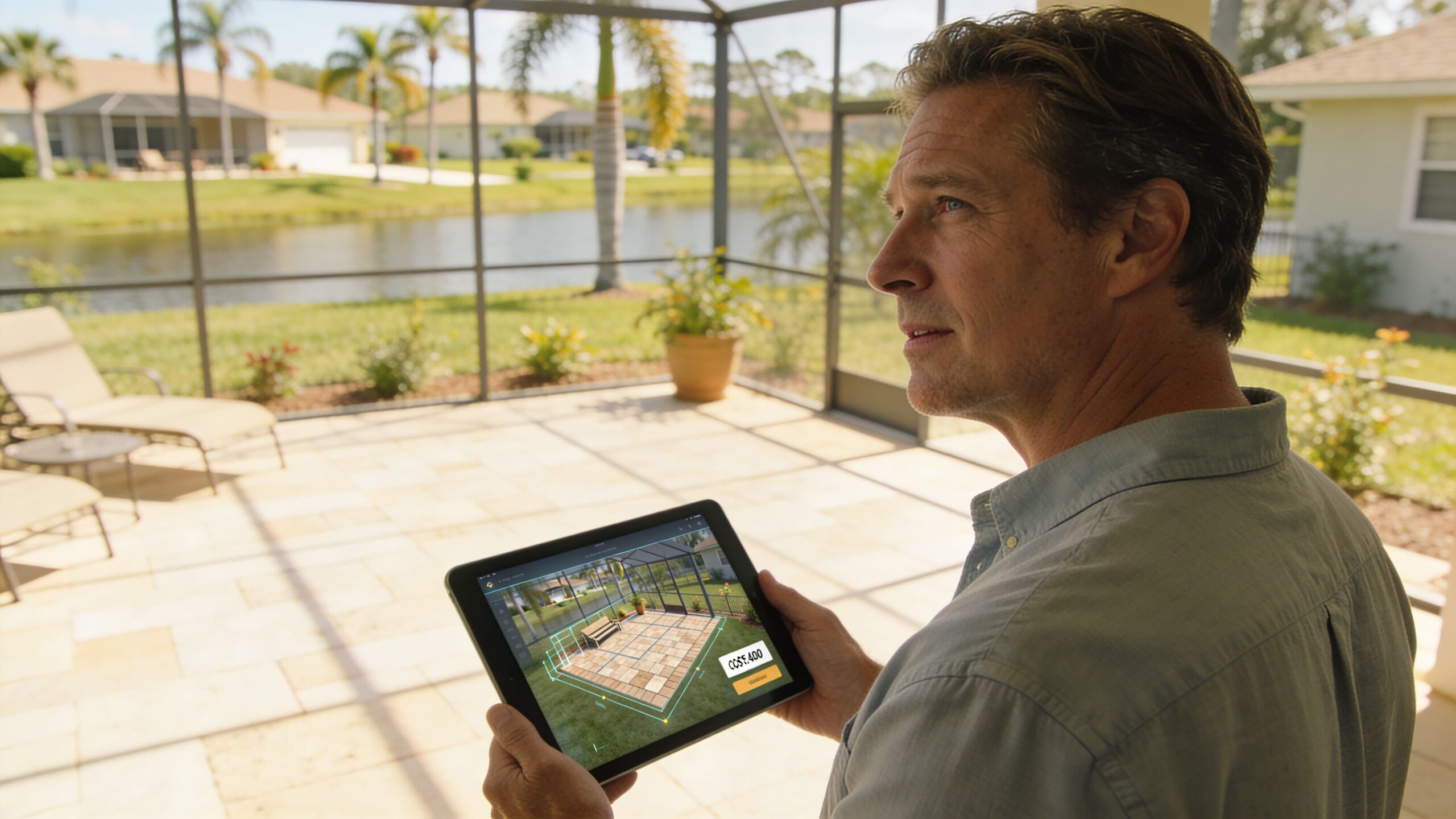
Start with use, not just size
Before anyone talks finish options, figure out how the patio will be used.
- Dining space: A smaller rectangle may work well if you only need a table and chairs.
- Entertaining area: A larger layout gives better flow for seating, grills, and foot traffic.
- Pool or wet-area access: Surface texture becomes more important because slick finishes can create problems.
- Commercial or HOA common areas: Traffic patterns, accessibility, and edge transitions matter as much as appearance.
A good plan also includes the ground underneath the slab. If the base isn’t prepared correctly, the finish on top won’t save the job. If you want a deeper look at that part of the process, this guide on how to prepare ground for a concrete slab is worth reading before you compare bids.
Practical rule: Patio pricing starts with site conditions. Finish choices come after the ground, drainage path, and layout make sense.
What usually drives early decisions
Owners often narrow the job down by balancing three things:
- Budget
- Appearance
- Long-term durability
If the goal is long-term value, keep all three in the conversation. A patio should look good, but it also has to hold up through Florida weather without becoming a maintenance headache.
The Average Cost of a Concrete Patio in 2026
A homeowner in Ocala might see an online patio price that looks reasonable, then get a higher local quote and assume the contractor is padding the number. In practice, the gap usually comes from Florida job conditions that national averages do not capture well.
The national baseline is still useful. In 2026, the average installed concrete patio cost is about $2,532 to $2,925, with most projects falling between $1,533 and $4,740, or roughly $4 to $16 per square foot, according to LawnStarter’s 2026 concrete patio cost guide.
For budgeting purposes, plain broom-finish concrete typically runs $4 to $12 per square foot nationally. Treat that as a starting range, not a local promise.
In Marion and Citrus County, many patios land above the low end because the slab has to survive hard sun, heavy rain, drainage issues, and sandy or shifting subgrade. A basic patio on stable ground with easy access can stay closer to entry-level pricing. A patio that needs extra base work, better water control, thicker edges, or cleaner joint layout usually costs more and performs better over time.
What the base price usually includes
A standard patio price usually assumes a fairly simple scope:
- Plain poured concrete: A basic slab rather than a custom decorative install.
- Standard finish: Broom finish for traction and everyday use.
- Typical forming and placement: No unusual shape, tight access, or major obstacles.
- Normal site prep: Minor grading, not full correction of drainage or soil problems.
It also assumes the slab is detailed correctly. Good joint placement matters in Florida heat, and a contractor should account for concrete expansion joints and where they belong in a patio slab, not treat them as an afterthought.
Why national averages miss Florida costs
National estimators are broad by design. They do not know whether your backyard holds water after a summer storm, whether the crew has to bring material through a narrow gate, or whether the patio will sit on loose sand that needs more compaction and base prep.
Those details change real cost fast.
A 12-by-12 patio poured in a clean, accessible yard is one kind of job. The same size patio behind an older home in Inverness or The Villages, with drainage corrections and soft spots in the subgrade, is a different job even before decorative upgrades enter the picture.
A patio quote covers more than concrete. It covers prep, grading, forming, reinforcement decisions, finishing, curing, and the workmanship that helps the slab hold up in Florida weather.
A better way to use the average
Use the national range to set expectations. Then compare it against local conditions and the level of finish desired.
For many homeowners in Central Florida, a realistic budget for a plain patio often starts in the middle of the national range rather than at the bottom. The cheapest square-foot number online usually reflects an easy job with very few complications. That is not the same as a patio built to handle Florida rain, heat, and soil movement for years.
Key Factors That Determine Your Final Price
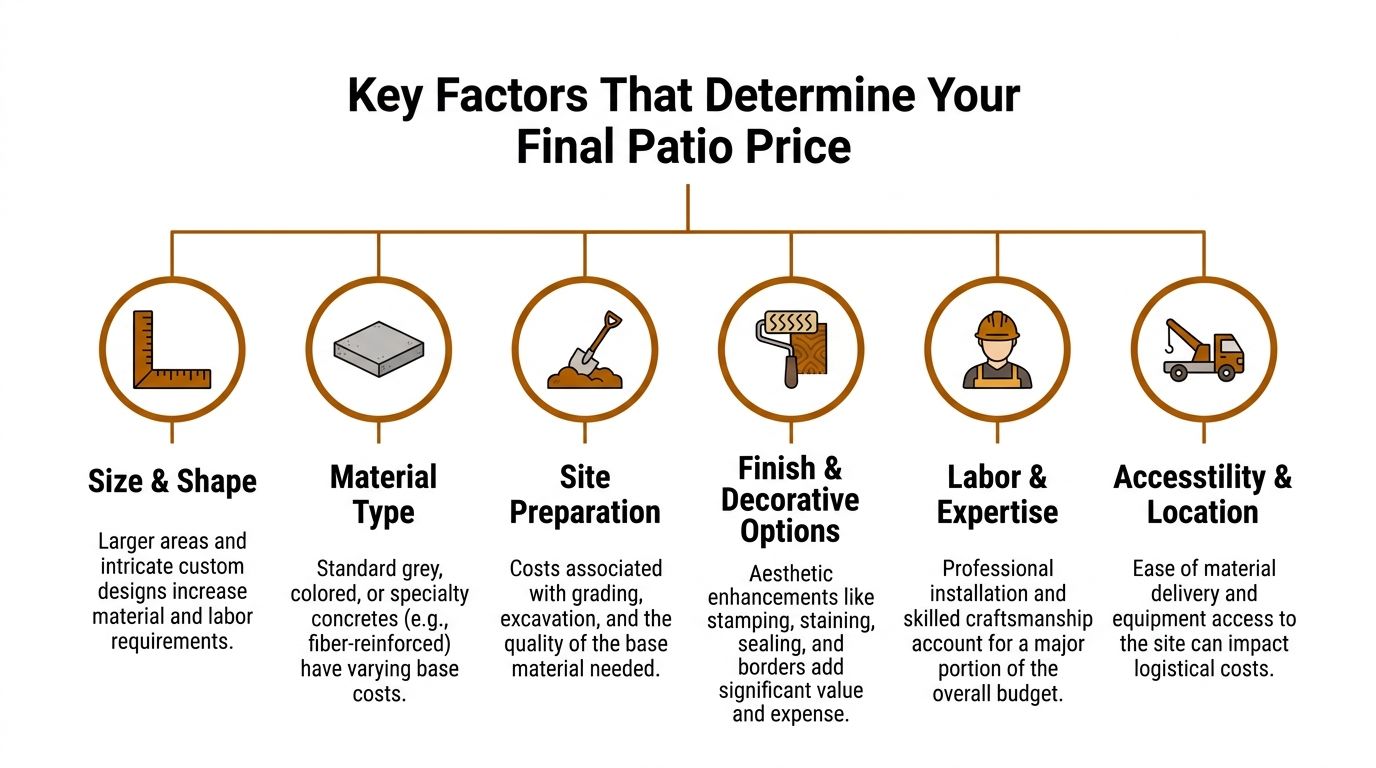
Two patios can be the same square footage and still price out very differently. The reason is simple. Final cost is built from several job-specific pieces, not just one square-foot number.
Size and thickness
Size is the first driver because larger patios need more material, more labor, and more finishing time. Shape matters too. A clean rectangle is usually simpler to form and finish than a patio with curves, offsets, or built-in sections around columns, posts, or landscaping.
Thickness also affects cost. A typical patio is built as a standard slab, but some projects call for added strength depending on use, load, or local conditions. In Florida, that conversation often comes up sooner because water movement and soil behavior can expose weak construction faster than a mild climate will.
Site preparation and sub-base
Many low quotes hide risk in this area.
A patio needs a stable base. If the yard has soft spots, old roots, buried debris, poor grading, or elevation issues, the crew has to fix that before the pour. A flat backyard in Belleview won’t always require the same prep as a sloped or uneven lot in Dunnellon.
Some warning signs that usually increase prep work:
- Existing concrete removal: Old cracked slabs, footings, or hardscape have to come out first.
- Poor drainage: Water should move away from the house and away from the patio surface.
- Loose or shifting soil: Sandy ground can work well, but it still needs proper compaction and support.
- Low areas: Depressions often need correction before forming begins.
Reinforcement and control details
A good slab is more than concrete depth. Reinforcement and crack-control planning matter. Depending on the job, contractors may recommend reinforcement choices and details that support durability.
Expansion and control planning is one of the most overlooked parts of the work. If you want a better understanding of that piece, this explanation of what is a concrete expansion joint gives a practical overview.
On-site insight: If a bid barely mentions base prep, reinforcement, or joint layout, ask more questions before you sign anything.
Finish and decorative options
Surface finish changes the budget quickly. A broom finish is usually the most economical. Decorative work takes more labor, more setup, and more finishing skill.
Costs often rise when the project includes:
- Stamped patterns: These mimic stone, brick, or other materials.
- Color integration: Integral color or surface-applied color adds another design layer.
- Borders and saw-cut details: These improve the look, but they also add layout and finishing time.
- Sealing requirements: Some decorative surfaces benefit from sealing to protect appearance.
Access and logistics
Access is a practical cost issue that many owners don’t notice until estimate day. A backyard with a wide gate and clear path is easier to serve than a fenced lot with limited entry, long wheelbarrow runs, or obstacles around the house.
That doesn’t mean the project shouldn’t be done. It means labor and setup can change based on how the crew has to get material, tools, and equipment to the pour area.
Sample Concrete Patio Estimates for Central Florida
A homeowner in Ocala may price a simple patio by square footage and expect one number. Then the site visit happens. The yard holds water after summer rain, the gate is tight, or the back lot needs more prep because of sandy soil. That is why sample estimates help, but local conditions determine the final cost.
For a consistent benchmark, the national ranges cited earlier from LawnStarter still work as a starting point here. Basic concrete pricing sits at the lower end of the budget, while decorative finishes move higher because they add labor, layout time, and finishing skill. In Marion and Citrus County, those ranges are useful for early planning. Florida conditions often push a job up or down inside that range faster than national calculators suggest.
Common patio sizes people ask for
Smaller patios usually serve one purpose. A grill area, two chairs, or a compact spot off a lanai.
Mid-size patios give you better day-to-day use. They fit a dining table, walking space around furniture, and a cleaner transition from the house to the yard. Larger patios start acting more like outdoor living space, especially on homes with pools, sliders, or plans for entertaining.
Here is a simple budget snapshot using the same national square-foot ranges referenced earlier.
| Patio Size (Square Feet) | Standard Broom Finish (Est. Cost) | Decorative Stamped/Colored (Est. Cost) |
|---|---|---|
| 120 | $480 to $1,440 | $960 to $3,600 |
| 168 | $672 to $2,016 | $1,344 to $5,040 |
| 400 | $1,600 to $4,800 | $3,200 to $12,000 |
How these examples fit local jobs
A 120 square foot patio fits a small seating area behind a home in Belleview or Beverly Hills. If access is open and the grade is cooperative, this size often stays closer to the lower half of the range.
A 168 square foot patio is a common sweet spot in places like Ocala, Summerfield, and Lecanto. It is large enough to feel useful without turning into a full backyard buildout. On a straightforward site, this size gives solid value per square foot.
A 400 square foot patio changes the conversation. At that size, drainage, layout, joint placement, and finish quality matter more because mistakes become easier to see and more expensive to correct. This is the range many owners in The Villages or Inverness choose for outdoor dining, entertaining, or tying together multiple doors and activity zones.
In Central Florida, large patios also collect more heat and more stormwater. That can affect where the slab should slope, how it ties into existing structures, and whether the base needs extra attention.
Square footage gets you a planning range. Site drainage, soil conditions, access, and finish level usually decide where the final quote lands.
What these estimates don’t include
These sample numbers are budget anchors, not full project quotes. They may not include:
- Tight backyard access or long material runs
- Drainage correction for heavy summer rain
- Demolition and haul-off of an old slab
- Extra base work for soft spots or shifting sandy soil
- Complex forming around lanais, screens, pools, or landscaping
- Upgraded reinforcement for heavier use or problem areas
Two patios with the same 20 by 20 footprint can price very differently in Marion or Citrus County. On one lot, the crew forms, pours, and finishes without much resistance. On another, the site needs grading, thicker edge support, or extra labor just to get concrete to the back yard. That difference matters more here than many national patio calculators account for.
Upgrading Your Look with Decorative Concrete
A plain slab does the job. Decorative concrete changes the job from functional to finished.
For many homeowners, that upgrade is worth it because the patio becomes part of the home’s design rather than just an outdoor surface. The right finish can tie into the house, landscaping, pool area, or outdoor kitchen without the maintenance demands that often come with more complex materials.
Stamped concrete
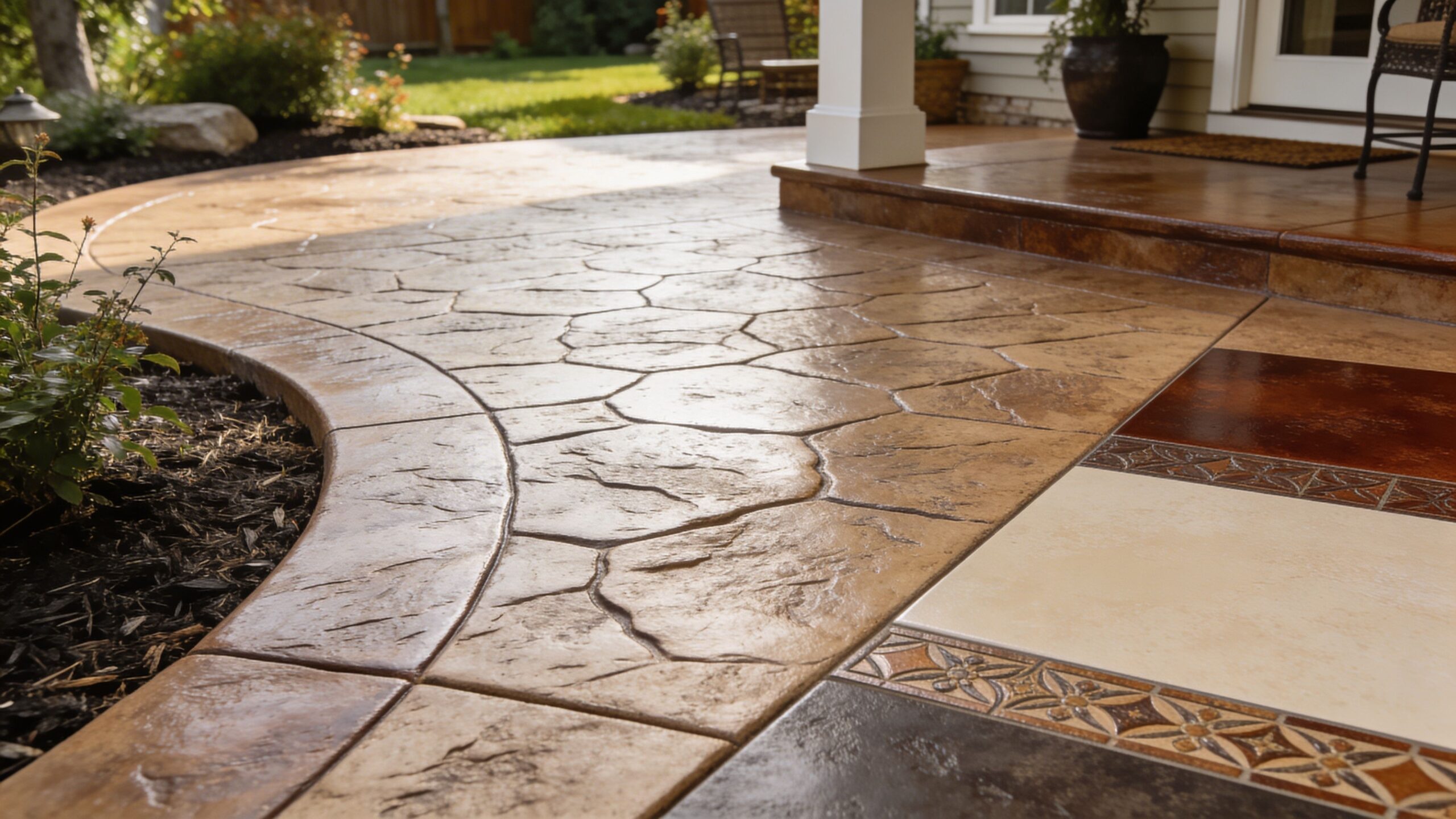
Stamped concrete is a frequently requested option. It’s designed to create texture and pattern so the slab resembles stone, brick, or similar materials.
The main advantage is visual impact. You get a more custom look without building the patio from separate individual units. The trade-off is cost and execution. Decorative work leaves less room for sloppy timing or weak finishing practices.
Stamped surfaces can be a strong fit when:
- You want the look of pavers or stone
- The patio is a focal point in the yard
- You’re building an entertainment area, not just a utility pad
Colored concrete and accent work
Color changes the personality of a patio fast. Some owners want an earth tone that blends into the house and surroundings. Others prefer borders, bands, or saw-cut patterns that break up a large slab visually.
This kind of work often makes sense on front-entry patios, screened lanai extensions, and backyard spaces where appearance matters as much as square footage. It’s less about showing off and more about making the concrete feel intentional.
What works well in Florida and what doesn’t
Not every decorative choice is smart for every property.
A patio still has to perform in heat and rain. If the finish is too slick for the location, or if the design creates maintenance headaches the owner won’t keep up with, the extra money wasn’t well spent. In many Central Florida settings, a lightly textured surface is the safer practical choice, especially near wet areas.
Decorative concrete pays off when the finish matches how the patio will be used. Good looks matter, but traction, drainage, and durability matter more.
If the budget is tight, many owners get the best balance by keeping the shape simple and putting money into one upgraded finish detail rather than trying to customize every inch of the slab.
Budgeting Smart for Your Florida Concrete Project
A patio quote in Central Florida can look reasonable on paper and still miss the costs that drive the job. I see that happen when national calculators treat an Ocala backyard, a Dunnellon lot, and a property closer to the Gulf as if the ground conditions are all the same. They are not.
In high-humidity Florida markets, site prep for sandy soils and flood risk can add 20 to 50 percent to the base cost, according to ZBL Concrete’s pricing discussion. Reinforcement and slab thickness also get more attention here because long sun exposure, heavy rain, and shifting subgrade put more stress on a patio than many out-of-state pricing tools account for.
A local quote should reflect your lot, your drainage, and your access. Square footage is only the starting point.
Read the quote for scope, not just price
The lowest number often leaves out the work that keeps a patio from settling, cracking early, or holding water after a summer storm. In Marion and Citrus County, that missing scope usually shows up in grading, base work, reinforcement, or cleanup.
Check the estimate for these items:
- Excavation and grading: Is the contractor pricing the ground work, or only the concrete itself?
- Base preparation: Sandy soil can drain well, but it still needs a stable, compacted base.
- Reinforcement details: Wire mesh, fiber, or rebar should be listed if included.
- Finish type: A basic broom finish costs less than stamped, colored, or sealed concrete.
- Cleanup and haul-off: Spoil removal and final site cleanup should be part of the written price.
If a bid is far below the others, ask what was excluded. That one question can save you from paying twice.
Match the slab to the property
A patio behind a home in Ocala may need a different approach than one in Homosassa or Crystal River. Some lots stay dry and give crews easy machine access. Others have softer ground, tighter gates, tree roots, or drainage patterns that force more hand labor and more prep time.
Those details affect price fast.
They also affect what kind of patio makes sense. A simple, well-built slab with proper slope often delivers better value than a larger decorative patio installed over weak prep. In Florida, water management and base stability usually matter more than adding square footage for the sake of it.
Where owners save money without cutting corners
Good budgeting is mostly about choosing where the money goes first.
Three moves usually keep costs under control without hurting service life:
- Keep the layout simple. Straight edges, fewer corners, and standard dimensions reduce forming time and waste.
- Use one upgrade, not several. A single border, saw-cut pattern, or color upgrade can improve the look without pushing the whole project into premium pricing.
- Handle drainage before the pour. Correcting runoff after the slab is in place costs more and limits your options.
Cheap shortcuts usually show up in the parts you cannot see once the job is finished. Thin base, weak compaction, rushed finishing, or poor slope can turn a budget patio into a repair project. A smart budget in Central Florida is not about getting the lowest price. It is about paying for the parts that help the slab hold up in heat, rain, and sandy soil.
Long-Term Value Maintenance and Return on Investment
A patio in Central Florida earns its keep over time, not on pour day. In Marion and Citrus County, the slabs that hold up best are the ones built for hard sun, heavy summer rain, and soil that can shift or wash out if water is not controlled.
That matters because long-term cost is usually decided after installation. A lower bid does not stay cheap if the patio starts settling at one corner, traps water against the house, or loses its finish after a few wet seasons. A properly installed concrete patio is easier to live with and easier to maintain.
Routine care is simple. Keep leaves and dirt from holding moisture on the surface. Rinse off mildew and tannin stains before they set. If you chose a decorative finish, reseal it on the schedule that fits the product and the amount of sun and rain the slab gets.
Why durability changes the math
The return is not only about resale. It is about how well the patio works year after year.
For a homeowner, that can mean a clean, stable place for grilling, seating, and poolside traffic without constant upkeep. For a rental, HOA, or managed property, it means fewer complaints, fewer trip hazards, and less patchwork spending.
Florida conditions expose weak work fast. Poor drainage stains the slab and softens the edges. Inadequate base prep can show up as settlement in sandy areas after repeated rain. Decorative coatings and sealers also need realistic expectations. Some look great at first but need more maintenance in full sun than owners expect.
That is why I tell customers to judge value by service life, maintenance demands, and how the patio handles weather on their lot. If you want pricing and recommendations based on local site conditions, start with a concrete patio installation quote in Central Florida. A well-built slab usually costs less to own, even if it is not the cheapest number on paper.
Frequently Asked Questions and Get Your Free Estimate
Does concrete make sense in Central Florida?
Yes, if it’s installed with the site and weather in mind. Concrete is a practical fit for patios in Marion and Citrus County because it’s durable, versatile, and available in both simple and decorative finishes.
Is concrete cheaper than pavers?
In many cases, yes. The verified pricing above shows concrete often starts from a lower baseline, especially for plain broom-finish installations. Pavers may appeal for style, but they usually aren’t the budget-first choice.
Can an old patio be removed and replaced?
Yes. Many jobs involve demolition and replacement when the existing slab is cracked, settled, or poorly located. The exact scope depends on access, haul-off, and the condition of the base underneath.
Do permits matter for patio work?
They can. Permit requirements vary by location and project type, so it’s smart to confirm local requirements before work starts.
What areas do you serve?
Homeowners and property managers often look for help in Ocala, Dunnellon, Belleview, Silver Springs, Summerfield, Crystal River, Homosassa, Inverness, Lecanto, Beverly Hills, Hernando, The Villages, and surrounding parts of Marion and Citrus County.
Do you handle more than patios?
Yes. Many owners also need driveway replacement, sidewalks, slabs, asphalt seal coating, parking lot striping, and ADA-compliant markings. If you're comparing local options for patio work, this page on patio installation near me is a useful next step.
If you're ready to get a real number for your project, contact Riverside Sealing & Striping, LLC for a free, no-pressure estimate. They serve Marion County, Citrus County, Ocala, Dunnellon, Crystal River, Inverness, The Villages, and surrounding Central Florida communities with reliable concrete construction and asphalt maintenance services, including patios, driveways, sidewalks, seal coating, striping, and ADA-compliant pavement improvements.