
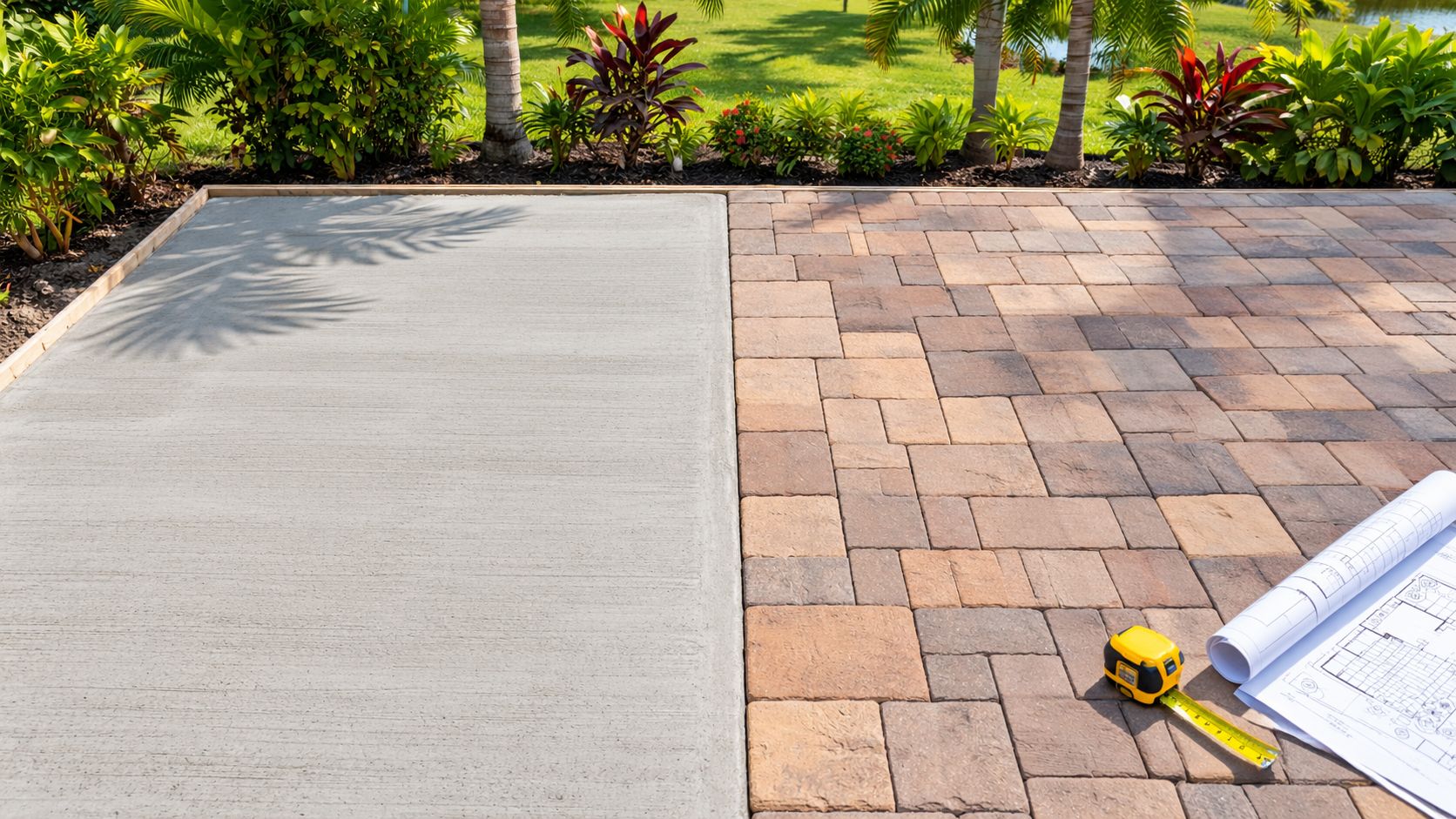
A typical Central Florida patio installation costs roughly $5 to $40 per square foot, with most Marion and Citrus County projects landing between about $2,000 and $8,000. On Florida lots, site preparation and drainage usually determine whether your quote stays near the low end or climbs toward the high end.
You may be in Ocala, Dunnellon, Crystal River, or Inverness right now, comparing three patio bids that don't seem to describe the same project. One contractor prices a simple slab, another includes excavation and a compacted base, and a third has allowed for drainage, root removal, premium finish work, and difficult access. The material name on the quote gets your attention, but the ground underneath usually controls the actual patio installation cost.
Table of Contents
- What Most Homeowners in Central Florida Pay for a Patio
- How Material Choice Drives the Per-Square-Foot Price
- Patio Size and Layout and the Total Dollar Amount
- Florida Site Prep Drainage and Access Costs That Move the Number
- Lifecycle Cost Over 10 to 20 Years for Concrete Pavers and Stone
- How to Get Accurate Patio Quotes in Marion and Citrus County
- Budgeting Permits and Maintenance for Central Florida Patios
- Questions Homeowners Ask After Reading a Patio Cost Guide
What Most Homeowners in Central Florida Pay for a Patio
A homeowner in Ocala or Inverness requests three bids for the same 300-square-foot patio. The estimates come back at $2,400, $6,500, and $11,000. Each figure can be reasonable because the scopes may include different levels of base preparation, finish work, drainage correction, and site access.
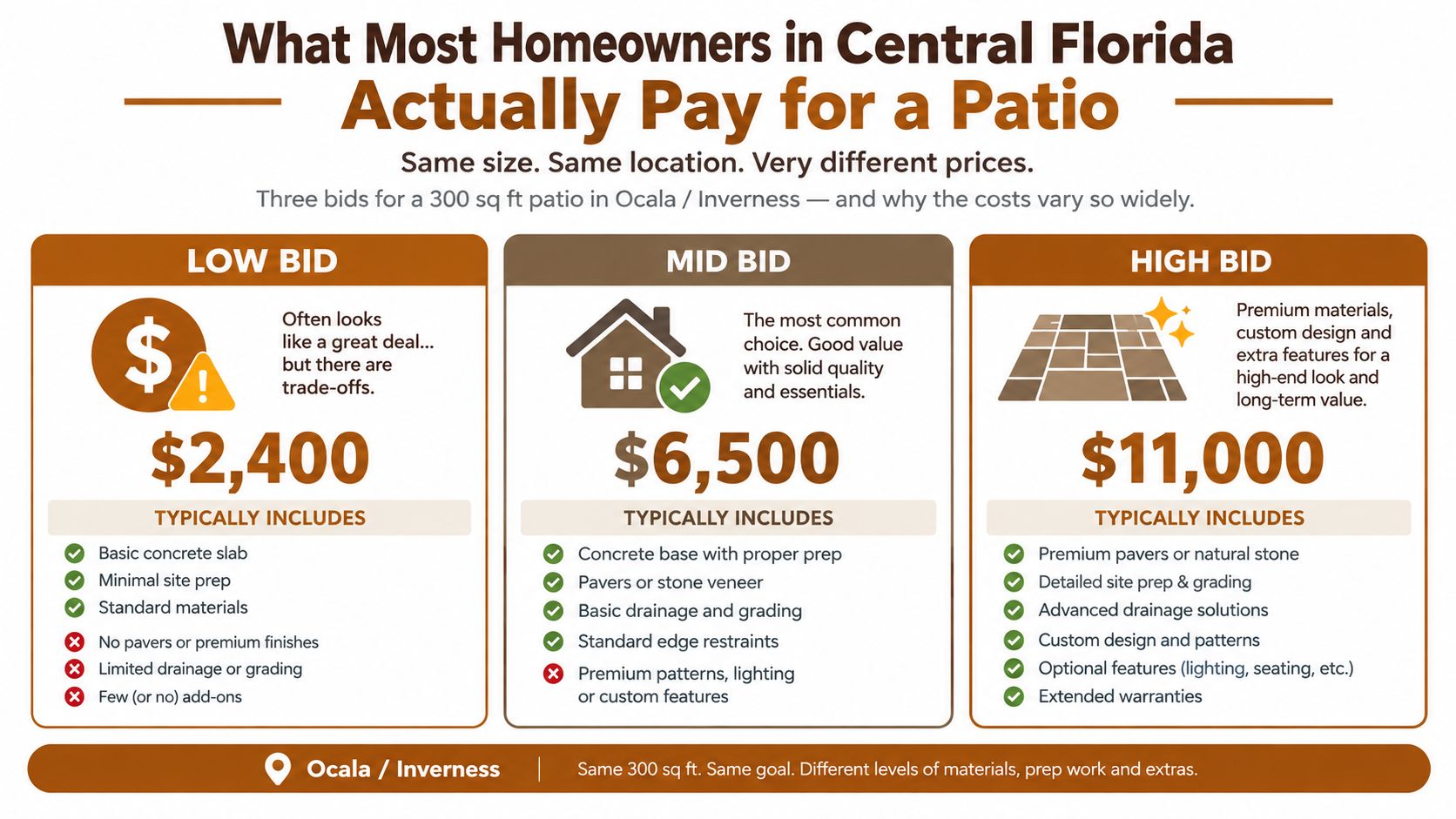
A useful 2026 installed patio benchmark is $5 to $40 per square foot. Small 80 to 100 square foot patios can range from $400 to $4,000, while patios of 400 square feet or more can range from $2,000 to $16,000, according to current patio cost benchmarks. Treat those figures as broad planning ranges, not a property-specific quote. Size, material, labor, drainage, and ground conditions can move the invoice substantially.
For a typical home in Marion County, FL or Citrus County, FL, a straightforward residential project usually fits a working budget of about $2,000 to $8,000. A basic broom-finish concrete patio on flat, cleared sand should sit near the lower end. An engineered paver or travertine patio with a built base, detailed cuts, root removal, or drainage corrections belongs closer to the upper end.
Central Florida soil and weather make the site more important than a material-only price comparison. Sandy subgrade may need additional stabilization, summer rain exposes poor grading quickly, and nearby tree roots can shift pavers or interfere with excavation. The finished surface also needs to direct water away from the home and comply with applicable drainage requirements.
Why three bids can look unrelated
The gap between bids rarely comes from material markup alone. It usually reflects what each contractor included for:
- Subgrade preparation: Excavation, unsuitable soil removal, and compacted aggregate create the foundation beneath the patio.
- Water management: Grading, channel drains, French drains, and discharge planning address runoff moving toward the house.
- Root and site conditions: Root intrusion, soft spots, buried debris, or wet areas can require extra removal and repair.
- Access: A crew placing material near the work area prices labor differently from one carrying every load through a narrow side yard.
- Finish and geometry: A rectangular broom-finish slab requires less cutting and detailing than curves, borders, steps, or decorative concrete.
Practical rule: Do not compare grand totals until every bidder itemizes the base, drainage, demolition, concrete or pavers, labor, access, and cleanup.
Ask what the contractor expects below the surface and how the finished patio will handle a Central Florida downpour. Compare bids from Ocala, Belleview, Summerfield, The Villages, Homosassa, or Beverly Hills by scope, not by the material name or headline price.
How Material Choice Drives the Per-Square-Foot Price
Material sets the visual character of a patio, but installation mechanics set much of the price. National benchmarks place plain concrete around $4 to $12 per square foot, with a typical concrete patio project commonly cited between $1,919 and $5,393. Decorative finishes can reach $30 per square foot, as shown in concrete patio pricing guidance.
For Central Florida budgeting, I use three practical material bands. These are working ranges for comparing scopes, not guaranteed quotes.
| Material | Installed Cost per Sq Ft | Typical Finish Options | Main Labor Driver |
|---|---|---|---|
| Poured concrete | About $6 to $12 | Broom finish, color, stamped details | Forming, reinforcement, finishing, and thickness |
| Concrete pavers | About $14 to $25 | Running bond, herringbone, borders | Individual bedding, cuts, compaction, and jointing |
| Natural stone | About $22 to $40 | Travertine, flagstone, premium borders | Sourcing, irregular cuts, mortar or pedestal setting |
Poured concrete
A basic broom-finish slab is usually the most efficient choice for a flat, accessible backyard. The price rises when the design requires color, stamping, multiple pours, heavier reinforcement, additional thickness, or careful work around existing structures. The slab itself is only one part of the job. Forms, base preparation, delivery access, finishing, control joints, and cleanup all affect the installed figure.
Concrete remains cheaper in many markets than pavers or stone. A separate comparison of concrete and pavers for patios is useful when you're deciding whether a solid slab or modular surface fits your property better.
Concrete pavers
Pavers cost more because the crew builds the surface piece by piece. Workers excavate, install and compact the base, set the bedding layer, place edge restraints, lay each unit, cut perimeter pieces, compact the field, and fill the joints. A simple running-bond pattern is more efficient than a herringbone layout with contrasting borders and many small cuts.
Pavers can be sensible where future repairs matter. A damaged unit can be removed and replaced without demolishing the entire surface, but that repair advantage doesn't eliminate the need for a properly compacted base.
Natural stone
Travertine and flagstone occupy the premium end because sourcing, handling, shaping, and setting take more time. Irregular flagstone creates more fitting and cutting work, while travertine may require a carefully prepared setting system and attention to drainage. Stone can deliver a distinctive outdoor living area, but you shouldn't price it like a basic slab with a more expensive surface.
For a home near Silver Springs, Lecanto, or Hernando, the best material is the one that matches the intended use, drainage plan, surrounding architecture, and maintenance tolerance. A lower initial price doesn't make sense if the selected finish can't handle the way the space will be used.
Patio Size and Layout and the Total Dollar Amount
A patio beside an existing lanai can look like a small job on paper, yet Central Florida access, sand preparation, delivery, and cleanup still require crew time. Square footage starts the estimate. It does not determine the final invoice by itself.
Three useful planning examples
For a 100-square-foot patio, a mid-range concrete assumption of about $10 per square foot produces a surface calculation near $1,000. The practical project floor can reach roughly $1,800 to $2,500 after minimum mobilization, dump fees, and base preparation. Small patios often carry a higher effective price per square foot because those fixed tasks cannot be spread across much area.
A 300-square-foot patio makes material differences easier to see. At approximately $10 per square foot, mid-range concrete totals roughly $3,000. At approximately $20 per square foot, pavers total roughly $6,000 before site-specific adjustments. Those figures are planning math only. Slope, loose sand, roots, drainage, and equipment access can move the quote substantially.
A 400-square-foot or larger entertaining patio distributes some mobilization and labor across more area, but the total invoice still rises. Curves, steps, separate seating zones, long material runs, and drainage work add labor. Around a pool or outdoor kitchen, the crew must also set elevations carefully so rainwater does not collect against the home or flow toward neighboring improvements.
| Patio Size | Low-End Material | Mid-Range Material | High-End Material |
|---|---|---|---|
| 100 sq. ft. | About $500 | About $1,000 | About $4,000 |
| 300 sq. ft. | About $1,500 | About $3,000 | About $12,000 |
| 400+ sq. ft. | About $2,000 | About $4,000 | About $16,000 or more |
These table figures reflect broad installed ranges from patio cost data by size and material. Use them to compare project scale, not to promise a final price. The smaller example can exceed simple multiplication because setup and preparation remain necessary.
Layout can matter as much as area. A clean rectangle reduces cuts and formwork. Curved edges, diagonal patterns, built-in steps, and separate grill pads increase layout time and material handling. Mark furniture locations, grill clearance, walking paths, and door swings before choosing the shape. A slightly larger, simpler layout is often more practical and less expensive to build than a smaller design crowded with curves.
Florida Site Prep Drainage and Access Costs That Move the Number
Central Florida patios fail at the base more often than they fail at the surface finish. Sand can drain quickly, but loose or disturbed sand still needs proper compaction. Organic soil, roots, fill, and areas that stay wet require a different response than clean, stable subgrade.
Site preparation and excavation commonly add about $1 to $5 per square foot, depending on grading, removal, and soil conditions, according to concrete patio site-preparation guidance. A standard 4-inch compacted gravel base is commonly priced at about $1 to $1.50 per square foot. Those figures explain why two patios with identical surface materials can have very different totals.
What the crew is solving below the patio
A contractor should identify low areas, soft pockets, exposed roots, old slabs, buried debris, and soil that won't compact properly. Live oak roots deserve particular attention around Ocala, Dunnellon, Silver Springs, and The Villages. Cutting roots without a plan can damage the tree, while leaving major roots directly beneath the patio can create future movement.
A concrete slab also needs adequate thickness and reinforcement. Broward County guidance states that a slab placed directly on supporting soil must be at least 4 inches thick and reinforced with not less than 0.028 square inches of reinforcing per linear foot in each direction. You can review the concrete patio specification reference when discussing slab details with a contractor.
Where rainwater goes
Summer storms expose weak grading quickly. The finished surface should move water away from the home, doors, foundations, and neighboring improvements. Depending on the lot, the solution may be positive grading, a channel drain at a transition, a French drain, or a discharge route that does not relocate the problem.
Water management isn't an accessory. It is part of the patio structure and should appear in the written scope.
Access changes labor too. A tight side yard, narrow gate, steps, landscaping, or a distant street location can require manual wheelbarrow hauling. Concrete trucks and equipment may not reach the work area, and paver pallets may need to be moved in smaller loads.
A base installation priced at $4,000 can climb to approximately $6,500 after meaningful preparation is added, and reach about $9,000 when drainage and difficult access also need to be solved. These are project examples, not universal quotes. They show why the surface price alone isn't a reliable budget.
For a practical explanation of the ground work, review how to prepare ground for a concrete slab. Ask the estimator to identify the existing grade, proposed finished elevation, base material, compaction method, and drainage destination.
| Prep or Drainage Item | Typical Cost Adder | When It Applies |
|---|---|---|
| Compacted gravel base | About $1 to $1.50 per sq. ft. | Standard slab or paver foundation |
| Excavation and site preparation | About $1 to $5 per sq. ft. | Grading, removals, poor soil, or uneven ground |
| Root and unsuitable-soil removal | Project-specific | Live oak roots, organic soil, or buried debris |
| Drainage correction | Project-specific | Runoff toward the home, pooling, or elevation conflicts |
| Difficult access | Project-specific | Narrow gates, long hauling distances, or restricted equipment |
Lifecycle Cost Over 10 to 20 Years for Concrete Pavers and Stone
The cheapest patio to install isn't automatically the cheapest patio to own. Concrete offers a lower first cost, but a crack caused by root movement or poor subgrade may require a larger repair. Pavers cost more at installation, yet individual units can be removed and replaced when the underlying base remains serviceable.
Routine maintenance can run $0.30 to $0.75 per square foot annually, while a reseal may cost $1 to $2 per square foot at the relevant service interval, based on patio ownership and maintenance guidance. Paver releveling can run $2 to $4 per square foot when sections settle and need to be lifted, corrected, and reset.
Comparing the ownership pattern
Poured concrete usually needs cleaning, crack observation, and periodic sealing when the finish or exposure calls for it. Pavers need joint attention, weed and ant control, occasional sand replacement, and possible releveling after repeated rain or movement. Natural stone can require more careful cleaning and sealing because staining, surface wear, and uneven pieces are more visible.
| Material | Install Cost (per sq. ft.) | Maintenance (per sq. ft. per year) | 20-Year Total (300 sq. ft.) |
|---|---|---|---|
| Poured concrete | About $6 to $12 | About $0.30 to $0.75 | Installation plus roughly $1,800 to $4,500 in routine maintenance |
| Concrete pavers | About $14 to $25 | About $0.30 to $0.75 | Installation plus roughly $1,800 to $4,500, with releveling if needed |
| Natural stone | About $22 to $40 | About $0.30 to $0.75 | Installation plus roughly $1,800 to $4,500, with premium repairs possible |
The table uses the 300-square-foot example and routine maintenance range cited above. It doesn't pretend to predict a specific home's repair history. Root intrusion, drainage failure, staining, furniture movement, and poor original installation can change ownership cost substantially.
My recommendation is straightforward. Choose poured concrete when you want a clean, economical surface and the base can be prepared correctly. Choose pavers when repairability and design flexibility justify the higher entry price. Choose natural stone when appearance is the priority and you're willing to fund more detailed installation and maintenance.
How to Get Accurate Patio Quotes in Marion and Citrus County
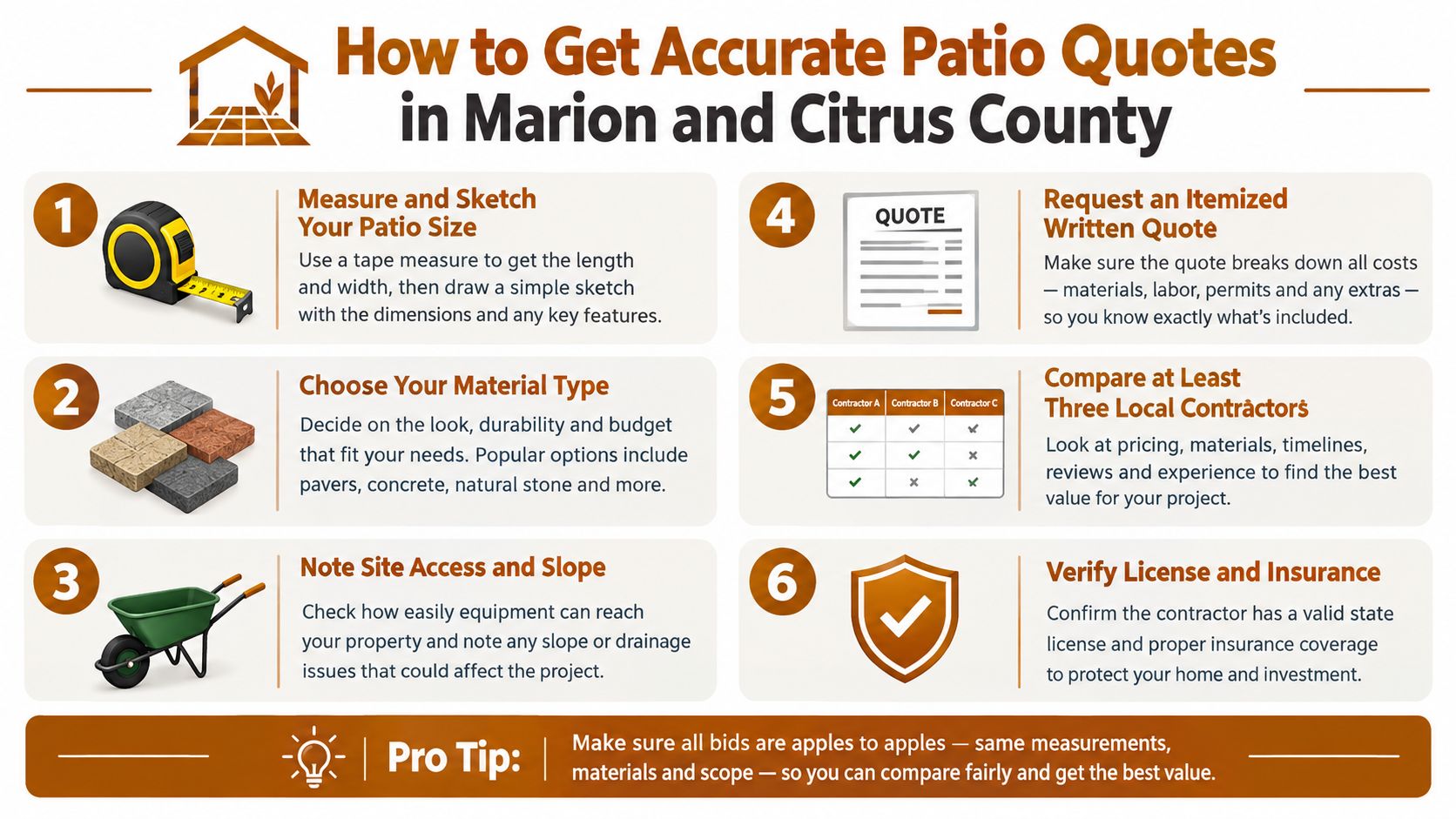
You can improve your quotes before the first contractor arrives. Spend ten minutes measuring the approximate area, photographing the yard from several angles, noting standing water or erosion, and writing down how you'll use the space. Tell each bidder whether the patio will hold a grill, dining furniture, lounge seating, a spa, or a connection to an existing lanai.
Ask every contractor the same questions
Use a written checklist so the lowest number doesn't win only because it leaves out essential work.
- What happens below the surface? Ask about excavation, base material, thickness, moisture, and compaction equipment.
- How will water leave the area? Request the proposed slope and any channel drain, French drain, or discharge solution.
- What exactly is included? Confirm demolition, root removal, hauling, forms, reinforcement, finish, joints, cleanup, and restoration.
- Who handles permits and reviews? Ask whether the contractor checks county, city, stormwater, and HOA requirements.
- What warranty applies? Get the coverage and exclusions in writing, especially for cracking, settling, drainage, and workmanship.
- Can you verify licensing and insurance? A professional contractor should be comfortable providing documentation.
A lowball quote often uses vague language such as “prepare area as needed” or “drainage by owner.” It may omit compaction, base depth, permit handling, access difficulty, or disposal. Cash-only pricing and pressure to start immediately are also reasons to slow down and ask for a complete written scope.
The best quote isn't the cheapest total. It's the quote that makes the most assumptions visible.
Require separate lines for site preparation, material, labor, drainage, access, permits, and cleanup. Then compare the bids in Marion County, FL and Citrus County, FL using the same dimensions and finish. The following video provides another visual reference for discussing patio quote details:
A licensed and insured local contractor with reliable scheduling should be able to explain why the work is priced as quoted. That conversation matters more than a polished estimate with no excavation or drainage detail.
Budgeting Permits and Maintenance for Central Florida Patios
Your patio budget shouldn't stop at the installation invoice. In Central Florida, a project may involve building-permit review, impervious-surface rules, drainage considerations, footers, screened or covered structures, and HOA approval. Requirements vary across Marion County, Citrus County, Ocala, Crystal River, Inverness, and surrounding jurisdictions, so verify the address-specific rules before work starts.
Ground-level paver patios may receive different treatment from concrete slabs, while covered patios, screened enclosures, structural connections, and footers can trigger additional review. An unpermitted improvement can create problems during inspection, refinancing, insurance review, or resale. Put responsibility for permit research in writing rather than assuming the homeowner or contractor will handle it.
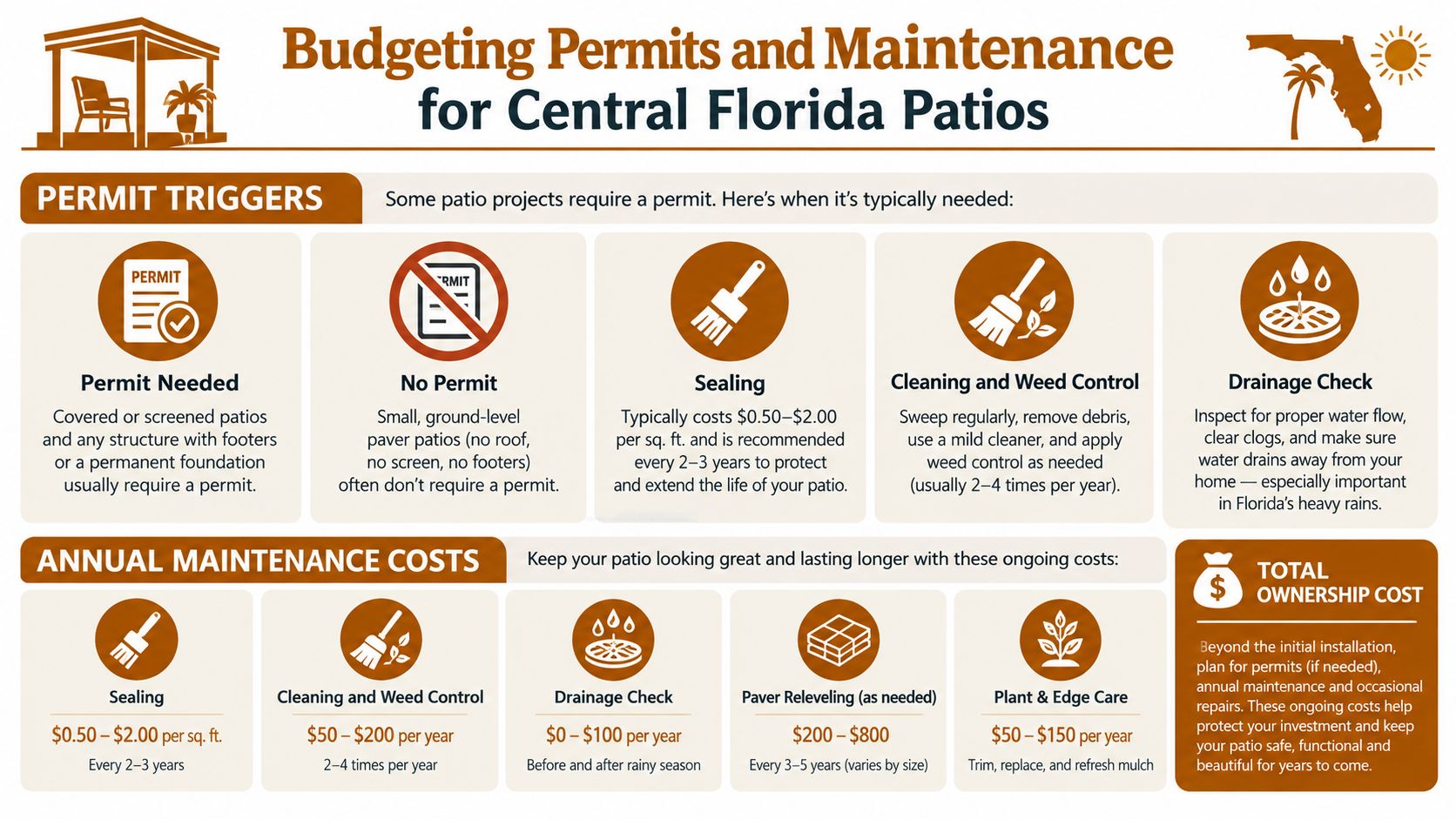
Maintenance planning depends on the material. Concrete owners should budget for cleaning, finish care, and inspection of cracks or joint areas. Paver owners should watch for weed growth, joint loss, ant activity, and localized settlement. Stone owners should expect more attention to staining, sealing, and surface appearance.
A drainage check after heavy summer rainfall can identify pooling before it reaches the foundation or undermines an edge. For practical care guidance, use this resource on concrete patio maintenance.
Build a maintenance reserve into the project from the beginning. The exact amount depends on surface type, tree coverage, drainage, traffic, and exposure. A properly prepared patio with a clear maintenance plan is less likely to become an expensive surprise after the first wet season.
Questions Homeowners Ask After Reading a Patio Cost Guide
What might monthly financing look like?
There isn't a responsible single monthly payment without the project price, down payment, interest rate, and term. A $3,000 concrete patio and a $6,000 paver patio may have very different payments, even before financing terms are considered. Ask the contractor whether financing is available, then compare the total repayment amount rather than focusing only on the monthly figure.
Will a patio pay for itself at resale?
A patio can improve curb appeal, outdoor usability, and buyer perception, especially in communities where outdoor living is part of the lifestyle. It won't automatically return every dollar spent, and a percentage-based resale formula doesn't fit every property in Ocala, The Villages, Crystal River, or rural Citrus County. Good design, sound drainage, and workmanship matter more than adding features solely to raise the invoice.
When does a patio need a permit?
A simple ground-level project may have different requirements from a slab connected to a home, a covered or screened structure, a project with footers, or work that changes drainage. Check the governing city or county before excavation, and ask the contractor to document who will obtain approvals.
How long does installation take?
A straightforward patio can move quickly once the design, materials, access, and approvals are settled. Excavation, base work, concrete placement, paver setting, curing, inspections, and weather can extend the schedule. Central Florida summer storms may interrupt site preparation and finishing, so get a written sequence rather than relying on a casual verbal promise.
For a reliable number, request an on-site evaluation. A contractor who measures the area, checks grade and drainage, reviews access, and discusses material choices can give you a useful patio installation cost instead of a generic square-foot guess.
Riverside Sealing & Striping, LLC provides concrete patio and slab installation, site-preparation review, and related concrete work for homeowners in Marion County, Citrus County, and surrounding Central Florida communities. Visit Riverside Sealing & Striping, LLC to request a free, no-pressure on-site estimate and discuss your patio, driveway, sidewalk, or broader concrete and asphalt needs with a licensed and insured local team.