
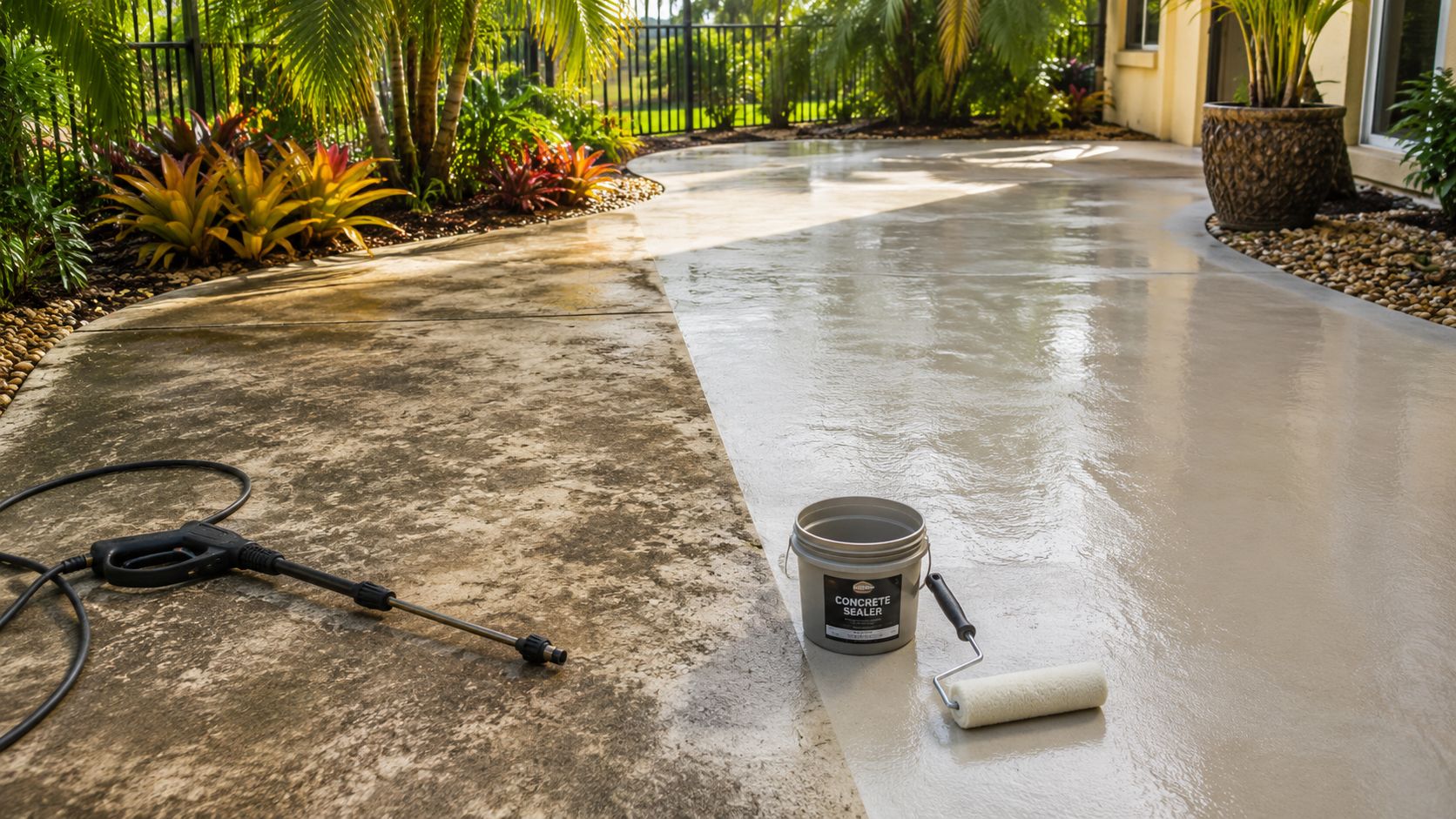
You step onto the lanai after an afternoon storm and notice three things at once: chalky white patches near the pool, dark leaf stains under the furniture, and a faint crack running away from the grill. None of them looks urgent. In Central Florida, though, small surface problems can become expensive repairs when heat, humidity, heavy rain, and pool chemicals keep working on the slab.
Concrete patio maintenance in Marion County, FL and Citrus County, FL is a year-round responsibility, not a single spring cleaning project. The right routine keeps patios safer, cleaner, and more resistant to moisture, UV exposure, staining, and movement.
Table of Contents
- What Concrete Patio Maintenance Really Means in Central Florida
- How Marion and Citrus County Weather Affects Your Patio
- Routine Cleaning and Stain Removal That Actually Works
- Sealing Frequency and Choosing the Right Sealer
- Crack Repair and Joint Care for Lasting Results
- DIY Maintenance Versus Hiring a Local Pro
- Frequently Asked Questions About Concrete Patio Maintenance
What Concrete Patio Maintenance Really Means in Central Florida
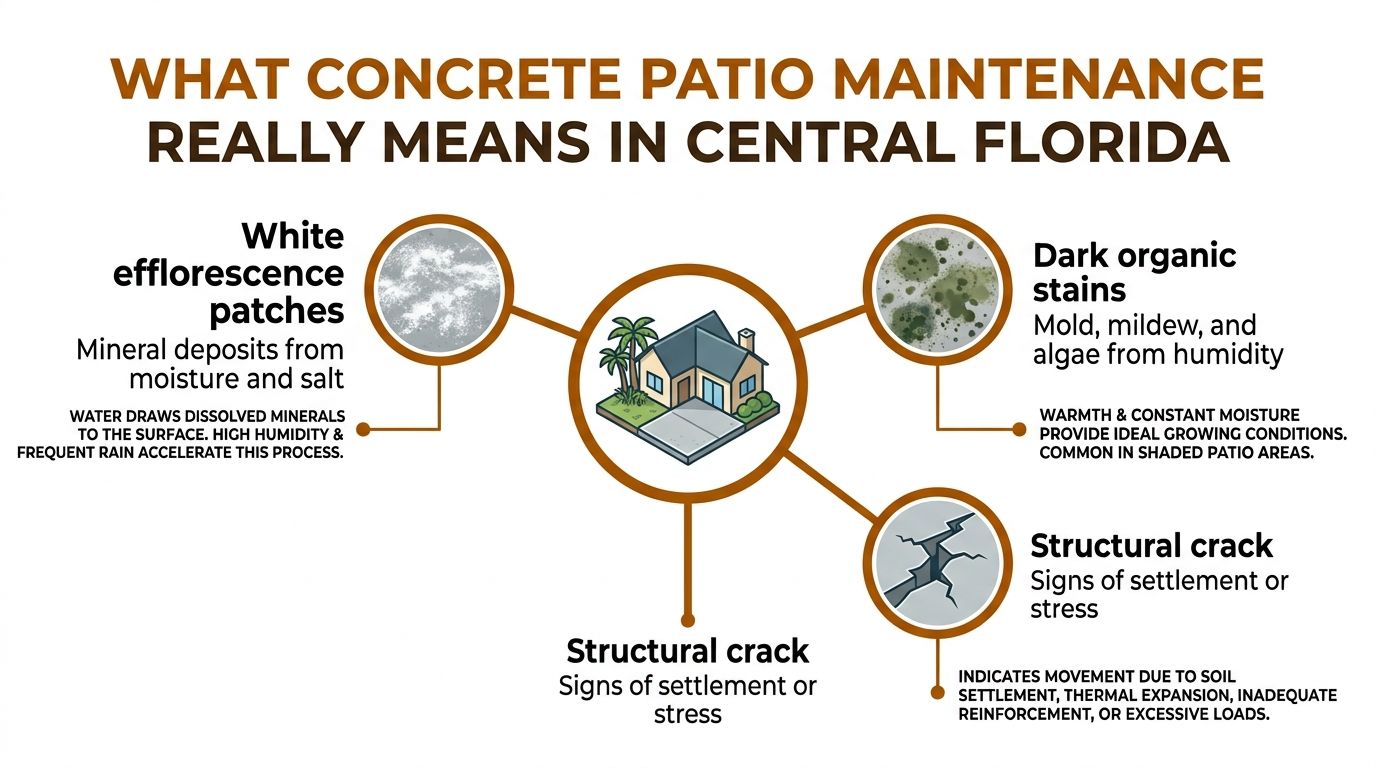
A homeowner in Ocala might hose off a patio after a storm and assume the surface is fine. The white residue may return after drying. The leaf stains may darken under humid air. That faint crack may widen as water enters, evaporates, and returns during repeated weather changes.
Central Florida patios need four forms of attention:
- Routine cleaning removes grit, leaves, algae, and surface residue before they become embedded.
- Stain removal targets grease, tannins, rust, mildew, and pool splash instead of treating every mark with the same chemical.
- Sealing limits water and contaminant absorption, but only when the slab is dry and ready.
- Crack and joint repair keeps minor openings from allowing water beneath the surface and protects movement joints from failure.
Each task addresses a different pathway to damage. Sweeping helps protect the finish from abrasive grit. Cleaning controls organic growth encouraged by humidity. Sealing helps reduce moisture penetration and staining. Flexible joint and crack repairs accommodate movement rather than hiding it under rigid patch material.
Why cold-climate checklists miss Florida problems
Freeze-thaw damage matters in some environments, but Marion and Citrus County homeowners usually face a different daily pattern. A patio may bake in direct sun, absorb humid air, receive a sudden downpour, and get splashed with chlorinated pool water within the same week.
That combination changes the maintenance calendar. You need to watch for fading, mildew, mineral deposits, erosion around slab edges, and chemical discoloration, not just winter scaling. Proper drainage still matters, especially where downspouts or roof runoff discharge near the patio.
Concrete quality also affects service life. In testing involving de-icing calcium chloride, lower-strength concrete lost 46% of its strength, while high-strength concrete lost 13%, and the stronger mix showed much less surface scaling (freeze-thaw durability research). The lesson applies beyond cold regions. A slab with poor mix quality, weak surface mortar, or inadequate protection gives weather more opportunity to cause visible deterioration.
Practical rule: Clean what sits on the slab, control the water that reaches it, and repair openings before they become pathways for deeper damage.
How Marion and Citrus County Weather Affects Your Patio
From Dunnellon and Ocala to Crystal River, Homosassa, Inverness, Lecanto, Beverly Hills, and Hernando, patios deal with a demanding mix of sun and moisture. A covered lanai has different exposure from a full-sun pool deck, but neither is maintenance-free.
Intense UV exposure can fade decorative finishes and make some topical sealers lose their appearance sooner. Humid air supports mildew and algae where shade, furniture, planters, or poor drainage keep the surface damp. Afternoon thunderstorms push water into hairline openings, wash soil against slab edges, and leave organic debris behind.
Pool areas add another concern. Chlorinated or salt-water splash can leave deposits, discolor the surface, or contribute to surface wear when the concrete remains wet and unprotected. The risk increases where swimmers repeatedly exit the pool and where furniture prevents the slab from drying evenly.
| Weather factor | Typical damage | Maintenance response |
|---|---|---|
| Intense sun and UV exposure | Fading, sealer breakdown, surface discoloration | Inspect the finish, clean gently, and choose a sealer suited to exterior exposure |
| Humidity and shaded dampness | Mildew, algae, dark organic staining | Improve airflow, remove debris, and use targeted cleaning rather than aggressive scrubbing |
| Afternoon thunderstorms | Water entry through cracks, runoff staining, edge erosion | Check drainage, redirect downspouts, and repair openings before the next wet period |
| Pool splash and chemicals | Mineral residue, etching, discoloration | Rinse splash zones, remove deposits carefully, and maintain suitable surface protection |
| Furniture and planters | Trapped moisture and uneven fading | Move items periodically so the slab can dry and the finish can be inspected |
A Central Florida patio also needs a drainage review. Technical freeze-thaw guidance recommends a minimum slope of 1/8 inch per foot away from a structure, along with downspouts that don't discharge onto the slab (outdoor concrete drainage guidance). The same principle helps Florida patios, even when freezing isn't the main threat.
A separate durability study measured scaling, mass loss, and ultrasonic pulse velocity across 56 freeze-thaw cycles in a sodium chloride solution, showing why repeatable testing matters when evaluating surface deterioration (concrete freeze-thaw study). For local homeowners, the takeaway is simple: every Central Florida patio generally needs more attentive cleaning and sealing than a generic national checklist suggests.
Routine Cleaning and Stain Removal That Actually Works
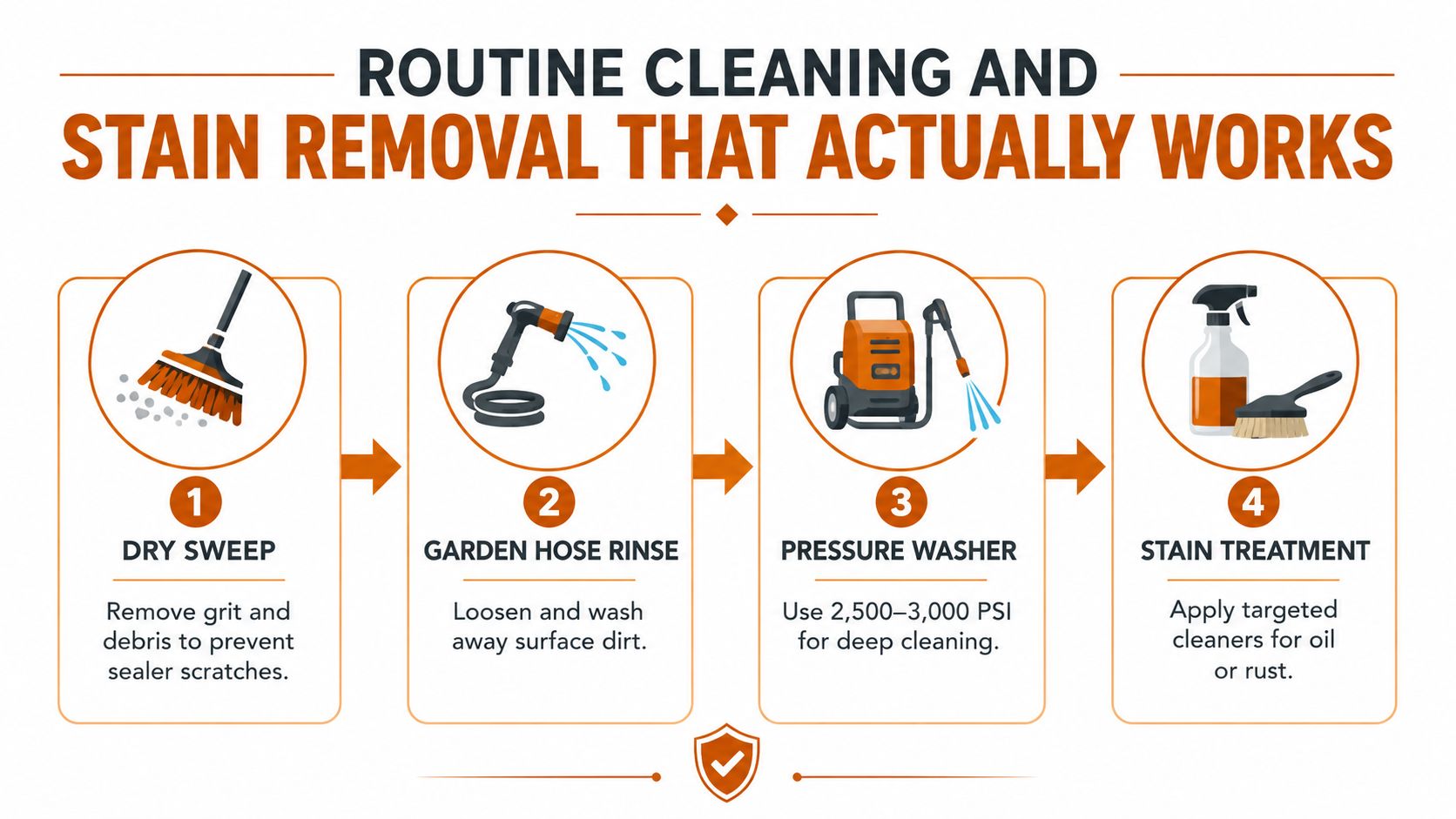
Start with the least aggressive method. Move furniture and planters, then dry-sweep the patio to remove sand, grit, leaves, and loose debris. Wet grit can act like sandpaper against a sealer or decorative finish.
Rinse with a garden hose before using stronger equipment. For an unpainted, sound slab, a pressure washer in the 2,500 to 3,000 PSI range may be suitable, but the setting must match the condition of the concrete (Florida patio pressure-washing guidance). Keep the spray moving and test a hidden area first. Painted, flaking, cracked, or visibly worn concrete needs gentler treatment, and damaged concrete should remain below about 1,200 PSI according to the same guidance.
Match the cleaner to the stain
Use a pH-neutral concrete cleaner for ordinary washing. It removes routine grime without forcing a harsh chemical into the slab. For mildew, oak-leaf tannins, and some organic staining, an oxygenated cleaner can be more appropriate. Let the product dwell for the time stated on its label, then rinse thoroughly. Don't let a cleaner dry in the sun.
Grease near a grill needs a degreaser and agitation. Blot fresh spills before they spread, work in a small area, and rinse completely. Rust requires a concrete-compatible rust treatment, while pool splash deposits may need careful spot cleaning rather than a broad acid wash.
The concrete oil stain removal guide can help with grease-related spots, but test any method on an inconspicuous area before treating the entire patio.
Build cleaning into the Florida calendar
A practical rhythm includes light spring cleaning, a more thorough wash before the hottest summer exposure, a mid-storm-season scrub, and a post-storm-season rinse. That schedule isn't a substitute for addressing spills immediately. It just keeps the routine from depending on memory after the patio already looks neglected.
For painted or coated surfaces, use extra caution. Abrasive tools, acidic cleaners, excessive pressure, and hot water can damage the finish. A garden hose and soft brush are often safer than trying to restore a painted patio with a powerful washer.
Use this short sequence:
- Dry-sweep the entire surface.
- Rinse loose dirt with a hose.
- Apply the selected cleaner to a small test area.
- Scrub or wash using controlled pressure.
- Rinse until no cleaner remains.
- Allow the concrete to dry before inspecting stains or deciding whether it needs sealing.
Sealing Frequency and Choosing the Right Sealer
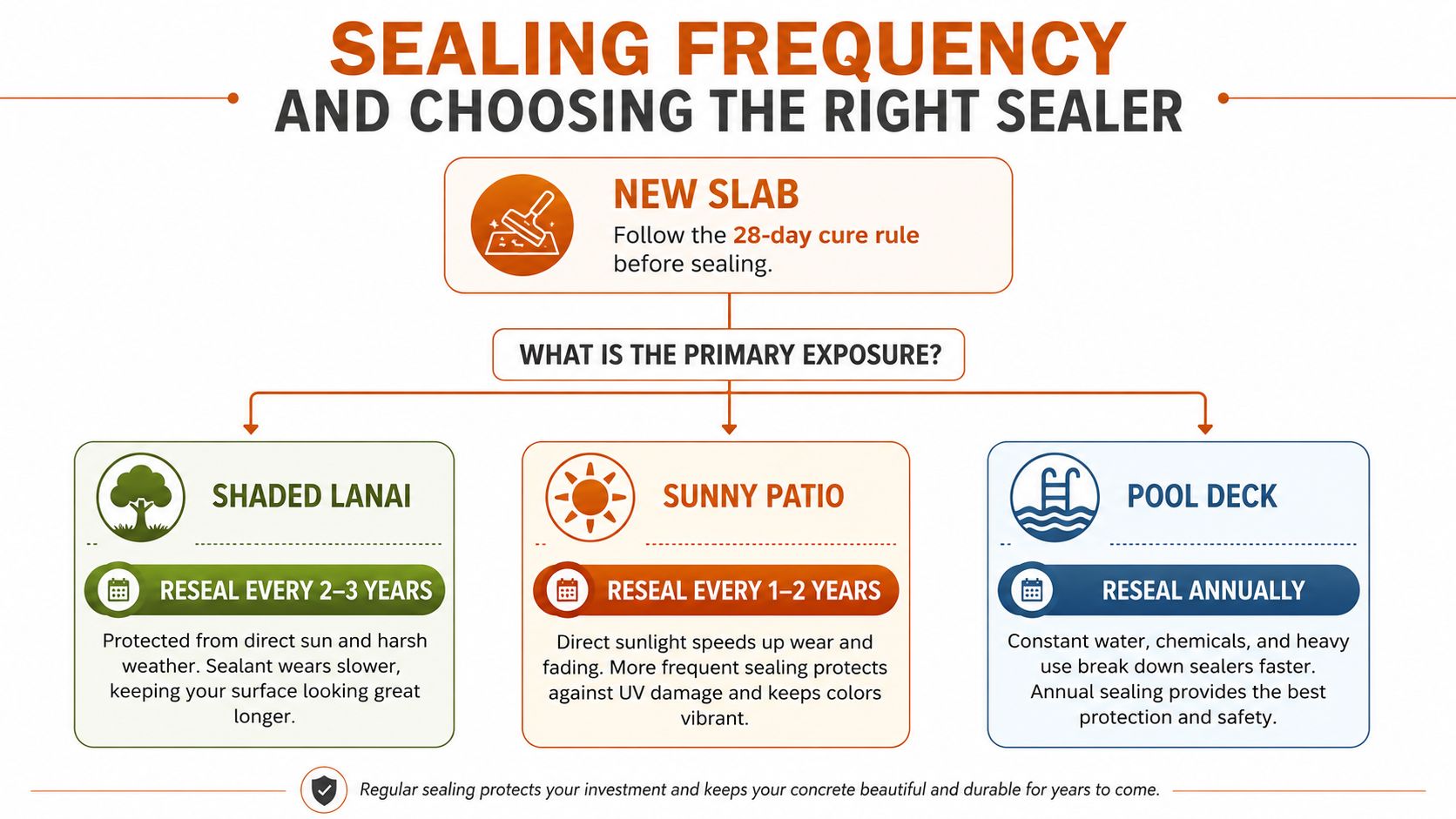
Sealing starts with preparation, not the product. A new patio should cure for at least 28 days before application, as noted in this new patio sealing guidance. The slab must also be dry. Tape clear plastic to the surface for 24 hours. Condensation beneath the sheet means moisture is still present, so wait before sealing.
Central Florida exposure sets the maintenance rhythm. Florida guidance places resealing between 2 and 5 years, depending on the product and exposure, with acrylic sealers generally requiring renewal sooner than penetrating sealers (Florida concrete sealing guide). A patio beside a chlorinated pool, in full sun, or near a driveway deserves earlier inspection than a shaded lanai. Pool splash, intense UV, year-round humidity, and repeated afternoon storms can wear the finish and carry contaminants across the slab.
Judge the patio by its condition, not by the calendar. Look for fading, reduced water repellency, worn walking paths, or spots that absorb stains faster than they did after the previous application. Those signs indicate that the protection is thinning.
Choose the sealer by how the patio is used
Penetrating silane or siloxane sealers suit many exposed Florida patios because they repel water without leaving the heavy surface film associated with some topical coatings. They are a practical option where the priority is moisture resistance and easier maintenance rather than a glossy appearance.
Acrylic sealers can deepen color and create a visible finish. UV exposure, humidity, pool water, and foot traffic can wear that film sooner, so they fit decorative patios when the homeowner accepts more frequent upkeep.
Polyurethane or epoxy systems create a tougher surface film, but exterior installation requires a product rated for outdoor moisture and careful preparation. Vapor trapped beneath the coating can cause blistering or adhesion loss during humid weather. Pool decks also need slip resistance, especially where splash regularly reaches walking areas.
Apply it without trapping moisture
Plan around a dry forecast window of 24 to 48 hours. Clean with a pH-neutral product, rinse thoroughly, and wait until the slab is completely dry. Apply thin, even coats instead of flooding low areas. For products specified for two coats, wet-on-wet application and back-rolling can spread the material more evenly and limit puddling. Follow the manufacturer's instructions for recoat timing and coverage.
Do not seal while moisture is moving upward through the slab. Bubbles, whitening, peeling, and uneven gloss often trace back to damp concrete or poor preparation. Central Florida's frost-free season, from mid-March through early November, is generally a workable period, but the actual slab condition, shade, humidity, and forecast still determine whether application should proceed.
Crack Repair and Joint Care for Lasting Results
A crack isn't automatically a structural emergency, but it does need classification. A stationary hairline opening can often receive a compatible penetrating crack sealer or silica-fortified slurry. A joint that is designed to move needs flexible sealant, not a rigid patch that will tear the next time the slab expands.
Clean the opening first. Remove dirt and loose edges, then use a shop vacuum or leaf blower to clear dust. Narrow cracks may need careful routing so the repair material can bond to sound sides rather than sitting on a dusty surface. Don't widen a crack casually if the slab is heaving, separating, or moving differently on each side.
| Crack or joint type | Width | Recommended repair | When to call a pro |
|---|---|---|---|
| Hairline crack | Under 1/8 inch | Penetrating crack sealer or silica-fortified slurry | If it keeps returning or branches across the slab |
| Small moving crack | 1/8 to 1/4 inch | Backer rod where appropriate and flexible polyurethane sealant | If the edges are offset or the crack is growing |
| Wide crack or open separation | Wider than 1/4 inch | Professional evaluation before patching | Heaving, settlement, differential movement, or water entry |
| Expansion joint | Joint opening | Keep clean and use flexible joint sealant | If the joint is missing, compressed, or allowing slab displacement |
Expansion joints must remain open and functional. Guidance for joint repairs commonly places sealant depth between 1/8 inch and 1/2 inch, with backer rod used for joints wider than 1/4 inch (concrete patio joint care guidance). The backer rod controls sealant depth and helps the sealant move with the joint instead of bonding on three sides.
Know when caulk isn't enough
Flexible sealant works when the surrounding concrete remains stable and the opening is localized. It won't correct a settled slab, a poor base, failed drainage, or a surface with widespread spalling. Patch material may improve appearance temporarily while water continues reaching the underlying problem.
For practical repair options, review professional concrete crack repair before buying products. A contractor should inspect cracks that show vertical displacement, recurring separation, exposed reinforcing steel, substantial surface loss, or water movement toward the home.
Allow the repair to cure according to the product directions before washing or sealing the patio. Rushing that step can pull the repair loose and leave a visible, soft edge.
DIY Maintenance Versus Hiring a Local Pro
Routine sweeping, rinsing, and minor spot cleaning are reasonable DIY work. You can also handle a small, stable crack if you understand the repair material and don't mistake a moving joint for a defect that should be filled rigidly.
The risk rises when you pressure-wash an unfamiliar surface, apply sealer over trapped moisture, or use chemicals near a pool and enclosed lanai. A homeowner may save the labor charge but still lose time correcting etched concrete, streaked sealer, slippery finish, or damaged paint.
Where DIY makes sense
For basic cleaning and a modest maintenance visit, homeowners may spend $80 to $150 on cleaner and sealer, while crack repair tubes may cost around $40 (DIY and professional maintenance comparison guidance). A visit can take 4 to 8 hours, especially when furniture removal, washing, drying, stain treatment, and surface inspection are included.
You may also need a pressure-washer rental, extension equipment, gloves, eye protection, and suitable clothing for chemical products. A 3,500 PSI machine has more power than many patios need, so using the lowest effective pressure and the correct tip matters more than chasing maximum force.
When professional work earns its place
Comparable professional cleaning and resealing for a typical 400-square-foot patio may range from $250 to $600, while crack repair and joint resealing may range from $300 to $900 in Marion and Citrus County. These ranges are project-dependent and should be confirmed through an on-site evaluation. Commercial equipment, hot-water surface preparation, product knowledge, and a controlled application can reduce the chance of a costly mistake.
Professional work is especially useful when:
- The slab has moved: Heaving, settlement, or differential elevation requires more than surface filler.
- The coating is failing: Blistering, peeling, or widespread whitening may require removal and preparation before resealing.
- The setting is hazardous: Pool cages, wet surfaces, ladders, electrical equipment, and enclosed lanais create avoidable safety problems.
- The project is large: Resurfacing, decorative restoration, and extensive joint work need consistent preparation across the whole slab.
- A warranty matters: Commercial-grade sealers and workmanship warranties are easier to manage when one contractor controls the preparation and application.
Slip risk during curing is easy to underestimate. So are chemical fumes in enclosed lanais and falls while reaching around pool-cage structures. Ask about preparation, drying requirements, repair materials, schedule, insurance, licensing, and warranty terms using this guide to questions to ask a concrete contractor.
Riverside Sealing & Striping, LLC provides concrete patio evaluation, cleaning and sealing work, crack and joint repairs, patio construction, and related asphalt maintenance for properties across Central Florida. The company is licensed and insured, offers reliable scheduling, and provides free, no-pressure consultations for homeowners, HOAs, and commercial property managers.
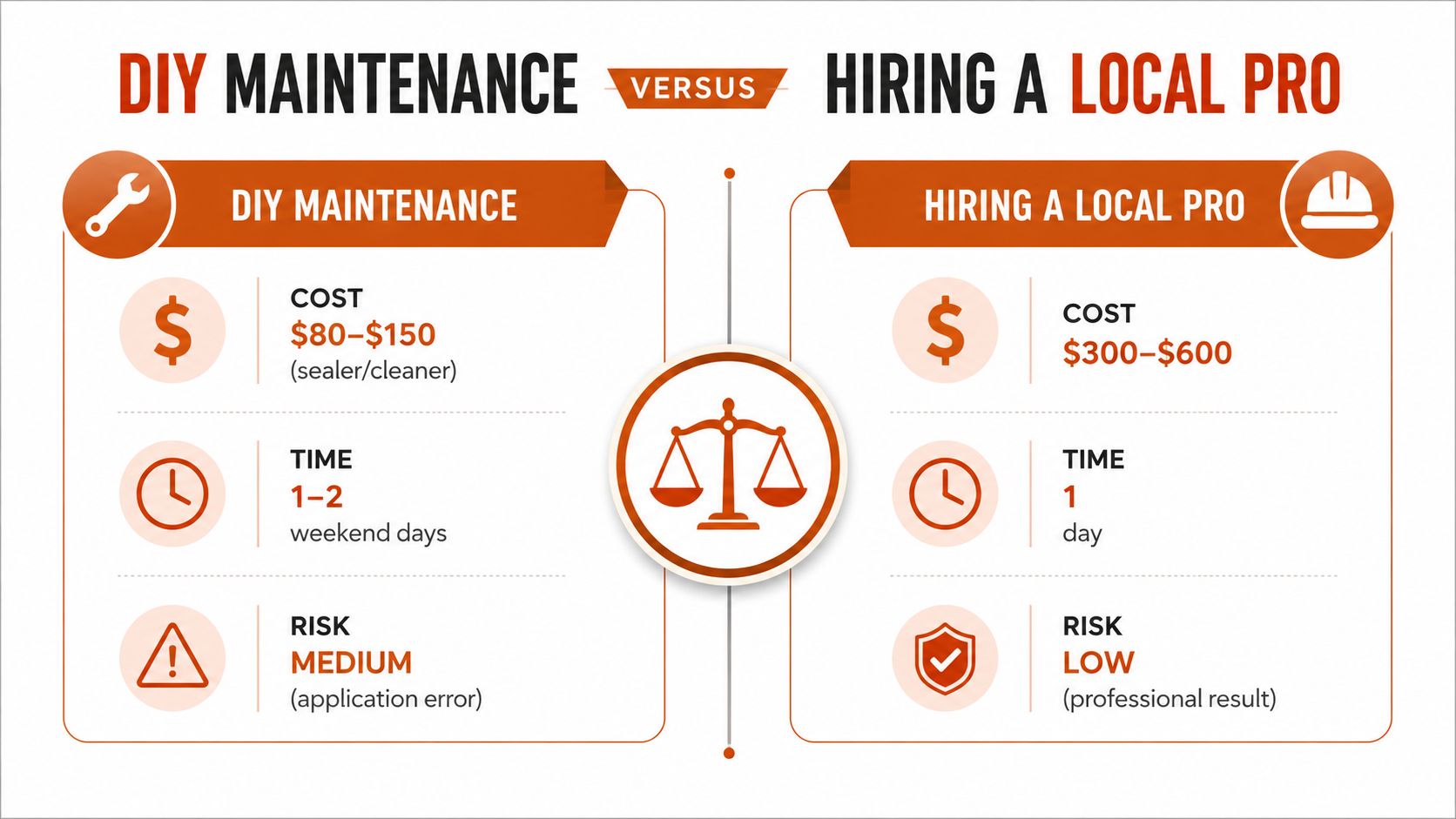
For a patio in Ocala, Belleview, Silver Springs, Summerfield, The Villages, Crystal River, or nearby communities, the right choice depends on the condition of the slab and the consequences of getting the work wrong. A clean, stable surface can remain a DIY project. Storm-damaged concrete, persistent cracks, coating failure, and drainage problems deserve a professional evaluation.
Frequently Asked Questions About Concrete Patio Maintenance
How often should a Florida concrete patio be cleaned?
Inspect the patio throughout the year and clean it whenever leaves, algae, grease, or pool residue accumulate. Florida-focused guidance commonly recommends washing concrete patios every 6 to 12 months, with pressure selected according to the slab's condition (Florida patio cleaning guidance). Shaded, wet, or heavily used areas may need attention sooner than a dry, covered lanai.
Can I seal a new concrete patio right away?
No. Allow a new slab to cure for at least 28 days, then verify that it has dried adequately before sealing (concrete patio sealing guide). Moisture trapped beneath a coating can lead to poor bonding, blistering, or uneven appearance.
Is a penetrating sealer better for a pool deck?
A penetrating silane or siloxane product is often a practical choice for exposed concrete because it provides water resistance without relying on a thick surface film. The right product still depends on the existing finish, decorative treatment, slip requirements, and moisture condition of the slab.
Should I fill an expansion joint with concrete patch?
No. An expansion joint needs room to move. Keep it clean and use a compatible flexible sealant with the correct depth, rather than filling the joint with rigid patching material.
When should I hire a contractor?
Call for an evaluation when cracks are wider, displaced, recurring, or associated with settlement, drainage problems, spalling, or exposed reinforcement. Professional help also makes sense when you need resurfacing, consistent sealer application, or a clear warranty for the completed work.
Riverside Sealing & Striping, LLC offers concrete patio cleaning, sealing, crack and joint repair, drainage-aware patio work, and new or replacement concrete services for homeowners and properties throughout Marion County, FL, Citrus County, FL, and surrounding Central Florida areas. Visit Riverside Sealing & Striping, LLC to request a free, no-pressure evaluation and discuss a practical maintenance plan for your patio.