Your Concrete Project: A Contractor Vetting Checklist
Hiring a concrete contractor for a new driveway in Ocala or a patio in The Villages is a big investment. If you pick the wrong crew, you can end up with early cracking, standing water, sloppy edges, and a job that looks fine on day one but starts failing long before it should.
That risk is real in Central Florida. In Marion County, FL and Citrus County, FL, concrete has to deal with heat, hard rain, shifting soil, and daily vehicle use. A contractor who doesn’t account for drainage, reinforcement, and mix design can leave you paying twice for the same project.
The good news is that bad contractors usually give themselves away when you ask the right questions. Good ones answer clearly, put details in writing, and don’t get defensive when you ask about licensing, estimates, reinforcement, timelines, or warranty coverage.
If you’re comparing bids in Ocala, Dunnellon, Belleview, Silver Springs, Summerfield, Crystal River, Homosassa, Inverness, Lecanto, Beverly Hills, Hernando, or nearby parts of Central Florida, use these questions to ask a concrete contractor before you sign anything.
1. Are They Licensed, Insured, and Bonded?
Start here. If a contractor can’t prove they’re properly licensed and insured, stop the conversation. Nice photos and a low quote don’t matter if the paperwork isn’t right.
This protects you if someone gets hurt on your property, if equipment damages your home, or if the job gets abandoned halfway through. It also tells you whether the contractor is running a real business or just chasing quick jobs around Marion County and Citrus County.
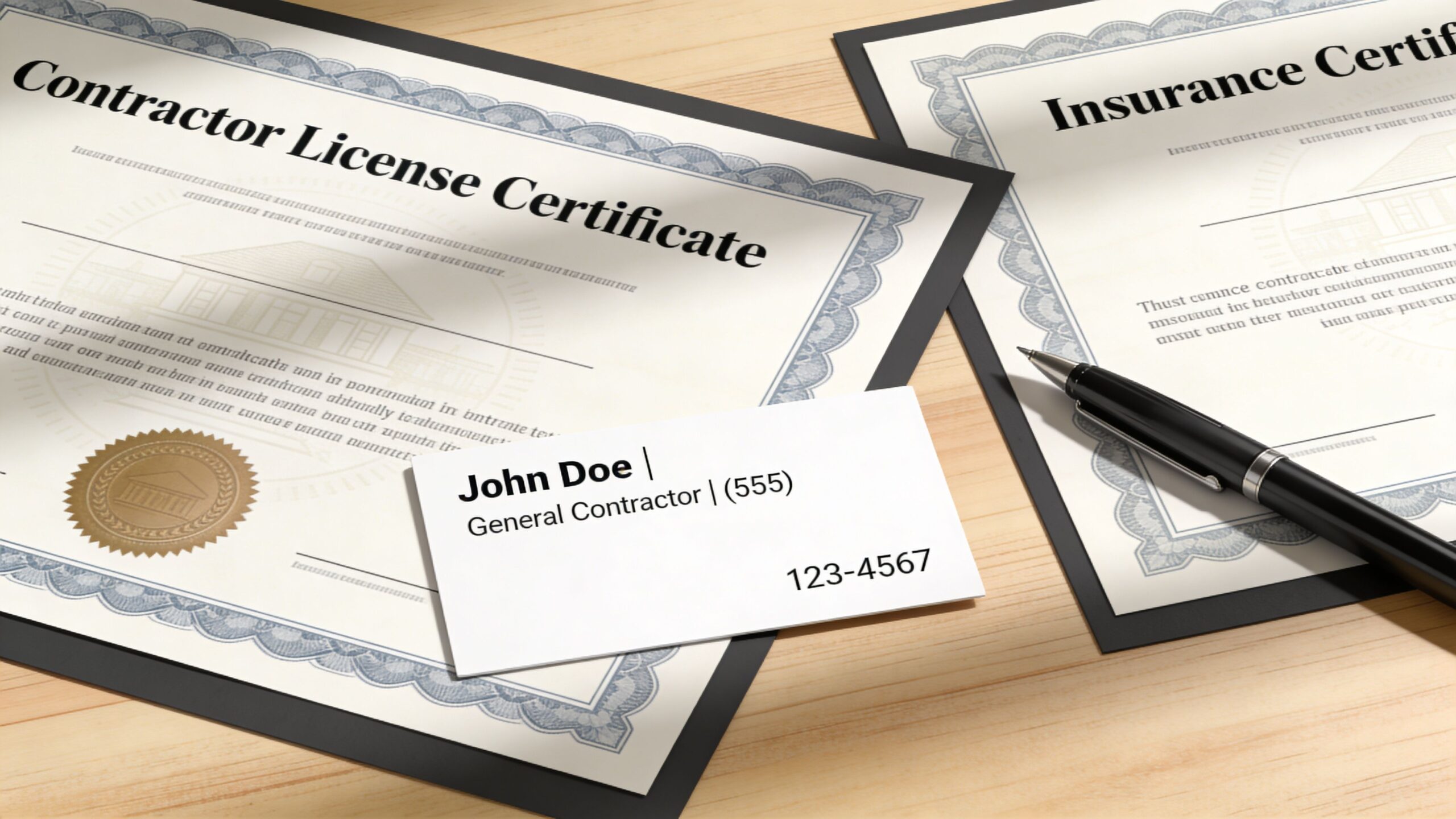
A professional should give you their license number, proof of liability coverage, and documentation for workers’ compensation if they use a crew. If they say, “Don’t worry about it,” worry about it.
What to ask for in writing
Don’t settle for verbal assurances. Ask for documents you can verify before the project starts.
- License details: Ask for the contractor’s license number and verify it yourself through Florida’s licensing system.
- Insurance certificate: Confirm the policy is current and covers the type of work being done on your driveway, patio, sidewalk, or slab.
- Crew coverage: Ask whether every worker on site is covered, including subcontractors.
- Bonding proof: If your job requires bonding, get that paperwork before any money changes hands.
Practical rule: If a contractor wants a deposit before they’ll show proof of licensing or insurance, walk away.
This matters even more if the work involves demolition, excavation, or tie-ins to existing pavement. A driveway replacement in Summerfield or an access area near a commercial lot in Crystal River creates more exposure than a small backyard pad.
If you’re comparing companies, use a guide to best concrete driveway contractors near me and make paperwork one of your first filters, not your last.
2. Can They Provide References and a Portfolio of Recent Work?
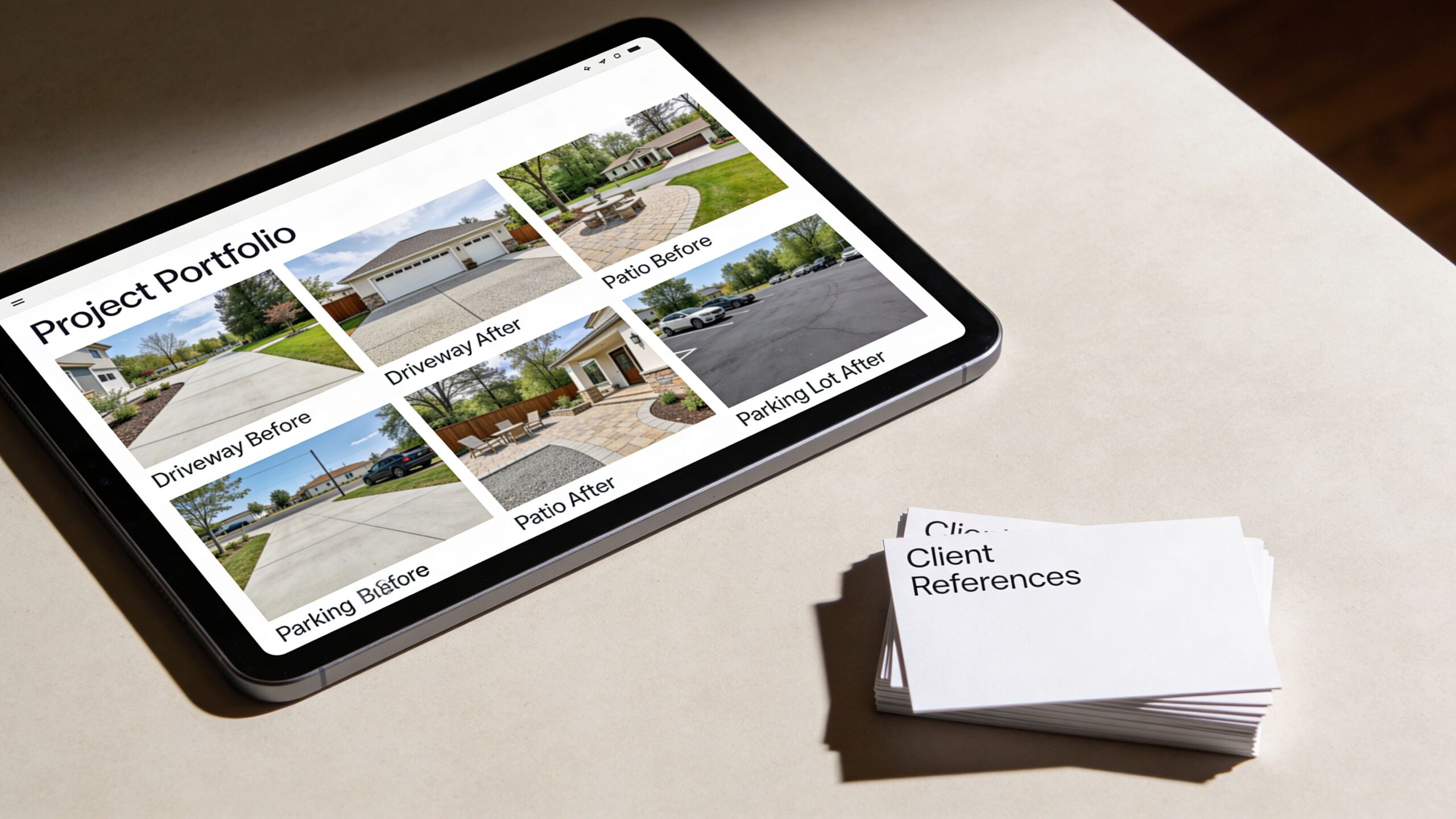
A contractor’s past work tells you more than their sales pitch ever will. You want to see finished driveways, patios, sidewalks, and slab work that match the kind of project you need.
Ask for recent local jobs, not photos from years ago and not a random gallery full of stock-looking images. In places like Ocala, Inverness, and Homosassa, local references matter because soil, drainage, and weather conditions are similar to your property.
A serious contractor should be able to show you actual completed work. Browse a company’s concrete and asphalt project portfolio and then ask which jobs are most comparable to yours.
Don’t ask for generic references
Ask for references from projects that line up with yours. A contractor who’s good at small residential pads may not be the right fit for a long driveway, decorative patio, ADA sidewalk, or a commercial apron.
Use questions like these when you call past clients:
- Job similarity: Was your project the same type of work I’m hiring for?
- Jobsite conduct: Did the crew show up when they said they would and keep the site clean?
- Problem handling: If issues came up, did the contractor fix them without excuses?
- Finished result: Has the concrete held up well through rain, traffic, and normal use?
A short video can also help you see whether the company’s work looks organized and professional.
If you can, drive by a completed project. Look at the finish, edge lines, control joints, drainage slope, and whether the slab still looks clean and even. In Belleview or Lecanto, a local visit will tell you quickly whether the contractor does careful work or just fast work.
3. Do They Provide Detailed Written Estimates and Contracts?
A lot of homeowners in Ocala and Crystal River get burned right here. The price sounds good on day one, then the crew shows up, starts talking about extra base work, thicker edges, haul-off, drainage fixes, or reinforcement upgrades, and the bill climbs fast.
Get everything in writing before a shovel hits the ground.
In Central Florida, that matters even more because rain, soft spots, and shifting subgrade can change a job quickly. A contractor who writes a one-line quote without spelling out prep, materials, and exclusions is leaving themselves room to charge more later or cut corners to protect their margin. Neither outcome helps you.

What a solid estimate should spell out
A proper estimate should tell you exactly what you are buying, how the job will be built, and what triggers added cost. If a contractor cannot explain the slab thickness, base prep, reinforcement, finish, cure method, and cleanup, they have not priced the work carefully.
Look for these line items:
- Concrete specs: Mix strength, slab thickness, finish type, and whether additives are included for weather or workability.
- Site prep: Grading, compaction, base material, demo, haul-off, and whether soft or wet areas will cost extra.
- Reinforcement: Rebar, wire mesh, or fiber, plus where and how it will be installed.
- Drainage details: Slope, runoff direction, and any tie-in work needed to keep water away from your slab and foundation.
- Payment terms: Deposit, progress draws if any, and what has to be complete before final payment is due.
- Change orders: A written process for approving extra work before it happens.
- Warranty language: What is covered, what is excluded, and how service calls are handled.
Ask one more direct question. “What is not included in this price?”
That answer tells you a lot. In Marion and Citrus County, weak estimates often leave out permit handling, base repair, stump or root removal, thickened edges, or replacement of unsuitable soil. Then those items show up later as “unexpected” charges. An experienced local contractor knows these problems are common and addresses them up front.
A clean contract protects your budget. A vague one protects the contractor.
If you are comparing outdoor living bids, review a local pricing breakdown for how much a concrete patio costs so you can spot quotes that are suspiciously low or padded with vague allowances. In places like The Villages, Beverly Hills, and Hernando, that extra homework can save you from hiring the cheapest number instead of the right contractor.
4. What Experience Do They Have With Your Specific Project Type?
Concrete work isn’t all the same. A contractor who pours a decent shed slab may not understand driveway traffic loads, decorative patio finishing, ADA walkway requirements, or transitions between concrete and asphalt.
Ask what percentage of their work matches your project type. If you need a driveway in Ocala, you want a crew that regularly handles driveway removal, grading, reinforcement, and vehicle load planning. If you need a commercial sidewalk or lot entrance in Crystal River, you want someone who understands compliance, drainage, and traffic sequencing.
Match the crew to the work
Technical questions separate experienced contractors from sales-focused ones. One of the best expert-level questions is whether they’ll reinforce the slab with rebar or wire mesh, and what size and spacing they recommend based on expected loads.
Benchmarks cited in NCBC’s contractor question article state that residential driveways should use #4 rebar at 18-24 inch centers or 6×6 W1.4/W1.4 welded wire mesh for 4-inch slabs under ACI 332 residential concrete guidance. That same source notes that contractors using fiber-reinforced mixes should be able to justify the choice through ASTM C1116 compliance, and it says rebar remains the gold standard for spans greater than 10 feet or unsupported edges.
That’s not a small detail. It’s the difference between a slab built for real use and one poured just to get through the sale.
Ask directly:
- Driveway loads: What reinforcement do you use where vehicles turn or park?
- Patio use: Will the slab support future additions like screens, hot tubs, or outdoor kitchens?
- Drainage design: How do you slope the concrete so water moves away from the house?
- Local conditions: What changes do you make for Marion County and Citrus County soil and rain patterns?
A good contractor won’t just say “we always do it this way.” They’ll explain why their method fits your job in Dunnellon, Summerfield, or Inverness.
5. Do They Have a Clear Process and Professional Communication?
You can learn a lot before the first shovel hits the ground. If a contractor is hard to reach before the job, they’ll usually be worse once they have your deposit.
Professional communication isn’t fluff. It shows whether the company schedules well, manages crews well, and respects your property and your time. For homeowners in Silver Springs or The Villages, that can mean the difference between a smooth project and two weeks of unanswered calls.
Watch how they handle the first few conversations
Pay attention to how they respond when you ask basic questions. Do they answer clearly, or do they dodge details and rush you to sign?
Good signs include:
- Clear scheduling: They tell you when they can inspect the site and when they can start.
- Defined contact person: You know who will answer questions during the job.
- Written updates: They confirm changes, delays, or approvals in writing.
- Site expectations: They explain access, cure time, cleanup, and protection of nearby surfaces.
The first phase of the project is communication. If that phase is sloppy, the rest usually follows.
This matters even more on jobs with multiple steps, like replacing a driveway, tying into an asphalt apron, or coordinating concrete work with parking lot striping later on. In Central Florida, weather can interrupt a schedule fast. A good contractor won’t pretend otherwise. They’ll tell you how they handle rain delays and what happens if site conditions change after demolition.
6. What Is Their Track Record With Timeline and Budget Adherence?
Your driveway gets torn out on Monday. By Friday, afternoon storms roll in, the base is still soft, and the contractor is asking for more money and "a few extra days." In Ocala and Crystal River, that story is common. Poor scheduling and weak estimating show up fast once rain, heat, and sandy soil get involved.
Ask a direct question: How often do your jobs finish on the original timeline and original price?
A good contractor should answer without tap dancing. They should be able to point to recent jobs in Marion or Citrus County and explain where delays came from, how they handled them, and whether change orders were caused by real site conditions or bad planning. If every delay was "unexpected," you're dealing with someone who either bids too low to win work or doesn't know how to schedule concrete in Central Florida.
You also need to know how they built the estimate. Was the site measured carefully, including thickness, base prep, reinforcement, drainage needs, and removal? Or did they glance at the area and throw out a number? Cheap bids usually get expensive after demolition starts.
Ask what can change the price before the contract is signed. The right answer is specific. Soft spots in the subgrade, hidden root intrusion, drainage corrections, added thickness, access problems for trucks, and owner-requested changes can all affect cost. "We'll figure it out later" is a red flag.
For timeline control, look for a contractor who can walk you through the sequence in plain English:
- demolition and haul-off
- grading and base preparation
- form setting and reinforcement
- pour day and finishing
- cure time before traffic
- cleanup and final walkthrough
That matters here because weather is not a minor detail. Summer rain can shut down prep work, delay finishing, and ruin a rushed pour. A disciplined contractor builds weather time into the schedule instead of promising an unrealistically fast turnaround just to get your deposit.
Then ask former clients two things that matter: Did the final bill match the original proposal, and did the job finish close to the promised date? If the answer is no, ask why. A reasonable delay with a clear written change order is one thing. A pattern of surprise charges, missed dates, and excuses is enough reason to move on.
7. What Warranty and After-Service Support Do They Offer?
A clean pour on day one proves very little. In Ocala, Crystal River, and the rest of Central Florida, the true test comes after heat, pounding rain, irrigation, and daily traffic start working on that slab. If a contractor gets slippery when you ask about warranty service, move on.
Ask for the warranty in writing before you sign. It should spell out what they cover, how long coverage lasts, what voids it, and how a claim gets handled. “We stand behind our work” is sales talk. A real warranty names the workmanship issues they will correct, such as scaling, spalling tied to poor finishing, settlement caused by bad base prep, or surface defects that should not be there in the first place.

Ask what happens after the check clears
Good contractors have a clear service process; weak ones often disappear without one. They tell you who to call, how fast they respond, whether they do a post-job walkthrough after curing, and whether they come back to inspect cracking, drainage problems, or finish complaints.
That matters here because Florida concrete gets stressed early. Fast drying sun can hurt curing. Heavy summer rain can expose drainage mistakes. Expansive or poorly compacted soils in parts of Marion and Citrus County can show up later as movement at the edges, low spots, or cracking. If the contractor refuses to talk through those risks in plain English, assume they do not want responsibility for them.
You should also ask what you have to do as the owner. The Concrete Company’s hiring article explains why post-install care, including proper curing time and timely protective treatment, affects long-term durability. That means your contractor should give you written care instructions. How long before you park on it? When should you seal it, if sealing makes sense for that surface? What cleaners should you avoid? If they cannot answer those questions clearly, they are leaving you to guess.
Ask these before you hire them:
- What exactly is covered? Get specific about workmanship, cracking, settlement, finish defects, and drainage-related corrections.
- What is excluded? Normal shrinkage cracking, storm damage, tree root movement, or damage from heavy vehicles may not be covered. You want that spelled out.
- How do service calls work? Ask for the contact person, response time, and whether service requests are handled in-house or handed off.
- What maintenance is required? Get written instructions so there is no argument later about owner neglect.
- Will they still be around next year? A warranty means nothing if the company is hard to reach or has no local presence.
One more red flag. Contractors who offer a long warranty but no after-service plan are selling paper, not support. The right contractor treats warranty service as part of the job, not an inconvenience. That protects your concrete and your wallet.
8. Are They Locally Based With Deep Community Ties?
Local matters. A contractor who works regularly in Central Florida understands the weather, the soil, local expectations, and the practicalities of getting back to the job if something needs attention later.
That matters in Marion County, FL and Citrus County, FL because this region isn’t generic. You’ve got heavy rain, high humidity, strong sun, and areas where drainage and base prep make or break the project. A contractor with real local roots in Dunnellon, Ocala, Crystal River, or Homosassa is easier to verify and easier to reach.
Why local knowledge changes the job
Ask how they adapt concrete for Florida conditions. This is one of the most overlooked questions to ask a concrete contractor.
A forward-looking climate-resilience discussion in Port Aggregates’ contractor question article highlights the importance of asking about permeable options, drainage integration, and sulfate-resistant cement choices for local conditions. Whether or not your project needs specialty materials, the point stands. In hurricane-prone, rain-heavy areas, a contractor should be able to explain how they handle runoff, slope, and durability.
Local contractors also tend to know county expectations, neighborhood standards, and how to coordinate with related services. That’s useful if your project includes driveway replacement plus transitions to asphalt, striping updates, or ADA-related access work.
Hire someone who plans to answer the phone after the job is done, not someone who disappears to the next county.
Ask where they’re based, how long they’ve been serving Central Florida, and whether they have repeat clients in your area. A company with strong ties to Belleview, Summerfield, Inverness, Beverly Hills, or Hernando has more to lose by doing bad work, and that’s good for you.
8-Point Concrete Contractor Comparison
| Item | Implementation complexity 🔄 | Resource requirements ⚡ | Expected outcomes 📊⭐ | Ideal use cases 💡 | Key advantages ⭐ |
|---|---|---|---|---|---|
| Are They Licensed, Insured, and Bonded? | Low, document verification and DBPR check | Low, time for calls/online checks | High, liability protection and legal recourse | Mandatory for most residential and commercial projects | Regulatory compliance; financial protection; professional credibility |
| Can They Provide References and a Portfolio of Recent Work? | Moderate, request & vet references, inspect portfolio | Moderate, time to contact refs and visit sites | High, visible workmanship and client satisfaction signals | When assessing finish quality or contractor fit | Real examples of work; direct client feedback; specialty insight |
| Do They Provide Detailed Written Estimates and Contracts? | Medium, requires detailed scope and contract drafting | Moderate, contractor time; possible legal review | High, reduces disputes; clarifies costs and timelines | Multi‑phase, high‑value, or commercial projects | Prevents scope creep; legal protection; easier comparisons |
| What Experience Do They Have With Your Specific Project Type? | Low, targeted questions and portfolio review | Low, inquire about past projects and methods | High, tailored solutions and fewer surprises | Specialized work (ADA, commercial, local climate issues) | Localized expertise; appropriate mix/spec choices; code familiarity |
| Do They Have a Clear Process and Professional Communication? | Low, evaluate responsiveness and documented processes | Low, time to monitor communication practices | High, smoother project flow and fewer misunderstandings | Projects requiring coordination or frequent updates | Better scheduling; faster issue resolution; client confidence |
| What is Their Track Record With Timeline and Budget Adherence? | Moderate, verify past timelines and change‑order history | Moderate, reference checks and review of past docs | High, predictable completion and cost control | Time‑sensitive commercial or operational projects | On‑time, on‑budget reliability; reduced operational disruption |
| What Warranty and After‑Service Support Do They Offer? | Low, request written warranty terms and procedures | Low–Moderate, paperwork plus possible maintenance costs | High, protection against defects and long‑term support | Long‑term assets, resale properties, commercial sites | Written warranty; maintenance guidance; remedial support |
| Are They Locally Based With Deep Community Ties? | Low, verify local address, tenure, and involvement | Low, local reviews and community references | High, easier follow‑up and local code/soil knowledge | Regional projects needing supplier/inspector relationships | Accessibility; local reputation; knowledge of regional conditions |
From Questions to Quality Partnering with the Right Pro
Asking smart questions changes the whole hiring process. You stop being the customer who’s hoping for a good result and become the customer who knows what quality looks like before the contract is signed.
That’s how you protect your investment. A solid concrete project in Ocala, Dunnellon, Crystal River, or The Villages should be built around proper prep, clear drainage, the right reinforcement, a written scope, and a contractor who communicates like a professional. If any of those pieces are missing, the job gets riskier fast.
The strongest answers are usually straightforward. A good contractor won’t get irritated when you ask about licenses, insurance, references, reinforcement, mix specs, schedule, warranty terms, or follow-up service. They’ll be ready for those questions because they handle them all the time.
That matters in Central Florida more than many homeowners realize. Heat, heavy rain, and site-specific drainage can turn a small mistake into a big repair. In places like Marion County, FL and Citrus County, FL, the contractor you hire needs to know more than how to pour and finish. They need to know how to build for local conditions and how to explain their decisions clearly.
If you’re comparing bids, don’t focus only on price. Focus on completeness. A contractor who gives you a detailed estimate, spells out concrete specs, explains the reinforcement plan, and gives you a clear timeline is usually giving you something much more valuable than a cheap number. They’re giving you predictability.
That same principle applies whether you’re a homeowner replacing a cracked driveway in Summerfield, an HOA planning walkway improvements in Lecanto, or a property manager coordinating concrete work with asphalt maintenance in Inverness or Homosassa. The best contractors treat the project like a long-term asset, not a quick pour.
Riverside Sealing & Striping, LLC is built around that approach. As concrete and asphalt experts in Marion and Citrus County, the team handles concrete driveways, patios, slabs, sidewalks, asphalt sealcoating, and parking lot striping with the same focus on durability, scheduling, and clear communication. Being licensed, insured, and locally based matters. So does having a team that understands how concrete and asphalt perform in Central Florida conditions.
If you want a no-pressure way to compare your options, get a professional evaluation before you commit. A clear site visit and written estimate will tell you a lot about the company you’re dealing with, and it can save you from paying for the same project twice.
If you’re planning a driveway, patio, sidewalk, slab, sealcoating project, or parking lot striping update in Marion County, FL or Citrus County, schedule a free, no-pressure estimate with Riverside Sealing & Striping, LLC. You’ll get straightforward recommendations, local experience, and a team that understands both concrete and asphalt in Central Florida.