You're probably at the same point many property owners reach before a project starts. The driveway in Ocala is broken up and ready for replacement. The parking lot in Crystal River needs milling, paving, sealcoating, or fresh striping. The patio in Summerfield is finally getting expanded. Everything looks straightforward until someone asks a simple question: What's underground right there?
That question decides whether a concrete or asphalt job stays on schedule or turns into a shutdown, a repair bill, and a liability mess. In Marion County, FL and Citrus County, FL, that matters on small residential jobs and large commercial work alike. A new slab in Belleview, a driveway apron in Dunnellon, or parking lot work in Inverness all start with the same rule. Locate first. Dig second.
For property owners across Central Florida, the biggest mistake isn't only skipping 811. It's assuming 811 covers the whole property. It doesn't. That gap catches homeowners, HOAs, and property managers all the time, especially on projects involving driveways, sidewalks, curbs, pads, and parking lots. If you understand that workflow before demolition starts, you avoid the most common preventable problems.
Table of Contents
- Why a Simple Dig Can Become a Costly Disaster
- The 811 Process Your First Call Before Any Project
- Decoding the Marks A Guide to Utility Color Codes
- The Post-Meter Blind Spot Public vs Private Utilities
- When to Hire a Private Locator For Your Project
- Your Marion and Citrus County Project Checklist
- Frequently Asked Questions About Utility Locating
Why a Simple Dig Can Become a Costly Disaster
A homeowner in The Villages schedules a new concrete driveway. Another owner in Homosassa plans to replace cracked asphalt at a small commercial property. The demolition crew shows up, equipment is ready, and then one bucket tooth or saw cut reaches the wrong buried line. Now the job stops. Utilities may be out. The site may become unsafe. Everyone starts asking who called, who marked, and who owns the damaged line.
That chain reaction occurs with greater frequency than commonly assumed. In the United States, a utility line is damaged every six seconds on average, leading to approximately $30 billion in total unexpected expenses each year for homeowners and contractors, according to this industry summary of underground utility strike data. Those costs aren't abstract. They show up as emergency repairs, schedule overruns, damaged equipment, business interruption, and disputes over responsibility.
Practical rule: If a project involves cutting, coring, trenching, grading, breaking out concrete, milling asphalt, or setting forms with stakes, underground utility location is part of the job.
Concrete and asphalt work creates more exposure than many owners realize. A driveway replacement in Silver Springs may disturb irrigation sleeves, power feeding a gate, or water service beyond the meter. A parking lot project in Lecanto can involve lighting circuits, telecom lines, drainage structures, or older private lines no one has documented well. Even when the visible work looks shallow, access cuts, edge work, sign bases, wheel stops, and ADA improvements can put buried lines at risk.
The problem starts before equipment moves
The expensive part usually isn't the locate itself. It's the assumption that the site is clear because no one sees a problem from the surface.
A clean-looking property can still hide:
- Private irrigation lines running beneath a future driveway widening
- Pool equipment feeds crossing behind the house
- Detached building power added years ago without clear plans
- Site lighting or communications lines in commercial lots
- Septic components and force lines near slabs, sidewalks, or additions
In Central Florida, where owners in Ocala, Beverly Hills, Hernando, and Dunnellon often improve older properties, that hidden layer matters. Safe excavation isn't paperwork. It's what keeps a routine project from becoming a costly one.
The 811 Process Your First Call Before Any Project
The first required step in Florida is simple. Before any digging starts, someone has to contact 811.
What Florida law requires
Under Florida's Underground Facility Damage Prevention and Safety Act, property owners and excavators are legally required to call Sunshine State One Call 811 at least two full business days before any digging project begins, as described by the City of Leesburg utility safety guidance. That waiting period excludes weekends and legal holidays.
Florida utilities also make another point clear. The person or company doing the digging is responsible for calling 811, and that applies to small residential jobs and larger commercial excavation work, as noted by Peoples Gas safety guidance.
That means this applies to more than trenching. It includes many common site tasks tied to concrete and asphalt work in Marion County, FL and Citrus County, FL, such as:
- Driveway replacement when demolition, grading, or form setting will disturb the ground
- Patio and slab installation where excavation or edge work is required
- Parking lot repairs involving signage, bollards, curbing, drainage, or island work
- Sidewalk projects near meters, risers, valves, boxes, and service paths
What happens after you place the request
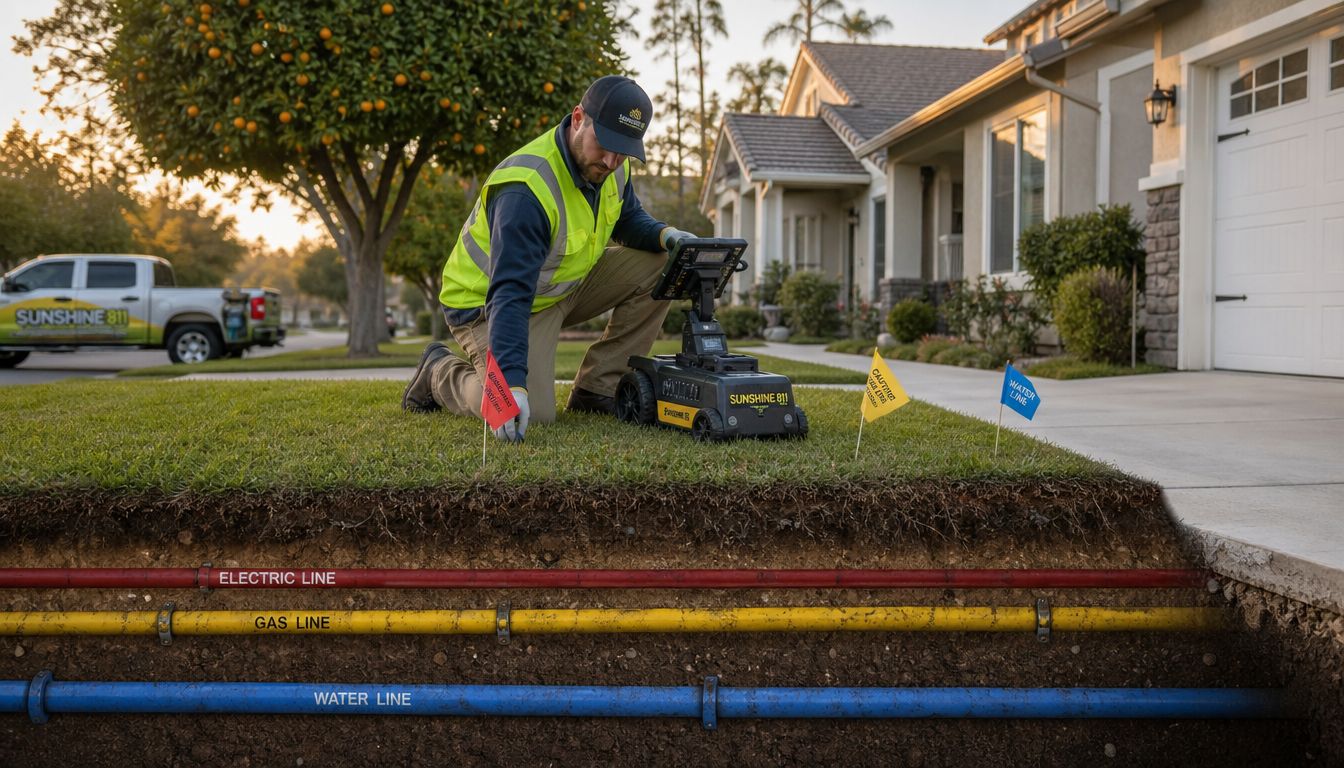
After the locate request is submitted, utility operators or their locating contractors come out to mark the public lines they own. In Florida, utility locators mark natural gas and other public utility lines on the property for free, using visual markers such as colored stakes or paint to identify line locations and safe digging zones, according to Florida Public Utilities safe digging information.
The process works best when the site is prepared before locators arrive.
- Mark the work area in white. White paint or flags help show the planned excavation area.
- Make the site accessible. Locked gates, parked trailers, stacked materials, or overgrown edges can interfere with marking.
- Give a real scope. “Driveway replacement from street to garage” is more useful than a vague request.
- Wait for the markings. Don't let demolition start early because the crew is already on site.
Public markings are there to guide excavation, not to speed past caution. Once the colors are down, the next step is to review what was marked and what was not.
For a homeowner in Belleview or a property manager in Crystal River, 811 should be treated as the opening step in a safe workflow, not the last one. On many sites, especially where older improvements were added over time, the public locate reveals only part of the underground picture.
Decoding the Marks A Guide to Utility Color Codes
Once the locators finish, the property starts to look like a coded map. Paint lines, arrows, and flags appear around curbs, lawns, easements, and building edges. If you understand the colors, you can read the site before concrete or asphalt work starts.
What the paint and flags usually mean
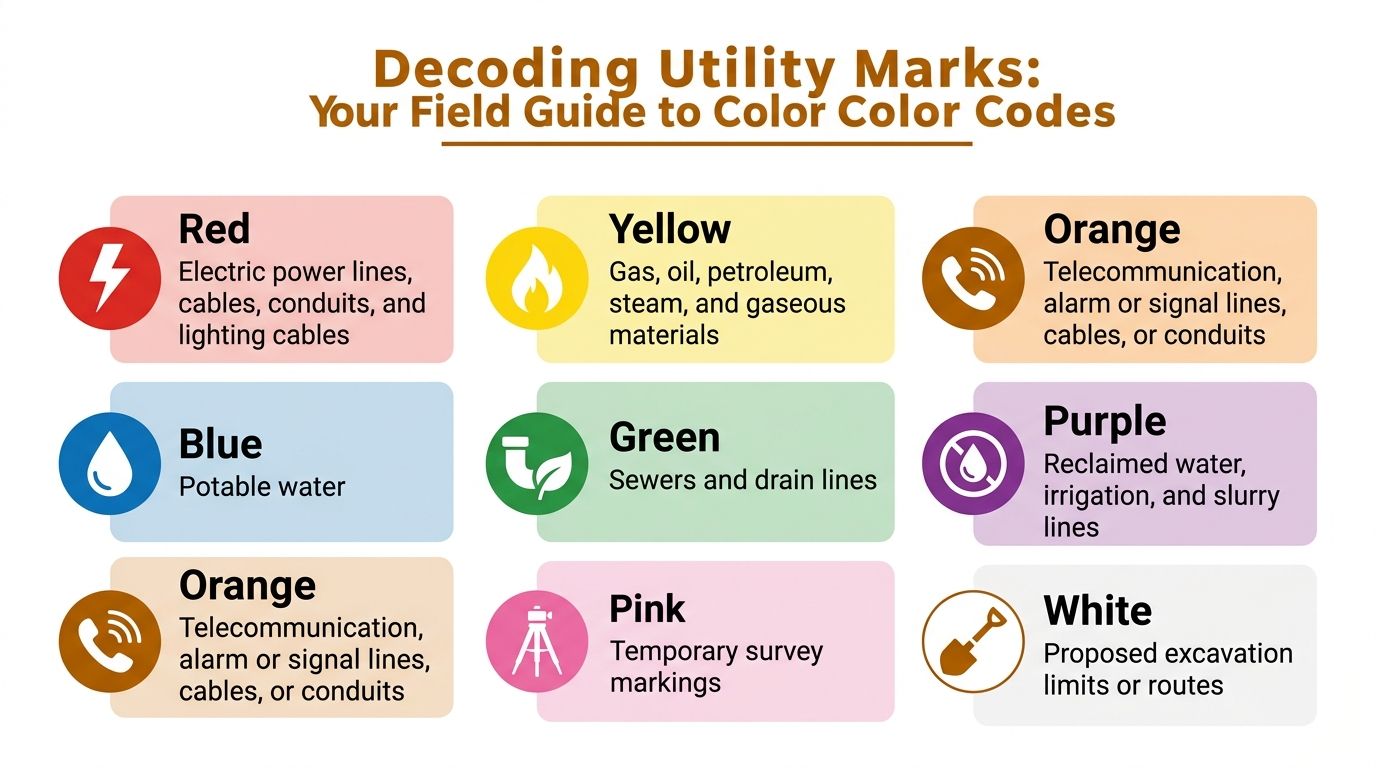
Here's the field guide most contractors and locators rely on:
- Red means electric power lines, cables, conduits, and lighting cables.
- Yellow marks gas, oil, petroleum, steam, and gaseous materials.
- Orange identifies communication, alarm, or signal lines, cables, or conduits.
- Blue is potable water.
- Green indicates sewers and drain lines.
- Purple marks reclaimed water, irrigation, and slurry lines.
- Pink is used for temporary survey markings.
- White shows the proposed excavation area or route.
If you're walking a property in Ocala, Inverness, or Beverly Hills before a driveway or parking lot job, these colors help you understand where risk is concentrated. A yellow line crossing the work zone changes the entire demolition plan. So does orange along a frontage, or blue near a meter and sidewalk approach.
What those marks do not tell you
The paint usually shows the approximate horizontal path of a utility. It doesn't mean the line is centered exactly under the mark, and it doesn't automatically tell you the depth.
That matters on real jobs. A concrete saw cut near a red or orange mark isn't minor just because it's narrow. A curb replacement next to blue marks still requires care. A purple line can also mean irrigation-related infrastructure that may affect driveway widening, entry columns, or hardscape work.
Walk the site slowly after the locate is complete. Don't just confirm that marks exist. Confirm whether they make sense for the work area.
If a marked route seems incomplete, oddly placed, or inconsistent with what's on the property, that's a signal to pause and ask more questions before excavation starts.
The Post-Meter Blind Spot Public vs Private Utilities
Many owners get caught when they call 811, see the site marked, and assume everything underground has been addressed. It hasn't.
Where 811 stops
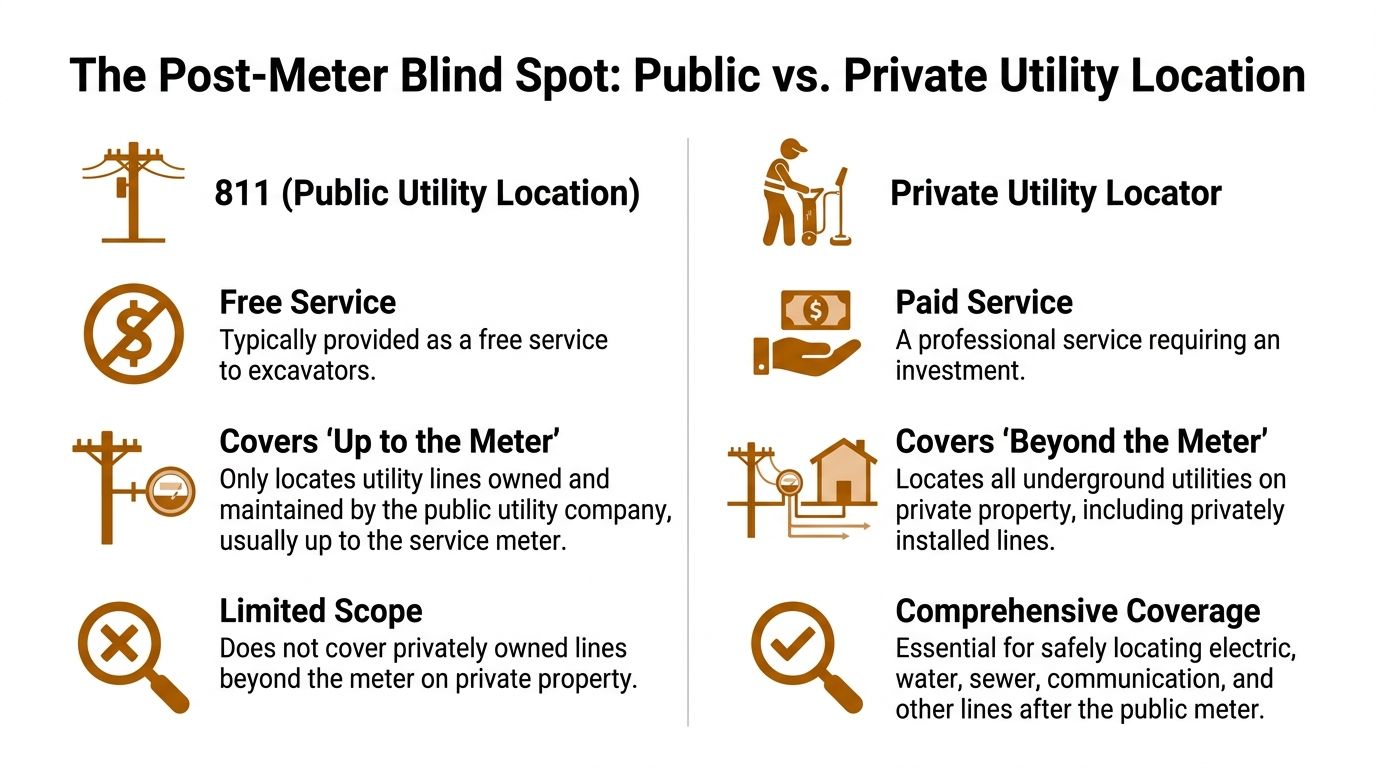
The free 811 system is tied to public utility ownership. While 811 is mandated for public lines, it legally terminates at the utility meter, leaving everything downstream unmarked, creating what many in the field recognize as a major blind spot for property owners, as explained by this overview of free utility locating limits.
That means the line from the street to the meter may be covered. What happens after the meter often becomes the owner's responsibility.
In practical terms, the site may have public marks and still contain unmarked private infrastructure under the exact area where demolition or grading is about to begin.
A short prep guide like this overview of ground preparation before a slab pour makes much more sense when you view utility locating as part of site prep, not as a separate paperwork task.
Common private lines people overlook
On residential properties in Summerfield, Silver Springs, and The Villages, private utilities often include lines and systems added after the original home was built.
Examples include:
- Irrigation supply and control lines under lawn areas and driveway crossings
- Power to pool pumps or detached structures
- Outdoor lighting circuits
- Water or drain lines serving additions, outdoor kitchens, or accessory buildings
- Septic-related components
- Private communication lines or gate operators
Commercial and HOA properties in Marion County, FL and Citrus County, FL have their own version of the same issue. Site lighting feeds, sign power, irrigation mains, low-voltage controls, and private water or sewer service lines may all run through islands, medians, sidewalks, and parking fields.
To see the issue explained visually, this short video is useful:
Why this matters on concrete and asphalt jobs
Concrete and asphalt projects often cross the very areas where private lines are most likely to be buried. A driveway replacement in Belleview may cut across irrigation and lighting. A new sidewalk in Homosassa might pass near septic or private water service. A parking lot improvement in Crystal River can run into lighting circuits or private communications feeding site features.
The meter is the dividing line many owners never think about until after a strike. By then, the job has already stopped.
This is why Concrete and Asphalt Experts in Marion and Citrus County treat underground utility location as part of responsible planning. It isn't enough to ask whether 811 was called. You also have to ask what 811 didn't mark.
When to Hire a Private Locator For Your Project
A private locate isn't for every tiny surface task. But once a project involves demolition, excavation, saw cutting near services, or any meaningful disturbance inside private property, it deserves a hard look.
Projects that deserve more than a public locate
A private locator is worth considering when the work area includes known or likely private infrastructure. That commonly includes:
- Driveway replacement where irrigation, lighting, or water service may cross
- Concrete patios and slabs near pools, detached garages, sheds, or outdoor kitchens
- Sidewalk and ADA work around commercial buildings, entry monuments, and designed corridors
- Parking lot improvements involving islands, light poles, drainage work, signage, wheel stops, or trenching
For owners comparing contractors, asking about locate coordination is smart. A checklist like these questions to ask a concrete contractor should include how the company handles public and private utility risk before breaking ground.
What the locator actually uses on site
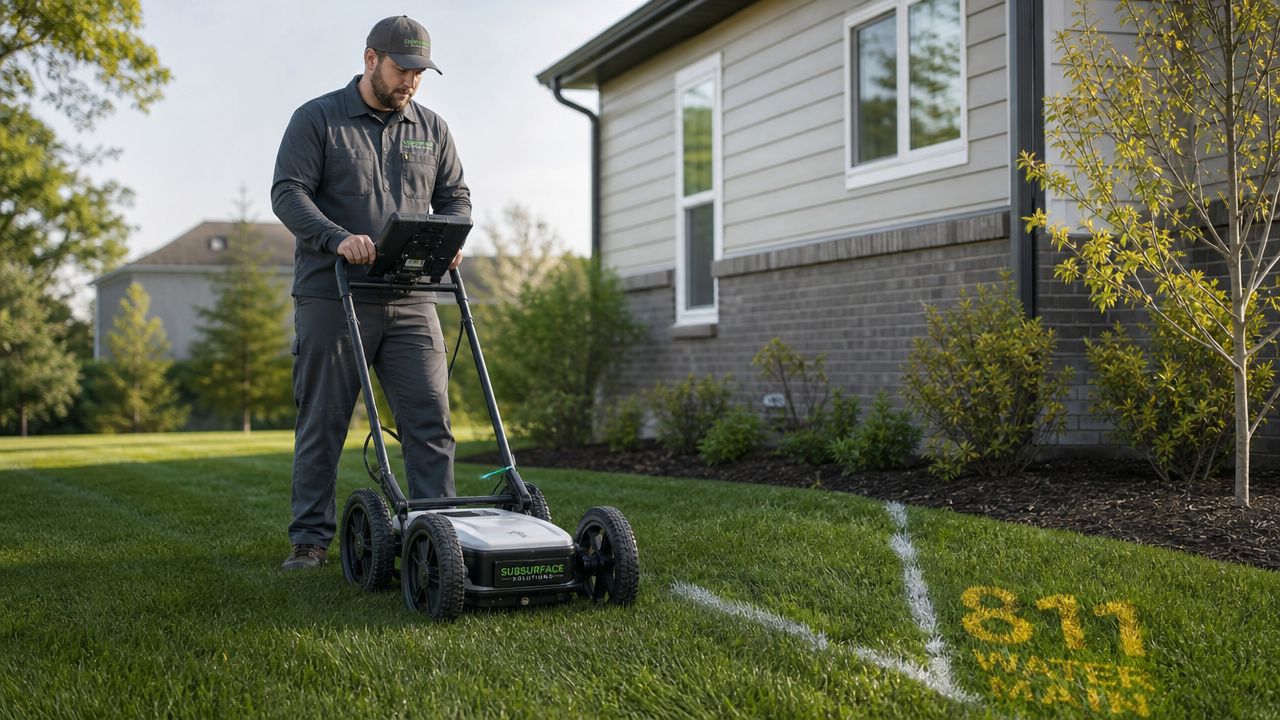
Professional locators usually work with two core tools. Electromagnetic locators are used for metallic lines. Ground Penetrating Radar helps locate non-metallic materials such as PVC, plastic, and concrete pipes. According to Honeywell's line locating white paper, GPR effectiveness drops in high-clay soil, where utilities deeper than 2 to 4 feet may be undetectable.
That trade-off matters. EM is strong when the line is conductive or has tracer wire. GPR is valuable when the line is non-metallic. Neither method should be treated like magic.
Central Florida soil changes the job
Central Florida sites vary a lot. One property in Dunnellon may have sandy conditions that support cleaner readings. Another in Lecanto or Hernando may have heavier clay content or mixed fill that makes interpretation more difficult. Add older construction, undocumented repairs, and root-heavy ground, and locating becomes less about owning the tool and more about reading the site correctly.
This is why experienced crews don't rely on one shortcut. They combine what the marks show, what the site physically suggests, and what the planned excavation requires. On higher-risk work, they slow down, verify suspicious areas, and adjust the construction approach before the slab, sidewalk, or pavement work begins.
Field judgment matters: If a property has had additions, landscape upgrades, lighting, irrigation, or utility reroutes over the years, assume the underground story is more complicated than the plans show.
For homeowners and property managers in Ocala, Crystal River, Inverness, and surrounding areas, a private locate is usually cheaper than a shutdown and easier than a dispute after something gets hit. That's the practical way to look at it.
Your Marion and Citrus County Project Checklist
Safe underground utility location works best when the sequence is clear. For jobs in Marion County, FL and Citrus County, FL, this checklist keeps residential and commercial projects moving in the right order.
A practical pre-job workflow
- Call 811 early. Florida requires advance notice before digging begins, so don't wait until the week of demolition.
- Define the work area clearly. Show where the driveway, sidewalk, slab, curb, or parking lot work will happen.
- Walk the site yourself. Look for sprinkler heads, valve boxes, pool equipment, detached structures, lighting transformers, septic indicators, and utility meters.
- Review the public markings once they appear. Check whether the paint lines and flags make sense against the planned work zone.
- Flag private utility concerns with the contractor. If there's any chance of private lines in the area, discuss a private locate before excavation starts.
- Protect the marked area. Don't let traffic, pressure washing, regrading, or material storage wipe out locate marks before the crew begins.
- Use extra care in tolerance zones. Marked areas require slower, more controlled excavation methods.
- Document what the site shows before work starts. Photos of marks, meters, valve boxes, and visible site features can help everyone stay aligned.
For local owners looking at project planning examples, this company background page also reflects the kind of practical site-focused approach that matters before concrete and asphalt work begins.
This workflow applies whether you're replacing a residential driveway in Belleview, planning commercial pavement maintenance in Ocala, or coordinating common-area improvements for an HOA in Homosassa. Concrete and Asphalt Experts in Marion and Citrus County should be talking about this before they talk about finishes, striping layouts, or mix designs.
Frequently Asked Questions About Utility Locating
Do 811 marks show the exact location and depth
No. 811 marks are an estimate of location, not a guarantee, and utility installation varies. Guidance discussed in this explanation of public versus private utility locating also notes that GPR depth detection is reduced in high-clay soils common in Central Florida, which is why high-risk excavation often needs added verification.
Who has to call 811 in Florida
Florida places that responsibility on the person or company doing the digging. On a home project, that may be the contractor. On some owner-managed work, it may be the property owner. What matters is that the call is made correctly and early enough for marking to occur before excavation.
Do I need a private locator for a driveway or patio job
If the work area may involve irrigation, pool equipment feeds, detached building service, private lighting, septic-related components, or undocumented utility runs, a private locator is a smart move. This is especially true when replacing driveways, patios, slabs, sidewalks, and parking lot features that disturb the ground beyond a minimal surface repair.
What if my property has older additions and undocumented lines
Treat it as a warning sign. Older improvements often mean buried lines were added, rerouted, or repaired without records that are easy to find later. In that situation, don't assume the absence of marks means the absence of utilities.
Why does utility locating matter so much before concrete and asphalt work
Because these projects often involve demolition, grading, subgrade prep, edge restraint, form setting, saw cutting, signage, and related work that can reach buried lines fast. For homeowners in The Villages and Summerfield, and for property managers in Crystal River, Lecanto, or Ocala, proper locating protects safety, scheduling, and the budget at the same time.
If you're planning driveway replacement, new concrete work, asphalt sealcoating, or parking lot striping in Central Florida, Riverside Sealing & Striping, LLC brings local experience, reliable scheduling, and a practical understanding of safe site preparation. As Concrete and Asphalt Experts in Marion and Citrus County, they provide licensed and insured service, free estimates, and no-pressure consultations for residential and commercial projects throughout Marion County, FL, Citrus County, FL, and nearby communities including Ocala, Dunnellon, Belleview, Silver Springs, Summerfield, Crystal River, Homosassa, Inverness, Lecanto, Beverly Hills, Hernando, and The Villages.