
If you're planning a new driveway in Ocala, a patio in Crystal River, or a sidewalk upgrade in Dunnellon, you've probably heard the term reinforced concrete slab and wondered what it means. Most homeowners know concrete is strong. The part that gets confusing is why some slabs stay stable for years while others crack, settle, or start looking rough much sooner than expected.
In Central Florida, that question matters more than people think. Heat, heavy rain, sandy soil, and daily use all put pressure on a slab. So when people ask what is reinforced concrete slab, the best answer isn't just a textbook definition. It's an explanation of why reinforcement helps concrete handle the actual conditions we see across Marion County, FL and Citrus County, FL.
What Is Reinforced Concrete and Why Does It Matter
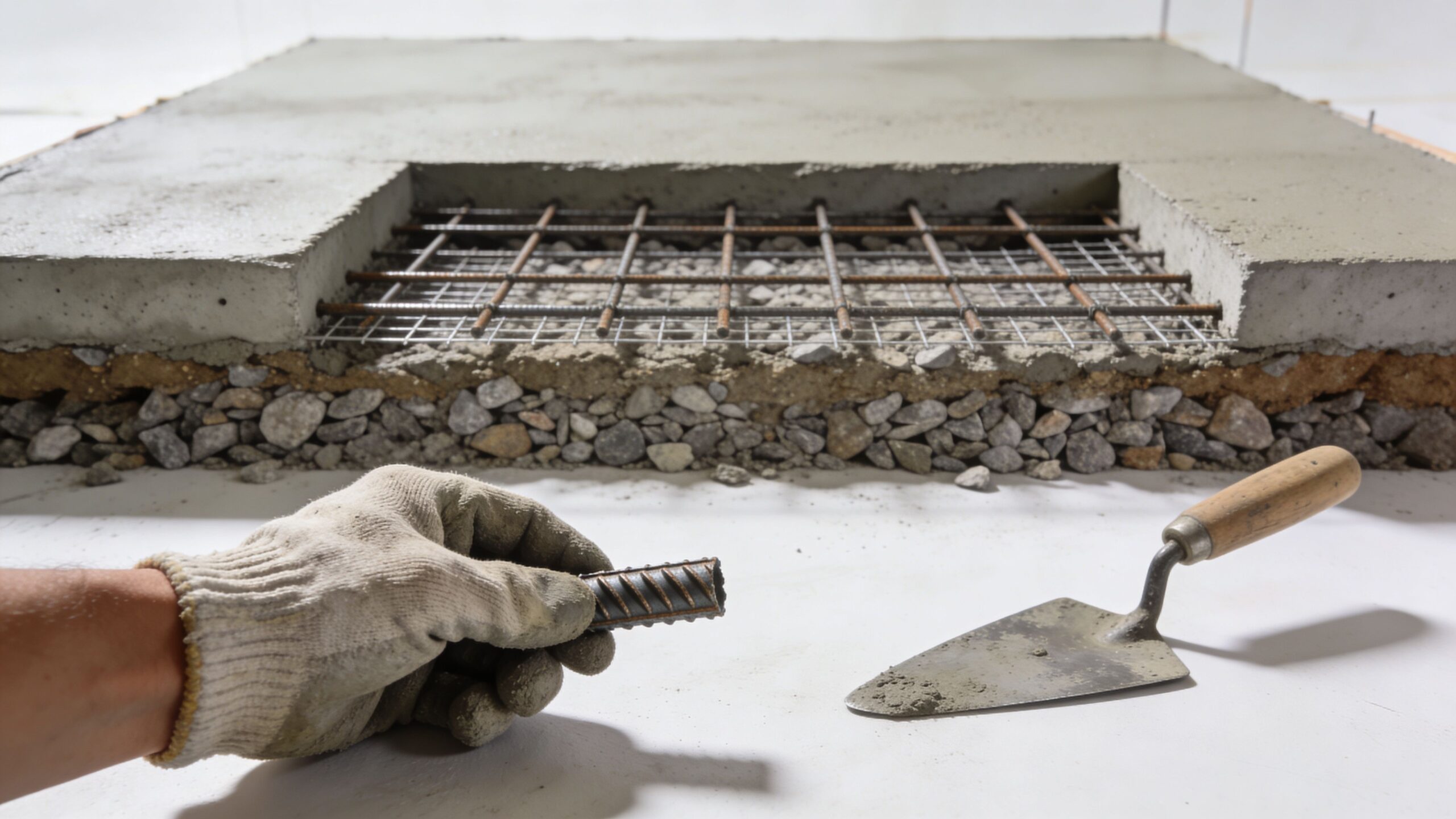
A reinforced concrete slab is a flat section of concrete that has reinforcing material inside it, usually steel rebar, wire mesh, or fiber. The concrete handles compression well. In plain language, that means it resists being squeezed. The reinforcement handles tension, which means it helps when forces try to pull the slab apart.
That combination is the reason reinforced concrete became the standard for so many projects. A driveway in Belleview, a patio in Homosassa, and a commercial slab in Ocala all need to do more than just look smooth on pour day. They need to stay intact as the ground shifts slightly, temperatures change, and traffic loads come and go.
Why plain concrete isn't enough
Concrete by itself is hard and durable, but it has a weakness. It can crack when it's stretched, bent, or exposed to shrinkage and temperature movement. Reinforcement doesn't make concrete magically crack-free. What it does is help control cracking, hold the slab together, and improve long-term performance.
A simple way to think about it is this:
- Concrete carries the weight
- Reinforcement helps the slab stay together when stress shows up
- Good design makes those two parts work as a system
Practical rule: Concrete is strong, but reinforced concrete is what gives a slab staying power.
Why this matters in the real world
Reinforced concrete isn't a new experiment. It has a long track record. The Alvord Lake Bridge, built in 1889, is considered the world's oldest reinforced concrete bridge, and that early use of twisted iron bar reinforcement helped pave the way for larger projects, including the 16-story Ingalls Building just 14 years later, as described in BigRentz's history of concrete.
That history matters because it shows this material system has been tested in practice for over a century. Homeowners in Summerfield, Inverness, and The Villages aren't betting on a trend. They're using a building method with a long, proven record.
For local residential work, that's its primary benefit. A reinforced slab gives a driveway, walkway, or patio a much better chance of handling Florida conditions without turning into a patchwork of uncontrolled cracks and uneven sections.
The Core Components Inside a Concrete Slab
A reinforced slab isn't just "concrete with metal in it." It's a system made of two main parts that need to work together. If one part is wrong, the finished slab suffers.
The concrete mix
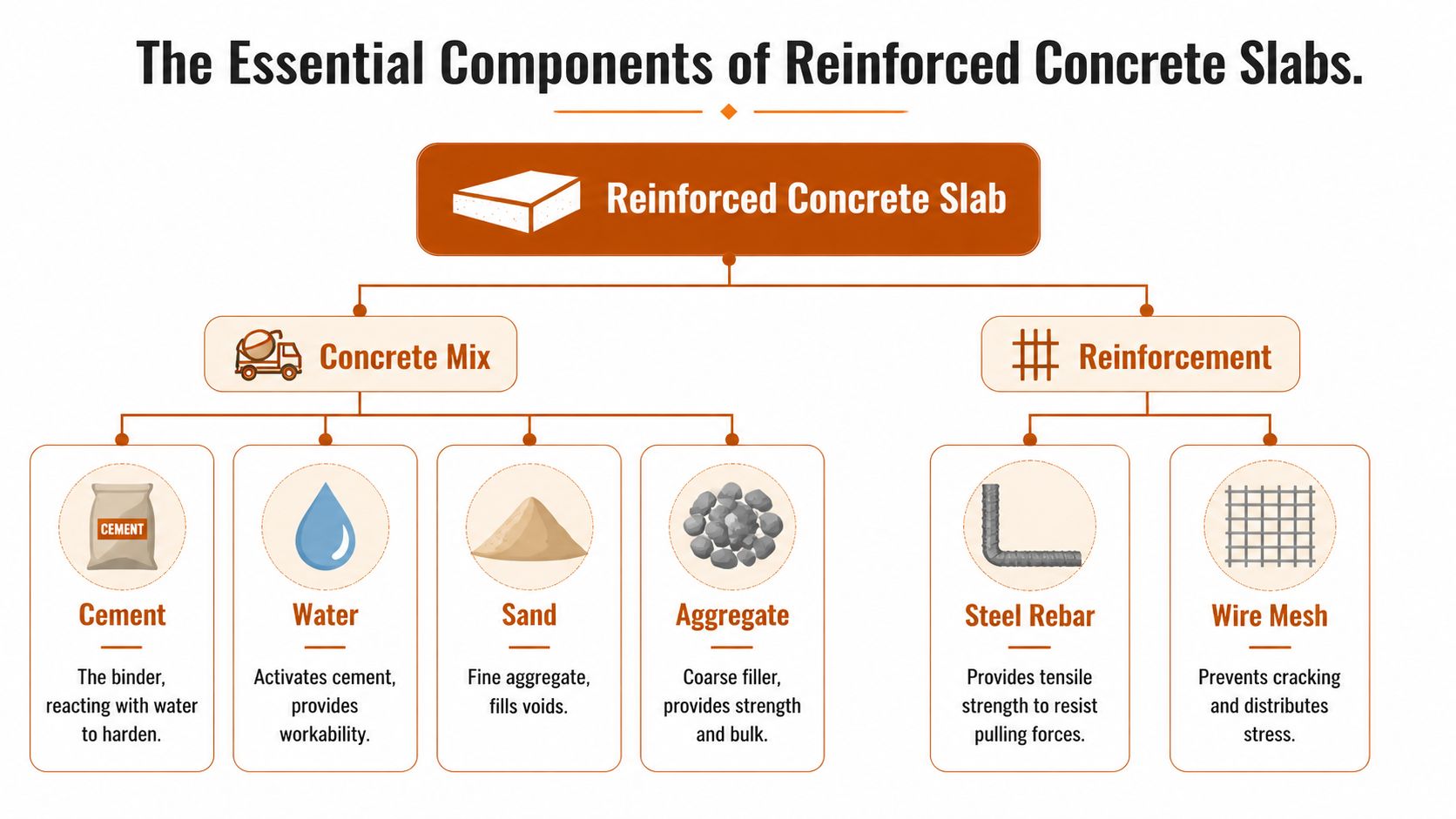
Concrete is made from a blend of cement, water, sand, and aggregate. Each ingredient has a job.
- Cement binds everything together.
- Water activates the cement and makes the mix workable.
- Sand fills smaller spaces in the mix.
- Aggregate adds strength and bulk.
When these materials are proportioned properly, the slab cures into a hard surface that can support vehicles, foot traffic, furniture, and daily wear. But the mix alone doesn't solve movement. Concrete shrinks as it dries, and it reacts to changing temperatures. That's where reinforcement comes in.
The reinforcement layer
Think of the concrete as the body of the slab and the reinforcement as its internal support. The reinforcement doesn't replace good concrete. It strengthens how the slab behaves once stress begins.
Homeowners usually hear about three options.
| Reinforcement type | What it does best | Common residential use |
|---|---|---|
| Steel rebar | Adds strong internal support and crack control | Driveways, structural slabs, heavier-use areas |
| Wire mesh | Helps distribute stress and limit surface cracking | Patios, sidewalks, lighter slabs |
| Fiber reinforcement | Spreads crack control throughout the mix | Patios, sidewalks, ramps, some residential slabs |
Rebar, mesh, and fiber explained in plain language
Rebar is the traditional choice when a slab needs stronger internal reinforcement. It's especially useful when a slab may deal with vehicle loads or areas where soil conditions make movement more likely.
Wire mesh is a steel grid. It can help with crack control, but it has to be placed correctly to do its job. If it ends up too low in the slab during placement, it won't help the way people expect.
Fiber reinforcement is different because the fibers are mixed throughout the concrete instead of laid in sheets or bars. According to the FIP-8 design specification for fiber-reinforced concrete, modern fiber-reinforced concrete can allow a 20-30% reduction in thickness while carrying the same load, and 4 kg/m³ of macrofibers can provide crack control comparable to 3.1 kg/m² of steel mesh with 75% less steel weight.
For a homeowner, the takeaway is simple. Different reinforcement choices change how a slab handles cracking, labor, and long-term maintenance.
In Marion County, FL and Citrus County, FL, the right choice depends on the slab's purpose. A driveway in Silver Springs isn't asked to do the same job as a backyard patio in Lecanto. That's why reinforcement shouldn't be treated like a one-size-fits-all decision.
Common Types of Reinforced Concrete Slabs
Most homeowners only deal with one type of slab, but it helps to know the categories. The slab under a driveway in The Villages is very different from the slab system used in a multi-story building in Ocala.
Slab-on-grade
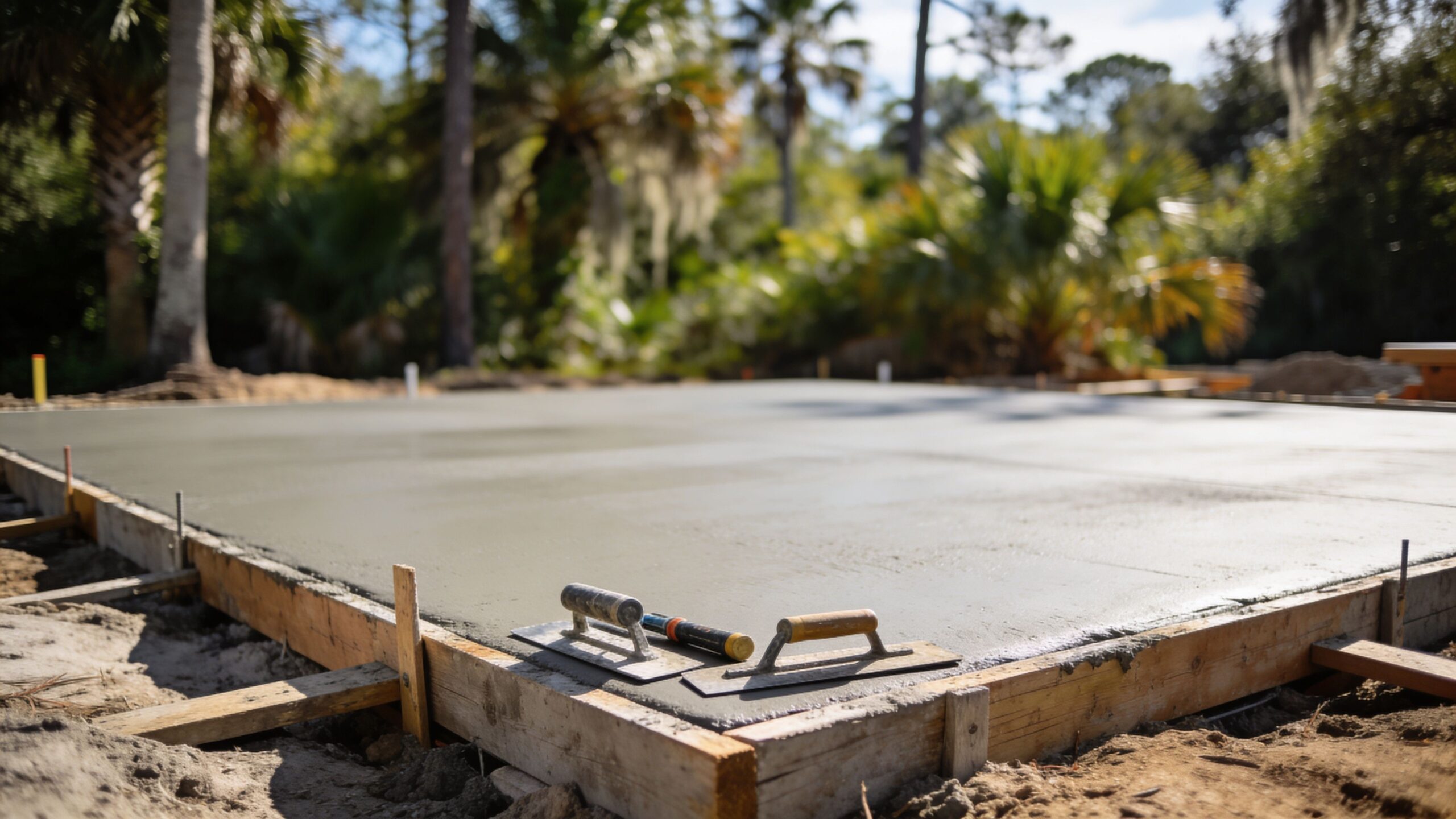
This is the type most homeowners are asking about when they search what is reinforced concrete slab. A slab-on-grade is poured directly over a prepared ground base. You'll see this in:
- Driveways in Ocala and Belleview
- Patios in Crystal River and Homosassa
- Sidewalks in Inverness and Beverly Hills
- Many residential foundations across Central Florida
A slab-on-grade works by spreading weight over the prepared soil below it. If the base is stable and evenly compacted, the slab performs much better. If the base has weak spots, water issues, or poor compaction, the slab can settle unevenly and crack.
Suspended or elevated slabs
A suspended slab isn't poured directly on the ground. It's supported by beams, walls, or columns. This type is more common in larger buildings, parking structures, upper floors, and certain raised construction.
For most homeowners in Marion County, FL or Citrus County, FL, this isn't the everyday slab they install in a backyard. Still, knowing the difference helps because the design logic changes completely once a slab is spanning open space instead of resting on soil.
A quick visual can help if you're comparing slab types in the field:
One-way and two-way action
Engineers also describe slabs by how they carry load.
One-way slabs mainly transfer weight in one direction, usually because they're supported on two opposite sides.
Two-way slabs transfer weight in two directions, usually because they're supported on all four sides.
A driveway or patio homeowner doesn't need to calculate slab action. But a builder or contractor does need to understand how the slab will carry stress before choosing thickness, reinforcement, and support details.
For residential work in Dunnellon, Hernando, or Summerfield, the practical point is this: the slab type affects how it should be designed and reinforced. A slab isn't just a flat pour. It's a structural surface with a specific job.
Key Design and Installation Considerations
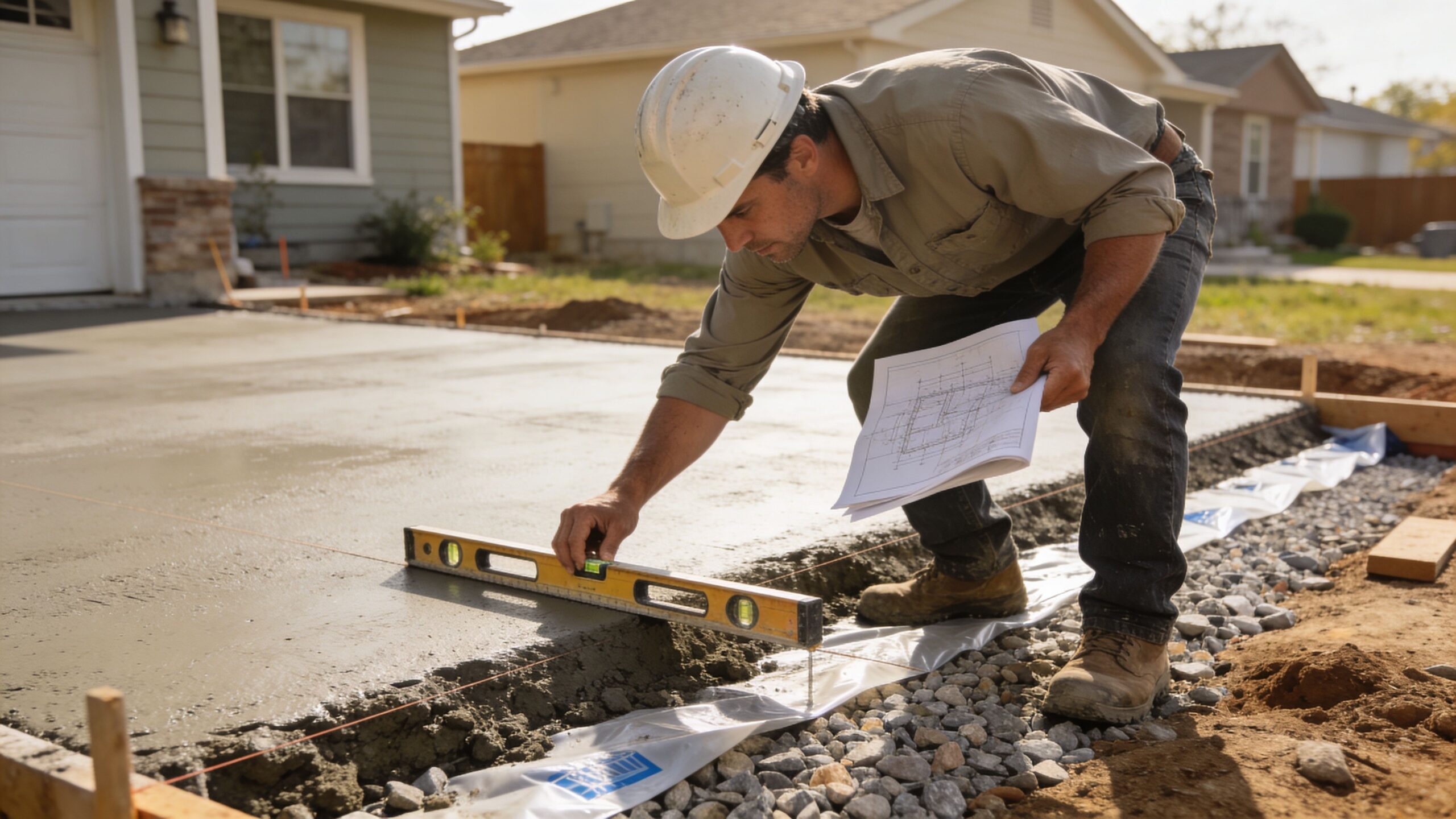
A durable slab starts long before the concrete truck arrives. Most failures people notice on the surface begin underneath the slab.
The ground below matters first
Florida soil can be sandy, loose, and sensitive to water movement. If the subgrade isn't prepared correctly, even a well-reinforced slab can struggle. Soft pockets, poor compaction, or trapped moisture can lead to settlement and cracking later.
That's why proper base prep is one of the most important parts of the job. If you want a closer look at that process, this guide on how to prepare ground for concrete slab breaks down what should happen before the pour.
Thickness and reinforcement work together
Slab thickness isn't chosen at random. A residential patio usually doesn't need the same design approach as a driveway that carries vehicles every day. The expected load, the condition of the subgrade, and the reinforcement plan all affect what makes sense.
Engineers also use reinforcement to control movement-related cracking. According to PDH Online's discussion of Subgrade Drag Theory, proper reinforcement such as #4 bars at 18-24 inch intervals on a 4-inch slab can increase control joint spacing from about 20 feet to over 100 feet while keeping crack widths to a nearly invisible level.
That doesn't mean every residential slab should be built that way. It means reinforcement layout has a direct effect on how the slab manages shrinkage and temperature stress.
Joints are not a flaw
A lot of homeowners see joints in concrete and assume something was cut because the slab had a problem. Usually, it's the opposite. Joints are planned on purpose.
There are two common types:
- Control joints guide cracking to a planned location.
- Expansion joints allow movement as the slab expands and contracts.
Without proper joints, concrete still moves. It just chooses its own place to crack. If you want a homeowner-friendly explanation, this article on what is a concrete expansion joint explains why these gaps matter.
Good slab work is often invisible. Homeowners notice the finish, but long-term performance usually depends on the base, reinforcement placement, thickness, drainage, and joint layout.
Florida Climate Challenges for Concrete Slabs
Concrete in Central Florida doesn't live in a gentle environment. A slab in Marion County, FL or Citrus County, FL has to deal with heat, storms, humidity, and changing ground moisture.
Heat, rain, and movement
Hot afternoons expand concrete. Rain-cooled evenings and temperature swings change how that slab moves. Over time, those cycles add stress. If reinforcement, joints, and curing were handled poorly, the slab is more likely to show uncontrolled cracking.
Humidity adds another layer. Moisture affects curing and long-term slab behavior. Water can also move through surrounding soil, which changes support conditions under the slab.
Sandy soil and washout risk
In places like Dunnellon, Lecanto, and Crystal River, sandy subgrades can be workable, but they need proper preparation and drainage planning. Heavy rains can wash out support beneath slab edges or low areas if runoff isn't managed well.
When that happens, the slab may no longer be fully supported. A driveway can look fine one month and then start showing settlement or edge cracking after repeated storms.
Why maintenance planning matters
A lot of online advice says concrete can last indefinitely if it's maintained, but that kind of statement doesn't help a homeowner plan. As noted in BECOSAN's discussion of reinforced concrete slabs, the core issue is understanding how humidity and temperature cycles affect reinforcement over time and how preventive maintenance such as sealing can shape the 20-30 year ownership picture.
For Florida property owners, that means thinking beyond installation day. A slab may be structurally sound and still benefit from maintenance decisions that protect appearance, reduce water intrusion, and limit future repair headaches.
When to Hire Concrete and Asphalt Experts
Understanding the basics helps you ask better questions. It doesn't replace field experience.
A reinforced concrete slab can fail for ordinary reasons. The base wasn't compacted evenly. The reinforcement type didn't match the job. The joints were poorly planned. The finishing crew moved too fast, or the slab cured under bad conditions. Most homeowners won't spot those issues until months later.
Projects that need a professional eye
Some jobs should always be evaluated by a qualified contractor, especially when you're dealing with:
- Replacement driveways with existing cracks or settlement
- Patios where drainage already causes standing water
- Sidewalks that need smoother transitions or ADA-friendly access
- Commercial slabs or parking areas with repeated traffic stress
- Sites with soft ground, washout concerns, or visible soil movement
In Florida, material choice also isn't limited to standard rebar. According to Concrete Network's overview of slab reinforcement, options such as Helix Micro Rebar and other polymer or composite reinforcement materials can offer advantages in corrosion resistance and installation speed in humid environments.
Why local experience matters
A contractor working in Ocala, Inverness, Homosassa, or The Villages should understand local soils, rainfall patterns, and how Florida heat affects placement and curing. That's not a small detail. The best reinforcement on paper won't save a slab poured over a poorly prepared base.
The value of an experienced contractor isn't just in pouring concrete. It's in making the right decisions before the pour, during placement, and after finishing.
For homeowners and property managers, that's where real long-term value comes from. Not from the lowest bid. From a slab that fits the site and holds up under local conditions.
Frequently Asked Questions About Concrete Slabs
Does reinforced concrete mean the slab won't crack?
No. All concrete can crack. Reinforcement helps control where cracks happen, how wide they become, and how well the slab stays together over time. That's a big difference from expecting a perfectly crack-free slab forever.
For a homeowner in Belleview or Silver Springs, that means the goal isn't perfection. The goal is a slab that handles normal movement in a controlled, durable way.
Is rebar always better than wire mesh?
Not always. It depends on the use of the slab, the expected load, and how the reinforcement is installed. Rebar is often preferred for driveways and heavier-use slabs because it provides stronger internal support. Wire mesh can still be useful in lighter residential applications if it's placed correctly.
Fiber reinforcement can also be a strong option in the right application, especially when broad crack control and efficient installation are priorities.
Why do some new slabs crack so quickly?
Usually because one or more basics were missed. Common causes include poor subgrade preparation, weak drainage, rushed curing, bad joint placement, or reinforcement that wasn't installed where it needed to be.
In places like Homosassa and Crystal River, water movement under the slab can be just as important as the concrete itself. A surface finish can look great on day one and still hide problems below.
Are joints a sign of poor workmanship?
No. Proper joints are part of good workmanship. Concrete shrinks and moves. Joints help manage that movement in planned locations instead of letting random cracks appear wherever stress builds up.
If you're pricing a project, it's also smart to understand how layout and slab design affect the final budget. This guide to concrete slab cost per square foot gives helpful context for homeowners comparing options.
What reinforcement makes sense for a Florida patio or driveway?
There's no universal answer. A driveway in Ocala that carries vehicles daily may call for a different reinforcement approach than a patio in Lecanto used mainly for outdoor seating. The best choice depends on soil conditions, slab thickness, load, joint design, and whether the priority is stronger structural support, broad crack control, or faster installation.
How can I tell if an old slab should be repaired or replaced?
Look at the pattern, not just the crack. A small surface crack may be manageable. Wide movement cracks, settling sections, drainage problems, or repeated edge failure usually point to deeper issues below the slab.
If the problem starts in the base, patching the surface often won't solve it for long. That's why an on-site evaluation matters before committing to repairs.
If you're planning a driveway, patio, sidewalk, or slab project in Ocala, Crystal River, Dunnellon, Inverness, or nearby areas, Riverside Sealing & Striping, LLC offers free, no-pressure consultations for homeowners and property managers who want clear answers before they build. As licensed and insured Concrete and Asphalt Experts in Marion and Citrus County, the team handles concrete installation, replacement, asphalt sealcoating, and parking lot striping with reliable scheduling and local experience.