
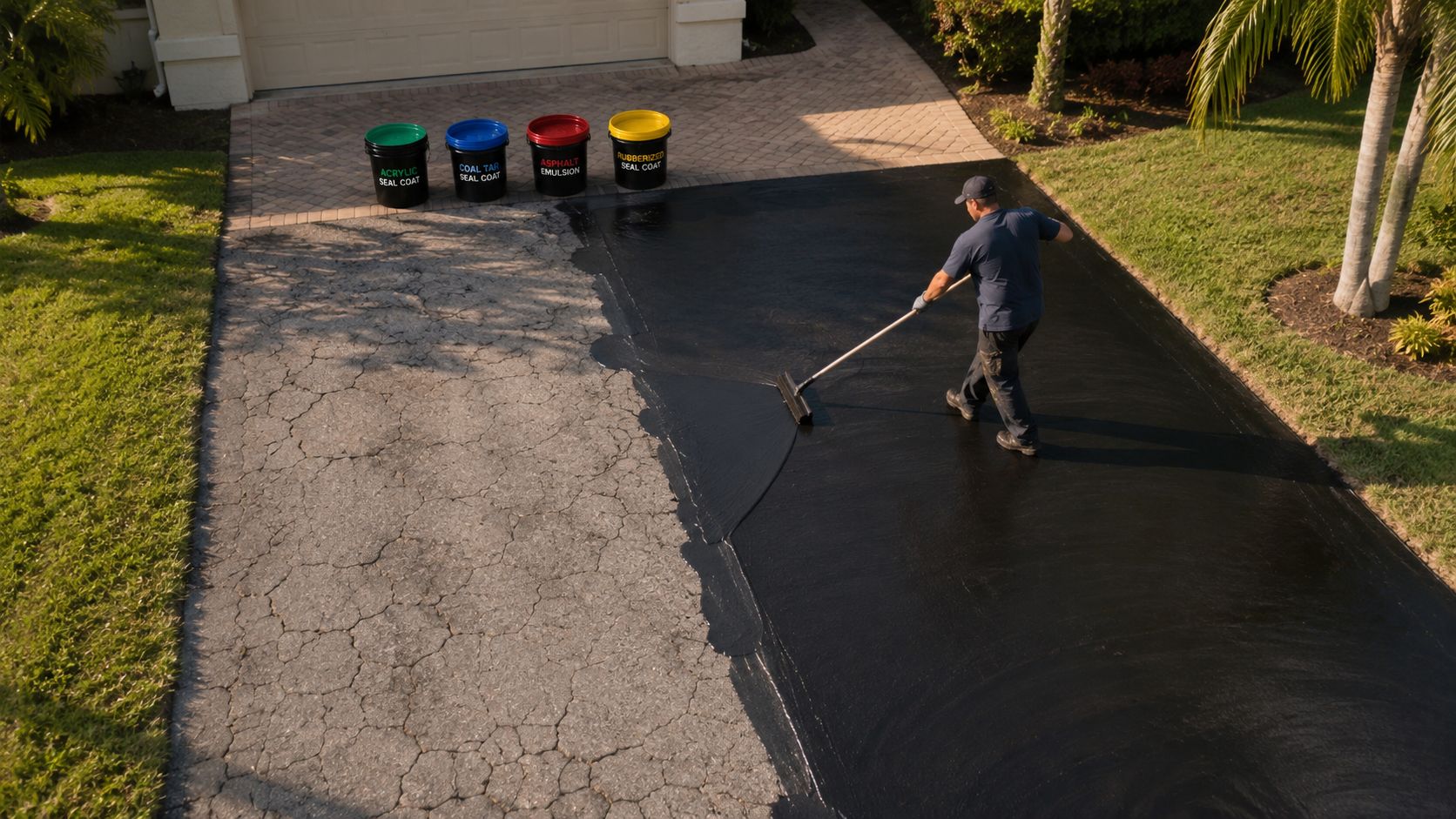
There isn't one best seal coat for asphalt. For most Central Florida driveways, the practical default is a water-based asphalt emulsion that meets ASTM D8099 with at least 28% residual asphalt by weight.
The loudest advice online usually picks a product first and a driveway second. That's backwards in Marion County, FL and Citrus County, FL, where heat, UV, storm timing, and base condition decide whether a seal coat performs for years or fails fast. If you own a home in Ocala, Dunnellon, Belleview, Silver Springs, Summerfield, Crystal River, Homosassa, Inverness, Lecanto, Beverly Hills, Hernando, or The Villages, the essential question isn't “what's the best brand,” it's “what matches my surface?”
| Chemistry | Best Use | Main Strength | Main Trade-Off |
|---|---|---|---|
| Asphalt emulsion | Residential driveways, many light-duty lots | Breathability and easy recoatability | Less fuel resistance than specialty blends |
| Coal-tar emulsion | Heavy fuel exposure where legal | Strong oil and gasoline resistance | Environmental concerns and legal limits in some areas |
| Polymer-modified emulsion | Commercial lots, higher stress areas | Better flexibility and adhesion | Costs more than standard emulsion |
| Acrylic coating | Specialty entrances and fast-turn jobs | Fast cure and strong UV stability | Higher price for targeted applications |
Table of Contents
- Why There Is No Single Best Seal Coat
- The Four Main Types of Asphalt Seal Coat
- Performance Trade-Offs Side by Side
- How Central Florida Conditions Change the Answer
- DIY Versus Professional Application
- Maintenance Cadence and Lifecycle Cost
- Recommendations and How to Pick a Contractor
Why There Is No Single Best Seal Coat
The bucket label is not the main performance driver. Aggregate, binder, application rate, and the pavement base determine how a seal coat wears. A Transportation Research Board report records asphalt aggregate seals used in Manitoba for decades, with some seal-coat structures introduced in 1959 still performing more than 20 years later. These are surface systems, not cosmetic paint. The same research reports reseals on asphalt surface treatments lasting about 7 years, while chip seals on hot-mix asphalt lasted about 10 to 12 years. Transportation Research Board historical seal-coat report
What drives the result
A Transportation Research Board field study found that aggregate choice often matters more than binder type. Over three years, asphalt emulsion and polymer-modified asphalt emulsion seals showed no significant performance difference, while aggregate type affected friction and longer-term results. The practical lesson is direct: choose the aggregate and emulsion as a matched system instead of paying for the most expensive chemistry by default. Transportation Research Board field study summary
Start with the pavement, then assess the exposure. Is the base sound, or are cracks moving through it? Does the surface take all-day sun, fuel drips, or repeated turning traffic? A Summerfield driveway may need straightforward protection, while a busy entrance in Ocala or The Villages needs more grip and wear resistance.
Practical rule: if the pavement underneath is failing, no seal coat fixes the base. It only buys time.
Material quality matters more than a brand name. ASTM D8099 treats sealer performance as a formulation issue and sets minimum requirements for water-based asphalt emulsion pavement sealer on bituminous pavements. Industry specifications based on the standard commonly call for at least 28% residual asphalt content. Check that requirement on the product data sheet before comparing buckets. ASTM D8099 specification
For Central Florida properties, my recommendation is simple. Match the aggregate and binder to traffic, sun, fuel exposure, and base condition. A premium binder cannot rescue weak asphalt, and a low-cost sealer cannot compensate for poor aggregate selection or an incorrect application rate.
The Four Main Types of Asphalt Seal Coat
Asphalt emulsion
This is the default choice for most residential driveways in Central Florida. It's a water-based blend that uses asphalt, water, clay fillers, and additives, so it applies and cures in a way that's easier for typical driveways and less aggressive in odor than older options. The upside is simple, good UV protection, breathable performance, and easier recoatability when the surface is maintained on schedule.
Coal-tar emulsion
Coal-tar sealer is built for toughness against gasoline and motor oil. It's chemically distinct from asphalt emulsion, and that distinction matters because coal tar is known for strong fuel resistance, while asphalt emulsion is generally the more common residential choice. The trade-off is the environmental and regulatory profile, which is why some buyers avoid it even when it performs well on paper. Coal-tar versus asphalt-emulsion overview
Polymer-modified emulsion
This is the workhorse for many parking lots and higher-stress surfaces. Contractors add polymers such as latex or SBS-type modifiers to improve flexibility, adhesion, and sand loading, which helps the coating stand up better to turning tires and repeated traffic. If you manage a lot in Citrus County or a commercial entrance in Marion County, this is often the smarter middle ground between standard emulsion and specialty coatings.
Acrylic coating
Acrylic is the premium, specialty option. It cures fast, handles sun exposure well, and makes sense where appearance, turnaround time, or a specialty finish matters more than pure economy. That's why it shows up on features like entrances, sports courts, and HOA showcase areas, not every plain driveway. If you're looking for a tar-and-chip style surface instead of a conventional sealcoat, this tar and chip reference shows how different surface systems solve different problems.
Performance Trade-Offs Side by Side
The fastest way to choose wrong is to buy for one strength and ignore the rest. Coal tar can win on fuel resistance and still be the wrong answer for a quiet residential drive. Acrylic can look sharp and cure fast, then make no financial sense on a plain driveway in Hernando. Standard emulsion sits in the middle, which is exactly why it gets used so often.
| Chemistry | UV Resistance | Fuel/Oil Resistance | Typical Lifespan | Cure Time | Cost per Sq. Ft. | Regulatory Notes |
|---|---|---|---|---|---|---|
| Asphalt emulsion | Good | Moderate | Moderate | Normal | Lower | Broadly accepted for residential and many commercial uses |
| Coal-tar emulsion | Good | Strong | Moderate to strong | Normal | Moderate | PAH concerns and limits in some jurisdictions |
| Polymer-modified emulsion | Very good | Good | Strong for traffic stress | Normal to slightly longer | Moderate to higher | Often chosen where durability matters more than lowest price |
| Acrylic coating | Excellent | Moderate | Strong in specialty uses | Fast | Highest | Used where appearance and fast return-to-service matter |
The practical takeaway is easy. Coal tar wins on fuel resistance, but that doesn't make it the universal best. Acrylics cure fastest, but that premium only pays off on the right surface. And emulsion wins on balance, especially for homeowners who want a clean, durable finish without overbuying chemistry they don't need. For quote sanity checks, this asphalt sealcoating cost reference is a useful reminder that product choice and coverage rate drive the bill as much as the bucket label.
If a contractor can't tell you why one chemistry fits your surface better than another, they're selling a coating, not a solution.
The other issue is compliance and risk. A 2024 peer-reviewed study found that some seal coat emulsions with polymer dispersion additives can leach toxic substances, and that latex-based seal coats can release isothiazolinone biocides during early service life, so the “best” product isn't always the one that sounds toughest on a flyer. Peer-reviewed 2024 seal-coat leaching study
How Central Florida Conditions Change the Answer
Central Florida isn't gentle on pavement. Marion County and Citrus County get the kind of heat, sun, and storm cycles that punish weak coatings fast, and that's why generic national advice misses the mark. A product that works fine in a cooler region can look tired here after one hard summer.
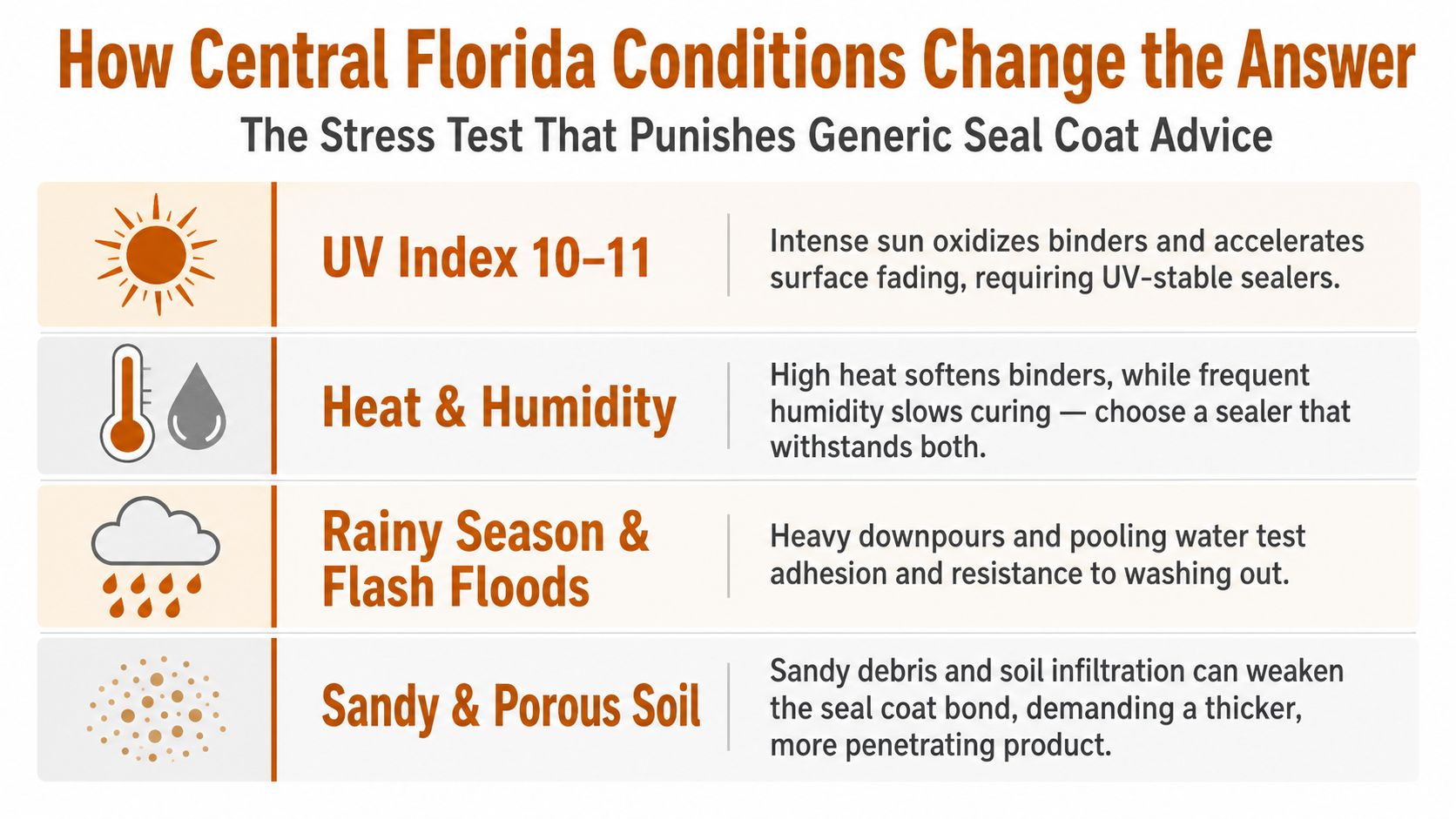
The sun matters first. Long service in places like Ocala, Belleview, Crystal River, Homosassa, and Inverness means the coating has to survive intense UV exposure without chalking out too quickly. That is why a UV-stable coating, especially a polymer-modified emulsion or acrylic on the right job, starts to make sense when the surface gets blasted all day.
Heat and rain matter just as much. One industry guide says sealcoating needs both air and surface temperatures at 50°F or higher, and the temperature has to stay above that level for the first 8 hours after application, with no overnight drop below that threshold. Another guide says traffic usually stays off for 24 to 48 hours while the coating cures. In Florida, that means timing is not a side issue, it's the whole job. Sealcoating temperature range guide
The seasonal storms are the other problem. Afternoon downpours can wash out uncured material, especially on driveways with poor drainage or thin base sections in sandy soil. That's where a polymer-modified system or a more carefully selected emulsion can outperform a bargain product that looked fine on the shelf. For broader pavement maintenance work in Dunnellon, Lecanto, Beverly Hills, or The Villages, asphalt paving and maintenance has to be part of the conversation, because coating only works when the surface underneath is stable.
DIY Versus Professional Application
DIY makes sense on a small, sound residential driveway. If you've got about 400 to 800 square feet, good hose access, a base that isn't breaking apart, and the patience to block it off for 48 hours, you can buy materials and do the work yourself. The materials cost often lands around $0.15 to $0.30 per square foot, while professional pricing can run around $0.12 to $0.25 per square foot depending on the job and product.
What DIYers usually miss
- Surface moisture: a damp driveway ruins adhesion fast.
- Agitation: the emulsion has to stay mixed, or the finish goes uneven.
- Crack prep: unfilled cracks just reopen under heat and traffic.
- Oil spots: sealer won't bond well over contamination.
- Weather window: a 3 p.m. thunderstorm can turn a good application into a redo.
The tools also matter more than many expect. A squeegee, 5-gallon buckets, edging tools, and a power blower for drying the surface are basic gear, not extras. If you skip them, the job looks cheap even before it fails.
| Factor | DIY | Professional |
|---|---|---|
| Material control | You buy and mix it yourself | Contractor supplies and calibrates it |
| Surface prep | Limited by homeowner tools | Better cleaning and crack prep |
| Finish consistency | Depends on your skill | More even coverage and edges |
| Weather response | You handle it alone | Job can be scheduled around conditions |
| Traffic management | You block it off yourself | Easier for active homes or businesses |
A professional brings better control over additives, sand ratios, and application consistency. That matters on parking lots in Marion County, HOA entrances in Citrus County, and active commercial sites where the work has to happen overnight or around business hours. Riverside Sealing & Striping, LLC does this kind of pavement work in Dunnellon and across Central Florida, and the difference is usually in prep, not just in the coating itself.
Maintenance Cadence and Lifecycle Cost
The old advice to “seal every 2 to 3 years” is too blunt. Traffic changes the math. A quiet residential driveway in Silver Springs doesn't age like a rental road in Summerfield, and neither one ages like a busy commercial entrance in Ocala.
A better schedule by traffic tier
Residential driveways with light daily use can often hold 3 to 4 years between coats if the base is sound and drainage is decent. HOA roads and rental streets with more turning traffic usually run on a tighter cycle. Commercial lots with fuel exposure and steady vehicle movement need more attention at the entries, lanes, and loading areas than a typical home driveway ever will.
The long view is what saves money. A neglected surface oxidizes, gets brittle, and eventually needs resurfacing instead of sealcoating. That's the significant cost jump, not the price of one extra coat.
| Seal Coat Type | Installed Cost / Sq Ft | Typical Cycle (FL) | Annualized Cost / Sq Ft |
|---|---|---|---|
| Budget emulsion | Lower | Longer residential cycle | Lower annual cost |
| Polymer-modified emulsion | Mid-range | Tighter on traffic-heavy sites | Mid-range annual cost |
| Acrylic | Higher | Best used where fast cure or premium finish matters | Highest annual cost |
A simple maintenance rhythm keeps the surface from slipping backward. Sweep in spring, inspect after hurricane season, spot-seal fuel pads, and restripe every other cycle if the lot has painted markings. That routine works in Marion County, Citrus County, and surrounding Central Florida because it matches the climate instead of fighting it.
Practical rule: the cheapest seal coat is the one you apply before the surface turns into a repair job.
Recommendations and How to Pick a Contractor
For a residential driveway in Central Florida, I'd start with a water-based asphalt emulsion meeting ASTM D8099 and at least 28% residual asphalt. It gives you the best balance of UV protection, breathability, and easy recoatability for the money, which is what most homeowners need. If the driveway sees more fuel drip, more turning tires, or more frequent traffic, move up to a polymer-modified emulsion.
For commercial parking lots, fuel bays, and drive-thrus, I'd push harder toward polymer-modified emulsions, and coal-tar emulsion only where it's still permitted and the owner understands the trade-offs. For HOAs that care about curb appeal, an acrylic topcoat over an emulsion base can be the right answer when appearance and color retention matter more than lowest upfront cost.
Picking the right contractor matters just as much as picking the chemistry. Ask for a written quote that names the product, the coverage rate, and the number of coats. Ask for proof of Marion County or Citrus County business licensing, general liability insurance, workers' comp, and product data sheets that show ASTM D8099 compliance. If the contractor won't tell you what sand adders they use, how many pounds per gallon they're mixing, or how they'll handle crack filling, keep looking.
A professional quote should also come with local references from jobs that are at least three years old, because that's the only way to judge whether the work held up through Florida sun and rain. Avoid anyone who pressure-washes with no follow-up plan, bids by square footage without checking the base, or skips prep because “the coating will cover it.” It won't.
If you want a contractor who handles both concrete work and asphalt maintenance, Riverside Sealing & Striping, LLC in Dunnellon fits that model, because the company covers sealcoating, parking lot striping, and concrete driveways under one roof. That matters when a property needs both a surface fix and a maintenance plan, not just a bucket of sealer.
If you want a straight answer for your driveway, lot, or HOA, Riverside Sealing & Striping, LLC can evaluate the surface and recommend the right seal coat for Central Florida conditions. Visit Riverside Sealing & Striping, LLC for a free, no-pressure estimate and a practical plan for your asphalt.