
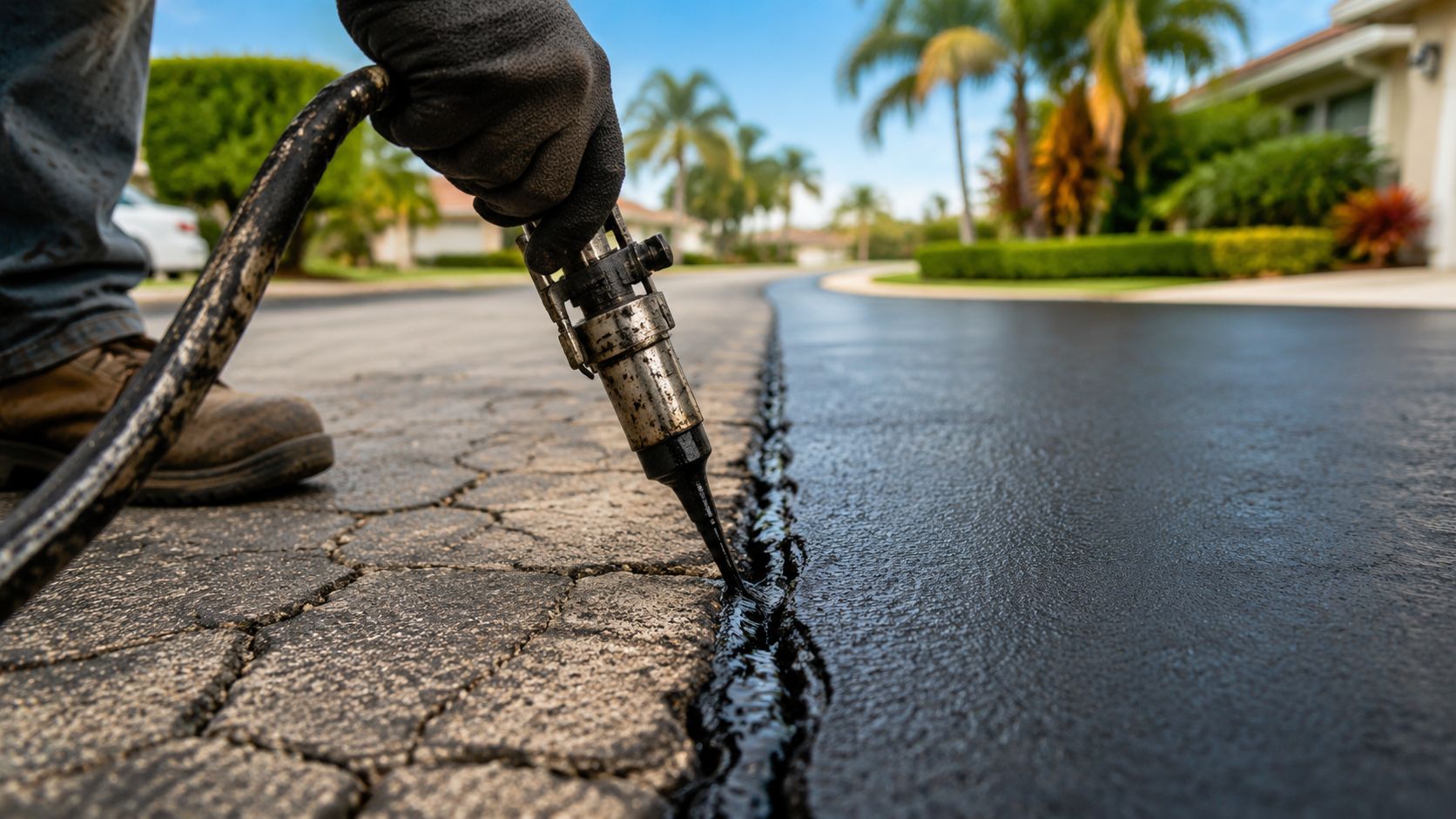
You walk out to the driveway in Crystal River or pull into a parking lot in Ocala and notice the surface doesn't look the way it did a year ago. The color has faded. A few cracks have opened. Water sits in one low spot after every storm. If it's a business, you may also be thinking about trip hazards, worn striping, and whether customers notice the lot before they ever notice the building.
That's usually the point where property owners start asking the same questions. Is this cosmetic, or is the pavement starting to fail? Should you seal it, patch it, or start planning for replacement? And in Central Florida, when is the right time to do the work so rain doesn't ruin the schedule?
This guide is built for those real-world decisions. It focuses on asphalt paving and maintenance in the conditions we deal with across Marion County, FL and Citrus County, FL, including Ocala, Dunnellon, Belleview, Silver Springs, Summerfield, Crystal River, Homosassa, Inverness, Lecanto, Beverly Hills, Hernando, and The Villages. It also reflects the bigger picture. Good pavement care doesn't stand alone. It often connects to drainage, sidewalks, ramps, curbs, and other site work, which is why it helps to work with Concrete and Asphalt Experts in Marion and Citrus County who can look at the full property.
Table of Contents
- Introduction Your Guide to Protecting Pavement in Central Florida
- The Asphalt Lifecycle in Florida From Fresh Pavement to Replacement
- Your Year-by-Year Asphalt Maintenance Schedule
- The Twin Pillars of Prevention Sealcoating and Crack Filling
- Parking Lot Safety Striping and ADA Compliance
- How Florida Weather Attacks Your Asphalt
- Choosing a Paving Contractor in Marion and Citrus County
- Frequently Asked Questions About Asphalt Maintenance
- Conclusion Partner with Central Florida's Pavement Experts
Introduction Your Guide to Protecting Pavement in Central Florida
Asphalt rarely fails all at once. It starts with small changes that are easy to ignore. A light crack near the edge. Loose stone near a turn. Fading where the Florida sun beats on the surface every day. In places like Inverness, Homosassa, and Belleview, those early signs can turn into expensive repairs if water gets below the surface.
That's why owners who get the best long-term value don't wait for potholes. They pay attention to the full pavement lifecycle. Installation quality matters. Drainage matters. Timing matters. So does knowing when sealcoating is the right move and when the problem is deeper than the surface.
Practical rule: Good pavement maintenance starts below your feet. If the base stays dry and stable, the surface has a far better chance of lasting.
For homes, that may mean protecting a driveway before cracking spreads. For commercial sites in Ocala, Lecanto, or The Villages, it may mean keeping traffic lanes, handicap spaces, and entry routes safe and clearly marked. The same principle applies in both cases. Concrete and Asphalt Experts in Marion and Citrus County should think beyond one quick fix and help you protect the entire property.
The Asphalt Lifecycle in Florida From Fresh Pavement to Replacement
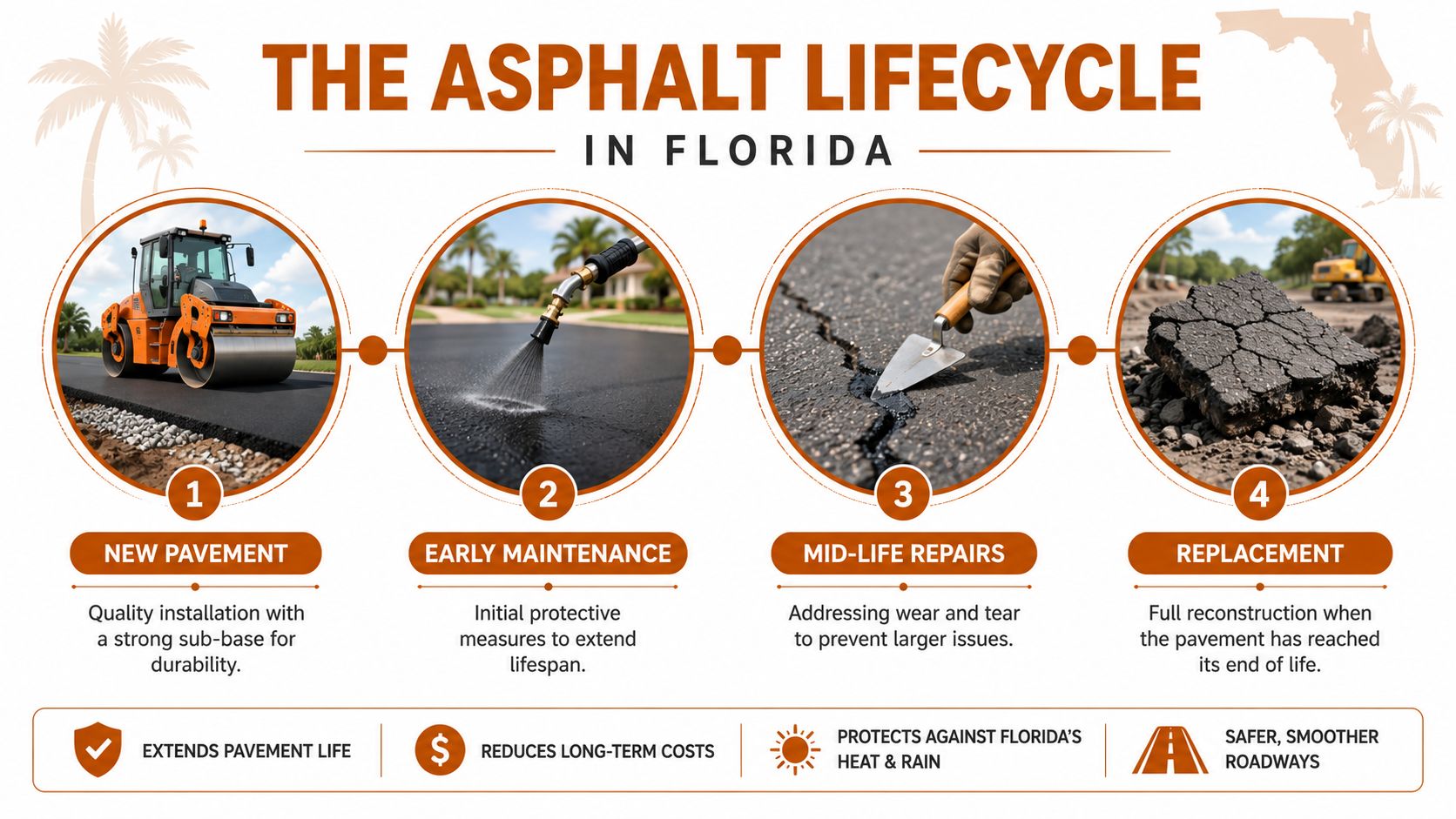
A new driveway or parking lot can look sharp on day one and still be headed for early trouble if water control and base preparation were weak. In Central Florida, that risk shows up fast. Heat hardens the surface, afternoon storms push water into weak spots, and sandy subsoils can shift when edges lose support.
What a strong start looks like
Long pavement life starts below the blacktop. Proper grading, solid compaction, and a base built to shed water matter just as much as the finished surface. A fresh mat can hide problems for a while, but it cannot overcome a soft base, poor drainage, or thin edges for long.
That matters more in places like Dunnellon and Summerfield, where sandy soils drain differently from one property to the next and heavy summer rain can expose weak construction details quickly. If runoff collects along an edge or near a low area, the pavement structure starts losing support from the bottom up.
Surface treatment details matter too. The Asphalt Institute notes in its engineering FAQs that chip seal performance depends on proper aggregate embedment and coating. If those details are off, stone loss and early surface wear become more likely. The same principle applies across asphalt work in general. Good materials help, but placement, compaction, and drainage decide how long the pavement holds up.
How failure usually develops in Central Florida
Asphalt in this part of Florida ages in a predictable pattern. Sun and heat dry the binder. Daily traffic works the same paths over and over. Then summer rain finds every small opening the surface gives it.
The first stage is usually cosmetic, but it should not be ignored.
- Early-stage wear shows up as fading, light oxidation, and small cracks near joints, edges, or places where water lingers.
- Mid-life distress brings wider cracks, shallow depressions, raveling, and soft spots that stay wet after a storm.
- Advanced failure includes alligator cracking, potholes, pumping water, and visible movement in the base below the surface.
The pattern changes slightly by property type. On a narrow residential driveway in Beverly Hills or Silver Springs, edge cracking often starts first because tires drift off the side and break support along the shoulder. On commercial pavement in Ocala or Crystal River, entrances, dumpster pads, and turning areas usually fail first because they carry slow, heavy, repeated loads.
A pothole is usually a late symptom. The real problem started earlier, when water got into the structure and traffic kept flexing the same weak area.
That is the key lifecycle shift Florida owners need to understand. Early wear can often be managed with timely maintenance. Once cracks connect, water reaches the base regularly, and the pavement begins to move, surface treatments stop being enough. At that point, patching may hold things together for a season, but resurfacing or full replacement becomes the better investment.
Your Year-by-Year Asphalt Maintenance Schedule
A lot in Ocala can look fine in May, then come out of one summer with edge breakdown, open cracks, and soft spots where water sat too long. Central Florida pavement ages by season as much as by year. The right schedule accounts for heat, afternoon downpours, and how quickly water turns a small surface issue into a base problem.
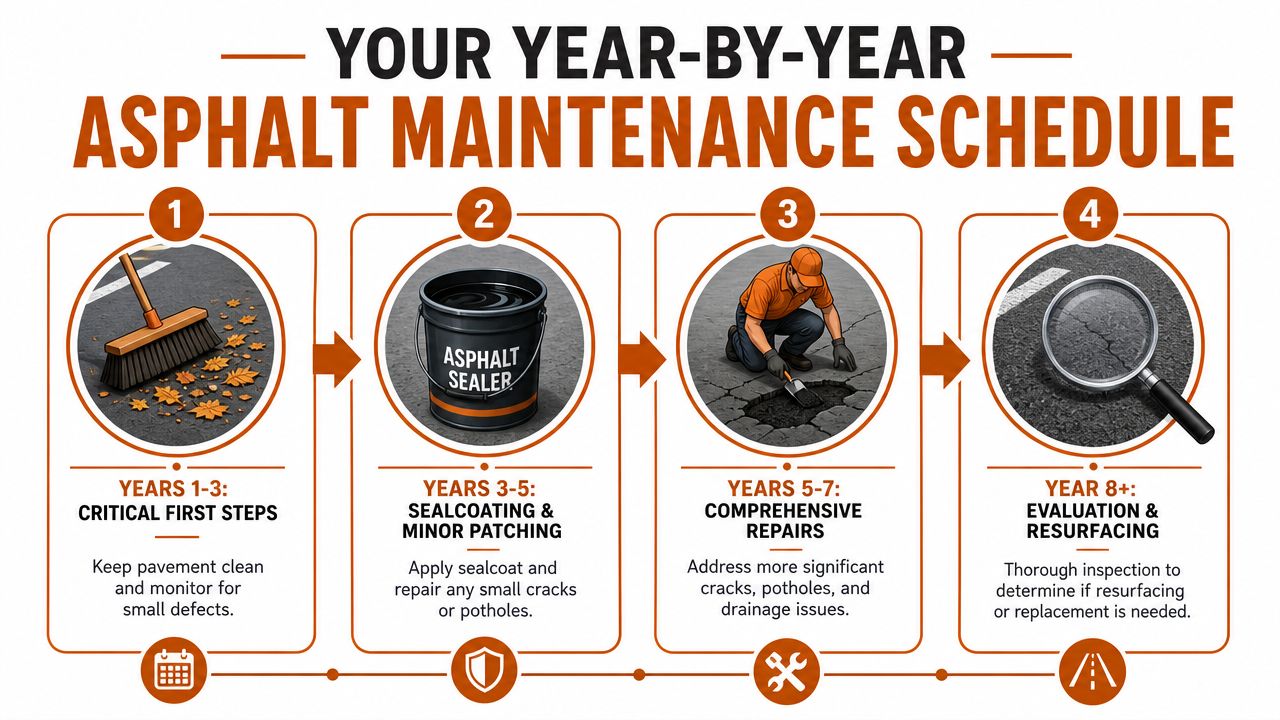
Years 1 to 3 protect the new surface
New asphalt is still curing during its early service life, so the priority is to protect it and catch defects before they spread. Keep the surface clean, watch how it drains after heavy rain, and pay close attention to edges, joints, and utility cuts. In Florida, those are often the first places where trouble starts.
Owners often ask when to schedule the first sealcoat. A practical window is after the pavement has had time to cure, then on a regular cycle based on exposure and traffic. A shaded residential driveway in Summerfield will not age like a retail lot entrance in Ocala. The better approach is condition-based planning, not a date on a calendar with no site context. If you are comparing timing and service options, this page on asphalt sealcoating services in Central Florida gives a useful starting point.
Small habits matter in this stage. Parking in the same spot every day, letting irrigation spray the pavement edge, or allowing shoulder material to wash away can shorten the life of an otherwise sound driveway or lot.
Years 3 to 7 focus on water control and targeted repairs
This is the period where disciplined maintenance usually saves the most money. By now, the surface has seen enough UV exposure, stormwater, and traffic wear that protective work pays off. The goal is simple. Keep water out and repair isolated failures while the surrounding structure is still sound.
Use this checklist during the mid-life years:
- Inspect after major rain events: Look for puddles that stay in place, edges that feel soft, and cracks that remain dark after the rest of the surface dries.
- Fill cracks while they are still isolated: Once water starts reaching the base regularly, repairs become larger and more expensive.
- Seal on a planned cycle: Schedule protection before the surface turns brittle and heavily oxidized.
- Patch failed areas properly: Cut out soft or broken sections and repair them full-depth when needed. Surface treatment alone will not fix a weak base.
Commercial properties usually need a tighter schedule here than residential driveways do. Entrances, pickup lanes, dumpster pads, and turning areas carry slow, repeated loads that stress asphalt more than straight parking stalls. On mixed-surface sites, check nearby concrete walks, ramps, and curb lines at the same time so drainage still works the way it should.
Years 8 and beyond require an honest structural decision
At this point, the question is no longer whether the pavement needs attention. The question is what kind. Some lots still have a stable base and respond well to patching, crack work, and an overlay. Others show widespread fatigue, movement, or drainage-related failure that makes resurfacing a short-lived fix.
I tell owners to judge older asphalt by pattern, not by color. A faded lot with a firm structure can often be restored. A dark, freshly coated lot with alligator cracking underneath is still failing. That is an expensive mistake in Florida because summer rain keeps exploiting the same weak areas.
Preventive work still has value in the later years, but it has to match the condition of the pavement. Sealcoat improves protection and appearance on sound asphalt. It does not rebuild a broken section. For older properties in Lecanto, Dunnellon, Belleview, and similar markets, the best plan is often a mix of targeted patching, resurfacing where the base is intact, drainage correction, and full replacement only in the areas that have reached the end of their service life.
The Twin Pillars of Prevention Sealcoating and Crack Filling
A Central Florida parking lot can look serviceable at the end of spring, then come out of one wet summer with open cracks, soft edges, and low spots that hold water. That shift happens fast here. Heat hardens the surface, afternoon storms find every opening, and small defects turn into repair bills.
Sealcoating blocks the daily wear
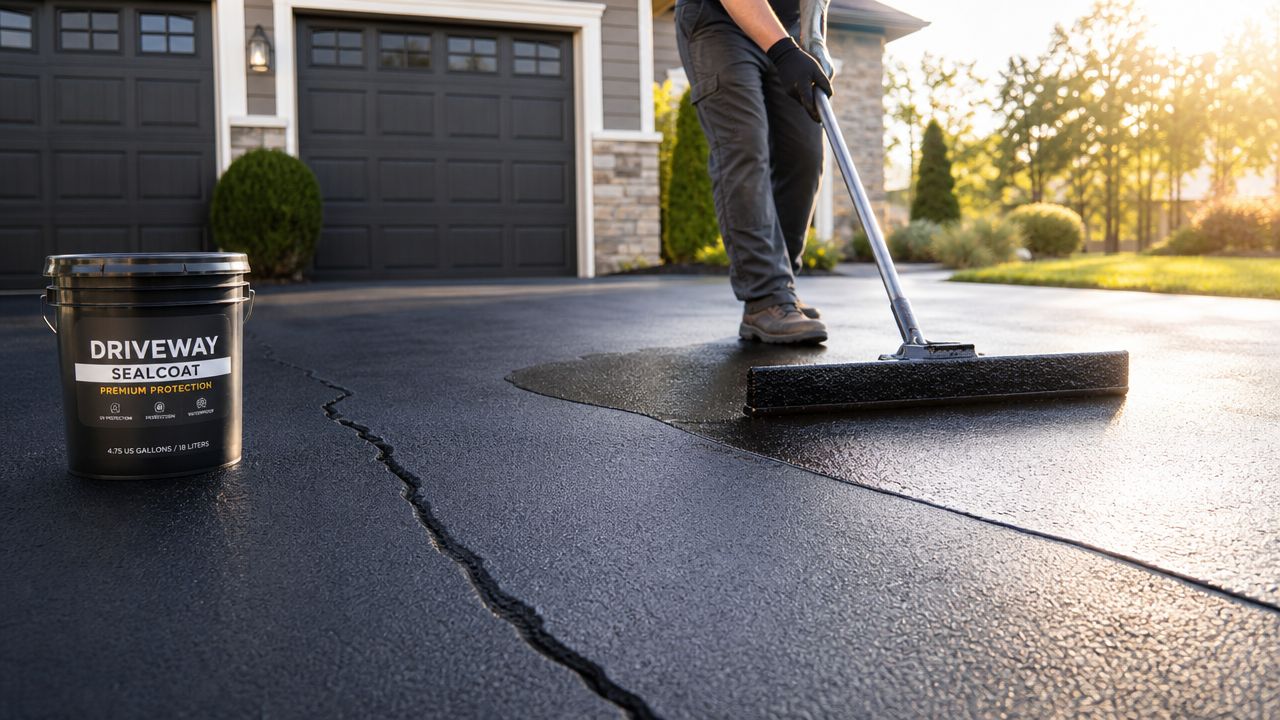
Sealcoating protects asphalt that still has good structure. It helps slow oxidation, reduces surface wear, and gives water, oil, and tire traffic less opportunity to work into a weathered mat. In Florida, that matters more than it does in milder climates because pavement spends months under intense sun, then gets hit with heavy rain on a repeated cycle.
Property owners sometimes expect sealcoat to fix rough texture, depressions, or cracking that has already spread. It will not. A fresh black finish can improve appearance, but appearance is not the same as condition. On sound pavement, sealcoating extends the useful life of the surface. On failing pavement, it mainly covers the problem for a short time.
That trade-off matters.
If you are comparing local options, a contractor offering asphalt sealcoating services near you should be willing to talk through preparation, weather windows, cure time, traffic control, and whether your pavement is a good candidate for coating.
Crack filling keeps water out of the base
Crack filling does a different job. It closes active openings before rain can move below the surface and weaken the support under the asphalt. In Central Florida, that window is important. Once water starts getting into the base during the rainy season, the repair often shifts from simple crack treatment to patching or partial replacement.
Timing matters more than owners expect. A narrow, early crack in a driveway apron in Homosassa is usually straightforward to treat. A network of connected cracks across a medical office drive lane in Inverness is a different situation, especially after months of stormwater intrusion and turning traffic.
The practical rule is simple:
- Sealcoat protects sound pavement: Use it on asphalt that is weathered but still structurally stable.
- Crack filling closes entry points: Use it before cracks widen, branch, or connect.
- Patching repairs failed sections: Use it where the asphalt has already broken, shifted, or lost support.
I have seen plenty of owners spend money at the wrong stage. They coat pavement that needed repairs first, or they ignore working cracks until summer rain turns a maintenance item into a structural problem. The best results come from matching the treatment to the condition of the asphalt, not from choosing the cheapest line item on the estimate.
A short demonstration helps show the difference between surface protection and real repair work:
Parking Lot Safety Striping and ADA Compliance
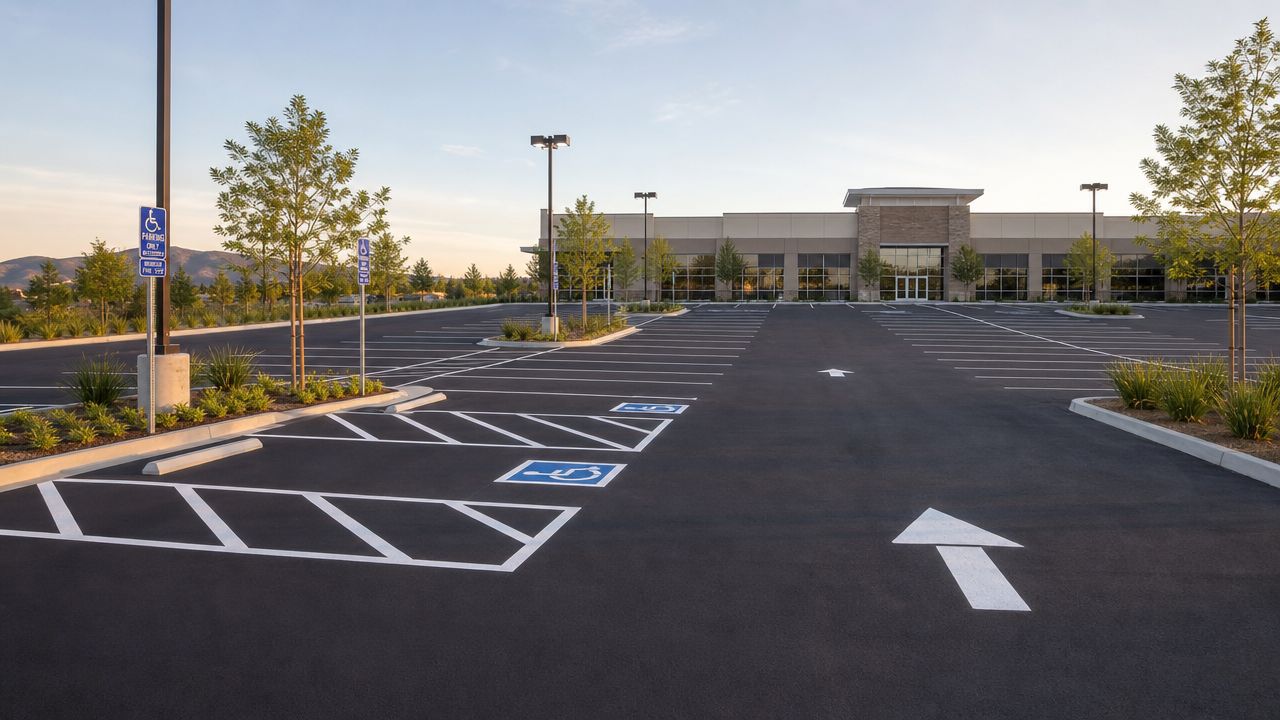
For commercial property, asphalt maintenance doesn't end when the surface is repaired or sealed. If the markings are faded, the lot still feels neglected and functions poorly. Drivers hesitate. Pedestrians take less predictable paths. Accessible spaces become unclear. That's a real liability issue, not just an appearance issue.
Striping does more than improve appearance
Good striping organizes the lot. It tells drivers where to park, where to stop, and how to move through the site. On busy properties in Ocala, Crystal River, and The Villages, fresh markings also help reduce confusion at entrances, fire lanes, loading areas, and directional turns.
Important striping elements often include:
- Parking stalls: Keep spacing consistent and traffic orderly.
- Directional arrows: Reduce wrong-way movement in tight aisles.
- No-parking zones: Protect corners, loading points, and access areas.
- Reserved and handicap markings: Help users identify the right spaces quickly.
For owners who want a practical overview of layout and marking basics, this guide on how to stripe a parking lot correctly is a useful starting point.
ADA work often involves both asphalt and concrete
ADA compliance is where many sites need more than paint. Accessible parking depends on the surrounding route as much as the stall itself. If the path to the entrance is uneven, if the ramp is deteriorated, or if the sidewalk connection doesn't work, the lot may still have a functional access problem.
That's one reason it helps to work with Concrete and Asphalt Experts in Marion and Citrus County rather than treating pavement and concrete as separate issues. A commercial site in Lecanto may need restriping after sealcoating, but it may also need a concrete ramp repair or a sidewalk adjustment. In Beverly Hills or Inverness, an HOA may need access aisles refreshed while also replacing broken walkway panels that affect safe travel.
Clear striping helps people move through a property. ADA-compliant ramps, sidewalks, and transitions help people actually use it.
The best commercial maintenance plans look at both.
How Florida Weather Attacks Your Asphalt
Central Florida doesn't damage asphalt in one simple way. Heat, UV exposure, heavy rain, and humidity work together. That combination is why generic advice from cooler or drier regions often falls short for owners in Marion County and Citrus County.
Heat and sun harden the surface
Florida sun steadily oxidizes asphalt binder. As the surface ages, it loses flexibility and becomes more likely to crack under daily traffic stress. On open properties in places like Belleview or Silver Springs, sun exposure can be relentless, especially where there's no shade and dark pavement absorbs heat all day.
That hardening process doesn't always look dramatic at first. Owners usually notice fading before they notice structural symptoms. The danger is assuming faded pavement is only cosmetic when it may also be becoming less resilient.
Rain exposes every weak point
Once cracks open, Florida rainfall does the rest. Water enters from above, moves through joints and weak spots, and begins affecting the layers below. If the lot or driveway has low areas, edge erosion, or poor runoff, moisture keeps returning to the same trouble spots.
One widely cited maintenance source notes that climate timing is often underexplained in storm-prone regions and that in Florida the key question isn't solely whether to seal, but what maintenance sequence makes sense for your climate and traffic, and when the work is best performed between rainy seasons, as discussed in this climate-timing article on asphalt maintenance.
Humidity and traffic make timing matter
High humidity can slow drying and curing. Daily storms can break up a work schedule that looked fine at the start of the week. Heavy vehicles can also deform softer pavement during hotter periods, especially in parking stalls, tight turns, and loading areas.
That's why local scheduling matters so much. In Homosassa, Dunnellon, or Hernando, the right maintenance window may not be the same from one property to the next. Surface condition, shade, traffic, drainage, and rainfall exposure all affect the plan. Owners who do well over time usually don't ask for the quickest possible coating date. They ask for the right sequence at the right time.
Choosing a Paving Contractor in Marion and Citrus County
Hiring the wrong contractor can leave you with a surface that looks better for a short time and fails earlier than it should. Hiring the right one usually comes down to a few practical checks, not flashy promises.
What to verify before you sign
Start with the basics. The contractor should be licensed and insured, familiar with Florida conditions, willing to inspect the site in person, and able to provide a clear written estimate. That estimate should describe the scope of work, not just give a lump sum with no detail.
A solid vetting checklist looks like this:
- Ask about local work: Look for experience in places like Ocala, Inverness, Crystal River, or Dunnellon, not just general claims.
- Request a written scope: You want to know whether the price includes cleaning, crack treatment, patching, striping, prep, and traffic control.
- Discuss drainage directly: If the contractor ignores water movement, they're ignoring one of the main causes of failure.
- Pay attention to timing: Reliable scheduling matters, especially in Florida's wet season.
You should also be cautious of vague sales language. Good contractors explain what a treatment can and can't do. If a lot has structural failure, they shouldn't present sealcoating as a cure-all.
Why dual concrete and asphalt capability matters
Many projects don't fit neatly into one trade. A shopping center may need asphalt sealcoating and restriping, but also a repaired dumpster pad, sidewalk panel, curb section, or ADA ramp. A homeowner may need driveway replacement plus a concrete apron or walkway tie-in.
That's where dual capability becomes valuable. A contractor with experience in both trades can look at the whole site and prevent the handoff problems that happen when one company handles asphalt and another handles concrete. It usually means cleaner transitions, better drainage coordination, and less scheduling friction.
For readers who want to understand the background and service approach of one local option, James Young Paving and related company information gives useful context on experience in this type of work. Riverside Sealing & Striping, LLC is one example of a local contractor that handles both concrete and asphalt maintenance work in Central Florida.
If a contractor only talks about the top layer, keep asking questions. Pavement performance depends on the full system, including base support, drainage, edges, concrete transitions, and traffic use.
Frequently Asked Questions About Asphalt Maintenance
How often should asphalt be sealcoated in Florida
The commonly cited maintenance benchmark is to apply the first seal coat within 2 to 3 years after new asphalt is installed and then repeat it every 3 to 5 years after that, based on condition and use. Florida properties often need closer attention to timing because heat, UV exposure, and heavy rain can be harder on pavement than more moderate climates.
For a residential driveway in Summerfield or Beverly Hills, the right timing depends on sun exposure, drainage, and how the driveway is used. For a commercial lot in Ocala or Lecanto, traffic volume, turning movements, and oil exposure also matter.
Can sealcoating fix cracks or potholes
No. Sealcoating is a protective treatment, not a structural repair. It helps shield sound pavement from weathering and surface wear, but it won't rebuild failed asphalt, close active potholes, or solve a broken base.
If the surface has cracks, those need to be evaluated first. Some can be crack filled. Some areas need patching. If there's widespread structural distress, resurfacing or replacement may be the right path instead.
What's the best time of year to schedule asphalt maintenance in Central Florida
The best timing is usually a dry weather window with enough warmth and stable conditions for the material to cure properly. In Florida, that often means planning around rainy periods rather than following a simple calendar rule.
For owners in Marion County, FL and Citrus County, FL, the smart approach is to inspect pavement before and after the heaviest rain periods. If you wait until damage is obvious in the middle of a storm-heavy stretch, options narrow and scheduling gets harder.
When should a driveway or parking lot be replaced instead of repaired
Replacement becomes more likely when problems are structural rather than surface-level. Signs include broad alligator cracking, repeated potholes in the same areas, base movement, chronic low spots that hold water, and repairs that don't last.
A few isolated failures don't automatically mean replacement. Some pavements in Crystal River, Homosassa, or Belleview still have a sound base and respond well to targeted repair. The decision turns on what's happening underneath, not just how the top looks from the street.
Does concrete ever make more sense than asphalt
Yes. It depends on the area and the use. Concrete is often a strong choice for dumpster pads, sidewalks, patios, ramps, aprons, and other places that take concentrated loads or need a defined finished edge. Asphalt may still be the right material for the broader drive or parking area.
That's why many property owners benefit from working with Concrete and Asphalt Experts in Marion and Citrus County rather than treating materials as an either-or decision. The best result often comes from using each material where it performs best on the site.
Conclusion Partner with Central Florida's Pavement Experts
In Florida, pavement lasts longer when owners act early and plan around climate, not just appearance. A strong installation, attention to drainage, timely crack filling, and properly scheduled sealcoating can protect a driveway or parking lot from the kind of damage that gets expensive fast.
That matters whether you own a home in Dunnellon, manage a retail site in Ocala, or oversee an HOA in Citrus County. The right maintenance plan should fit your traffic, your drainage conditions, and your timing between rainy stretches. It should also account for the rest of the property, including concrete ramps, sidewalks, aprons, and access points.
If you want a professional evaluation of your pavement in Marion County, FL, Citrus County, FL, or nearby Central Florida communities, a local contractor with experience in both concrete and asphalt can help you decide what's worth repairing now and what should be planned next.
If you need a practical plan for your driveway, parking lot, striping, or ADA-related concrete work, Riverside Sealing & Striping, LLC offers free, no-pressure consultations for property owners across Central Florida.