
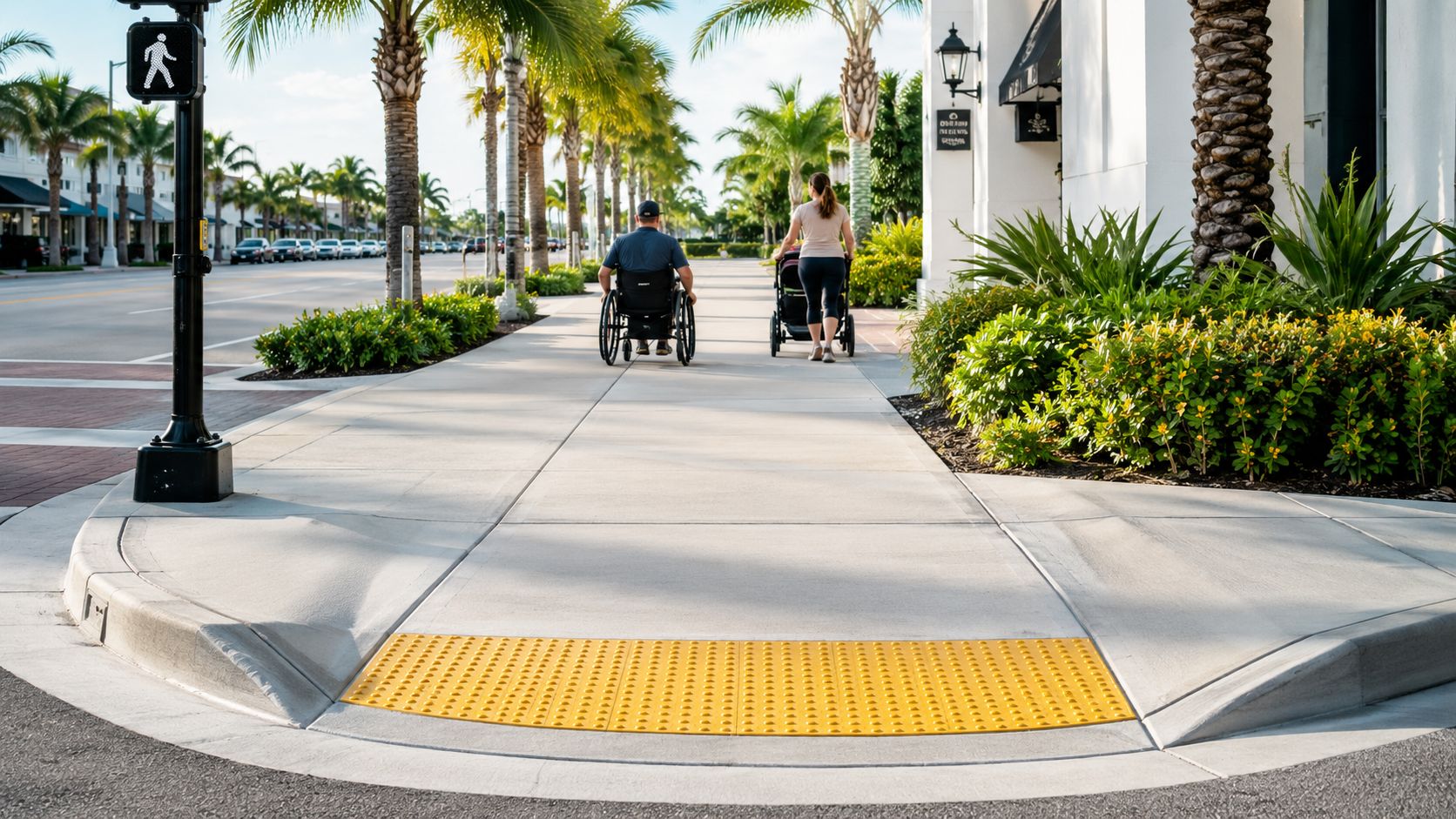
A lot of property owners first look up ADA sidewalk requirements after something has already gone wrong. A tenant complains about a sharp lip in the walk. A customer in Ocala points out that the curb ramp at the entrance is too steep. An HOA in The Villages starts planning repairs and realizes the old sidewalk layout may not meet current accessibility expectations.
That's a stressful place to start, especially in Central Florida where sidewalks take a beating from root heave, washout, shifting base, and heavy summer rain. In Marion County, FL and Citrus County, FL, a sidewalk can look serviceable at a glance and still create access problems for wheelchair users, people with walkers, parents with strollers, or anyone with balance limitations. Property owners in Dunnellon, Belleview, Silver Springs, Crystal River, Homosassa, Inverness, Lecanto, Beverly Hills, Hernando, and Summerfield run into the same issue. The surface may seem “close enough,” but close enough usually isn't how compliance works in the field.
This guide focuses on the practical side of the job. Not just what the rules say, but what those rules mean when you're deciding whether to grind, replace, regrade, add a ramp, or rebuild a section so the route works.
Table of Contents
- Why ADA Sidewalk Compliance Matters in Central Florida
- The Core Numbers of ADA Sidewalk Compliance
- Essential Elements Beyond Slope and Width
- Florida-Specific Sidewalk Challenges in Marion and Citrus County
- Common Violations and Your ADA Compliance Checklist
- The Path to Compliance From Audit to Repair
- ADA Sidewalk FAQs for Florida Property Owners
Why ADA Sidewalk Compliance Matters in Central Florida
If you manage a shopping center in Inverness or oversee an HOA in The Villages, sidewalk accessibility isn't an abstract code issue. It affects how people enter, move through, and safely use the property every day. A route that's too narrow, tilted, broken, or missing a proper connection at the curb can keep someone from reaching the door at all.
That's why compliance matters beyond paperwork. It's about safe access and usable access. A sidewalk can be poured with good intentions and still fail in practice if users have to fight the slope, dodge obstructions, or cross a lip that catches a wheel or toe.
Practical rule: If a route works only for able-bodied pedestrians in dry weather, it isn't doing the job an accessible route is supposed to do.
In Central Florida, owners often discover problems during routine maintenance planning. A church in Ocala wants to replace a few cracked panels. A retail property in Crystal River needs a curb transition fixed. A multifamily site in Homosassa has walkways lifted by roots. Once those conditions are on the table, the conversation shifts from “How do we patch this?” to “What has to be corrected so the route is compliant?”
A professionally built concrete sidewalk also supports the property in ways owners care about every day. It improves walkability, helps reduce trip hazards, and gives the site a more finished look. For commercial properties and community associations, that translates into fewer complaints and a more usable environment for residents, visitors, and customers.
For local owners, the big takeaway is simple. ADA sidewalk requirements aren't just a checklist for new construction. They shape how repairs, replacements, and access upgrades should be handled across Marion County, FL and Citrus County, FL.
The Core Numbers of ADA Sidewalk Compliance
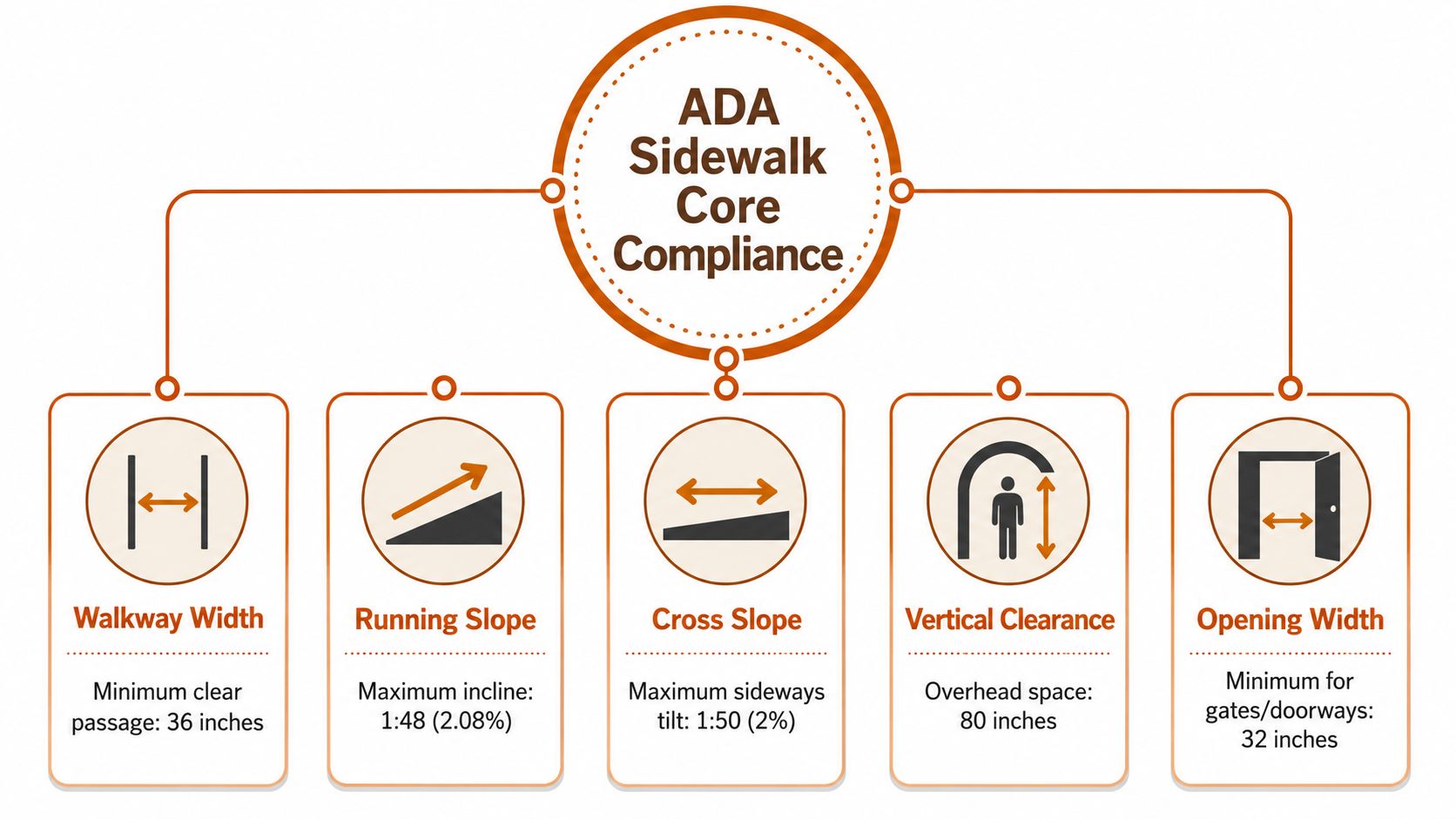
The numbers matter because they control whether a sidewalk feels like a route or an obstacle. The baseline rule is straightforward. An accessible route must provide at least 36 inches of clear width, a maximum running slope of 5% (1:20), and a maximum cross-slope of 2% (1:48), with surfaces that are firm, stable, and slip resistant. The same guidance limits vertical level changes to 1/4 inch, or 1/2 inch only when beveled according to the ADA sidewalk accessibility factsheet from the ADA National Network.
Width, slope, and surface all work together
The 36-inch clear width is the minimum corridor. “Clear” is the important word. A walk might measure wide enough from edge to edge, but if light poles, sign posts, hedge growth, meter boxes, or fence lines crowd the path, the usable width shrinks fast.
In the field, many owners are better served by planning wider where the site allows it. The reason is simple. People don't travel in perfect straight lines, and sidewalks on active properties need room for passing, turning, and avoiding small surface defects without forcing users off the route. The article on sidewalk installation cost factors is useful when you're comparing whether widening during replacement makes more sense than rebuilding to the bare minimum.
The running slope controls how steep the route feels in the direction of travel. Once the walk gets too steep, it stops functioning like a standard route and starts acting more like a ramp. That changes effort, braking control, and fatigue for wheelchair users.
The cross-slope is the tilt from side to side. This one gets missed all the time because a sidewalk can look flat while still leaning enough to pull wheels sideways or shift a walker off balance. It also gets worse when contractors try to chase drainage without carefully controlling grade.
A sidewalk doesn't fail only when it cracks. It also fails when the shape of the slab forces users to fight gravity the whole way.
What contractors watch during layout and finish work
The hardest part of compliant concrete work usually isn't the pour. It's the setup. Problems often begin before concrete arrives, during grading, form placement, and tie-in to existing pavement or buildings.
Here's what matters most on site:
- Clear corridor: Measure the actual path people use, not just the formed slab width.
- Tie-ins at both ends: A compliant panel in the middle won't solve a bad transition at a doorway, parking area, or curb.
- Vertical edges and joints: Even small lips can become barriers if adjacent panels settle differently.
- Finish texture: The surface has to be usable in wet conditions, not slick or overly polished.
A practical mistake I see often is trying to “fix” one panel while leaving the surrounding geometry untouched. That rarely works when the existing route already has drainage issues, grade mismatch, or encroaching roots. In Belleview, Lecanto, and Silver Springs, the cleaner solution is often a longer replacement area that lets the contractor re-establish proper grade instead of trapping the new work between old problem points.
Essential Elements Beyond Slope and Width
A sidewalk route isn't complete just because the straight sections measure correctly. The transition points decide whether a person can get from parking or the street onto the walkway without hitting a barrier.
Curb ramps are where many projects fail
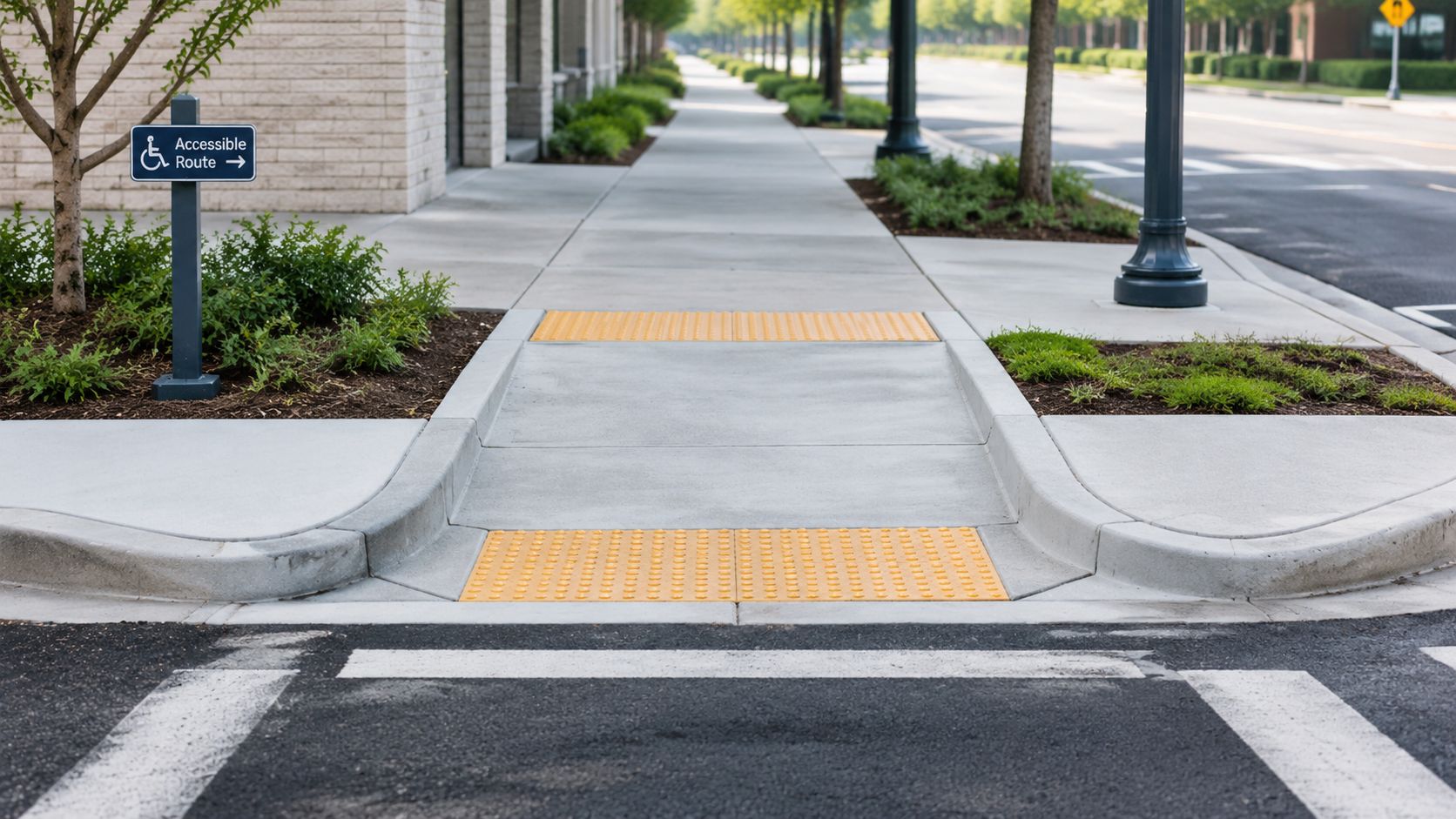
The ADA curb-ramp rules require a slope no steeper than 8.33% (1:12) for curb ramps built after January 26, 1992, and curb ramps are required wherever sidewalks or walkways intersect streets, roads, or legally crossable points. Title II guidance also says that for pre-ADA streets and sidewalks that haven't been altered, governments may choose where to add curb ramps, but once a sidewalk is altered post-ADA, curb ramps are required at those crossings under the ADA Title II curb ramp guidance.
That distinction matters in practice. Owners sometimes assume an older site is automatically exempt because the original walk has been there for years. But once you alter the route in a way that triggers those obligations, the old condition stops being a safe excuse.
The trouble spots are predictable:
- Ramp too steep: Usually caused by trying to force a short ramp into a tight vertical change.
- Bad alignment: The ramp points users into traffic or away from the natural crossing path.
- Poor transitions: The top or bottom of the ramp has abrupt edges, ponding, or broken concrete.
- Missing connection: The sidewalk is repaired, but the crossing still leaves no proper sloped route.
For uneven transitions, many properties need more than patching. They need slab correction, replacement, or adjacent grading changes. A guide on fixing uneven concrete slabs helps explain why surface grinding alone doesn't solve every accessibility issue.
Surface details and overhead conditions matter too
A compliant route also needs to stay usable in day-to-day conditions. That means a surface that is firm under wheels and feet, stable at the joints, and not slippery when Florida rain hits a hard-finished slab.
In places like Inverness and Lecanto, another issue shows up around landscaping. Tree limbs, signs, and utility elements can intrude into the path, especially where older sidewalks were built before the site filled in. The route may have enough pavement width on paper and still feel cramped or unsafe because users have to duck, lean, or detour.
This short visual is useful if you want to see how curb ramps and accessible route details translate in the field:
Another practical point is detectable warning surfaces at crossings. Owners often focus on concrete only, but the warning area and the concrete around it have to work as one system. If the domes are set into a ramp with poor drainage, rocking edges, or a bad finish, the route still performs poorly.
For sites in Marion County, FL and Citrus County, FL, the best approach is to inspect every crossing as a complete sequence. Parking or sidewalk. Ramp. Landing. Street connection. Opposite side. If one link is missing, users feel it immediately.
Florida-Specific Sidewalk Challenges in Marion and Citrus County
Central Florida changes sidewalks faster than many owners expect. The ADA standards are fixed, but the ground under the sidewalk isn't. That's why a route that looked acceptable a few years ago can become difficult to use in Ocala, Dunnellon, or Beverly Hills without any dramatic single failure.
Tree roots and settlement change compliance over time
In Marion County, mature oaks are one of the biggest real-world causes of sidewalk displacement. Roots lift one panel edge, then the next. The result isn't just cosmetic cracking. It creates localized lips, rocking panels, and grade shifts that interrupt the route.
In Citrus County, especially closer to the coast and in areas with softer or more variable subgrade conditions, settlement is just as common. One slab drops, water starts holding in the low spot, and the cross-fall changes enough that the walk no longer feels level under a wheelchair or walker. Property owners in Crystal River and Homosassa see this around older neighborhoods, commercial frontages, and common-area paths where the base has slowly moved over time.
Don't judge an accessible route from the driver's seat or from the curb. Walk it slowly. Then imagine pushing a wheelchair across every joint after a summer storm.
These are the trade-offs contractors deal with every day. Preserving a mature tree may mean rerouting the sidewalk, using a longer replacement area, or redesigning the transition so the route remains usable. Trying to save every inch of the original layout often leads to repeat repairs.
Rain, drainage, and finish quality affect real-world access
Heavy rain exposes weak sidewalk work fast. If the walk was pitched carelessly, runoff cuts across the path instead of away from it. If the subgrade wasn't compacted well, washout and voids can show up underneath. If the surface finish is too tight, wet conditions make the route more slippery than it should be.
This matters for both concrete and asphalt surfaces around the sidewalk system. A property may have a decent walkway but poor adjoining asphalt grades, clogged drainage paths, or failing striping transitions that push water and foot traffic into the wrong places. That's one reason local owners benefit from working with Concrete and Asphalt Experts in Marion and Citrus County instead of treating sidewalk work as an isolated patch job.
On commercial properties in Summerfield, Hernando, and The Villages, I'd rather see an owner fix the drainage pattern and the sidewalk together than pay twice for repairs. If the water problem stays, the surface problem usually comes back.
Common Violations and Your ADA Compliance Checklist
Most sidewalk violations aren't hidden. They're visible once you know what to look for. The problem is that owners often see them as wear and tear instead of access barriers.
The most common failures on existing properties are usually tied to grade changes, damaged panels, bad transitions, or obstructions that have gradually become part of the site. In practical terms, the sidewalk quit working before anyone officially labeled it noncompliant.
What shows up most often on existing properties
The repair scope matters here. According to the PennDOT ADA sidewalk technical sheet, minor sidewalk maintenance may not trigger full retrofit requirements, but larger alterations often do, including projects of about 100 linear feet or more or work replacing more than 50% of a sidewalk run. The same guidance treats a vertical change in level above 1/4 inch as a trip hazard.
That's where owners get into trouble. They plan a “simple repair” that qualifies as alteration territory, or they replace isolated panels and leave new lips at the tie-in points.
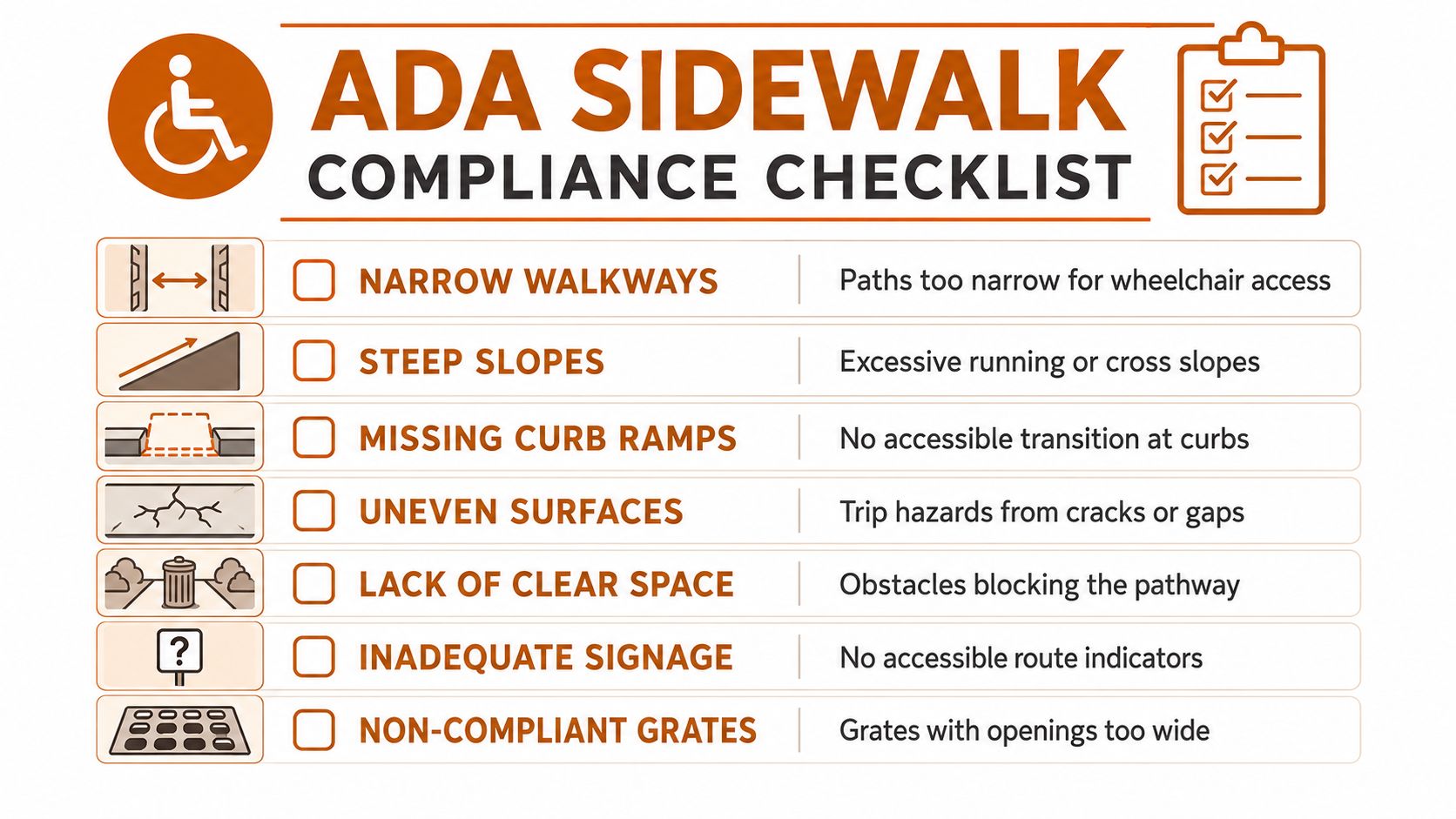
Here are the violations that show up again and again:
- Heaved concrete panels: Usually from root pressure. The slab may remain structurally intact but still create a trip edge.
- Settled sections: Common where base support was weak or drainage washed material away.
- Cross-slope problems: The path drains, but it drains across the user instead of away from the route comfortably.
- Steep or missing curb ramps: Especially on older commercial sites that have had piecemeal repairs.
- Obstructions in the clear path: Sign posts, bollards, overgrown landscaping, utility hardware, or parked encroachments.
- Loose repair patches: Temporary fixes often leave rough transitions, inconsistent finish, or edges that break down quickly.
Field note: The violation people notice first is rarely the only one there. If one panel has moved, check the whole run, the adjacent curb ramp, and where the water is going.
A practical walk-through checklist
If you manage a property in Dunnellon, Summerfield, Belleview, or Beverly Hills, walk the route the same way a visitor would. Start at parking or the street and continue all the way to the destination entrance.
Use this checklist:
Follow the full route
- Start where a person arrives, not halfway down the walk.
- Check that the sidewalk connects continuously to the entrance.
Look for pinch points
- Measure the usable path: Fences, posts, hedges, and building projections can reduce clear passage.
- Watch corners and bends: Tight turns often feel narrower than straight runs.
Check the slab edges
- Scan every joint: A small height change can be enough to interrupt wheels or catch a foot.
- Look at patched areas: Cold joints and mismatched repairs are frequent problem spots.
Watch how water behaves
- Inspect after rain if possible: Ponding, wash lines, and algae growth usually point to slope or drainage trouble.
- Check the base conditions: Voids and settlement often follow repeated water movement.
Inspect every curb transition
- Confirm there's an accessible connection: A good sidewalk section doesn't help if the curb edge blocks the route.
- Check alignment: The ramp should serve the crossing path, not dump users into awkward travel lines.
Note maintenance versus alteration scope
- Small repairs aren't always small legally: Once work expands, obligations can expand with it.
- Plan the entire correction: It's cheaper than revisiting the same area after an inspection or complaint.
A clean checklist walk won't replace a professional evaluation, but it does help owners stop guessing. If you can identify where the route narrows, lifts, drops, or stops making sense, you're already in a much better position to plan the fix correctly.
The Path to Compliance From Audit to Repair
Once a property owner knows there's a problem, the next mistake is rushing straight to demolition. Good ADA work starts with verification. You need to know what is out of tolerance, what is merely worn, what ties into other access elements, and whether the planned repair area will create broader compliance obligations.
Start with field verification, not assumptions
A proper site review should look at the route as a system. That includes the sidewalk itself, curb transitions, parking connections, drainage patterns, adjacent landscaping, and any place where old and new surfaces meet. If one part gets corrected while the neighboring piece stays misaligned, the route can still fail in use.
For many properties in Ocala, Inverness, or Crystal River, the right answer isn't “replace every sidewalk.” It's more targeted than that. Some areas need removal and replacement. Others need grade correction, root-related redesign, or coordination with adjacent asphalt work so the accessible route stays continuous from stall to entrance.
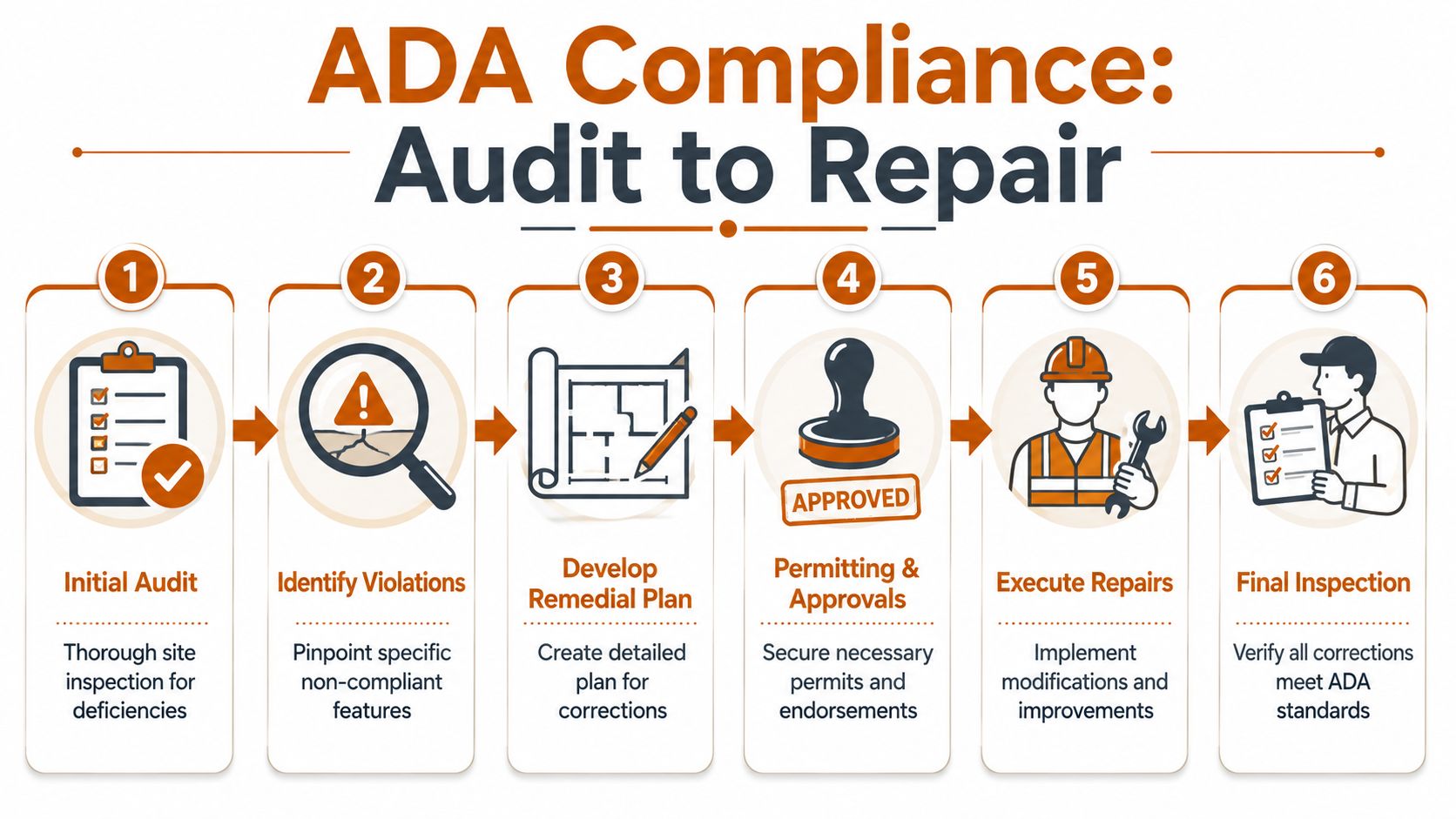
A practical audit usually includes:
- Route mapping: Identify where people travel, not only where the original plans intended them to go.
- Deficiency marking: Flag lips, slope concerns, drainage failures, and curb-ramp issues.
- Scope definition: Separate isolated maintenance from work that is better treated as an alteration project.
- Repair sequencing: Decide whether concrete, grading, drainage, striping, and signage need to happen together.
Why the repair plan matters as much as the repair itself
The best fix is the one that stays fixed. That usually means addressing the cause, not just the visible symptom. If a panel lifted because of roots, you may need rerouting, root management, or a longer rebuild section. If a curb ramp is too steep because the grades were forced into a short distance, the surrounding approach may need to be rebuilt too.
Owners also need to think about permits, inspections, scheduling, and liability. A licensed and insured contractor matters here because ADA-related repairs aren't just finish work. They involve layout accuracy, grade control, demolition limits, tie-ins, and final usability. A cheap patch can become an expensive redo if an inspector, property manager, or user finds the route still doesn't work.
For local projects, one option property owners consider is Riverside Sealing & Striping, LLC, a contractor serving Marion and Citrus counties with both concrete and asphalt work. That mix is helpful on properties where sidewalk compliance intersects with parking lot striping, curb ramps, drainage, or access aisle connections.
Here's what tends to work best for owners in Central Florida:
| Situation | What usually works | What usually fails |
|---|---|---|
| Root-heaved walkway | Longer replacement area with grade reset | Grinding one edge and leaving the rest distorted |
| Settled sidewalk near pavement | Repairing sidewalk and adjacent grade together | Replacing one slab while leaving the low asphalt edge |
| Missing curb connection | Rebuilding transition as part of route | Pouring a new sidewalk that still dead-ends at a curb |
| Recurring ponding | Correcting drainage with the surface work | Replacing concrete only and ignoring water flow |
The cheapest square foot on bid day can become the most expensive square foot on the property if the route has to be redone.
For HOAs, retail centers, churches, schools, and multifamily properties in Marion County, FL and Citrus County, FL, the smartest move is usually a documented evaluation followed by a repair scope that solves the full access path in one pass.
ADA Sidewalk FAQs for Florida Property Owners
How much does an ADA sidewalk repair project cost in the Ocala area
There isn't one standard price because the cost depends on scope and site conditions. A short panel swap is different from rebuilding a full route with curb ramps, drainage correction, demolition, base work, and tie-ins to asphalt or entrances.
The biggest cost drivers are usually access complexity, how much removal is required, whether roots or settlement have to be addressed, and whether the repair affects adjacent features like ramps, parking access, or landscaping. If the site is in a busy commercial area in Ocala, The Villages, or Inverness, scheduling and traffic control can also affect the project approach. The practical way to price it is with an on-site evaluation, not a generic per-foot guess.
Is an older sidewalk grandfathered in
Not automatically. Older sidewalks can create confusion because owners assume age alone ends the discussion. It doesn't work so easily.
For pre-ADA streets and sidewalks that haven't been altered, there can be different obligations than for post-ADA construction or alteration work, as noted earlier in the curb-ramp guidance. The important issue for most private and public property owners isn't the age of the concrete alone. It's whether current conditions deny usable access and whether the planned work changes the compliance obligations for that route.
When does a repair turn into an alteration issue
That line matters a lot. Some maintenance work may stay in the maintenance category. Larger repair programs can trigger broader obligations.
If the work extends into a substantial portion of the sidewalk run or starts reconstructing the route instead of performing maintenance alone, you need to assume the compliance conversation may widen with it. That's why owners should define the repair scope before authorizing piecemeal demolition. A patch list can turn into an alteration project faster than many people expect.
How does sidewalk compliance connect to parking lot access
It connects directly. An accessible route doesn't start in the middle of the walk. It usually begins where someone parks or enters the site and continues through the property.
That means sidewalks, curb ramps, access aisles, and striping all have to work together. If your lot markings and accessible parking layout are part of the issue, this guide to ADA parking lot striping requirements helps explain how the parking side of access ties into the sidewalk side.
What should I do first if I think my property has a problem
Start with a route-based inspection. Walk the property from arrival point to entrance. Take photos of lips, cracks, narrow points, ponding, and curb transitions. Then have a qualified contractor or accessibility-focused professional review the route and define the repair scope before work starts.
That first step matters because it keeps you from paying for a cosmetic fix when the actual issue is grade, drainage, or route continuity.
If you need help evaluating sidewalk access issues on a home, HOA, church, retail center, or commercial property, Riverside Sealing & Striping, LLC offers no-pressure consultations and free estimates in Marion County, FL, Citrus County, FL, and surrounding Central Florida communities. As Concrete and Asphalt Experts in Marion and Citrus County, the company handles concrete sidewalk replacement, access-related site repairs, asphalt maintenance, and parking lot striping with local knowledge of the soil, drainage, and weather conditions that affect long-term performance.