
Concrete sidewalk installation usually starts around $6 to $12 per square foot as a practical national benchmark, but that number moves fast once you factor in Florida site conditions, drainage, demolition, and finish details. For property owners in Ocala, Homosassa, and nearby Central Florida communities, the online calculator price is often only the starting point.
A lot of people reading this are in the same spot. You've got a cracked front walk, a side yard path that turns muddy every rainy season, or a commercial sidewalk that needs to be safer and easier to use. You want a straight answer on cost, but you also want to know why one quote comes in reasonable and another is much higher.
That is the underlying issue with concrete sidewalk installation cost. The slab itself is only part of the job. In Marion County, FL and Citrus County, FL, the hidden cost drivers are usually under the surface or around the edges: unstable soil, grading, tear-out, water flow, access, and whether the walkway needs to meet ADA expectations for a business, HOA, church, school, or community entrance.
Homeowners in Dunnellon, Belleview, Summerfield, and Silver Springs usually care most about durability and curb appeal. Property managers in The Villages, Crystal River, Inverness, Lecanto, Beverly Hills, Hernando, and Homosassa often need something more demanding: safe pedestrian access, consistent finish, predictable scheduling, and fewer callback problems later.
This guide breaks down what moves the price, what's worth paying for, and what shortcuts usually come back as cracks, settling, and drainage complaints.
Understanding Sidewalk Cost Benchmarks
A homeowner in Ocala may price a short front walk by square footage and expect a simple number. Then the quote changes after the contractor checks slope, access, and subgrade. That gap is where a lot of sidewalk budgets go sideways.
The most useful starting point for concrete sidewalk installation cost is the installed square-foot range, not the raw concrete price. LawnStarter puts the average concrete sidewalk at $8.63 per square foot, with a typical range of $5.89 to $12 per square foot, and notes that land preparation can add another $1 to $10 per square foot if grading or resloping is needed, according to its concrete sidewalk price guide.
That baseline helps with early budgeting in places like Dunnellon, Inverness, and The Villages. It does not tell you whether the number includes the parts of the job that usually change the final price in Florida.
What square-foot pricing really means
Square-foot pricing works because sidewalks are usually estimated by length times width. It gives owners and property managers a quick way to compare bids on a front entry walk, a side-yard path, or a longer run along a building.
Linear foot pricing can still show up, especially on street frontage or commercial repair work. But linear footage only means something after the width is set. A standard residential walk and a wider pedestrian route for heavier foot traffic do not carry the same material, forming, and finish cost, even at the same length.
In the field, the square-foot number is only useful if the scope is clear. Some quotes include excavation, base prep, forming, reinforcement, control joints, cleanup, and final grading. Others leave out haul-off, sod repair, or drainage correction, which is exactly how an online calculator turns into a change order.
Practical rule: Ask what is included before you compare prices. A low square-foot quote can become the higher total if site prep, tear-out, or cleanup is missing.
Why benchmarks are only a starting point
Two sidewalks with the same measurements can land in very different price ranges in Marion and Citrus County. A straight backyard walk on dry, stable ground is usually straightforward. A replacement sidewalk at a business entrance in The Villages, where drainage, slope transitions, and ADA compliance need to be right, takes more labor and more layout time.
Rain matters too. So does soil. In this part of Florida, a sidewalk that looks simple on paper can need extra base work, edge support, or grading changes to keep water from sitting against the slab or washing out beneath it.
That is why national averages help with budgeting, but they miss the local cost drivers that show up after a site visit. For a broader pricing reference across flatwork, this guide to concrete slab cost per square foot gives useful context.
Property owners in Marion County and Citrus County often get the best value from benchmarks by treating them as a starting range, then checking how the site conditions and scope details affect the actual number.
An Itemized Breakdown of Key Cost Drivers
A good sidewalk quote reads like a scope of work, not a single price for concrete. In Ocala, The Villages, Dunnellon, and surrounding areas, the actual cost comes from the labor and site conditions under the slab as much as the concrete on top.
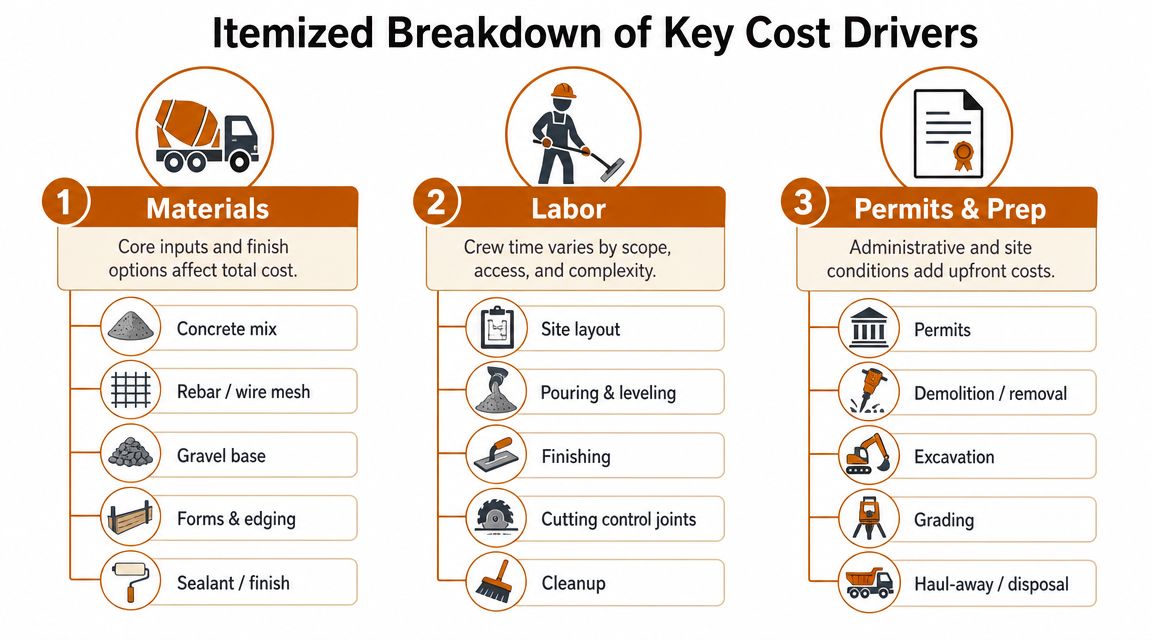
Site prep and grading
Site prep is where a lot of budget drift starts. A clean, level area with stable soil is straightforward. A site with roots, washed-out sand, soft spots, or low areas that hold water takes more labor before forms ever go down.
That prep work is not optional if you want the sidewalk to stay put.
In Marion and Citrus County, I see this on properties that look easy from the street but have hidden grade issues once the crew starts checking elevations. If the sidewalk needs to shed water away from a house, pool deck, storefront, or parking lot edge, the layout and grading take longer and the quote goes up for a reason.
Demolition and haul-off
Replacement costs more than new installation because the old slab has to be saw-cut or broken out, loaded, hauled away, and disposed of. Then the base has to be rebuilt before the new concrete goes in.
That part gets missed in online calculators all the time.
Old sidewalk removal can also uncover problems that were hidden by the existing slab, including tree roots, voids under the concrete, buried edges, irrigation lines, and utility conflicts. Those are real cost drivers, especially on older properties in established neighborhoods and commercial sites with years of patchwork repairs.
Base material and compaction
Base work is one of the biggest quality differences between a cheap sidewalk and one that lasts. If the subgrade is loose or uneven, the slab may settle, tilt at a joint, or crack early even if the finish looked good on pour day.
Some sites need only minor shaping and compaction. Others need imported base material, more passes with compaction equipment, or edge support where water has been washing soil away. In sandy Florida conditions, that extra work often determines whether the sidewalk stays stable through wet seasons.
Concrete mix, thickness, and reinforcement
Sidewalk cost changes with use. A narrow residential path from the driveway to the front door is one thing. A sidewalk at an apartment entrance, medical office, church, school, or retail center usually calls for tighter tolerances and a stronger build.
Thickness matters. Reinforcement matters. So does the mix design if the slab will sit in full sun, see frequent traffic, or tie into curbs, ramps, or other hard surfaces.
More material and stricter specs raise the price, but they can prevent repairs that cost far more later.
Finish work and layout complexity
Standard broom finish is still the practical choice for most sidewalks because it gives good traction and keeps labor predictable. Once the design moves beyond a straight run, labor starts stacking up.
Curves, radius forms, decorative borders, tight tie-ins to existing concrete, and work around beds, signage, or utilities all slow production. A straight backyard walk is efficient. A winding path around landscaping or a front entry with multiple elevation changes takes more layout time, more forming, and more hand finishing.
Joints, edges, and crack control
Jointing is a small line item with a big effect on performance. Crews use control joints and expansion points to manage movement, reduce random cracking, and keep sections from binding against adjoining concrete.
Homeowners usually notice the finish. Contractors pay close attention to spacing, depth, and placement. Poor joint layout shows up later.
If you want a plain-language explanation of why those separations matter, this guide on concrete expansion joints and slab movement covers the basics.
Drainage, permits, access, and compliance
This category is where hidden costs show up fast, especially on commercial work. A sidewalk at a home may need little more than good grading and clean access. A sidewalk at a business, HOA entrance, church, office, or multifamily property can involve slope corrections, ramp transitions, inspections, and ADA-related layout requirements.
Access also changes labor in a hurry. If a truck and buggy can get close, placement is faster. If the crew has to move material by wheelbarrow through gates, around AC units, or across active property, production slows and labor rises.
Here are a few items that commonly push pricing higher:
- Tight access: More hand work, smaller equipment, and slower concrete placement
- Drainage corrections: Regrading, swales, or slope adjustments so water does not pond on or under the walk
- Permit or inspection requirements: More common on public-facing and commercial projects
- Protection and cleanup: Extra care around landscaping, irrigation, storefronts, residents, or customer traffic
- ADA slope and transition work: Common at commercial entries, connecting walks, and curb-ramp areas where tolerances matter
A solid estimate should separate these costs clearly enough that you can see what is driving the number. If the quote is vague, ask what happens if the crew finds bad base, drainage trouble, or removal issues after the job starts. That answer usually tells you how complete the bid really is.
Florida-Specific Factors That Influence Your Sidewalk Price
The biggest difference between a generic online estimate and a real local quote is Florida itself. In Central Florida, the ground, weather, and water movement all affect how a sidewalk should be built.
Sandy soil changes the prep
Parts of Ocala, Summerfield, Dunnellon, and Silver Springs have soil conditions that can look easy to work with but still need disciplined base prep. Sand drains well, but it can also shift, wash, or compact unevenly if the ground underneath isn't prepared correctly.
That's why local contractors spend time on subgrade shaping and compaction instead of just focusing on the pour. If the base moves, the finish doesn't matter.
Rain and drainage matter more than most people expect
In Homosassa, Crystal River, Inverness, and Hernando, heavy rain can expose bad grading fast. Water that runs across or under the sidewalk can erode support, create puddling, and turn a clean-looking new installation into a nuisance.
For commercial properties and community walkways, this becomes more than appearance. If water stands where people walk, slip risk and trip risk go up. That's where the quote may include more grading, transitions, or layout adjustments than a homeowner expected.
A sidewalk should move water away from the walking surface and away from structures. If it traps water, the job isn't finished correctly.
Heat and sun affect placement quality
Florida heat doesn't automatically make a sidewalk fail, but it changes how crews need to work. Hot, bright conditions can speed surface drying and make finishing timing more sensitive.
That's one reason reliable scheduling and experienced finishing matter. A slab poured on a hot day in Beverly Hills or The Villages still needs proper timing, texture, joints, and curing attention, or the surface can suffer.
A quick visual on how placement and finishing come together helps here:
ADA expectations can reshape the whole scope
For a backyard path, the main concerns are usually access, drainage, and appearance. For an HOA entrance, church campus, retail frontage, medical office, or community sidewalk in Marion County, FL or Citrus County, FL, slope and surface consistency can become much more important.
That doesn't always mean the project is huge. It does mean the contractor has to pay attention to grade transitions, cross-slope, connections, and finish quality. In The Villages and other active communities, those details are often the difference between a basic sidewalk and one that performs well for everyday public use.
Comparing Sidewalk Materials Concrete vs Pavers and Asphalt
A homeowner in Ocala might be pricing a straight front walk. A property manager in The Villages might be replacing a long pedestrian route that needs to stay even, clean-looking, and easier to maintain. Those two jobs can point to different materials, even if the square footage looks similar on paper.
Concrete stays the standard choice in Marion and Citrus County because it gives a stable walking surface, a clean edge, and predictable maintenance. For residential entries, side-yard walks, HOA sidewalks, church campuses, and retail frontage, it usually offers the best balance of appearance, durability, and cost control. It also handles Florida's rain patterns better than loose-jointed systems when the base and drainage are built correctly.
Pavers have a different value. They give you more design freedom, and repairs can be more targeted if a section settles or has to be opened later for utility work. That matters on decorative paths, courtyards, and higher-end entries where appearance carries more weight. The trade-off is upkeep. In this part of Florida, pavers need a well-compacted base, edge restraint, joint sand maintenance, and periodic attention to weeds, ants, and movement after heavy rain. If that maintenance gets skipped, the walkway can start looking old faster than the budget expected.
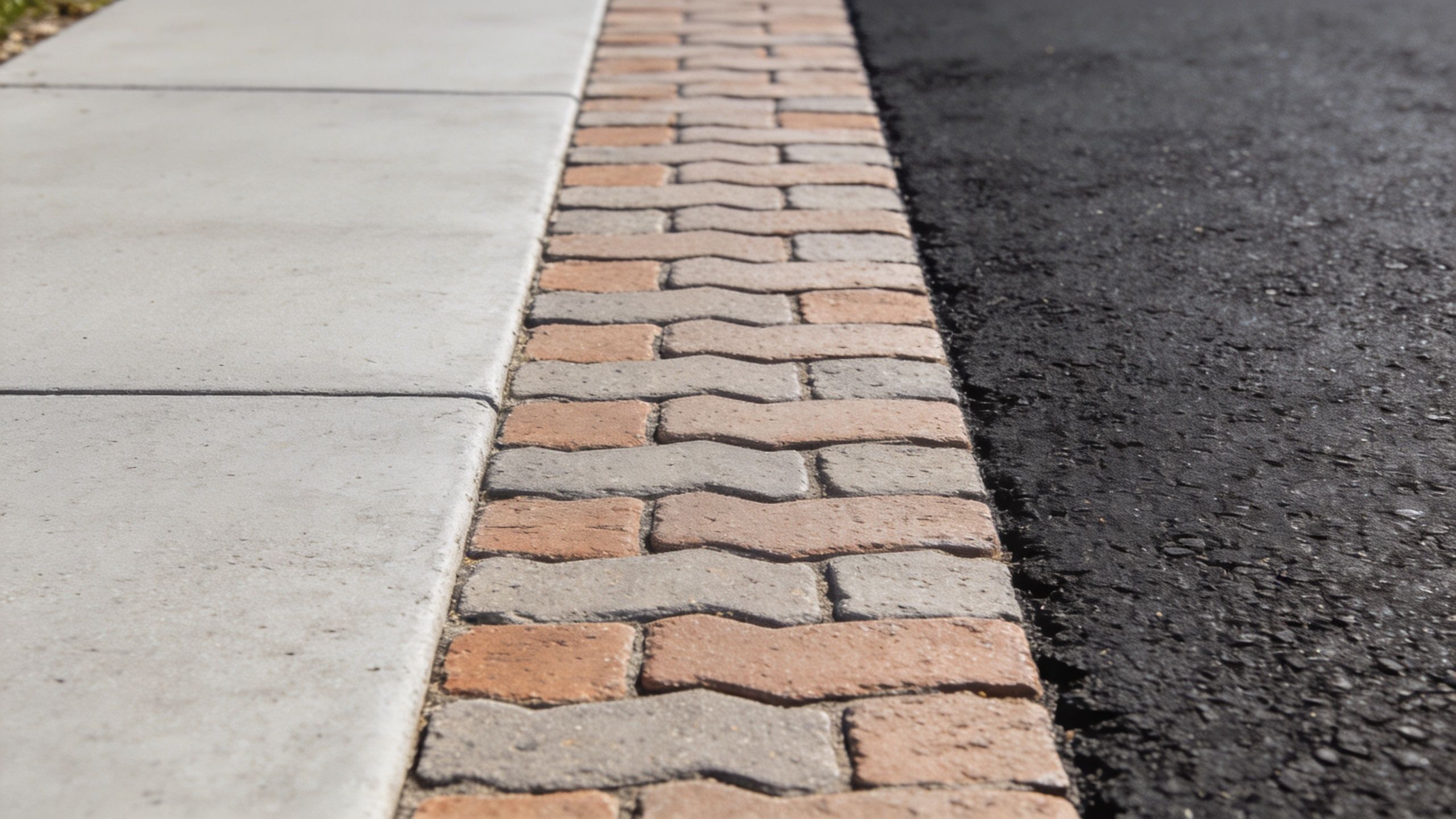
Asphalt fits a narrower set of sidewalk projects. It can make sense for informal paths, trail connections, or areas that already tie into a larger asphalt parking or roadway system. For a finished front walk or a commercial pedestrian route, it usually falls short on edge definition, appearance, and long-term surface crispness. Florida heat can also soften the look of asphalt over time, especially at edges and transition points.
For commercial properties, material choice is not just about the install price. Surface consistency, trip hazard risk, and maintenance planning matter. A paver walk with small vertical shifts can become a management issue sooner than a properly poured concrete sidewalk. Asphalt may be cheaper in some cases, but if the property needs a more formal appearance or tighter control at entrances and crossings, the savings may not hold up well.
If you're comparing pedestrian surfaces near parking areas or access drives, this guide on concrete driveway vs asphalt driveway differences gives useful context on how those materials perform in Florida conditions.
A practical way to choose is simple:
- Choose concrete for the best all-around value, cleaner edges, and lower day-to-day maintenance.
- Choose pavers when appearance and localized repairs matter enough to justify more installation detail and upkeep.
- Choose asphalt for lower-profile paths that need to blend into surrounding pavement, not stand out as a finished walkway.
Cheap upfront pricing can be misleading. The better question is what the sidewalk will cost to keep safe, presentable, and serviceable in Florida weather.
Sample Sidewalk Estimates for Marion and Citrus County Projects
A sidewalk that looks simple on a sketch can turn into a different job once the crew is on site. In Marion and Citrus County, the price often shifts because of what is under the slab, how water moves across the lot, and whether the walk has to meet stricter access requirements.
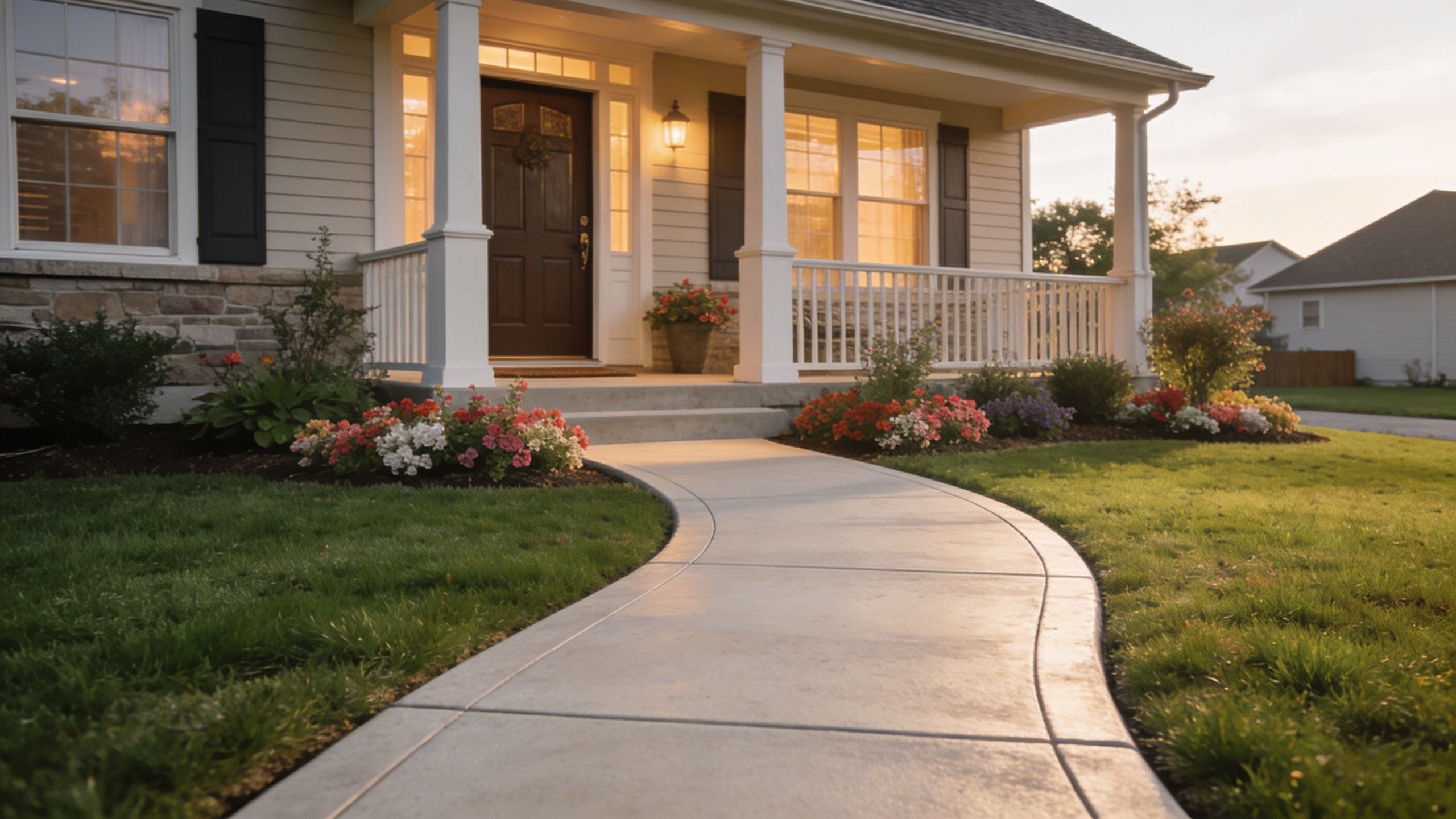
A simple residential replacement in Hernando
A homeowner in Hernando might call about a short front walk with a few cracks and one panel that has lifted near the porch. That sounds minor until the old concrete starts coming out. Replacement usually includes saw-cutting clean tie-in lines, demolition, haul-off, base repair, forming, and matching the new walk to the existing entry height so water does not run back toward the house.
That is where online calculators miss the job. They price fresh concrete by square foot and ignore disposal, limited access, and the time it takes to correct what failed underneath the old slab.
On a Florida replacement, hidden cost often sits below grade. Soft spots, root intrusion, washed-out base, and poor drainage can show up only after tear-out.
A curved garden path in Lecanto
A new curved sidewalk in Lecanto can be less disruptive because there is no demolition, but it is not automatically cheap. Curves take more layout time, more forming labor, and more finish attention if the owner wants clean edges and a consistent look through the yard.
Landscaping affects cost fast. Irrigation lines need to be protected or rerouted. Decorative beds limit where crews can stage material. If the path crosses a low area that stays wet after rain, the base may need extra prep before concrete is poured.
I tell owners to expect shape and site conditions to matter as much as size on this kind of project.
An ADA-focused commercial walk in Ocala
Commercial sidewalk work in Ocala usually has less pricing flexibility because the walk has to do more than connect point A to point B. If the route runs from parking to an entrance, slope, cross-slope, surface consistency, and transitions all have to be handled carefully. For retail centers, offices, churches, HOAs, and medical properties, that can mean more forming time, more grading, and more inspection of the existing base before any pour starts.
If the old walkway is failing, tear-out and replacement can push costs well above a basic new residential pour, as noted earlier in the article. The reason is simple. Removal is only the first part. The expensive surprises are usually base correction, drainage adjustment, and the extra labor needed to keep the route safe and usable around an active property.
The cost drivers on a job like this are usually practical:
- Access and staging: Crews may need to protect pedestrians, work around business hours, and keep entrances open.
- Grade correction: ADA-sensitive walks leave less room for sloppy transitions at curbs, ramps, and door approaches.
- Drainage handling: In Ocala summer weather, a sidewalk that traps water can become a slip risk and a maintenance problem.
- Demolition and haul-off: Older commercial concrete often breaks out into a larger repair area than expected.
What these examples tell you
Two projects with similar square footage can price very differently in this area. A short replacement in Summerfield may stay straightforward if access is easy and the base is dry. A comparable walk in The Villages can cost more if the site needs stricter slope control, cleaner sequencing, or coordination around residents and foot traffic.
The same pattern shows up across Citrus County. A Crystal River property with drainage issues or saturated soil can cost more than a larger but simpler sidewalk in Belleview or Dunnellon.
The useful estimate is the one that accounts for local soil, rain exposure, demolition, access, and code-related slope work before the crew starts. That is how owners avoid the change orders and surprises that generic square-foot pricing leaves out.
Why a Professional Sidewalk Installation Is a Smart Investment
Sidewalks look simple. Good sidewalks are not simple. The difference is usually in the parts that are rarely noticed until something goes wrong.
An inexperienced or uninsured contractor may give you a lower number by skipping base prep, rushing grading, underbuilding edges, or treating joint layout like an afterthought. The slab might look acceptable the day it's poured. A season of rain, irrigation, heat, and daily use can expose every shortcut.
For residential work, that usually means cracking, rocking panels, ponding water, or ugly transitions at the porch, driveway, or garage side entry. For commercial and HOA properties, these problems carry greater risk because trip hazards, drainage issues, and inconsistent slopes affect safety and liability.
A professional install is worth it when the crew understands site prep, finish timing, drainage, and local conditions in Marion County and Citrus County. That matters whether the project is a short sidewalk in Dunnellon or a longer pedestrian route in The Villages.
One local option is Riverside Sealing & Striping, LLC, a licensed and insured contractor serving Central Florida with concrete work and asphalt maintenance, including sidewalks, removal and replacement, sealcoating, and parking lot striping. For property owners comparing bids, the useful part isn't the brand name. It's whether the contractor can explain the scope clearly, show up on schedule, and build the walk correctly the first time.
Cheap concrete can become expensive concrete if you have to tear it out early.
Frequently Asked Questions About Sidewalk Installation
How long does a new concrete sidewalk take to install and cure
Most sidewalk jobs move through layout, prep, forming, pour, and finish in stages, and the exact timeline depends on weather, access, and project size. In Florida, rain and heat can both affect scheduling. A contractor should give you a realistic sequence instead of a vague promise.
Use matters too. A front walk for a home in Ocala may be simpler to reopen than a business entrance in Crystal River or The Villages, where pedestrian access has to be managed carefully.
Do I need a permit for a new sidewalk in Marion County or Citrus County
Sometimes yes, sometimes no. It depends on where the sidewalk sits, whether it ties into public right-of-way, and whether the work affects drainage, access routes, or regulated site features.
That's why permit questions should be settled before the pour date, not after demo starts. For commercial, HOA, church, and school properties, it's smart to assume review requirements may be stricter than for a basic residential walk.
What's the best way to maintain a new sidewalk in Florida
Keep it clean, avoid letting soil wash onto the edges, and watch how water behaves during storms. If sprinklers constantly soak one side or runoff cuts under the slab, the sidewalk may not fail immediately, but the support can start weakening.
Maintenance is also about early correction. If you notice minor settlement, joint issues, or drainage problems, address them before they turn into a bigger replacement project.
Can a small crack be repaired, or does the whole sidewalk need replacement
It depends on the type of crack and what caused it. A minor surface issue is different from a panel that has moved, settled, lifted, or broken because the support underneath failed.
If the problem is structural, patching the surface usually won't solve it for long. In many cases, replacing only the failed section is possible, but the decision should be based on movement, drainage, and how the affected panel ties into the rest of the walk.
What should I ask before accepting a sidewalk quote
Ask what the bid includes below the surface and at the edges. You want to know about prep, grading, joints, cleanup, demolition if needed, and whether the finish and slope are appropriate for the way the sidewalk will be used.
A solid quote should answer questions like these:
- What prep is included: Excavation, grading, and base work should be clearly addressed.
- Is removal included: If it's a replacement, make sure tear-out and haul-off are spelled out.
- How will water move: The contractor should explain slope and drainage in plain language.
- What finish is planned: A broom finish is common, but the surface should match the use.
- Who handles site coordination: This matters for HOAs, retail properties, and shared community access.
If you're planning a sidewalk project in Ocala, Dunnellon, Belleview, Summerfield, Silver Springs, Crystal River, Homosassa, Inverness, Lecanto, Beverly Hills, Hernando, or The Villages, Riverside Sealing & Striping, LLC offers free, no-pressure consultations for concrete and asphalt work across Marion County, FL and Citrus County, FL. If you want a clear estimate that accounts for site prep, drainage, replacement needs, and real Florida conditions, it's worth scheduling an on-site evaluation before you commit to a number from an online calculator.