
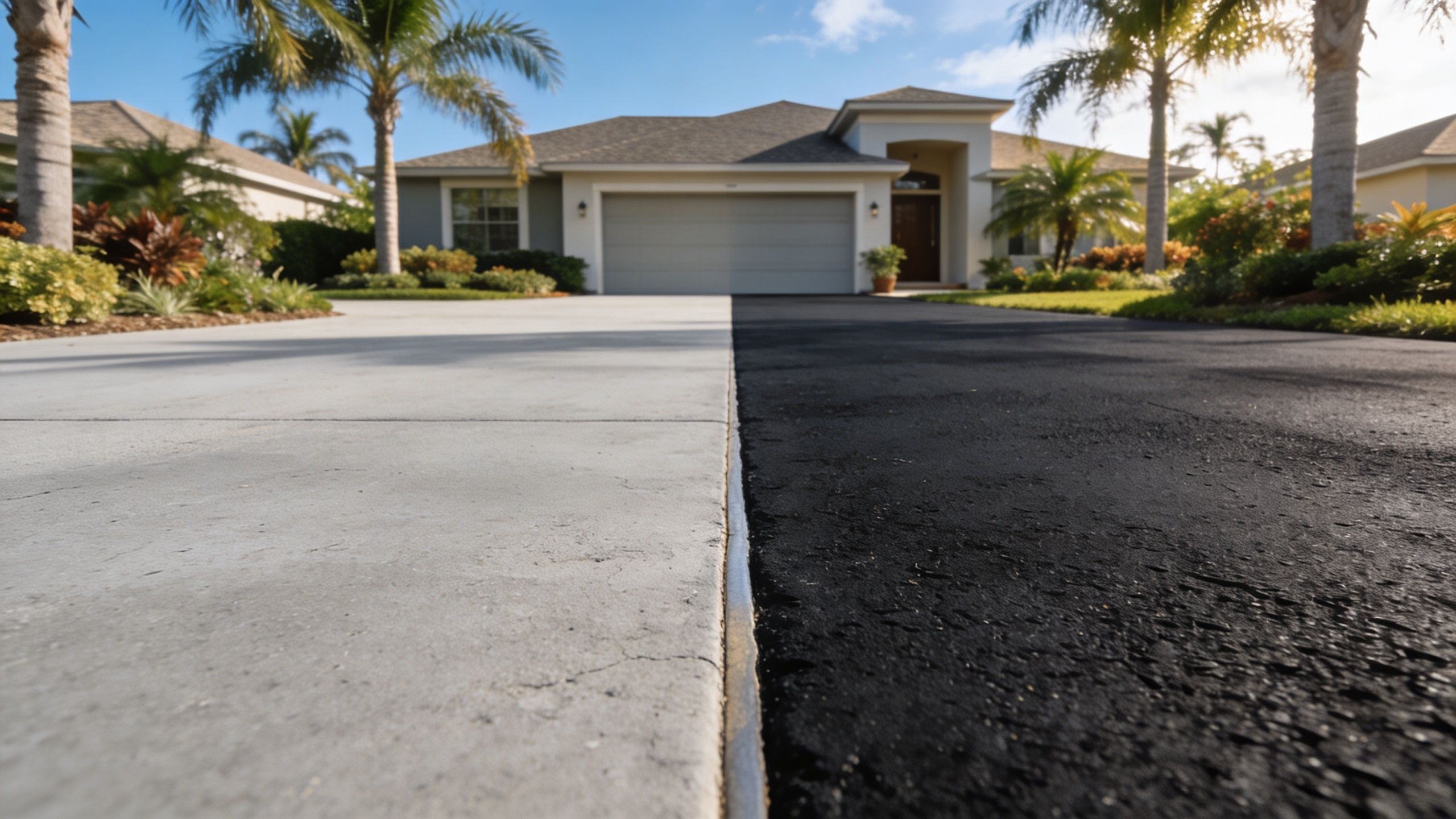
A lot of driveway decisions in Central Florida start the same way. You pull into the house in Ocala, Dunnellon, Crystal River, or Inverness, and the driveway looks worse than it did a year ago. Cracks are spreading. Edges are fraying. Low spots are holding water after every hard rain. The surface that used to look fine now looks tired every time you come home.
At that point, most homeowners and property managers ask the same question. Should the replacement be concrete or asphalt?
That’s a fair question, especially in Marion County, FL and Citrus County, FL, where heat, UV exposure, summer storms, and daily vehicle use all work against pavement. The wrong choice can lock you into more maintenance, more patching, and a shorter service life than you expected. The right choice can give you a surface that performs well for years and fits the way the property is used.
For homes in Belleview, Silver Springs, Summerfield, Homosassa, and Lecanto, the answer usually comes down to more than upfront cost. Long-term performance matters. Maintenance schedule matters. So does how the driveway handles Florida heat when the sun stays on it all afternoon.
Choosing Your Next Driveway in Central Florida
A typical replacement job starts with a driveway that has already told you it’s done. Maybe the asphalt has oxidized and opened up. Maybe an older concrete slab has settled, cracked badly, or lost its clean finish. In neighborhoods across The Villages, Beverly Hills, Hernando, and surrounding areas, that decision often lands on the same fork in the road. Concrete driveway vs asphalt driveway.
For some owners, asphalt looks appealing because the initial number is lower. For others, concrete stands out because it feels more permanent and cleaner-looking. Both materials can work, but they do not behave the same way in Central Florida.
What homeowners are really deciding
This isn’t just a material choice. It’s a question of how much upkeep you want, how long you plan to own the property, and how the driveway needs to perform.
- Daily use matters: A home with regular parking, trailers, service vehicles, or frequent guests puts more stress on a driveway than a lightly used surface.
- Climate matters: What works in a colder region doesn’t always make sense in Ocala or Crystal River.
- Appearance matters: The driveway takes up a large part of your front elevation, so the surface affects curb appeal every day.
A driveway should be judged the same way as a roof or slab. Not by the cheapest day-one number, but by how it holds up after years of weather and use.
For most property owners in Marion and Citrus counties, the practical decision comes down to lifespan, maintenance burden, and total lifecycle cost. That’s where the main difference shows up.
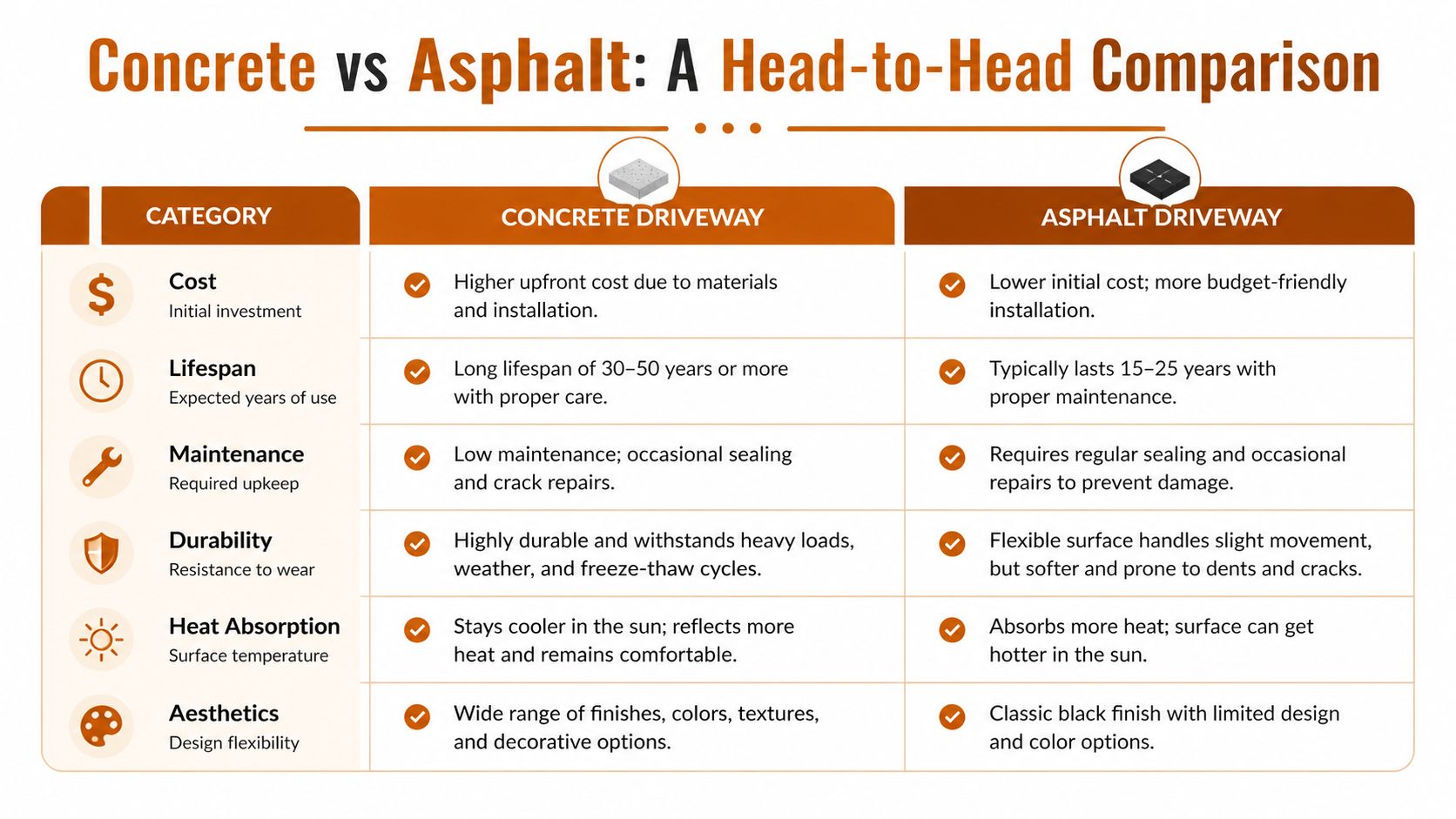
Concrete vs Asphalt A Head-to-Head Comparison
A driveway in Ocala or Crystal River has to do more than look good on bid day. It has to hold up through hard sun, heavy rain, and years of vehicle traffic without turning into a maintenance project.
Here is the practical side-by-side view.
| Decision Factor | Concrete | Asphalt |
|---|---|---|
| Initial installed cost | Usually higher at installation | Usually lower at installation |
| Service life | Longer service life when the slab is properly installed on a stable base | Shorter service life, especially if maintenance is delayed |
| Routine maintenance | Lower maintenance frequency, though cleaning and joint or crack attention still matter | Higher maintenance frequency, with sealing and surface care needed more often |
| Heat and sun exposure | Holds its shape better in prolonged heat and reflects more sunlight | Absorbs more heat and is more prone to softening during long hot periods |
| Heavy vehicle use | Better choice for sustained loading, larger vehicles, and repeated parking in the same spots | More likely to rut or deform if the base is weak or loads are concentrated |
| Appearance | Brighter finish and more options for texture, edging, and overall presentation | Simpler, darker look with less design flexibility |
| Repair approach | Spot repairs can be more visible, and full panel replacement is sometimes the cleanest fix | Patching is usually simpler, but patches often show and age differently than the original surface |
Where concrete usually pulls ahead
Concrete makes more sense for owners who expect to keep the property for years and want fewer maintenance cycles. In Central Florida, that matters. Heat, UV exposure, and afternoon storm runoff are hard on any surface, but concrete generally stays more stable if the base, thickness, drainage, and joints are done right.
It also gives a cleaner finished look. That matters on homes where the driveway takes up a large share of the front elevation.
If you want a better sense of pricing before choosing, this breakdown of concrete slab cost per square foot helps frame what drives the number.
Where asphalt still has a place
Asphalt is not the wrong choice. It is often the practical choice for owners who need to control upfront cost, improve a long drive area without a large initial spend, or plan to hold the property for a shorter period.
It is also easier to patch in many cases.
The trade-off is ongoing attention. In Marion and Citrus counties, asphalt surfaces take more punishment from sun and water, and neglected maintenance usually shows up faster as fading, surface wear, soft spots, or edge breakdown.
The real decision
For a lightly used driveway and a shorter ownership horizon, asphalt can pencil out. For a primary residence, higher-end home, rental with steady traffic, or property where you want the surface to stay presentable with less frequent upkeep, concrete often gives the better long-term return.
The base matters either way. A well-built asphalt driveway will outperform a poorly installed concrete one every time. But when both are installed correctly for local conditions, concrete usually gives Central Florida owners the stronger long-run value.
Analyzing the True Cost Installation and Lifecycle Value
The biggest mistake in this decision is comparing only the bid total. That’s useful, but it isn’t enough. A driveway is a long-term surface, so the right question is what you’ll spend over the life of the installation.
Upfront price is only the first number
Asphalt often gets attention because it can come in lower at the start. That’s real, and for some owners with a short ownership horizon, it may still be the right move. But in Central Florida, that lower entry price can be misleading if you don’t account for maintenance frequency and earlier replacement needs.
A Florida-focused projection matters more than a generic national comparison. For Central Florida's hot, humid climate, a 20-year cost projection shows that what appears as 30% upfront savings with asphalt could result in 40-60% higher total spending when accounting for heat-driven maintenance, as asphalt requires resealing every 2-4 years according to Ciriello Contracting’s concrete vs asphalt driveway analysis.
Why lifecycle cost changes in Marion and Citrus counties
Heat changes the math. So does constant UV exposure and repeated rain. In Ocala, Silver Springs, and Crystal River, a driveway doesn’t just sit there looking good or bad. It’s reacting to sun, water, tire loads, and the condition of the base underneath it.
That’s why a lower initial bid can turn into higher ownership cost. Asphalt’s maintenance cycle comes around faster, and those intervals matter. Every sealcoat, crack repair, patch, or overlay adds another layer of expense and another disruption to the property.
If you're comparing project budgets, it helps to review a local breakdown of concrete slab cost per square foot alongside the expected service life of each material.
Where concrete usually wins financially
Concrete isn’t always the cheapest install. It is often the better financial decision for owners who plan to stay put or hold the property long term.
- Longer useful life: More years of service spreads the initial investment out over a longer period.
- Lower maintenance burden: Fewer recurring interventions mean fewer chances for costs to pile up.
- More predictable planning: Property managers and homeowners can budget with less guesswork.
For a homeowner in Belleview or a rental property owner in Dunnellon, that’s often the deciding factor. The less dramatic number on day one isn’t always the cheaper driveway in the years that follow.
Durability and Long-Term Maintenance Schedules
A driveway in Ocala or Crystal River usually does not fail all at once. It ages through a series of maintenance decisions. That is what owners need to price out.
Concrete usually gives you a longer maintenance cycle. Industry guidance commonly puts concrete ahead of asphalt for service life, and in the field that difference shows up as fewer recurring visits for sealcoating, patching, and surface restoration. For homeowners and property managers in Central Florida, that schedule matters as much as the installation price because every service call adds labor cost, material cost, and inconvenience.
What concrete maintenance usually looks like
Concrete still needs upkeep, but the work is generally more spread out. In this climate, the main job is protecting the slab from water intrusion, surface staining, and small cracks that can widen if they are ignored through a rainy season.
Typical concrete upkeep includes:
- Routine cleaning: Remove dirt, mildew, leaf tannins, and tire marks before they set into the surface.
- Joint and crack monitoring: Catch movement early so water does not work below the slab and soften the base.
- Periodic resealing: Sealing helps reduce moisture penetration and keeps the driveway easier to clean.
Concrete also stays more stable under regular vehicle loads during hot weather. That helps limit the rolling maintenance cycle owners often deal with on softer surfaces.
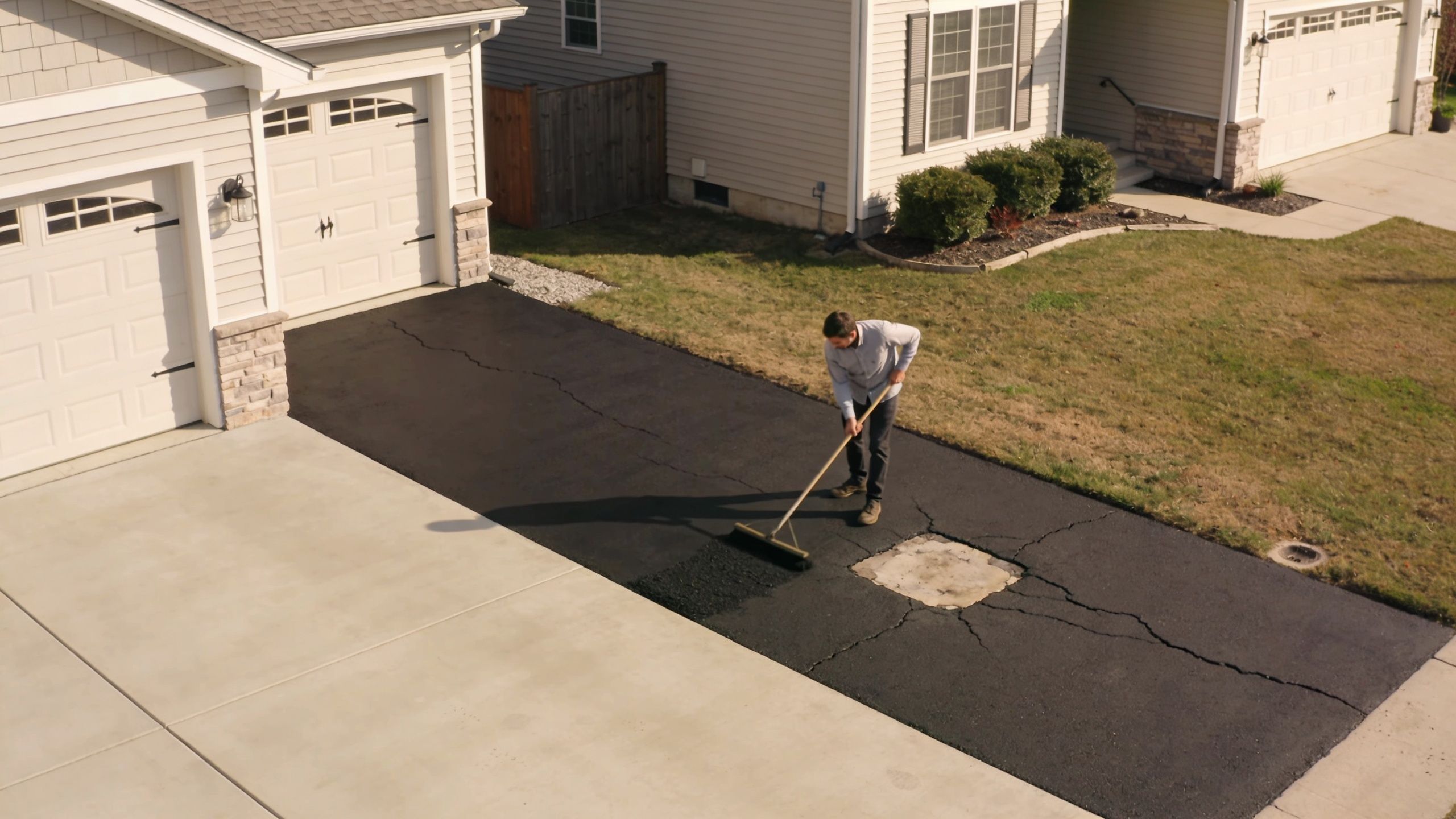
What asphalt maintenance usually looks like
Asphalt asks for more regular attention, especially under strong sun and heavy summer rain. Oxidation dries the surface out. Water finds small openings. Edges start to break down if runoff is not controlled and the base was not built right in the first place.
If you are considering asphalt, review how often asphalt driveways need sealcoating in Florida before you decide. That schedule belongs in the ownership budget, not as an afterthought.
Crack sealing, sealcoating, occasional patching, and later overlays are all part of the normal life of an asphalt driveway here. None of that makes asphalt a bad material. It does mean the lower entry price can narrow quickly over time.
What works and what does not
The owners who get the best lifespan out of either surface stay ahead of water. They keep drainage working, address small cracks early, and avoid letting minor edge damage turn into base failure.
Waiting until the driveway looks rough from the street is what gets expensive. By that point, a simple maintenance item may have turned into a larger repair or partial replacement. In places like Summerfield, Beverly Hills, and Hernando, that is often the difference between a manageable upkeep budget and a much bigger bill.
Which Driveway Is Best for the Central Florida Climate
A driveway in Ocala or Crystal River does not age in a neutral environment. It sits under strong sun for months, then takes hard summer rain that tests every weak spot in the surface, edges, and base. That climate changes the actual cost of ownership.
For that reason, concrete is usually the better fit in Central Florida.
Heat performance in places like Ocala and Homosassa
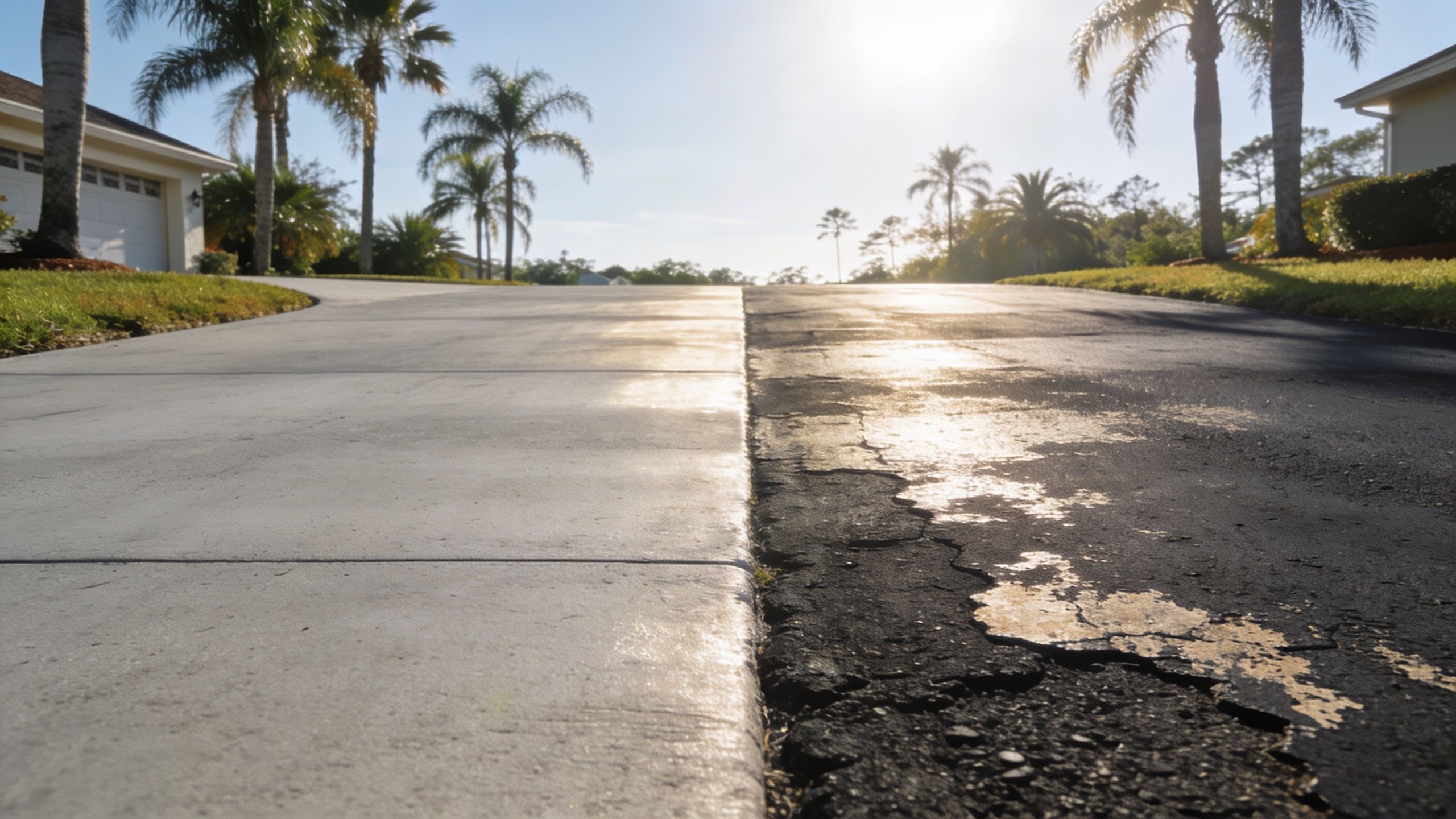
Hot pavement tells the story fast. In midsummer, asphalt is more likely to soften, scuff, and show marks from parked vehicles, turning tires, and concentrated weight. Concrete stays more stable through those same conditions and usually keeps a cleaner appearance longer.
That matters for more than looks. A surface that holds its shape in the heat generally needs fewer corrections over time, which helps control lifecycle cost instead of just lowering the entry price.
Rain, drainage, and surface stability
Central Florida rain exposes installation quality fast. Water does not only affect the top layer. It works on the joints, the edges, and the base underneath. If runoff is poor or the subgrade was not prepared correctly, both materials can fail early.
Concrete has a wider margin for error once it is installed properly. It resists rutting and shape loss better during long wet periods, which is one reason many owners see better long-term value from it here. Owners comparing lifespan in local conditions should review how long a concrete driveway lasts in Florida before deciding on material alone.
Best fit by property type
The right choice depends on how long the owner plans to keep the property and how much maintenance they want to manage.
- Primary residences: Concrete usually makes more financial sense over the full ownership cycle because it stays more stable in heat, holds appearance better, and does not need the same recurring surface maintenance.
- Rental homes: Concrete often fits owners who want fewer service calls and a surface that presents well between tenants.
- Short-term budget decisions: Asphalt can still be the practical option if lower upfront cost matters most and the owner is prepared for regular upkeep and earlier corrective work.
For most homes in Marion and Citrus counties, concrete gives the better long-term return in our climate. Asphalt still has a place, but in hot, rainy Central Florida, the lower install price often stops looking like the lower total cost.
Considerations for Commercial Properties and HOAs
A driveway at a home can tolerate a few cosmetic issues for a while. An HOA entrance, church loop, retail lot, or multi-building property usually cannot. In Ocala, Crystal River, and surrounding parts of Marion and Citrus counties, one low spot or soft wheel path can turn into standing water, trip hazards, striping problems, and tenant complaints within one rainy season.
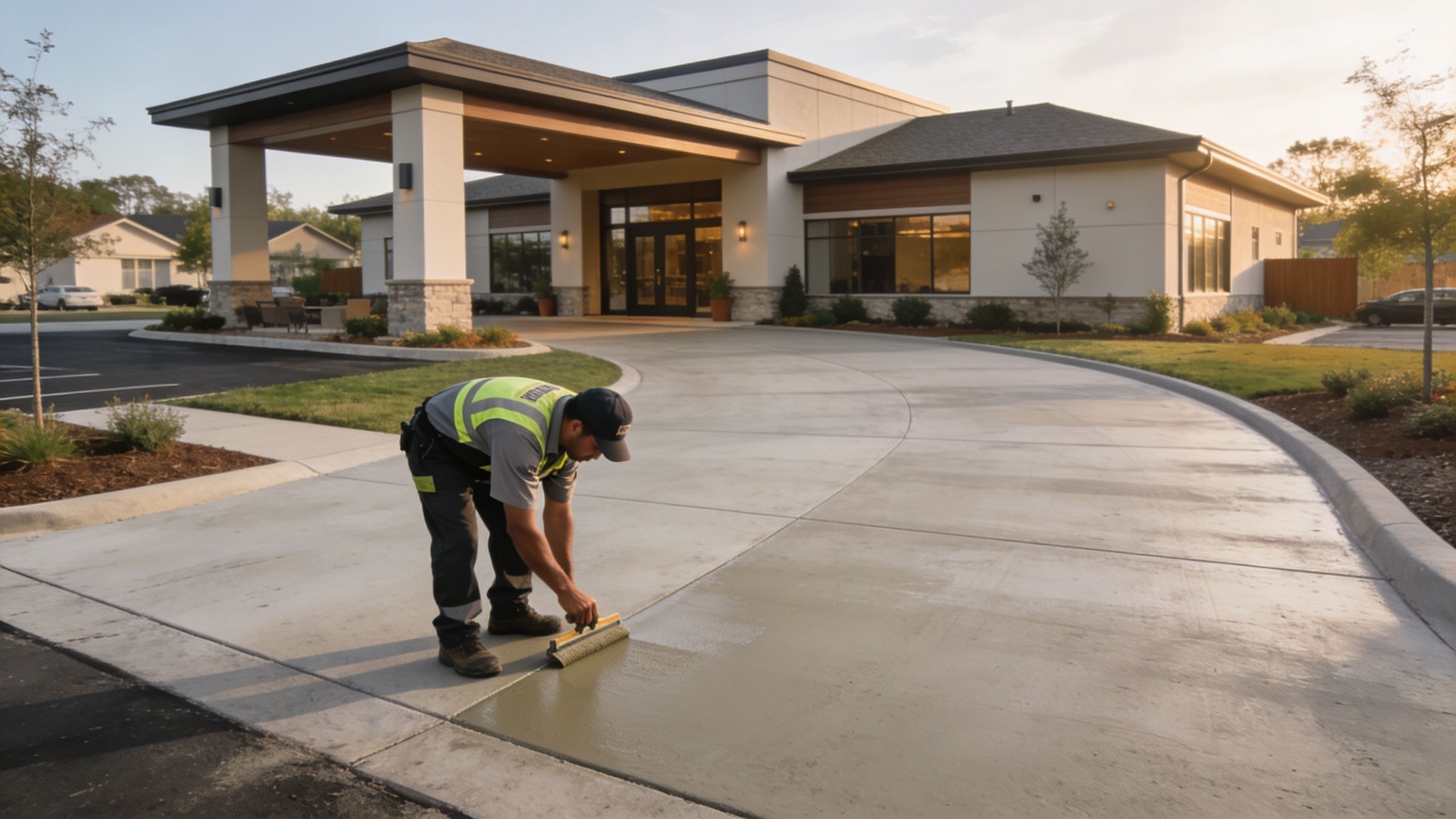
Concrete often earns its higher installation cost on these properties because the investment is more critical and the service demands are different. Boards, facility managers, and commercial owners are not just buying pavement. They are buying fewer disruptions, more predictable budgeting, and a surface that stays stable under delivery vans, trash trucks, service traffic, and steady daily use.
Where load-bearing capacity matters
On commercial and HOA sites, the material choice is usually less about appearance and more about how the surface holds its shape over time. Asphalt can perform well in parking areas with lighter traffic and a solid maintenance plan. Under repeated turning, braking, and heavier vehicle loads, it is more likely to show deformation sooner, especially during long hot stretches common in Central Florida.
Concrete usually fits better in high-stress areas such as entrances, dumpster pads, loading zones, fire lanes, and tight turning sections. Those are the spots where surface movement gets expensive fast. Once rutting or depressions start, water collects, edges break down, and repairs tend to spread beyond the original problem area.
Safety and compliance issues
Commercial owners and HOA boards also have to think beyond pavement life. They have to reduce liability.
A surface that settles or deforms can affect pedestrian crossings, accessible routes, curb transitions, and parking layout visibility. If striping fades because the pavement underneath is shifting, repainting alone does not solve the problem. The base issue is still there.
For property managers, the practical checklist usually looks like this:
- Stable walking surfaces: Residents, customers, and guests notice movement underfoot long before a board approves replacement.
- Predictable drainage: Ponding near entrances, mail kiosks, dumpster areas, or accessible spaces creates complaints and accelerates wear.
- Striping that stays readable: Handicap markings, fire lanes, arrows, and stall lines last better on pavement that is not flexing or breaking apart.
- Fewer reactive repairs: Patchwork fixes can disrupt traffic flow and often cost more over several budget cycles than a better material choice upfront.
Why mixed-property sites need both materials managed correctly
Some of the best-performing properties in this region use both materials. Concrete handles the punishment points. Asphalt covers broader parking areas where the lower install cost still makes sense and maintenance can be scheduled properly.
That kind of layout usually gives commercial owners and HOAs a better lifecycle result than forcing one material across the entire site. The goal is not to choose sides. The goal is to put money where it returns the most service life.
For properties in Lecanto, Beverly Hills, Dunnellon, and The Villages, that often means using concrete where failure would be costly or disruptive, then maintaining asphalt in the surrounding areas before small issues turn into reconstruction. That is how property managers keep paving costs under control in a hot, wet climate.
Your Expert Partner for Paving in Marion and Citrus County
The best driveway recommendations usually come from a contractor who works with both materials, not one who only sells one answer. That matters because the right choice depends on the property, budget, traffic, drainage, and how long you expect the surface to serve you.
In Marion County, FL and Citrus County, FL, some projects clearly call for concrete replacement. Others call for asphalt maintenance, sealcoating, or striping upgrades rather than full reconstruction. A contractor with real experience in concrete work and asphalt maintenance can tell the difference without trying to force the job into a single service line.
What a professional should evaluate
Before any recommendation is made, the site should be looked at for a few basic issues:
- Base condition: If the foundation under the surface is failing, surface fixes won’t last.
- Water movement: Drainage problems shorten the life of both concrete and asphalt.
- Traffic type: Passenger cars, trailers, commercial vehicles, and service equipment all change the design needs.
- Access and finish requirements: Residential curb appeal and commercial ADA layout are different jobs.
A good paving recommendation starts with the property itself. Not with a sales script.
For homeowners in Ocala, Summerfield, and Silver Springs, and for property managers in Homosassa, Lecanto, and The Villages, it pays to work with a licensed and insured local contractor who understands Central Florida soil, weather, and scheduling realities. Reliable timelines, clear scope, and quality site prep matter just as much as the top surface you choose.
Frequently Asked Questions About Driveway Paving
Can you put asphalt over a concrete driveway
Sometimes, but it’s not automatically a good fix. If the concrete underneath is already moving, settling, or breaking apart, asphalt over the top usually won’t solve the root problem. It may cover the damage for a while, but it often won’t deliver the service life most owners want from a replacement project.
Does concrete add more curb appeal than asphalt
In many cases, yes. Concrete usually gives a cleaner, brighter appearance, and it pairs well with sidewalks, patios, and updated home exteriors. Asphalt still has a classic look, but it generally offers fewer finish options and tends to show weathering faster.
Which driveway is better for a long-term homeowner in Florida
For most long-term owners in Central Florida, concrete is the stronger choice because it handles heat better, usually lasts longer, and doesn’t require the same maintenance rhythm as asphalt. Asphalt can still fit a tighter upfront budget, but it asks for more attention over time.
Is asphalt ever the better option
Yes. Asphalt can make sense when the immediate install budget is the top priority and the owner understands the maintenance commitment going in. It can also be a practical material for certain larger paved areas where ongoing sealcoating and maintenance are already part of the plan.
What should be inspected before replacing a driveway
The surface condition is only one part of it. A proper evaluation should look at the base, drainage, edge support, traffic patterns, and whether the driveway layout still works for how the property is used today. That’s especially important on older homes in Marion and Citrus counties where water and subgrade issues may be part of the failure.
If you're weighing a concrete driveway vs asphalt driveway for a home or commercial property in Central Florida, Riverside Sealing & Striping, LLC offers free, no-pressure consultations for owners in Marion County, Citrus County, and nearby communities. As concrete and asphalt experts in Marion and Citrus County, the team handles concrete driveway replacement, new concrete work, asphalt sealcoating, and parking lot striping with reliable scheduling, clear recommendations, and local experience that fits Florida conditions.