
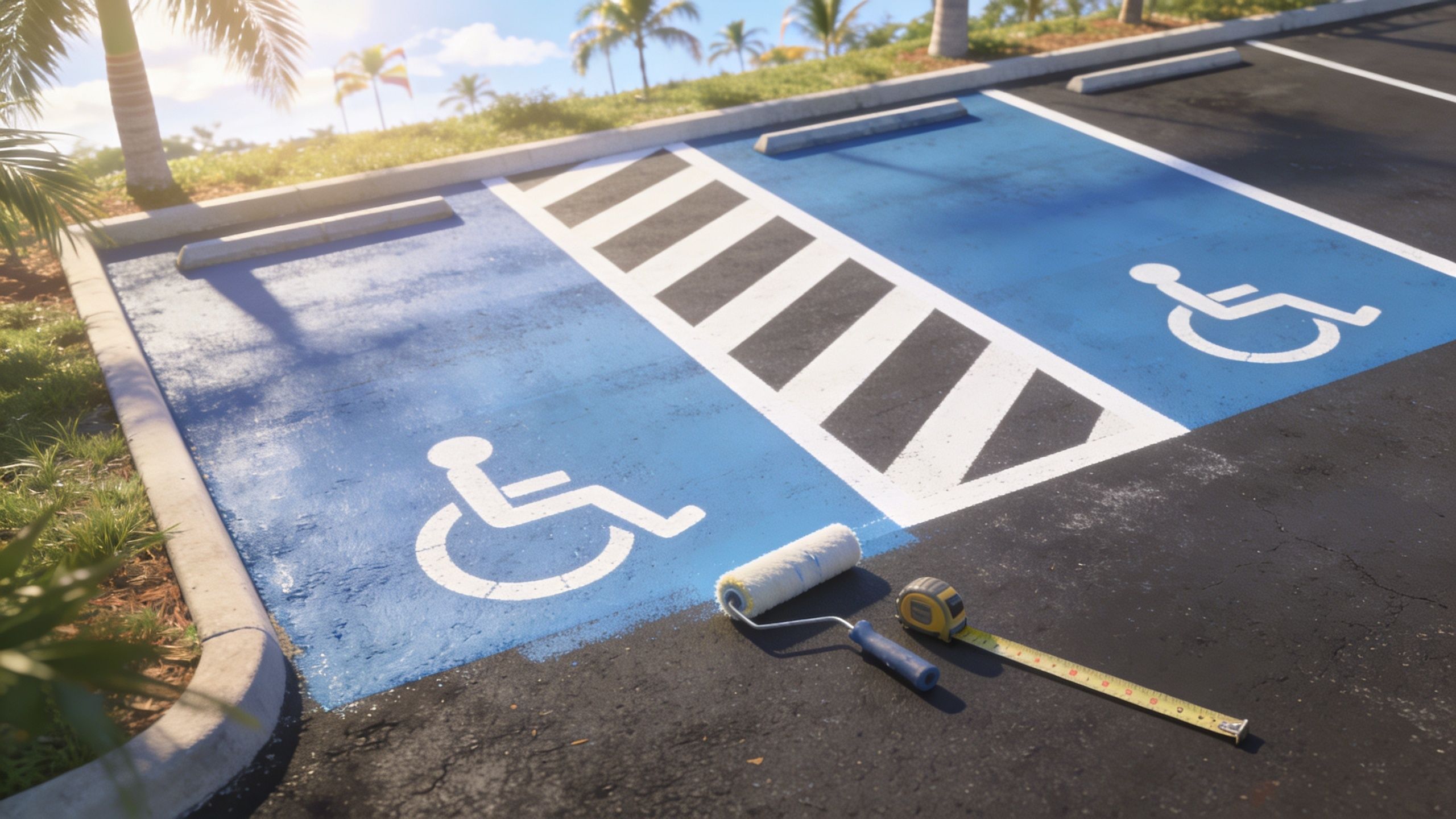
If you manage a shopping center in Ocala, a church in Inverness, an HOA in The Villages, or a medical office near Crystal River, you've probably looked at your parking lot and wondered whether the accessible spaces are compliant or just painted that way. That's a common problem in Central Florida. A lot can look acceptable at a glance, then fail on width, aisle layout, faded markings, or slope.
That uncertainty matters. ADA parking lot striping requirements aren't just about paint. They affect safe access, day-to-day usability, complaint risk, and potential enforcement. For property managers in Marion County, FL and Citrus County, FL, they also intersect with Florida weather. Sun, rain, traffic, and resurfacing cycles wear markings down faster than many owners expect.
Local conditions make generic advice less useful. A lot in Dunnellon, Belleview, Homosassa, or Lecanto doesn't age the same way as one in a milder climate. Heat fades lines. Stormwater exposes drainage problems. Sealcoating and repairs can wipe out markings that were compliant before the work started.
This guide is written from the practical side of the work. The goal is simple. Help you understand what a compliant accessible space needs, how many spaces your lot likely requires, what commonly goes wrong, and what to check before hiring a striping contractor in Central Florida.
Your Guide to ADA Parking Lot Compliance
A Central Florida property manager usually finds out about ADA parking problems at the worst time. The lot has already been sealcoated, the stripes look fresh, and a tenant, visitor, or inspector points out that the accessible space is in the wrong place, the aisle is hard to read, or the path to the door no longer works. By then, the fix is no longer a simple repaint. It can mean layout changes, new signage, curb-ramp adjustments, or rework after money has already been spent.
That is why ADA parking compliance needs to be checked before striping starts, not after. A parking lot striping crew can follow old lines and still leave you with a noncompliant layout if the last layout was wrong to begin with. Property managers in Marion County and Citrus County run into this after repaving, patching, tenant turnover, and frontage updates that shift traffic flow or accessible routes.
On a working commercial property, the inspection is straightforward. Confirm that the accessible spaces are in the right location for the accessible entrance. Check that the markings are easy to identify from a driver's seat, not just visible when standing over them. Make sure the space, aisle, signs, and route to the sidewalk still function together after every pavement project. If you want a better sense of how layout decisions affect compliance, this guide on how a parking lot is striped in practice helps explain where mistakes often start.
Central Florida adds its own problems. In Ocala, Inverness, Crystal River, and The Villages, UV exposure and heavy rain shorten the life of pavement markings faster than many national articles admit. A freshly painted line in Ocala can lose half its visibility in a single summer due to UV, a problem less common in northern climates. Afternoon storms also expose drainage issues fast. If water sheets across an access aisle or ponds near the curb ramp, the space may still be painted correctly and still fail in daily use.
Hiring the right local contractor matters for that reason. In Marion or Citrus County, ask whether the contractor checks slope, drainage, signage placement, and accessible route continuity before restriping. Ask what material they use for Florida sun and how they handle restriping after sealcoating so the access aisles stay readable through the rainy season. A contractor who only talks about paint color and line width is only addressing part of the job.
The practical standard is simple. The space has to remain clear, usable, and defensible after weather, traffic, and maintenance work, not just on the day it was striped.
The Anatomy of a Compliant ADA Parking Space
A property manager usually sees the problem after the complaints start. A wheelchair user cannot deploy safely because the aisle is too narrow, a van space has the wrong layout, or the striping faded so badly after a Florida summer that drivers drift into the hatch marks. By that point, the fix costs more than getting the layout right the first time.
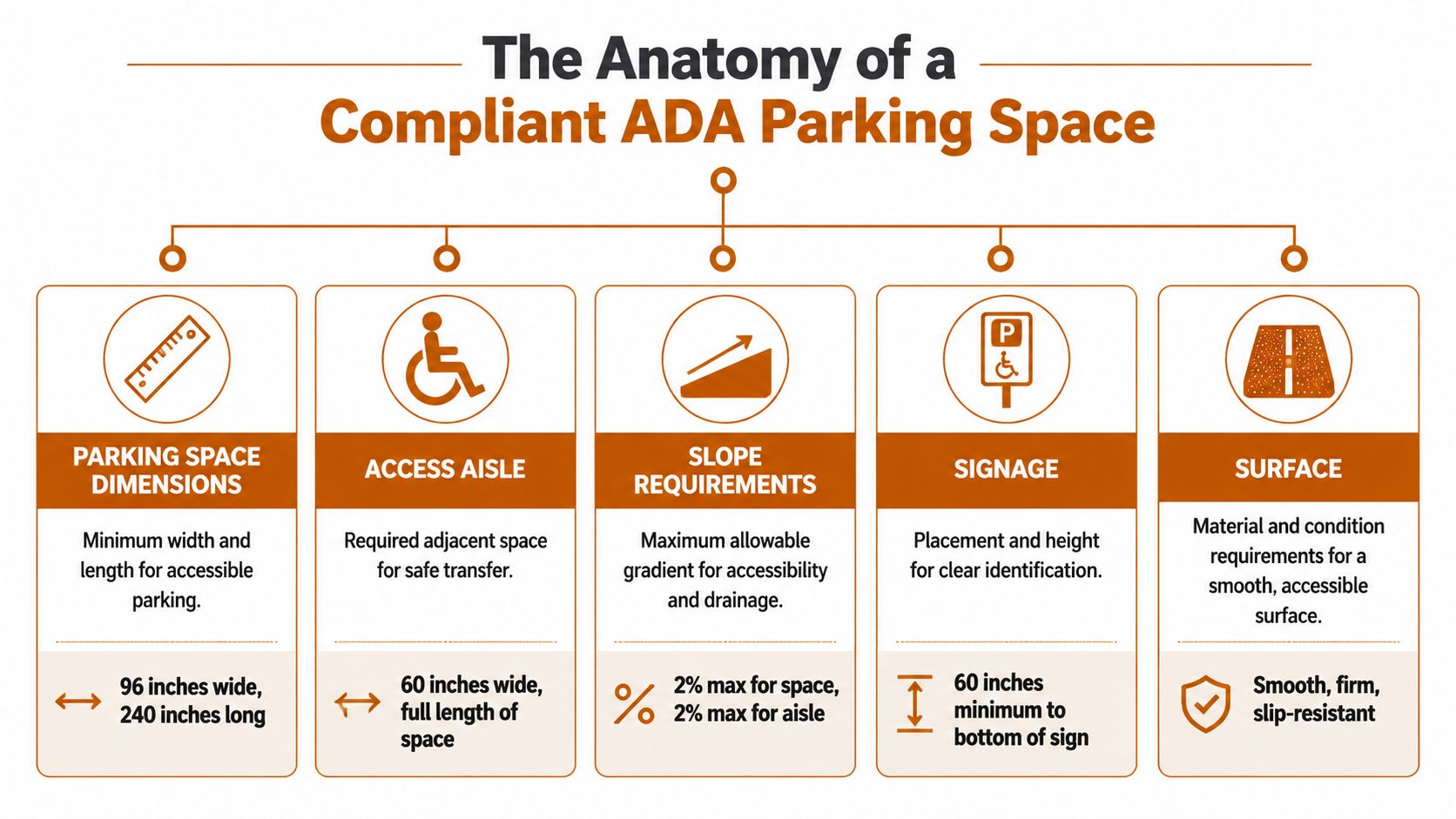
Standard accessible space dimensions
A compliant ADA space starts with the stall width and the access aisle beside it. For a standard accessible space, the baseline dimensions are a 96-inch-wide parking space and a 60-inch-wide access aisle. Those are field measurements, not rough estimates from old striping that may already be off.
I tell managers in Marion and Citrus County to measure from the actual usable edges, not from faded paint ghosts. On older lots in Ocala, Inverness, or Crystal River, prior restriping often narrowed the aisle a little at a time until the space looked acceptable from a car but failed for real use.
Van-accessible space dimensions
Van spaces need more care because crews get them wrong all the time. A van-accessible space can be laid out in either of these approved configurations:
- 132-inch parking space with a 60-inch access aisle
- 96-inch parking space with a 96-inch access aisle
The sign alone does not make it a van space. The width has to be there on the pavement, and the access aisle has to stay clear enough for lift or ramp deployment in daily use.
That matters even more on busy medical, retail, and office sites where cars tend to crowd the lines.
The access aisle and striping pattern
The access aisle is part of the accessible parking space, so it needs to be obvious and protected from encroachment. Diagonal striping is the standard field method because it clearly marks the area as no-parking space and helps drivers read the layout quickly.
In Florida, visibility drops faster than many owners expect. Sun bleaches paint. Rain washes dirt into the hatch marks. If the aisle striping is faint by late summer, the space may still exist on paper and still perform poorly in the lot.
For a practical view of field layout and paint sequencing, this guide on parking lot striping layout and setup shows how measurement mistakes usually happen before the first line is sprayed.
No storage should end up in that aisle. No wheel stops that block deployment. No portable signs. No pressure washing trailers parked there during service calls.
What property managers should verify on site
A quick site walk catches a lot of problems before they become formal complaints or failed inspections.
| Component | What to verify |
|---|---|
| Standard stall | At least 96 inches wide |
| Standard access aisle | At least 60 inches wide |
| Van stall | One of the two approved width and aisle combinations |
| Aisle markings | Diagonal striping is visible and readable |
| Route connection | Aisle leads to an accessible path, not into a curb or dead end |
One more practical check matters in Central Florida. Look at the space after rain. If water ponds in the aisle or runs across the route to the sidewalk, the striping may be accurate and the space can still be hard to use safely.
Markings that need to stay clear
The pavement markings have to remain easy to identify from a moving vehicle and from a standing position in the lot. The International Symbol of Accessibility should be visible, the aisle striping should still read clearly, and the reserved space should not blend into surrounding stalls.
Local contractor selection affects compliance. In The Villages, Summerfield, and surrounding areas, ask whether the crew uses materials suited for heavy UV exposure and frequent rain, and ask how they verify final dimensions before they leave the site. If a contractor only discusses paint color and price, keep asking questions. A compliant ADA space is measured, laid out, marked clearly, and built to hold up under Florida conditions.
Calculating Your Required Number of Accessible Spaces
A lot gets restriped after sealcoating, the crew puts back the same layout that was there before, and six months later a tenant complaint or inspection shows the property is short on accessible parking. I see that mistake on Florida commercial sites more often than I should.
The required count starts with the total number of spaces in the lot, not with how many accessible spaces the property had last year. If the site was expanded, reconfigured, or combined with adjacent parking, the count needs to be recalculated before any lines go down.
Quick reference table
| Total Parking Spaces in Lot | Minimum Required Accessible Spaces |
|---|---|
| 1 to 25 | 1 |
| 26 to 50 | 2 |
| 51 to 75 | 3 |
| 76 to 100 | 4 |
| 101 to 150 | 5 |
| 151 to 200 | 6 |
| 201 to 300 | 7 |
| 301 to 400 | 8 |
| 401 to 500 | 9 |
| 501 to 1000 | 2% of total |
The federal scoping table for parking comes from the U.S. Access Board parking guide. For a property manager, the practical takeaway is simple. Count every marked parking space in the lot, match that number to the table, and verify the striping plan reflects the current total.
The van-accessible rule
At least 1 out of every 6 accessible spaces must be van-accessible. On smaller sites, that usually means the first accessible space should be laid out as a van space from the start.
That choice affects more than paint. The van space and access aisle need to fit the site without forcing vehicles into the drive lane, blocking turning movement, or pushing pedestrians into a poor route to the entrance. On older shopping centers in Marion and Citrus County, that is often the hard part. The lot was built for a different standard, and the striping plan has to work around tight geometry, existing curbs, and drainage slopes.
A good contractor should catch that before mobilizing. Ask how they confirm the total parking count, how they identify which accessible stalls must be van-accessible, and whether they field-measure the layout instead of copying the old striping.
Where Florida properties get this wrong
Count errors usually show up after changes that seem minor on paper. A landlord adds a few spaces near a pad site. A medical office restripes after resurfacing. A retail center loses spaces to a dumpster enclosure or cart corral and shifts the layout. Any of those changes can affect the required accessible count or where those spaces should sit.
Central Florida weather adds another wrinkle. Lots in places like Dunnellon, Inverness, and Lecanto get restriped more often because sun, traffic, and rain wear markings down faster. Every repaint is a chance to correct an old counting mistake, but only if someone reviews the layout before the crew starts.
If you are hiring a local striping contractor, ask one direct question. “Are you restriping the existing layout, or are you verifying ADA counts and stall assignments from the current site plan and field conditions?” In Marion or Citrus County, that answer tells you a lot about whether you are buying paint or buying compliance work.
Florida-Specific Challenges for ADA Compliance
A manager in Ocala gets a lot restriped on Friday, then a summer storm rolls through on Monday. By Tuesday, water is sitting across the access aisle, the blue markings already look dull against the wet asphalt, and tenants are asking whether the ADA spaces were laid out correctly. That is a Florida problem, not a generic code issue.
Central Florida weather shortens the life of pavement markings and exposes layout mistakes fast. Strong sun fades blue and white markings sooner than many owners expect. Heavy rain shows where low spots, drainage flow, and worn paint make an accessible space harder to see and harder to use. In Marion and Citrus County, ADA compliance is not only about the day the stripes go down. It is about whether the space still reads clearly after months of heat, traffic, and afternoon storms.
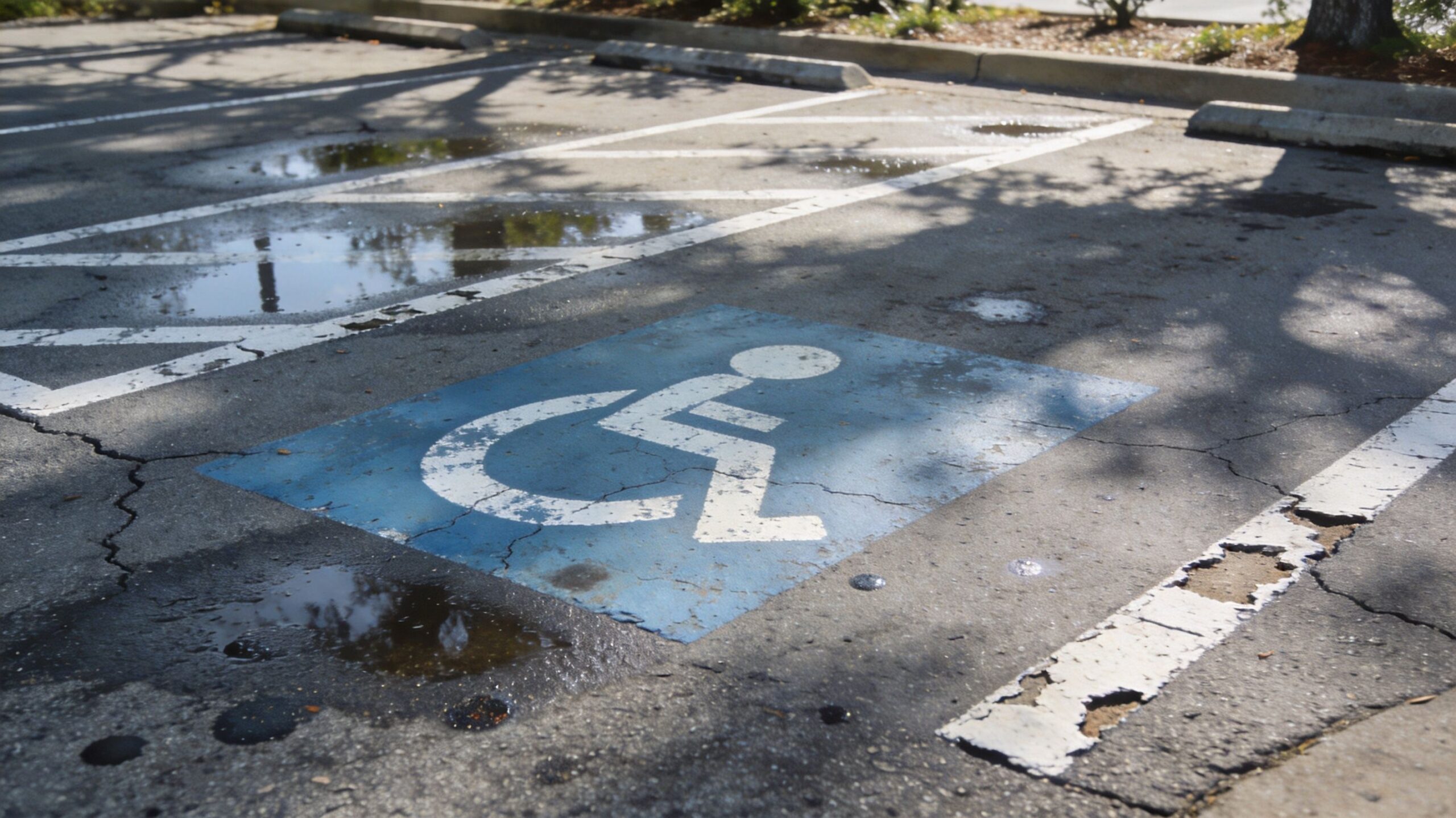
Walk the lot and ask these questions
Start after a rain event if possible. Dry-weather inspections miss problems that show up immediately in Florida.
- Do the accessible stall lines and access aisle markings still stand out from the driving lane? If drivers have to slow down to figure out the space, the markings are already too weak.
- Is water ponding inside the stall, access aisle, or accessible route? That usually points to drainage or surface issues, not just a striping problem.
- Was the lot recently sealcoated, resurfaced, or patched? Any pavement work can affect visibility, slope, and the exact location of the accessible route.
- Do signs, wheel stops, curbs, or new concrete line up with the painted layout? Florida repair work often happens in phases, and the striping does not always get adjusted to match.
- Has anyone reviewed the site as part of a parking lot maintenance checklist for Florida properties? That is a practical time to catch ADA items before a complaint or inspection does it for you.
Why Florida weather changes maintenance timing
In places like Ocala, Silver Springs, Inverness, and Lecanto, UV exposure bleaches contrast out of traffic paint faster than owners budget for. Then rain does the second half of the damage. It tracks through weak paint, settles in low areas, and makes faded markings almost disappear at the exact time visitors need to identify them quickly.
Humidity matters too. A contractor can use decent material and still get a poor result if the surface is dirty, damp, or too hot. I have seen fresh striping fail early because the crew treated an ADA refresh like a routine repaint instead of a compliance job with surface prep and layout checks.
What property managers should ask a local contractor
Local experience matters here. A contractor working in Marion or Citrus County should be able to explain how they handle Florida-specific conditions, not just quote a price per stall.
Ask direct questions.
- What paint or coating system are you using for ADA markings, and how does it hold up in full sun?
- Do you inspect ponding, broken edges, and patched asphalt before striping, or only paint the layout provided?
- If water sits in the access aisle, do you flag it as a compliance risk before work starts?
- Will you field-check the route from the space to the sidewalk after recent concrete or curb work?
- Have you worked on older shopping centers, medical offices, churches, or multifamily sites in this area where drainage and existing geometry are tight?
Those answers tell you whether the contractor understands compliance in Florida field conditions or is just repainting old lines.
For properties in The Villages, Beverly Hills, Dunnellon, and nearby markets, the practical standard is straightforward. If the accessible spaces cannot stay visible, drain reasonably well, and remain usable through a Central Florida summer, the striping plan was not thought through well enough.
Common Violations and How to Spot Them
The most expensive ADA parking problems usually aren't hidden. They're visible to anyone who knows what to look for during a site walk.

One of the biggest issues is slope. The accessible parking space and access aisle cannot exceed 1:48, or about 2.08%, in any direction, and non-compliance can lead to Department of Justice fines up to $75,000 for a first violation according to this review of ADA-compliant parking lot striping requirements.
Violation signs a manager can catch early
Some problems show up during a simple walk-through.
- Faded access aisle striping: Drivers drift into the hatched area when the markings lose contrast.
- Incorrect stall width: A space may look close enough until someone measures it.
- Missing or unclear signage: The pavement symbol alone may not be enough for a clearly marked stall.
- Blocked accessible route: Wheel stops, temporary signs, planters, or stored materials can make the space unusable.
- Patching and overlays: Surface work can change drainage and slope even if the layout lines remain in place.
The lot can be freshly painted and still fail if the measurements, slope, or route are wrong.
Why contractors matter here
Hiring decisions become part of compliance. A striping contractor who only paints what was there before can preserve an old mistake. A qualified contractor measures, checks spacing, reviews the route, and flags slope concerns before layout begins.
For property managers, that means asking better questions:
- Will they field-measure the accessible stalls and aisles?
- Will they inspect the surface condition before painting?
- Will they call out layout issues instead of painting around them?
- Will they coordinate with asphalt or concrete repairs if needed?
A practical pre-project review helps. This parking lot maintenance checklist is a good reference for spotting issues that affect both compliance and general lot performance.
Look beyond the paint
A proper ADA upgrade is rarely just a striping job. The contractor may need to coordinate with asphalt patching, drainage correction, or concrete walkway work to make the area properly usable.
This video gives a useful visual overview of accessible parking details in the field:
In Marion County and Citrus County, the best results usually come from treating the lot as a system. Pavement condition, drainage, concrete transitions, and striping all affect whether the finished accessible space works.
Hiring a Professional for Striping and Compliance Upgrades
When a property needs ADA striping work, the process should start with field verification, not a paint estimate. A contractor should visit the site, review the existing layout, and check whether the accessible spaces still work with the current pavement and pedestrian route.
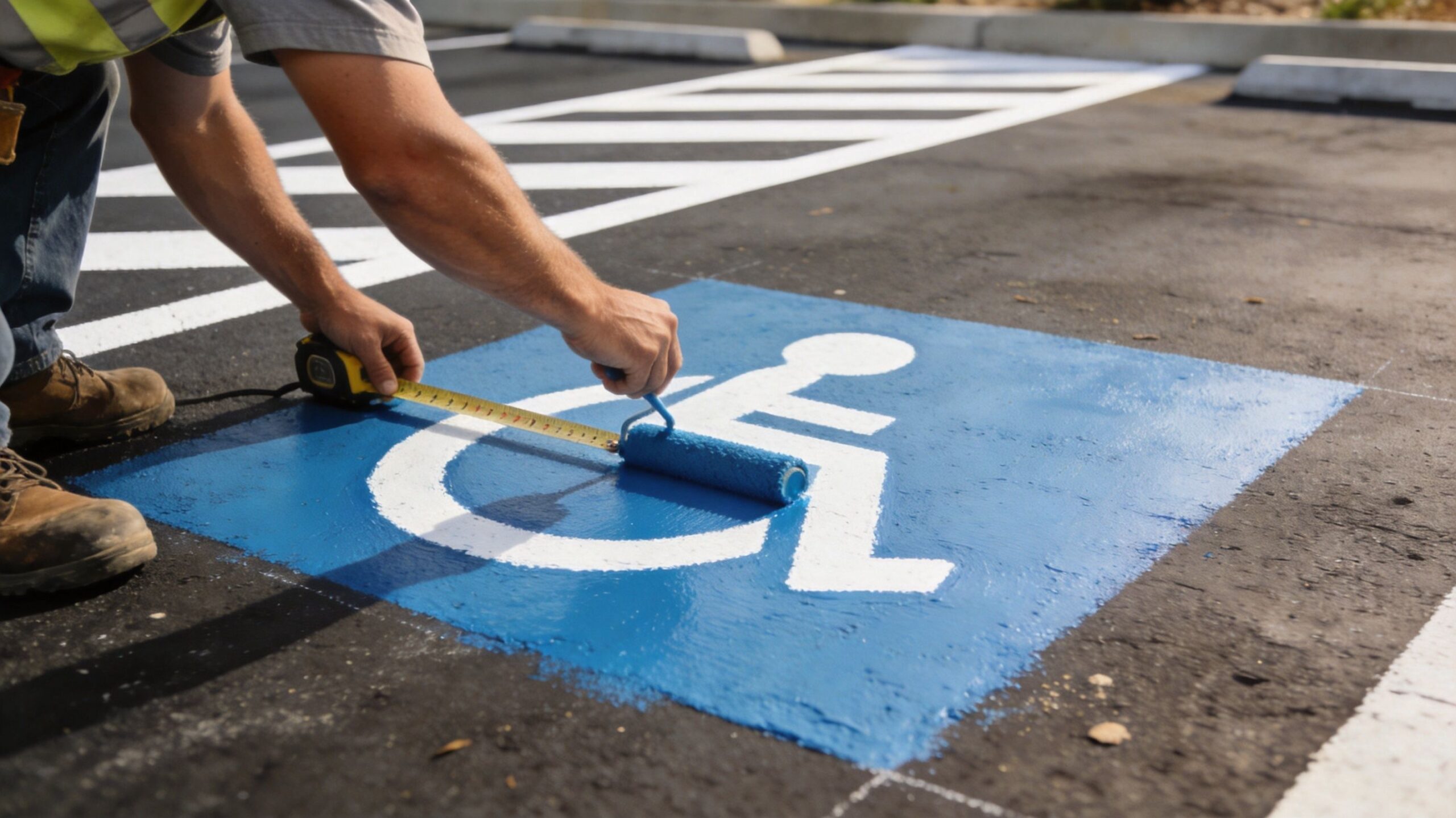
What a solid process looks like
A professional striping and pavement contractor should typically handle the job in this order:
- Site review first. They should measure the accessible stalls and aisles, study traffic flow, and identify obvious conflicts.
- Surface check next. If the asphalt is failing or the concrete route is damaged, painting alone won't solve the underlying issue.
- Layout before production. A clean chalk or layout plan prevents field guesswork.
- Striping with durable materials. The markings need to stay readable under Florida sun and rain.
- Final walk-through. The completed work should be reviewed for clarity, consistency, and site usability.
What to ask before you hire
Not every striping company handles compliance work the same way. Property managers in Homosassa, Crystal River, Hernando, and Ocala should ask direct questions.
- Are they licensed and insured? That's basic risk management.
- Do they handle both asphalt and concrete issues? Accessible parking often ties into curb ramps, sidewalks, or pavement repairs.
- Do they know local property types? HOAs, churches, retail centers, and office lots all have different circulation patterns.
- Will they identify problems beyond paint? A useful contractor points out slope, drainage, and route conflicts.
One local option for this type of work is commercial parking lot striping services, which can be part of a broader pavement maintenance plan rather than a stand-alone repaint.
A contractor who only talks about line color and turnaround time probably isn't looking deeply enough at ADA compliance.
Why full-service capability matters
This topic connects directly to the company's broader role as Concrete and Asphalt Experts in Marion and Citrus County. A compliant accessible parking area may require more than striping. It may also involve sidewalk adjustments, concrete replacement, pavement prep, sealcoating coordination, or localized asphalt repair.
That's especially true on older properties in Belleview, Dunnellon, Lecanto, and The Villages where the lot has been modified over time. Hiring a contractor who understands both concrete and asphalt usually makes the project more practical and easier to coordinate.
Frequently Asked Questions About ADA Parking
Does the ADA require blue paint for accessible parking spaces
No specific color is mandated in the federal standard discussed earlier. What matters is that the markings are clear, visible, and compliant with applicable local requirements. In practice, many Florida properties use familiar blue-and-white markings because drivers recognize them quickly.
How often should a Central Florida property inspect accessible parking striping
In this region, annual review is a smart operating habit, especially after sealcoating, resurfacing, or major rain seasons. Even when striping still seems visible, Florida sun and traffic can reduce contrast enough to create confusion.
Is restriping enough to fix a non-compliant accessible space
Sometimes, but not always. If the issue is faded paint, restriping may solve it. If the problem is slope, drainage, damaged pavement, or a broken route to the entrance, the fix usually involves more than paint. That may include asphalt work, concrete repair, or layout changes.
What's the most common mistake property managers make
A common mistake is assuming the old layout was correct and repainting it. That can lock in bad dimensions, poor aisle placement, or route problems. Anytime a lot is being refreshed, it's worth verifying the layout instead of copying it blindly.
Do small lots in places like Inverness or Beverly Hills still need close ADA review
Yes. Smaller lots are often where mistakes slip through because managers assume the layout is simple. In reality, compact lots leave less room for error. A single accessible stall in a small lot has to be placed and marked with the same care as multiple stalls in a larger shopping center.
Ensure Your Property is Safe and Compliant
ADA parking compliance comes down to field accuracy, visible markings, and a parking area that works for the people using it. On Central Florida properties, that also means accounting for weather, wear, drainage, and resurfacing cycles that can undo good striping faster than expected.
For managers in Marion County, FL and Citrus County, FL, the practical takeaway is simple. Don't treat accessible parking as a one-time paint task. Treat it as part of ongoing property maintenance. That mindset helps protect safety, appearance, and compliance across retail centers, churches, offices, HOAs, and community properties in Ocala, Dunnellon, Belleview, Summerfield, Crystal River, Homosassa, Inverness, Lecanto, Beverly Hills, Hernando, Silver Springs, and The Villages.
If your lot needs a fresh review, a restripe, or a broader upgrade tied to asphalt or concrete work, it helps to have a local contractor look at the site conditions in person.
If you need a no-pressure review of your parking lot, Riverside Sealing & Striping, LLC offers free on-site consultations and estimates for ADA striping, pavement maintenance, concrete work, and compliance-related parking upgrades across Central Florida.