
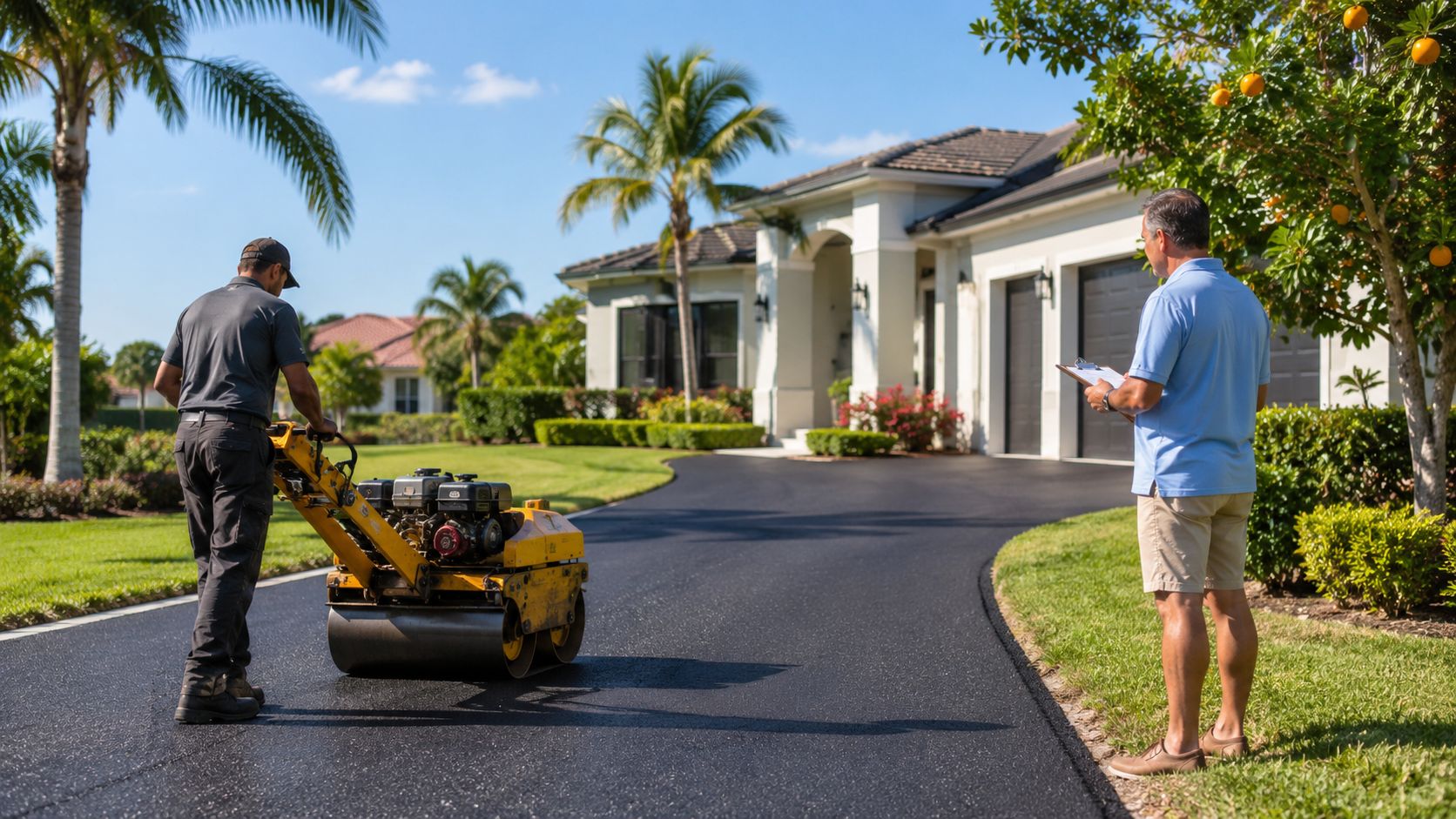
You pull into your Ocala home after an afternoon storm and notice the same problems you've been ignoring: faded asphalt, widening cracks near the garage, and water collecting along one edge. A quick search for asphalt driveway installation near me brings up several contractors, but the prices and promises rarely look alike. One company advertises a low square-foot rate, another talks about full replacement, and neither estimate clearly explains what happens beneath the pavement.
That uncertainty is common across Marion County, FL and Citrus County, FL. Heat, ultraviolet exposure, heavy rain, drainage conditions, and vehicle use all affect the result. A driveway in Dunnellon may need a different preparation plan from one in Inverness, even when the finished surfaces look similar.
This guide looks at the parts that decide whether a new driveway performs well, from total installed cost and base preparation to slope, thickness, permits, contractor qualifications, and maintenance. The focus is practical: how to compare bids and recognize quality work from a concrete and asphalt expert serving Central Florida.
Table of Contents
- Why Homeowners in Central Florida Search for Asphalt Driveway Installation
- What Drives the Real Cost of Asphalt Driveway Installation
- How a New Asphalt Driveway Is Actually Built
- Central Florida Climate and What It Means for Your Driveway
- How Thick the Asphalt and Base Should Be for a Florida Driveway
- Permits, Timelines, and What to Expect From Start to Finish
- Choosing the Right Contractor in Marion and Citrus County
Why Homeowners in Central Florida Search for Asphalt Driveway Installation
A homeowner in Dunnellon may start the search after a storm exposes a soft shoulder beside the driveway. In Ocala, the trigger might be raveling asphalt that has become rough under months of strong sun. Around Inverness, Crystal River, or Homosassa, standing water and repeated traffic can turn small surface defects into deeper structural problems.
The first instinct is often to ask whether the driveway needs sealing, repair, resurfacing, or complete replacement. That distinction matters. Sealcoating can protect a sound surface, crack repair can slow water entry, and resurfacing can improve a driveway when the foundation remains stable. None of those treatments can correct a failed base, widespread settlement, or drainage that repeatedly saturates the structure.
Why local conditions change the decision
Central Florida properties don't share identical soil or drainage conditions. A sandy site may drain quickly but still require careful edge support and compaction. Clay-heavy or poorly drained ground can move, retain moisture, and demand more aggregate or separation material. A flat lot can also send stormwater toward the pavement unless the finished grade gives water a clear path away.
The climate adds continuous stress. Direct sun dries and oxidizes the surface, while sudden downpours test the slope, shoulders, joints, and low points. Traffic then works on any weakness left by poor preparation.
Practical rule: A driveway quote should describe the ground beneath the asphalt, not just the asphalt visible from the street.
The same reasoning applies whether the property sits in Belleview, Silver Springs, Summerfield, The Villages, Lecanto, Beverly Hills, or Hernando. The right question isn't, “Who installs asphalt near me?” It's, “Who will evaluate my site and explain the structure they're proposing?”
Riverside Sealing & Striping, LLC operates as a concrete and asphalt expert in Marion and Citrus County, not as an asphalt-only provider. That broader perspective matters when a homeowner is comparing a new asphalt driveway with concrete work, removal and replacement, or related drainage and site-preparation needs.
What Drives the Real Cost of Asphalt Driveway Installation
The price of asphalt driveway installation near me can vary widely because contractors don't always include the same work. Recent 2026 estimates range from about $3 to $5 per square foot in some listings and $7 to $15 per square foot in others, while separate calculators show figures around $5,265 or $12.46 to $15.23 per square foot. Those figures come from Homewyse asphalt driveway cost estimates, and the spread shows why a surface-only comparison can be misleading.
A low number may assume an uncomplicated site, little removal, and a thin paving layer. A higher number may include demolition, hauling, subgrade correction, additional aggregate, thicker asphalt, edge work, or drainage improvements. Both prices can be accurate for different scopes.
Read the scope, not just the rate
Ask each contractor to identify the existing surface, the planned excavation depth, the aggregate base, the compacted asphalt thickness, and the drainage approach. If those details aren't written down, you can't make a fair comparison between bids in Marion County or Citrus County.
| Cost Driver | What It Covers | Why It Matters in Central Florida |
|---|---|---|
| Removal | Breaking out old asphalt, concrete, or unsuitable material, then hauling it away | Demolition and disposal can change the total substantially |
| Subgrade repair | Removing soft soil, correcting settlement, and rebuilding weak areas | Wet ground and variable soils can cause early movement |
| Aggregate base | Crushed stone placed and compacted beneath the pavement | The base distributes vehicle loads and supports drainage |
| Asphalt thickness | The compacted hot-mix layer specified for the expected traffic | Passenger vehicles and heavier loads don't impose the same demand |
| Grading and drainage | Sloping, crowning, swales, or underdrains where required | Stormwater that remains on or beside the pavement accelerates failure |
| Access and geometry | Driveway size, tight entrances, slopes, curves, and obstacles | Crew time and equipment access affect installation effort |
A useful estimate separates preparation from paving. If the contractor gives one unexplained total, ask what happens if the crew finds unsuitable soil after excavation. You should also ask whether the stated asphalt thickness is measured loose or after compaction. The finished thickness is the number that matters.
For technical background on paving scope and material choices, review the company's information about Florida asphalt paving. The point isn't to select a contractor from a web page. It's to arrive at the estimate with enough understanding to identify omissions.
Compare equivalent bids
Two bids become comparable when they describe the same removal, base, asphalt thickness, drainage work, edges, cleanup, and warranty terms. A contractor who recommends extra base on a wet or clay-heavy site may appear more expensive, but removing that line item can move the cost into future settlement and repair.
The lowest initial price doesn't necessarily represent the lowest ownership cost. A properly installed and maintained asphalt driveway commonly serves for about 15 to 25 years, and some well-maintained driveways last 30 years or more, while neglected surfaces can fall to roughly 8 to 12 years, according to industry driveway lifespan guidance.
How a New Asphalt Driveway Is Actually Built
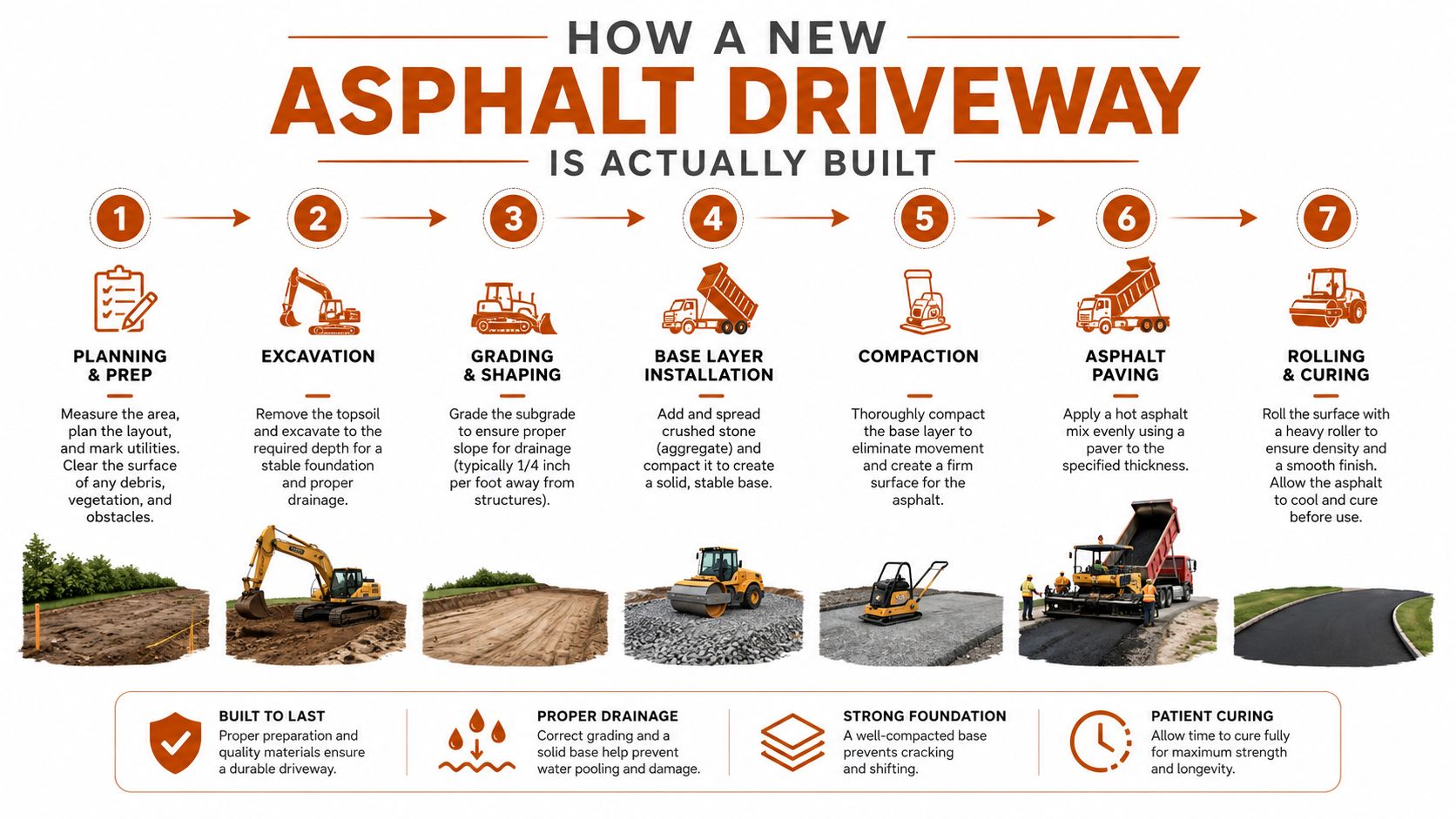
A durable driveway starts before the asphalt truck arrives. The crew needs to create a stable platform that can carry vehicles, shed water, and remain compacted through Central Florida weather.
The work below the surface
First, the crew removes topsoil, roots, organics, and other unsuitable material. Organic soil compresses and changes volume, so leaving it beneath a driveway creates a weak zone that can settle later.
Next, the crew grades the native soil to establish the drainage pattern. The soil is compacted near its optimum moisture condition, then the contractor places crushed aggregate in compacted lifts. A typical base may be 4 to 8 inches, with the actual depth depending on soil, drainage, traffic, and design requirements, as outlined by Asphalt Institute engineering guidance.
Each lift needs proper compaction. Dumping the full base thickness at once and rolling only the top does not produce the same structure as placing and compacting separate lifts. The finished surface should have at least a 1/4-inch-per-foot slope, about 2%, to keep water from ponding.
Paving and rolling
The crew then places hot mix asphalt while it remains hot and workable. Rollers follow the paver or placement crew quickly because compaction becomes harder as the mix cools. The goal is not merely a smooth appearance. The contractor must achieve enough density to limit air voids, resist water penetration, and support traffic.
The Asphalt Institute recommends random sampling for compaction quality control, with a minimum of five tests per lot, and agencies increasingly use percent within limits methods that consider both average density and variability. Homeowners don't need to operate testing equipment, but they can ask how the contractor checks compaction and whether testing is included in the project scope.
A homeowner should see a prepared, compacted base before paving begins. Ask where water will go, what the finished asphalt thickness will be after compaction, and how the crew will protect edges. For material background, the company's explanation of hot-mix asphalt provides useful terminology for that conversation.
Site observation: If the crew skips careful base preparation, a clean-looking surface can still fail from below.
Central Florida Climate and What It Means for Your Driveway
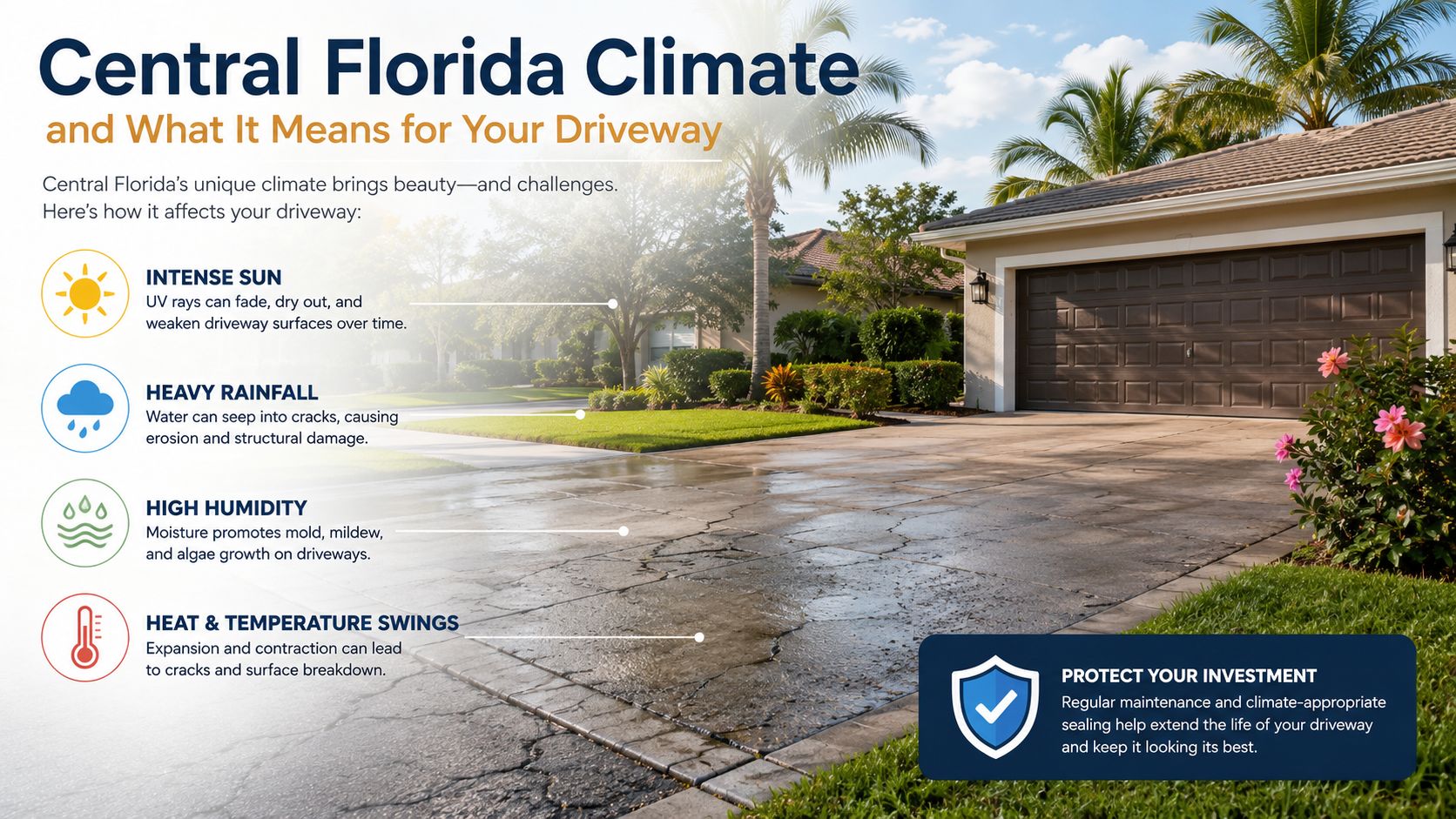
A driveway can last far longer on one property than another nearby because the site controls how heat, water, and traffic interact. Asphalt handles normal residential use well when the structure drains and remains compacted. It struggles when moisture reaches weak soil, edges lack support, or the surface holds water.
Strong Florida sun and ultraviolet exposure gradually dry the binder in asphalt. The surface can become less flexible and more vulnerable to oxidation, cracking, and raveling. Rain then enters through cracks and weak edges. On a flat property, repeated ponding places stress on the surface and can soften supporting materials below it.
Soil and drainage deserve the attention
Marion County and Citrus County include properties with different soil and drainage behavior. A sandy site may need attention to lateral movement and edge stability. Clay-heavy ground may need deeper base preparation, undercutting, or geotextile separation. A contractor should identify those conditions during the site visit rather than applying one standard section to every driveway.
A flat-area driveway should have at least a 2% slope, or a crown of not less than 1/4 inch per foot, so water can drain away instead of collecting on the pavement, according to the Virginia Asphalt Association driveway design guidance. On a difficult site, the solution may include a built-up subgrade, drainage swales, or underdrains.
Decide which upgrades solve a real problem
Extra base is worthwhile where the soil is weak or drainage is poor. Edge restraint deserves attention where vehicles regularly turn near the shoulder. Drainage work is necessary when roof runoff, roadway flow, or yard grading sends water toward the driveway.
Not every property needs the same upgrade. A contractor should connect each recommendation to an observed condition, such as soft subgrade, a low point, or concentrated runoff. Be cautious when a bid adds materials without explaining the site reason, but be equally cautious when a contractor promises one thin design for every lot.
How Thick the Asphalt and Base Should Be for a Florida Driveway
For standard passenger vehicles, a common residential benchmark is 2.5 to 3 inches of compacted hot mix over 4 to 6 inches of compacted aggregate base, based on residential driveway technical guidance. The word compacted matters. A loose placement depth isn't the finished structural thickness.
Heavier use changes the design. A driveway that regularly carries delivery trucks, recreational vehicles, trailers, or work equipment may need 4 inches or more of asphalt and 6 to 8 inches or more of base. On clay or poorly drained soils, the base may need to reach 8 to 10 inches, with geotextile separation where the soil and aggregate need to be kept from mixing.
Put the section in writing
Your estimate should identify:
- Finished asphalt thickness: Confirm the compacted depth, not just the amount placed before rolling.
- Aggregate base depth: Ask whether the stated depth is compacted and whether it will be installed in lifts.
- Traffic assumption: Explain whether the driveway is designed for passenger cars, heavy vehicles, or both.
- Soil treatment: Look for undercutting, stabilization, or geotextile separation if the site has weak or wet ground.
- Edges and transitions: Confirm how the new work meets the garage, roadway, walkway, and adjoining grade.
The Illinois Asphalt Pavement Association also presents 4 inches as a minimum full-depth asphalt thickness in some driveway guidance, while 5 to 6 inches may be recommended for a stronger driveway under broader load and climate conditions. That doesn't replace a site evaluation. It shows why a contractor should explain the selected structure rather than quoting a universal thickness.
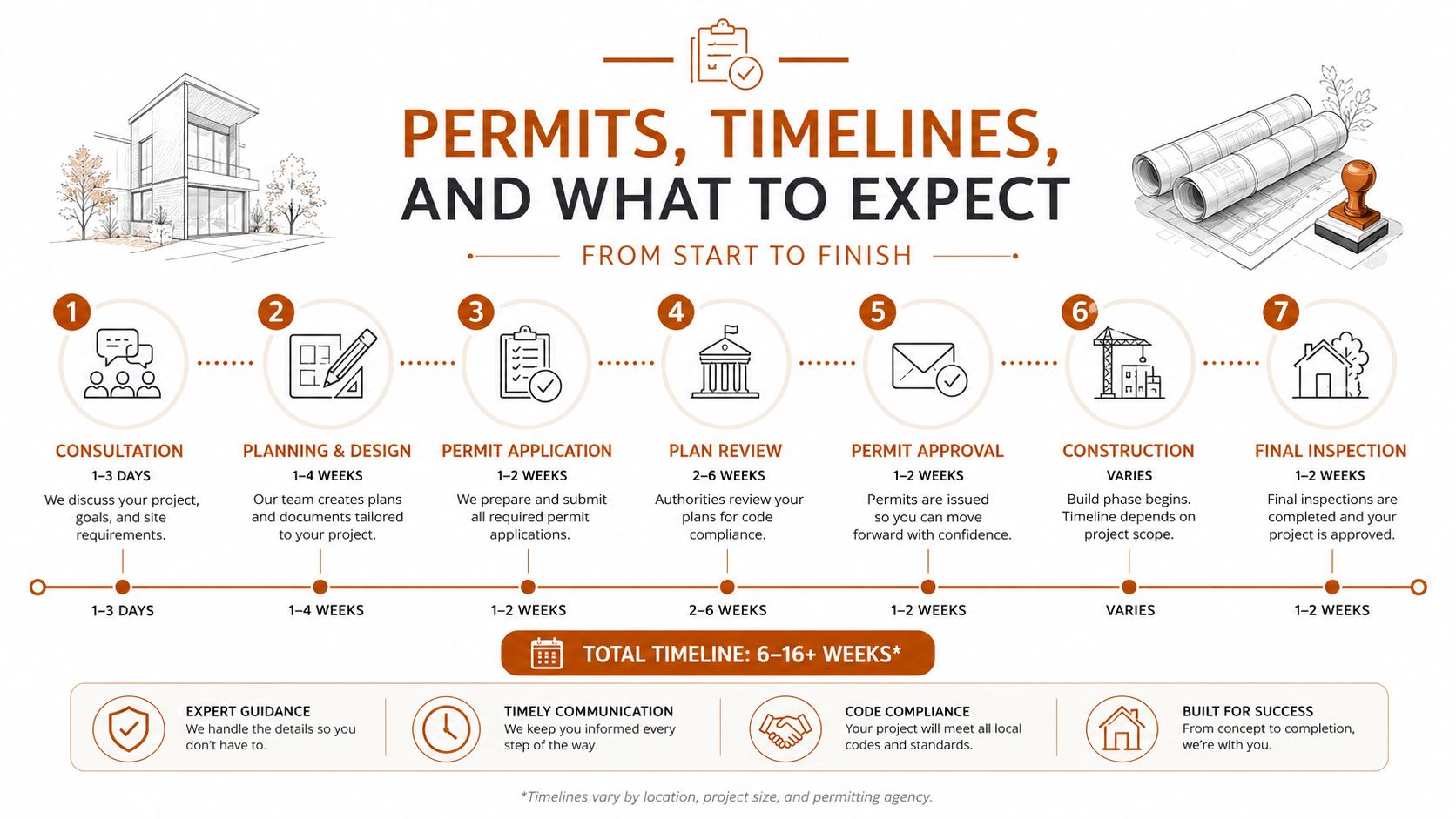
Permits, Timelines, and What to Expect From Start to Finish
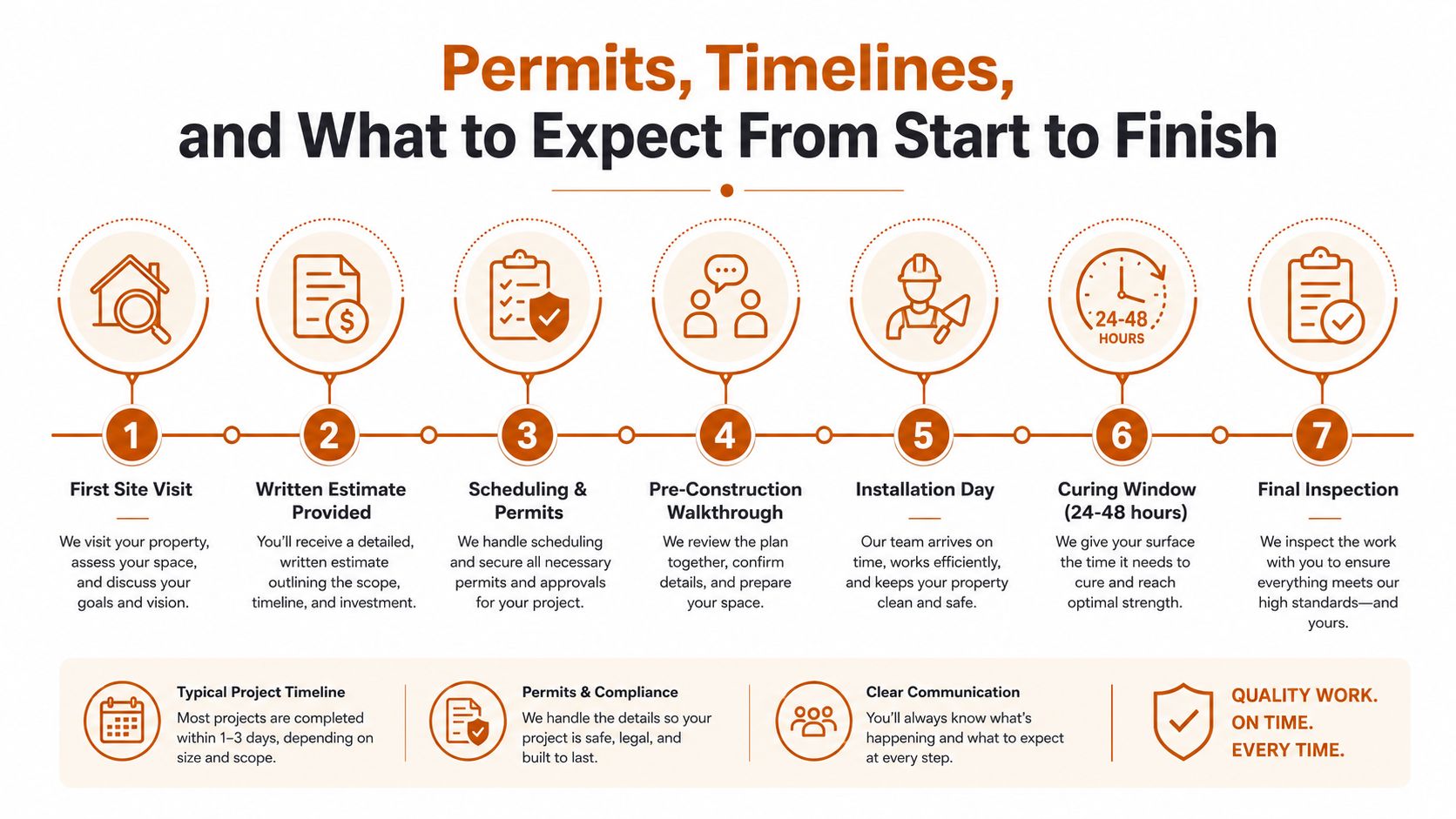
A driveway project is easier to manage when you treat it as a sequence rather than as one paving day. The first visit should establish the driveway dimensions, existing surface, soil concerns, drainage path, access, and likely scope. The written estimate should then state the materials, thicknesses, exclusions, schedule assumptions, and payment terms.
Scheduling may depend on crew availability, material delivery, weather, and any local approval required for work near a right-of-way or drainage feature. Straightforward residential replacements often follow a simpler path, but setbacks, easements, alterations to drainage, or changes near the roadway can trigger permit or review requirements. Ask the contractor who will verify requirements in your specific part of Marion County or Citrus County.
Use a practical project checklist
Before signing, ask:
- Licensing and insurance: Is the contractor properly licensed for the work and insured?
- Scope: Does the estimate include removal, hauling, subgrade correction, aggregate, paving, cleanup, and edge treatment?
- Drainage: Where will runoff go, and what slope or drainage structure will be installed?
- Compaction: How will the crew verify density and compact each base lift?
- Warranty: What does the warranty cover, and what conditions or maintenance obligations apply?
- Site access: Where will vehicles, equipment, and material trucks enter and park?
- Household planning: When should vehicles, trash service, deliveries, and visitors use another route?
The new surface must remain protected while it gains strength. A contractor should give you a project-specific curing and use recommendation, including when to drive on it and when to apply maintenance treatments. Don't rely on a generic promise if the weather, thickness, or site conditions differ.
Choosing the Right Contractor in Marion and Citrus County
Homeowners searching in Ocala, Belleview, Dunnellon, Crystal River, Homosassa, Inverness, Lecanto, Beverly Hills, Hernando, or The Villages should compare contractors on scope and accountability, not on a headline price.
Look for a written estimate, proof of insurance, clear licensing information, local references, a stated base depth, a drainage plan, and warranty terms that explain exclusions. Ask how many crew members will be on site, what equipment they use, and who supervises compaction. A contractor who can't explain what happens below the asphalt may be offering a surface treatment rather than a complete driveway installation.
Know the maintenance ladder
Sealcoating belongs on an asphalt surface that is structurally sound. Crack repair helps keep water from reaching the base. Full replacement becomes more appropriate when the foundation has failed, settlement is widespread, or drainage problems have made repeated repairs ineffective. Concrete may be the better fit for some driveways, patios, sidewalks, or slabs, particularly when the property owner wants a different finish or use profile.
Riverside Sealing & Striping, LLC provides driveway paving contractor services along with concrete construction, asphalt sealcoating, and parking lot striping for commercial and HOA properties. A free, no-pressure on-site estimate can help you decide whether your driveway needs maintenance, resurfacing, or removal and replacement.
Riverside Sealing & Striping, LLC offers concrete driveway installation, damaged concrete removal and replacement, asphalt driveway work, sealcoating, and parking lot striping across Marion County, FL, Citrus County, FL, and surrounding Central Florida communities. Visit Riverside Sealing & Striping, LLC to request a professional evaluation and a clear, no-pressure estimate for your property.