
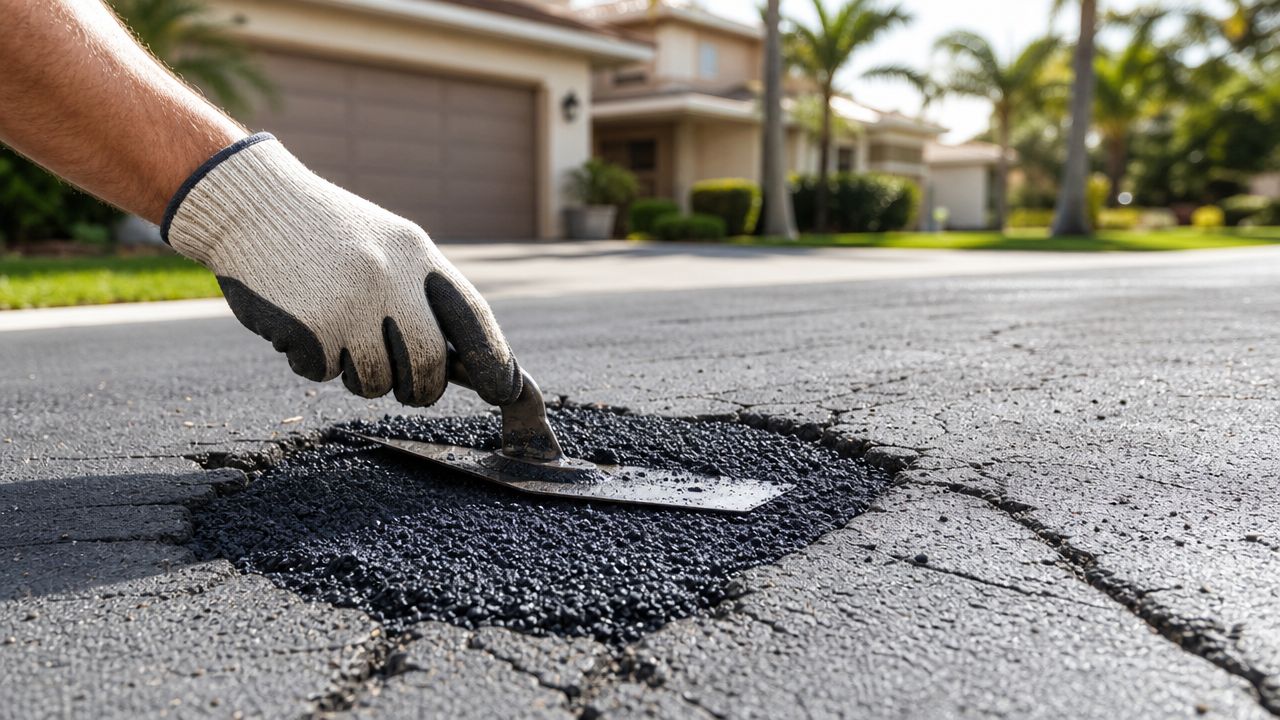
You walk outside after another Florida rain and spot a fresh pothole, a soft low spot, or a cracked area that wasn't there a few months ago. Most property owners in Ocala, Inverness, Crystal River, and nearby communities do what anyone would do. They search for asphalt patch near me and look for the fastest fix.
That makes sense, but speed isn't always the same as the right repair. A patch works well for some problems and wastes money on others. If the surface failed in one isolated spot, patching can buy you useful time. If water has been getting under the pavement or the base has started breaking down, a patch may only cover the symptom.
For homeowners and property managers across Marion County, FL and Citrus County, FL, the essential question isn't just who can fill the hole. It's whether patching is the correct move at all. That's especially true in Central Florida, where heat, rain, and daily traffic can turn a small defect into a recurring repair.
Table of Contents
- How to Tell if Your Driveway Needs an Asphalt Patch
- A Professional's Step-by-Step Asphalt Patching Guide
- Patch, Resurface, or Replace? Making the Right Choice
- How Florida's Climate Impacts Your Asphalt Repair
- When to Call a Professional for Asphalt Patching
- Frequently Asked Questions About Asphalt Repair
How to Tell if Your Driveway Needs an Asphalt Patch
The first step is figuring out whether you're looking at a surface issue or a structural issue. A lot of bad repair decisions happen because people treat every crack, dip, and pothole like the same problem.
What surface damage looks like
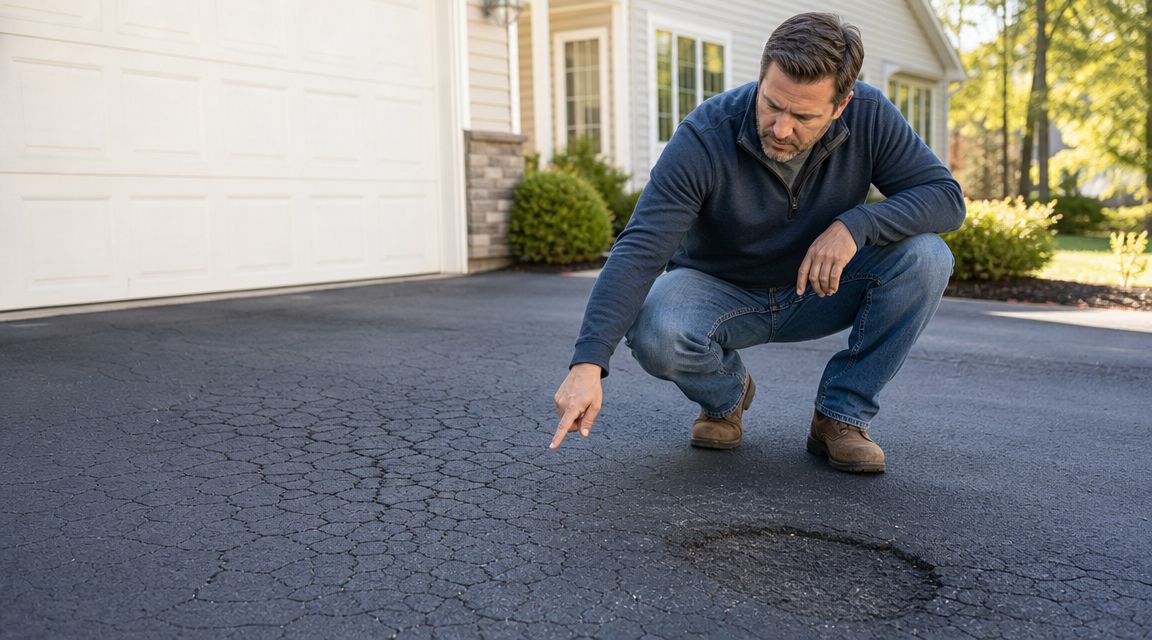
A patch is usually the right conversation when the damage is localized. That means one pothole, one broken corner, one short failed section near the garage apron, or one spot where the asphalt has chipped away and left a void.
Look for these signs:
- A pothole with defined edges that hasn't spread far beyond the immediate area
- A broken section after standing water where the surrounding pavement still feels firm
- A small failed area inside otherwise solid pavement
- A void deeper than a simple crack, where filler alone won't hold
By contrast, a long narrow crack is usually a crack-sealing issue, not a patching issue. If the pavement is still intact and the crack hasn't turned into missing material, you're generally trying to keep water out, not rebuild a failed area.
If you're unsure whether you're seeing early crack-related failure, this guide on why a driveway starts cracking helps separate cosmetic cracking from the kind of damage that keeps spreading.
What points to deeper failure
Some patterns tell you the problem is below the surface. The classic one is alligator cracking, where the asphalt breaks into small connected pieces. Once you see that pattern, the surface has usually lost support. Patching one loose spot in the middle may not solve much if the surrounding area is already weak.
Watch for these red flags:
- The spot feels soft underfoot or under a tire. That usually means the base has been compromised.
- Water sits in a dip after rain. A bird bath often means water is working into the pavement and below it.
- The same place keeps breaking apart. Repeated failure usually means the first repair didn't address the underlying cause.
- The edges crumble when you poke them. Solid asphalt should have defined, stable edges around the damaged area.
Practical rule: If the asphalt around the hole is loose, web-cracked, or pumping moisture, don't assume a simple fill-and-go patch will last.
That's the difference a property manager in Belleview or Beverly Hills needs to understand before calling anyone out. The right answer isn't always patch it now. Sometimes it's seal the crack. Sometimes it's cut out the failed section. Sometimes it's time to stop patching and plan a larger repair.
A Professional's Step-by-Step Asphalt Patching Guide
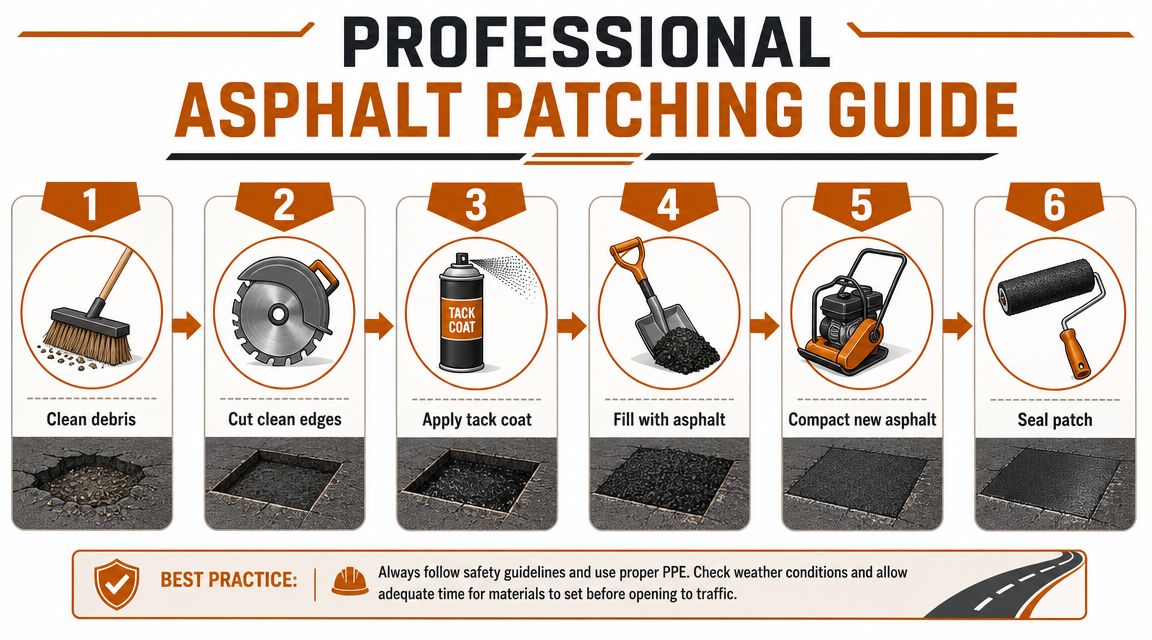
A durable patch isn't just asphalt dumped in a hole and tamped flat. The repair has to bond to solid edges, sit on stable support, and get compacted correctly. If any of those steps get skipped, the patch usually fails at the seams.
Here's the process worth expecting from a real repair.
Step one starts before any mix goes down
The damaged area should be cleaned out completely. Loose asphalt, dirt, leaves, and standing water all interfere with bonding. If a contractor patches over contamination, the patch is already compromised.
Then the repair area needs to be cut back to sound edges. Its importance should not be underestimated. The patch has to tie into pavement that still has strength. According to the NJDOT pothole repair guidance, a reliable repair should be cut back to sound edges and placed in incremental lifts of about 1 inch each, with each lift thoroughly compacted before the next.
If the base underneath is weak, it needs rebuilding with compacted crushed stone in thin lifts before asphalt goes in. A patch placed over a weak base is just a lid over a problem.
For readers comparing repair materials, this breakdown of what hot mix asphalt is gives useful context on why professional patches often hold up better than quick bagged repairs.
A quick visual helps if you want to see the sequence in action:
Why lifts and compaction matter
Professionals don't fill a deep pothole in one load unless the repair depth allows for it. Deep repairs should be built in about 1-inch lifts, compacting each layer before the next goes in. That keeps the material dense and reduces voids where water can work back in.
The field steps are straightforward:
- Clean the cavity: Remove loose material and water.
- Square the repair: Cut the perimeter to solid pavement.
- Stabilize the base: Add and compact stone if support is missing.
- Place asphalt in lifts: Build the patch in manageable layers.
- Compact every lift: Use proper equipment, not just foot pressure.
- Seal the edges: Help keep water from sneaking in at the joint.
A patch usually fails from the edge first, not the middle.
Compaction is where a lot of DIY repairs fall short. The asphalt might look level on top, but if it isn't dense enough internally, tires and rain will find the weakness fast. Good crews pay attention to lift thickness, edge contact, and final surface tie-in so the patch becomes part of the pavement instead of a plug sitting inside it.
That standard applies whether the repair is on a residential driveway in Summerfield, a church lane in Silver Springs, or a small parking area in Inverness.
Patch, Resurface, or Replace? Making the Right Choice
Most bad asphalt decisions come from using the cheapest visible fix instead of the correct one. Patching has a place, but it's only one tool.
A practical rule from the field is simple. Patching is a short-term fix for localized failures. Broader issues like extensive cracking or base problems often require a more complete solution, as noted in this discussion of matching asphalt repair to the actual distress.
A simple way to decide
If the damage is isolated, patching makes sense. If the surface is aging broadly but still stable, resurfacing may make more sense. If the foundation is failing, replacement is usually the honest answer.
| Repair Method | Best For | Cost | Lifespan |
|---|---|---|---|
| Crack sealing | Individual cracks where pavement is still intact | Lower-cost maintenance compared with patching or replacement | Preventive maintenance when done before water intrusion worsens damage |
| Asphalt patching | Localized potholes, broken corners, isolated failed sections | Small patch jobs are often priced as maintenance work | Short-term repair for localized failure |
| Resurfacing | Widespread surface wear where the structure below is still sound | Higher than patching, lower than full replacement in many cases | Better fit when the top surface is tired but the base is still holding |
| Full replacement | Base failure, extensive alligator cracking, recurring soft spots | Highest upfront cost | Longest-term correction when underlying support is the problem |
A few examples make it clearer:
- One pothole near the end of a driveway in Dunnellon: usually a patching conversation.
- Several long open cracks across an otherwise firm surface in The Villages: often maintenance first, not patching.
- A driveway in Crystal River with dips, ponding water, and widespread breakup: patching may only delay the inevitable.
- A section near the street that keeps sinking: likely base trouble, not just surface distress.
Repeated patching in the same spot often costs more than one correct repair.
That's the decision many contractor pages skip. They'll gladly sell a patch. A better approach is to ask whether the surrounding asphalt still has enough life to justify one.
How Florida's Climate Impacts Your Asphalt Repair
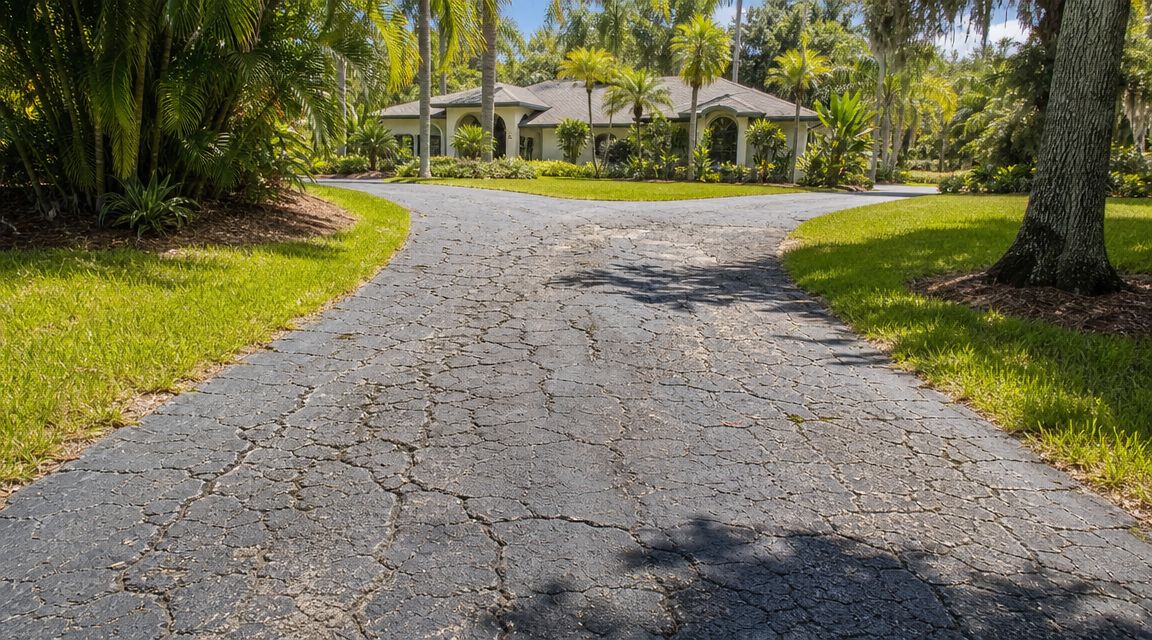
Central Florida pavement takes a beating even without snow and ice. The combination of heat, UV exposure, heavy rain, and daily traffic creates a different kind of wear pattern than colder states.
Heat and rain work together
Strong sun dries and oxidizes asphalt over time. As the surface ages, it gets more brittle. Brittle pavement cracks more easily, especially in driveways that see turning tires, parked vehicles, and edge stress.
Rain does the next round of damage. Once water gets through cracks or around failed patch edges, it starts weakening the material below. That's why a small defect in Ocala or Hernando can grow faster than many owners expect during a wet season.
The local maintenance answer isn't just reacting to potholes. It's protecting the surface before water starts working underneath. If you're planning routine upkeep, this article on the best time to seal an asphalt driveway is worth reading.
In places like Homosassa, Lecanto, and Beverly Hills, drainage matters just as much as the patch itself. If runoff crosses the driveway, collects in a low spot, or drains toward the edge, the repair has to address that condition or the same area often fails again.
Concrete and Asphalt Experts in Marion and Citrus County see this all the time. The visible hole is only half the job. The water path is the other half.
When to Call a Professional for Asphalt Patching
Some repairs are reasonable for a handy homeowner. Others need saws, plate compactors, proper mix, and a trained eye. Knowing the difference saves money.
Where DIY makes sense and where it doesn't
A bagged cold patch can help when you need a temporary repair on a small spot and want to stop the damage from spreading. Quikrete's cold patch guidance says the material is typically applied at a depth of 1 to 3 inches, in 1-inch lifts if deeper, and it can be driven on immediately after compaction. The same product sheet also notes that its cold patch contains more than 90% recycled asphalt pavement, which makes it a practical option for routine pothole repair with a material-efficiency benefit, according to the Quikrete asphalt cold patch data sheet.
That said, temporary and durable are not the same thing.
Professional hot-patch work usually makes more sense when:
- The hole is deeper or wider than it looks
- The edges need cutting back to solid pavement
- The area has traffic every day
- The same spot has already been patched once
- Drainage or soft base material is involved
What a contractor should bring to the job
Cost matters, but the cheapest line item isn't always the lowest-cost decision. HomeGuide reports asphalt repairs typically cost $250 to $800, with hot-patch repairs around $2 to $5 per square foot, cold-mix patching at $2 to $4 per square foot, and an added service fee of $100 to $250 on some jobs. For larger damaged areas, HomeAdvisor data cited there shows most homeowners pay $1,070 to $4,020, with an average of $2,468, according to this asphalt repair cost guide.
Those numbers explain why many owners in Belleview or Lecanto first ask for a patch instead of replacement. Sometimes that's the right move. Sometimes it's just the less expensive first step on the way to the repair that should've been done from the start.
Licensed and insured contractors should be able to explain what failed, how they'll prep it, and whether the repair is expected to be temporary or more permanent. For owners who want a local evaluation, Riverside Sealing & Striping, LLC handles both asphalt maintenance and concrete work in Central Florida, which helps when a driveway has mixed issues at transitions, aprons, sidewalks, or adjacent slabs.
A no-pressure site visit is the best way to separate a small maintenance patch from a larger pavement problem.
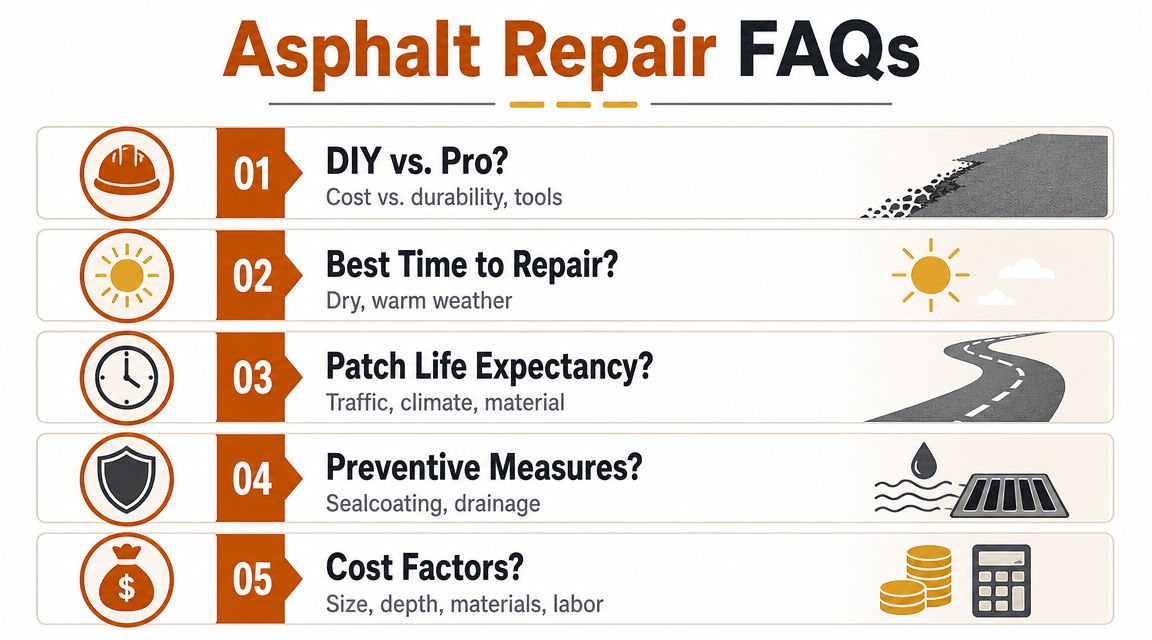
Frequently Asked Questions About Asphalt Repair
Some questions come up on almost every estimate, especially from homeowners trying to decide whether they can buy time with a patch or need to plan bigger work.
What hot mix and cold mix really mean
What's the difference between hot mix and cold mix asphalt patch?
Hot mix is usually the stronger professional repair material because it's placed and compacted as a heated asphalt mix. Cold mix is more convenient for smaller or temporary repairs and is often used when speed and accessibility matter more than long-term performance.
How long before I can drive on a patch?
That depends on the material and how the repair was done. Quikrete states its cold patch can be driven on immediately after compaction, as noted earlier. Professional crews will usually give site-specific instructions based on the mix, weather, and traffic pattern.
Field note: The patch that looks finished first isn't always the patch that was compacted well enough to last.
Questions property owners ask right away
Can a patch be installed on a slope?
Yes, but slope changes the challenge. The mix has to stay in place during placement, and the crew needs solid edge prep and proper compaction so the repair doesn't shove or ravel under traffic.
Why do some patches fail so quickly?
Most early failures come from poor prep, weak edges, water left in the repair, or bad compaction. Asphalt Magazine notes that dense-graded lifts should be at least 4 times the nominal maximum aggregate size, and that each additional 1% density can add about 10% service life, which is why compaction is so important in patching work, according to this explanation of asphalt lift thickness and density.
Is patching enough if my driveway has a lot of cracks?
Not always. If the cracks are isolated and the pavement is still sound, maintenance may be enough. If the area is broken across a wide section or the base has started failing, a patch may only delay more serious work.
Does this apply only to homeowners?
No. The National Asphalt Pavement Association says asphalt pavement supports about 4 million jobs, and another 63 million jobs depend on reliable roads and pavements. That scale, cited in the same practical discussion referenced earlier, shows why patching matters for homes, shopping centers, churches, HOAs, and small commercial properties alike.
If you're in Ocala, Dunnellon, Summerfield, Inverness, Crystal River, or nearby parts of Marion County and Citrus County, the right first step is a real evaluation of the damaged area, not just a fast quote to fill a hole. Riverside Sealing & Striping, LLC provides free, no-pressure consultations for asphalt maintenance and concrete work, so you can find out whether a patch is the right fix, or whether a more durable repair will save you money over time.