
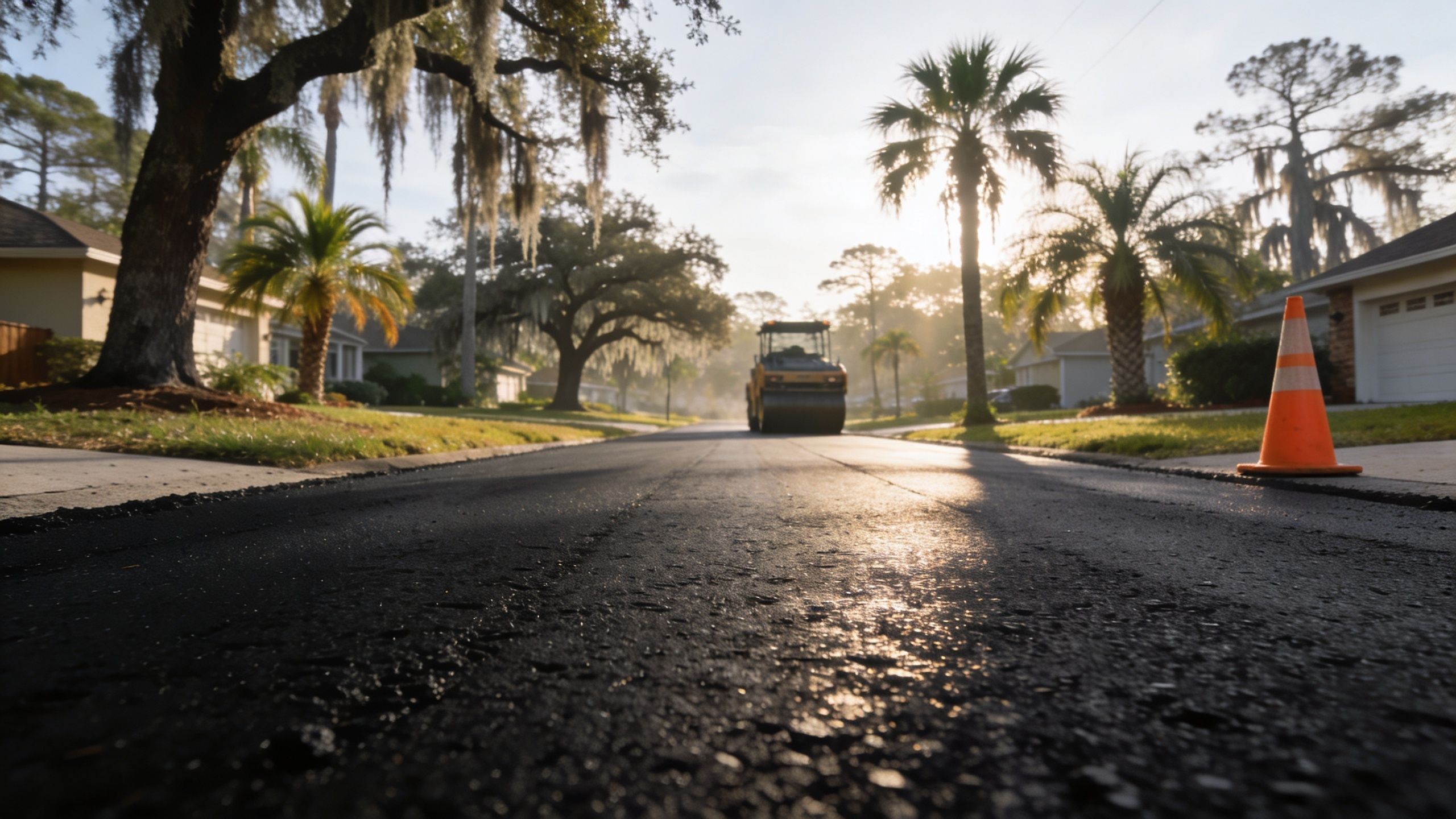
A lot of Deltona property owners start looking into asphalt paving after the same moment. You pull in after a hot afternoon, see fading, cracks, loose edges, or shallow low spots holding water, and realize the surface isn’t just ugly anymore. It’s starting to affect drainage, curb appeal, and how the property functions day to day.
That’s where local context matters. Asphalt paving in Deltona isn’t the same as paving in a mild, dry climate. Central Florida heat, UV exposure, humidity, and heavy rain change how asphalt ages, how repairs should be planned, and when maintenance should happen. The right solution for a driveway in Deltona may be different from what works in Ocala, Summerfield, or a commercial lot serving steady traffic near The Villages.
Property owners also need straight answers, not vague sales language. Sometimes a surface needs full replacement. Sometimes an overlay is the smart move. Sometimes sealcoating and striping are enough. And in some cases, concrete is the better long-term fit for part of the project, especially for sidewalks, patios, or certain driveway layouts.
Your Guide to Asphalt Paving in Deltona
A worn asphalt surface in Deltona usually tells its story clearly. The color turns from deep black to dull gray. Fine cracks widen. The edge starts to break where tires roll off the side. In parking lots, striping fades until drivers guess where to park. On driveways, water starts sitting where it used to run off.

That kind of wear makes people search for asphalt paving in Deltona because they want a fix that lasts, not a short-lived patch. The challenge is that many online guides stay generic. They don’t account for Florida weather, subgrade moisture, drainage demands, or the practical difference between a residential driveway and a commercial lot.
For property owners in Central Florida, that gap matters. A driveway in Deltona faces many of the same climate pressures seen across Marion County, FL and Citrus County, FL, including places like Dunnellon, Belleview, Silver Springs, Crystal River, Homosassa, Inverness, Lecanto, Beverly Hills, Hernando, and Ocala. The advice has to fit local conditions, not just national averages.
Good asphalt work starts before the first load is dumped. Drainage, base condition, and edge support decide whether the surface stays smooth or starts failing early.
If you’re comparing options, reviewing bids, or trying to understand whether repair or replacement makes more sense, this guide gives you the practical side of the job. For a broader look at professional Florida asphalt paving services, it helps to understand what the work includes and what separates a durable result from a cosmetic one.
Paving Services Explained Beyond Simple Blacktop
“Asphalt paving” sounds simple, but it covers several different services. Property owners often use one term for everything, even though new installation, overlay work, and sealcoating solve very different problems.
New asphalt installation
New installation is the full-build option. It’s used when the old pavement has failed beyond practical repair, when a site is being developed from scratch, or when the base under the asphalt is unstable and has to be rebuilt correctly.
That’s the most involved version of the work because it includes excavation, grading, base preparation, and new asphalt placement. If the foundation is weak, putting fresh asphalt on top won’t solve the problem. It only hides it for a while.
Overlay or resurfacing
An overlay is often the right middle-ground solution. The existing asphalt stays in place if it’s structurally sound enough to support a new surface, but problem areas still need to be repaired first. An overlay can improve appearance, restore ride quality, and extend service life without the cost and disruption of a total rebuild.
It isn’t a cure-all. If the pavement has widespread base failure, major movement, or serious drainage problems, resurfacing over it usually leads to the same issues showing back up through the new layer.
Sealcoating and maintenance
Sealcoating is preventive maintenance, not structural repair. It protects the surface layer from weathering and helps maintain a cleaner, more uniform finish. It works best on asphalt that still has good structure and has been kept ahead of major cracking.
By the time deep cracks, alligator cracking, or unstable edges are widespread, sealcoating alone won’t save the pavement.
Practical rule: If the problem is in the base, surface treatments won’t fix it. If the structure is still sound, maintenance is often the cheapest way to avoid bigger work later.
Why asphalt remains the standard choice
Asphalt became the dominant paving material long ago. By 1937, approximately 80% of all roads in the United States were blacktop, and the 1956 Interstate Highways Act committed $51 billion to new roads nationwide, helping shape the transportation network that supported growth in places like Central Florida, as noted in this history of asphalt paving in the United States.
That history matters because it explains why asphalt is still the standard choice for so many driveways, roads, and parking lots. It’s proven, serviceable, and adaptable.
When concrete is the better answer
Not every surface should be asphalt. Some projects are better served by concrete, especially where a property owner wants a different finish, firmer edges, or a slab application such as:
- Patios and walkways: Concrete often gives more finish options and cleaner borders.
- Sidewalk sections: Concrete is common where shape control and accessibility details matter.
- Driveway combinations: Some homes use asphalt for the main run and concrete for aprons, sidewalks, or entry features.
That’s why the best contractor conversation doesn’t start with “Which product can I sell?” It starts with “What is this surface supposed to do?”
The Asphalt Paving Process From Start to Finish
A professional paving job should feel organized, not mysterious. If a contractor can’t explain the process clearly, that’s a warning sign. Good asphalt paving in Deltona follows a sequence, and each step affects the next one.
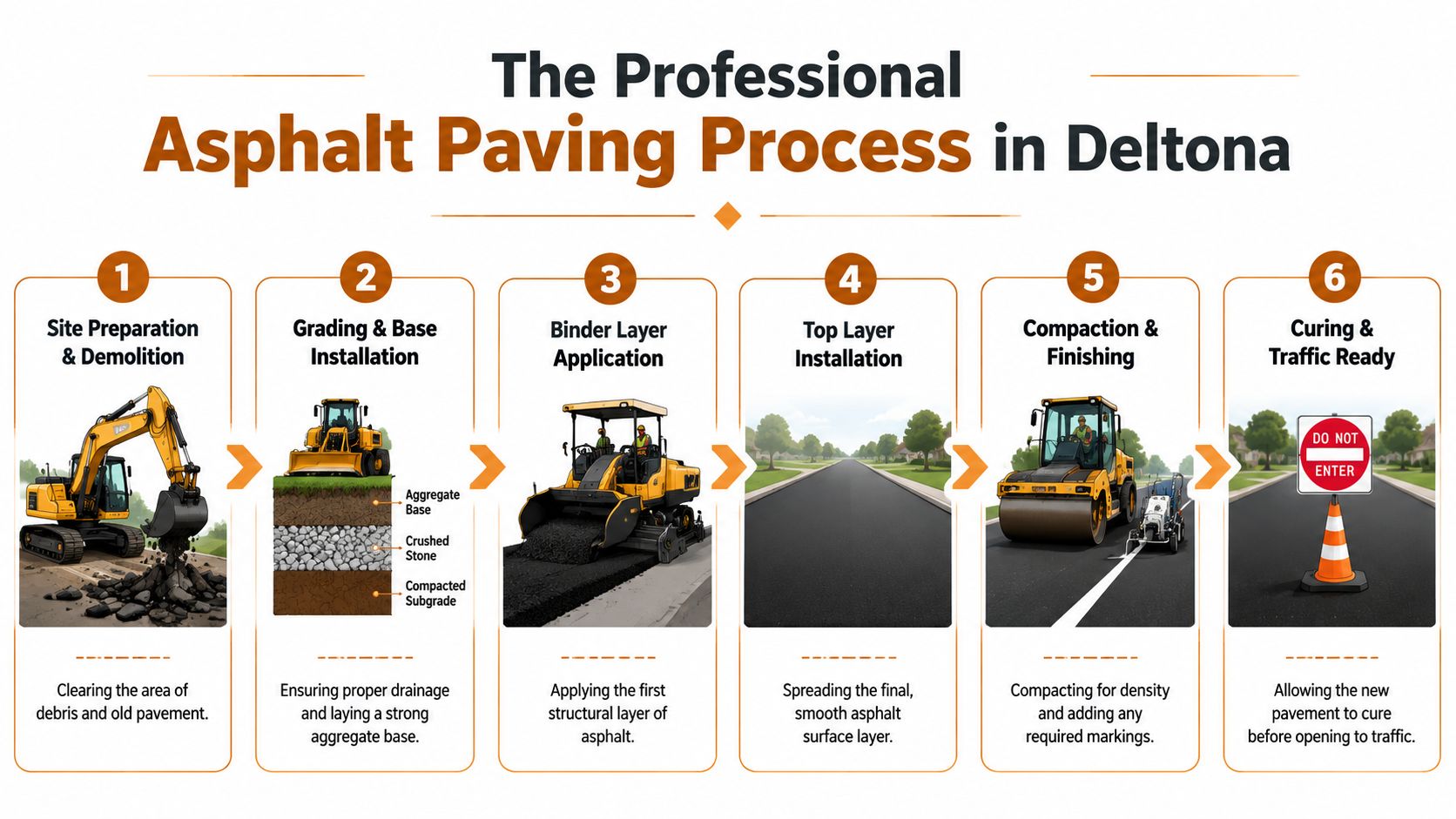
To make the flow easier to visualize, this graphic breaks down the job from site prep to opening the pavement for use.
Site evaluation and planning
Every solid job starts with measuring the site and reading the surface. Contractors should check drainage patterns, existing asphalt thickness, edge condition, soft spots, and how traffic uses the area. A residential driveway and a church parking lot don’t need the same design approach.
This is also where practical details get decided. Will the old asphalt be removed or reused as a base? Are there low areas trapping water? Will concrete tie-ins be needed near sidewalks, aprons, or ramps?
Demolition and subgrade prep
If the existing pavement is too far gone, removal comes first. That includes tearing out failed asphalt, hauling off debris, and exposing the underlying subgrade or base. A surface is only as reliable as what’s underneath it.
Soft or unstable areas have to be corrected before new material goes down. Skipping that step is one of the fastest ways to end up with settling, cracking, and premature failure.
Base installation and grading
The aggregate base carries the load. It also helps the finished asphalt maintain shape under traffic and weather. Contractors grade the base to control water movement and create a stable platform before paving starts.
A driveway can look smooth on day one and still be headed toward trouble if the grade is wrong. In Deltona, where heavy rains can test drainage quickly, base work is not the place to cut corners.
For a quick visual explanation of how professional crews handle the paving sequence, this video is useful:
Asphalt placement and compaction
Once the site is ready, the asphalt is placed and compacted while it’s still workable. For residential driveways in Deltona’s climate, best-practice design calls for a minimum compacted lift thickness of about 1 to 1.5 inches. Below 1 inch, the mix can fail under vehicle loads, while a 1.5-inch overlay provides adequate strength and durability for Florida’s high-temperature conditions, aligning with FDOT standards in this Florida specification reference.
That point gets missed in low-price bids. Thin asphalt may look acceptable right after installation, but it doesn’t hold up the same way under regular vehicle traffic.
Final details and curing
After compaction, crews clean transitions, check edges, and verify the finish is consistent. On commercial work, striping and markings may follow after the surface is ready. On residential work, the focus is usually on clean lines, proper tie-ins, and making sure runoff moves where it should.
A typical professional sequence looks like this:
- Inspect the site and confirm the scope
- Remove failed material and correct weak areas
- Grade and compact the aggregate base
- Place the asphalt at the right thickness
- Compact for density and finish the edges
- Allow curing before regular traffic use
Thin asphalt is one of the most expensive “savings” in paving. It lowers the bid fast, then raises the repair bill later.
Budgeting for Your Deltona Paving Project
Most property owners want a number first. That’s understandable, but paving prices depend heavily on what the site needs before the asphalt work even begins. A simple resurfacing job and a failed driveway rebuild might look similar from the street while carrying very different scopes.
Because the verified data provided for this article doesn’t include local pricing figures, the most accurate way to think about budgeting is by service category and cost drivers, not invented averages. Any article that gives exact local square-foot pricing without a documented source should be treated carefully.
Estimated Cost for Asphalt Services in Central Florida (2026)
| Service Type | Estimated Cost per Square Foot |
|---|---|
| New asphalt installation | Custom quote based on site conditions |
| Asphalt overlay or resurfacing | Custom quote based on existing pavement condition |
| Professional sealcoating | Custom quote based on surface size and prep needs |
If you want a more detailed breakdown of how contractors approach asphalt sealcoating cost per square foot, the key is understanding what goes into the number rather than chasing a generic online estimate.
What changes the final price
Some cost factors are obvious. Others are buried in the prep work.
- Existing condition: A surface with base failure, standing water, or widespread breakup costs more than one that only needs surface restoration.
- Project size and layout: Larger areas can be more efficient, while tight driveways, odd shapes, and islands add labor.
- Access to the site: Equipment access matters. A clean, open parking lot is easier to pave than a narrow residential area with obstacles.
- Drainage corrections: If water is draining poorly, the contractor may need to regrade or rebuild sections before paving.
- Transitions and tie-ins: Aprons, sidewalks, curbs, ramps, and garage thresholds all affect the labor involved.
How to read a paving estimate
A good estimate should tell you what’s included. Look for scope details, not just a total number.
Ask whether the quote includes removal, base repair, edge support, crack repair, grading, cleanup, and striping if needed. The cheapest bid often leaves out the work that keeps the asphalt performing well.
If two paving estimates are far apart, the first thing to compare isn’t the price. It’s the prep.
For Deltona property owners, the safest approach is a site-specific inspection. That’s what reveals whether you need a maintenance plan, an overlay, or a full rebuild.
Florida-Specific Paving Challenges and Solutions
Florida weather changes how asphalt behaves. The same surface that might hold up reasonably well in a cooler, drier region can deteriorate much faster in Deltona if it isn’t built and maintained with local conditions in mind.
That’s one reason generic online advice often falls short for asphalt paving in Deltona, as well as nearby communities across Marion County, FL and Citrus County, FL such as Lecanto, Beverly Hills, Homosassa, and Inverness.
Heat and UV wear the surface differently
Strong sun doesn’t just make asphalt hot. It also dries and oxidizes the binder over time, which is why older pavement turns gray and brittle. Once that happens, the surface becomes more vulnerable to cracking and raveling.
That’s why appearance matters more than many owners think. Fading is often an early sign that the surface is losing protection.
Rain exposes drainage mistakes fast
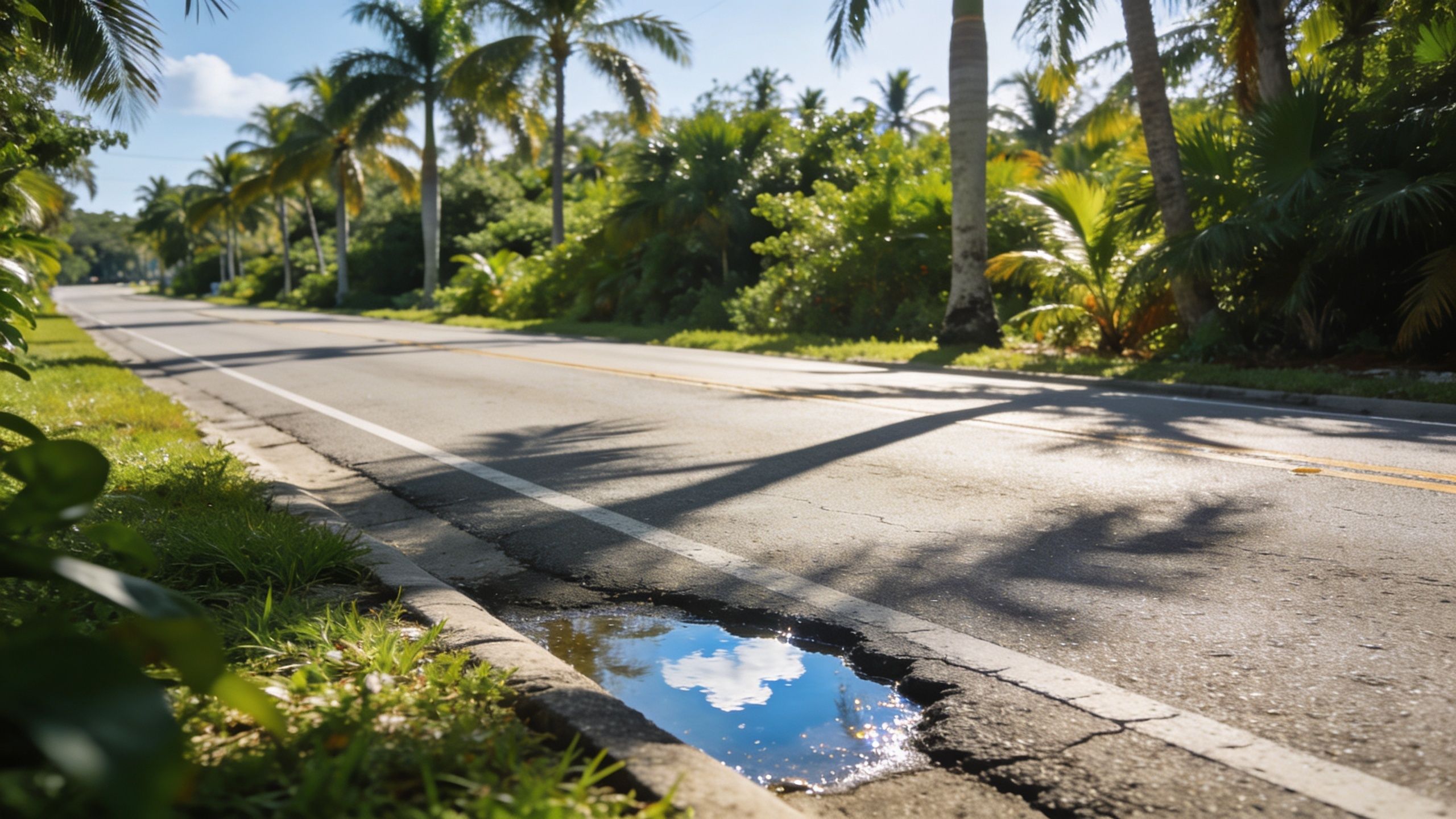
Heavy rain is hard on weak spots. If water sits on the surface or seeps into open cracks, it can soften support layers and widen small failures into bigger repairs. Deltona lots and driveways need proper grade, edge support, and ongoing crack management to keep water moving away instead of down into the structure.
Humidity also affects maintenance timing. Sealcoating and similar treatments need the right weather window to cure properly.
Generic schedules don’t fit Central Florida
Generic advice often suggests resealing every 2 to 3 years, but that doesn’t account for Central Florida’s subtropical climate, where high humidity, intense UV exposure, and frequent heavy rain can accelerate asphalt degradation, as discussed in this asphalt maintenance guidance. In practice, pavement here often needs a more customized maintenance schedule.
That doesn’t mean every property should follow the same shorter cycle. It means owners should make maintenance decisions based on exposure, traffic, drainage, and current surface condition.
What works better in this climate
The better approach is local and practical:
- Watch the color and texture: A dull, drying surface needs attention sooner than a dense, healthy-looking one.
- Repair cracks before rainy periods: Open cracks invite water into the structure.
- Protect high-exposure areas: Entrances, turn areas, and open sun-facing sections usually age faster.
- Choose the right season for maintenance: Application timing matters when humidity and storms are part of the equation.
Pavement in Central Florida rarely fails from one big event alone. Most of the damage comes from heat, water, and delayed maintenance working together.
For homes in Summerfield or Ocala and commercial properties in Crystal River or Hernando, local observation beats a canned schedule every time.
Commercial Paving ADA Compliance and Maintenance
Commercial paving has a second layer of responsibility that residential jobs usually don’t. The asphalt has to hold traffic and look professional, but it also has to support safe access, clear circulation, and compliant markings.
That’s where many property owners separate pavement work from striping work when they should be planning both together. A freshly sealed lot with poor markings is still a problem. A newly striped lot on a failing surface won’t stay sharp for long either.

Why property managers need an integrated plan
Many paving guides miss a critical risk for commercial properties. Non-compliant parking lots expose property managers in Deltona to significant ADA-related lawsuits, and an integrated plan that includes protective sealcoating plus precise, compliant striping is an important risk-reduction strategy, as explained in this commercial paving and compliance discussion.
For churches, retail centers, HOAs, schools, and office properties, that means maintenance planning should include more than pavement condition alone.
What should be reviewed on a commercial lot
A useful lot review typically includes these items:
- Accessible parking spaces: Markings need to be visible, correctly placed, and coordinated with access routes.
- Directional control: Arrows, lane markings, and traffic flow indicators should be easy to read.
- Fire lanes and no-parking zones: These areas need clear striping and durable visibility.
- Pedestrian areas: Crosswalks, ramps, and transitions should connect safely.
- Surface condition under markings: Striping performs better on pavement that has been properly maintained.
Property managers looking at compliance details should review current ADA handicap parking space requirements as part of their maintenance planning.
Where concrete and asphalt work together
Commercial sites often need both materials. Asphalt may be right for the lot itself, while concrete is often used for sidewalks, ramps, pads, and other site features where defined edges and durable pedestrian surfaces matter.
That combination is common across Marion County, FL and Citrus County, FL, including shopping centers in Dunnellon, office properties in Inverness, and community facilities around Belleview and The Villages. For those properties, the smartest maintenance plan isn’t asphalt-only. It’s a coordinated surface plan.
A compliant parking lot isn’t just striped correctly. It’s maintained so people can actually use it safely.
Common Questions and Your Free Project Estimate
A few questions come up on almost every paving conversation in Deltona.
How long should I wait before driving on new asphalt
Follow the contractor’s guidance for the specific job and weather conditions. Cure time depends on heat, surface thickness, traffic type, and site exposure. In Florida, hot weather can soften fresh asphalt even when it looks ready, so patience matters.
Is asphalt or concrete better for my driveway
It depends on the layout, usage, and finish you want. Asphalt is a strong choice for many driveways and is widely used for residential paving. Concrete can be the better fit for decorative areas, sidewalks, aprons, or properties that want a different look and edge profile.
Can cracks just be sealed and covered
Sometimes yes, sometimes no. If the cracks are surface-level and the structure underneath is still solid, repair and maintenance may be enough. If the pavement is moving, breaking apart, or failing from the base, covering it won’t solve the underlying problem.
What should I prepare before getting an estimate
Make a list of the issues you’ve noticed. Include drainage problems, crumbling edges, trip hazards, faded striping, and areas where vehicles regularly turn or park. Photos help, but a site visit tells much more.
Asphalt paving in Deltona works best when the decision is based on condition, drainage, traffic, and climate, not guesswork. The same practical approach applies across Ocala, Silver Springs, Lecanto, Beverly Hills, and the rest of Central Florida. Property owners who also need sidewalks, ramps, patios, or slab work should think in terms of the full site, because concrete and asphalt often need to work together.
If you want a no-pressure evaluation of your driveway, parking lot, sidewalk connections, or ADA-related site markings, Riverside Sealing & Striping, LLC offers free estimates and practical guidance as concrete and asphalt experts serving Marion County, Citrus County, and surrounding Central Florida communities.