
If you manage a retail center in Ocala, an HOA in The Villages, a church in Dunnellon, or a medical office in Lecanto, ADA parking usually gets attention only after a complaint, a repaint gone wrong, or a property review turns up obvious problems. The usual pattern is simple. The lot looks fine at a glance, but the details are off. A sign is too low, a van space is striped like a standard space, water ponds in the access aisle, or the route from the stall to the entrance isn’t practical after a heavy Florida rain.
That’s why ada handicap parking space requirements matter so much in Central Florida. Compliance isn’t just about blue paint and a wheelchair symbol. It’s about getting the count right, laying out the space correctly, maintaining a firm and stable surface, and making sure the work still functions after sun, storms, and traffic wear on asphalt and concrete.
Property owners in Marion County and Citrus County also face a practical reality. ADA work often touches more than striping. A lot may need sealcoating, crack repair, concrete sidewalk replacement, curb ramp adjustments, or a fresh layout that matches how the site operates. The best results come from treating parking, pavement, and pedestrian access as one system instead of separate line items.
Navigating ADA Parking Rules in Central Florida
A lot of property managers first encounter ADA issues when someone points out a problem that’s hard to unsee. The accessible stall is there, but the aisle is too tight. The paint has faded so badly in the summer sun that drivers can’t tell where the no-parking hatch area starts. The sign sits behind parked vehicles and disappears from view. In Central Florida, those mistakes show up fast because heat, rain, and frequent traffic expose weak work almost immediately.
The ADA standards give property owners a clear framework, but field conditions make the job harder than many people expect. A parking lot in Crystal River may drain differently than one in Belleview. A church lot in Hernando may only use overflow parking during events. An older plaza in Inverness may have decent asphalt but failing concrete sidewalks leading to the entrance. The striping can’t be treated as a stand-alone fix if the surrounding surface or route doesn’t support safe use.
Where owners usually get tripped up
Most compliance problems come from one of three sources:
- Old layouts that were never updated after restriping, resurfacing, or tenant changes.
- Well-meaning maintenance work that refreshed paint without checking current ADA dimensions and signage placement.
- Surface issues such as settlement, rough asphalt, broken concrete, or drainage problems that make a technically marked space function poorly.
Practical rule: If an accessible space only works on paper, it doesn’t work in the field.
In Marion County and Citrus County, concrete and asphalt work often overlap. A compliant parking area may need fresh striping, but it may also need a stable asphalt surface, repaired curb transitions, or a new concrete sidewalk section to create a usable path from the stall to the building.
What works in real parking lots
The most reliable approach is to start with a site-specific review. Count the total spaces in the facility. Verify how many accessible spaces are required. Confirm which ones must be van-accessible. Then inspect layout, slope, signage, markings, and surface condition as one coordinated system.
That approach saves time, avoids repainting the same lot twice, and helps property owners in places like Ocala, Homosassa, and Summerfield fix the right problem the first time.
Calculating the Required Number of Accessible Spaces
A lot can look freshly striped and still be out of compliance before the first car parks. The count is where that starts. If the property does not have enough accessible spaces, or enough van-accessible spaces, every other measurement in the layout is built on the wrong plan.
The ADA sets the required number of accessible spaces by the total number of parking spaces in the facility, as shown in the ADA National Network’s accessible parking guide. That same guidance explains the van-space rule: at least one of every six accessible spaces, or fraction of six, must be van accessible.
A practical way to calculate the count
Start with the total number of marked spaces in the lot or garage. Match that number to the ADA count table. Then calculate the van-accessible minimum from the accessible-space total, not from the full parking count.
That last step is where crews and maintenance teams get tripped up.
On a small Central Florida property, the mistake usually happens after a resurfacing job. The lot gets restriped fast, someone remembers that one ADA stall is required, and a standard accessible space gets painted without checking whether the single required space also has to serve vans. On larger retail sites, the problem is different. The property may have the right total number of accessible stalls, but too few van spaces because nobody applied the one-in-six ratio before layout started.
In the field, that leads to expensive rework. Signs have to move. Access aisles get shifted. Traffic flow changes. On older lots in Ocala, Dunnellon, and surrounding areas, one correction can force a full restripe of an entire row.
ADA Required Accessible Spaces by Lot Size
| Total Spaces in Lot | Minimum Accessible Spaces | Minimum Van-Accessible Spaces |
|---|---|---|
| 1 to 25 | 1 | 1 |
| 26 to 50 | 2 | 1 |
| 51 to 75 | 3 | 1 |
| 76 to 100 | 4 | 1 |
| 101 to 150 | 5 | 1 |
| 151 to 200 | 6 | 1 |
| 201 to 300 | 7 | 2 |
| 301 to 400 | 8 | 2 |
| 401 to 500 | 9 | 2 |
| 501 to 1000 | 2% of total | At least 1 of every 6 accessible spaces |
| Over 1000 | 20 plus 1 for each 100 or fraction thereafter | At least 1 of every 6 accessible spaces |
Medical properties need a separate check. The ADA has higher parking requirements for certain hospital outpatient facilities and rehabilitation or physical therapy treatment areas, as noted earlier. Property managers should confirm the use category before approving a striping plan, because the standard parking table may not apply.
Central Florida adds another layer to the counting process. Sun-faded striping can make old stall lines hard to read, and after a few restripes, the visible count in the field is not always the legal count on the plan. We run into that often on lots that have been patched, widened, or reconfigured over time. The right approach is to verify the current space count on site, confirm the use type, then lay out the accessible and van-accessible spaces before any paint goes down.
That is how Riverside handles it. We do not just repaint what was there last year. We verify the count, map the required stalls, and build the layout around actual compliance so property owners avoid failed inspections, tenant complaints, and having to pay for the same lot twice.
The Anatomy of a Compliant Parking Space
A lot can look ADA-ready from the drive aisle and still fail the moment someone opens a wheelchair ramp in a Florida downpour. We see that on Central Florida properties all the time. The stall is painted blue, the sign is up, but the aisle is too tight, the cross-slope is off, or water runs straight through the loading area.
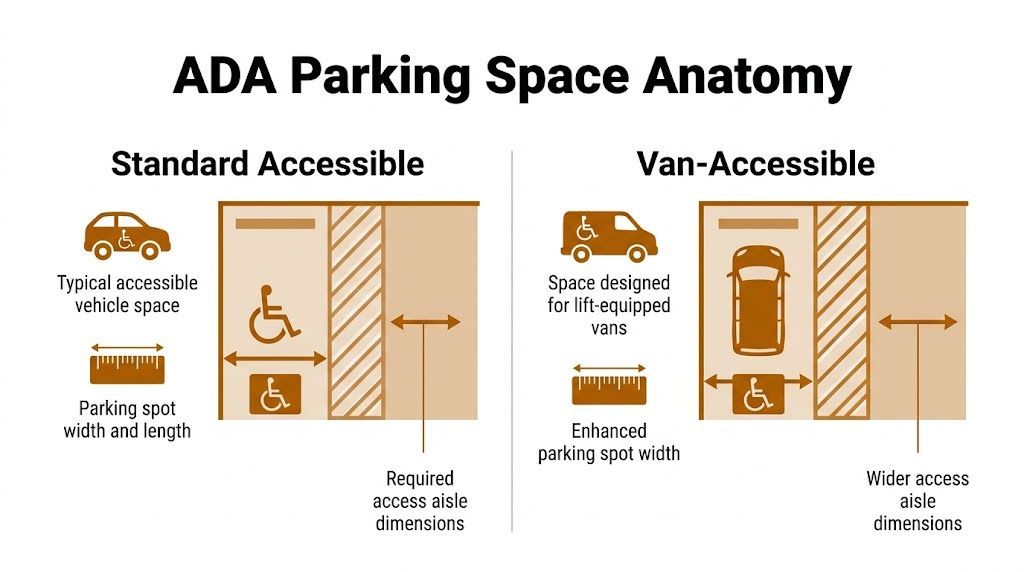
Standard accessible spaces
A compliant accessible space starts with width, aisle placement, and usable pavement. For a standard car-accessible stall, the parking space and adjacent access aisle have to be laid out to current ADA dimensions, as noted earlier. On paper that sounds straightforward. In the field, older striping, patched asphalt, and years of minor layout changes are what throw the job off.
One common problem is line creep. After multiple restripes, each pass borrows a little space from the aisle or the stall. The lot still looks organized, but the accessible area no longer works the way it should. That is why our crews measure from fixed site points and build a fresh layout instead of tracing faded lines. Property managers planning a restripe can see how that process works in our guide on how to stripe a parking lot correctly.
Van-accessible spaces
Van-accessible stalls need a larger operating area because people may be using side-entry vans, lifts, or wider mobility equipment. The ADA allows two compliant van-space layouts, as noted earlier. The right one depends on the shape of the parking field, nearby traffic movement, and how cleanly the access aisle connects to the pedestrian route.
Close enough is not compliant here. A van aisle is the space that makes unloading and transfer possible. If a restripe squeezes that area to preserve one extra standard stall, the property owner takes on the risk and usually ends up paying to redo the work.
Slope and drainage have to work together
In Central Florida, many lots often encounter problems. Accessible spaces and access aisles must stay within the allowed slope, but the lot still has to drain after heavy rain. If the asphalt crew uses the ADA stall as part of the drainage strategy, water ponds in the hatch marks, crosses the route, and creates a safety problem even if the dimensions are correct.
That trade-off has to be handled before paint goes down. On resurfacing jobs, we check grades first, then confirm where the accessible spaces can perform well. In some cases, the best answer is not repainting the old location. It is shifting the stall to a flatter area, correcting transitions at the sidewalk, or coordinating asphalt repair before striping starts.
Clearance and layout choices
Covered parking, porte-cocheres, garages, and low overhangs need another check. Van-accessible spaces require enough vertical clearance for the vehicle route and parking area. Miss that detail, and the stall may meet the striping layout while still being unusable for the drivers it is meant to serve.
The best ADA layouts usually share a few traits:
- Straightforward access: The stall and aisle connect cleanly to the accessible route and nearest entrance.
- Stable edges and transitions: No broken pavement, abrupt lips, or crumbling asphalt at the aisle.
- Controlled drainage: Water moves away without crossing the loading area.
- Clear geometry: Drivers can read the stall and no-parking zone quickly, even after weather exposure.
That last point matters more in Central Florida than many owners expect. Sun fades paint fast, and once markings start to wash out, drivers drift into the aisle or park on the hatch marks. Riverside handles the full correction. We assess slope, pavement condition, and layout together so the finished space is compliant on day one and still readable after a season of heat and storms.
Proper Signage, Markings, and Surface Integrity
A stall can be the right size and still fail in the field. We see it all the time in Central Florida. The sign is hidden behind a pickup, the hatch marks are chalked out by sun and traffic, or the accessible route starts in a puddle after a hard afternoon rain.
Sign height and visibility
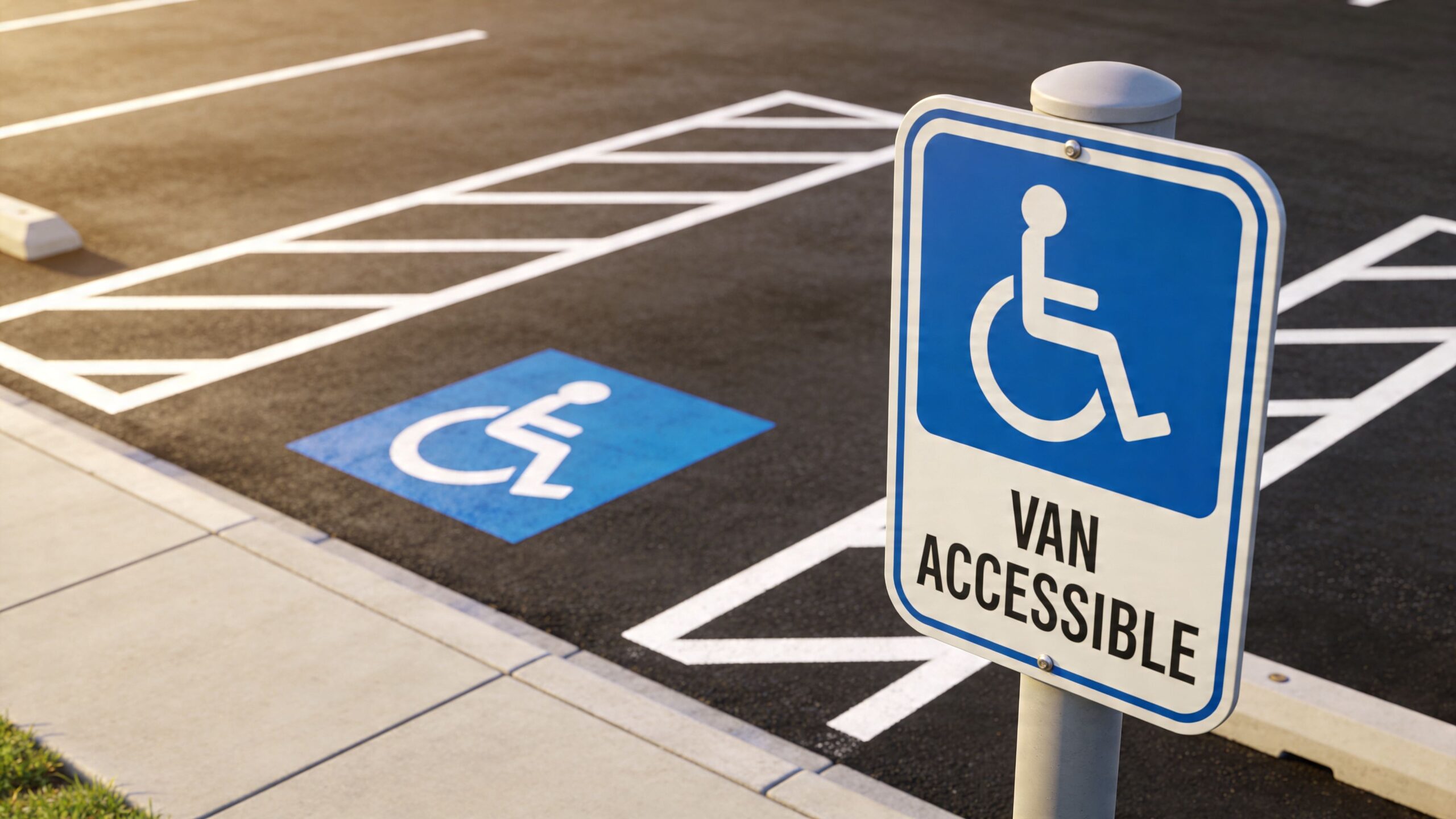
Accessible parking signs need to be mounted high enough to stay visible over parked vehicles. If the post is too low, drivers may miss the designation until they are already pulling in. That creates enforcement problems and complaints, especially at busy retail centers, churches, schools, and medical offices.
Sign placement also needs a field check after milling, paving, or sidewalk work. A lot can change elevation during resurfacing, and an older sign that was acceptable before can end up too low or slightly out of position. We verify sign location as part of layout so the stall reads clearly from the drive aisle, not just on paper.
Markings that stay readable in Florida weather
The painted wheelchair symbol, stall lines, and diagonal access aisle markings do more than identify the space. They control driver behavior. If the no-parking area is faded, drivers cut into it. If old stripes are still ghosting through the new layout, drivers hesitate or park crooked. That is how a compliant design turns into a daily problem.
Central Florida is hard on pavement markings. UV exposure burns color out fast, and heavy rain exposes every low spot in the front row. Water sitting across an access aisle reduces visibility, tracks dirt over the paint, and shortens the life of the surface underneath. Good ADA work has to account for all of that the first time.
Property managers who want a better sense of the process can review this guide on how to stripe a parking lot correctly. The sequence matters. Surface prep, layout control, and clean paint application all affect how long the markings stay clear.
Surface integrity affects compliance and service life
ADA parking needs a stable, slip-resistant surface in usable condition. In practice, that means cracked asphalt, loose aggregate, rutting, and broken concrete at the aisle or route cannot be treated as cosmetic issues. They affect how safely the space works.
Fresh blue paint over failed pavement does not hold up for long.
That is why we do not treat ADA compliance as a striping-only job. On many Central Florida properties, the right order is asphalt repair first, then sealcoating where it makes sense, then final striping and signage. That approach costs more upfront than a quick repaint, but it usually costs less than coming back after the next rainy season to fix ponding, peeling paint, and driver confusion.
A short visual helps show how signage and stall identification work together in the field.
Florida-Specific Rules and Special Use Cases
A lot can look compliant on a dry afternoon and fail the first hard summer storm. That is the Central Florida wrinkle property managers run into on overflow lots, medical sites, older plazas, and any property where the parking layout grew in phases instead of being planned all at once.
The trouble usually starts with conditions that are easy to underestimate. Paint fades fast under Florida sun. Rain exposes low spots that were not obvious during a quick site walk. Grass or gravel overflow areas may seem workable for occasional events, then turn soft and hard to use after a downpour. ADA compliance still has to work under those conditions, not just on paper.
Medical uses need a closer layout review
Healthcare properties often need more accessible parking than a standard office or retail site. The exact count depends on the use, so medical campuses, outpatient areas, and therapy-related facilities should be reviewed carefully before anyone restripes a row and calls it done.
On these jobs, the trade-off is usually between stall count and function. Owners want to preserve parking capacity. Patients need wider loading room, a clear access aisle, and a route that does not force them into drive lanes or awkward sidewalk transitions. On older sites in Ocala, Lecanto, and similar markets, that often means reworking part of the layout rather than repainting existing stalls.
Temporary and unpaved lots still have to function
Churches, schools, seasonal venues, and community event sites get caught here all the time. A temporary or unpaved parking area still needs accessible parking that is marked and served by a firm, stable, slip-resistant surface, as outlined in the U.S. Access Board parking guidance.
That requirement gets harder in rural and semi-rural parts of Central Florida where overflow parking may shift onto gravel, shell, or turf. After rain, those surfaces can rut, pond, or lose definition. The accessible area has to remain usable anyway, which usually takes more than cones and a portable sign.
We handle those sites by checking how the lot performs in real conditions, then building the fix around the surface, drainage, and traffic pattern. On properties where the existing pavement is already breaking down, targeted Florida asphalt repair services usually need to happen before final ADA striping and signage so the space still reads clearly and drains correctly six months later.
What works on difficult properties
The best field plans are practical, not theoretical.
- Choose a location that stays usable after rain: If water collects in the aisle or along the pedestrian connection, the space is wrong even if the stripe layout looks clean.
- Use markings that stay visible in Florida sun: Faded blue paint creates confusion fast, especially on lots with heavy turnover or shared event staff.
- Treat the route as part of the job: A compliant stall does not help much if the curb ramp, sidewalk link, or landing area is cracked, steep, or disconnected.
- Match the fix to the property type: A medical office, church overflow lot, and older mixed-use center do not need the same approach.
Properties with asphalt parking, isolated concrete walks, and pieced-together additions usually need one coordinated plan. That is where a turnkey contractor helps. Riverside can repair failed pavement, correct the layout, refresh markings, and install the right signage in the proper sequence so the accessible spaces work in real Central Florida conditions, not just on inspection day.
Avoiding Costly Fines and Common Compliance Mistakes
Most ADA parking problems aren’t caused by bad intent. They come from shortcuts, old striping habits, or maintenance decisions made one layer at a time. The expensive part is that a small mistake in layout can force a bigger repair later.
One common issue is surface condition. Property managers repaint over cracked asphalt, edge failure, or rough concrete because the markings are the visible problem. The lot looks cleaner for a while, but the accessible space still rides poorly, drains poorly, or breaks down again. When the pavement is failing, repair has to come first. On lots with broader wear, a targeted Florida asphalt repair plan usually prevents repeated restriping and patch-after-patch maintenance.
The mistakes that show up most often
- Wrong van-space layout: The stall gets labeled for van use, but the width and aisle don’t match an approved configuration.
- Signage mounted too low: Drivers can’t see the sign over parked vehicles.
- Faded or incomplete hatch markings: The access aisle stops reading as a protected no-parking area.
- Ponding water in the aisle: The space may meet the count requirement but doesn’t perform safely after rain.
- Broken pedestrian connections: The stall is present, but the route to the building is rough, cracked, or awkward.
The cheapest ADA job is the one you don’t have to redo.
The smarter fix
Property owners usually save money by reviewing the lot in this order:
- Confirm the required stall count and type
- Measure the actual layout on site
- Check signs, markings, and route conditions
- Repair asphalt or concrete defects before final striping
- Reassess after weather exposure, not just on the day the paint dries
That sequence matters in Florida. A lot can pass a quick visual review when it’s dry and freshly striped, then show its real problems after the next hard rain. Long-term compliance comes from durable surfaces, accurate layout, and maintenance that respects both.
Get Compliant with Riverside Sealing & Striping
A practical ADA parking review starts with a short checklist. Walk the property and ask a few direct questions. Do you have the right number of accessible spaces for the lot? Are the required van spaces laid out to the correct dimensions? Are the signs visible? Does the access aisle stay usable after heavy rain? Does the route from parking to the entrance rely on damaged asphalt, broken concrete, or unstable ground?
A field checklist for property owners
- Count the lot correctly: Verify the total number of spaces before changing any layout.
- Measure, don’t estimate: Accessible stalls and aisles fail when crews work from old stripes instead of current measurements.
- Look past the paint: Check slope, drainage, rough pavement, and worn concrete connections.
- Review special uses: Medical offices, churches, schools, HOAs, and event sites often need closer evaluation.
- Plan for maintenance: Florida sun and rain will test any striping job faster than many owners expect.
For owners and managers in Marion County, Citrus County, Ocala, Dunnellon, Crystal River, Inverness, Belleview, Lecanto, and nearby areas, the most effective ADA work usually combines multiple services. A property might need parking lot layout, ADA-compliant markings, sealcoating, sidewalk replacement, or a new concrete walkway section to create a route that functions.
That’s why full-site planning matters. If the asphalt needs protection, the striping should follow the maintenance schedule. If the concrete path is broken, fixing the lot alone won’t solve the access problem. If the entire parking field needs clearer organization, a professional commercial parking lot striping service should be coordinated with surface repairs instead of treated as a separate afterthought.
Good ADA compliance work is rarely just paint. It’s layout, signage, surface condition, and pedestrian access working together over time.
If you need a practical ADA parking review, concrete replacement, sealcoating, or parking lot striping in Marion County or Citrus County, Riverside Sealing & Striping, LLC provides free, no-pressure on-site consultations for commercial and residential properties. From Ocala and Dunnellon to Crystal River, Inverness, and surrounding Central Florida communities, the team handles concrete and asphalt work with reliable scheduling, clear communication, and durable results built for Florida conditions.