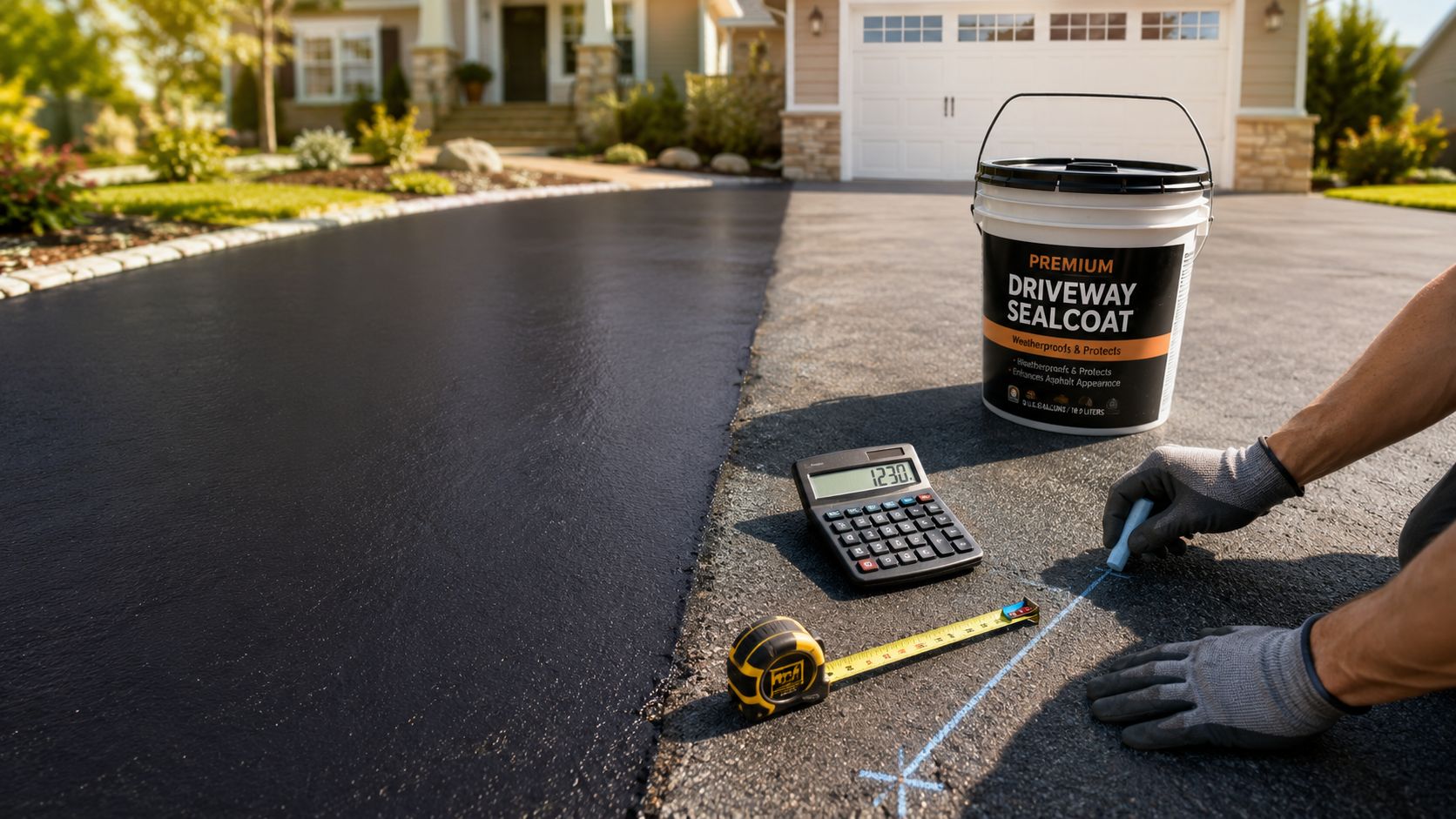
You can get halfway through a sealcoating project before the numbers stop making sense. The driveway looked straightforward, the online estimator looked easy, and then the sealer starts disappearing faster than expected because the surface is older, rougher, or more porous than it first looked. That's the part most homeowners and property managers in Marion County, FL and Citrus County, FL run into, especially when they're trying to budget for a home in Ocala, a rental in Dunnellon, or a small commercial lot in Crystal River.
A solid asphalt seal coat calculator should do more than multiply length by width. It should help you think like a contractor, starting with true coverage, then adjusting for surface condition, coat count, and Central Florida weather considerations. For property owners in Belleview, Silver Springs, Summerfield, Homosassa, Inverness, Lecanto, Beverly Hills, Hernando, and The Villages, that difference is what separates a rough guess from a usable estimate.
Table of Contents
- Start with an Accurate Pavement Measurement
- Assess Your Asphalt's True Condition and Porosity
- Calculate Your Total Sealer Needs and Coats
- The Florida Factor How Heat and Rain Affect Your Project
- When Your Project Needs More Than a Calculator
- Frequently Asked Questions About Sealcoating Costs
Start with an Accurate Pavement Measurement
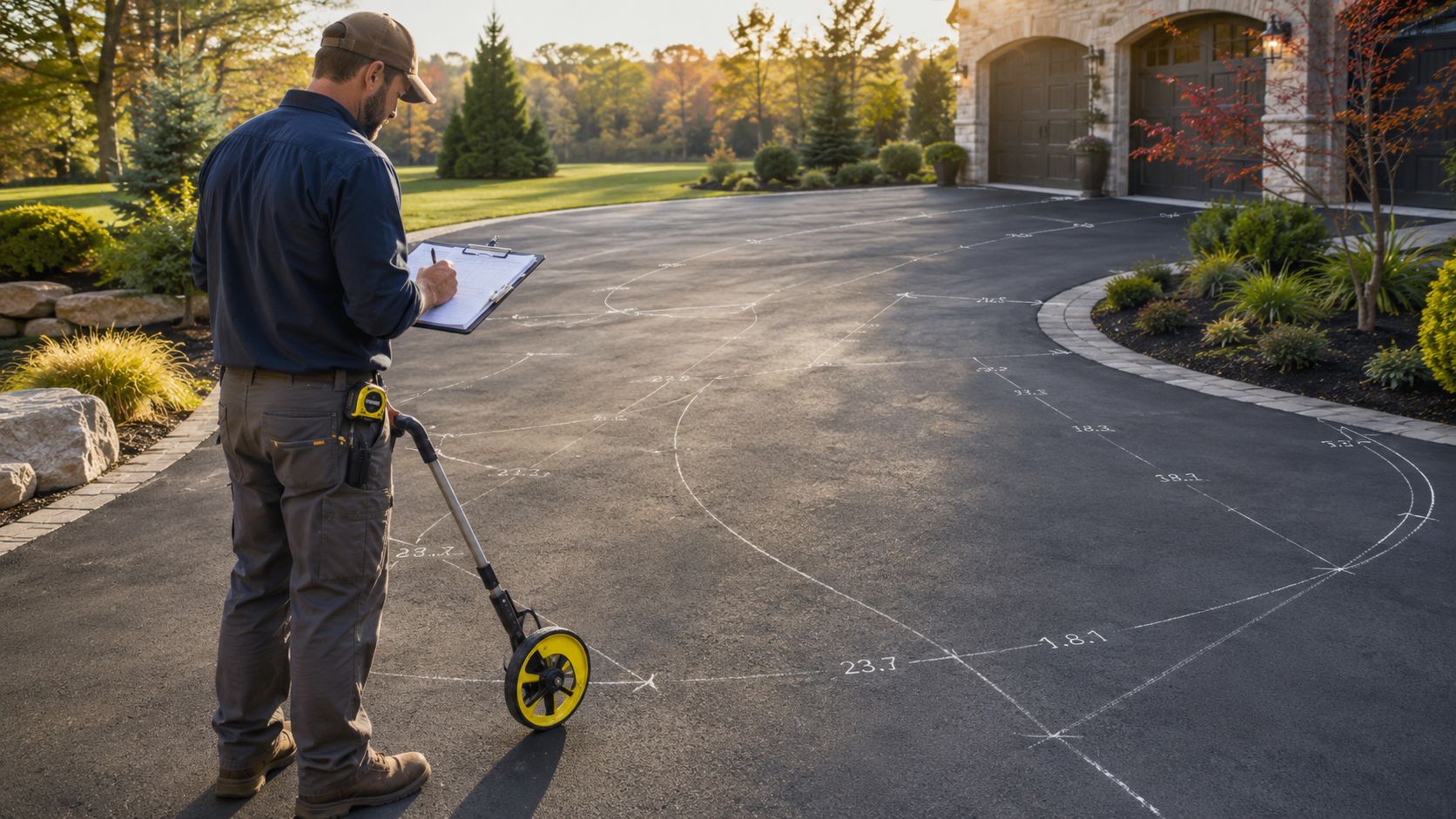
The first mistake people make is measuring the whole paved area and treating every square foot the same. That works only when the surface is a clean rectangle with no islands, drains, or transitions into sidewalks and concrete aprons. A contractor starts with the net sealable area, because that is the number the sealer has to cover.
Measure the paved footprint first
For a rectangular driveway, the math is simple. Multiply length by width, and you have a starting square footage figure. That's useful, but it's not the final number you want to use for material planning.
If the driveway has a turnaround, curved edges, or a flare near the street, break it into smaller shapes. Measure each section separately, then add them together. That approach is cleaner than guessing at a single average width, and it reduces the chance of overbuying or running short in the middle of the job.
Practical rule: measure every paved section you plan to seal, not just the big obvious rectangle.
Subtract what is not getting sealed
Now remove anything that won't receive sealer. That includes concrete drains, planted islands, grates, and sidewalk connections that sit inside the paved footprint. If you're estimating a property in Marion County, FL or Citrus County, FL, that subtraction matters just as much on a residential driveway in Summerfield as it does on a small lot in Inverness.
A good worksheet is simple:
- Length and width of each paved section
- Add all paved sections together
- Subtract non-sealable features
- Use the remaining number as your net sealable area
The reason this matters is straightforward. Practical coverage bands are around 80 to 100 sq ft/gal for many asphalt emulsion products, or about 400 sq ft per 5-gallon pail per coat on smooth asphalt, according to a sealcoat calculator guide from Pavemade's calculator page (Pavemade sealcoat calculator guidance). If you start with a footprint instead of a net area, the estimate will drift before you even factor in condition.
That same area-based method is why a pavement management approach works better than a one-line calculator. A net-area estimate gives you a number you can carry into material purchasing and scheduling, especially when the job needs to line up with pavement management planning.
Assess Your Asphalt's True Condition and Porosity
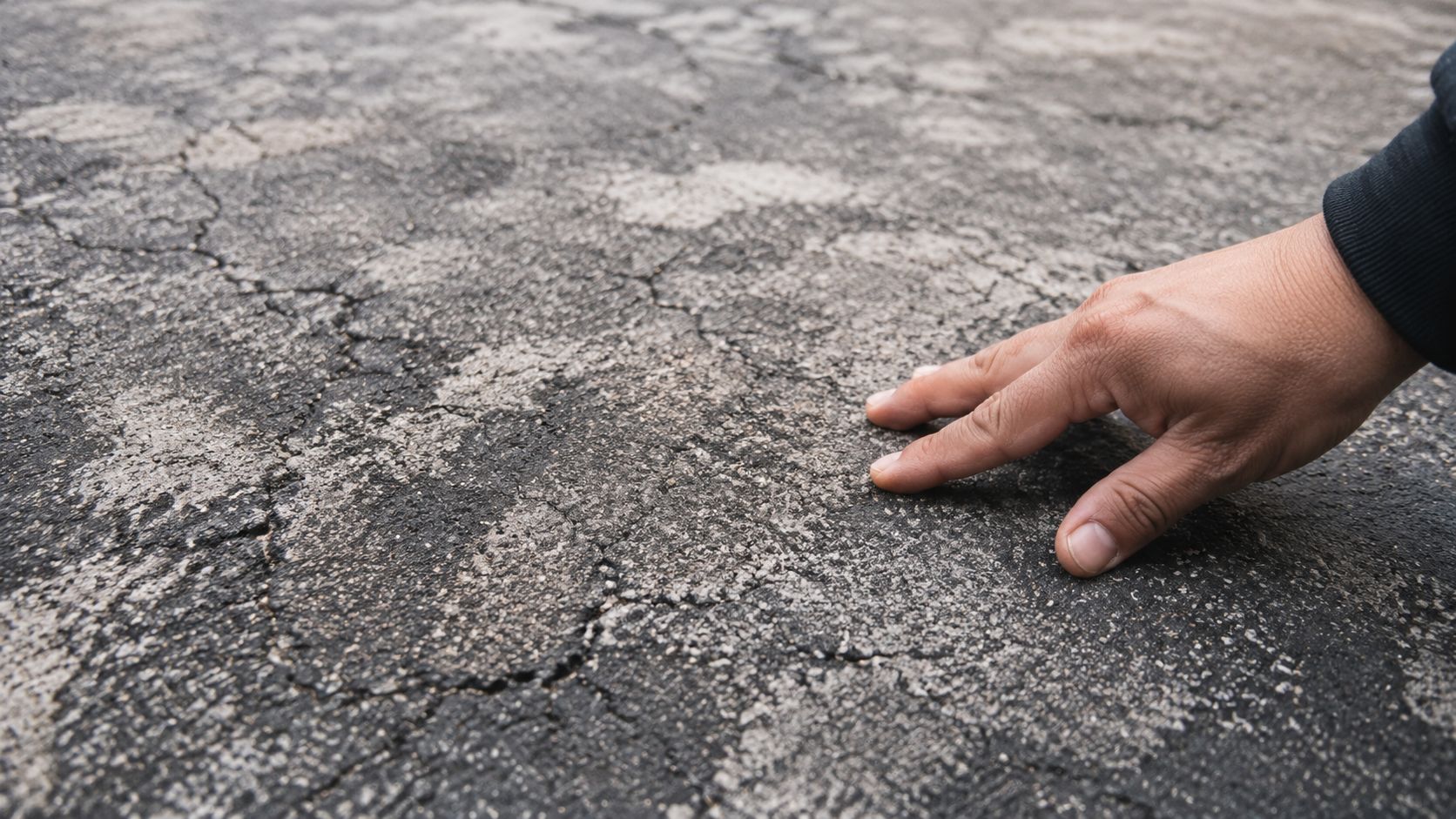
A driveway can look black from the curb and still act like a sponge once sealer hits it. That is why two properties with the same square footage can take very different amounts of material. Surface condition matters as much as area, and a driveway with hairline cracks and oxidation can absorb more product on the first coat, as shown in the BuildCalcHub asphalt sealcoat calculator.
Read the surface before you buy material
Old asphalt usually shows wear in layers. The color fades from deep black toward gray, the surface looks dry instead of oily, and the top starts to feel rough underfoot. Those are the signs that the binder at the surface has oxidized, and the pavement will take more product than a newer lot in better shape.
Hairline cracking is another warning sign. Even small cracks give sealer a path into the texture and voids at the surface, which is why the first coat disappears faster on worn pavement. On a newer driveway, the sealer tends to stay closer to the top and spread more evenly.
Compare two common surface types
A newer driveway in The Villages may only need a fairly predictable amount of product if the asphalt is tight and smooth. A grayer driveway in Dunnellon with light cracking and oxidation is a different job, because the surface profile is rougher and more absorbent. That gap is exactly why a generic coverage number misses the mark on real jobs.
The eye test matters. If the pavement looks thirsty, plan for it to act thirsty.
The same BuildCalcHub reference also gives a useful planning example. For a typical 600 ft² two-car driveway, published examples put material needs at roughly 13 to 15 gallons for two coats using asphalt-emulsion sealer at about 90 ft²/gal (BuildCalcHub asphalt sealcoat calculator). That example shows how fast condition changes the math.
If you are trying to decide whether your own pavement is a light top-up or a heavy first-time sealing job, a helpful starting point is how often to seal coat asphalt. The right timing usually lines up with what the surface is telling you, not just the calendar.
Calculate Your Total Sealer Needs and Coats
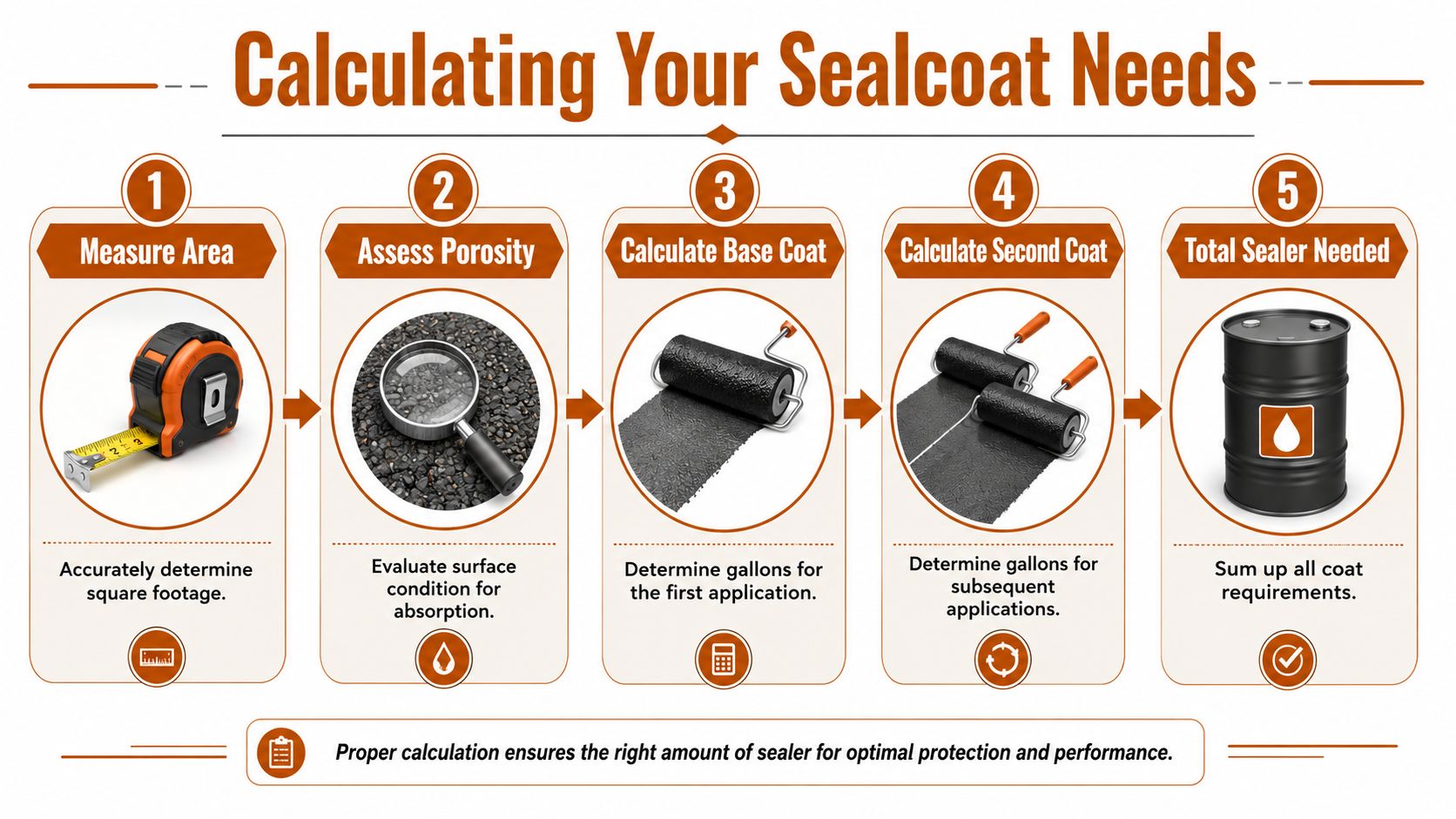
Once you have the net area and a realistic read on the pavement, the estimate starts to make sense. The math is straightforward in theory. Divide the sealable area by the coverage rate you can expect, then adjust for coat count and for the fact that the second pass usually uses less material than the first.
Use coat count as part of the formula
Two coats are common for poor pavement or for a first-time sealcoat job, and the second coat often takes less material than the first. On worn asphalt, that matters because the first pass can disappear into the surface faster than the eye expects, while the second pass builds the finish you want.
For a working estimate, I use this sequence:
- First coat uses your base coverage rate
- Second coat uses less if the pavement is already partly filled
- Total equals both coats combined, plus a small cushion if the surface is rough or open
A driveway in Belleview with medium porosity will usually tell you more about product demand than a bucket label will. The sealer has to go somewhere, and older asphalt gives it more places to sink in.
Work a sample estimate by hand
Take a 1,000 sq ft driveway in Summerfield with moderate wear. If the base coverage is roughly 90 sq ft/gal, the first coat would come out to about 11.1 gallons before any condition adjustment. If the second coat uses less product than the first, the total drops below a straight two-times calculation because the pavement is no longer starting from bare, open texture on that second pass.
That is the part a calculator cannot see. A driveway that looks smooth on a screen may still be porous enough to pull more sealer than expected, while a tighter surface can take less. Buying for the wrong surface condition is how small DIY jobs turn into extra store runs and a late start on the actual work.
For readers who want the order laid out visually, the infographic above follows the same sequence, measure area, assess porosity, calculate the first coat, calculate the second coat, then total everything. A contractor uses that same math, then checks traffic patterns, edges, and repair needs that do not show up in an online form.
The Florida Factor How Heat and Rain Affect Your Project
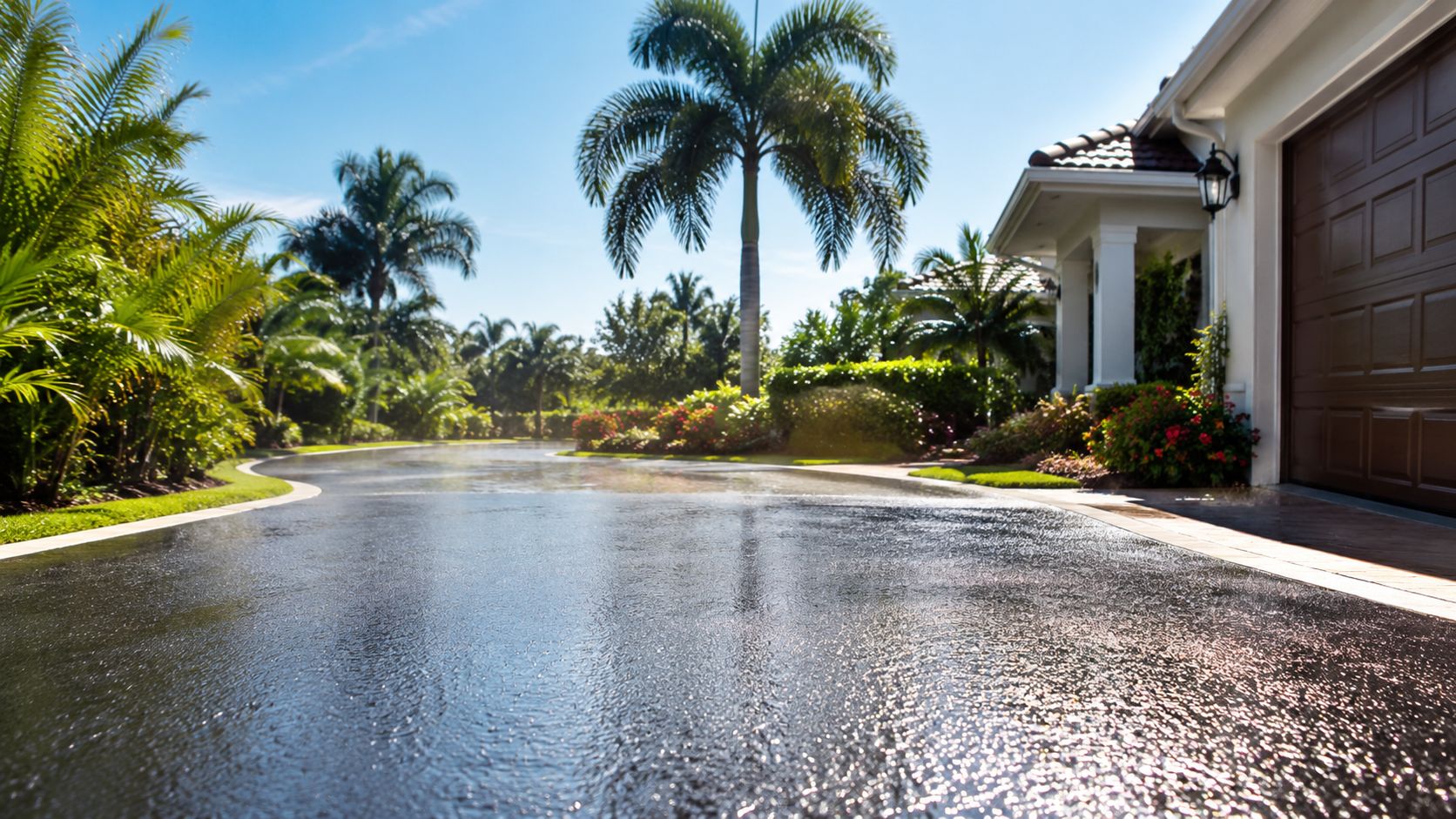
Central Florida makes sealcoating less forgiving than it looks on paper. Heat, UV exposure, and sudden rain all change how the sealer behaves once it's on the pavement. On a property in Ocala or Silver Springs, the surface can heat up quickly, then get hit with weather that ruins the cure if the timing is wrong.
Sun and moisture change the job window
Asphalt in Marion County, FL and Citrus County, FL takes a beating from long stretches of sun and then heavy rainfall. That combination speeds surface aging and raises the stakes on application timing. A coat laid down too late in the day can be interrupted by afternoon storms, while a coat applied in the wrong part of the day may not cure the way it should.
That's why the best schedule is usually the one matched to local conditions, not a generic weekend plan. A driveway in Crystal River or Homosassa doesn't need the same timing logic as a northern job in cooler weather.
Cure time matters as much as coverage
A sealcoat that looks dry on top can still be vulnerable underneath. The practical issue is not just appearance, it's whether the film has had enough time to set before traffic tracks through it. For that reason, it helps to keep the project window conservative and avoid forcing the job into a hot, storm-prone afternoon.
The local timing guidance from the best time to seal an asphalt driveway is worth following because weather in Central Florida can turn a neat estimate into a messy finish fast. In this climate, the calculator is only half the job. The calendar and sky matter too.
When Your Project Needs More Than a Calculator
A calculator is useful for a straightforward driveway in Hernando or a simple refresh in Beverly Hills. It starts to break down when the site gets bigger, the traffic pattern gets more complicated, or the surface needs work before any sealer can go down. That's where a field visit beats a spreadsheet.
Know the limits of DIY estimating
Commercial lots need more than square footage. They need access planning, repair coordination, striping decisions, and sometimes phased work to keep customers moving. If a property in Inverness or Crystal River also needs ADA markings or directional striping, a sealcoat estimate has to be tied to the rest of the site plan.
Concrete issues can also change the scope. If a driveway edge has failed, or a concrete apron needs replacement before sealing can make sense, the material estimate alone won't tell the full story. Riverside Sealing & Striping, LLC handles both concrete work and asphalt maintenance, so a site can be evaluated as one project instead of a stack of disconnected line items.
Use a contractor when the surface is doing multiple jobs
A small HOA lot, a church parking area, or a retail center doesn't just need fresh sealer. It needs safe circulation, clean striping, and a finish that doesn't create a maintenance headache next month. That's also where local experience matters, because a licensed and insured contractor can spot handling issues, repair priorities, and staging concerns before material gets ordered.
If the job has traffic control, repair work, or compliance concerns, the calculator is the starting point, not the answer.
That's the point where a professional quote becomes the smarter move. A no-pressure evaluation gives you a material plan, a work sequence, and a realistic schedule instead of a rough gallon count that ignores the job site.
Frequently Asked Questions About Sealcoating Costs
A driveway can look straightforward from the street and still need a very different sealcoat estimate once you walk it. Dry time, coverage, and coat count all shift with the surface itself, and Florida heat changes how that schedule plays out on site.
How long should sealer dry before traffic goes back on it?
Second coats are often applied after 4 to 8 hours of dry time, and traffic should stay off the surface for 24 to 48 hours (ASPHA Pro sealcoating calculator guidance). In Central Florida, hot pavement, afternoon humidity, and shaded areas can all change how fast a job sets up, so the surface should be checked in person instead of relying on the clock alone.
Why do some calculators seem to use less sealer than others?
Many calculators start with one generic coverage rate. That misses real job-site loss from porosity, oxidation, and the way material gets handled during application, so a simple area-only estimate often comes in light on older asphalt. A calculator is useful, but it cannot see how thirsty the pavement is.
Do I always need two coats?
Two coats are common on poor pavement or on a first-time sealcoating project, because the first pass often soaks in more material and the second pass finishes the surface more evenly. A smoother lot that has been maintained before may only need a lighter refresh, while a worn driveway with open pores can call for more material and more careful application. The right answer depends on how the asphalt looks after the first coat goes down.
What's the biggest mistake people make when estimating?
They measure only the full driveway footprint and stop there. That leaves out islands, grates, non-paved sections, and areas that should not receive sealer, so the final material count ends up distorted. A better estimate starts with the net sealable area and then adjusts for the surface condition, because a rough or oxidized lot will absorb more than a tight, newer one.
When should I stop guessing and get a quote?
Get a quote when repairs are part of the job, when commercial striping or ADA concerns are involved, or when the asphalt looks heavily oxidized and uneven. Those are the projects where a calculator cannot sort out patching, prep, and application needs on its own. A site evaluation is the safer way to avoid ordering the wrong amount of sealer or missing work that has to happen before sealing makes sense.
If you want a practical, field-based estimate for a driveway, parking lot, or mixed concrete and asphalt property in Marion County or Citrus County, visit Riverside Sealing & Striping, LLC for a free, no-pressure consultation. We help property owners compare material needs, surface condition, and repair priorities so the estimate matches the job site, not just the calculator.