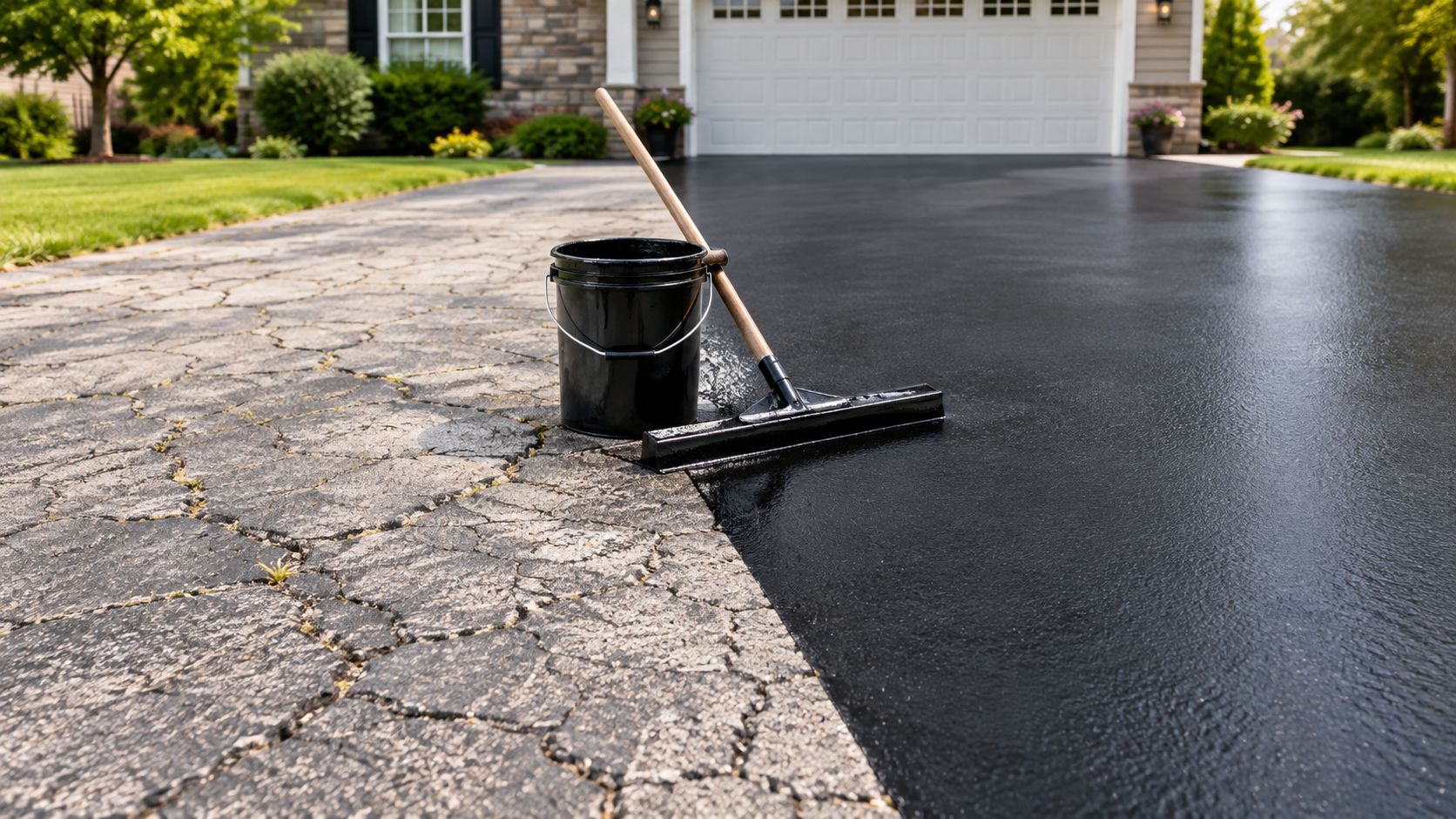
A faded driveway or parking lot can look overdue for replacement, but a gray surface alone doesn't tell you whether the pavement has failed. The useful part of an asphalt sealcoating before-and-after comparison isn't just the darker finish. It's seeing what changed beneath the surface story: whether cracks were repaired, oil stains treated, drainage checked, and traffic kept off until the sealer cured.
These six Central Florida examples show how preparation, material choice, sequencing, striping, and follow-up affect the result across commercial, residential, HOA, church, retail, and mixed concrete-and-asphalt properties. They reflect the kinds of maintenance decisions property owners face in Marion County, FL, Citrus County, FL, and communities from Ocala and Dunnellon to Inverness and Crystal River.
Sealcoating is preventive maintenance, not structural repair. Federal Highway Administration evaluations show that preservation outcomes vary with treatment and project conditions, so a dark “after” photo should be considered alongside pavement condition and the work performed (FHWA pavement-preservation evaluation).
Table of Contents
- 1. Commercial Strip Center Parking Lot Sealcoat and Restriping in Ocala, FL
- 2. Church Parking Lot ADA Restriping Upgrade in Inverness, FL
- 3. HOA Townhome Parking Area Crack Repair and Sealcoat in Summerfield, FL
- 4. Residential Asphalt Driveway Sealcoating in The Villages, FL
- 5. Combined Concrete and Asphalt Transition Repair at a Crystal River Business Entrance
- 6. Retail Lot Oil and Grease Stain Treatment Before Sealcoating in Dunnellon, FL
- 6 Asphalt Sealcoating Projects: Before & After Comparison
- Turn Maintenance Visibility into Long-Term Value
1. Commercial Strip Center Parking Lot Sealcoat and Restriping in Ocala, FL
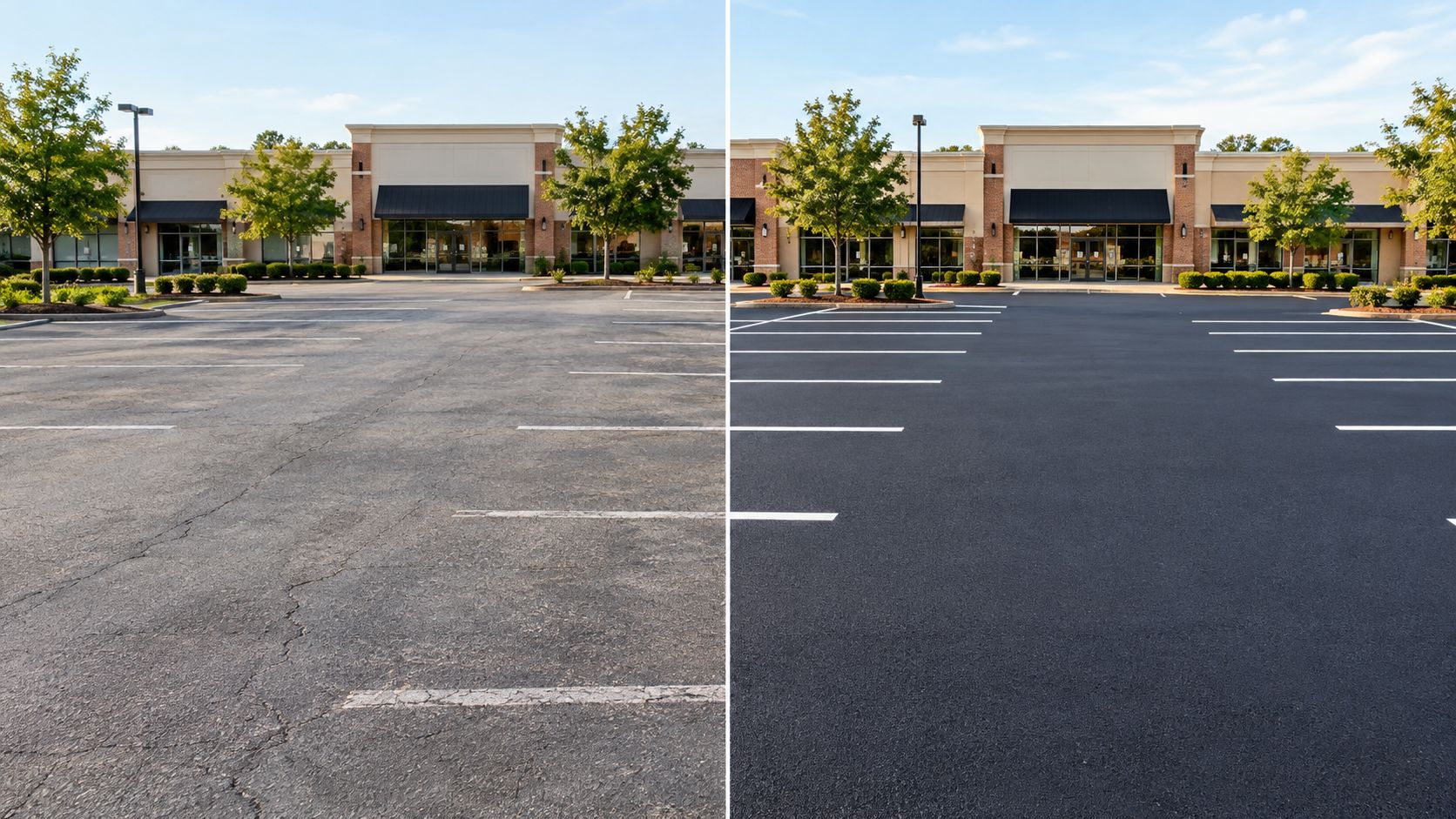
A shopping center's parking lot may be the first thing customers notice, but fading lines and oil spots also make it harder to follow the layout. In this Ocala example, the before condition is dull gray asphalt, hairline cracks, oil drips near the storefront stalls, and markings that drivers can barely follow. After the work, the surface looks more uniform, with renewed stall lines, fire lanes, and accessible parking markings.
The difference depends on treating the pavement as a sequence of tasks, not applying sealer. Crews first power-sweep debris, degrease oil spots, and clean and fill suitable cracks. Then they apply the specified sealer coats and wait for the surface to cure before restriping. Sealer shouldn't be expected to fill cracks or repair failed pavement.
Keep tenants and customers in the plan
A property manager can reduce disruption by asking for a pre-project walk-through and a phased closure schedule. That gives the contractor and tenants a chance to identify oil-contaminated areas, agree on access routes, and coordinate work around storefront entrances. A medical plaza may also need faded fire-lane and accessible-space markings assessed as part of the layout review.
For asphalt sealcoating, application rate and surface texture matter. The Asphalt Institute describes a light, uniform application of diluted slow-setting asphalt emulsion, with the rate adjusted to the pavement's condition; excessive material may remain tacky and pick up on shoes or tires (Asphalt Institute guidance on sealing parking lots).
Plan the sequence: Prepare and seal the pavement first, then repaint markings after the coating has cured enough for paint to adhere properly. Confirm the reopening plan with the contractor rather than guessing from the appearance of the surface.
For a strip center off an Ocala corridor, the goal is a clean, legible lot without full replacement when the pavement is still suitable for preservation. Property managers can also review asphalt sealcoating services, parking lot striping, and the company's guidance on how often to seal-coat asphalt.
2. Church Parking Lot ADA Restriping Upgrade in Inverness, FL
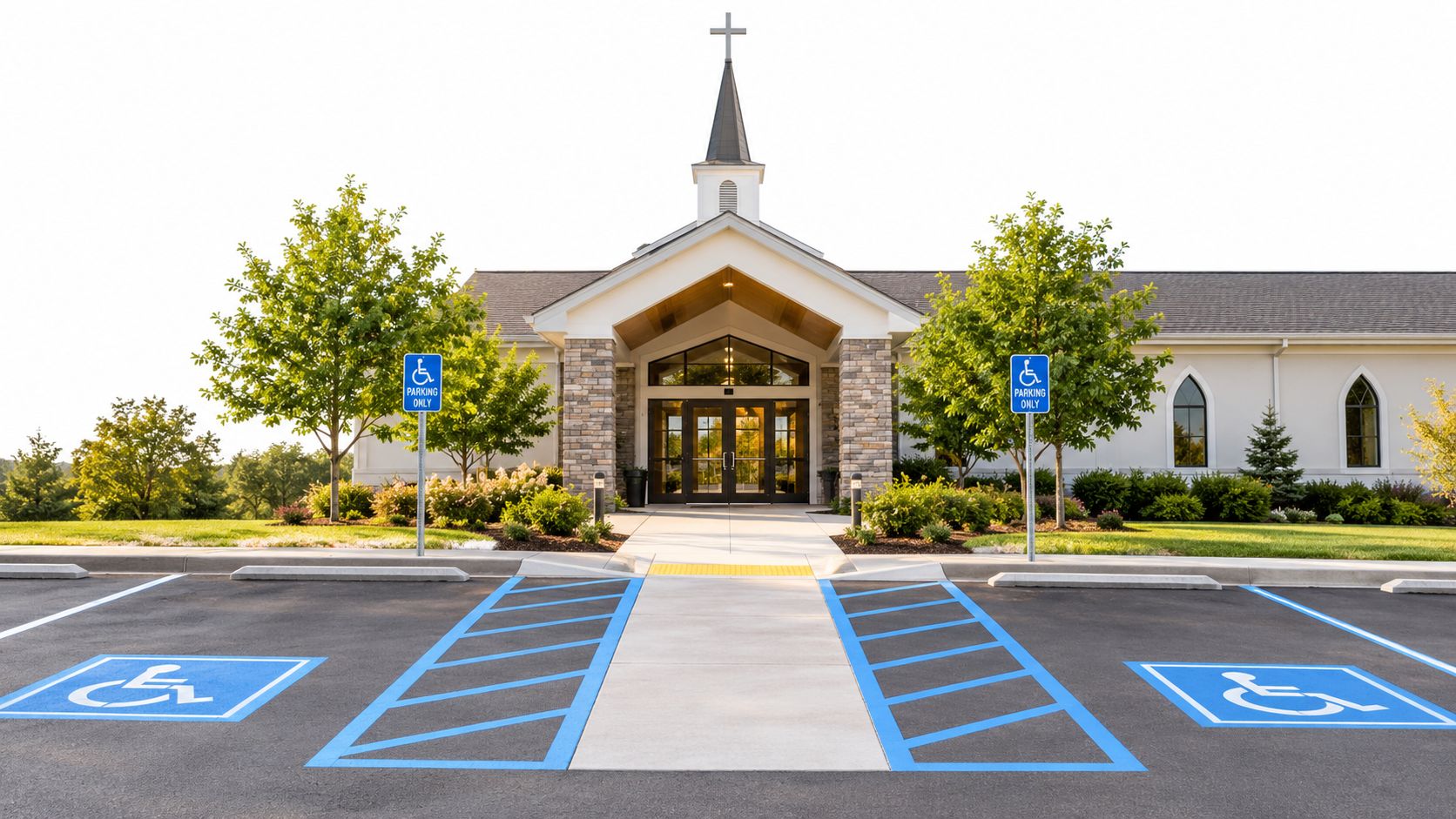
At a church or school, a faded parking layout can create confusion at the same time it makes the property look neglected. In this Inverness example, drivers arrive to worn stall lines, unclear accessible spaces, and no obvious access aisles beside the designated stalls. The improved layout makes accessible spaces and directional flow easier to identify near the building entrance.
The visible change is paint, but the project starts with a layout review. The contractor and facility representative should check stall and aisle dimensions, access routes, signs, and how the markings connect to the entrance. Pavement markings and signs are related but separate parts of the accessibility plan, so repainting alone may not address every concern.
Work around the facility's schedule
Churches often need the lot open for services and events. A weekday or evening work window can help avoid disrupting congregation access, while a clear closure notice gives people time to use alternate parking. A church in Inverness might also need the accessible route checked against the location of its ramp; a school in Lecanto may need its drop-off loop and parking flow clarified alongside the accessible stalls.
The final layout should be reviewed by the property's responsible parties against applicable requirements. A contractor can install markings and help identify layout questions, but owners should confirm that the overall site plan meets the requirements that apply to their facility. Keep before-and-after photographs with the facility records so the board or property manager can track what was changed.
Riverside provides parking lot striping options for accessible spaces, directional markings, and other pavement layouts. For a church, school, or nonprofit in Citrus County, the practical measure of a good result is a lot that reads clearly to drivers and supports safer movement from parking to the entrance.
3. HOA Townhome Parking Area Crack Repair and Sealcoat in Summerfield, FL
An HOA parking area can look uneven even when the main issue isn't color. A townhome lot in Summerfield might show a web of cracking in high-use areas, deteriorated edges along curbs, and patchwork in several shades of gray. A successful maintenance project starts by identifying what can be sealed and what needs repair first.
The contractor should map cracks by severity and inspect the edges, patched spots, drainage paths, and areas where vehicles turn or stop. A uniform coating can improve the appearance of serviceable asphalt, but it won't stabilize a failed base or correct standing water. Asphalt Institute guidance describes fog sealing as a preservation treatment for structurally sound pavement with minor surface deterioration, not a replacement for repairs to deeper damage (Asphalt Institute pavement-preservation guide).
Build a maintenance plan residents can follow
For a community with several buildings, the board can phase work to keep parking available and spread project disruption. For example, an association in Belleview might coordinate work by building or parking area, then share closure dates and temporary parking instructions with residents. The board should also budget for crack attention between larger sealcoating projects rather than waiting for every visible problem to return at once.
Look beyond the finished color. Ask for a written condition assessment that notes the crack types, repair needs, drainage concerns, and any areas that should be monitored rather than coated.
Crack sealing is a separate preparation step, and excess material left above the pavement can create complaints. The Asphalt Institute explains that crack sealant needs to be applied with care, since overfilling or sealant expansion can leave unwanted material on the surface (Asphalt Institute crack-sealing guidance).
HOA boards can compare contractor recommendations with reserve planning and explore commercial parking lot maintenance plans. A consistent appearance matters, but the more useful “after” is one that follows an honest diagnosis and a maintenance plan residents can understand.
4. Residential Asphalt Driveway Sealcoating in The Villages, FL
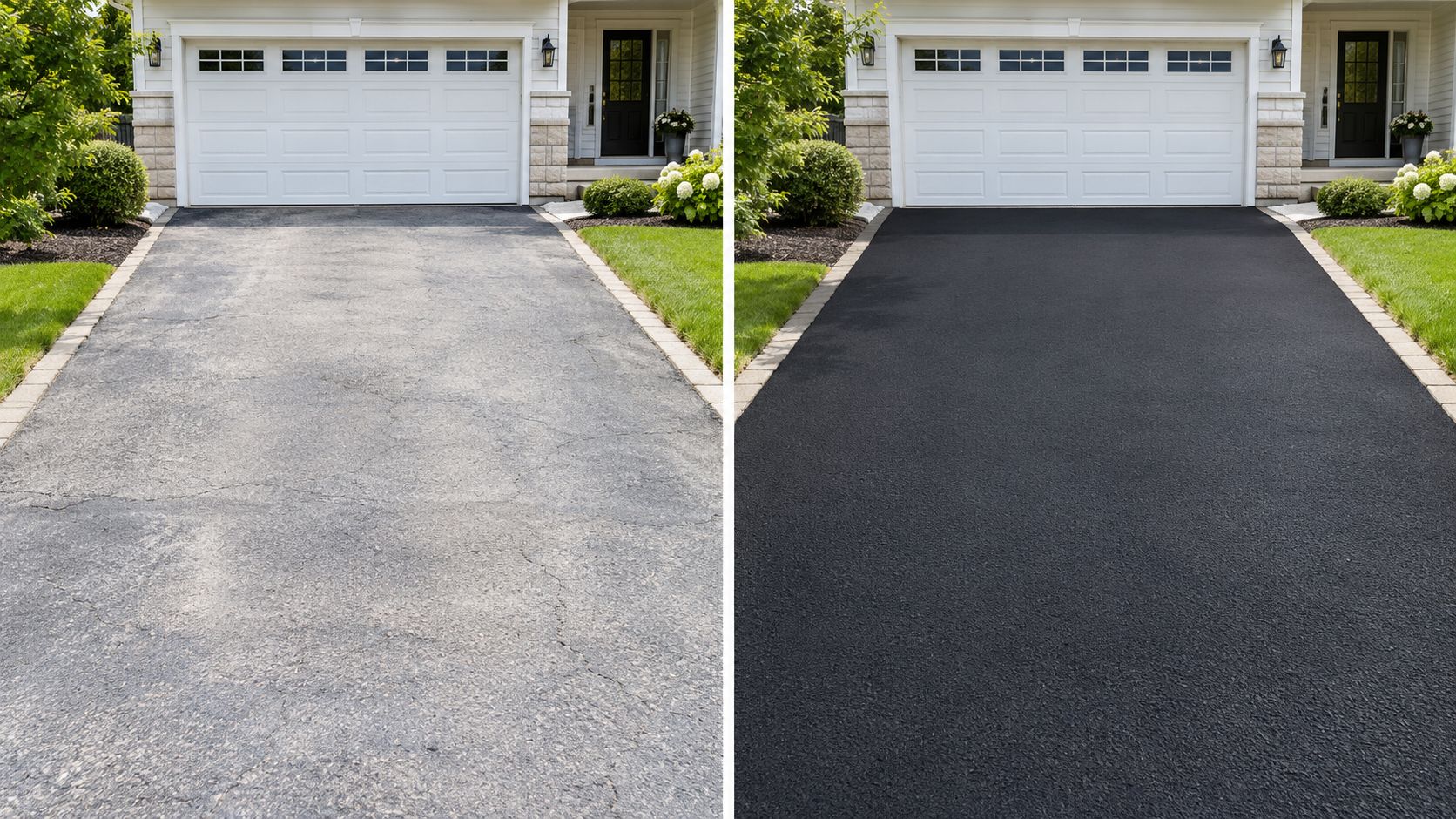
A driveway can turn chalky and gray after years of sun while its structure remains serviceable. In this Villages example, the before condition includes faded asphalt, oil marks beneath parked vehicles, and light surface wear along the wheel paths. The after photo shows a darker, more even finish and clean edges where the asphalt meets lawn or walkway.
That visual change can help protect an aging surface, but a newly paved driveway generally shouldn't be sealed immediately. The Asphalt Institute says properly designed and constructed pavement typically doesn't require sealing for approximately 2 to 5 years, depending on climate severity and construction quality (Asphalt Institute seal-coat FAQ). The right time to consider treatment is when the surface condition supports preservation, not just when a homeowner wants a darker finish.
Check what the driveway connects to
A contractor should inspect the driveway and nearby concrete together. In Summerfield, that may mean cleaning and sealing asphalt while also identifying a damaged apron; in The Villages, it may mean checking a concrete walkway or transition where water can collect. A company that handles both materials can help coordinate the work so one repair doesn't leave a weak connection beside the other.
Material choice matters, too. Ask whether the proposed product is asphalt-based or coal-tar-based, and whether local rules affect the options. A research synthesis in the verified background notes that sealant chemistry and runoff can have environmental and regulatory implications, so property owners should ask what product will be applied and how cleaning residue and runoff will be managed (TxDOT seal-coat guidance).
A sealcoat should be thin and uniform rather than piled on for a darker look. Keep vehicles off the surface until the contractor confirms it's ready for traffic, and ask for nearby concrete apron or walkway concerns to be noted during the visit. Homeowners can learn about residential asphalt sealcoating and read about the best time to seal an asphalt driveway.
5. Combined Concrete and Asphalt Transition Repair at a Crystal River Business Entrance
The seam between concrete and asphalt often deserves as much attention as either surface on its own. At a Crystal River business entrance, the before condition might include a cracked concrete apron, asphalt pulling away from the edge, and faded traffic markings. If a crew seals the asphalt without correcting the damaged transition, water and repeated vehicle loads can continue to affect the joint.
The repair sequence should match the work. First, the contractor assesses drainage and determines whether the concrete apron needs repair or replacement and whether the asphalt edge is stable. Concrete work comes before the final asphalt sealcoat and striping, so the finished markings and pavement treatment follow the repaired surfaces rather than being disturbed by later construction.
Make the transition part of the scope
A strip plaza in Crystal River may need a new concrete apron and reconstructed asphalt edge to address water collecting near the entrance. A small business in Homosassa may be updating its storefront and repairing the vehicle approach at the same time. In either case, ask how the joint will be treated, how water will drain away from the building, and how delivery vehicles will be accommodated while work is underway.
Sequence both materials together. Confirm the concrete scope, transition detail, drainage plan, and traffic access before scheduling sealcoating and striping.
A full-service contractor matters here. Concrete and asphalt have different repair needs, and the transition needs to be planned as one connection rather than two unrelated finishes. Review concrete construction services alongside asphalt maintenance options to discuss the complete entrance.
The result should be more than a fresh black surface. It should be a sound apron, a stable asphalt edge, a deliberate joint, and traffic markings that guide people through the entrance. That approach helps owners avoid repeating the same repair because the underlying interface was left out of the job.
6. Retail Lot Oil and Grease Stain Treatment Before Sealcoating in Dunnellon, FL
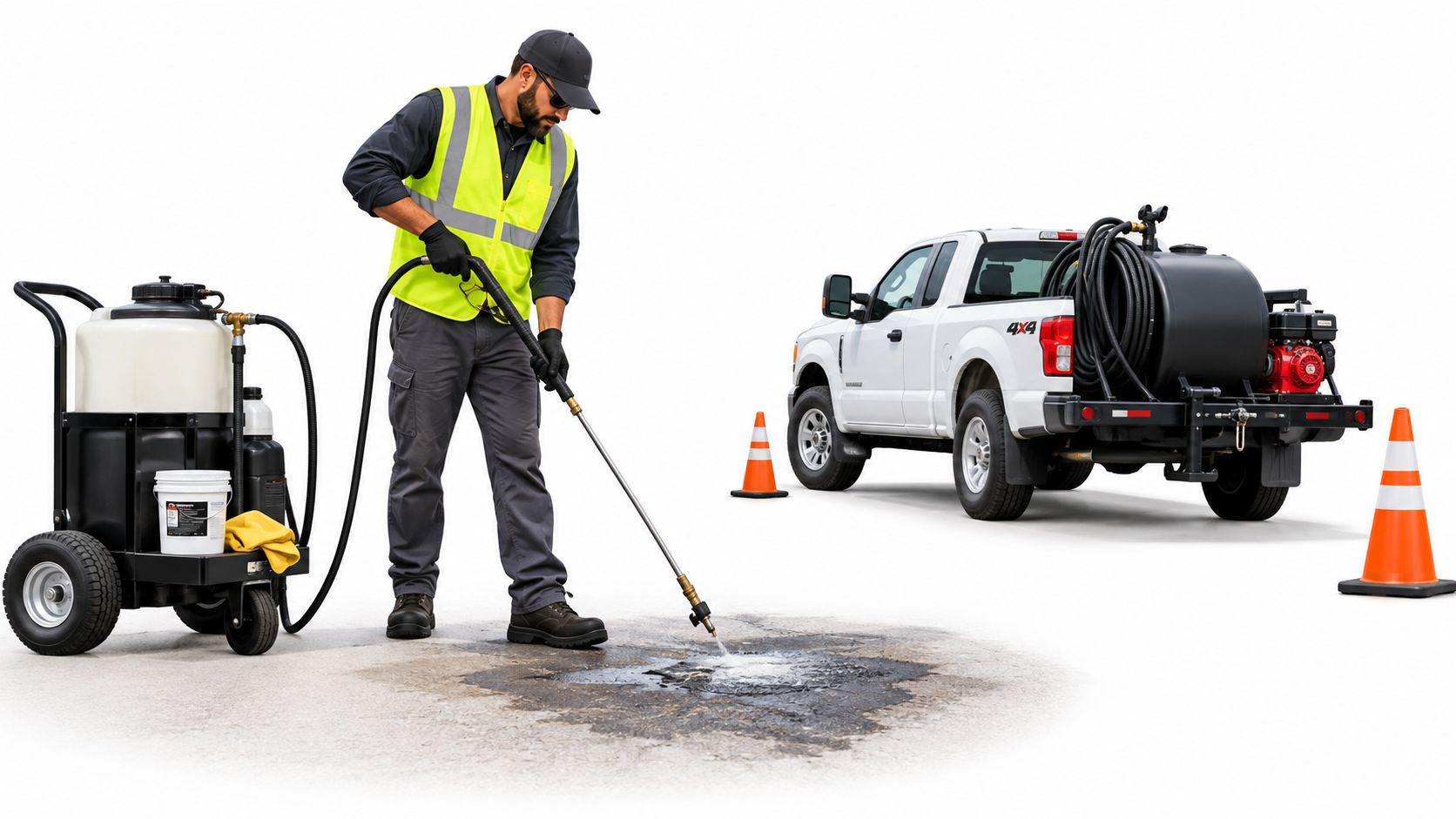
Dark, shiny patches near a restaurant drive-through, dumpster, or auto-service bay can make a lot look neglected. They also signal a preparation issue: if oil or grease remains on the pavement, sealer applied over it may not bond as intended. A better before-and-after result begins with identifying the source, treating the affected areas, and cleaning the surface before coating.
In Dunnellon, a restaurant might have oil spots near the pickup window and faded asphalt across the rest of its lot. An auto shop in Ocala may have recurring stains around a service area. The crew should identify any active leaks before cleaning; otherwise, new fluid can contaminate the prepared surface again.
Treat stains before applying the coating
Cleaning and spot treatment need to fit the product and the pavement condition. Ask the contractor how wastewater and debris will be managed, and keep a record of recurring stain locations so the property team can check for leaks later. Once the asphalt is clean and dry, the contractor can assess whether the area is suitable for sealcoating or needs a separate repair.
A dark appearance after sealing doesn't prove the stain was properly addressed. The practical test is whether the preparation removed contamination sufficiently for the product to adhere and whether the underlying asphalt remains serviceable. If the surface is brittle, cracked, or raveling, the contractor should explain what repair or preservation treatment fits rather than using sealer to disguise the condition.
Commercial owners can consider ongoing property upkeep options and request a scope that includes stain treatment, pavement cleaning, crack assessment, and a plan for reopening the lot. For a driveway with oil staining, Riverside also offers driveway oil-stain removal.
6 Asphalt Sealcoating Projects: Before & After Comparison
| Project type | 🔄 Implementation complexity & resources | ⚡ Typical timeline | 📊 Expected outcome | ⭐ Ideal use case & key advantage |
|---|---|---|---|---|
| Commercial strip center sealcoating and restriping | Moderate: cleaning, stain treatment, crack filling, two sealer coats, and new markings | Phased work; allow 1–3 days for closures and curing | Darker, protected pavement with clearer stalls, fire lanes, and accessible spaces | Commercial lots with sound pavement; improves appearance and visibility at lower cost than replacement |
| Church parking lot ADA restriping | Low to moderate: careful layout measurements, accessible-space markings, aisles, and signage review | Usually quick; often scheduled off-hours | More legible accessible parking and traffic routes; supports accessibility compliance | Churches, schools, and nonprofits; improves pedestrian safety and reduces confusion during busy events |
| HOA parking area crack repair and sealcoating | Moderate to high: crack routing, patching, edge repairs, resident coordination, and possible phased work | Varies by area and board schedule; may require multiple phases | More uniform surface and reduced water intrusion where repairs are appropriate | HOA and condo lots with aging pavement; supports planned maintenance and community appearance |
| Residential driveway sealcoating | Low: cleaning, minor crack filling, sealer application, and edge protection | Often one day of work, plus 24–48 hours before vehicle use | Restored curb appeal and added protection from UV exposure and staining | Home driveways with surface wear but no major structural damage; relatively modest investment |
| Combined concrete and asphalt transition repair | High: concrete removal and replacement, joint sealing, asphalt edge repair, curing, then sealcoating and striping | Longer; sequencing and concrete curing affect the schedule | More durable transition, improved drainage, and reduced recurring edge failure | Business entrances with damaged aprons or failing concrete–asphalt joints; addresses both materials together |
| Retail lot oil and grease stain treatment before sealcoating | Moderate: degreasing, spot treatment, pressure washing, runoff management, then sealing and optional restriping | Typically 1–2 days for a mid-sized lot; heavy stains may need repeat treatment | Cleaner, more uniform surface and improved sealer bonding in treated areas | Restaurants, service shops, and retail lots with fluid stains; helps prevent poor adhesion from untreated contamination |
Turn Maintenance Visibility into Long-Term Value
The strongest before-and-after results come from preparation, sequencing, and realistic maintenance planning, not from sealer alone. Homeowners, HOAs, and property managers across Marion County, Citrus County, Ocala, Dunnellon, Belleview, Summerfield, and nearby communities can use these examples to document pavement condition, prioritize repairs, protect drainage, and plan maintenance before minor surface wear becomes structural failure.
Central Florida conditions make a close look at the whole site useful. Heat and UV exposure contribute to surface aging, while heavy rain makes drainage and water entry important to inspect. Traffic, fluid leaks, prior repairs, and the condition of transitions between concrete and asphalt also affect what work is appropriate.
Sealcoating makes sense when the pavement is suitable for preservation. It isn't a substitute for correcting failed areas, deep cracking, poor drainage, or structural damage. The right contractor will explain what needs preparation or repair, what can be sealed, and when the surface can safely reopen. For commercial sites, confirm that striping and accessible-space markings are included where needed. For homes and HOAs, ask how nearby concrete and asphalt transitions fit into the same plan.
Riverside Sealing & Striping, LLC is a Dunnellon-based concrete and asphalt maintenance company serving Marion County, Citrus County, and surrounding Central Florida communities, including Ocala, Silver Springs, Crystal River, Homosassa, Lecanto, Beverly Hills, Hernando, and The Villages. The company provides asphalt sealcoating, parking lot striping, concrete repairs, and concrete construction. Its team offers free, no-pressure on-site consultations and estimates, with clear timelines and reliable scheduling.
A useful estimate should leave you with more than a price. It should identify the pavement's condition, explain the preparation and materials, account for curing and traffic access, and clarify which repairs fall outside sealcoating. That record helps owners compare scopes, plan future maintenance, and understand what the finished surface can realistically accomplish.
Riverside Sealing & Striping, LLC offers professional asphalt sealcoating, parking lot striping, and concrete work for homes, HOAs, and commercial properties across Central Florida. Request a free, no-pressure on-site consultation and estimate by visiting Riverside Sealing & Striping, LLC.