
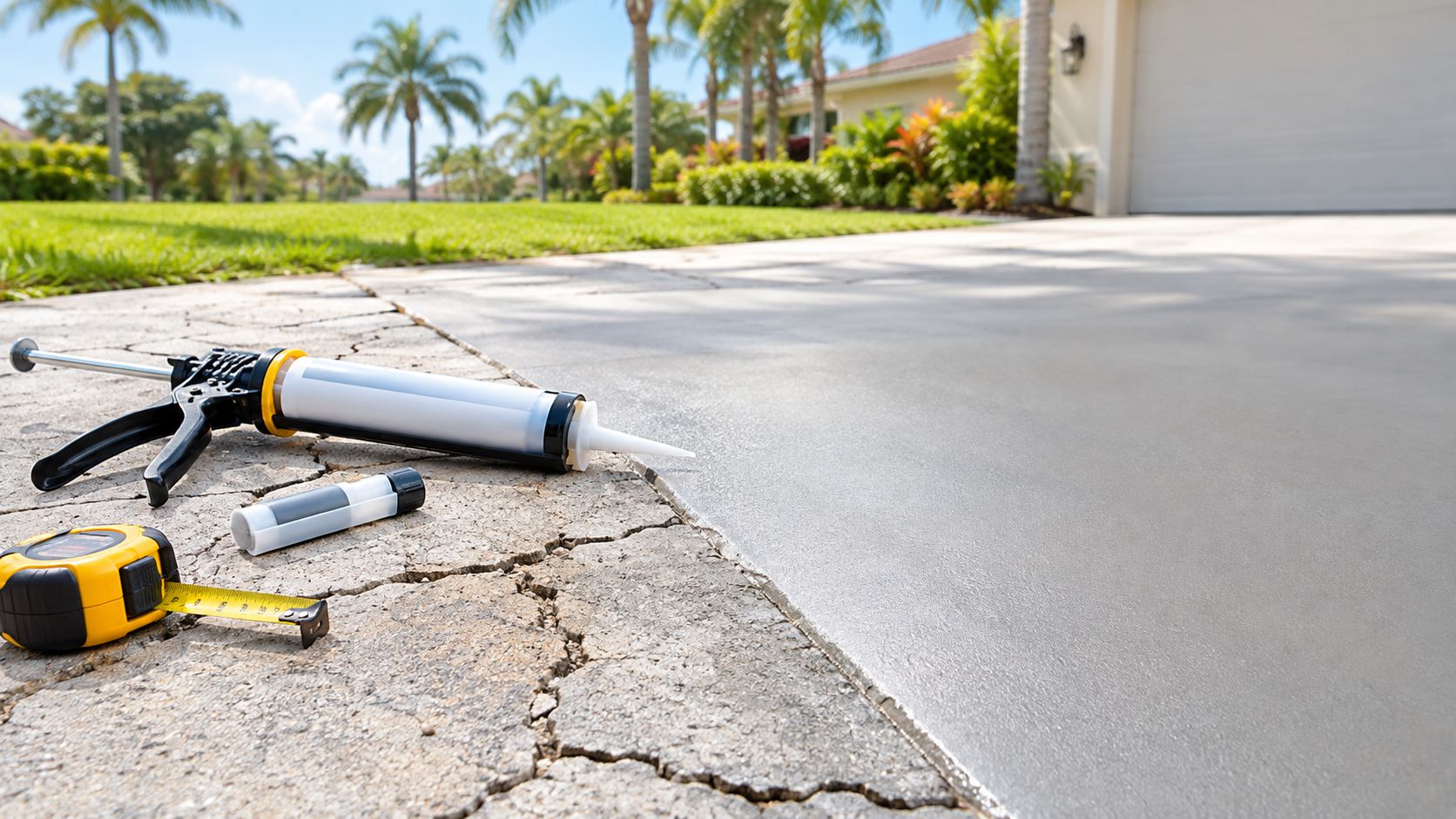
Polyurethane crack sealers are generally the best concrete driveway crack filler for moving cracks in Central Florida because they balance flexibility and UV resistance, while epoxies suit stable, non-moving hairline cracks. For hot-applied products, look for a softening point of at least 65.5 °C (150 °F), resilience of at least 30% recovery, and enough low-temperature flexibility to avoid debonding, as specified by ASTM D5078/D5078M.
You've probably seen the problem already. A thin crack runs across the driveway near the garage, a wider split opens beside the sidewalk, or a repaired line comes back after a season of Florida heat and rain. The tube that cured hardest didn't necessarily perform best. In Marion County, FL, Citrus County, FL, and surrounding Central Florida communities, crack movement and moisture exposure matter more than a product's label or cure speed.
Table of Contents
- Why the Best Concrete Driveway Crack Filler Depends on Your Crack
- Comparing Concrete, Epoxy, Polyurethane, Hydraulic Cement, and Caulk Crack Fillers
- How Florida Weather Impacts Concrete Driveway Crack Fillers
- How to Match Crack Filler to Crack Width and Movement
- Best Crack Filler Recommendations for Homeowners and Property Managers
- When to Call a Concrete Contractor in Marion or Citrus County
Why the Best Concrete Driveway Crack Filler Depends on Your Crack
A driveway crack isn't automatically a simple fill job. The concrete may have moved because of thermal expansion, settlement, tree roots, poor drainage, or repeated vehicle loading. A stable surface crack needs a different treatment from a crack that opens and closes through the year.
The American Concrete Institute's crack evaluation and repair guidance treats cracking as a durability concern, not merely a cosmetic defect. Cracks create direct pathways for water and aggressive agents to enter concrete. The same guidance says the repair method depends on the crack's cause, movement, width, and whether water is actively transmitting through it.
That changes how I'd shop for the best concrete driveway crack filler. Don't start with brand name, color, or the hardest cure. Start by answering four questions:
- What caused the crack? Settlement, roots, joints, drying shrinkage, and impact each point to a different repair strategy.
- Is it moving? A crack that widens seasonally needs an elastic material.
- How wide is it? Hairline fissures may need penetrating treatment, while wider openings may require routing, backer material, and sealant.
- Is water entering or passing through it? Active moisture can defeat a product that requires a dry bond.
Practical rule: If the crack changes width, choose movement tolerance before maximum hardness.
Rigid epoxy has a valuable place, especially where a stable crack needs bond strength and load transfer. It's the wrong first choice for a driveway crack that keeps opening under sun-driven expansion, slab settlement, or nearby root pressure. A flexible polyurethane or elastomeric sealant can stretch with the slab instead of breaking its bond.
That's why the same driveway may need more than one repair chemistry. A stable hairline crack can receive a low-viscosity epoxy treatment, while an active crack near an exposed edge may need a flexible sealant and a professional assessment of the underlying movement.
Comparing Concrete, Epoxy, Polyurethane, Hydraulic Cement, and Caulk Crack Fillers
The right filler depends on the job, not on which product sounds strongest. Concrete-based fillers, epoxy, polyurethane, hydraulic cement, and flexible caulk each solve a different problem.
| Filler Type | Best For | Flexibility | Key Limitation |
|---|---|---|---|
| Cementitious concrete filler | Stable, shallow, non-structural cracks | Low to moderate | Can reopen when the slab moves |
| Epoxy | Stable hairline cracks and structural repair conditions | Low | Rigid after curing, so active cracks can debond |
| Polyurethane | Moving exterior cracks and moisture-prone areas | High | Usually sacrifices some rigidity for movement tolerance |
| Hydraulic cement | Localized damp repairs and water-stopping situations | Low | Poor choice where the crack continues to move |
| Flexible concrete caulk | Small to moderate exterior cracks with seasonal movement | Moderate to high | Surface preparation and correct depth remain critical |
Independent technical data sheets show how sharply these materials differ. One polyurea filler lists tensile strength of about 4,500 to 4,800 psi with only 6% to 8% elongation, while a fast-set epoxy lists roughly 4,500 psi tensile strength and 5% to 6% elongation. By contrast, a flexible crack seal product reports about 12 N/mm² tensile strength with approximately 30% elongation, and another crack and joint filler reports 50% to 60% elongation with 180 to 230 psi adhesion to concrete in its technical information (technical data comparison).
Concrete and hydraulic cement fillers
Cementitious fillers blend naturally with concrete and make sense for stable, non-structural surface defects. They're familiar, easy to tool, and useful where the slab has stopped moving. Hydraulic cement can help in localized damp conditions because it's designed to set in contact with moisture.
Neither material should be treated as a universal driveway sealant. If the crack continues to open, a rigid cement-based patch can fracture at the same line. It may look solid on installation day and still fail because it can't accommodate movement.
Epoxy for stable cracks
Epoxy creates a strong bond and is better suited to cracks that are stable and require rigidity. Low-viscosity epoxy resins are commonly used for thin or hairline cracks because they can remain fluid long enough to penetrate tight fissures during low-pressure injection, particularly for cracks less than about 2 mm (epoxy and polyurethane repair guidance).
Use epoxy carefully on an exterior driveway. A strong, rigid repair won't solve settlement, root lifting, or recurring thermal movement. It can instead shift stress into the surrounding slab or reopen along the bond line.
Polyurethane and flexible caulk
Polyurethane is my first choice for an active exterior crack that's otherwise suitable for sealing. It remains more accommodating as the concrete expands and contracts, and it works well in a caulk-gun format for many residential repairs. Flexible concrete caulk follows the same basic logic, though the exact performance depends on formulation, preparation, and exposure.
The deciding factor is elongation, not tensile strength alone. A product that stretches more may protect a moving crack better than a harder product with impressive strength numbers.
How Florida Weather Impacts Concrete Driveway Crack Fillers
Florida driveways take a different beating from concrete in colder regions. The slab sits in direct sun, absorbs heavy rain, dries out, and expands and contracts as temperatures change. UV exposure can age low-quality sealants, while moisture entering an untreated crack can erode the edges and weaken the repair.
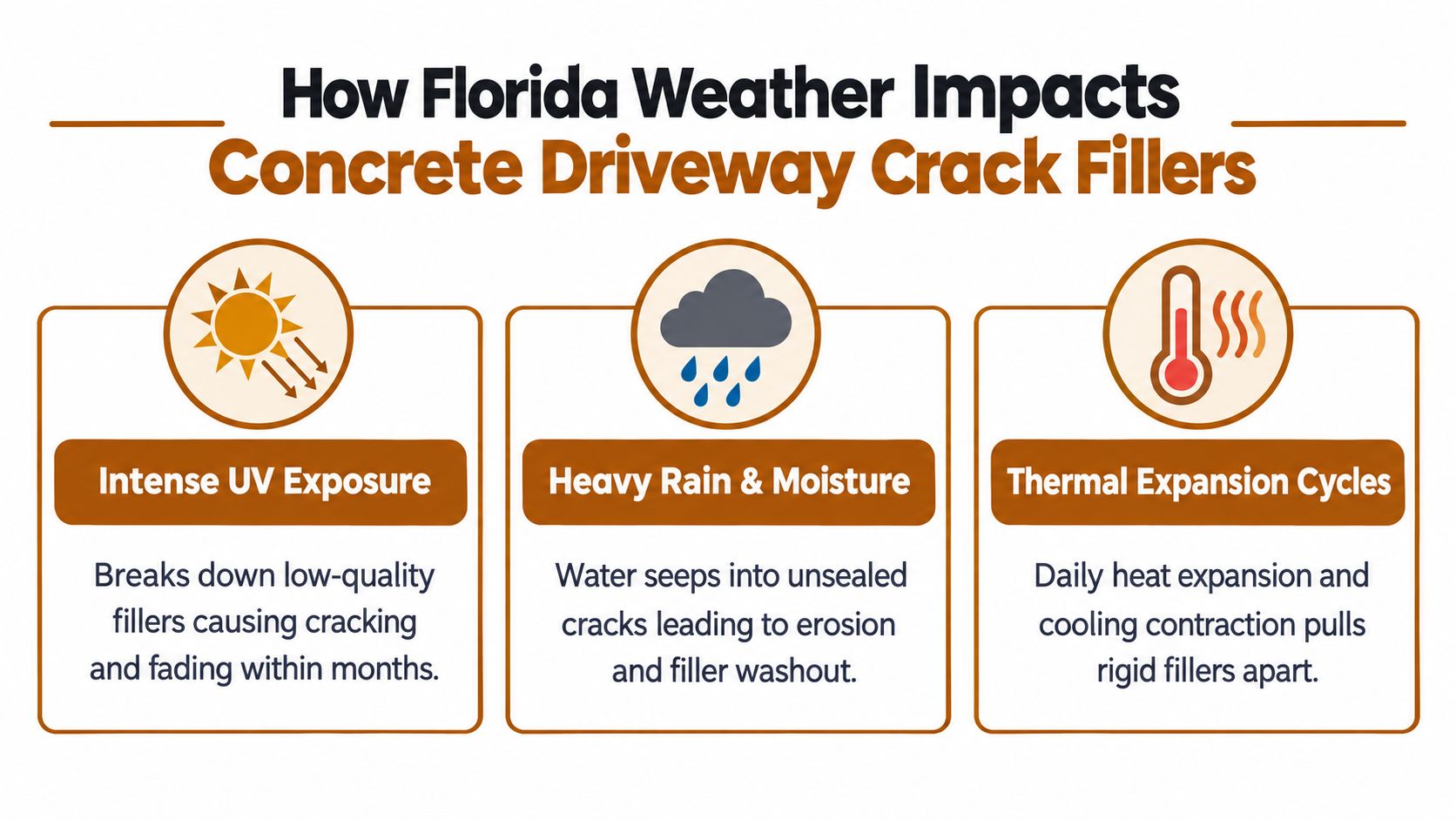
The American Concrete Institute's durability material emphasizes that cracks allow water and chemicals to move into concrete, especially in harsh exposure conditions. For Central Florida homeowners, that makes sealing a service-life decision, not just an appearance upgrade. A repair that blocks water while tolerating movement is more useful than one that just dries hard.
What hot-applied filler standards reveal
ASTM D5078/D5078M gives practical comparison benchmarks for hot-applied concrete driveway crack fillers. The standard specifies a minimum softening point of 65.5 °C (150 °F), non-immersed cone penetration at 25 °C no greater than 70 units, cone penetration at 4 °C of at least 15 units, and resilience of at least 30% recovery at 25 °C (ASTM performance requirements).
The same standard requires no adhesion failure and no oily exudate at the filler and concrete interface. Those requirements matter because heat can soften a poor product, causing tracking, bleed-out, or bond loss under tires.
For more background on how water affects slabs, see water damage to concrete. The repair material can't compensate for standing water, bad drainage, or a slab that continues to shift underneath it.
How to Match Crack Filler to Crack Width and Movement
Measure the crack before buying material, then inspect how it behaves. A ruler, feeler gauge, or crack-width card can help you distinguish a narrow surface fissure from an opening that needs routing and sealing.
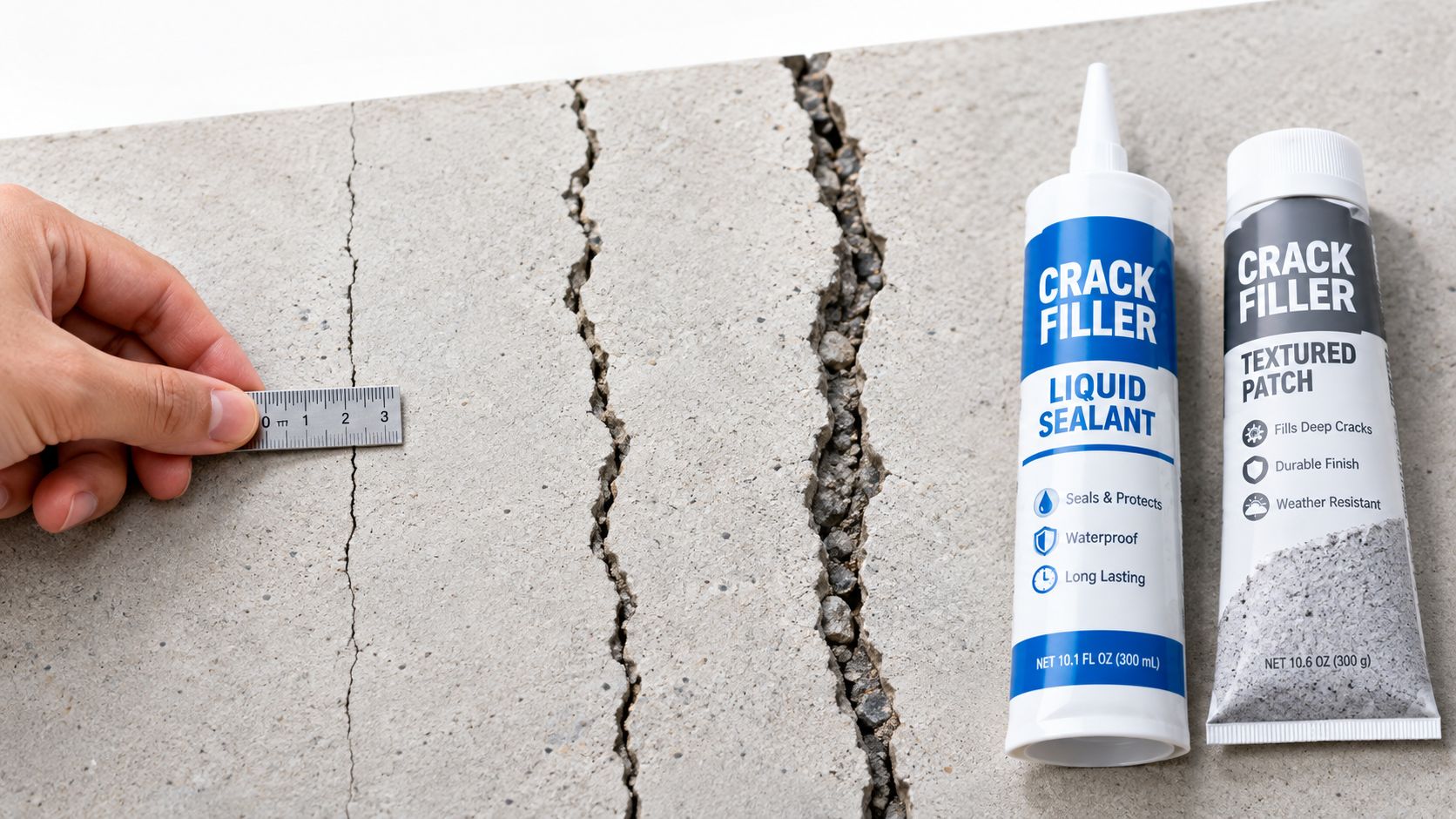
Look for these field clues:
- Stable hairline crack: The edges remain tight, with no visible offset or recurring moisture. A penetrating sealer or low-viscosity epoxy may be appropriate.
- Seasonally active crack: The opening changes, the sealant has split before, or the crack runs across a sun-exposed slab. Choose an elastomeric polyurethane or comparable flexible sealant.
- Moderate horizontal crack: The opening is wide enough to collect dirt and water. Clean it thoroughly, determine its depth, and consider routing or a backer material before sealing.
- Offset or settling crack: One side sits higher than the other, or the crack returns after repair. Filling the surface won't correct the slab movement.
The American Society of Concrete Contractors guidance provides a useful width-based framework for isolated horizontal cracks. Cracks less than 0.01 in. wide can be treated with a silane sealer, cracks from 0.01 in. to less than 0.03 in. can use methyl methacrylate, and cracks from 0.03 to 0.06 in. should be routed and sealed with a sealant.
Width alone doesn't settle the decision. A narrow crack that moves can outperform a wider stable crack as a repair challenge.
Use a stiff brush, vacuum, or compressed air to remove loose concrete and debris. Don't seal over dirt, vegetation, or standing water. If the crack has a joint-like pattern or lies where separate slabs meet, review guidance on concrete expansion joints before treating it as an ordinary crack.
The video below shows the type of inspection and repair sequence homeowners can use to evaluate a driveway opening before selecting a filler.
Best Crack Filler Recommendations for Homeowners and Property Managers
For a typical Central Florida driveway, my recommendation is straightforward. Use a flexible polyurethane crack sealer for moving exterior cracks, a low-viscosity epoxy for stable hairline cracks, and a cementitious material only when the crack is stable and the repair conditions suit it.
A homeowner can handle a limited DIY repair when the slab is level, the crack is clean, water isn't actively passing through, and the opening isn't returning after earlier work. Follow the manufacturer's preparation requirements, remove weak material, and use the correct application tool. A caulk gun is practical for many polyurethane products, while two-part epoxy may require a higher-thrust applicator and precise mixing.
The strongest filler is not automatically the most durable filler. Movement decides that.
Recommendations by property type
- Single-family driveway: Choose flexible polyurethane for an exterior crack that opens seasonally. Use epoxy only when the line is stable and hairline.
- HOA sidewalk or shared drive: Have recurring or offset cracks evaluated before spot filling. Repeated patching can leave trip hazards and inconsistent repairs.
- Rental or investment property: Seal manageable cracks early, then inspect drainage and slab edges. A cheap surface repair is a poor investment if water continues to enter.
- Commercial entrance or parking area: Coordinate crack treatment with traffic control, surface preparation, and broader asphalt or concrete maintenance. High traffic magnifies bond problems.
The International Concrete Repair Institute guidance makes the central distinction clear. If movement is expected, rigid fillers can fail and elastomeric sealants are preferred. Stable, non-structural cracks may accept cementitious or semi-rigid materials.
Riverside Sealing & Striping, LLC handles concrete crack filling and restoration alongside concrete replacement, asphalt sealcoating, and parking lot striping. That broader capability matters when a crack is part of a drainage, slab, or pavement-maintenance problem rather than an isolated cosmetic defect.
When to Call a Concrete Contractor in Marion or Citrus County
Call a contractor when the crack shows evidence of movement that a filler can't correct. That includes vertical displacement, a sunken slab, separated edges, recurring cracks after sealing, or a crack that continues to widen. A surface product can close the opening while leaving the cause untouched.
Water also changes the situation. Persistent dampness, runoff crossing the driveway, erosion beside the slab, or water transmitting through the crack points to drainage or concrete durability concerns. The ACI repair guidance identifies water transmission and crack cause as factors in choosing the repair method, so inspection should come before product selection.
Warning signs that need evaluation
- Uneven slab sections: A height difference suggests settlement, heaving, or loss of support beneath the concrete.
- Recurring repair failure: If the same line opens after repeated filling, the material is probably not the main problem.
- Structural-looking patterns: Long diagonal cracks, multiple connected cracks, or cracks near corners deserve more than a cosmetic patch.
- Active water intrusion: Sealing without addressing drainage can trap moisture or allow the repair to wash out.
- Very tight injection cracks: The U.S. Bureau of Reclamation concrete repair guide states that cracks receiving polyurethane resin injection shouldn't be less than 0.005 in. wide, while smaller cracks are better suited to methacrylic acrylates.
A professional can determine whether the driveway needs crack sealing, routing, injection, slab replacement, or full removal and replacement. The right answer may also involve nearby sidewalks, patios, curbs, or asphalt surfaces. Concrete and Asphalt Experts in Marion and Citrus County should evaluate the entire area when drainage and traffic affect more than one pavement type.

Local conditions across Central Florida
In Ocala, Dunnellon, Belleview, Silver Springs, Summerfield, and The Villages, homeowners often deal with intense sun, heavy rain, slab edges exposed to irrigation, and vehicle traffic concentrated near garage aprons. Citrus County properties around Crystal River, Homosassa, Inverness, Lecanto, Beverly Hills, and Hernando face the same need for moisture-conscious maintenance, with local drainage and soil conditions adding their own variables.
Riverside Sealing & Striping, LLC is a licensed and insured, family-owned Central Florida contractor serving Marion County, FL, Citrus County, FL, and surrounding counties. The company provides reliable scheduling, clear timelines, high-quality concrete workmanship, driveway and sidewalk replacement, asphalt sealcoating, and parking lot striping, with free, no-pressure on-site consultations and estimates available from 7am to 7pm. Before hiring any contractor, review questions to ask a concrete contractor and confirm that the proposed repair addresses movement, moisture, and the condition of the slab.
For a professional evaluation, contact Riverside Sealing & Striping, LLC for a free estimate on concrete crack repair, driveway replacement, patio or sidewalk work, or related asphalt maintenance. Visit Riverside Sealing & Striping, LLC to schedule a no-pressure consultation across Marion County, Citrus County, Ocala, Dunnellon, Crystal River, and nearby Central Florida communities.