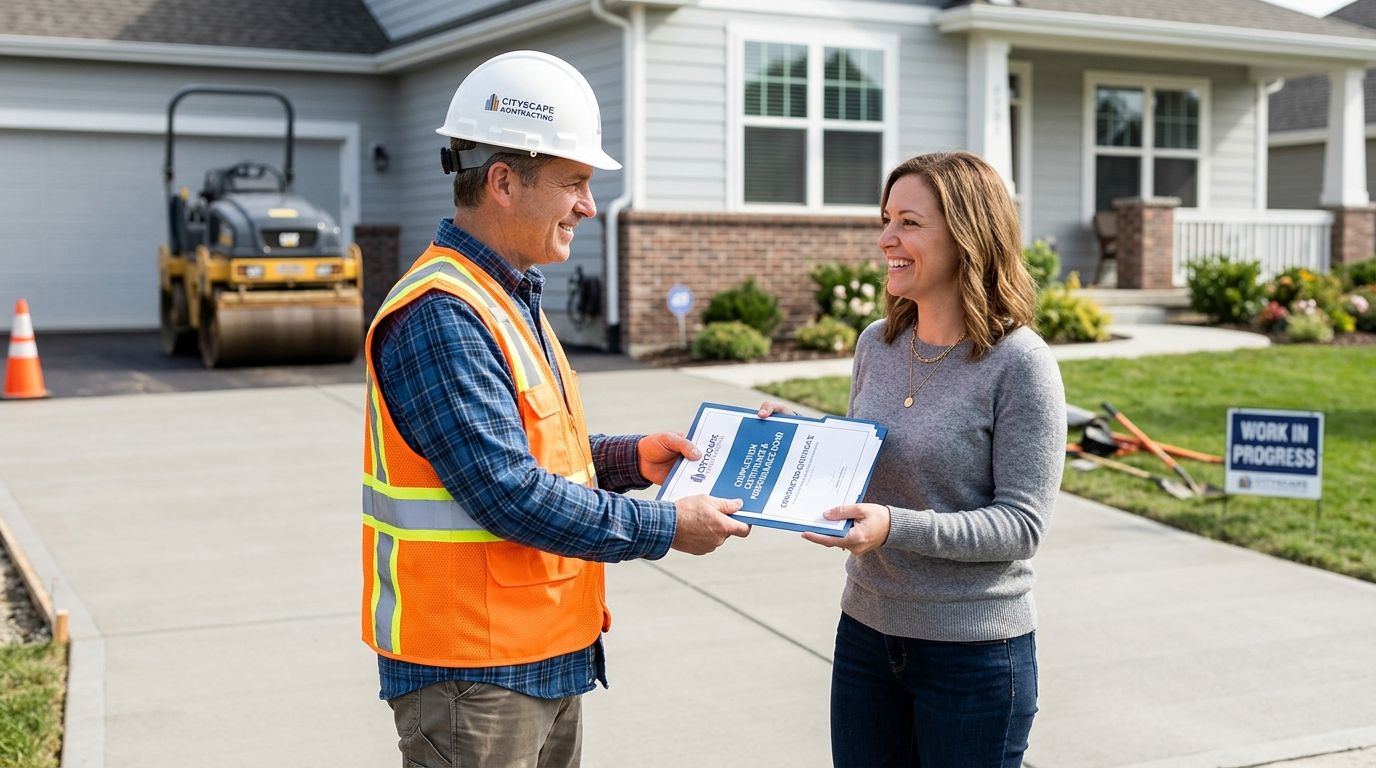
You're probably doing what most property owners in Central Florida do. You've got two or three quotes open on your phone for a new concrete driveway in Ocala, a patio in Summerfield, or asphalt repairs for a commercial lot in Belleview. One bid looks polished. One is cheap. One says “fully bonded and insured,” and you're left wondering whether that phrase protects you or just sounds good on paper.
That confusion costs people money.
In Marion County, FL and Citrus County, FL, I've seen homeowners focus on finish, price, and timeline while skipping the part that matters most when something goes wrong. If a contractor walks off the job, damages your property, or leaves you dealing with a claim, the quality of the sales pitch won't help. Credentials will.
For concrete and asphalt work in places like Dunnellon, Crystal River, Inverness, Homosassa, Lecanto, Beverly Hills, Hernando, Silver Springs, and The Villages, the safest hire is simple: work with bonded and insured contractors, then verify both before the first machine rolls in. If you want a good example of how local contractors present their background and experience, review a local company profile like James Young Paving information and compare that level of transparency to the bids on your desk.
Table of Contents
- Hiring a Contractor in Central Florida? Don't Just Skim the Quote
- What Bonded Really Means for Your Project
- How Insured Protects You from Accidents and Damage
- Why You Need Both Bonded AND Insured Contractors
- Your Contractor Verification Checklist for Marion and Citrus County
- How Riverside Sealing and Striping Delivers Peace of Mind
- Frequently Asked Questions About Contractor Credentials
- What's the difference between being licensed, bonded, and insured in Florida
- What are the real financial risks if I hire an uninsured contractor for a small job
- Is it rude to ask a contractor for proof of insurance and bond
- Should homeowners in Central Florida care about this as much as commercial property managers
- Does bonded and insured mean the contractor will automatically do great work
Hiring a Contractor in Central Florida? Don't Just Skim the Quote
A homeowner in Summerfield gets a quote for a replacement driveway. The concrete finish looks good on the proposal. The price is lower than the other bids. The contractor says he can start fast. That all sounds great until the homeowner asks for proof of coverage and gets a vague answer about “being covered.”
That's where smart hiring starts.
A property manager in Ocala faces the same problem on the commercial side. One company bids asphalt patching and striping for a retail lot. Another offers a cleaner scope, a clearer payment schedule, and proper paperwork. The first one is cheaper. The second one is safer. For parking lots, sidewalks, patios, slabs, and driveways across Marion County, FL and Citrus County, FL, that difference matters more than is often acknowledged.
Practical rule: If a contractor gets irritated when you ask for proof of bond and insurance, move on.
Central Florida weather adds pressure to every project. Heat, UV, heavy rain, standing water, and regular traffic all test workmanship fast. Concrete and Asphalt Experts in Marion and Citrus County know that a bad install doesn't stay hidden for long. Cracking, surface failure, drainage issues, and edge breakdown show up quicker when the work was rushed or underqualified.
That's why “bonded and insured” isn't a throwaway line. It's your first filter.
Why the phrase gets misunderstood
A lot of people assume bonding and insurance mean the same thing. They don't. One deals with performance and contractual responsibility. The other deals with accidents, injuries, and property damage.
If you hire the wrong contractor in Belleview, Dunnellon, or Homosassa, the problem usually falls into one of those two buckets. Either they fail to do the job they promised, or something goes wrong during the work. If you only checked price, you're exposed.
What matters more than the wording
Any contractor can print “licensed, bonded, and insured” on a quote. The key question is whether they can prove it with current documents and whether those documents match your job.
Use the quote as a starting point, not proof. For concrete driveways, sidewalks, patios, asphalt maintenance, sealcoating, and parking lot striping, verification is part of protecting your property, your budget, and your timeline.
What Bonded Really Means for Your Project
A bond protects you when the contractor fails to do the job promised in the contract. That is the practical meaning.
A bond is a three-party promise
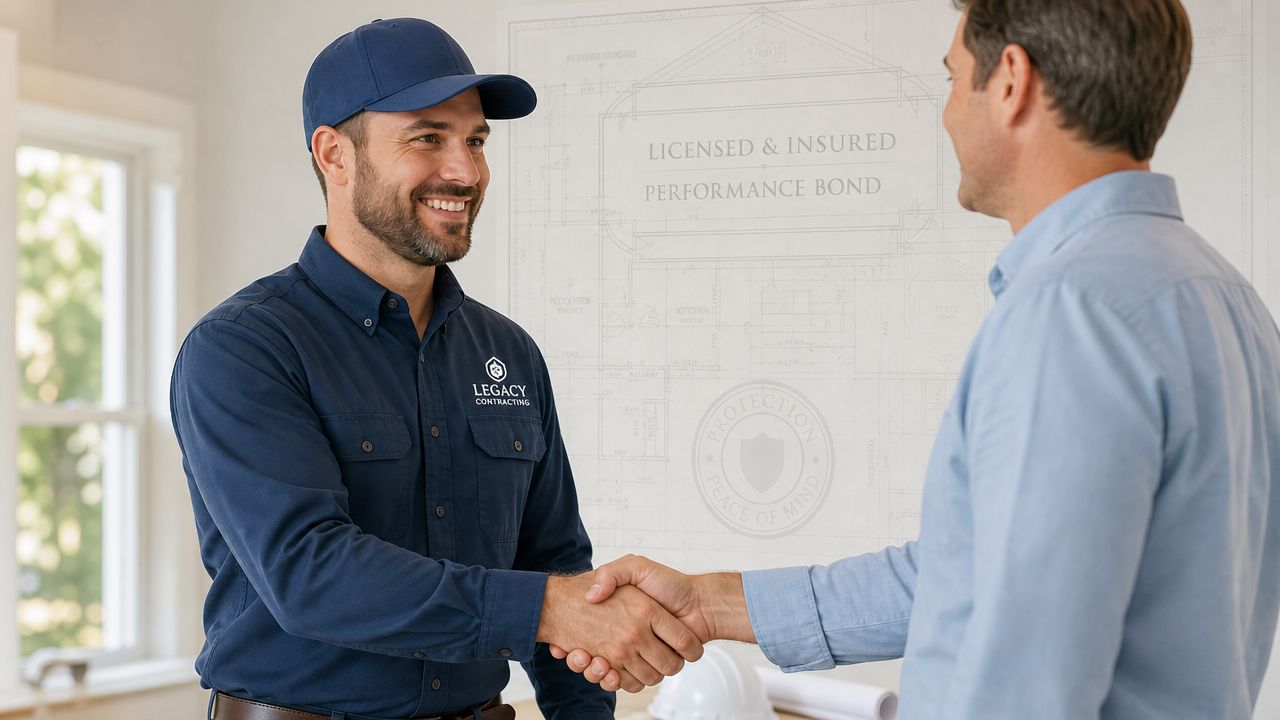
A surety bond involves three parties: the contractor, the property owner, and the surety company. If the contractor fails to meet the contract terms, the bond can provide a financial remedy up to the bond amount. The contractor still remains responsible for that loss. As explained by Surety Bonds Direct's overview of licensed, bonded, and insured contractors, a bond does not transfer the contractor's risk the way insurance does.
That matters for one simple reason. A bonded contractor has another layer of financial accountability attached to the job.
For concrete and asphalt work in Central Florida, that matters more than many owners realize. Heavy rain exposes grading mistakes fast. Heat and UV punish weak mixes, poor compaction, rushed curing, and thin applications. If a contractor cuts corners on a driveway, parking lot, sidewalk, or sealcoating job in Marion or Citrus County, the climate helps expose the problem early.
What a bond actually protects against
Bond protection applies to contract failure, not jobsite accidents.
For property owners in Lecanto, Ocala, or The Villages, that usually looks like one of these problems:
- The contractor takes a deposit and leaves the job unfinished
- The work does not match the written scope and the contractor refuses to correct it
- The contractor fails to meet project obligations that delay completion or trigger disputes
That is the lane a bond covers. Performance. Contract compliance. Financial accountability tied to the agreement you signed.
A bond does not pay because a machine damages your fence or a worker gets hurt on site. Insurance handles that. Bonding addresses a different risk entirely.
What to verify before you rely on the word “bonded”
Do not stop at the sales pitch. Ask for the bond information and check that it fits your job.
Look for these details:
- Bond type. Ask whether it is a license bond, bid bond, payment bond, or performance bond. For many private residential jobs, the word “bonded” may refer only to a license bond, which is not the same as a project-specific performance bond.
- Active status. Make sure the bond is current on the day you hire them.
- Business name match. The legal business name on the bond should match the name on the proposal and invoice.
- Bond amount. A tiny bond does not offer much protection on a larger paving or concrete job.
- Scope fit. Confirm the bond applies to the type of work being performed.
Owners often get burned. A contractor says he is bonded. The paperwork exists. Then you find out the bond is tied to a license requirement, covers a limited amount, or does not really address the project failure you are worried about.
Why bonding matters more in this region
In Central Florida, weather and drainage are part of the job whether the contractor plans for them or not. Afternoon storms, sandy subgrades, washout risk, standing water, and heat expansion all put pressure on workmanship. Local site conditions also raise the stakes on slope, base prep, compaction, and water management.
If the contractor fails to build the surface correctly, you may not be dealing with a cosmetic issue. You may be dealing with ponding near structures, early cracking, edge failure, peeling sealcoat, or striping that does not hold up through one wet season.
Bonding does not fix bad work by itself. It gives you a path to pursue when the contractor fails to meet the contract and will not make it right. That is why I treat bonding as a screening tool. It does not prove the contractor is great, but it does help weed out operators who have little financial backing and even less accountability.
How Insured Protects You from Accidents and Damage
Insurance handles a completely different category of risk. If bonding is about whether the contractor fulfills the agreement, insurance is about what happens when something goes wrong during the work.
General liability covers the accident side
Think of commercial general liability insurance like the contractor's accident coverage for third-party damage. If equipment cracks a nearby walkway, materials damage part of your property, or operations create covered third-party damage, this is the type of policy you want in place.
An insured contractor must carry commercial general liability insurance, typically a minimum of $50,000 to $1,000,000+ depending on state and project scope, to protect against third-party bodily injury or property damage accidents during operations, as outlined in Oklahoma contractor requirements discussing CGL coverage. The same source makes the distinction clear. Insurance covers accidental damage. Bonding covers non-performance or financial default.
For concrete and asphalt jobs in Crystal River or Homosassa, this matters because the work is physical, equipment-heavy, and done outdoors. Skid steers, saws, hot materials, delivery trucks, and surface prep tools can all create risk if the operator is careless.
A few realistic examples:
| Situation | What should respond |
|---|---|
| A machine damages a nearby structure during site prep | General liability |
| Overspray or material handling causes property damage | General liability |
| A contractor fails to complete the agreed scope | Bond, not liability insurance |
Workers comp matters on your property
If a crew member gets hurt while working on your project, you do not want a mess over who pays.
Workers compensation coverage matters because injuries happen on active job sites. Concrete tear-out, formwork, grading, asphalt repairs, and striping all involve labor, tools, and moving equipment. If a contractor cuts corners on this part of the business, you're taking on risk you didn't agree to.
Ask for proof of liability coverage and ask who carries coverage for the crew on site. Don't assume the answer is yes.
Homeowners often think this only matters on large jobs. It matters on small jobs too. A short sidewalk replacement in Silver Springs or a compact asphalt repair in Hernando can still turn into a liability problem if someone gets injured and the contractor doesn't have the right coverage.
Why insurance matters so much in Florida conditions
Florida weather isn't gentle on job sites. Rain can change site conditions fast. Heat affects crews, equipment, and materials. On concrete work, timing and curing matter. In Florida's hot and humid climate, concrete driveways require approximately 28 days to reach full hardness, while asphalt cures faster and is often better suited for quicker installations when a stable base exists, according to U.S. Pave's Florida comparison of asphalt and concrete.
Those conditions increase the need for organized crews, proper scheduling, and real coverage. When the weather turns or site conditions shift, professionals adjust. Uninsured contractors improvise, and that's when damage claims start.
Why You Need Both Bonded AND Insured Contractors
Start with a simple Central Florida scenario. A contractor removes part of your driveway in Ocala, collects a deposit, then disappears before the base is corrected and the pour is scheduled. Insurance does not solve that problem. A bond is what addresses contractor default.
Now flip the situation. A crew is repairing asphalt in Silver Springs after a week of rain, equipment shifts on soft ground, and a nearby curb or utility box gets damaged. A bond does not pay for that kind of accidental loss. Insurance is what matters there.

That is why hiring bonded and insured contractors is the baseline, not a bonus. These cover two different risks, and concrete and asphalt work in Central Florida creates both.
Bond covers contract failure. Insurance covers accidental loss.
Keep the distinction simple:
- Bonded: Helps protect you if the contractor fails to perform under the contract
- Insured: Helps protect you from covered property damage, job-site accidents, and injury claims
- Both: Reduce your financial exposure from two separate directions
If a contractor has one but not the other, you are still carrying part of their business risk yourself. That is a bad deal for any property owner.
Cheap bids usually hide expensive gaps
The Surety Foundation found that unbonded construction projects cost 85% more to complete upon contract default than bonded ones, according to the 2023 Surety Protects analysis. That matters on a commercial lot in Marion County just as much as it does on a residential driveway in Inverness.
Default costs pile up fast:
- You pay another contractor to inspect and price unfinished work
- You lose time while the site sits exposed to rain and traffic
- You may have to remove bad prep, bad mix, or failed sections before anyone can restart
- You can end up in disputes over deposits, materials, and damage to adjacent surfaces
That is the part many owners miss. The original quote is only one number. The replacement cost after a failed job is the number that hurts.
Central Florida conditions make verification more important
Concrete and asphalt work here is not forgiving. Heavy rain changes subgrade conditions. Heat shortens working time. UV exposure beats up surfaces. Drainage errors show up quickly in flat lots, drive lanes, sidewalks, and aprons across Marion and Citrus County.
Local code and inspection requirements matter too, especially where drainage, right-of-way tie-ins, striping layout, ADA access, and commercial pavement markings are involved. If the contractor mishandles the scope or abandons the job midstream, you are left with more than an ugly surface. You are left with compliance issues, rework, and delays.
That is why you should treat credentials as part of the job, not paperwork after the fact.
Before you sign anything, review a solid list of questions to ask a concrete contractor and demand proof that matches the company name on the proposal.
Hire the contractor who can prove both
A real professional should be able to show current insurance documentation, explain whether a bond applies to your project, and give you a contract that clearly matches the business entity doing the work.
If they dodge those questions, keep looking.
For concrete and asphalt in Central Florida, the right hire is not the lowest bidder. It is the contractor who can finish the job, carry the risk that belongs to them, and prove it before work starts.
Your Contractor Verification Checklist for Marion and Citrus County
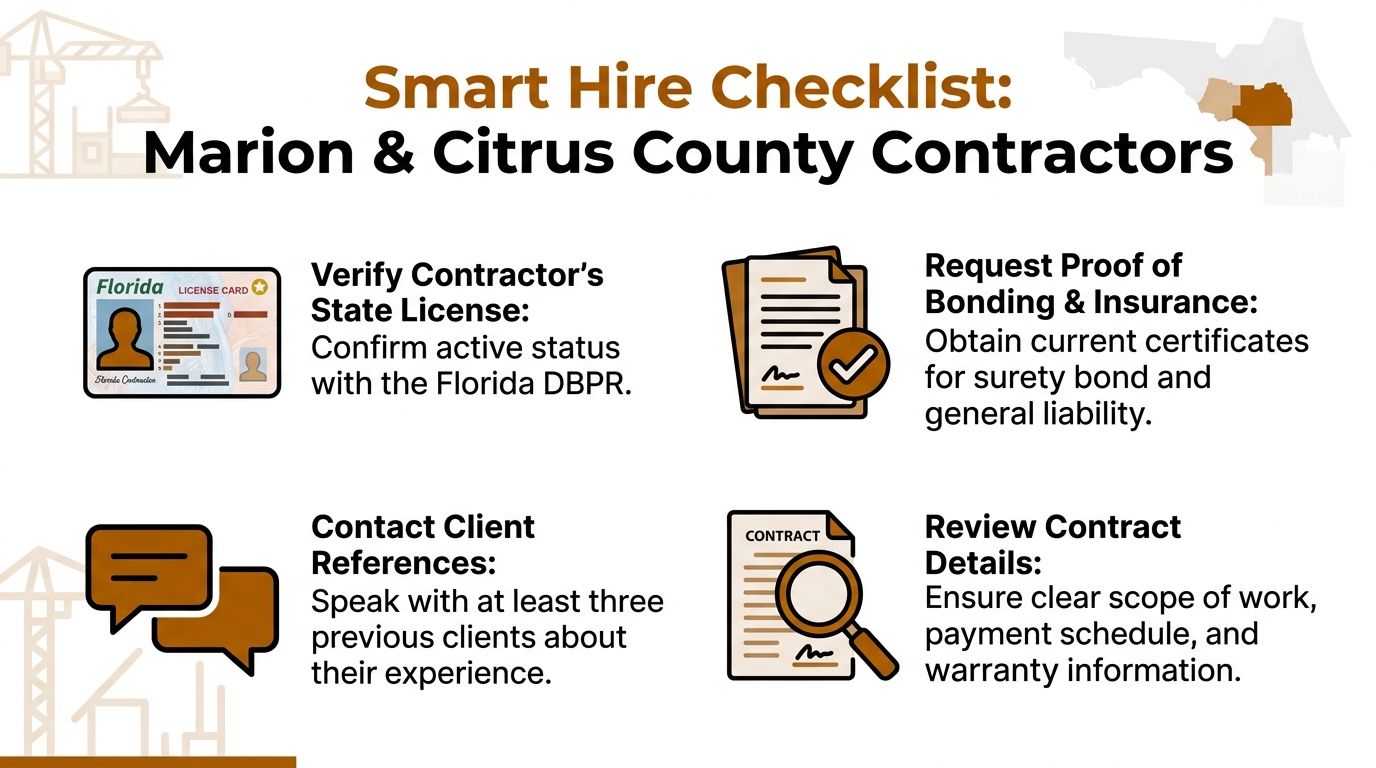
Most hiring mistakes happen because owners trust a verbal answer. Don't. Ask for documents, then verify them.
What to ask for before you sign
Use this checklist whether you're meeting a contractor in Crystal River, Inverness, Dunnellon, Belleview, or The Villages.
Ask for the contractor's state license information
Don't settle for “we're licensed.” Ask for the actual license details and verify active status through the appropriate Florida system.Request a current Certificate of Insurance
You want a real COI, not a screenshot of a policy page and not a verbal promise. Review the named insured carefully and make sure the business name matches the contract.Check the certificate holder details when appropriate
On many projects, especially commercial work, you should ask to be listed properly so there's a clear paper trail tied to your job or property.Call the insurance agent listed on the certificate
This step filters out bad paperwork fast. Confirm the policy is active and ask whether the certificate reflects current coverage.
Before you go further, it helps to know the broader screening questions that serious owners ask. A practical reference is this list of questions to ask a concrete contractor before hiring.
Here's a useful video overview on contractor verification and hiring due diligence:
Verify the bond, not just the insurance
A lot of owners stop at insurance. That's incomplete.
Ask for the bond number, the surety company name, and the exact business name the bond is issued under. Then call the surety company and confirm the bond is active and tied to the contractor you're hiring. If the names don't match, treat that as a problem until it's cleared up.
For larger residential jobs and commercial site work, also read the contract closely.
- Scope of work: Make sure demolition, base prep, materials, finish, cleanup, and striping details are spelled out.
- Payment schedule: Avoid front-loaded payments that give the contractor most of the money before meaningful progress.
- Correction terms: The contract should say how deficiencies are handled if the work doesn't match the agreement.
Good contractors answer credential questions quickly. Bad contractors turn simple paperwork into a long story.
Red flags that should stop the deal
You don't need to be rude. You do need to be firm.
Walk away if you hear any of these:
“We're covered, don't worry about it.”
If they won't show proof, assume the proof doesn't help them.“You don't need a bond for a job this size.”
Maybe, maybe not. But if they advertised bonded status, verify it.A bid that's dramatically lower without a clear reason
Cheap often means skipped prep, weak materials, no coverage, or all three.Pressure to sign immediately
Professionals let you review documents and compare apples to apples.
For owners in Marion County, FL and Citrus County, FL, this checklist is simple risk control. It works whether you're hiring for decorative concrete, driveway replacement, asphalt sealcoating, or parking lot striping.
How Riverside Sealing and Striping Delivers Peace of Mind
The easiest way to judge a contractor is to compare what they promise with what a professional operation should provide. A serious company should be ready to discuss licensing, insurance, project scope, scheduling, and site protection without getting defensive.
What professionalism looks like on a real project
For property owners in Ocala, Dunnellon, Summerfield, Crystal River, and surrounding Central Florida communities, peace of mind comes from process. That means clear communication, current documentation on request, realistic scheduling, and workmanship that fits Florida conditions.
Riverside Sealing & Striping, LLC presents itself exactly where a modern contractor should. The company serves as Concrete and Asphalt Experts in Marion and Citrus County, with work spanning concrete driveways, patios, sidewalks, slabs, asphalt sealcoating, and parking lot striping. That balance matters. If you need concrete replacement at one property and pavement maintenance at another, you want a contractor that understands both trades.
The company's local service model also matches what owners typically need most: reliable scheduling, no-pressure consultations, and practical recommendations instead of hard selling. If you're evaluating surface condition, it helps to review examples of specialized service pages like their information on Florida asphalt repair services and compare that clarity with other contractors you're considering.
A trustworthy Central Florida contractor should make it easy to confirm the basics:
| What you should expect | Why it matters |
|---|---|
| Current proof of insurance | Protects against covered accidents and damage |
| Proof of bonding when applicable | Protects against contract-related default risk |
| Clear scope and timeline | Reduces disputes and surprise costs |
| Local experience | Helps match methods to Florida heat, rain, and traffic |
That's the standard owners should expect in Marion County, FL, Citrus County, FL, and nearby cities like Belleview, Silver Springs, Homosassa, Lecanto, Inverness, and Beverly Hills. Not a polished estimate alone. Real documentation, clear answers, and work built for the region.
Frequently Asked Questions About Contractor Credentials
What's the difference between being licensed, bonded, and insured in Florida
A license shows the contractor has met the applicable requirements to operate legally. A bond relates to contractual accountability and financial responsibility. Insurance covers certain accidents, injuries, and property damage. They are not interchangeable.
What are the real financial risks if I hire an uninsured contractor for a small job
Even on a small driveway, sidewalk, or patio project, an accident can create a claim problem. If property gets damaged or someone gets hurt, lack of coverage can leave the owner dealing with expensive headaches that should have been the contractor's responsibility.
Is it rude to ask a contractor for proof of insurance and bond
No. It's standard business. Professional contractors expect the question and should be ready to answer it clearly.
Should homeowners in Central Florida care about this as much as commercial property managers
Yes. The project size changes. The risk doesn't disappear. Residential concrete jobs and commercial asphalt jobs both involve equipment, labor, contracts, and site conditions that can go sideways.
Does bonded and insured mean the contractor will automatically do great work
No. Credentials don't replace craftsmanship. They reduce financial risk. You still need to review scope, references, communication, and experience with concrete and asphalt work in Florida conditions.
If you need a contractor who understands both surface performance and risk protection, Riverside Sealing & Striping, LLC is a strong local option for homeowners, HOAs, and commercial properties across Central Florida. They serve Marion County, Citrus County, and nearby communities with concrete work, asphalt sealcoating, and parking lot striping, and they offer free, no-pressure consultations so you can review your project, your options, and your next step without being pushed into a rushed decision.