
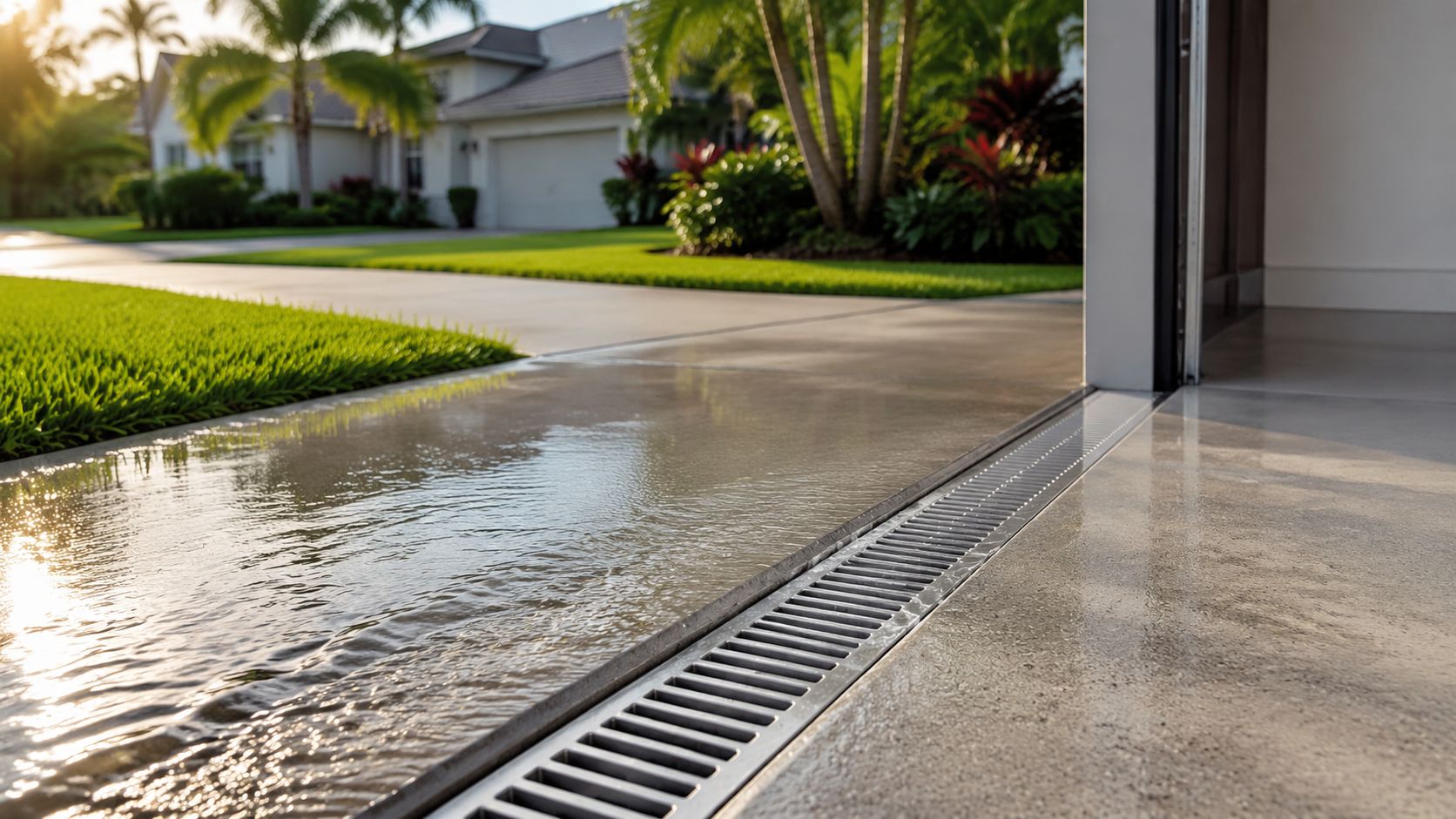
After a heavy Central Florida downpour, the water may still be sitting across your concrete driveway long after the clouds clear. In Ocala, Dunnellon, The Villages, Crystal River, and other communities across Marion County, FL and Citrus County, FL, flat lots, intense rain, settling soil, and poorly planned discharge routes can turn a usable driveway into a shallow basin.
Effective concrete driveway drainage requires more than checking whether the slab appears to slope away from the garage. The surface pitch, surrounding yard, roof runoff, soil infiltration, and final outlet all work together. A channel drain may solve one property, while regrading, a swale, a French drain, or full driveway replacement may be necessary on another.
Table of Contents
- Why Your Concrete Driveway Puddles After Every Storm
- Slope Standards and Grading Benchmarks That Actually Work
- Drainage Solutions From Channel Drains to Regrading
- The Whole-Site Water Problem Most Guides Ignore
- Permeable Concrete Versus Standard Slabs With Drains
- When to Call a Professional and What to Expect
Why Your Concrete Driveway Puddles After Every Storm
The rain stops, the sun comes back out, and you notice the same problem again. Water has collected near the garage, along one edge, or in a broad low area where your tires pass every day. The concrete may look intact, and from the side it may even appear to fall toward the street.
That appearance can be misleading. A driveway can have a general downhill direction while still containing a settled section, an uneven cross-slope, or a low point that traps water. Soil erosion beneath the slab can remove support, while nearby landscaping can redirect runoff back toward the concrete. In some cases, the slab drains correctly until the outlet, yard, or stormwater feature becomes overwhelmed.
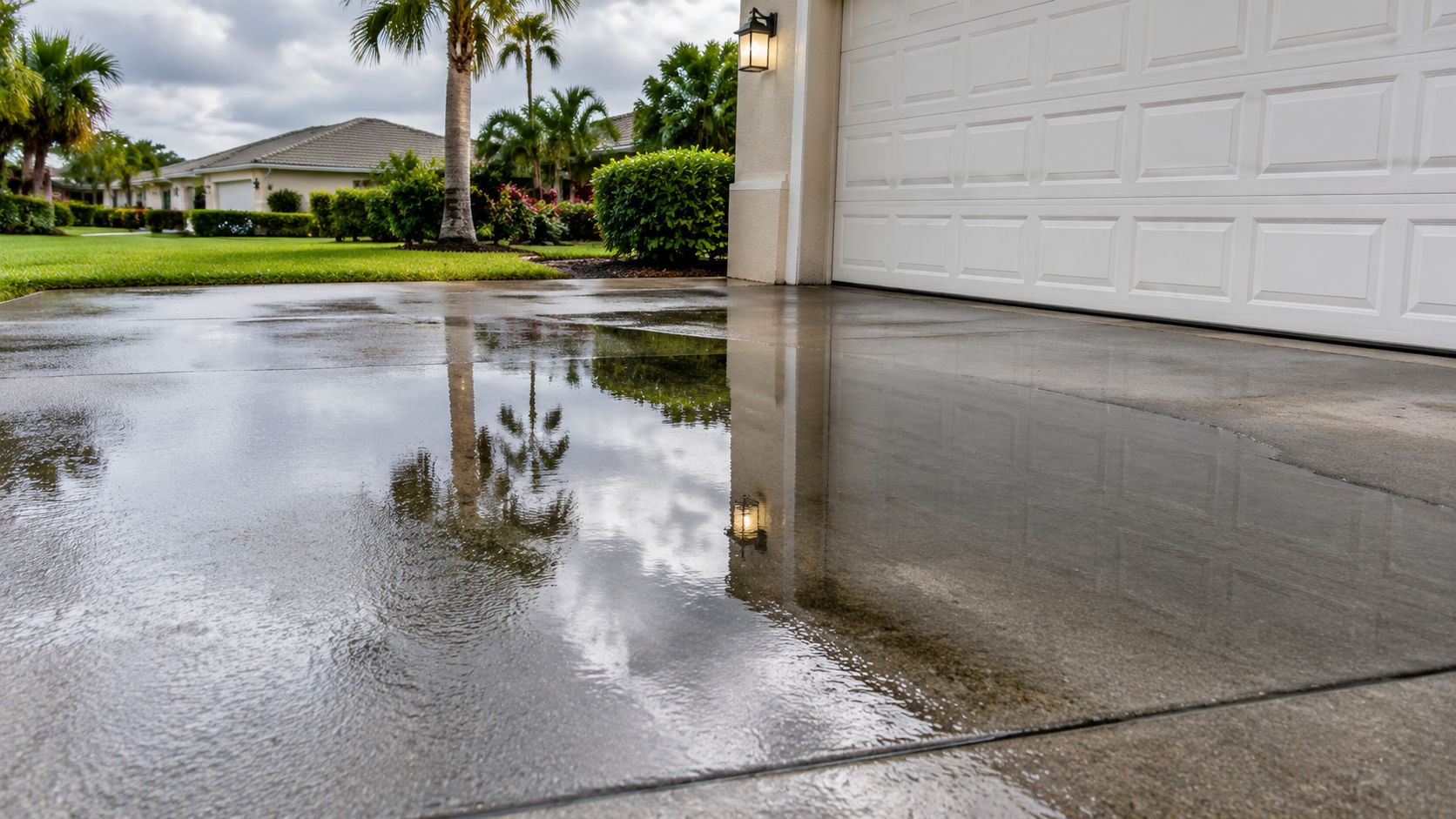
What the puddle is telling you
The location of the standing water provides a useful first clue:
- Near the garage threshold: The upper driveway may lack enough fall, or runoff may be moving toward the structure.
- Along one side: Adjacent grading, a roof downspout, or a neighboring hardscape may be feeding that edge.
- In the middle of the slab: Settlement or an inadequate original grade is more likely.
- At the street or property edge: The driveway may be working, but the receiving area or outlet can't accept the flow.
Standing water isn't only cosmetic. Repeated saturation can weaken the supporting base, expose joints to persistent moisture, and direct runoff toward foundations or other vulnerable areas. Concrete itself can also deteriorate faster when water repeatedly remains in the same locations.
Practical rule: Find where the water comes from and where it should go before choosing a repair.
This is why drainage complaints are common in areas such as Belleview, Summerfield, Silver Springs, and The Villages. Many Central Florida lots have limited grade, and a strong storm can deliver more water at once than a shallow surface route or undersized outlet can move. A patch over the puddle won't correct the grade beneath it.
Slope Standards and Grading Benchmarks That Actually Work
A driveway doesn't need to be level to be usable, and it shouldn't be. Exterior concrete is intentionally pitched so water leaves the slab instead of lingering at joints or soaking into the supporting base.
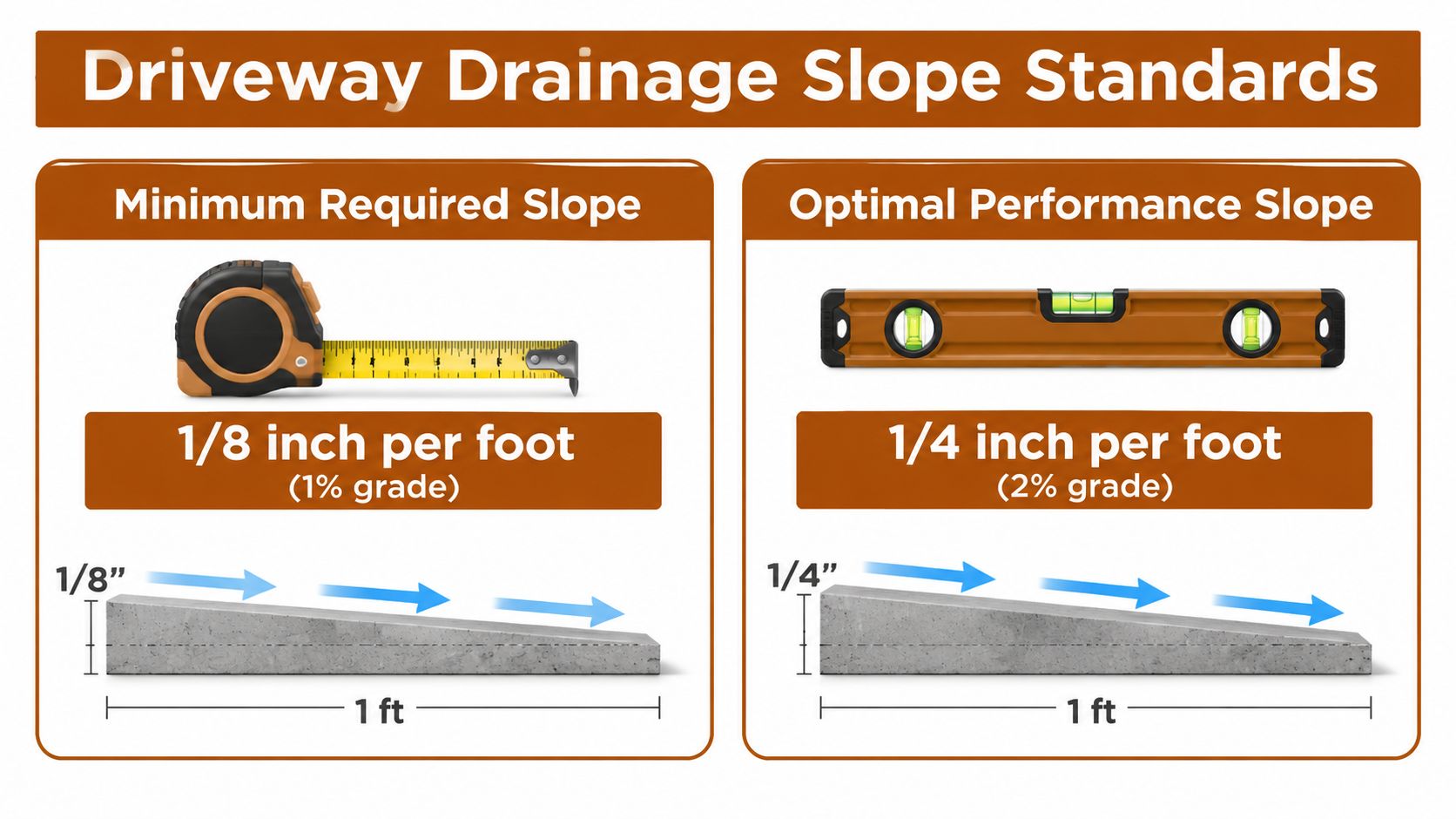
A widely used benchmark sets the minimum driveway slope at 1/8 inch per foot, which is about a 1% grade. A 1/4-inch-per-foot slope, about a 2% grade, is often preferred for stronger runoff performance. Near a garage, the first 4 to 6 feet should drain away at at least 1/4 inch per foot, according to practical driveway drainage guidance from concrete driveway drainage benchmarks.
Over a 50-foot driveway, a 1/4-inch-per-foot fall creates a 12.5-inch elevation change, as explained in the same driveway slope guidance. That difference is large enough to move water decisively toward the street or another planned outlet, provided the surrounding site accepts the discharge.
How to evaluate an existing driveway
A homeowner can make a preliminary check with a long level, a straight board, and a measuring tape. Measure the vertical difference over a known horizontal distance, then compare the result with the slope targets above. This won't replace a site survey, but it can reveal whether the slab is nearly flat or whether a visible low area interrupts the intended fall.
Look closely at the transition between the garage floor, driveway apron, sidewalk, and street. A driveway may need a stronger longitudinal slope while keeping the walkway transition comfortable. Guidance for accessible walking routes limits cross-slope to 2%, or 1:48, so drainage corrections can't tilt every surface as steeply as possible. The driveway drainage requirements guide discusses this balance, along with drain placement and channel fall.
A contractor also needs to inspect the soil and base. If the slab has settled, adding a topping layer may hide the low spot without restoring structural support. For homeowners planning replacement work, preparing the ground for a concrete slab is a critical part of achieving dependable drainage.
A visual explanation can help you understand how a small grade changes water movement:
Drainage Solutions From Channel Drains to Regrading
The correct fix depends on the location of the low point, the condition of the slab, available space, and where the water can legally and safely discharge. A drain isn't automatically the answer, and regrading isn't always practical beside an existing garage.
Channel drains at protected edges
A channel, or trench, drain is often appropriate where the driveway can't be pitched fully away from the structure. Place it at the true hydraulic low point near the garage or another protected edge, generally a few inches from the threshold rather than directly against the building. The grate must be rated for vehicle traffic, and the drain body should fall about 0.5%, roughly 1/16 inch per foot, toward a catch basin or outlet, as described in channel drain installation guidance.
The drain needs a real destination. Depending on the site, that may be an approved stormwater route, infiltration feature, soakaway, or catch basin. A flat channel collects sediment and standing water, even when the driveway surface has the correct pitch.
Regrading and slab correction
Regrading works when the surrounding soil and driveway layout allow a contractor to establish a continuous path away from the structure. It may involve removing unsuitable material, rebuilding the base, adjusting elevations, and replacing affected concrete.
A settled slab may require lifting or replacement, depending on the severity and condition of the concrete. Mudjacking or other lifting methods can sometimes restore a slope, but they won't solve a roof downspout that continues to discharge into the same low area. Cracked, broken, or badly tilted concrete often needs removal and replacement rather than a cosmetic surface repair.
Swales, French drains, and permeable options
A grassed swale can collect and redirect runoff on a property with enough open space and a gentle grade. Engineering guidance identifies swales as suitable for driveway and parking-lot runoff where the slope is 5% or less, and not effective where the slope exceeds 5%. See the grassed swale design guidance before assuming a shallow ditch will work.
French drains and gravel-filled trenches can help intercept water moving through the yard before it reaches the driveway. They still need a correctly selected location, adequate capacity, and a discharge route. Maintenance also matters. Storm drain maintenance information reinforces the need to keep drainage components clear rather than treating installation as a one-time task.
| Solution | Best For | Key Limitation |
|---|---|---|
| Channel drain | Water collecting near a garage or protected edge | Needs a traffic-rated grate, internal fall, and approved outlet |
| Regrading | Driveways with inadequate overall pitch | May require major excavation and concrete replacement |
| Slab lifting | Settled concrete that remains structurally usable | Won't correct site runoff or a failed base |
| French drain | Water moving through adjacent soil | Requires space, suitable soil, and a functioning outlet |
| Grassed swale | Open properties with gentle grades | Not effective beyond the stated slope limit |
| Permeable pavement | Sites designed for infiltration | Requires compatible soil, maintenance, and overflow planning |
The Whole-Site Water Problem Most Guides Ignore
A driveway can slope away from the house and still puddle because the slab is only one part of the drainage system. Start at the roof, not the concrete. A downspout discharging beside the driveway can send a concentrated stream across the edge, while an uphill lawn, patio, pool deck, or neighboring hardscape can add more runoff during a storm.
Trace the water during rainfall if it's safe to do so. Watch where it enters the property, where it crosses the yard, and whether it reaches the driveway before disappearing. Inspect downspout extensions, edging, berms, compacted soil, and any low areas along the driveway border.
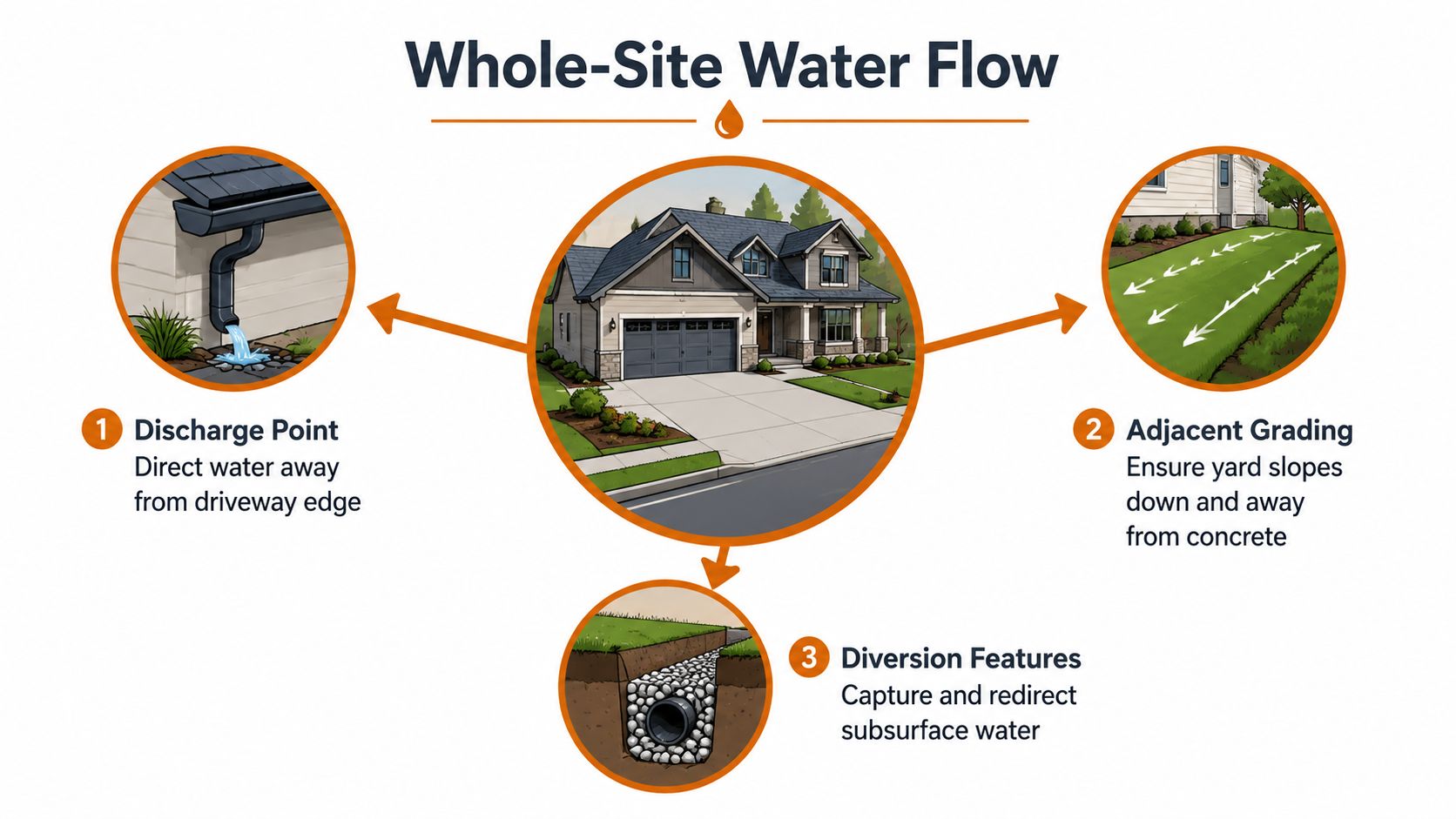
Follow the water beyond the slab
The downstream point matters as much as the driveway pitch. A channel drain that empties into a blocked area, a French drain installed in poorly infiltrating soil, or a swale with nowhere to release water will move the problem rather than solve it.
Stormwater guidance for pervious pavement makes this broader point clearly. The system must account for native subsoil infiltration, may require an underdrain for overflow, and should drain within 48 hours, according to pervious pavement stormwater guidance. Those principles also apply when diagnosing conventional driveway drainage. The water needs a complete route from collection to discharge.
This whole-site review is particularly important in Silver Springs, Beverly Hills, Hernando, and other Central Florida locations where flat lots and intense rain can make the surrounding area the limiting factor. Raising or resurfacing the slab won't help if the yard continues to send runoff into the same area.
Homeowners should also consider water from adjacent properties. A driveway may be receiving overflow from a higher neighboring surface, and correcting that condition could require coordinated grading or a diversion feature rather than a change to the concrete alone. Persistent water damage to concrete often reflects this interaction between the slab and the surrounding site.
Permeable Concrete Versus Standard Slabs With Drains
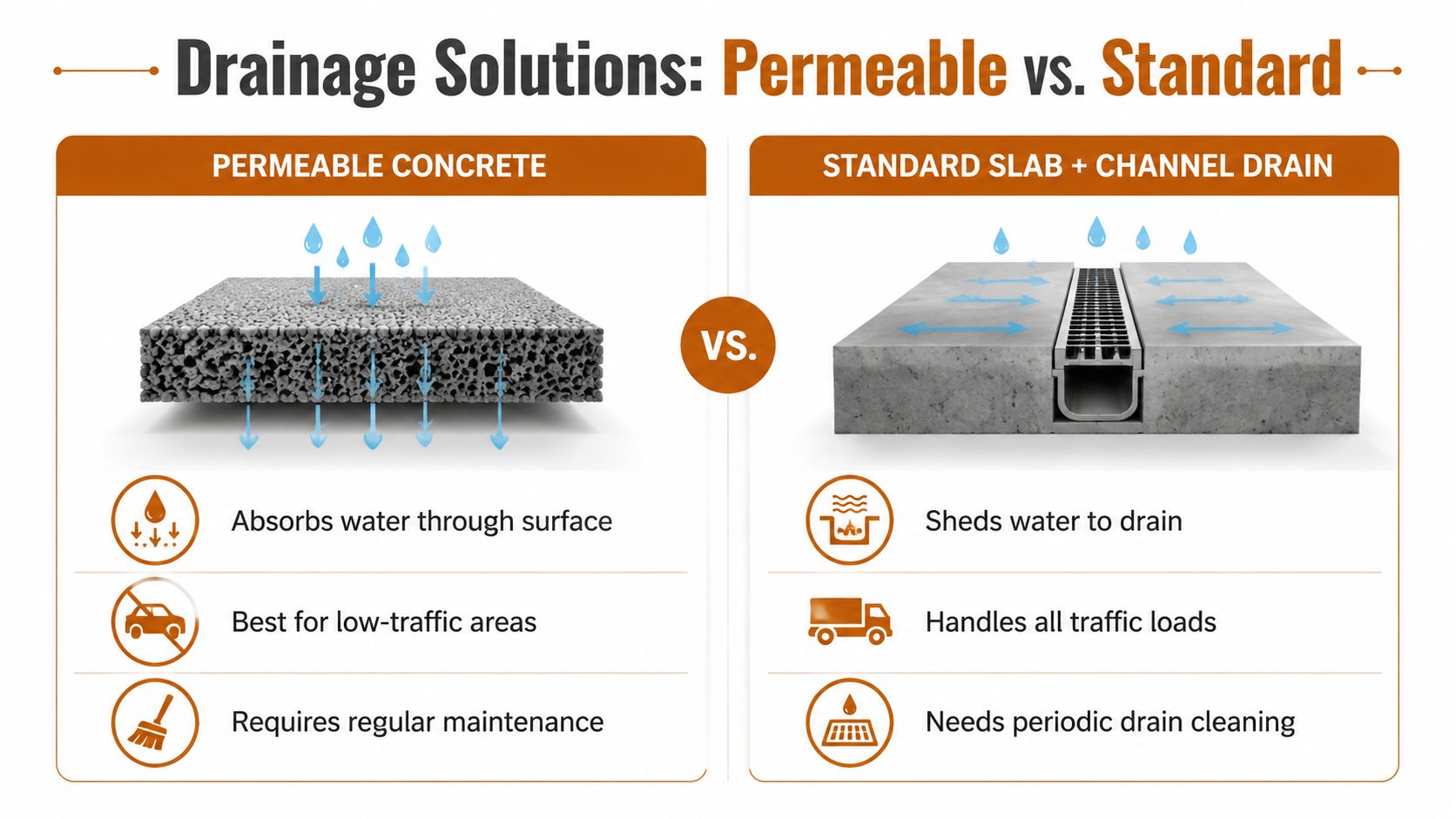
Permeable pavement changes the way water enters the system. Instead of shedding nearly all rainfall across a solid surface, the pavement allows water to move through the surface and into a designed stone base, where the soil can infiltrate it or an underdrain can carry overflow away.
The approach can work well when the native soil accepts water, the base is designed for the site, and the owner will maintain the surface. Planning guidance says permeable pavement can handle 70% to 80% of common storms when the complete base-and-outlet system is designed correctly, as summarized in pervious pavement design guidance.
Where permeable pavement fits
Permeable concrete may be worth considering for a replacement driveway, a parking area, or a site where runoff reduction is a priority and the subsoil supports infiltration. It can reduce the volume of water moving across the surface, but it isn't a magic material for a flat, poorly drained lot.
The system needs protection from clogging, appropriate base construction, and a plan for heavier storms. If water can't infiltrate quickly enough, an underdrain or overflow route must take over. Without that backup, the pavement may still pond.
Why standard concrete remains practical
A conventional slab paired with a properly sized channel drain is often easier to inspect, clean, repair, and coordinate with existing driveways. It also gives the contractor direct control over surface fall and the collection point. For many homes in Ocala, Dunnellon, and Citrus County, that straightforward arrangement is more practical than rebuilding the entire driveway around an infiltration system.
The decision should account for soil, maintenance expectations, traffic, available space, and the property's discharge limitations. A permeable design isn't automatically better, and a standard slab isn't automatically simpler if the site lacks a suitable outlet. The useful comparison is between complete systems, not between surface materials alone.
When to Call a Professional and What to Expect
Basic maintenance is reasonable when leaves block a grate, a downspout extension has shifted, or loose soil has filled a shallow edge channel. Professional help becomes important when the slab has visibly tilted, cracks widen with movement, the base appears undermined, or water pools despite an apparently adequate slope.
A proper assessment should look beyond the surface. The contractor can verify elevations with a laser level, identify the hydraulic low point, inspect transitions at the garage and walkway, evaluate the discharge route, and consider soil conditions before recommending a repair. That process prevents homeowners from paying for a drain that has nowhere to send water.
Riverside Sealing & Striping, LLC serves Marion County, FL, Citrus County, FL, and surrounding Central Florida communities with concrete driveway installation, removal and replacement, site preparation, and drainage-focused grading. The company also handles asphalt sealcoating and parking lot striping for commercial properties, HOAs, churches, and other sites where pavement safety and appearance matter. Its team is licensed and insured, provides reliable scheduling, and offers free, no-pressure on-site consultations and estimates from 7am to 7pm.
A professional evaluation makes sense when the drainage problem returns after basic troubleshooting. It can clarify whether you need a localized channel drain, yard diversion, slab correction, or full replacement, while avoiding a repair that only hides the symptom.
For concrete driveway drainage problems in Marion County, FL, Citrus County, FL, and nearby Central Florida communities, Riverside Sealing & Striping, LLC can evaluate the slab, grading, and discharge route during a free, no-pressure consultation. Visit Riverside Sealing & Striping, LLC to request an assessment for your driveway, patio, sidewalk, or related concrete and asphalt needs.