
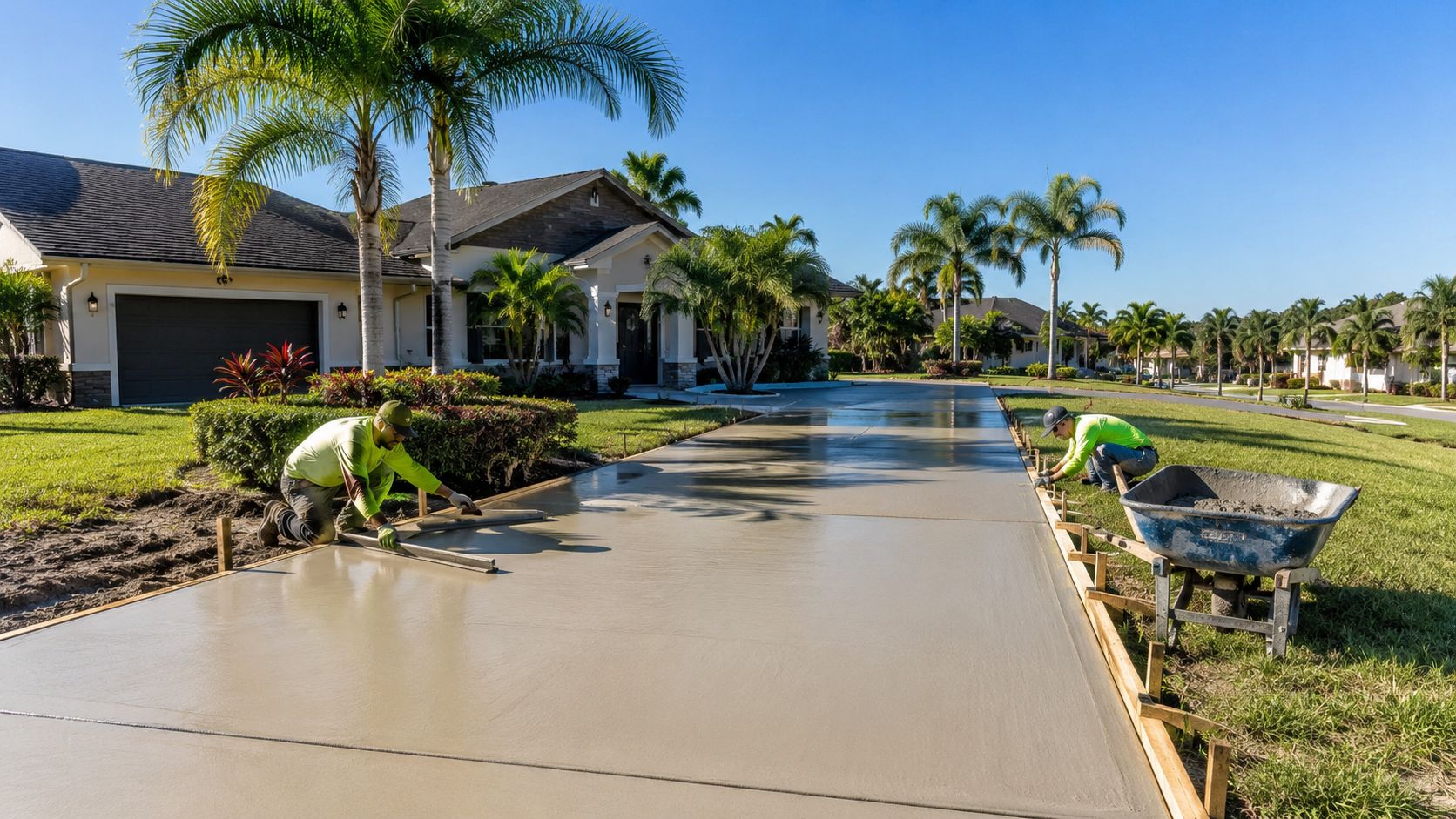
If you're pricing a new driveway in Marion County or Citrus County, the biggest surprises usually happen before the truck ever shows up. The slab can look simple from the street, but concrete driveway installation lives or dies on the work underneath it, the permit path, the apron tie-in, and how the crew handles Central Florida weather.
That's why homeowners in Ocala, Dunnellon, Belleview, Silver Springs, Summerfield, Crystal River, Homosassa, Inverness, Lecanto, Beverly Hills, Hernando, and The Villages need more than a quick quote. They need a contractor who understands permits, utility locates, drainage, curing, and local approval requirements, because a driveway can be poured correctly and still create problems if one of those steps gets skipped.
Table of Contents
- The Complete Driveway Installation Process
- Technical Specifications That Determine Driveway Longevity
- Permits, Utility Locates, and Pre-Construction Requirements
- Concrete Driveway Costs and Budget Planning
- How Central Florida Weather Changes the Installation Process
- Driveway Maintenance and Troubleshooting Common Issues
- Choosing the Right Concrete Contractor in Marion and Citrus County
The Complete Driveway Installation Process
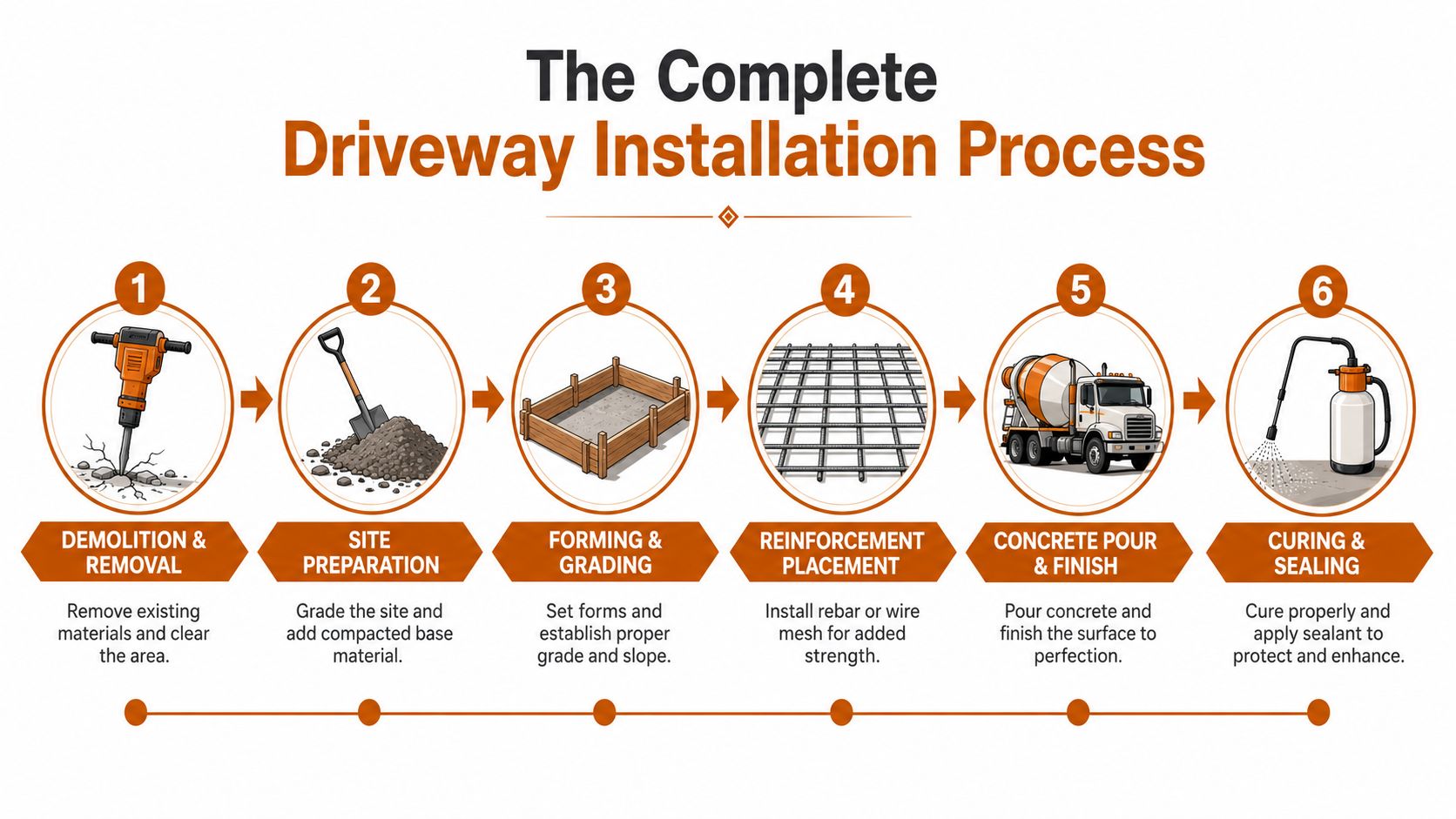
A driveway replacement starts with the old slab, not the new one. Crews break out the existing concrete, haul away the debris, and expose the ground so they can see what's really there, soft spots, roots, settled fill, or drainage problems that were hidden under the old surface.
Site preparation does the heavy lifting
After demolition, the crew grades the footprint, removes topsoil and unstable material, and builds a base that won't pump or settle under vehicle weight. A residential guide recommends 4 to 6 inches of compacted gravel in lifts, compacted to at least 95% density Grandma's House DIY. Michigan guidance also calls for a minimum 4-inch sub-base compacted and a drainage slope of 1/8 inch per foot away from structures Michigan Concrete Association.pdf?hsLang=en).
Practical rule: if the base is soft, wet, or uneven, the slab is already on the clock.
Forms go in next, and they have to be straight, braced, and set to the final elevation before any concrete arrives. Reinforcement follows, usually wire mesh on thinner residential slabs or rebar on heavier work, because steel belongs in the slab, not sitting on the ground where it can't help.
The pour itself is only part of the job. A broom finish gives traction, control joints guide shrinkage cracking, and the curing period protects the surface while the cement hydrates. If you're comparing bids, ask who handles each phase and how they protect the slab after the finish work is done. For a deeper look at the prep stage, see how to prepare ground for a concrete slab.
Technical Specifications That Determine Driveway Longevity
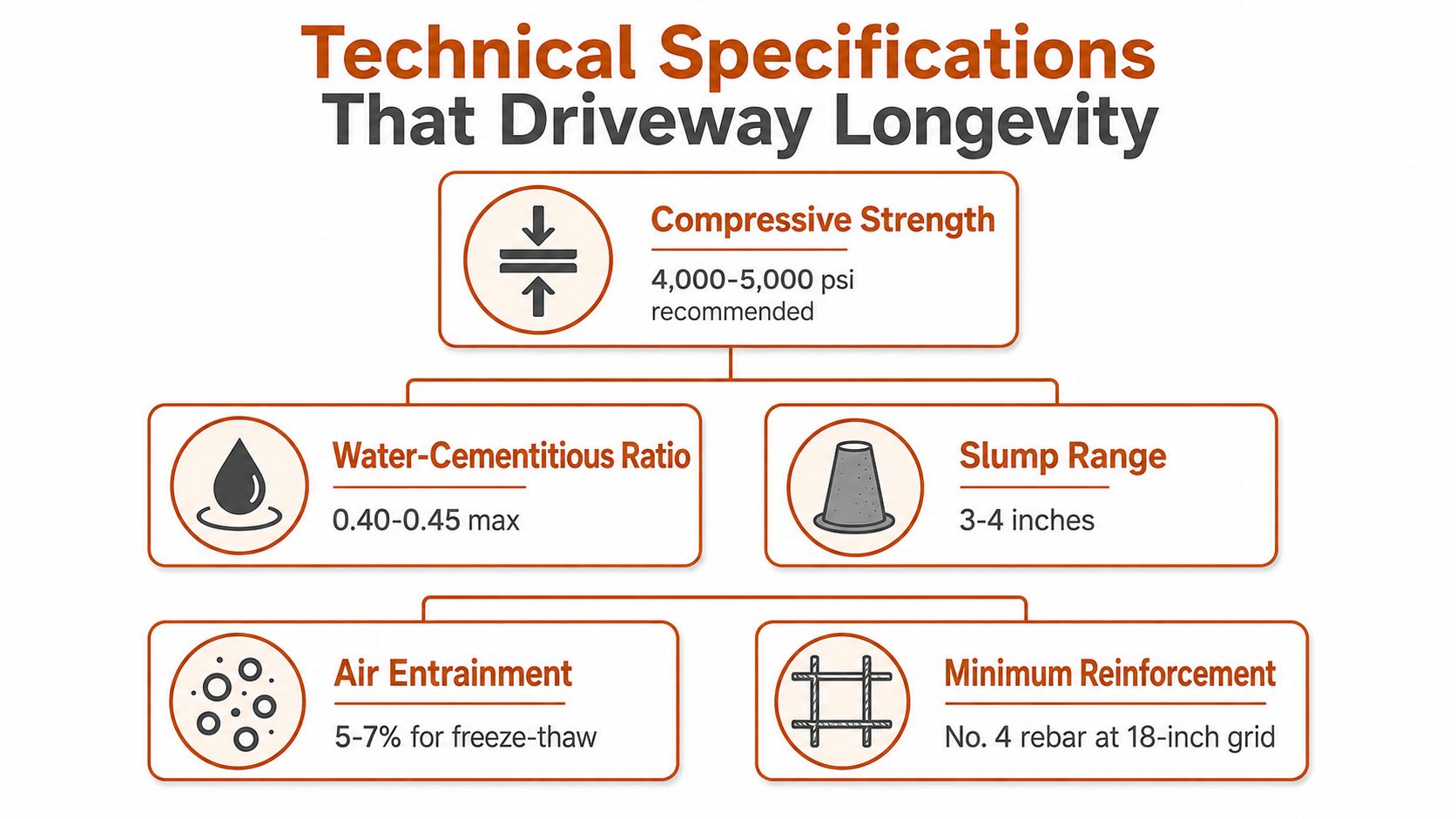
A driveway that survives daily truck traffic and Florida weather starts with the numbers behind the mix, not the finish coat. On residential work, the spec should call for minimum 4,000 psi compressive strength at 28 days, a water-cementitious ratio no higher than 0.45, air content around 6.5% ± 1.5%, and a maximum slump of 4 inches Michigan Concrete Association.
Why the mix design matters
Low water content keeps the paste tighter and less porous, which helps the slab resist wear and moisture intrusion. Air entrainment adds tiny voids that give the concrete room to move when temperatures swing and moisture works its way into the slab Michigan Concrete Association. For a Central Florida driveway, that matters because heat, afternoon rain, and long curing periods all affect how the surface hardens.
Thickness and reinforcement carry just as much weight. A residential driveway is commonly built at a minimum 4-inch slab thickness, with wire mesh often used for 4- to 5-inch slabs and rebar recommended for slabs 5 inches or thicker Concrete Network. If you want a practical rule of thumb before comparing bids, review concrete driveway thickness standards. In Marion County, Citrus County, and the surrounding Central Florida area, those choices affect how well the slab handles pickups, service vans, and repeated turning at the apron.
A driveway should be designed for the load it will carry, not the lowest number a contractor can write on paper.
Permits, Utility Locates, and Pre-Construction Requirements
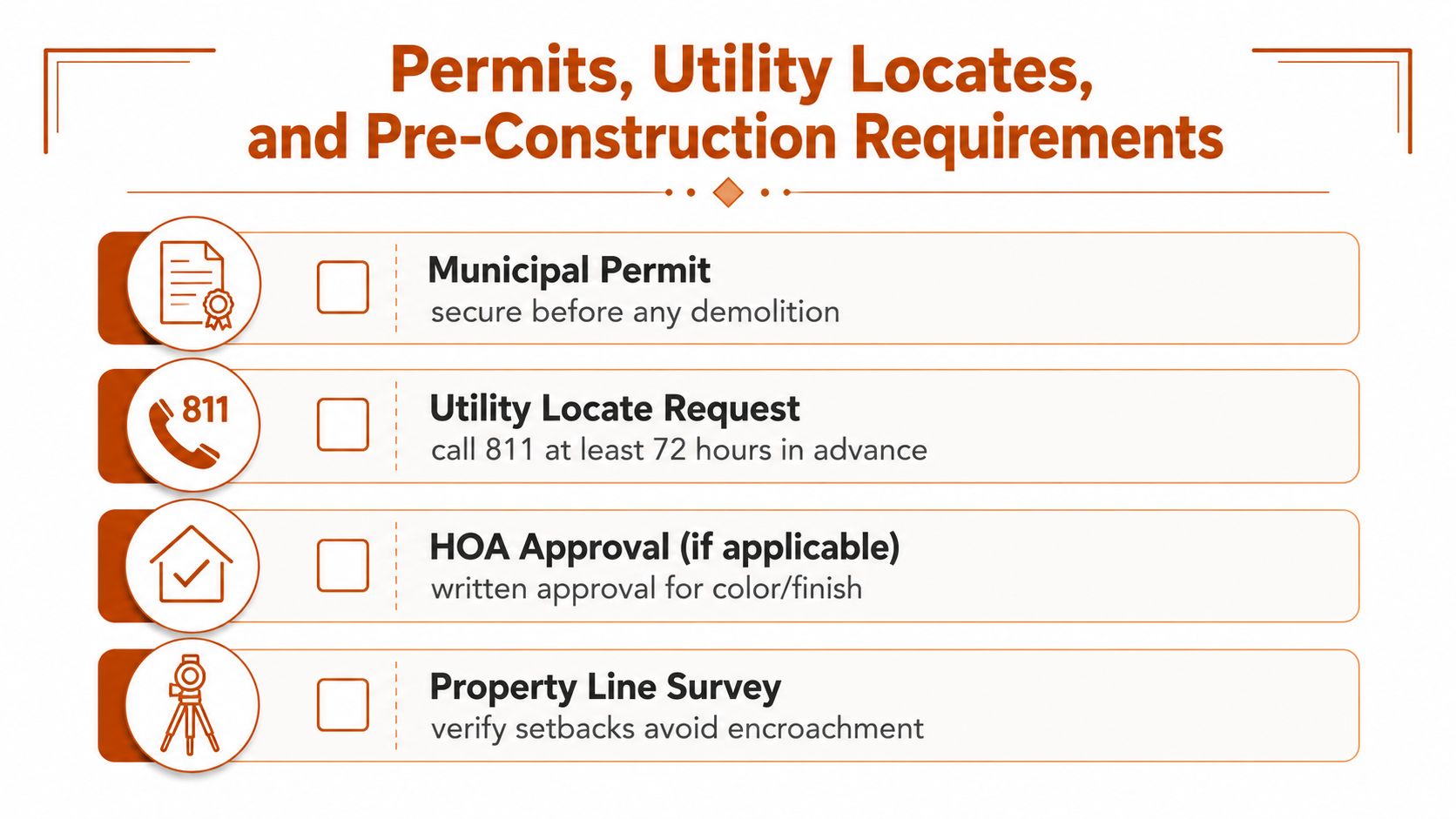
The paperwork side of driveway work gets ignored too often, and that's where a lot of headaches begin. A driveway can be poured straight and finished cleanly, then get flagged because the approach, curb cut, or sidewalk tie-in wasn't approved the way the city or county wanted it.
What should happen before excavation
At minimum, the contractor should confirm whether a municipal permit is needed, request utility locates before digging, and verify any apron rules or public-sidewalk requirements that apply to the property. Contractor checklists increasingly include permits, municipal apron requirements, utility locates, and access constraints as separate pre-construction items Angie. In HOA communities around The Villages and Summerfield, written approval can matter just as much as the fieldwork, especially when the finish or layout changes the site appearance.
Questions worth asking in writing
Ask who handles the permit, who marks utilities, and whether the estimate includes curb work or just the slab itself. If a contractor shrugs off those details, you're being asked to trust a process you can't verify.
If the estimate doesn't say who is responsible for the permit and utility locate, that responsibility may end up on you.
Riverside Sealing & Striping, LLC is one local option that handles concrete driveway work along with site prep, which is useful when the project needs a clear handoff from layout to excavation to pour. The right contractor should also know when a property in Belleview, Beverly Hills, Homosassa, Lecanto, or Silver Springs needs additional review before concrete is ordered.
Concrete Driveway Costs and Budget Planning
A driveway bid can look reasonable on paper and still miss the actual cost if it leaves out demolition, haul-off, access, or finish work. Around Central Florida, I look at the job in pieces, because the cheapest quote often turns expensive once the contractor starts counting extra concrete, tighter access, or site prep that was never discussed.
Angie's pricing guide shows how wide the spread can be, with installed costs that vary by finish, site conditions, and how much old material has to come out first Angie. That range is normal in the field. A plain residential driveway, a decorative surface, and a tear-out with disposal are not the same job, and they should not be priced like they are.
Concrete Driveway Cost Ranges by Finish Type
| Finish Type | Cost Per Square Foot | Typical 600 sq ft Total |
|---|---|---|
| Plain gray concrete | $5 to $8 | $3,000 to $4,800 |
| Standard residential pour | $6 to $12 | $3,600 to $7,200 |
| Decorative concrete | $8 to $21 | $4,800 to $12,600 |
The finish choice changes the budget fast. Decorative stamping, borders, and other upgrades add labor and materials, so the gap between a basic driveway and a decorative one is wider than many homeowners expect. A standard two-car driveway can stay in a basic price band, while larger footprints, thicker sections, or premium finishes push the total higher.
Concrete costs also rise when the site fights the crew. Long carries from the truck, tight side yard access, heavy demolition, or extra base prep all add time and labor. That is why two driveways of the same size can come in at very different numbers, even before you talk about color or texture.
The cleanest estimate is the one that separates each line item. Demolition, haul-away, thickness, finish, reinforcement, and access should all be spelled out so you can see what you are paying for. If you want a practical starting point for comparing bids, use this concrete driveway cost guide and compare each contractor's scope instead of only looking at the bottom line.
How Central Florida Weather Changes the Installation Process
Central Florida doesn't give crews the same working window they get in cooler, drier markets. Heat can speed surface set time, afternoon rain can ruin a finish pass, and humidity changes how moisture leaves fresh concrete once it's on the ground.
Why timing matters here
Crews in Ocala, Dunnellon, Crystal River, and Inverness usually try to pour early so the slab can be placed and finished before the afternoon storm cycle starts building. That isn't just about comfort, it's about control. Once the top starts tightening, a surprise shower or a delayed finishing step can leave marks that show up for years.
Curing has to begin as soon as finishing is complete and continue for at least 7 days County Ready Mix Corp. In hot, wet, or highly variable conditions, that usually means contractors rely on curing compounds, wet burlap, or other moisture-control methods to keep the surface from drying too fast.
Fresh concrete doesn't need heat to get strong. It needs controlled moisture and time.
Drainage matters in the same conversation. Water management is a durability issue, not just a comfort issue, so the slab still has to shed water away from the home and garage even when the weather is fighting the schedule. In Central Florida, a good crew plans for rain instead of pretending it won't show up.
Driveway Maintenance and Troubleshooting Common Issues
A driveway's lifespan doesn't end when the truck pulls away. The first few seasons tell you a lot about how well the slab was built, especially around drainage, joints, and the apron area near the garage.
What homeowners should watch
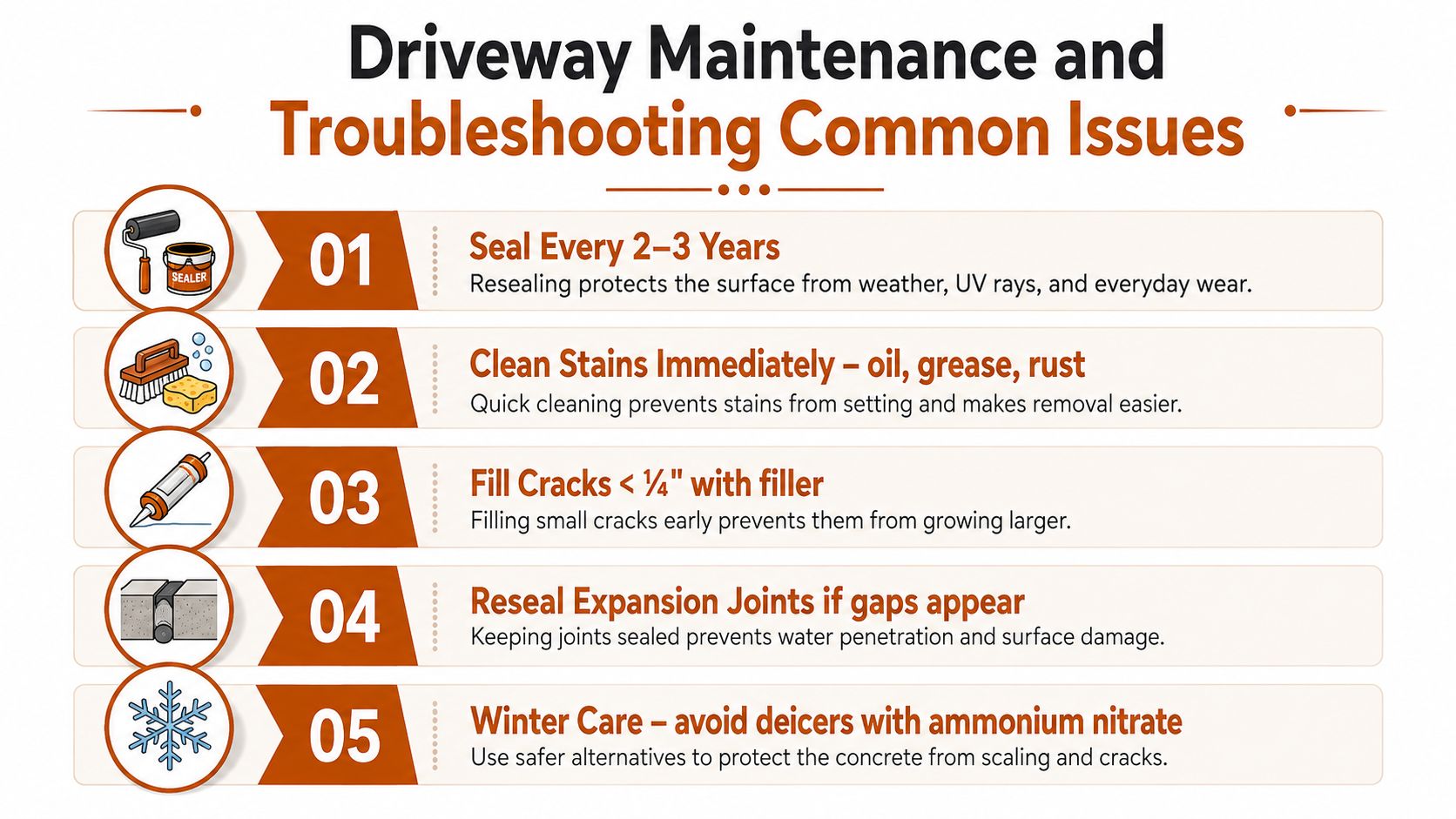
A practical care routine starts with keeping oil and grease off the surface, cleaning stains before they set, and watching cracks before they widen. Concrete driveways are commonly sealed on a recurring maintenance cycle, and hairline cracks that stay small are usually handled differently than cracks that move or separate. If a crack is wider than a simple cosmetic blemish, or if settling shows up near the garage apron, that's a job for a professional evaluation, not a tube of filler.
The maintenance questions get more specific in Florida because heat and heavy rain can expose weak spots quickly. Curing problems, joint movement, and drainage issues usually show up first as staining, edge wear, or small surface changes around the apron and control joints.
- Seal the surface on a regular cycle: protect the slab from water intrusion and staining.
- Clean spills quickly: oil, grease, and rust are easier to deal with when they're fresh.
- Watch the joints: open gaps or crumbling edges usually mean the slab is moving.
- Check drainage after storms: standing water near the slab edge signals a grading problem.
- Skip harsh deicers: they aren't part of normal Florida care, but they matter if the driveway travels outside the region.
For homeowners who want the work handled by a local crew, Riverside Sealing & Striping, LLC can evaluate driveways along with broader concrete and asphalt maintenance needs in Marion County and Citrus County. That matters when the property needs both a clean slab and a plan for the surrounding pavement.
Choosing the Right Concrete Contractor in Marion and Citrus County
The right contractor should be able to explain the job without hiding behind vague language. A solid on-site estimate includes site assessment, material specifications, timeline, permit handling, and a written proposal that spells out what's included and what isn't.
What separates a real bid from a guess
Ask how deep they'll excavate, what base material they use, how they handle reinforcement, and whether they'll provide the actual mix spec for the truck. Then ask how they plan to protect the pour if the weather turns, because a contractor who works in Marion County, FL and Citrus County, FL should have an answer that fits local conditions.
Red flags are easy to spot once you know what to look for. Vague answers about thickness, no mention of permits, no clarity on curing, and a price that seems oddly low usually mean somebody is leaving out a critical step.
Licensed and insured contractors with local Central Florida experience are easier to verify, and they're more likely to understand the apron, drainage, and access issues that show up in real neighborhoods.
That matters in places like Belleview, Silver Springs, Homosassa, Lecanto, and Beverly Hills, where references and past work should be easy to confirm. A professional shouldn't hesitate to walk the property, talk through the pour, and put the plan in writing.
If you're planning a driveway replacement or a new pour in Marion County or Citrus County, Riverside Sealing & Striping, LLC handles concrete driveway installation, site prep, and long-lasting finishes with local Central Florida experience. Visit Riverside Sealing & Striping, LLC to schedule a free, no-pressure on-site consultation and get a written estimate that reflects your property, your apron, and your weather reality.