
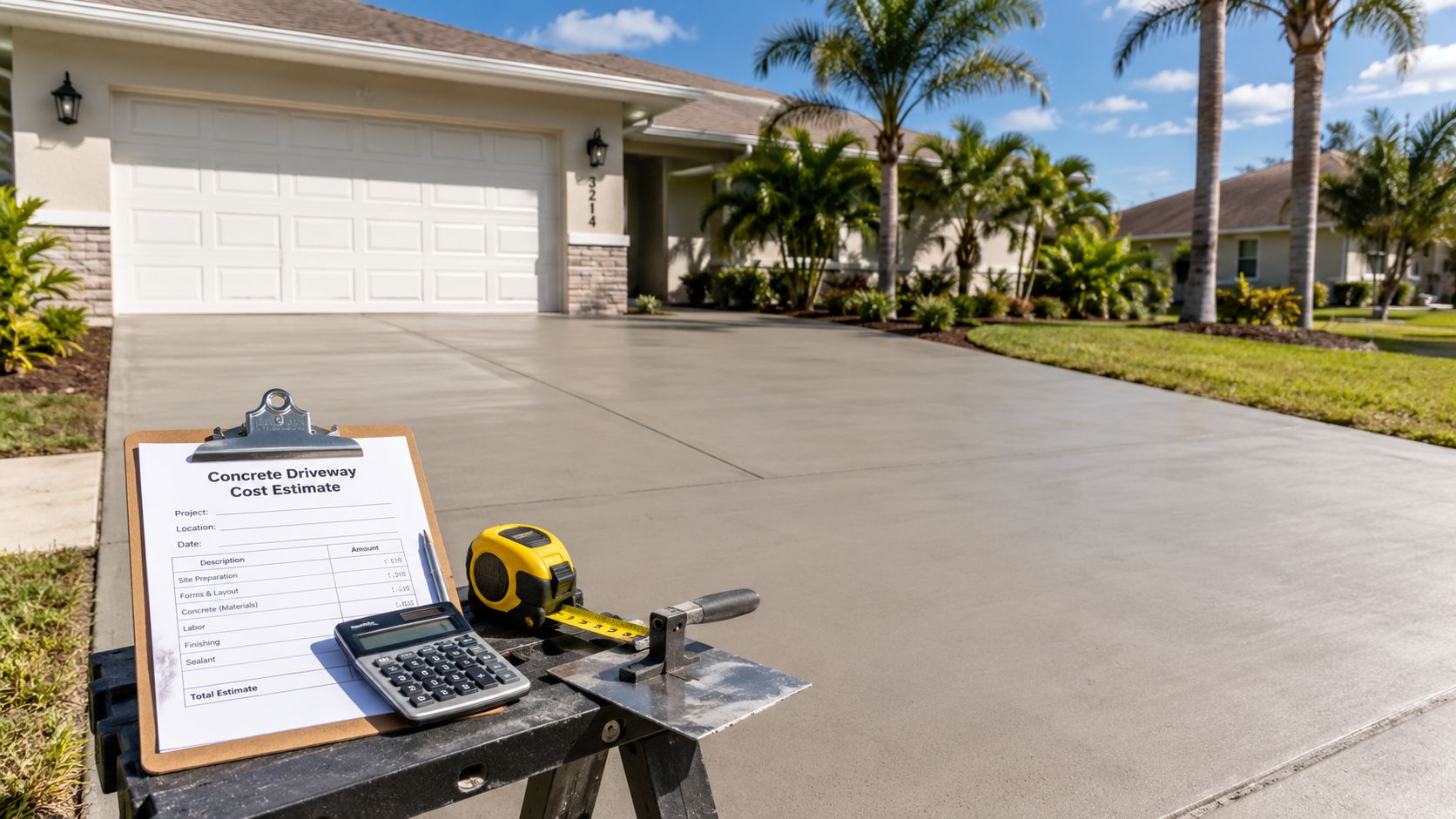
In Central Florida, the cost to install a concrete driveway usually falls between $8 and $15 per square foot for a standard broom-finish installation. If you're replacing an old driveway instead of pouring a new one, the total often runs higher because demolition, haul-off, and disposal add to the job.
If you're standing in your front yard in Ocala, Dunnellon, Inverness, or The Villages trying to figure out whether the quote you got is fair, that's the number range to keep in mind. The catch is that Central Florida pricing isn't just about square footage. Heat, heavy rain, sandy soil, drainage, and the condition of the existing driveway all affect what a contractor has to do before concrete ever comes out of the truck.
A driveway that looks simple from the street can still need extra base work, reinforcement, or removal of a failed slab underneath. That's why two homes in Marion County, FL or Citrus County, FL can have very different final prices even when the driveways look about the same size.
Table of Contents
- Concrete Driveway Costs in Central Florida
- A Detailed Breakdown of Installation Costs
- Sample Driveway Budgets for Local Homes
- How Florida's Climate Affects Your Driveway Cost
- Concrete vs Asphalt vs Pavers What Is the Best Value
- Getting an Accurate Estimate from Riverside Sealing & Striping
- Frequently Asked Questions About Driveway Costs
Concrete Driveway Costs in Central Florida
A homeowner in Ocala or Crystal River can get two driveway prices that look close on paper and end up with two very different slabs a few years later. In Central Florida, the difference usually comes from the ground below the concrete, how water moves across the lot, and whether the contractor priced the job for local conditions instead of a generic national average.
For budgeting, a plain broom-finish concrete driveway in this area often falls within the same broad range you will see in Florida cost guides, but local pricing swings for reasons that matter here. Heat speeds up placement and finishing. Heavy rain can interrupt prep and pour schedules. Sandy soil drains fast, but it also demands proper compaction so the slab is supported evenly. Homeowners comparing prices should look past the square-foot number and review what is included in the build. Our guide to concrete slab cost per square foot in Florida gives a useful starting point for that comparison.
National cost guides can help with broad expectations. Angi's national driveway cost guide shows how wide the overall range can be. In Central Florida, projects often drift upward when the lot needs extra grading, stronger base prep, thicker sections at vehicle stress points, or better drainage control.
Size, thickness, and finish drive the number
The three biggest price drivers are straightforward, but each one carries a Florida-specific trade-off.
| Factor | What it changes |
|---|---|
| Size | More square footage raises concrete volume, labor, forming, and base prep |
| Thickness | Heavier vehicles or weak subgrade may justify a stronger slab and more reinforcement |
| Finish | A basic broom finish costs less, while decorative borders, color, or stamped work add labor and material cost |
A simple straight driveway in Hernando is easier and cheaper to build than a wide parking pad with curves, apron transitions, and decorative edges. On some local lots, shape is not the expensive part. Prep is. If the driveway area has soft spots, root issues, poor runoff, or previous settlement, the crew has to correct that before the concrete truck shows up.
Local pricing works best as a field estimate, not a phone quote
The Florida premium is usually hidden in the prep work.
A contractor can give a rough range over the phone, but a real price should come after measuring the site, checking access, and looking at grade, drainage, and soil support. That is where low quotes often leave out work that keeps the slab from cracking early.
Practical rule: If a quote does not mention sub-base compaction, reinforcement type, or joint layout, treat that as a warning sign. In Central Florida soil, those details affect how well the driveway handles heat, rain, and movement under the slab.
That is why two homes with the same driveway size can land at different prices. One lot may be ready for forms and stone. Another may need removal, regrading, thicker base material, or drainage correction along the garage approach. The finished surface may look similar on day one, but the installation quality underneath decides how it performs after a few rainy seasons and a few summers of hard sun.
A Detailed Breakdown of Installation Costs
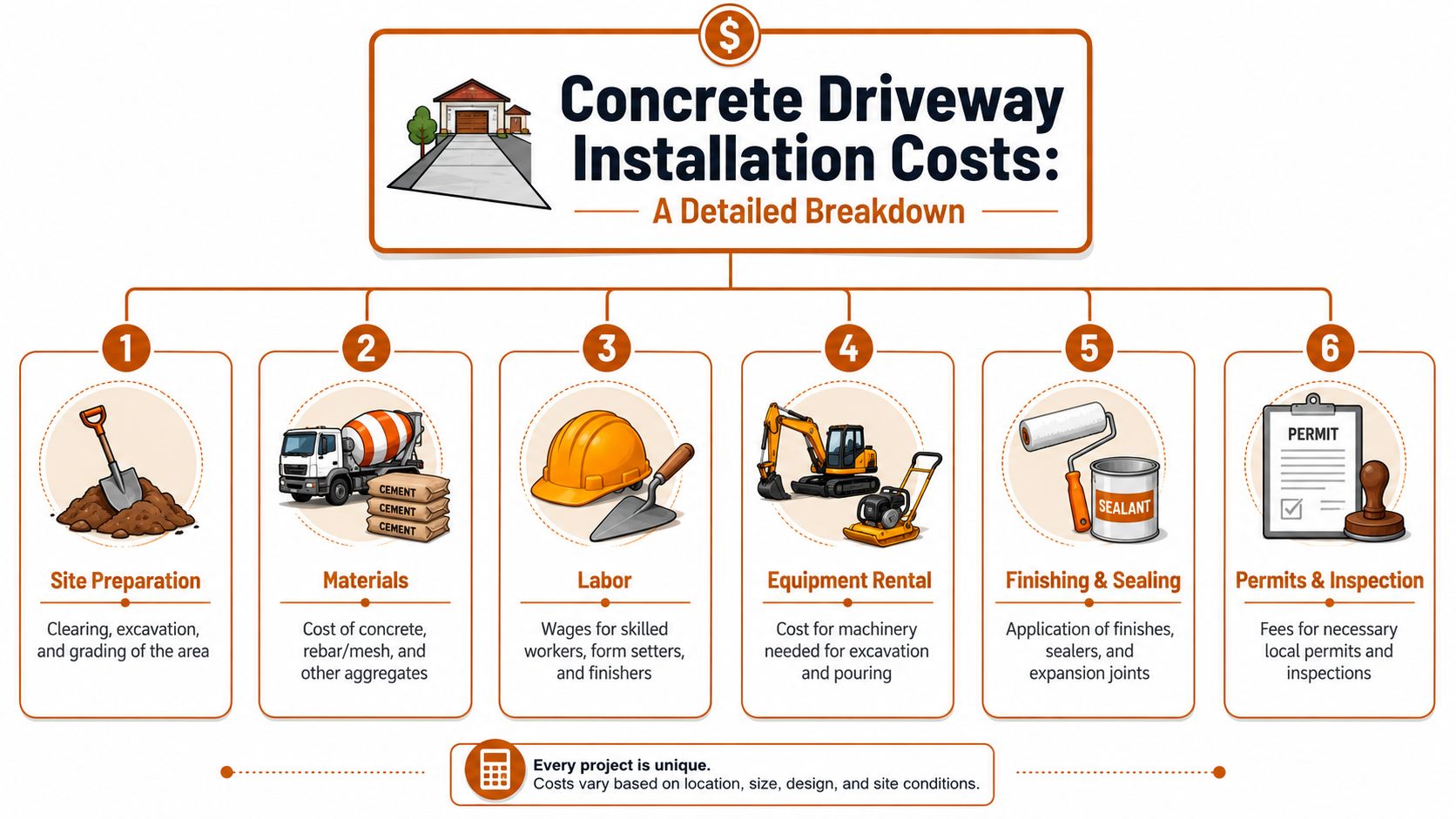
A concrete driveway quote makes more sense when you read it from the ground up. The installed price for a standard 4-inch broom-finish driveway in 2026 is projected at $8 to $15 per square foot, and that figure includes sub-base preparation, forming, reinforcement with rebar or mesh, and professional sealing according to Project Cost Pro's driveway calculator.
What a standard installation usually includes
The first cost is site preparation. That means clearing the area, cutting out soft spots if needed, grading, and building a stable base. On many Central Florida lots, this part matters more than homeowners expect because rain and shifting soils can turn a cheap prep job into a cracked slab later.
Then comes the forming and reinforcement. Forms control the shape and elevation of the driveway. Reinforcement helps the slab handle normal stress and resist movement better over time.
The concrete itself is only one line item. Labor to place, level, finish, joint, and cure the slab is a major part of the bill too. If you want a plain broom finish, pricing stays more predictable. If you want decorative color or texture, the labor and finish work become more involved.
For homeowners trying to understand slab-related pricing more broadly, this guide to concrete slab cost per square foot helps show how base work, reinforcement, and finish choices affect concrete projects beyond driveways alone.
Where replacement jobs get more expensive
Replacement is where many estimates jump.
If an old driveway has to be torn out first, the project includes demolition, loading, hauling, disposal, and then rebuilding the base before the new pour. Verified pricing shows replacement of an existing concrete driveway commonly ranges from $6,000 to $15,000 for a standard 600-square-foot project, averaging $10 to $25 per square foot, based on replacement cost data for existing concrete driveways.
Here's where costs usually show up on a quote:
- Demolition work: Breaking up and removing failed concrete adds labor and equipment time.
- Disposal and haul-off: Old concrete has to go somewhere, and that cost is real.
- Base correction: A driveway that failed may have failed because the support underneath it failed too.
- Drainage adjustments: Water runoff issues often need to be corrected before the new slab goes in.
A low quote on a replacement job sometimes leaves out the work that caused the old driveway to fail in the first place.
That's why a good estimate should explain what's included instead of showing only a bottom-line price.
Sample Driveway Budgets for Local Homes
A homeowner in Ocala or The Villages often starts with a simple question: what does a real driveway budget look like for my house, not a national average? The honest answer depends on size, layout, and how much site work the property needs before concrete is even ready to pour.
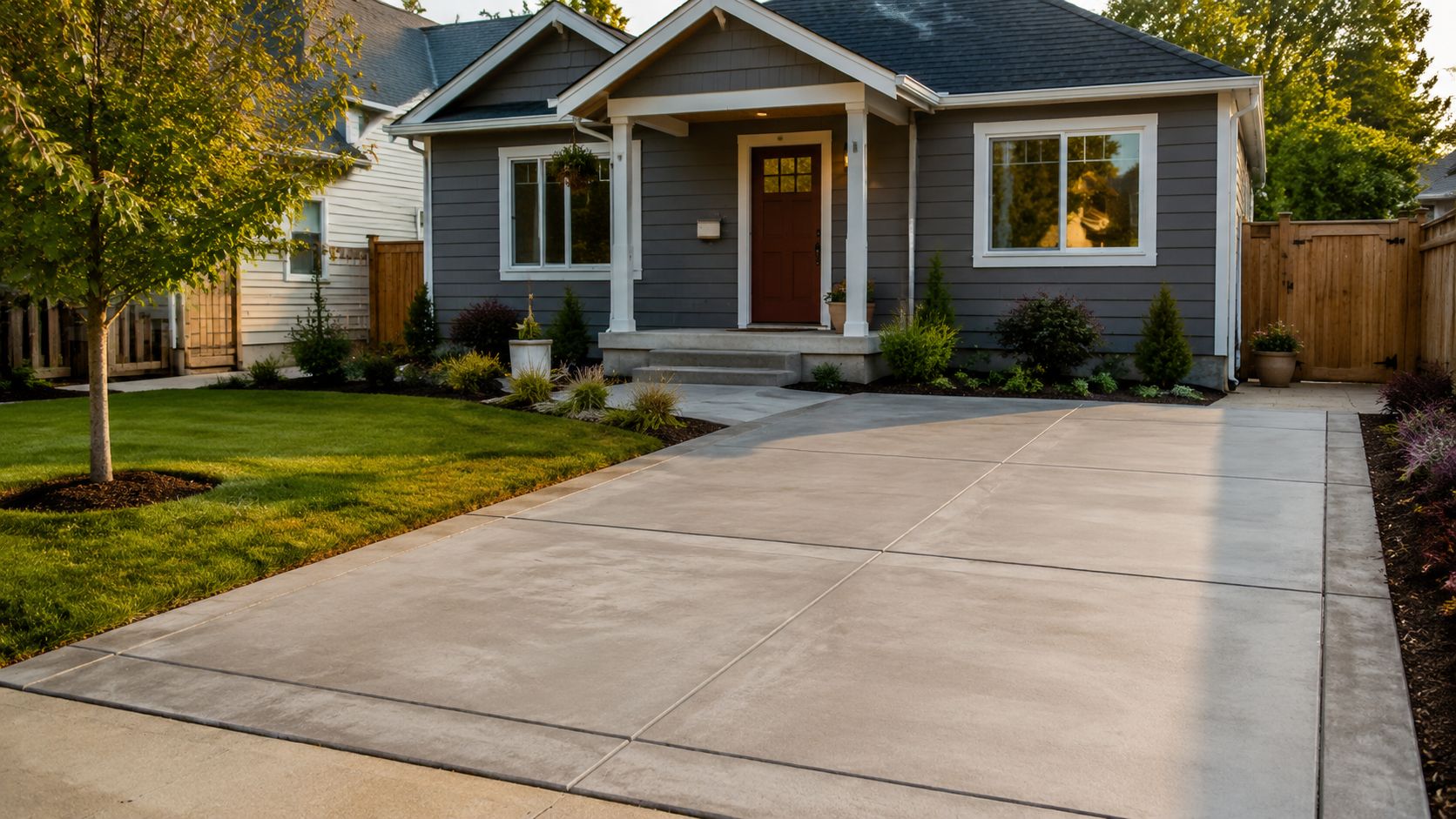
Small driveway in Dunnellon or Beverly Hills
A smaller single-car driveway or side parking pad usually lands at the lower end of the budget range, but only if the site is straightforward.
For a driveway around 250 square feet, many homeowners should expect a basic budget of about $2,000 to $3,750 for standard poured concrete with a broom finish. That usually assumes clear access, stable ground, and no major drainage correction.
On small jobs, fixed costs matter more than people expect. Forming, delivery, crew time, and cleanup do not shrink much just because the slab is smaller. If the lot holds water or the edges need extra support, the price per square foot can feel higher than it does on a larger driveway.
Standard two car driveway in Ocala or Summerfield
This is the range that fits a lot of front-entry homes in Central Florida.
A typical 600-square-foot two-car driveway often budgets out around $4,500 to $8,000 for a plain concrete installation. On a clean, level lot, that can cover a solid standard driveway. On a lot with soft spots, washout near the edges, or grading issues, the number climbs fast because the slab still needs proper support underneath.
I tell homeowners to pay close attention to what the estimate includes. One contractor may price a basic pour. Another may include thicker edges, better base prep, reinforcement, and cleaner finish work. Those quotes are not equal, even if the driveway size is the same.
Larger driveway in The Villages or Silver Springs
Larger driveways usually bring more than extra square footage. They often include wider aprons, longer runs, curved sections, or parking turnouts.
At roughly 1,000 square feet, a concrete driveway can run about $8,000 to $15,000 for a standard installation. The upper end is common when the shape gets more complex or the property needs more excavation and grading to handle Florida rain properly.
Large slabs also put more stress on the details that protect long-term performance. Joint placement, runoff control, and edge stability matter a lot more at this size. Homeowners who want the bigger picture on durability should read how long a concrete driveway can last in Florida conditions.
A sample budget is useful, but in Central Florida, the cost ultimately depends on site conditions. Heat, rain, and sandy or shifting soils are what create the Florida premium, and those are the costs that separate a driveway that lasts from one that starts showing problems too early.
How Florida's Climate Affects Your Driveway Cost
Generic national averages miss one of the biggest local realities. Central Florida has a real cost premium because climate and soil conditions change how a driveway has to be built.
Verified data notes that in hot, humid areas like Central Florida, UV exposure, high rainfall, and soil erosion increase sub-base prep and reinforcement costs by 15–25% compared to national averages, with local pricing often running $11 to $24 per square foot instead of the broader national $8 to $20 per square foot range, as outlined in this discussion of Florida-specific concrete driveway conditions.
Why the Florida premium is real
In Marion County, FL and Citrus County, FL, the ground can look fine in dry weather and still create trouble after a rainy stretch. Soil movement, runoff, and washout under slab edges can shorten the life of a driveway that wasn't prepared correctly.
Heat matters too. Concrete in Central Florida needs proper placement, finishing, and curing practices so it doesn't lose moisture too fast at the surface. A slab that's rushed in high heat can end up with avoidable surface issues and a weaker finish.
For homeowners who want a realistic view of durability, this article on how long concrete lasts is useful because longevity depends heavily on preparation, drainage, and exposure conditions, not just the mix itself.
What doesn't work in Central Florida
Cut-rate driveway work usually fails in familiar ways:
- Thin or poorly compacted base: The slab may settle, crack, or rock at weak points.
- Weak drainage planning: Water collects along edges or runs under the slab.
- Minimal reinforcement: The driveway has less support when soil and temperature conditions put it under stress.
- Skipping sealer or cure protection: The finished surface doesn't hold up as well against weather and daily use.
Paying for the Florida-specific prep up front usually costs less than paying to replace avoidable failure later.
Local experience matters. A contractor who works around Crystal River, Homosassa, Lecanto, and Hernando should already be thinking about water movement, soil support, and how the slab will behave through long heat cycles and heavy summer rain.
Concrete vs Asphalt vs Pavers What Is the Best Value
A homeowner in Central Florida usually ends up choosing between three things. Lower upfront cost now, lower upkeep later, or a higher-end look that costs more from day one. For many residential driveways, concrete lands in the strongest middle position.
Concrete usually costs more than basic asphalt and less than pavers. That by itself is not the full story in this market. In Florida, sun, rain, and shifting soil can make the cheapest option more expensive to live with if it needs more frequent repairs or maintenance.
Where concrete fits on cost and upkeep
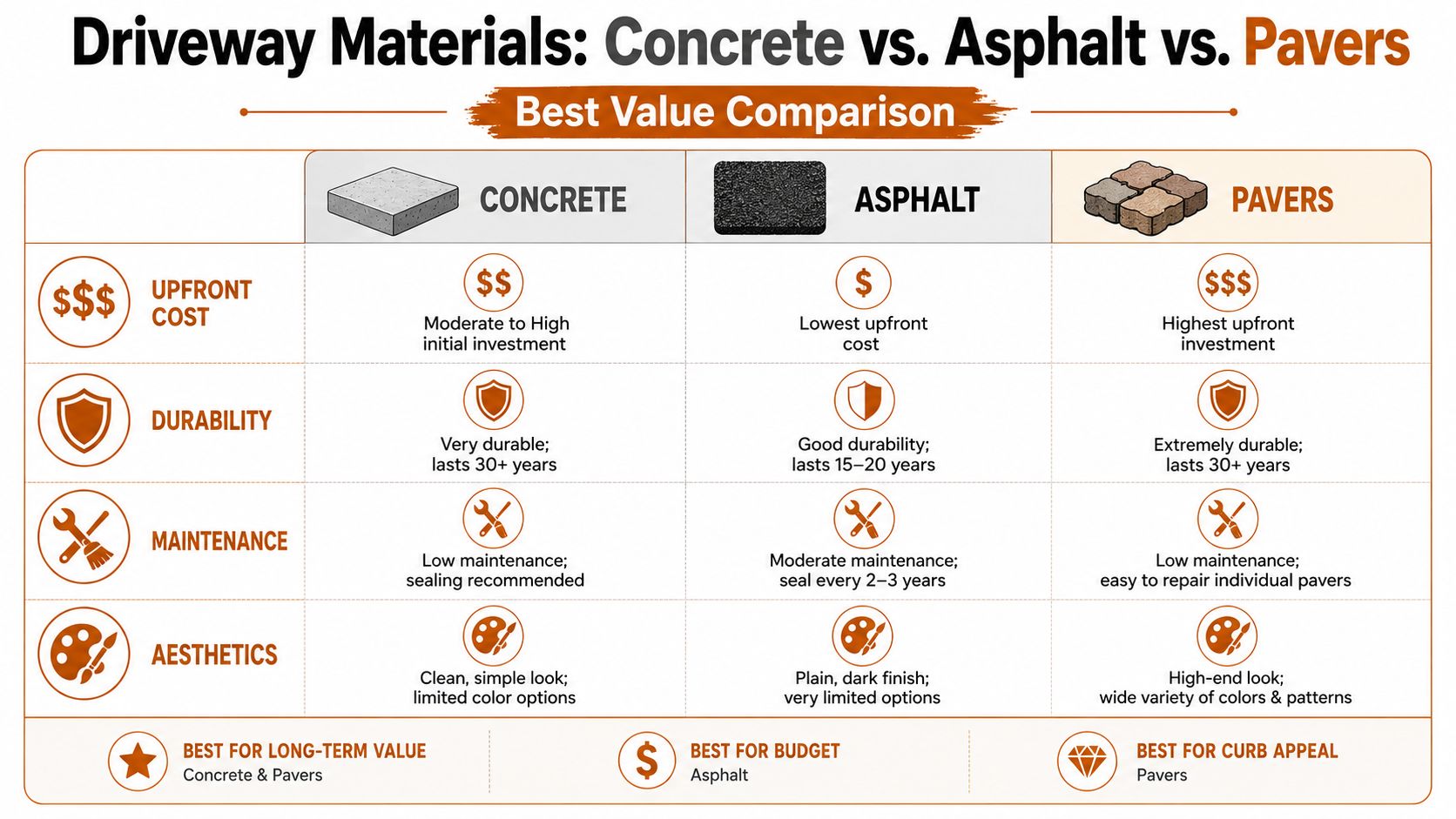
For many homes in Ocala, Dunnellon, and The Villages, concrete gives a good balance of price, durability, and appearance. It has a higher entry cost than asphalt, but it typically asks for less ongoing attention. It also avoids the premium price that comes with a full paver installation.
| Material | Upfront cost | Maintenance | Appearance |
|---|---|---|---|
| Concrete | Moderate | Lower routine upkeep than surfaces that need repeated maintenance | Clean, durable, adaptable |
| Asphalt | Often lower upfront | Benefits from ongoing maintenance in Florida sun and rain | Simple, functional |
| Pavers | Highest upfront | Individual repairs are possible, but installation is costly | Premium look |
Homeowners comparing surfaces often find this local look at concrete driveway vs asphalt cost helpful because it frames the decision around long-term ownership costs, not curb appeal alone.
A short overview can help if you're weighing options visually and practically:
When asphalt or pavers may make sense
Asphalt can still be a smart pick for a long driveway where keeping the initial bill down matters most. It is often chosen on rural properties or larger lots where square footage drives the budget. The trade-off is maintenance. Florida heat can age the surface faster, and periodic sealing is part of owning it.
Pavers fit a different goal. They offer the best design flexibility and can add a higher-end look around custom homes, pool areas, and decorative entries. They also cost more to install because of the labor, base work, and edge restraint needed to keep everything stable.
In my experience, concrete is the best value for a lot of Central Florida homeowners because it handles daily use well, looks clean, and does not push the budget as high as pavers. If the slab is installed correctly for local soil and drainage conditions, it gives solid long-term performance without the maintenance cycle that often comes with asphalt.
That is why concrete remains the standard choice for everyday residential driveways across Central Florida.
Getting an Accurate Estimate from Riverside Sealing & Striping
A homeowner can look at two driveways with the same square footage and still get two very different quotes. In Central Florida, the difference usually comes down to what is under the slab, how water moves across the lot, and how much correction the site needs before any concrete is poured.
Online calculators can give a rough range. They cannot see soft spots in the base, low areas that hold water after an afternoon storm, or edges that have started breaking down from poor drainage. A driveway in Belleview with stable access and a clean layout is a different project from one in Homosassa that needs tear-out, grade correction, and extra base work because of weak soil.
What a site visit should cover
A solid estimate starts with field measurements taken on site. Satellite images and rough guesses miss details that affect labor, material volume, and finish work.
The contractor should check the existing surface, the condition of the subgrade, drainage paths, and how the new driveway will meet the garage, sidewalk, street apron, or parking pad. In this part of Florida, that prep work affects cost more than homeowners expect. If the soil is loose, damp, or uneven, fixing it up front costs less than repairing a slab that settles later.
Finish choice should be spelled out clearly too. A broom finish is the standard on many residential driveways because it gives good traction, keeps the look clean, and holds the budget in a more predictable range. If you want a decorative edge, stamped sections, or color, the written estimate should show exactly what is included so there are no surprises once the job starts.
It also helps to know whether the same contractor can handle related exterior work later on, such as asphalt sealcoating or parking lot striping for another property. That kind of range does not change the driveway price by itself, but it tells you whether the company works in pavement and concrete every day or only takes on small residential pours from time to time.
Questions worth asking any contractor
Use the estimate meeting to get specific answers.
- What is included in removal and cleanup: If this is a replacement, ask whether demo, haul-off, and disposal are included in the price.
- How will the base be prepared: In Central Florida, base preparation is one of the biggest cost drivers because rain, heat, and shifting soils expose weak prep fast.
- What reinforcement is included: Different quotes may look similar on price but include different build standards.
- How will drainage be handled: Water should move away from the slab and away from the house. If grading or runoff correction is needed, it should be listed.
- Who manages scheduling and communication: Clear scheduling matters, especially during rainy periods when timing can change.
- Are you licensed and insured: Any contractor pricing a serious concrete or asphalt job should be able to answer yes without hesitation.
A good estimate should leave you with a clear scope, a clear price range, and a clear explanation for any added cost tied to site conditions. That matters whether the job is in Marion County, FL, Citrus County, FL, Inverness, Lecanto, or Summerfield.
Frequently Asked Questions About Driveway Costs
How long does a concrete driveway installation take
The exact schedule depends on site conditions, weather, access, and whether the project is new installation or replacement. A clean new pour is simpler than a job that starts with demolition, disposal, and base correction. The important part isn't speed by itself. It's whether the contractor allows enough time for prep, placement, finishing, and curing.
Does a thicker driveway cost more
Yes, because thicker concrete changes material volume and can also affect reinforcement and labor. Whether it's necessary depends on what will use the driveway. A standard residential driveway is different from a surface that will regularly support heavier vehicles or repeated edge loading.
What's the best way to save money without cutting corners
Keep the design simple. A standard broom finish is usually the most cost-effective option. Straight layouts are often more efficient than curved ones, and doing the project before a badly damaged driveway gets worse can help avoid extra corrective work.
The cheapest quote isn't always the lowest-cost driveway over time. Poor prep and weak drainage usually get expensive later.
How long should you wait before driving on new concrete
Follow the contractor's cure guidance for your specific project. Concrete gains strength over time, and driving on it too early can damage the surface or edges. Homeowners should treat curing as part of the installation, not as an optional waiting period.
Is concrete a better long-term choice than asphalt in Central Florida
For many homeowners, yes, especially when they want a hard surface with a clean appearance and less routine upkeep. Asphalt still has a place, particularly for certain budgets and property types. The best answer depends on layout, budget, maintenance expectations, and how the surface will be used.
If you're comparing quotes for a new or replacement driveway in Ocala, Dunnellon, Belleview, Crystal River, Homosassa, Inverness, Lecanto, Hernando, Silver Springs, Summerfield, or The Villages, Riverside Sealing & Striping, LLC offers free estimates and no-pressure consultations. As Concrete and Asphalt Experts in Marion and Citrus County, the team handles concrete driveway installation, replacement, asphalt maintenance, and professional striping with licensed and insured local experience, reliable scheduling, and workmanship built for Central Florida conditions.