

Most concrete is engineered to last 50 to 100 years, but that headline range doesn't tell most Marion County, FL or Citrus County, FL property owners what they need to know. For residential slabs in Florida, a more realistic expectation is often 30 to 50 years when you factor in installation quality, subgrade, drainage, traffic, and the way our climate works on reinforced concrete.
If you're standing in Ocala, Crystal River, Inverness, or The Villages looking at a driveway with hairline cracks, edge flaking, or a low spot that holds water after a storm, you're probably asking the right question a little differently. Not just how long does concrete last, but whether your concrete is aging normally or heading toward replacement sooner than it should.
That difference matters in Central Florida. The generic advice online usually stops at “concrete lasts a long time.” The actual answer is more specific. Sidewalks, patios, driveways, slabs, and reinforced structural concrete all age differently. In Florida, hidden steel reinforcement often decides the outcome long before the surface tells the whole story.
Table of Contents
- The Real Lifespan of Your Florida Concrete
- Typical Concrete Longevity by Project Type
- Seven Key Factors That Determine Concrete Durability
- How Florida's Climate Impacts Your Concrete
- Maintenance Tips to Make Your Concrete Last Longer
- Warning Signs That Your Concrete Needs Attention
- Your Concrete and Asphalt Experts in Central Florida
- Frequently Asked Questions About Concrete in Florida
The Real Lifespan of Your Florida Concrete
A homeowner in Ocala might notice one crack running from the garage to the apron and assume the slab still has decades left. A property owner in Crystal River might see minor chipping near the edge and think it's only cosmetic. Sometimes that's true. Sometimes the surface is the first visible sign that moisture has already started a deeper problem.
The biggest misconception is that all concrete behaves the same. It doesn't. Plain concrete and reinforced concrete are not the same lifespan story. A 2016 UNSW study on reinforced concrete deterioration notes that plain concrete can last for centuries, while reinforced concrete used in most driveways and structures can begin deteriorating in as little as 10 years because of rebar corrosion. It also notes that the often-quoted 50 to 100 year lifespan is an upper limit, not the norm.
That matters for homes in Belleview, Silver Springs, Homosassa, and Lecanto because most residential flatwork isn't just a plain slab sitting untouched. It's reinforced, loaded by vehicles, exposed to rain, and affected by soil movement and drainage.
Practical rule: If a Florida driveway is cracking, staining, and holding water, don't judge it by age alone. Judge it by structure, drainage, and whether moisture has a path to the steel.
For homeowners trying to compare general advice with driveway-specific expectations, this guide on how long a concrete driveway lasts is a useful companion read.
The short version is simple. In Central Florida, concrete lasts a long time when the whole system is right. When the base is weak, the drainage is poor, or water keeps reaching the reinforcement, the clock speeds up.
Typical Concrete Longevity by Project Type
The phrase how long does concrete last only makes sense when you attach it to a project type. A patio in Summerfield doesn't live the same life as a driveway in The Villages. One sees foot traffic and patio furniture. The other carries daily vehicle weight, turning tires, and more opportunities for water intrusion along joints and edges.
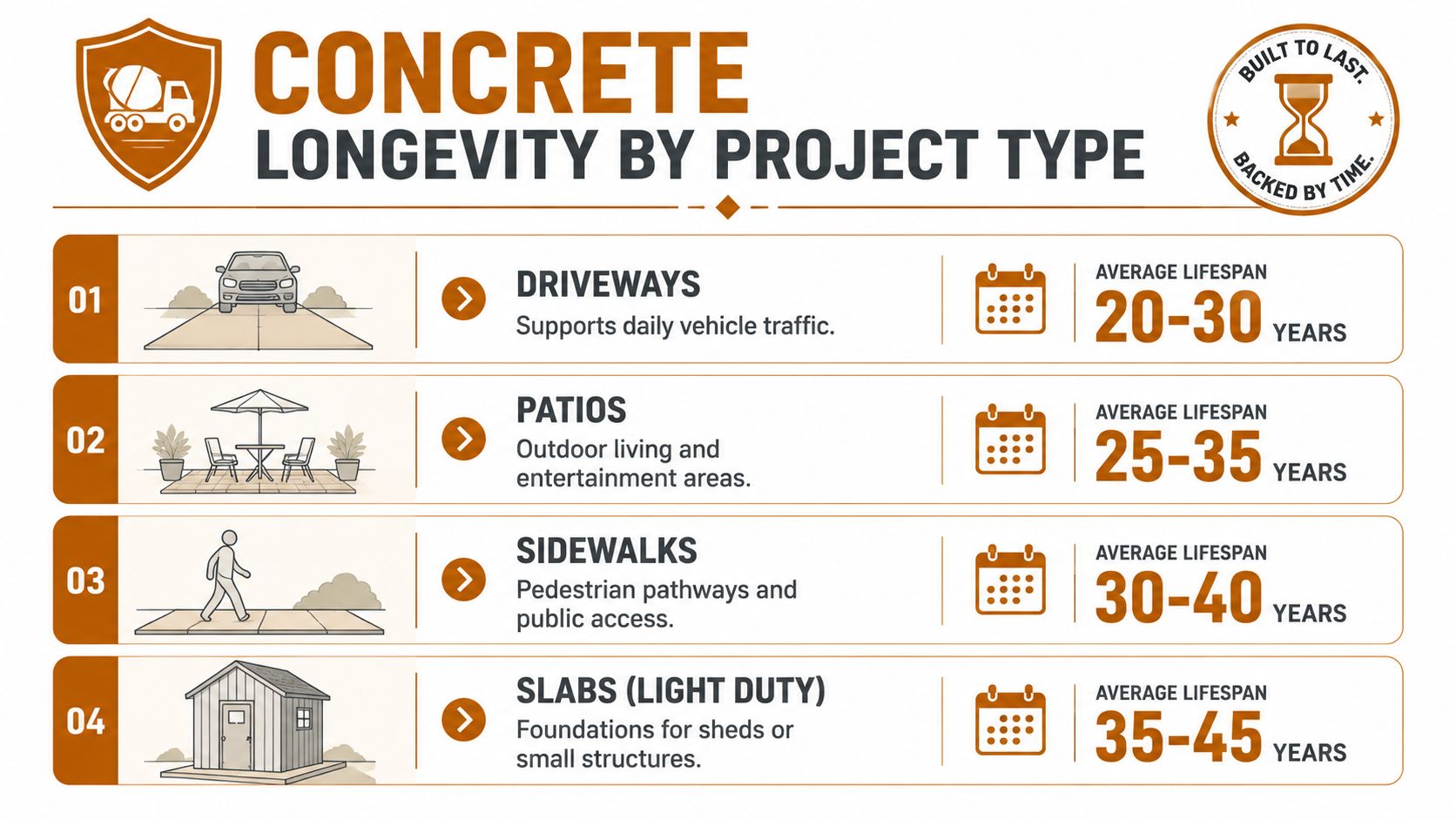
Here's the practical baseline many owners can use when planning repairs or replacement.
| Project type | Typical service life |
|---|---|
| Sidewalks | 20 to 40 years |
| Patios | 30+ years |
| Driveways | 40+ years |
| Interior concrete floors | Can last indefinitely if properly installed and sealed |
According to the Portland Cement Association, sidewalks typically last 20 to 40 years, patios 30+ years, and driveways 40+ years, though heavy machinery or deicing chemicals can shorten lifespan to as little as 30 years.
That last point is worth pausing on. Many people hear “40+ years” and assume all driveways should get there. That's not how it works in the field. A driveway in Dunnellon with good prep, solid edges, controlled drainage, and regular sealing has a fair shot at a long service life. A slab in Beverly Hills with runoff washing under one corner may start failing much earlier, even if the concrete mix itself was decent.
A few practical distinctions matter:
- Driveways carry repetitive vehicle loads, so edge support and subgrade consistency matter more.
- Patios usually avoid heavy loads, which is why they often age more gracefully.
- Sidewalks fail early when tree roots, washout, or settling lift panels.
- Light-duty slabs can last longer when they stay dry and don't see constant stress.
Concrete doesn't fail on paper. It fails where the use, soil, water, and construction details meet.
That's why lifespan charts are useful as a starting point, not a guarantee.
Seven Key Factors That Determine Concrete Durability
The concrete itself is only one part of the equation. What lasts in Marion County and Citrus County usually comes down to seven field conditions that either support the slab or gradually shorten its life.
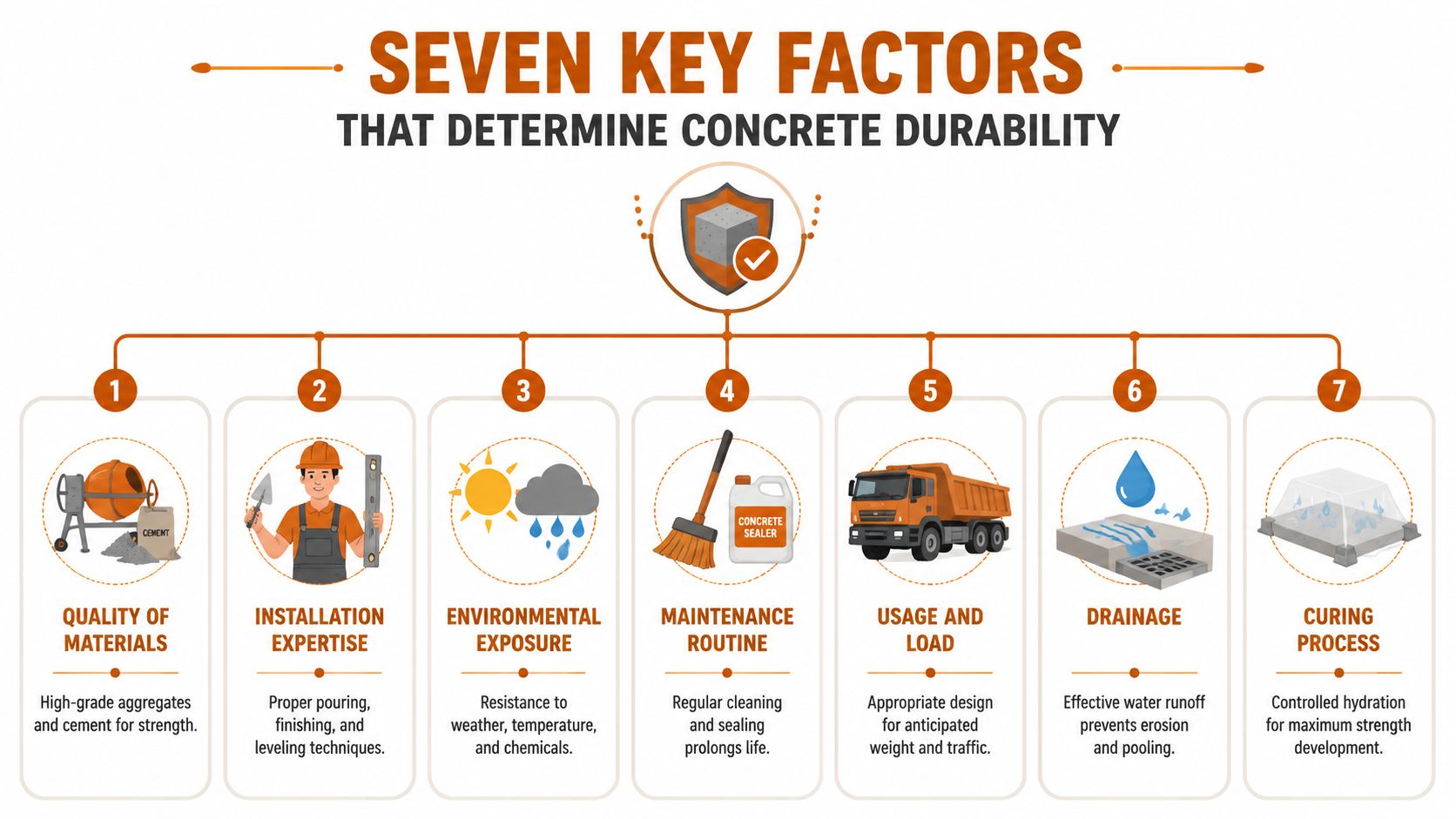
Civil engineering principles say longevity depends on four foundational factors: the environment, the mixture ingredients, workmanship during mixing and curing, and the loading stresses the concrete endures, as explained in this overview of concrete lifespan and durability factors. On an actual property, those fundamentals show up in the seven jobsite factors below.
Quality of installation
A slab can have a decent mix and still fail early if placement, finishing, joints, or curing are sloppy. Good installation means the crew controls thickness, surface finish, joint layout, and curing conditions. Bad installation often shows up years later as random cracking, scaling, or uneven wear.
If you're comparing options, this page on the best concrete mix for driveways helps explain why the mix design and the installation process have to work together.
Subgrade preparation
Many failures arise if the soil under the slab isn't uniform, compact, and stable, leading the concrete to bridge weak spots until it can't. Then you see settling, corner cracking, rocking panels, or long structural breaks.
A driveway doesn't sit on concrete alone. It sits on whatever was prepared under it.
Steel reinforcement
Reinforcement helps concrete handle tension and cracking, but it's also the hidden vulnerability in Florida conditions. Once moisture and contaminants reach the steel, corrosion expands and pressures the surrounding concrete from the inside. Homeowners often see the effect before they understand the cause.
Local climate
Heat, long wet periods, humidity, and repeated saturation all stress the slab differently than a drier climate would. Concrete in Central Florida has to survive sun exposure on top and moisture pressure from above, around, and sometimes below.
Proper drainage
Drainage protects the slab and the base under it. Water that ponds on the surface often finds a way into joints and cracks. Water that moves under the slab can erode support and leave sections hanging.
Here's a useful visual overview of the durability factors that matter most on site.
Traffic and weight loads
Concrete should be designed for actual use, not ideal use. A residential patio and a driveway approach used by delivery trucks are different jobs. Repeated heavy loading can expose weak base prep, thin placement, or poor edge support quickly.
Chemical exposure
Florida homeowners don't usually think first about chemicals, but oil, fuel, fertilizers, pool chemicals, and some cleaners can all speed up surface deterioration. Once the surface opens up, water gets in more easily. That starts a more expensive cycle.
- Installation problems usually show up as random cracks, weak edges, and surface defects.
- Base problems show up as movement, settlement, and broken sections.
- Moisture-related problems often appear as spalling, staining, or crack growth over time.
How Florida's Climate Impacts Your Concrete
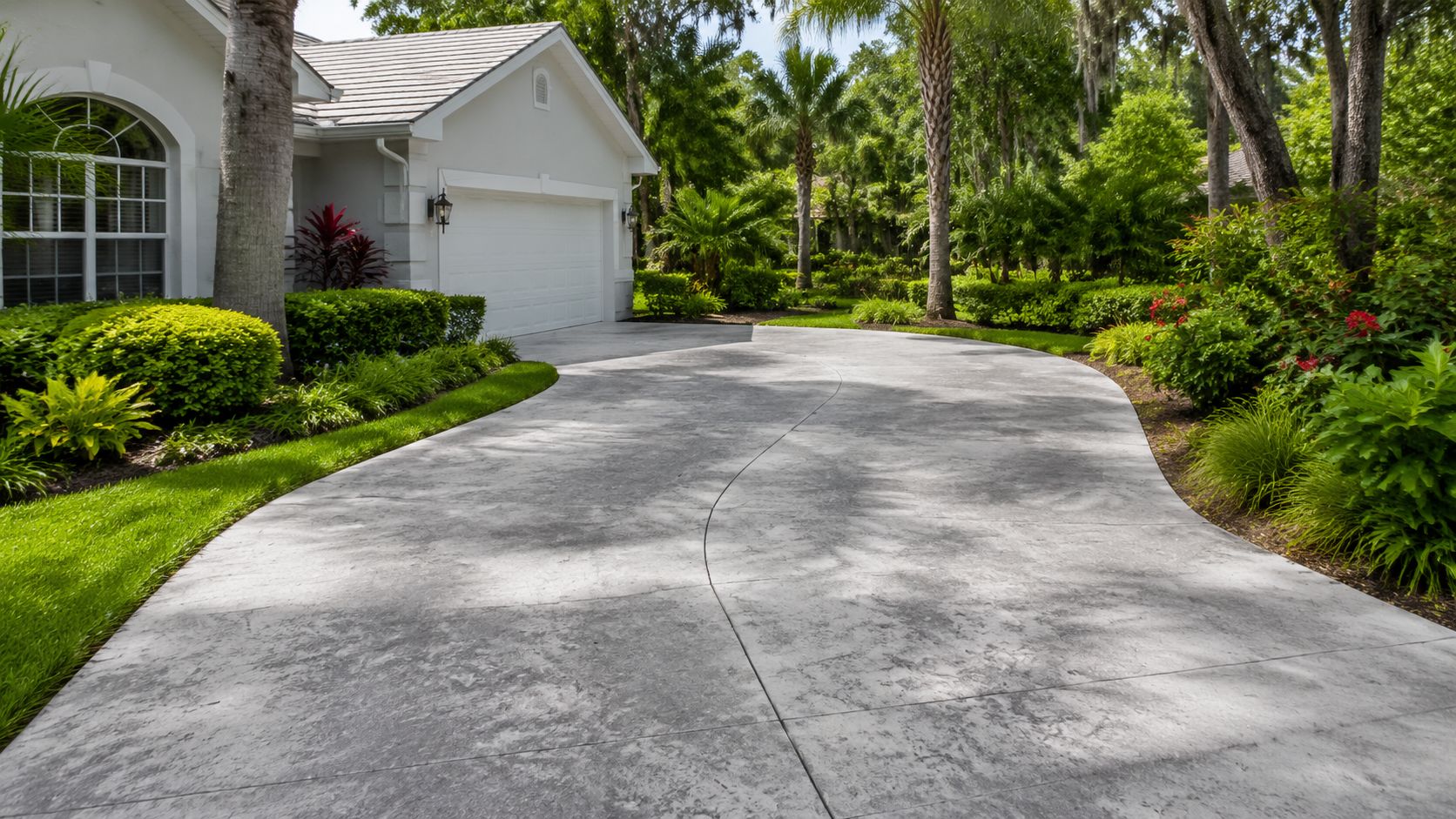
Central Florida is hard on concrete in a way many generic guides don't explain well. In Ocala, Summerfield, and Belleview, long hot stretches dry the surface fast. In Crystal River, Homosassa, and other wetter pockets, humidity stays high and heavy rain can keep slabs saturated for extended periods. That combination isn't just cosmetic. It affects the slab, the base, and the reinforcement.
Heat, humidity, and wet seasons work together
Florida concrete rarely gets a long break. UV exposure bakes the surface. Rain drives moisture into pores, joints, and existing cracks. Humid conditions slow drying. If the slab has reinforcement and moisture keeps reaching it, corrosion risk goes up.
This is why surface sealing matters here more than many owners think. In Central Florida, sealing isn't just about making the concrete look cleaner. It's about slowing water entry before the slab starts aging from the inside out.
The concrete you see on top may not be the part making the replacement decision. The steel and base underneath often decide first.
Why Central Florida drainage matters so much
A driveway's lifespan is heavily dependent on subgrade and drainage. A solid, well-drained base can help it achieve a 30 to 40 year life, while poor drainage is a critical failure mechanism because water erosion at the base leads to cracking and slab failure, according to this review of concrete versus asphalt longevity and drainage performance.
That tracks with what property managers in Inverness, Hernando, and Dunnellon deal with after big rain events. The damage often isn't dramatic at first. Water runs toward the slab, downspouts dump too close, or grading traps runoff near one edge. Over time, the base loses support. Then the surface tells on it.
Watch for these Florida-specific stress points:
- Roof runoff dumping beside the driveway or walkway
- Flat grading that leaves puddles after summer storms
- Garden beds that hold moisture against slab edges
- Low areas where soil stays soft after rain
Concrete can handle Florida. It just can't handle Florida water when the drainage plan is wrong.
Maintenance Tips to Make Your Concrete Last Longer
Most slab failures don't start with one dramatic event. They start with neglect that lets water keep doing the same damage over and over. If you want concrete to last, maintenance has to be treated as protection, not decoration.
Proactive maintenance matters because sealing concrete every 2 to 5 years and repairing minor cracks promptly reduces water permeability and can allow properly maintained concrete to last indefinitely in a serviceable condition.
What to do on a real property
The most effective maintenance plan is usually simple.
- Keep it clean so dirt, leaves, and organic buildup don't hold moisture on the surface.
- Seal on schedule with a quality sealer suited for exterior concrete exposure.
- Repair cracks early before they become water-entry paths.
- Control runoff by making sure gutters, downspouts, and grading move water away from the slab.
- Clean up spills from oil, fuel, and chemicals instead of letting them sit.
For homeowners in Lecanto, Beverly Hills, or The Villages, sealing is the biggest missed step. Many people wait until the slab looks worn. By then, water may already be moving through small defects.
Field advice: The best time to seal concrete is before it looks like it needs help.
What doesn't work
Some common habits don't protect concrete the way owners hope they will.
- Ignoring hairline cracks because they seem minor
- Power washing too aggressively and roughing up the surface
- Letting sprinklers soak slab edges day after day
- Using appearance-only coatings where a true protective sealer is needed
Good maintenance won't fix a bad base or reverse deep structural deterioration. It will, however, slow the most common path to early failure, which is moisture intrusion.
Warning Signs That Your Concrete Needs Attention
You don't need a contractor's eye to spot early trouble. Most slabs tell you something is wrong before they fully fail. The key is knowing which signs suggest normal aging and which ones point to moisture, movement, or internal deterioration.
Surface clues you can spot yourself
Start with a simple walkaround after rain or after the slab has fully dried.
- Spalling or flaking means the surface is breaking apart. Moisture intrusion is a common cause. If you're not sure what that looks like, this guide on what concrete spalling is shows the difference between minor surface wear and material loss.
- Map cracking looks like a web of connected cracks. That pattern often suggests surface stress and ongoing moisture issues.
- Efflorescence appears as a white, powdery residue. It doesn't always mean structural failure, but it does tell you water is moving through the concrete.
- Dark damp spots that stay longer than surrounding areas can suggest poor drainage or trapped moisture.
When a visual issue may point to structural trouble
Some signs deserve faster attention because they often relate to support loss or reinforcement trouble.
| Warning sign | What it may indicate |
|---|---|
| Uneven slab height | Settlement or erosion under the slab |
| Wide or growing cracks | Movement, load stress, or deeper structural issues |
| Rust-colored staining | Possible moisture reaching embedded steel |
| Pooling water | Low spots, poor grading, or drainage failure |
A crack by itself isn't always the problem. A crack that keeps widening, holds water, or appears with settlement usually is.
If you're in Silver Springs, Summerfield, or Homosassa, check slabs after heavy rain. That's when drainage-related defects show themselves most clearly.
Your Concrete and Asphalt Experts in Central Florida
Homeowners and property managers in Marion County, FL and Citrus County, FL usually need more than a generic answer. They need someone who can tell the difference between surface wear, drainage trouble, base failure, and a slab that's reached the point where replacement makes more sense than patching.
The right local contractor should be able to handle concrete and asphalt, not just one side of the property. That includes new concrete driveways, patios, slabs, sidewalks, removal and replacement of damaged sections, and related site prep. For commercial properties in Ocala, Inverness, Crystal River, and surrounding areas, it also helps to work with a team that understands asphalt sealcoating, parking lot striping, ADA-related layout work, and long-term pavement maintenance.
Look for a contractor that's licensed and insured, familiar with Central Florida soil and drainage conditions, clear on scheduling, and realistic about whether repair or replacement is the better investment. Concrete and Asphalt Experts in Marion and Citrus County should be able to evaluate the whole surface system, not just the crack you're pointing at.
Frequently Asked Questions About Concrete in Florida
Is concrete or asphalt better for a Florida driveway
It depends on your priorities. Concrete offers a long service life and strong curb appeal. Asphalt can be a good fit where lower upfront installation cost or easier resurfacing is the main goal. The right choice depends on traffic, appearance goals, drainage, and maintenance expectations.
Should I repair cracks or replace the whole slab
If the slab is stable, the cracks are limited, and the base is still sound, repair may be reasonable. If the slab is settling, rocking, breaking apart, or holding water because of support loss, replacement is often the smarter long-term move.
How often should concrete be sealed in Florida
A good rule is to follow the maintenance window discussed earlier and reseal before water intrusion becomes visible. Florida exposure is hard on exterior slabs, so waiting too long usually costs more later.
What shortens concrete life the fastest in Central Florida
Poor drainage, weak subgrade prep, moisture reaching reinforcement, and delayed crack repair are the main issues. Most early failures trace back to water getting where it shouldn't and staying there.
Do commercial properties need a different maintenance approach
Yes. Parking areas, sidewalks, loading zones, and access paths usually have different traffic, safety, and compliance demands than residential slabs. A maintenance plan should match the actual use of the property.
If you want a local opinion on whether your driveway, patio, sidewalk, or parking area is aging normally or heading toward costly failure, Riverside Sealing & Striping, LLC offers free estimates and no-pressure consultations across Central Florida. As Concrete and Asphalt Experts in Marion and Citrus County, the team handles concrete installation, removal and replacement, asphalt sealcoating, and parking lot striping with reliable scheduling, high-quality workmanship, and practical recommendations that fit the property.