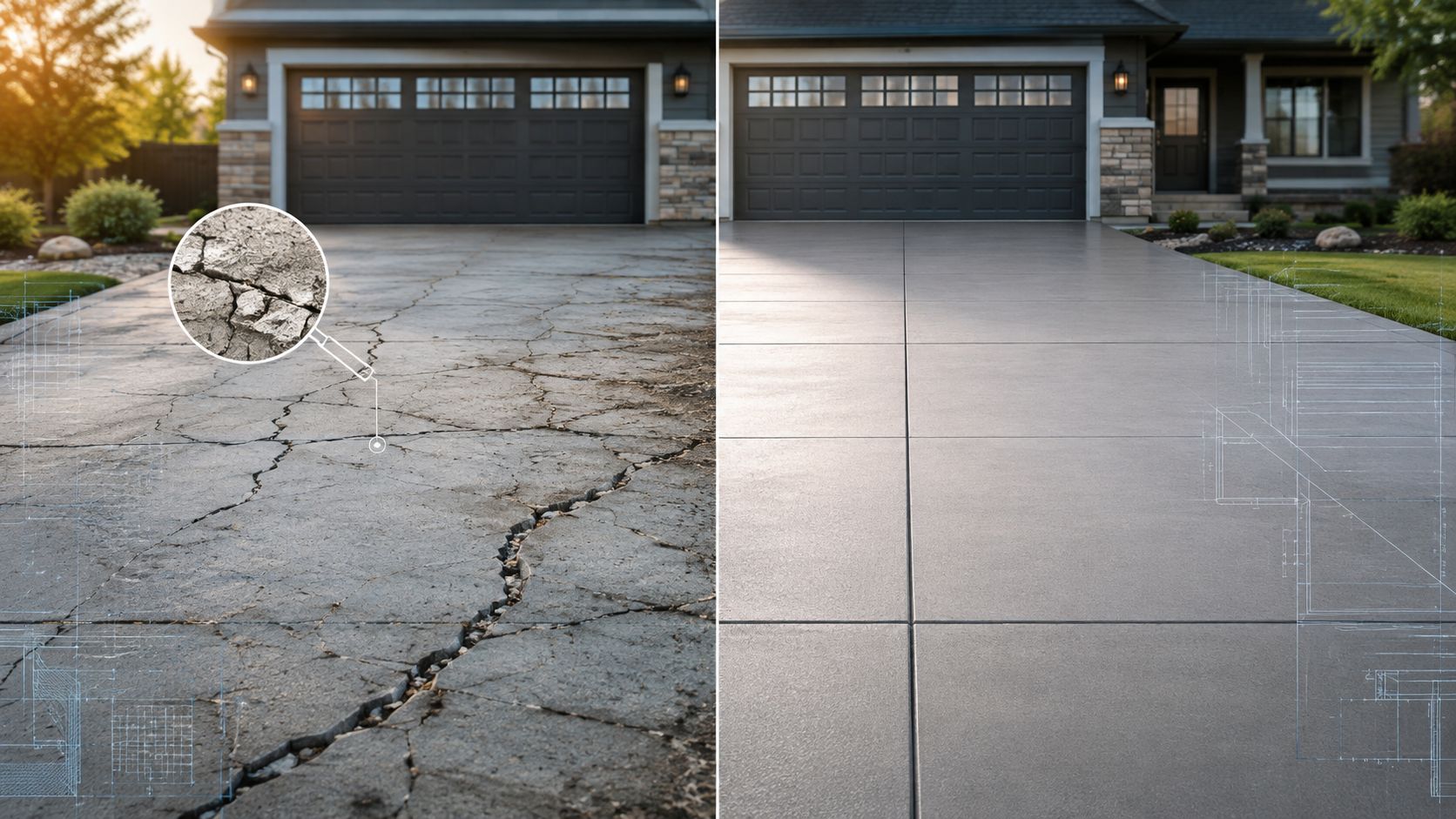
A driveway can look like a simple repair in a photograph, yet a cracked, settled, stained, or unsafe slab may require a completely different solution. One before-and-after image might show a cosmetic coating, while another shows concrete lifted back to grade or removed and replaced from the base up. The visual change matters, but the diagnosis behind it matters more.
This gallery evaluates seven documented examples of concrete driveway repair before and after work through the details homeowners need to plan responsibly: the underlying problem, repair scope, finish, expected timeline, cost considerations, benefits, and maintenance implications. Actual pricing still requires a site-specific evaluation. In 2026, typical U.S. concrete driveway repair spending is about $1,802 on average, with reported projects ranging from $300 to $5,900, while full replacement averages about $6,400 according to Angi's concrete driveway repair and replacement guide.
Central Florida adds its own variables, including heat, UV exposure, heavy rain, drainage, and vehicle traffic. Riverside Sealing & Striping, LLC serves Marion County, FL, Citrus County, FL, and communities including Ocala, Dunnellon, Belleview, Silver Springs, Summerfield, Crystal River, Homosassa, Inverness, Lecanto, Beverly Hills, Hernando, and The Villages. The gallery comes first, followed by repair-versus-replacement decisions, local climate considerations, professional service guidance, FAQs, and a practical next step.
Table of Contents
- 1. Riverside Sealing & Striping, LLC
- 2. LRE Foundation Repair
- 3. Advanced Concrete Coatings of SW Florida
- 4. Concrete Rejuvenation
- 5. A-1 Concrete Leveling
- 6. Vesta Foundation Solutions
- 7. ReVamp Concrete Lifting
- Before & After: 7 Concrete Driveway Repair Providers
- Choosing Repair or Replacement After the Photo
- Central Florida Climate Changes the After Result
- What a Professional Evaluation Should Include
- Frequently Asked Questions
- Turn the Right Before-and-After Option Into a Plan
1. Riverside Sealing & Striping, LLC
Riverside Sealing & Striping, LLC brings a useful perspective to driveway transformations because the company handles both concrete construction and asphalt maintenance. Based in Dunnellon, Florida, this third- and fourth-generation family-owned company works across Marion, Citrus, and surrounding Central Florida counties, with owner Bert Counts directly involved in the work.
The before-and-after question isn't limited to whether a surface looks cleaner. Riverside's concrete capabilities include damaged driveway removal and replacement, new driveways, patios, slabs, and sidewalks with durable finishes. That full-depth capability matters when settlement, extensive cracking, failed edges, or drainage problems make a surface-only treatment a poor investment. The company also provides asphalt sealcoating and professional parking lot striping, including ADA-compliant upgrades, handicap spaces, and directional markings.
What the company's scope reveals
A contractor that can evaluate both concrete and asphalt can help property owners avoid treating every pavement problem as a coating problem. A residential driveway may need replacement, while a nearby commercial lot may need maintenance through asphalt sealcoating or refreshed parking lot striping.
Riverside emphasizes clear timelines, on-time crews, neat work, and communication. Its consultations and estimates are free and no-pressure, with availability from 7am to 7pm. The company doesn't publish fixed driveway prices online, so a site visit is necessary to account for dimensions, access, demolition, base conditions, drainage, reinforcement, finish selection, and curing.
Practical rule: A strong before-and-after comparison should show more than the finished color. It should explain what caused the failure and why the chosen repair addresses that cause.
The main advantages are generational, family-owned experience, direct owner involvement, full residential and commercial capabilities, and reliable scheduling. The limitation is geographic. Riverside is a regional provider for Marion County, Citrus County, and nearby Central Florida communities, not a nationwide contractor. For homeowners in Dunnellon, Ocala, Belleview, Summerfield, Crystal River, or Inverness, that local focus makes a professional evaluation practical.
2. LRE Foundation Repair
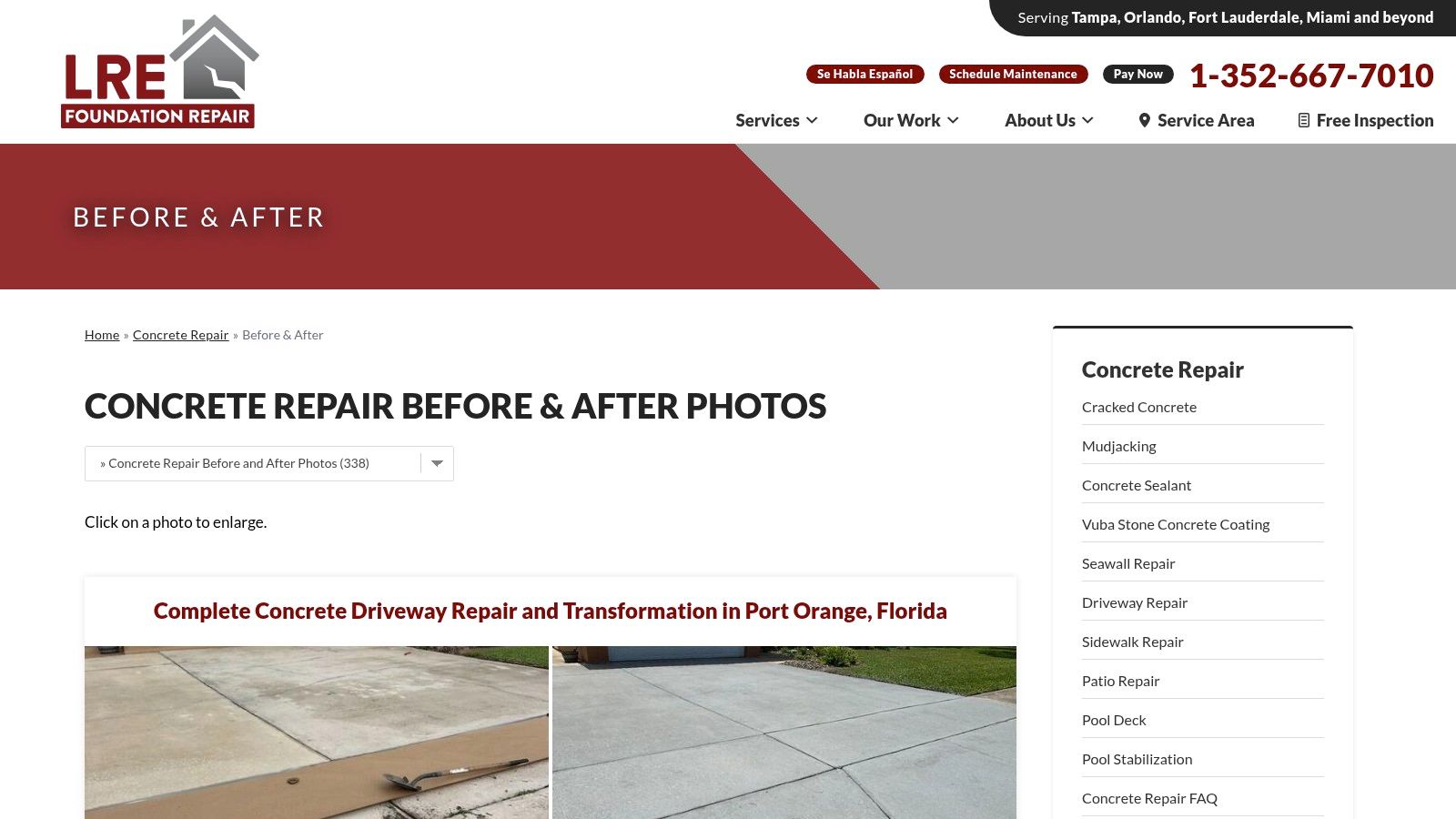
LRE Foundation Repair's gallery is most relevant when the driveway slab is largely intact but has settled, separated, or created an uneven transition. Its Central Florida project documentation includes work associated with Dunnellon, Ocala, and Homosassa, giving local homeowners examples that are more useful than generic images from a different climate or soil profile.
The company presents a three-part repair approach. PolyLevel foam injection lifts and levels the slab, NexusPro addresses cracks and joints, and an optional SealantPro topcoat adds surface protection. The transformation is therefore functional first. The goal isn't just to make cracks less visible. It's to restore elevation, improve usability, reduce trip hazards, and seal vulnerable joints.
Where lifting works, and where it doesn't
Lifting is a strong candidate when the concrete remains structurally serviceable and the main defect is differential settlement. It can reduce the disruption associated with full tear-out and replacement, and LRE promotes free inspections and estimates.
The limitation is important. Foam injection can't turn badly deteriorated concrete into new concrete. Extensive structural cracking, crumbling edges, unstable base material, or a driveway that has failed across much of its area may still require replacement. Homeowners should ask what happens if the underlying drainage or subgrade issue remains.
A photo set can show a smooth final surface, but it can't confirm long-term performance by itself. Ask for the cause of settlement, the repair boundaries, the material used, and the maintenance plan. LRE's documented concrete repair gallery is helpful for understanding the visual sequence, but the decision still depends on an inspection.
3. Advanced Concrete Coatings of SW Florida
Advanced Concrete Coatings of SW Florida focuses on the transformation that homeowners notice fastest, a worn slab becoming cleaner, more consistent, and more decorative. Its gallery includes driveways, pool decks, patios, and walkways, with rubber overlays and slip-resistant decorative finishes that can change both texture and appearance.
This approach makes sense when the concrete is stable enough to serve as a reliable base. Surface preparation becomes the deciding factor. Cleaning, crack treatment, edge preparation, bonding, and finish application determine whether the new layer performs as intended. A decorative overlay can improve curb appeal and provide a refreshed walking or driving surface, but it isn't a substitute for correcting settlement or structural movement.
Read the finish as evidence
The best before-and-after photos show whether the contractor addressed stains, patchwork, color variation, worn texture, and slippery areas. They should also make clear what the overlay does not solve. If a driveway has active movement, substantial elevation changes, or recurring cracks caused by water, a coating may hide the symptom temporarily while the slab continues to move underneath.
Advanced Concrete Coatings highlights rubber overlay options, decorative patterns, color choices, and slip resistance. Those features can be valuable around pool decks and outdoor living areas, although a driveway still needs a finish appropriate for tire traffic and weather exposure. See the SW Florida residential project gallery for examples of resurfacing and decorative renewal.
For a homeowner in Marion County or Citrus County, the practical question is not whether the finish looks attractive. It's whether the existing slab is sound enough to justify resurfacing instead of removal and replacement. A local evaluation should inspect cracks, edges, slope, drainage, and the areas where vehicles enter and leave the garage.
4. Concrete Rejuvenation
Concrete Rejuvenation's project gallery is useful because it places several transformation types side by side. Its Florida examples include driveway repair, driveway replacement, decorative concrete, cool-deck overlays, and staining. That range helps homeowners compare a cosmetic renewal with a true reconstruction instead of assuming every improved image represents the same level of work.
A crack repair or overlay can be appropriate when the slab has manageable surface damage and remains stable. Staining and decorative finishes can then change the visual character of the concrete without removing the entire driveway. Replacement becomes more relevant when the slab has widespread failure, serious settlement, or a base and drainage condition that makes a surface treatment unlikely to last.
Match the photo to the project scope
Image-forward galleries can inspire useful ideas, but they often provide limited technical detail. Look for clues about whether the contractor repaired individual cracks, installed an overlay, or demolished and replaced the driveway. Those choices affect disruption, finish options, drainage coordination, and the time before the surface can handle normal use.
The Concrete Rejuvenation project gallery includes examples from Palm Beach County and Riviera Beach, so it demonstrates Florida-specific finishes while representing a different service territory from Central Florida. Its images can help with design expectations, but local conditions in Dunnellon, Ocala, Crystal River, Lecanto, or The Villages still need local assessment.
Homeowners considering a surface refresh can also review Riverside's guidance on how to resurface a concrete driveway. The central lesson is simple. Don't select a finish before confirming that the slab itself is a suitable candidate.
5. A-1 Concrete Leveling
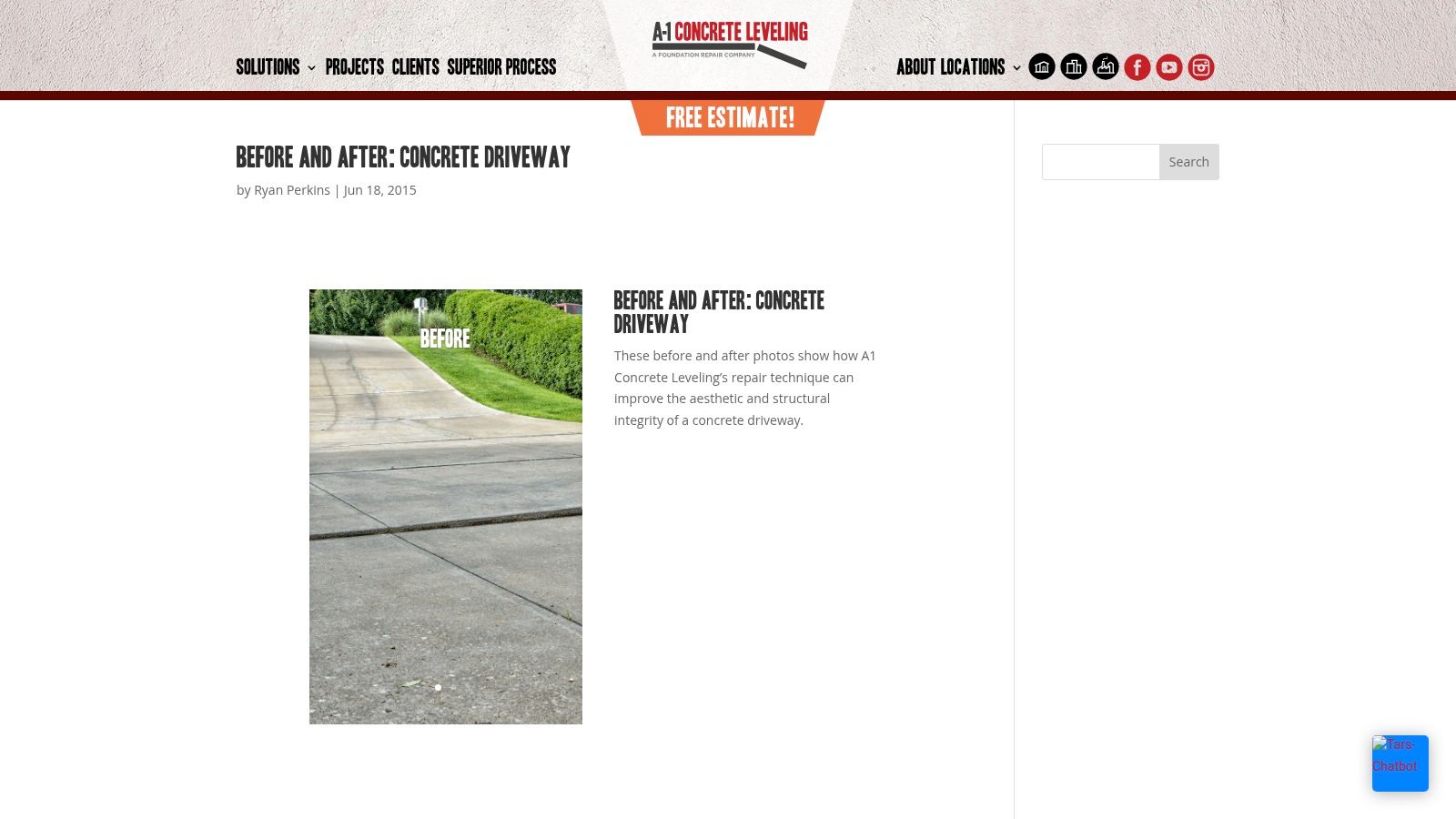
A-1 Concrete Leveling presents a national collection of settled-panel repairs built around slab lifting and leveling. Its before-and-after examples show the visual difference created when a panel returns closer to its intended elevation, rather than receiving a new surface treatment.
That distinction is valuable. A driveway can look rough because it's dirty or stained, but it can also be unsafe because one slab sits higher or lower than the next. Leveling addresses the change in elevation. It doesn't automatically correct every crack, failed joint, drainage issue, or deteriorated concrete edge.
The advantage of a salvageable slab
A minimally invasive lifting approach can be attractive when the panels retain adequate integrity. It generally produces less demolition than tear-out and replacement, and A-1 emphasizes fast turnaround through local branches and owner-operators. The quality question shifts to the local crew, the diagnosis, and the condition of the supporting material.
A national brand can offer a consistent service model, but franchise outcomes may vary by market. Homeowners should ask who will perform the work, how the void beneath the slab will be assessed, how cracks and joints will be sealed, and what conditions would make lifting unsuitable.
The A-1 concrete driveway before-and-after page offers a useful visual reference. For Central Florida homeowners, Riverside's explanation of how to fix uneven concrete slabs adds a local service pathway for evaluating whether leveling or replacement makes more sense.
6. Vesta Foundation Solutions
Vesta Foundation Solutions provides an extensive photo gallery with labeled driveway and walkway repairs. The labels identify materials such as PolyLevel and NexusPro, which gives homeowners more information than a finished image alone. A visible product or process callout helps explain whether the contractor lifted the slab, sealed joints, or combined both steps.
This is the kind of documentation homeowners should look for when reviewing driveway repair before and after examples. The before image should establish the problem. The process images should show access points, lifting or sealing work, and surface preparation. The after image should make clear whether the repair restored grade, closed joints, improved a transition, or changed the appearance.
Educational value, geographic limitation
Vesta's gallery is based on work in Oklahoma and Arkansas, not Florida. That makes it useful for understanding repair methods, but not as a direct local recommendation for Marion County or Citrus County. Climate, drainage patterns, soil behavior, traffic, and contractor availability differ by region.
The company also focuses on lifting and sealing rather than complete driveway replacement. That specialization is helpful when the slab is a candidate for salvage, but it narrows the available solution if the concrete is unstable or extensively deteriorated. Financing and service information are available through the website, while project pricing requires a quote.
Review the Vesta concrete repair photo gallery for method-labeled examples. Then use the same questions with a local contractor: What caused the settlement? Is the concrete structurally sound? Will water continue reaching the repaired area? Which defects will remain after the work?
7. ReVamp Concrete Lifting
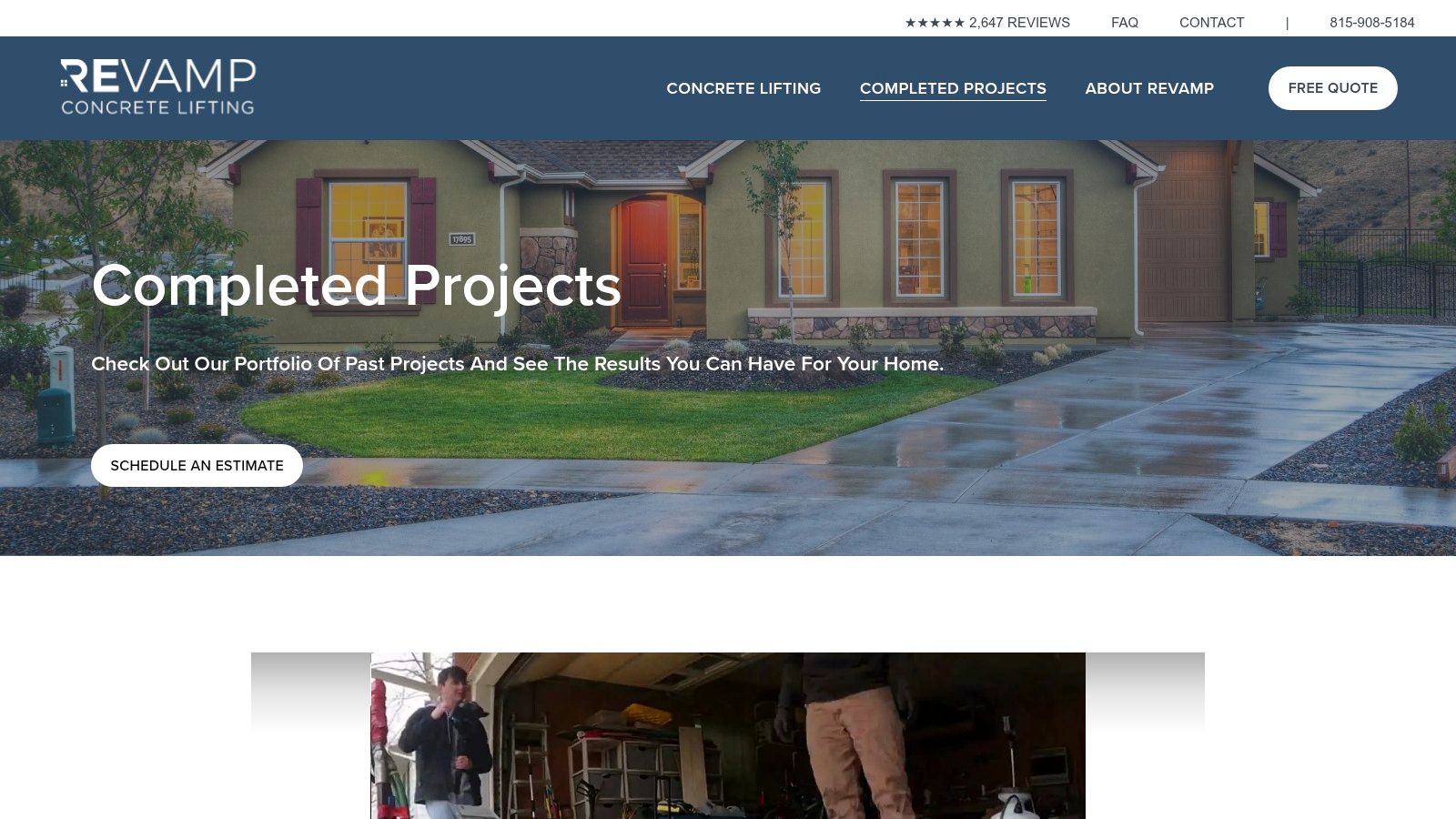
ReVamp Concrete Lifting's completed-project page stands out because it documents the repair sequence instead of showing only the final surface. The images explain polyurethane foam injection and connect the process to practical outcomes, including the removal of trip hazards and improved transitions.
One example shows a driveway raised over 2 inches to eliminate a garage-lip trip hazard, as shown in ReVamp's completed concrete lifting projects. That measurement gives the before-and-after comparison more meaning. The important result isn't merely that the driveway looks smoother. The slab elevation changed enough to address a specific safety and usability problem.
Use measurements, not just appearance
Elevation at the garage threshold, sidewalk crossing, and slab joints can provide better decision evidence than a close-up photograph. A documented case from Atlanta Basement Systems similarly describes settled driveway slabs being lifted back toward their original height with polyurethane foam, restoring a smoother surface and eliminating differential settlement, as shown in its sunken driveway repair case study.
ReVamp is a Northern Illinois provider, so its service territory isn't Central Florida. Its visual documentation still demonstrates how a contractor can communicate scope clearly. Homeowners should look for the same discipline locally, especially where a driveway meets a garage, sidewalk, road, or sloped approach.
Riverside's concrete lifting solutions can help Central Florida property owners explore an appropriate local evaluation. If the concrete has extensive cracking or an unstable base, lifting may not be the correct endpoint. In that case, removal and replacement can provide a more dependable reset.
Before & After: 7 Concrete Driveway Repair Providers
| Provider | Implementation Complexity 🔄 | Resource Requirements ⚡ | Expected Outcomes ⭐ 📊 | Ideal Use Cases 💡 | Key Advantages |
|---|---|---|---|---|---|
| Riverside Sealing & Striping, LLC | Moderate 🔄, multi-trade concrete & asphalt work | Local crews, standard paving/concrete equipment, striping tools ⚡ | Durable repairs, professional striping, ADA upgrades ⭐⭐⭐⭐ 📊 | Residential & commercial maintenance, HOAs, parking lots 💡 | Generational expertise, reliable scheduling, strong local reviews |
| LRE Foundation Repair | Low-Moderate 🔄, targeted foam injection and sealing | PolyLevel foam, NexusPro/SealantPro materials, injection rigs ⚡ | Lifted/leveled slabs, minimal downtime, restored usability ⭐⭐⭐⭐ 📊 | Sunken panels, trip hazards; salvage instead of replace 💡 | Fast turnaround, minimally invasive, photo-documented results |
| Advanced Concrete Coatings of SW Florida | Low 🔄, resurfacing/overlay focused | Decorative coatings, rubber overlays, surface prep tools ⚡ | Cosmetic renewal, improved slip resistance ⭐⭐⭐ 📊 | Sound slabs needing aesthetic/protective refresh (pool decks, patios) 💡 | Decorative customization, slip-resistant finishes |
| Concrete Rejuvenation | Variable 🔄, from crack repair to full replacement | Crack/overlay materials or full replacement crews as needed ⚡ | Range of outcomes: patching to full replacement; visual upgrades ⭐⭐⭐ 📊 | Homeowners comparing repair vs replacement in SE Florida 💡 | Broad service mix; local project examples for decision-making |
| A-1 Concrete Leveling | Low 🔄, standardized franchise slab lifting | Polyurethane foam systems, franchise crews, local equipment ⚡ | Fast, cost-effective leveling for salvageable slabs ⭐⭐⭐⭐ 📊 | Nationwide quick slab leveling; budget-conscious repairs 💡 | National footprint, consistent process, local availability |
| Vesta Foundation Solutions | Moderate 🔄, labeled lifting/sealing workflows | PolyLevel, NexusPro, documented materials; financing options ⚡ | Transparent lifts with material callouts; educational results ⭐⭐⭐⭐ 📊 | Homeowners seeking method transparency and financing options 💡 | Detailed galleries, clear method labeling, financing availability |
| ReVamp Concrete Lifting | Low-Moderate 🔄, foam injection with measured lifts | Polyurethane foam equipment, measurement documentation ⚡ | Measured lifts (e.g., >2"), trip hazard elimination, quick fixes ⭐⭐⭐⭐ 📊 | Driveways/sidewalks with measurable settlement or garage-lip issues 💡 | Clear visual storytelling, measured outcomes, quick turnaround |
Choosing Repair or Replacement After the Photo
The right decision depends on what the before image reveals beneath the surface. Lifting and joint sealing may fit a driveway that has settled but remains structurally sound. Resurfacing or decorative renewal may fit stable concrete with staining, shallow wear, or an appearance problem. Removal and replacement becomes more logical when the driveway has widespread cracking, unstable concrete, failed edges, or drainage-related deterioration.
A useful local repair guide distinguishes cosmetic cracks from more serious defects. Hairline cracks under 1/8 inch are often cosmetic, while cracks over 1/2 inch, recurring joint failure, or visible settling can indicate subgrade or drainage problems that surface patching won't solve, according to Masonry Calculs' concrete driveway repair guide. Those thresholds aren't a substitute for inspection, but they help homeowners describe what they see.
Cost can also shape the decision. One contractor guide states that repair is commonly preferred when it remains below 50% of replacement cost, while its listed ranges are about $0.50 to $10 per square foot for targeted repairs and $8 to $18 per square foot for full replacement, as explained by Estimate Concrete's driveway repair guide. These figures are not a quote for Marion or Citrus County. They're planning references only.
What a site evaluation must check
A photo gallery cannot establish a reliable project price or guarantee a result. A contractor needs to evaluate:
- Dimensions and access: The driveway's size, shape, equipment access, and proximity to structures affect labor and logistics.
- Base and drainage: Settlement may return if water continues washing through or softening the supporting material.
- Reinforcement and demolition: Replacement scope depends on the existing slab, reinforcement, removal method, disposal, and edge conditions.
- Finish selection: Broom texture, decorative treatments, overlays, and other finishes change preparation and installation requirements.
- Curing and use: The surface needs appropriate curing time before traffic and sealing.
A convincing after photo proves that the surface changed. It doesn't prove that the cause of failure was corrected.
Central Florida Climate Changes the After Result
Marion County and Citrus County driveways deal with heat, intense sun, heavy rain, humidity, drainage challenges, and repeated vehicle loading. Those forces affect both concrete and asphalt, although they don't create the same repair decisions. A driveway that looks excellent immediately after work can still fail early if water remains trapped at joints, runoff reaches the slab edge, or traffic loads exceed the surface's condition.
Concrete maintenance guidance reports that minor surface repairs may last 5 to 10 years, structural repairs 15 to 20 years, and crack injection or resurfacing commonly 10 to 20 years. In freeze-thaw regions, some repair lifespans may fall to roughly 10 to 15 years, according to Metro Concrete Repair's durability guidance. Central Florida doesn't present the same freeze-thaw exposure as northern markets, but heat, moisture, drainage, and traffic still make preparation and maintenance decisive.
Sealing is part of that maintenance plan. Guidance recommends sealing concrete driveways every 1 to 3 years, with some recommendations centering on about every 2 years, to slow moisture intrusion and protect the repaired finish, as described in the same concrete repair lifespan guidance. The surface should be clean and dry before sealing. Pressure-washed concrete may need 24 to 48 hours to dry, and light vehicles should generally wait about 7 days after repair, while heavier vehicles may need the full 28 to 30 days, according to DG Floors' driveway repair guidance.
Plan around weather and traffic
Freezing temperatures can compromise curing, but Florida weather creates its own scheduling concerns. Heavy rain can interfere with preparation and sealing, while extreme heat and direct sun can affect application conditions. A contractor should explain what happens if rain enters the forecast and when the repaired surface can accept cars, delivery vehicles, or commercial traffic.
For asphalt areas, Florida maintenance also needs a separate plan. One Florida asphalt maintenance source recommends sealcoating busy commercial lots every 2 to 3 years, with the first application about 6 to 12 months after new paving, during dry, warm months, as described by PLS of Florida's sealcoating guidance. That reinforces the broader lesson. Concrete repair and asphalt maintenance require different materials and schedules, even when both are part of the same property plan.
What a Professional Evaluation Should Include
A qualified contractor should start with the problem, not the product. For a driveway in Ocala, Dunnellon, Silver Springs, or Beverly Hills, that means checking whether cracks are isolated or recurring, whether panels have settled, how water moves across the property, and whether the garage transition or sidewalk crossing creates a safety concern.
The evaluation should separate cosmetic renewal from structural correction. A stable slab with staining may be a resurfacing candidate. A settled slab may need lifting and joint sealing. A driveway with extensive deterioration, failed drainage, or an unstable supporting base may need removal and replacement. A contractor should explain why the selected approach fits the evidence and what defects will remain.
The same care applies to sidewalks and shared access points. ADA guidance for sidewalks crossing driveways states that cross slope shouldn't exceed 2.0%, while one handbook excerpt identifies a maximum running slope of 8.3% at driveways, according to the California Department of Transportation ADA compliance handbook. A municipal sidewalk specification identifies trip hazards such as a slab raised 1/2 inch or more, cracking, chipping, spalling, and cross slope exceeding 1/2 inch per foot, while also noting the ADA maximum cross slope of 2%, as shown in Watertown's sidewalk and apron specifications.
Riverside Sealing & Striping, LLC is positioned to help with this broader evaluation. As a licensed and insured, family-owned Concrete and Asphalt Experts in Marion and Citrus County, the company handles driveway replacement, new concrete work, patios, slabs, sidewalks, asphalt sealcoating, and parking lot striping. Its service approach emphasizes reliable scheduling, high-quality workmanship, clear communication, and free no-pressure on-site consultations and estimates from 7am to 7pm.
Frequently Asked Questions
Is lifting better than replacing a settled concrete driveway?
Lifting can be a sensible option when the slab is structurally sound and settlement is the main defect. It may restore elevation with less demolition than replacement. It isn't the right solution for every driveway. Extensive cracking, crumbling concrete, unstable base conditions, or recurring drainage failure may require removal and replacement.
Can resurfacing fix cracked concrete?
Resurfacing can improve appearance when the slab is stable and damage is primarily at the surface. It won't reliably correct active settlement, significant structural cracking, or movement caused by water and subgrade problems. A contractor should inspect the slab before recommending an overlay.
How long should a repaired driveway cure before use?
Guidance commonly recommends waiting about 7 days for light vehicles after repair, while heavier vehicles may need 28 to 30 days, depending on the repair and curing conditions, according to DG Floors' repair guide. Rain, heat, material choice, and traffic load can change the schedule, so follow the contractor's written instructions.
How often should a concrete driveway be sealed?
Maintenance guidance recommends sealing every 1 to 3 years, with some recommendations using about 2 years as a general interval, according to Metro Concrete Repair. The actual schedule depends on exposure, surface condition, water intrusion, traffic, and the sealer used.
When should a driveway be replaced instead of repaired?
Replacement deserves serious consideration when repair costs approach the replacement cost, when cracking is widespread, when panels continue settling, or when drainage and base problems undermine the slab. The decision should follow an inspection rather than a photograph or a generic price rule.
Turn the Right Before-and-After Option Into a Plan
The best concrete driveway repair before and after result starts with the right diagnosis. Lifting and joint sealing may fit a structurally sound slab that has settled. Resurfacing or decorative finishes may fit stable concrete with cosmetic wear. Extensive cracking, drainage-related failure, unstable concrete, or repeated settlement can point toward removal and replacement.
Photo galleries help homeowners understand what a finished project may look like, but they can't establish a reliable cost range without evaluating dimensions, access, base conditions, drainage, reinforcement, demolition, disposal, finish selection, and curing requirements. The 2026 U.S. planning figures illustrate why scope matters. Typical repair spending is reported at about $1,802, with a range from $300 to $5,900, while replacement averages about $6,400, according to Angi's repair-versus-replacement guide. Your Central Florida project may differ substantially.
Maintenance starts after the crew leaves. Manage runoff, prevent standing water, monitor cracks and settlement, maintain joints, limit harsh deicing products, and address small defects before they spread. Sealing at an appropriate interval can help protect the repaired finish, but it won't correct a drainage or structural problem that remains below the surface.
Riverside Sealing & Striping, LLC provides local guidance for homeowners, HOAs, property managers, churches, schools, nonprofits, builders, and investors. Its concrete work covers driveways, patios, slabs, sidewalks, and replacement projects. Its asphalt services include sealcoating and parking lot striping, including ADA-compliant spaces and directional markings. That combination makes the company a practical partner when a property needs both concrete correction and pavement maintenance.
For a driveway in Dunnellon, Ocala, Crystal River, Inverness, The Villages, or a nearby Central Florida community, a no-pressure site evaluation is the next useful step. Riverside can review the visible damage, identify likely repair limits, discuss replacement when appropriate, and provide a local estimate based on the actual site.
Visit Riverside Sealing & Striping, LLC for a free, no-pressure on-site consultation and estimate for concrete driveway repair, replacement, or related asphalt maintenance. The team serves Marion County, Citrus County, and nearby Central Florida communities, helping property owners choose a durable solution based on the driveway's condition, drainage, traffic, and long-term use.