
For a realistic concrete patio cost in Central Florida, most homeowners typically expect roughly $5 to $16+ per square foot, with many complete projects landing around $3,000 to $7,000+ depending on size, finish, and prep. That said, the number that really changes your budget in Marion County and Citrus County isn't just the concrete itself. It's the ground underneath it, the drainage around it, and whether you're building a simple slab or a decorative patio.
A lot of homeowners in Ocala, Dunnellon, Homosassa, or The Villages start in the same place. They want a clean backyard space for a grill, a few chairs, maybe a covered sitting area later. Then they check an online calculator, see a broad national average, and still don't know what their own yard will cost.
That's a normal problem because patio pricing in Central Florida isn't just about square footage. A flat backyard in Belleview with easy truck access is one kind of job. A replacement patio in Crystal River with drainage issues, soft sandy areas, and tight access through a fence is a very different job. Both may be the same size on paper, but they won't price the same in the field.
This guide is built for local homeowners who want straight answers. It covers what the national cost ranges mean, where patio quotes usually go up, what hidden site conditions tend to surprise people, and how to budget for a patio that will hold up in Marion County, FL, Citrus County, FL, and nearby places like Summerfield, Silver Springs, Inverness, Lecanto, Beverly Hills, Hernando, and beyond.
Table of Contents
- Introduction
- Average Concrete Patio Costs in 2026
- Key Factors Driving Your Final Patio Price
- Local Factors Affecting Costs in Marion and Citrus County
- How to Get a High-Quality Patio Without Overspending
- What to Expect During Your Patio Installation
- Partnering with Central Florida's Concrete Experts
- Frequently Asked Questions About Patio Installation
Introduction
A homeowner in Ocala recently asked the same question many people ask first. "Can you just give me a ballpark for a patio?" That sounds simple, but a ballpark only helps if it's tied to real conditions.
A basic patio for a backyard sitting area might stay close to the lower end of the common range. A decorative patio with added thickness, tougher access, or replacement work can move well beyond the first number a homeowner sees online. That's why one neighbor in Summerfield may get a straightforward quote, while another in Beverly Hills gets a higher one for what looks like a similar patio from the street.
The biggest mistake I see is treating patio work like a commodity. Homeowners assume concrete is concrete, so the only thing that matters is the square footage. In practice, what matters is whether the slab has the right base, slope, finish, thickness, and installation conditions for a Florida yard that sees heavy rain, heat, and long periods of sun.
A low quote can be expensive if it skips the prep work that keeps the patio from settling, cracking badly, or holding water.
For property owners in Marion County and Citrus County, the right question isn't only "What does a concrete patio cost?" It's "What will my site require to build one that lasts?" That's the difference between a patio that stays clean and useful for years and one that starts showing problems early.
Average Concrete Patio Costs in 2026
What the national numbers show
National averages are useful for setting a rough budget, but they are only a starting point for a patio in Central Florida. A typical concrete patio costs about $2,925 nationwide, with most projects falling between $1,580 and $4,465, or about $4 to $26 per square foot, according to Lawn Love's 2026 concrete patio cost guide.
That spread is so wide because online averages combine very different jobs. A small backyard pad with simple finishing sits at one end. A larger patio with decorative work, thicker concrete, difficult access, or removal of an old slab lands much higher. In Marion and Citrus County, rain runoff, soft spots in sandy soil, and permit requirements can push a local price beyond what a national calculator suggests.
Here is the practical way to read those numbers:
| Patio type | Typical pricing view |
|---|---|
| Small, basic patio | Usually near the lower end if the site is open and prep is minimal |
| Standard residential patio | Often lands in the middle after normal grading, forming, and finishing |
| Large or upgraded patio | Climbs fast once design work, extra thickness, or site corrections are added |
Those numbers are a budget range, not a working quote. They do not account for drainage fixes, demolition, root removal, hauling material through a fenced backyard, or the extra base prep many Florida yards need to keep a slab from shifting or holding water.
If you want a broader pricing reference beyond patios alone, this guide to concrete slab cost per square foot helps explain how size affects total cost.
Thickness changes price and purpose
Thickness is one of the clearest cost differences on a patio proposal. A 4-inch slab averages $5.35 per square foot, while a 6-inch slab averages $6.20 per square foot, based on the same cost data noted earlier.
The cheaper option is not always the better value.
A basic backyard patio for patio furniture and foot traffic is one use case. A slab supporting heavier loads, an outdoor kitchen, poor subgrade conditions, or edges that are more likely to wash out after hard summer rain is another. In those cases, the added cost for thickness can be money well spent if the base and reinforcement are also handled correctly.
Practical rule: Choose slab thickness based on use, soil support, and drainage conditions, not just the lowest square-foot price.
Key Factors Driving Your Final Patio Price
Finish choice changes the budget fast
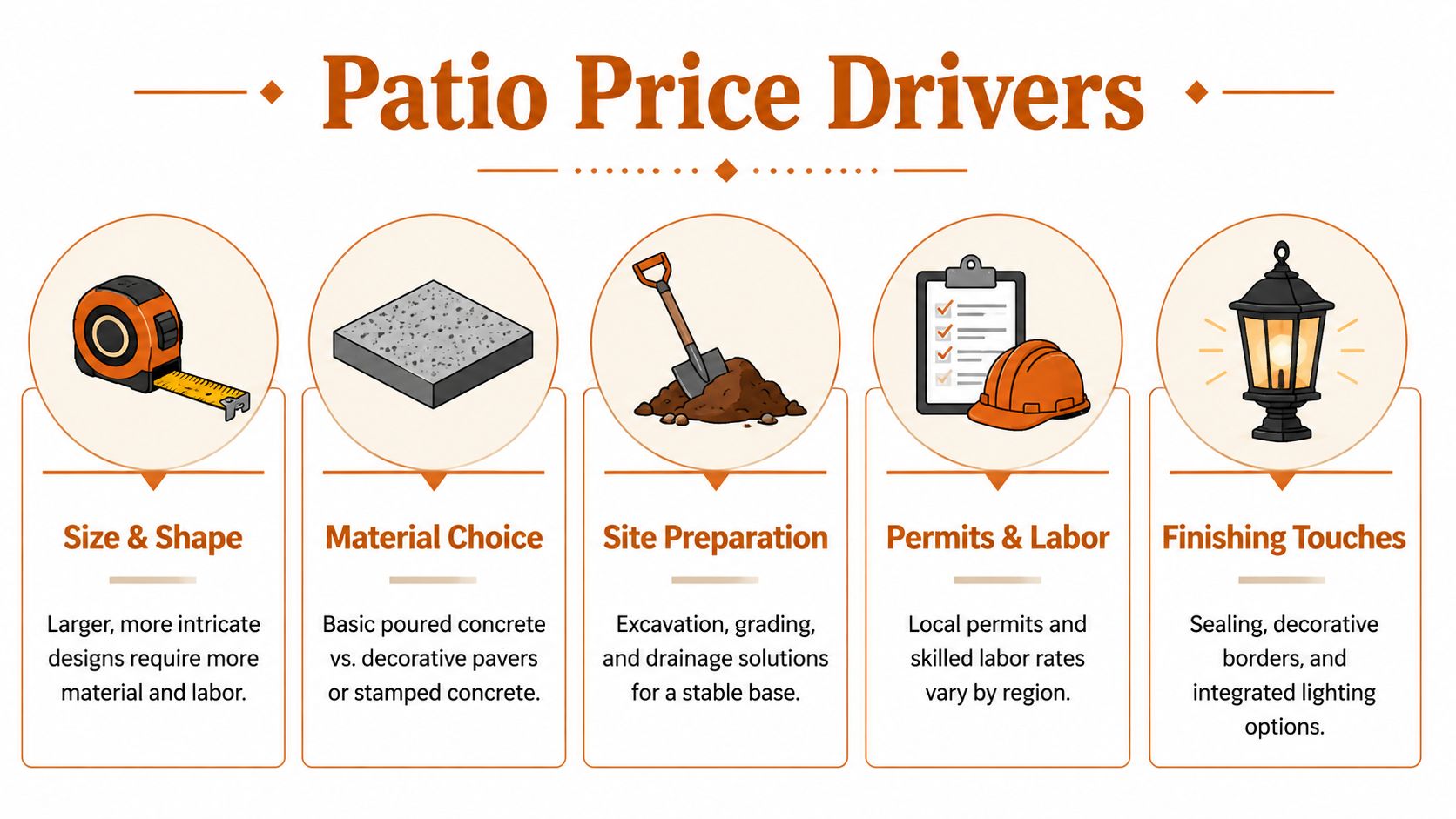
A patio quote can swing hard before the crew even starts digging. In Central Florida, homeowners often compare two prices on the same size patio and assume one contractor is overpriced. In many cases, the finish package is driving a big part of that gap.
Plain installed concrete is commonly estimated at $4 to $12 per square foot, while stained or stamped concrete can rise to $8 to $30 per square foot. Labor can account for about half the total project cost. That is why decorative patios often cost far more than a basic slab, even before site problems are added, according to HomeGuide's concrete patio cost overview.
Stamped concrete takes more crew time, tighter timing, and better finish control. It also leaves less room for weather delays, color inconsistency, and surface defects. A broom-finish patio is usually the simpler and more forgiving option, especially in a backyard that already has drainage or access issues.
Here is the practical difference:
- Basic slab: Lower cost, easier to maintain, and a solid choice for grills, patio furniture, and screened-in spaces.
- Stained concrete: Adds color, but still depends on a clean finish and good surface prep to look right.
- Stamped concrete: Higher design value, higher labor cost, and more risk if the pour schedule, weather, or drainage plan is off.
Sample patio budget ranges by size and finish
The ranges below use the national pricing bands above. They are examples, not quotes.
| Patio size | Plain concrete at $4 to $12 per sq. ft. | Decorative concrete at $8 to $30 per sq. ft. |
|---|---|---|
| 10×10 | About $400 to $1,200 | About $800 to $3,000 |
| 12×20 | About $960 to $2,880 | About $1,920 to $7,200 |
| 20×20 | About $1,600 to $4,800 | About $3,200 to $12,000 |
Those ranges help with early budgeting, but they still miss the field conditions that usually separate a rough estimate from a real proposal.
Other line items homeowners often miss
The expensive problems are usually below the surface or around the patio, not in the concrete itself.
A clean rectangular pour in an open backyard is one price. A patio with tear-out, tight gate access, tree roots, standing water, soft sandy spots, or grade corrections is a different job entirely. In Marion and Citrus County, that difference shows up all the time after heavy rain exposes low areas and washout points.
Several job conditions push the final number up:
- Demolition and disposal: Removing an old slab, footings, pavers, or buried debris adds labor, equipment time, and dump fees.
- Backyard access: If crews have to wheel material through a fence line instead of placing close to the formwork, production slows down and labor goes up.
- Patio shape and layout: Curves, steps, columns, screen enclosures, and tie-ins to existing concrete all take more forming and finish work.
- Subgrade correction: Sandy or uneven soil often needs grading, compaction, and base material so the slab has uniform support.
- Drainage work: A patio has to shed water away from the house. If the grade is wrong, fixing that before the pour is cheaper than living with ponding later.
- Permit or inspection requirements: Some patio projects trigger local review, especially if they connect to other structures or affect drainage patterns.
Good prep is where a durable patio starts. If you want a clear look at what proper site work involves, this guide on how to prepare ground for a concrete slab explains the steps that affect both price and long-term performance.
Cheap concrete is easy to buy. A patio that stays level, drains properly, and holds up through Florida rain is what costs money.
Local Factors Affecting Costs in Marion and Citrus County

Why online patio calculators miss the job in front of you
A homeowner in Ocala might price a patio online on Monday and feel good about the number. By the time the site gets checked, the yard may need grading, an old section of concrete may need to come out, and the only path to the backyard may be through a narrow gate. That is where the estimate changes.
Online calculators usually price square footage and finish type. They do not price the conditions that decide how the slab has to be built in Marion and Citrus County.
The spread in national project pricing makes that obvious. A 20×20 patio can range from $3,200 to $7,200, according to Thumbtack's concrete patio cost discussion. That kind of range usually comes from site work, access, drainage, and prep, not just from the concrete itself.
A successful patio job starts long before the concrete truck arrives. If the base, grade, and water flow are wrong, a good-looking finish will not fix the problem.
What Central Florida yards do to a patio budget
Local soil and weather change the price faster than many homeowners expect.
Sandy soil is common across this part of Central Florida, and that cuts both ways. It is easier to dig than hard clay, but it can also shift, wash at the edges, or stay uneven if the subgrade is loose. Add summer rain, flat lots, and runoff coming off a roof line, and a basic patio can turn into a drainage project if nobody catches those issues early.
Permitting can also affect cost. In some cases, the patio itself is simple, but tying it into an existing slab, enclosure, or covered structure can trigger more review than a homeowner expected.
Common local cost drivers include:
- Old concrete removal: Replacement work often starts with demo, haul-off, and cleanup before new forming can begin.
- Soft or uneven subgrade: Some yards need extra grading, compaction, or base material to support the slab evenly.
- Tight backyard access: Gates, septic locations, screen enclosures, and narrow side yards can slow production and raise labor time.
- Drainage corrections: A patio has to move water away from the house and avoid creating a low spot in the yard.
- Jurisdiction requirements: City or county review can vary depending on location, drainage impact, and how the patio connects to nearby structures.
I see homeowners compare pricing between Crystal River, Inverness, Silver Springs, and Dunnellon as if every yard starts the same. It does not. One property may be ready for forms and base prep, while another needs removal, regrading, and a plan for water before a single yard of concrete gets poured.
That difference is why local experience matters. A patio can look fine the day it is finished and still have trouble ahead if the installer ignored runoff, weak edges, or poor support under the slab.
How to Get a High-Quality Patio Without Overspending

A patio budget goes off track when money gets spent on appearance before the slab is built to handle Florida conditions. In this area, the expensive mistakes usually show up later. Standing water near the house, settling at one corner, edge cracking, or a surface that looked good at handoff and starts showing problems after a rainy season.
The best way to control cost is to separate what affects service life from what affects appearance. Put the budget into the parts that keep the slab stable and draining correctly. Keep the design simple unless there is room for upgrades.
Spend on the parts that prevent failure
Start with the work below and around the concrete, not just the surface finish.
Subgrade and base preparation
If the soil is loose, uneven, or disturbed, fix that first. In Central Florida, sandy ground can look fine during layout and still shift under load if it was not compacted properly. Money spent here helps prevent settlement and uneven cracking.Correct slope away from the house
A patio has to shed water on purpose. If the slab is flat or pitched the wrong way, the repair cost is usually much higher than the savings from skipping proper layout and grading.Reinforcement and slab thickness that match the job
A small sitting area and a patio that ties into heavy traffic, grills, or nearby structures are not always the same build. The installer should explain what is being placed in the slab and why.Crew quality and scope clarity
A lower quote can leave out prep, haul-off, jointing, or cleanup. Good contractors spell out what is included before the job starts, which helps homeowners compare bids on the actual work instead of the bottom number.
Decorative upgrades are easier to add later than structural corrections.
Where homeowners can simplify the project
There are practical ways to lower concrete patio cost without stripping out the parts that matter.
- Use a simple layout. Rectangles and standard dimensions are faster to form and finish than curved or heavily cut-up designs.
- Choose a broom finish if function matters more than decoration. It holds up well, gives traction in wet weather, and usually costs less than stamped or highly decorative surfaces.
- Build the patio around how you will use it. Size it for furniture, grill clearance, and walking space instead of paying for square footage that stays empty.
- Phase upgrades. Homeowners can pour the main slab now and add coatings, borders, or nearby features later if the base patio already does the job.
- Read estimates line by line. One bid may include excavation, base correction, reinforcement, and cleanup. Another may price only the pour and leave the rest to change orders.
I also tell homeowners to be careful with stamped concrete if the budget is tight. It can look great, but it adds labor, color work, and more room for disappointment if the installer rushes the finish. A clean, well-poured broom finish with straight edges often gives better long-term value than a decorative patio built on weak prep.
For a realistic number, get the site looked at in person. Riverside Sealing & Striping, LLC provides concrete and asphalt services in Central Florida, including patios, slabs, and related site work, and offers free, no-pressure estimates.
What to Expect During Your Patio Installation

The job before the pour
Most homeowners only picture the concrete truck and the finishing crew. The installation starts earlier than that.
First comes the site visit. The contractor checks grade, access, dimensions, drainage, finish choice, and whether there's old material to remove. During this stage, a good estimate gets built from real conditions instead of guesswork.
Then the crew prepares the area. That may include demolition, excavation, grading, forming, and reinforcement depending on the job. If anything is rushed in this phase, the patio can show it later.
A professional patio installation usually follows this order:
- Consultation and measuring: The layout, use, and finish are discussed on site.
- Prep and forming: The area is shaped for drainage and formed to final dimensions.
- Reinforcement and pour planning: The slab is readied for concrete placement.
- Placement and finishing: The crew pours and applies the selected finish.
The pour finish and curing stage
The pour day gets the most attention, but curing is just as important. Concrete doesn't become strong just because the surface looks dry.
Homeowners should expect some limits on use while the slab cures. That's one reason it's worth understanding the process ahead of time instead of treating a new patio like it's ready for full traffic immediately. If you want a practical explanation of that stage, this page on how long concrete takes to cure covers what homeowners should expect after the pour.
Good patio work looks clean on the surface, but the real quality shows in the slope, edge work, joint placement, and the way the slab cures after installation.
Sealing may also be part of the final protection plan depending on the finish and project goals. For decorative patios especially, the finish stage is where appearance and long-term maintenance start to connect.
Partnering with Central Florida's Concrete Experts
What a qualified local contractor should account for
If you're comparing patio contractors in Ocala, Dunnellon, Crystal River, or The Villages, the estimate should reflect more than square footage. It should account for access, grading, drainage, slab design, finish, and whether the job is new construction or replacement work.
A reliable quote should also be clear about what is and isn't included. Homeowners deserve to know whether the proposal covers site prep, removal of old material, forming, finishing, and cleanup. Vague bids are where surprises tend to start.
Licensed and insured contractors with local Central Florida experience usually approach patio work differently than companies relying on generic pricing. They know that a flat-looking yard may still need drainage correction. They know sandy soils can behave differently from one property to the next. They also know that a modest patio in Marion County can be straightforward while a same-size patio in Citrus County can require more prep because of conditions on site.
Why local concrete and asphalt experience matters
This is also where it helps to work with a company that isn't limited to one narrow trade. Concrete and Asphalt Experts in Marion and Citrus County understand how surface performance, site prep, drainage, and long-term maintenance fit together across the whole property.
That matters for homeowners and commercial owners alike. A house in Lecanto may need a new backyard patio today and driveway replacement later. A property manager in Silver Springs may need sidewalk repairs, asphalt sealcoating, or updated parking lot striping after concrete work is complete. The contractor who understands both concrete construction and pavement maintenance can often spot issues that affect the full site, not just one slab.
Good workmanship is still the core issue. Reliable scheduling, clear communication, and realistic job planning matter just as much as the concrete mix on the truck.
Frequently Asked Questions About Patio Installation
Do I need a permit for a concrete patio in Marion County or Citrus County
Sometimes yes, sometimes no. It depends on local requirements, patio size, location on the property, and whether other work is involved. Rules can vary by county and city, so homeowners in places like Ocala, Inverness, Crystal River, or Belleview should verify local permitting requirements before work starts.
Is stamped concrete worth the added cost
It can be, if appearance is a priority and the budget allows for it. Decorative finishes create a different look than a plain slab, but they also add labor and cost. For some homeowners, a simpler broom-finish patio delivers better value.
How long will a concrete patio last in Florida
A properly installed patio can serve a property for many years if the base, drainage, and finish are handled correctly and the surface is maintained. Longevity depends heavily on workmanship, site conditions, and how the slab handles water.
Is a concrete patio slippery when wet
That depends on the finish. Outdoor patios should be chosen with traction in mind, especially around rain, lawn irrigation, or pool areas. Homeowners should ask specifically how the chosen finish will perform when wet.
What should I compare when I get multiple quotes
Don't compare price alone. Compare scope. Ask whether each bid includes prep, grading, old concrete removal if needed, finish details, cleanup, and a clear explanation of how the patio will drain.
If you're planning a new patio or replacing an older slab in Marion County, FL or Citrus County, FL, Riverside Sealing & Striping, LLC offers free, no-pressure consultations for concrete and asphalt work across Central Florida. A site visit can give you a more accurate patio budget based on your actual yard, your finish choices, and the prep your property needs.