
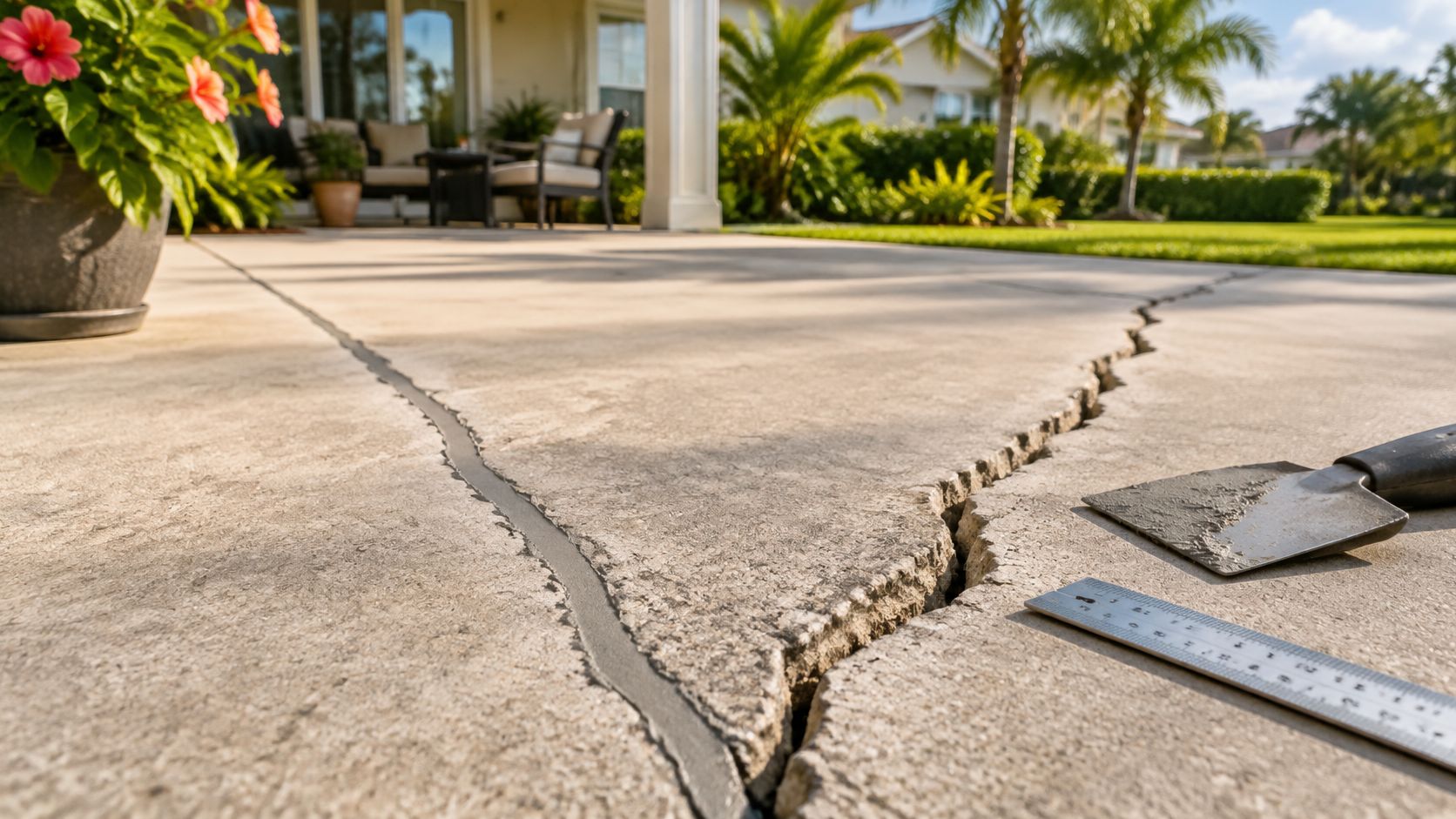
The most common advice for concrete patio crack repair, clean the line and fill it, skips the decision that matters most. A filler can close an opening, but it can't correct a dropped slab, replace washed-out support, or hold together concrete that's still moving.
For homeowners in Marion County, FL, and Citrus County, FL, the right starting point is a site check, not a shopping trip. Central Florida heat, summer rain, irrigation, and drainage all affect which repair makes sense. Before buying anything, find out whether you're treating a stable surface defect or a symptom of a larger problem.
Table of Contents
- Which Patio Crack Repair Fits the Damage
- Why Patio Cracks Form and How Central Florida Weather Stresses Them
- Repair Methods That Match Crack Behavior
- How to Repair a Stable Patio Crack
- Patio Crack Repair Costs and How Long They Last
- When a Contractor Should Take Over
- Frequently Asked Questions About Patio Crack Repair
- Key Takeaways and Next Steps for Patio Crack Repair
Which Patio Crack Repair Fits the Damage
A crack across an Ocala patio raises the same question as one in Dunnellon, The Villages, or Crystal River: Is this a cosmetic line, or is the slab moving? Width helps describe the damage, but width alone doesn't answer that question.
Before choosing concrete crack filler, record these field observations:
- Opening width: Measure the widest part with a ruler, rather than judging it from standing height.
- Edge alignment: Lay a straightedge across the crack and look for a raised edge or a gap beneath it.
- Recent change: Note whether the opening grew, lengthened, or developed a lip after rain.
- Water movement: Watch where runoff enters, crosses, ponds on, or disappears beneath the patio.
Photograph the opening beside the ruler from the same position whenever you check it. That gives you something more reliable than memory when deciding whether it's changing.
Patio crack signs and the repair they call for
The width bands below are screening categories, not structural safety thresholds. A narrow crack with displacement deserves more attention than a wider opening that has remained level and stable.
| What you see | Usual meaning | Repair approach | Who should do it |
|---|---|---|---|
| Hairline under 1/8 inch, level edges, no growth | Dormant shrinkage, nonstructural | Matched cementitious mortar; don't widen the crack | DIY if edges are sound and moisture conditions suit the product |
| 1/8 to 1/2 inch, stable, no lip | Wider but dormant surface crack | Sanded mortar or a routed seal if moisture exclusion is the goal | DIY or a concrete contractor |
| Reopens with heat or seasons, no settlement | Moving thermal crack | Clean and route, then elastomeric sealant, not rigid paste | Usually a contractor |
| Vertical lip, widening, or soft soil along the line | Settlement or lost support | Fix drainage and support; partial or full replacement | Contractor evaluation |
| Spalling, exposed steel, or a patch that failed again | Failed concrete or ongoing movement | Don't coat over it; restore or replace the damaged area | Contractor |
The National Park Service's concrete preservation guidance distinguishes dormant cracks suited to matched cementitious mortar from moving cracks that need an elastomeric sealant, and generally advises against widening a nonmoving crack before mortar repair.
That distinction prevents a common mistake: grinding every opening into a larger groove just because a repair video shows someone doing it.
Practical rule: A level, unchanged line may be a reasonable DIY repair. A height change is a reason to investigate the slab and its support.
Why Patio Cracks Form and How Central Florida Weather Stresses Them
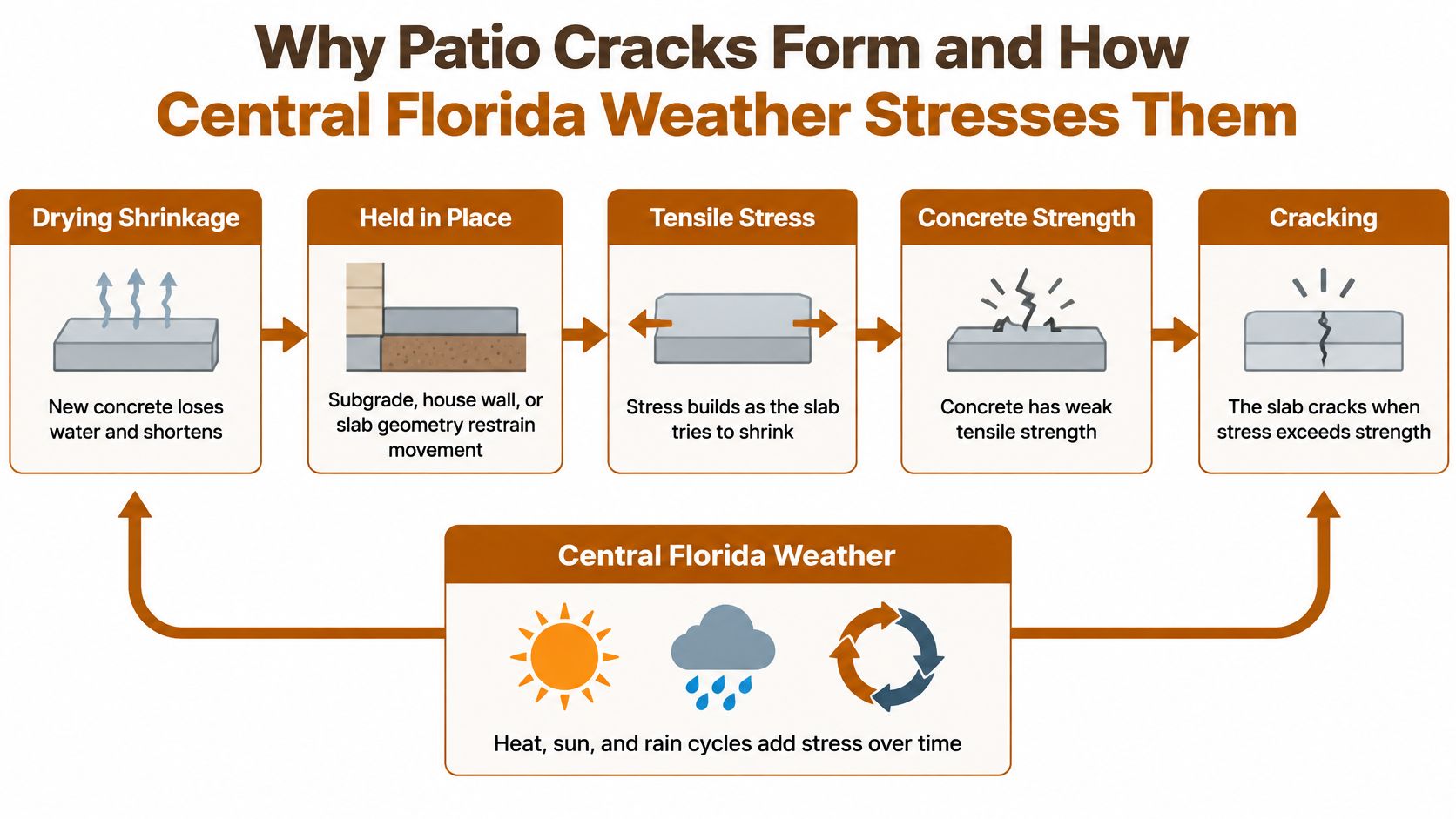
Consider a patio beside a Summerfield home. The concrete loses water as it dries and tries to shorten, but friction beneath the slab, its shape, and adjoining construction restrain that movement. Stress builds until the concrete cracks.
The American Concrete Institute's guidance on concrete cracking identifies drying shrinkage, settlement shrinkage, thermal movement, chemical reactions, corrosion, and structural loading as separate causes. That's why no single repair compound solves every patio crack.
This cause-and-effect diagram shows how restraint and weather contribute to cracking.
Follow the water before selecting the repair
Say an Inverness patio has a low corner beside a regularly irrigated planting bed. The visible crack might be the easiest defect to notice, but runoff disappearing beneath that corner is the more important finding.
Walk the perimeter during rain, without entering unsafe conditions. Check these locations:
- At the roofline: Downspouts shouldn't concentrate discharge beside an unsupported slab edge.
- Along planting beds: Soil and mulch shouldn't conceal the edge or trap water against the concrete.
- At sprinklers: Adjust heads that repeatedly soak the patio or saturate adjacent ground.
- Beside the house: Look for ponding, reverse slope, and gaps that admit water beneath the slab.
FHWA's guidance on moisture-related concrete distress explains that moisture contributes to deterioration and recommends reducing exposure through drainage improvements and protective measures. For a residential patio, that means correcting a water source before hiding its effects.
Heat, sunlight, and use affect the repair window
Hot afternoons and cooling rain change slab temperature. Direct sun can also heat a repair surface beyond suitable placement conditions, while UV exposure matters when selecting exposed sealants and finishes. Foot traffic and furniture then add wear before an inadequately cured repair is ready.
These aren't interchangeable with asphalt maintenance concerns. Asphalt sealcoating addresses weathering and surface protection; concrete repair must also account for rigid slab movement and support.
Keep deliberate movement gaps functional. Understanding what a concrete expansion joint does helps prevent the mistake of packing a working joint with rigid mortar.
Postpone cosmetic work when water is actively entering the repair area. Persistent settlement after drainage correction calls for a replacement assessment, not another coating.
Repair Methods That Match Crack Behavior
Choose the repair by what it must accomplish: restore a small surface defect, exclude water while allowing movement, restore continuity, or replace failed concrete. Those are different jobs, with different materials and preparation.
Mortar and flexible sealant solve different problems
For a dormant opening, a cementitious repair mortar provides a firm, finishable patch. Narrow openings need a product fine enough to enter the gap; wider stable defects can accept sanded mortar. Neither should be selected merely because the bag promises high compressive strength.
A moving crack needs a sealant system that can stretch and compress. The contractor prepares sound bonding faces and controls sealant depth, often using backer rod or a bond breaker where the system requires it. Self-leveling sealant suits appropriately level surfaces; a sloping patio may need a non-sag product.
FHWA pavement guidance makes annual horizontal movement the principal seal-versus-fill consideration and describes routing certain pavement cracks 1/8 to 1/2 inch wide into a reservoir two to three times the original width and 1/2 to 3/4 inch deep. Those are pavement procedures, not residential patio cutting instructions.
A contractor must account for slab thickness, reinforcement, crack depth, and the selected sealant system. Blindly chasing a crack deeper can damage otherwise serviceable concrete.
Epoxy and replacement require a different decision
Epoxy injection is for selected dormant cracks where restoring continuity matters. It isn't an upgraded cosmetic filler, and it won't correct ongoing soil movement. ACI's epoxy injection procedure describes specialized preparation, surface sealing, ports, and controlled injection rather than pouring resin into an opening.
Mortar compatibility also matters. The ACI Concrete Repair Guide explains that differential shrinkage and creep between repair material and existing concrete can cause perimeter cracking and delamination. Choose controlled-shrinkage, substrate-compatible material, not the strongest-sounding product.
| Method | What it can do | What it can't do |
|---|---|---|
| Cementitious mortar | Restore a stable surface defect | Accommodate continuing movement |
| Elastomeric sealant | Limit water entry while accommodating movement | Restore missing slab support |
| Epoxy injection | Restore continuity in suitable dormant cracks | Stabilize moving soil |
| Partial or full replacement | Remove failed concrete and rebuild the affected assembly | Succeed without proper base preparation |
When concrete is deteriorated or unsupported, replacement should extend to sound boundaries. FHWA full-depth repair guidance reinforces the importance of repair geometry and load transfer, although roadway dimensions shouldn't be copied onto a residential patio.
A narrow strip of new concrete isn't automatically a durable repair. The replacement needs sound edges and reliable support.
How to Repair a Stable Patio Crack
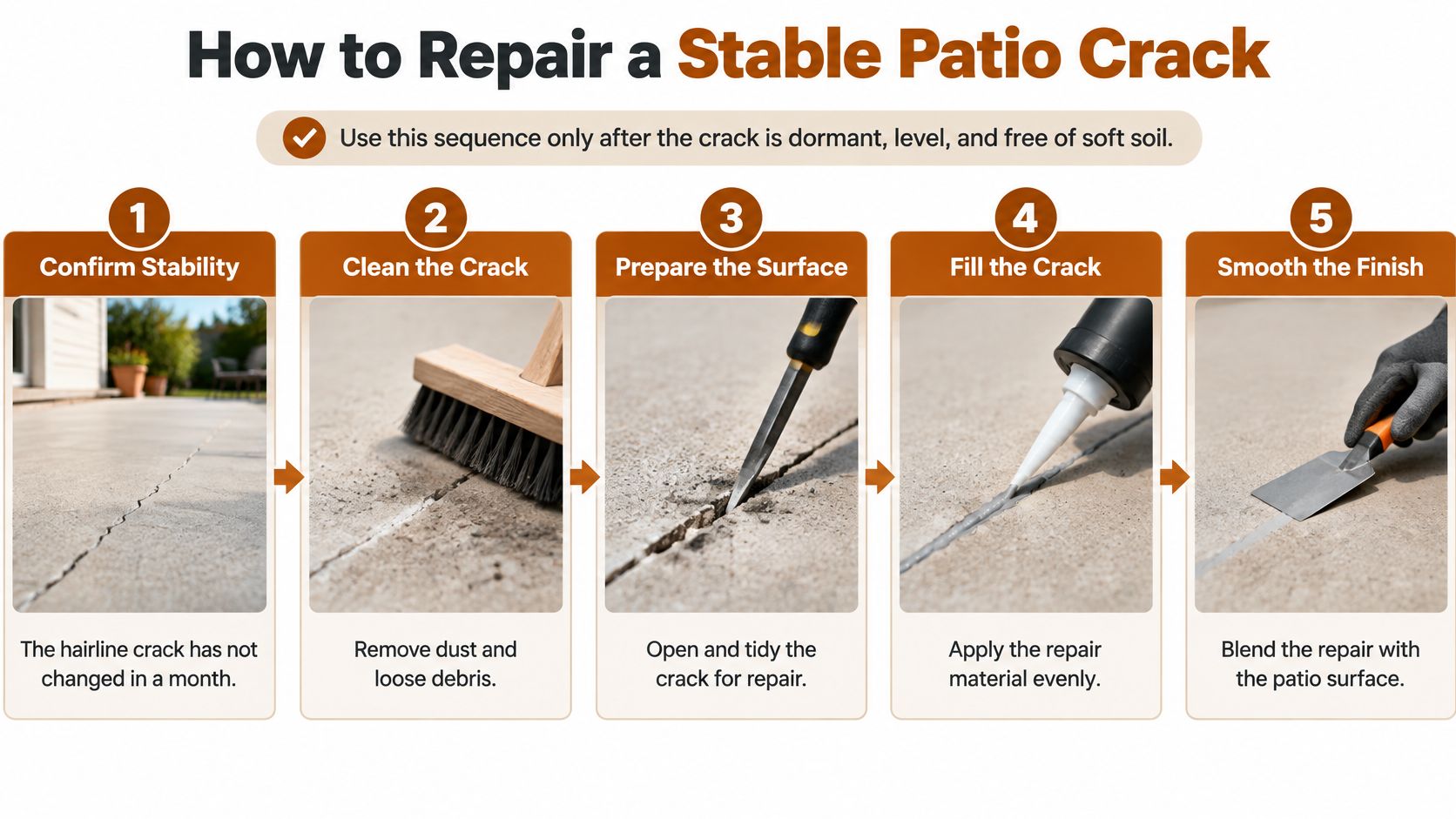
Use this sequence only for a dormant, level crack with sound surrounding concrete and no evidence of lost support. Think of a stable line across a Belleview patio, not a dropped corner pulling away from the house.
The visual below summarizes the workflow. For this mortar repair, preparing the opening means cleaning it, not deliberately widening a sound, nonmoving crack.
Prepare, place, and protect the mortar
Confirm the conditions. Compare your photographs and measurements, check both edges with a straightedge, and mark the crack ends. Don't proceed if the opening is changing or water is emerging through it.
Remove loose material. Scrape out failed filler with a putty knife, brush away friable debris, and vacuum the opening. Wear eye protection and gloves, and avoid dry grinding that creates airborne concrete dust. If cleaning keeps exposing crumbling edges, stop.
Select and prepare the repair mortar. Use an exterior-rated cementitious product approved for the opening and placement thickness. Choose unsanded material for narrow gaps and sanded material for wider stable openings where appropriate. Test color in an inconspicuous spot, because new mortar rarely disappears against weathered concrete.
Condition the substrate and mix accurately. Follow the product's specific moisture requirement. Some cementitious systems need a damp, surface-dry substrate rather than bone-dry concrete; standing water isn't acceptable. Measure mixing water, use a clean container, and don't add extra water to revive stiffening mortar.
Pack and finish the opening. Press the material into the defect with a margin trowel or putty knife within its permitted thickness. Tool the surface flush, without a raised ridge or an unsupported feather edge. Match the surrounding texture rather than polishing a slippery stripe across a broom-finished patio.
Cure and reinspect. Protect the repair from direct rain, irrigation, premature drying, and traffic using the curing method specified for that product. After rain returns, check the bond line and confirm that runoff still leaves the patio.
Know when to stop
Stop if you discover a height difference, deep deterioration, or a damaged joint that needs reconstruction. Don't bridge a working joint with mortar just to make the surface look continuous.
A patch can feel hard before it's ready for concentrated furniture loads. Plan access and weather protection before mixing, rather than improvising after the material is placed.
For an additional visual demonstration, use the video alongside the selected product's instructions, not as a substitute for diagnosing the crack.
Patio Crack Repair Costs and How Long They Last
Price the repair scope, not just the material. A short crack with difficult access, old filler removal, and deteriorated edges can require more preparation than a longer, clean opening.
In 2025, ConcreteNetwork reported crack-filling costs of $5–$15 per linear foot for minor to moderate nonstructural concrete cracks, depending on materials and methods. In 2025, Angi reported typical concrete patio resurfacing costs of $3–$5 per square foot, averaging approximately $4 per square foot.
These are published reference prices, not a Marion or Citrus County quote.
Patio repair costs and what the price assumes
| Repair | Typical cost | Price assumes | Service note |
|---|---|---|---|
| Minor to moderate crack filling | Published linear-foot range above | Nonstructural cracks; material and method affect price | Recheck after the first wet season |
| Patio resurfacing | Published square-foot range above | Slab is sound and not settling | Improves the surface; doesn't fix support |
| Partial replacement | Site price by area and access | Failed area removed with sound boundaries restored | A strip that's too narrow can fail again |
| Full patio replacement | Site price after evaluation | Widespread cracking, movement, or bad slope | Address joints and drainage, not just appearance |
Resurfacing can make a stable, repaired patio more uniform. It can't lift a settled corner, and an unresolved moving crack may reflect through the new finish.
Replacement pricing must account for demolition, removal, access, slab construction, and drainage work. Ask for those items separately so a cosmetic proposal isn't mistaken for a complete repair.
Judge durability beyond the finished appearance
FHWA reports that 80% to 100% of properly installed partial-depth concrete pavement repairs perform well after 3 to 10 years when construction quality control is good. That's pavement evidence, not a patio warranty, but it supports the importance of preparation, appropriate materials, placement, and maintenance.
Don't turn that range into a promised residential lifespan. A patio's support, moisture exposure, existing condition, and repair purpose still control the outcome.
Budget advice: A cheaper patch isn't a saving if the unresolved cause requires you to remove it and repair the same area again.
Use a simple concrete patio maintenance routine to inspect repairs, keep drainage routes clear, and evaluate joints and surface protection. Compare photographs after wet weather rather than waiting until a failed patch becomes obvious.
When a Contractor Should Take Over
Bring in a licensed and insured concrete contractor when you find vertical displacement, continuing growth, exposed reinforcement, deep spalling, or repeated repair failure. A crack crossing much of the patio also deserves evaluation when it's accompanied by movement or drainage problems.
Water ponding against the house or disappearing beneath the slab changes the scope. The next job may involve grading, support correction, and concrete replacement, not another tube of filler.
What a useful evaluation should include
A professional assessment should separate a serviceable slab from concrete that needs removal. The written scope should identify:
- The cause being addressed: Movement, deterioration, drainage, or lost support.
- The work boundaries: What remains, what's removed, and how edges and joints are treated.
- The return-to-use plan: Weather protection, curing, and access restrictions.
Use these questions to ask a concrete contractor to compare proposals on more than the finish color.
At Riverside Sealing & Striping, LLC, we're Concrete and Asphalt Experts in Marion and Citrus County, family owned and operated by third- and fourth-generation professionals. Our concrete patio and slab services include custom design and installation, reinforced slabs, and weather-resistant finishes; we also provide asphalt sealcoating and parking lot striping.
Our Central Florida service area includes Silver Springs and Summerfield, along with Homosassa, Lecanto, Beverly Hills, and Hernando. We provide free, no-pressure consultations and estimates, reliable scheduling, and clear timelines. Ask about the earliest practical turnaround, but don't trade proper preparation and curing for a rushed completion date.
Frequently Asked Questions About Patio Crack Repair
Can furniture or stain go back on right away?
No. Furniture loading, stain application, and sealer application may each have different waiting requirements. Follow the repair product's cure instructions and the finish manufacturer's compatibility requirements, not just whether the patch feels dry.
Will concrete sealer stop new cracks?
A sealer can reduce water entry into suitable concrete, but it won't hold a moving slab together or replace missing support. Apply it as surface protection after the underlying condition is addressed, not as a structural repair.
How long should I watch a hairline before repairing it?
There isn't a universal waiting period that proves stability. Compare its width and edge alignment through changing weather, including rain, and don't assume an unchanged photograph proves the base is sound.
If you notice growth, displacement, or a soft perimeter, stop treating the opening as a simple cosmetic defect. These answers apply to residential patios, not structural beams or other load-bearing concrete that needs specialized evaluation.
Key Takeaways and Next Steps for Patio Crack Repair
Good concrete patio crack repair starts with movement, height change, and stormwater, not the product shelf. Record what's happening before deciding whether the job is a small mortar patch, flexible sealing, specialized restoration, or replacement.
Keep the repair objective clear. A surface patch improves a stable defect; a movement-accommodating seal limits water entry; replacement allows failed concrete and support conditions to be addressed together. None should be sold as an interchangeable upgrade over the others.
For homeowners from Ocala to Crystal River, the most useful next step is a careful perimeter walk and a set of clear photographs. Note the house connection, low corners, sprinkler coverage, and any place runoff disappears beneath the slab.
Then compare complete scopes rather than bags of material or surface appearance alone. Durable work supports safe use, curb appeal, and long-term savings by addressing the reason the patio needs attention.
Riverside Sealing & Striping, LLC offers concrete patio and slab services alongside asphalt sealcoating and parking lot striping across Central Florida. For a second set of eyes on your concrete patio crack repair, visit Riverside Sealing & Striping, LLC to request a free, no-pressure consultation and estimate.