
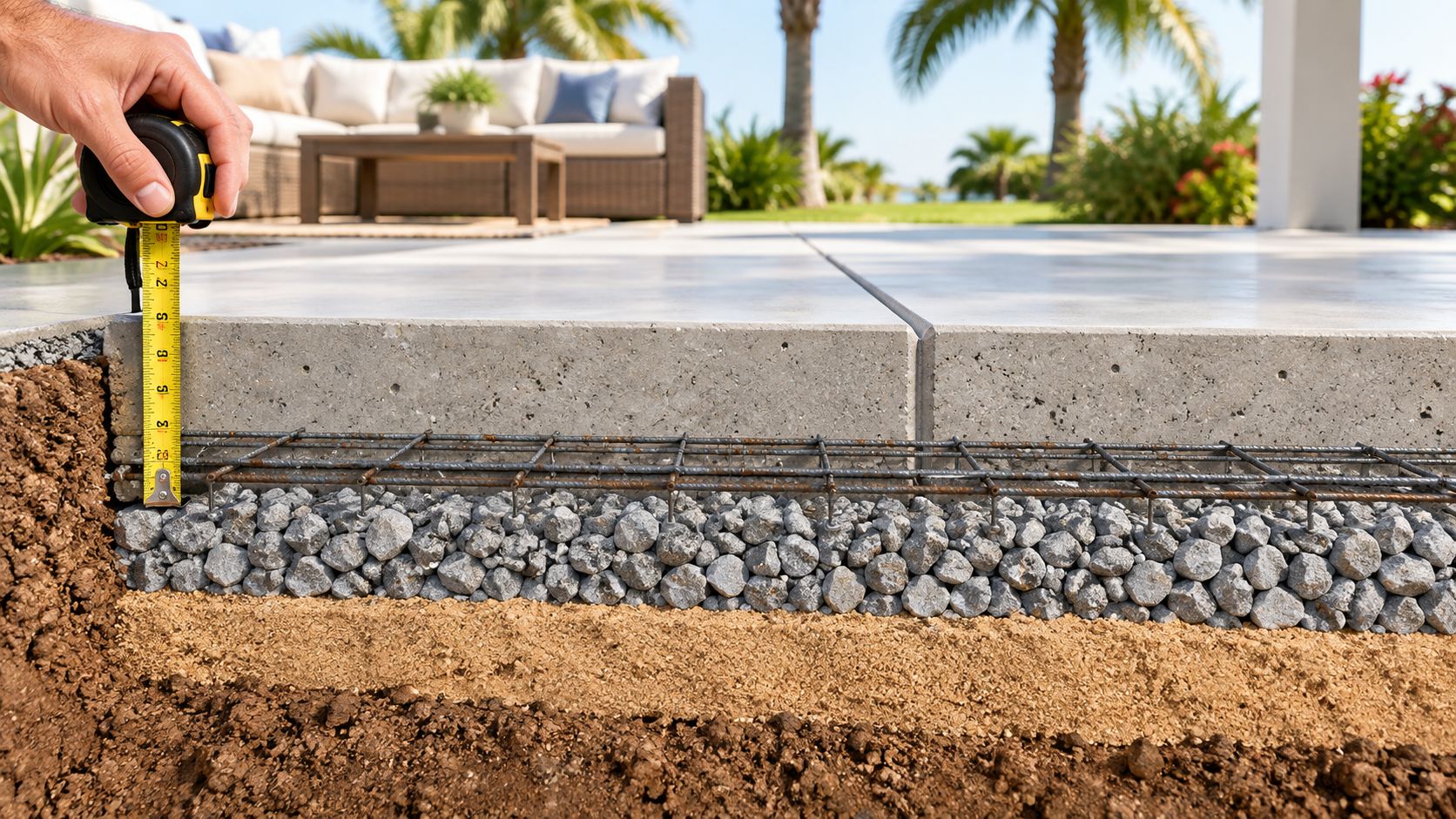
A 4-inch concrete slab is the standard for most Florida patios, but thickness alone doesn't prevent cracking unless the base, drainage, reinforcement, and control joints are also installed correctly. For heavier uses or unstable ground, the slab may need to be thicker or reinforced.
You may be standing in a Dunnellon backyard right now, looking at a proposed patio and wondering whether four inches is enough. Perhaps you're planning a seating area, grill, and outdoor dining space, but you're also considering an outdoor kitchen or hot tub later. The extra concrete sounds like inexpensive insurance, yet the right answer depends on more than the number of inches.
Central Florida conditions make that decision especially important. Rain can saturate soil beneath the slab, sandy ground can settle when it isn't compacted, and repeated heat cycles place stress on the concrete surface. A successful patio comes from matching concrete patio thickness to the planned load, then supporting that thickness with a stable base, appropriate reinforcement, drainage, and control joints.
Table of Contents
- Why Patio Thickness Matters in Central Florida
- The 4-Inch Standard and What It Actually Covers
- Choosing the Right Thickness for Your Patio Use
- Base, Reinforcement, and Joints That Make Thickness Work
- Florida Soil, Heat, and Rain Considerations
- How to Check an Existing Patio's Thickness
- Getting a Patio Built Right and FAQs
Why Patio Thickness Matters in Central Florida
A homeowner in Dunnellon might plan a 16-by-20 patio and receive two estimates, one for a four-inch pour and another for a thicker slab. The natural question is what the extra concrete buys. The answer is greater resistance to flexing under concentrated loads, but only when the ground beneath the slab can support it.
A patio doesn't crack because a contractor chose the wrong number. Cracks often appear when soil settles unevenly, water erodes support, edges remain vulnerable, or the concrete has no planned location for movement. A thicker section spreads weight across more material and reduces flexural stress, but it can't correct a poorly prepared subgrade.
Practical rule: Choose patio thickness by load class and ground conditions, not by patio size alone.
Central Florida yards vary considerably. A clean, firm, well-drained sandy area may support a standard residential patio after proper excavation and compaction. A low area containing soft fill, organic material, or disturbed soil can move beneath the slab after heavy rain. The same four-inch design may perform well in one Ocala neighborhood and struggle in another property near Silver Springs or The Villages.
Heat adds another layer. Concrete expands and contracts as temperatures change, while moisture changes can affect the soil beneath it. A patio with inadequate joints, weak edges, or inconsistent thickness is more likely to develop random cracking and settlement.
A layered way to make the decision
Start with the ordinary residential standard. Then ask four practical questions:
- What will sit on the patio? Furniture and a grill create a different demand than a hot tub or masonry outdoor kitchen.
- What is under the patio? Firm, compacted material behaves differently from soft fill or a wet low spot.
- Where will water go? Drainage protects the base from saturation and erosion.
- How will movement be managed? Reinforcement and control joints help the slab respond in an orderly way.
That layered approach gives a more useful answer than adding concrete. It also helps homeowners in Marion County, FL, and Citrus County, FL, compare proposals without assuming the thickest option is automatically the best one.
The 4-Inch Standard and What It Actually Covers
For most residential patios, four inches is the practical standard. Multiple residential flatwork references repeat that depth for patios, walkways, and other light-duty slabs, while code-oriented guidance commonly identifies about 3.5 inches as a residential slab-on-grade minimum. Florida local-government guidance states that minor exterior flatwork, including patios, walkways, and driveways, must be at least four inches thick in the referenced jurisdiction. See the Broward County patio and driveway slab guidance for that local requirement.
That baseline fits ordinary residential activity. A properly constructed four-inch slab can serve:
- Foot traffic: Daily walking and normal backyard use.
- Furniture: Seating, tables, planters, and similar household items.
- Grills: A standard gas grill or comparable residential cooking equipment.
- Light outdoor living: Dining, conversation areas, and routine entertaining.
Many residential guides pair this thickness with concrete compressive strength around 3,000 PSI, a commonly cited baseline for foot-traffic use and general durability. The concrete slab thickness guidance from ConstructionCalc connects the four-inch standard to light-duty patios while identifying heavier applications as a reason to increase slab depth.
What the baseline assumes
Four inches isn't a magic shield. It assumes the installer has removed unsuitable material, prepared a compacted base, placed the reinforcement correctly, and created joints that guide cracking. A slab can be four inches at the form but thinner in low areas if the base wasn't graded accurately.
The residential concrete thickness guide from Builder Toolkits also emphasizes that thickness must work with a compacted base and adequate concrete strength. Poor drainage or subgrade settlement can damage a slab even when the nominal thickness looks correct.
Light reinforcement may include welded wire mesh or fiber reinforcement, depending on the design. Reinforcement doesn't stop every crack, but it helps hold the concrete together and distribute stress after small cracks develop. Control joints provide intentional lines of weakness so movement is more likely to occur in planned locations rather than across the middle of the patio.
Four inches is therefore a proven starting point, not a universal answer. It works for a normal seating patio, but it shouldn't be used automatically for vehicle loading, hot tubs, heavy structures, or uncertain soil.
Choosing the Right Thickness for Your Patio Use
The best concrete patio thickness follows the patio's planned use. A four-inch slab is usually appropriate for people, furniture, and grills. Heavier or concentrated loads may justify five to six inches or more, or a reinforced four-inch design in some situations, as described in guidance on concrete patio slab thickness.
The table below gives a practical starting point. The PSI entries use the commonly cited 3,000 PSI baseline for ordinary foot-traffic patios. Heavier applications require a project-specific design rather than an assumed strength value.
Patio Thickness by Use
| Patio Use | Recommended Thickness | Typical PSI | Reinforcement |
|---|---|---|---|
| Furniture, grill, and foot traffic | 4 inches | Around 3,000 PSI | Fiber or welded wire mesh, as appropriate |
| Larger entertaining area or outdoor kitchen with concentrated loads | 5 inches | Project-specific | Welded wire mesh or rebar, based on load |
| Hot tub, vehicle loading, or uncertain supporting soil | 6 inches or more | Project-specific | Reinforced design with rebar or other specified steel |
A four-inch patio fits a normal backyard seating arrangement. If you're adding a built-in outdoor kitchen with masonry counters, the concentrated weight deserves closer review. The same applies to a spa or hot tub, where the load remains focused in a relatively small area.
A five-inch slab can be a reasonable middle choice when the space will carry more concentrated activity than a basic patio but doesn't require a vehicle-rated design. It may also provide additional edge support for larger outdoor living layouts, although the base and reinforcement still control much of the result.
Six inches or more becomes more appropriate when the patio will receive occasional vehicle loading, support a hot tub, or sit over ground that remains difficult to stabilize. A golf cart path or driveway connection should be treated as a vehicle-load question, not as an ordinary patio.
Before comparing bids, review the relevant concrete driveway thickness standards if the patio connects to a driveway or may carry vehicles. Choosing the right depth helps reduce common failures such as corner cracking, settlement through the middle of the slab, and damage along joints and edges.
Base, Reinforcement, and Joints That Make Thickness Work
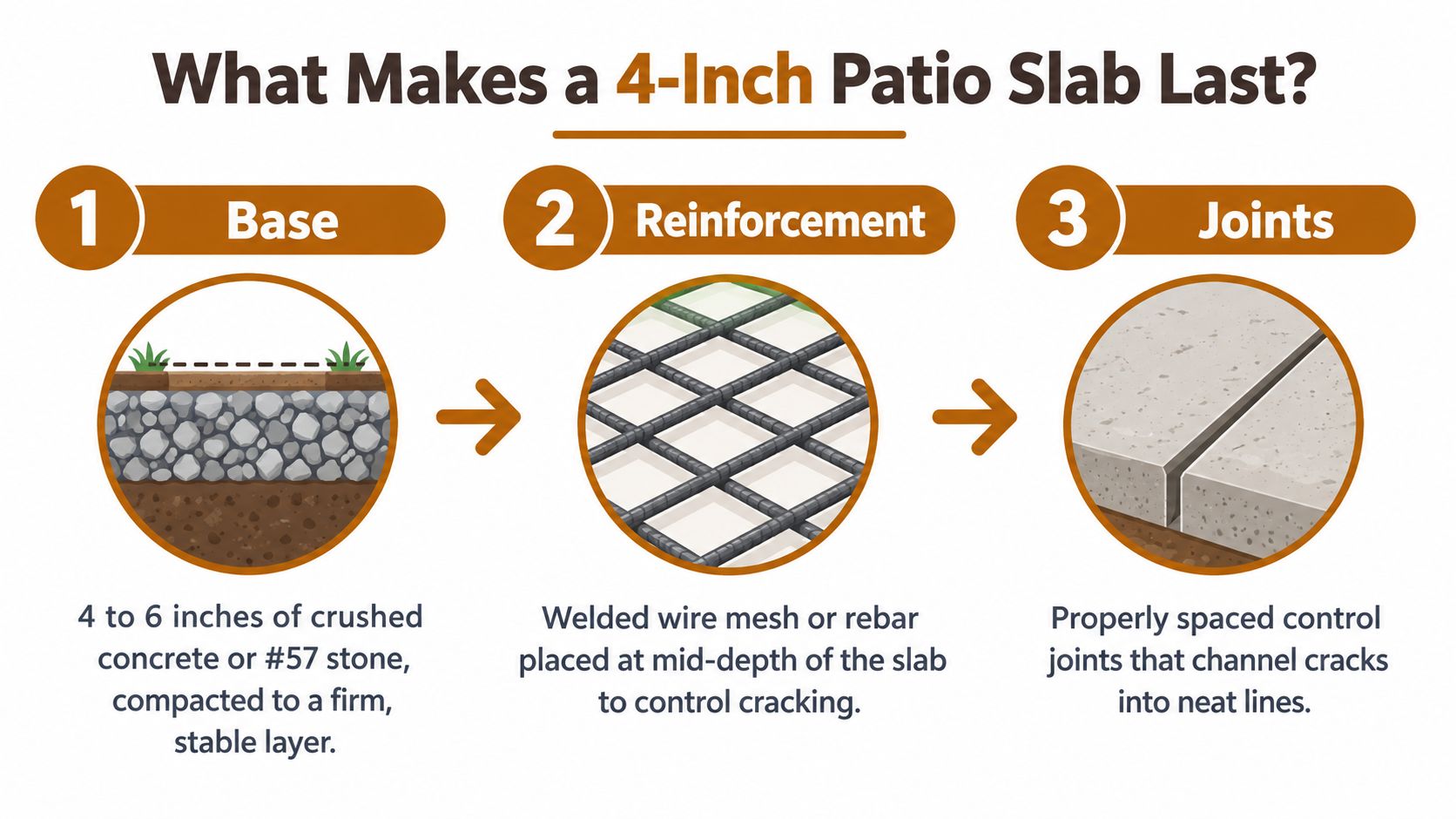
A four-inch slab performs best when three supporting elements work together: a compacted base, reinforcement, and control joints. These components don't substitute for adequate thickness. They make the selected thickness behave more consistently.
Start beneath the concrete. A common residential approach uses four to six inches of compacted crushed concrete or #57 stone, placed in a controlled layer and compacted until it feels firm rather than springy. The base should not pump or shift under foot traffic during preparation. If the material moves under a plate compactor or remains wet and unstable, pouring over it covers the problem.
Reinforcement must stay in the slab
Wire mesh should be supported so it remains in the concrete rather than lying on the soil or gravel. For heavier conditions, #3 rebar on chairs at mid-depth can distribute loads and help bridge cracks. Steel won't prevent the concrete from moving, but it can help the slab act as a connected surface when small cracks form.
Control joints complete the system. They should be cut or tooled to a depth equal to one-quarter of the slab thickness, with residential layouts commonly using 8-to-10-foot spacing where movement and site conditions warrant that arrangement. Joints tell the concrete where to release tension, which is preferable to allowing random cracks to cross the patio.
A reliable concrete slab construction detail guide can help homeowners review the base, steel, forms, and joint layout with an installer.
This matters in areas around Dunnellon, Ocala, and nearby communities because wet sandy soil, roots, and changing moisture conditions can undermine a slab from below. Adding extra concrete over an unstable base may waste material without addressing the source of the movement.
A short installation video can also help homeowners visualize how preparation and placement fit together:
Ask the installer where the reinforcement will sit, how the base will be compacted, and how the joints will be laid out before the truck arrives. Those details are as important as the thickness written on the proposal.
Florida Soil, Heat, and Rain Considerations
Central Florida doesn't have one uniform soil profile. Some sites drain well and provide a workable foundation after preparation. Others contain soft fill, organic material, low areas, or disturbed soil that may settle unevenly. Homeowners in Dunnellon, Ocala, and The Villages should judge the actual building area rather than rely on a citywide assumption.
Rain is a major consideration. Intense summer storms can send water toward and beneath a patio, especially where the finished surface doesn't drain away from the home. Water can carry fine material out of an inadequately compacted base, leaving unsupported areas beneath the slab. A sound base and planned drainage often matter more than adding an arbitrary layer of concrete.
Heat affects the concrete itself. Strong sun and repeated temperature changes can stress thin edges, poorly cured surfaces, and slabs with weak joint layouts. The contractor may respond with better curing practices, closer attention to joint placement, stronger edge details, or additional reinforcement rather than increasing depth.
Florida Conditions vs. Patio Thickness Adjustments
| Florida Condition | Thickness Adjustment | Reinforcement or Base Change |
|---|---|---|
| Firm, well-drained native soil | Four-inch baseline may be suitable | Compact the base and provide planned joints |
| Soft fill or uneven settlement risk | Consider five to six inches or a project-specific design | Remove unsuitable material, improve the base, and reinforce |
| Water moving beneath the patio | Thickness alone may not solve the issue | Correct grading, drainage, and compaction before pouring |
| Concentrated loads such as a hot tub | Increase depth or use a reinforced design | Use reinforcement selected for the load and support conditions |
| Root movement near trees or landscaping | Review excavation and local weak spots | Remove unstable material where appropriate and detail joints carefully |
The project-specific concrete thickness guidance from Builder Toolkits reinforces this broader point: a standard patio design relies on a compacted gravel base, reinforcement, and control joints, not slab depth alone.
Cold weather is less dominant in Central Florida than in northern regions, but unusual cold snaps can still affect exposed surfaces. That doesn't turn every patio into a six-inch project. It does support careful curing, drainage, and joint planning when the site has movement-prone conditions.
How to Check an Existing Patio's Thickness
You can often estimate an existing patio's thickness without immediately cutting a large section. Begin at an exposed edge, such as the side beside a flower bed, an open border, or a location where the concrete has already chipped. Measure from the finished top surface down to the gravel or soil beneath it.
A tape measure works when the edge is visible. A caliper can help when the edge is narrow or irregular. Check more than one location if the patio appears to have settled, because a thickened perimeter or footing may give a misleading result.
A discreet field check
If no edge is exposed, a cordless drill with a masonry bit can probe a discreet corner hole. Choose an inconspicuous location and avoid drilling near plumbing, electrical routes, house foundations, or post footings. The hole can confirm the concrete depth, but it won't tell you whether the base beneath it is compacted or whether the reinforcement is correctly positioned.
Tap the surface with a hammer and listen for changes. A solid area tends to produce a consistent response, while a hollow-sounding area may indicate a separation or unsupported section. This method is only a screening tool, not a structural diagnosis.
Before measuring: Confirm that you're checking the structural slab, not a stamped overlay, resurfacing layer, or thickened edge.
Look for these warning signs:
- Uneven thickness: Measurements vary substantially across the patio.
- Settlement: One portion slopes or sits lower than the surrounding surface.
- Open or recurring cracks: Cracks widen, shift, or appear beside joints.
- Hollow areas: Tapping reveals broad changes in sound.
- Heavy planned loads: You intend to add a hot tub, masonry kitchen, or vehicle access.
- Uncertain construction: You don't know the original base, reinforcement, or drainage details.
A professional can use coring or other investigative methods when the result affects a remodel or structural load. Don't assume the slab is uniformly four inches because one exposed corner measures that depth.
Getting a Patio Built Right and FAQs
The decision becomes manageable when you follow a practical order. Identify the main use first, match that use to the appropriate slab design, then review the base, reinforcement, drainage, and joint layout with the installer. Before work begins, homeowners can also review how to prepare ground for a concrete slab so they know which site conditions deserve attention.
A local contractor should explain whether the ground needs excavation, imported base material, additional compaction, or a reinforced design. Riverside Sealing & Striping, LLC works on concrete patios, slabs, driveways, and sidewalks, while also providing asphalt sealcoating and parking lot striping for properties in Marion County, FL, Citrus County, FL, and surrounding Central Florida communities.
FAQ Quick Reference Patio Thickness Decisions
| Question | Answer |
|---|---|
| How long should a properly built Florida patio last? | A well-designed patio can provide long service when the base, drainage, reinforcement, joints, placement, and maintenance are handled correctly. Actual performance depends on site conditions and use. |
| Can a thin existing slab receive an overlay? | Sometimes, but an overlay won't correct settlement, poor drainage, or a failing base. A professional should evaluate the existing concrete before adding a surface layer. |
| What does a hot tub or outdoor kitchen change? | These concentrated loads may require five to six inches or more, or a reinforced design. The installer should review the load, support points, and soil before selecting the final detail. |
| Do permits or inspections apply? | Requirements vary by county, municipality, project scope, and relationship to the home or other structures. Check with the applicable building department before construction. |
For a patio in Ocala, Belleview, Summerfield, Silver Springs, Crystal River, Homosassa, Inverness, Lecanto, Beverly Hills, Hernando, or The Villages, the right design should reflect the actual property rather than a generic national rule. The same evaluation can also protect HOA common areas, sidewalks, and connected driveway sections from mismatched construction.
Riverside Sealing & Striping, LLC can evaluate your site, discuss the right concrete patio thickness, and provide a free, no-pressure estimate for patio or slab work in Marion County, FL, and Citrus County, FL. Visit Riverside Sealing & Striping, LLC to request a professional consultation and review your base, drainage, reinforcement, and load requirements before pouring.