
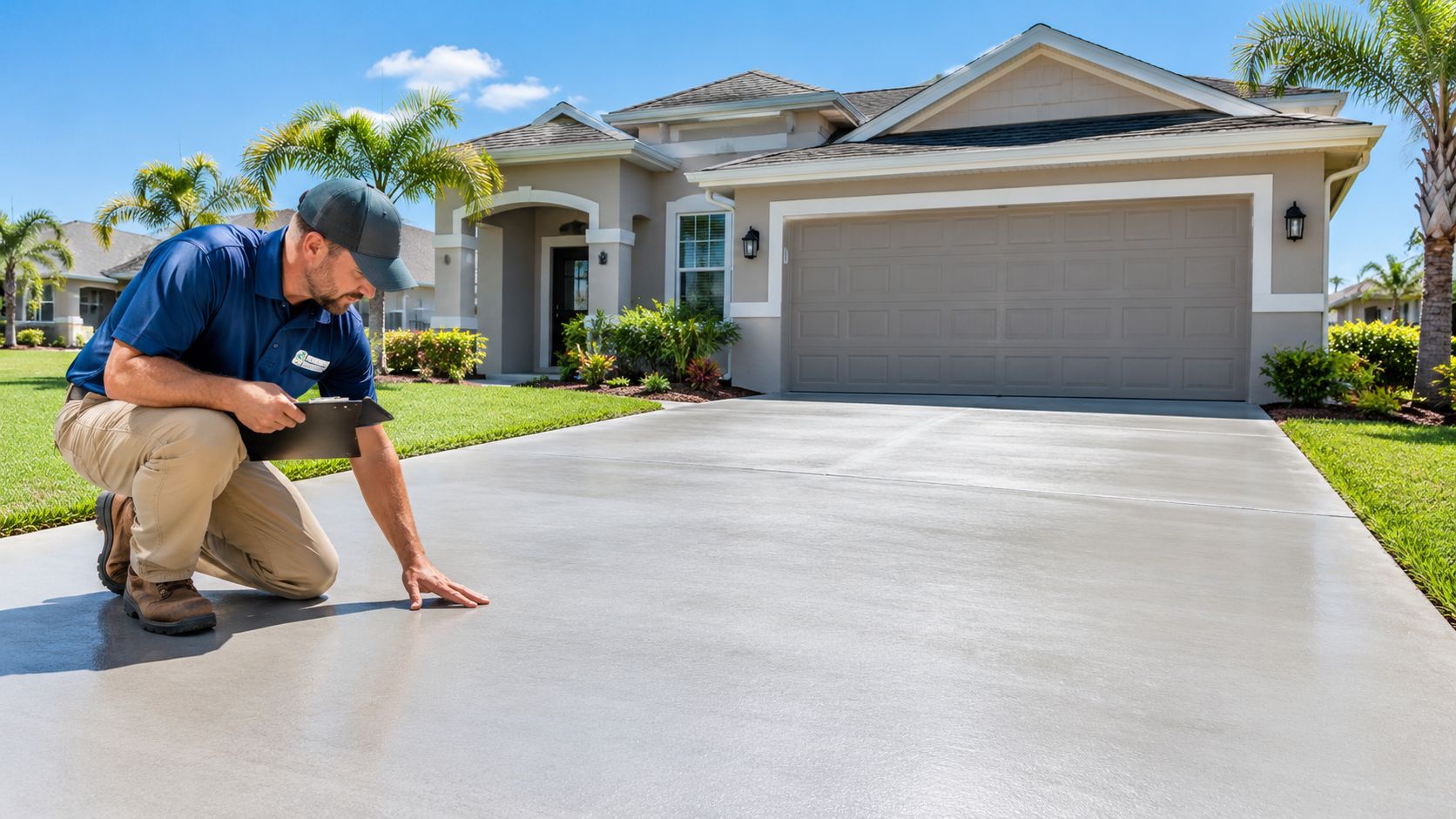
A concrete driveway replacement runs about $6,400 on average, while replacement work is often priced at $8 to $20 per square foot, depending on site conditions, demolition, access, thickness, and finishes. Decorative options can raise installed pricing to $10 to $25 per square foot.
You may be looking at your driveway after another Florida downpour, noticing a crack that has spread, an edge that has crumbled, or a section that no longer drains correctly. The hard part isn't finding a contractor who can pour concrete. It's deciding whether your slab needs a small repair or whether patching would only postpone the same failure.
That decision matters across Marion County, FL, Citrus County, FL, and surrounding Central Florida communities. The heat, intense sun, heavy rain, vehicle loads, and changing soil conditions expose weak preparation quickly. A sound replacement starts below the visible surface, with diagnosis, drainage, excavation, compaction, and a concrete mix suited to the way the driveway will be used.
Table of Contents
- Understanding Concrete Replacement Costs and Lifespan in Central Florida
- Signs Your Driveway Needs Full Replacement Instead of Repair
- The Professional Concrete Removal and Installation Process
- Hiring Local Concrete Experts in Marion and Citrus Counties
- Weighing Repair Against Complete Driveway Replacement
- Curing, Finishing, and Long-Term Maintenance for New Concrete
Understanding Concrete Replacement Costs and Lifespan in Central Florida
A deteriorating driveway often looks like a surface problem at first. You see cracks, stains, or broken corners, but the underlying failure may be underneath. If the base has moved or water has washed out support, a new patch is sitting on the same unstable ground.
The national cost picture gives homeowners searching for concrete driveway lifespan information a useful starting point. A complete replacement averages about $6,400, with quoted totals ranging from roughly $1,600 to $32,000. Replacement pricing commonly falls between $8 and $20 per square foot, while tear-out and haul-away may add about $1 to $3 per square foot, according to Angi's concrete driveway cost guide.
What replacement pricing includes
Patching covers a limited area. Replacement usually includes:
- Demolition: Crews break the failed slab into manageable pieces and remove it.
- Disposal: The old concrete must be loaded, hauled away, and disposed of properly.
- Subgrade preparation: The soil is excavated, shaped, and compacted before the new base goes down.
- Base and forming: Gravel, forms, reinforcement, and drainage details become part of the installation.
- New placement: The crew pours, finishes, joints, and cures the replacement slab.
Access can change the estimate substantially. A driveway in Ocala with open equipment access won't present the same labor challenge as a narrow property in Silver Springs, a sloped approach in Dunnellon, or a long residential drive near The Villages. Thickness, reinforcement, drainage, and decorative finishes also affect the final scope. Industry guides place colored borders and stamped finishes in the range of $10 to $25 per square foot installed, which is why a written, site-specific estimate matters.
Concrete is a long-cycle improvement rather than routine upkeep. Major guides commonly place its service life around 30 to 40 years, with maintenance, installation quality, drainage, and local conditions determining where a driveway lands within that range. Florida-specific guidance often places properly installed driveways around 25 to 30 years, while poor drainage or weaker installation can shorten that life, as explained in Florida concrete lifespan guidance.
Practical rule: A low quote that leaves out demolition, base preparation, or drainage isn't a lower-cost replacement. It's an incomplete scope.
Signs Your Driveway Needs Full Replacement Instead of Repair
The first question isn't, “How much does concrete replacement near me cost?” It's, “What caused the failure?” A cosmetic crack and a moving slab can look similar from the street, but they need different solutions.
Start by checking whether the damage is isolated or widespread. One narrow surface crack in an otherwise stable slab may be repairable. Multiple cracks that connect across the driveway, widening gaps, broken sections, or corners that continue to drop point to a larger structural issue.
Look below the visible crack
Use these observations during your own inspection:
- Settlement: If a section sits lower than adjoining concrete, water may collect there and vehicles may bounce across the transition. Settlement usually indicates movement in the soil or base, not a problem that filler can correct.
- Heaving or buckling: A raised section can reflect soil movement, root pressure, or drainage-related expansion. Grinding the high spot may remove the trip hazard without removing the cause.
- Widespread crumbling: Surface scaling is different from deep deterioration. If the edges, joints, and multiple panels are breaking apart, a thin repair may fail to bond to sound material.
- Failed previous repairs: Repeated patches tell you the original cause remains active. New material can't stabilize a base that continues to move.
- Drainage and erosion: Standing water beside the slab, washout at the edge, or soil disappearing beneath concrete deserves attention before anyone recommends a cosmetic fix.
- Age and overall condition: A driveway over 20 years old with severe, widespread damage is often a replacement candidate, according to guidance on when to repair, resurface, or replace concrete.
The reason for careful diagnosis is straightforward. Industry repair summaries indicate that roughly 50% of concrete repairs can fail when the underlying cause isn't addressed, as discussed in ICRI repair guidance. That doesn't mean every crack requires demolition. It means the contractor should explain whether the proposed repair addresses movement, water, and support, or only covers the symptom.
A professional evaluation should identify the crack pattern, slab movement, drainage path, base condition, and expected vehicle loads. Homeowners in Belleview, Summerfield, and Hernando should ask for that diagnosis in plain language before approving work.
The Professional Concrete Removal and Installation Process
Good replacement work is deliberate, and the most important work happens before the concrete truck arrives. A crew that rushes through the base can produce a clean-looking driveway that settles later.
From failed slab to stable base
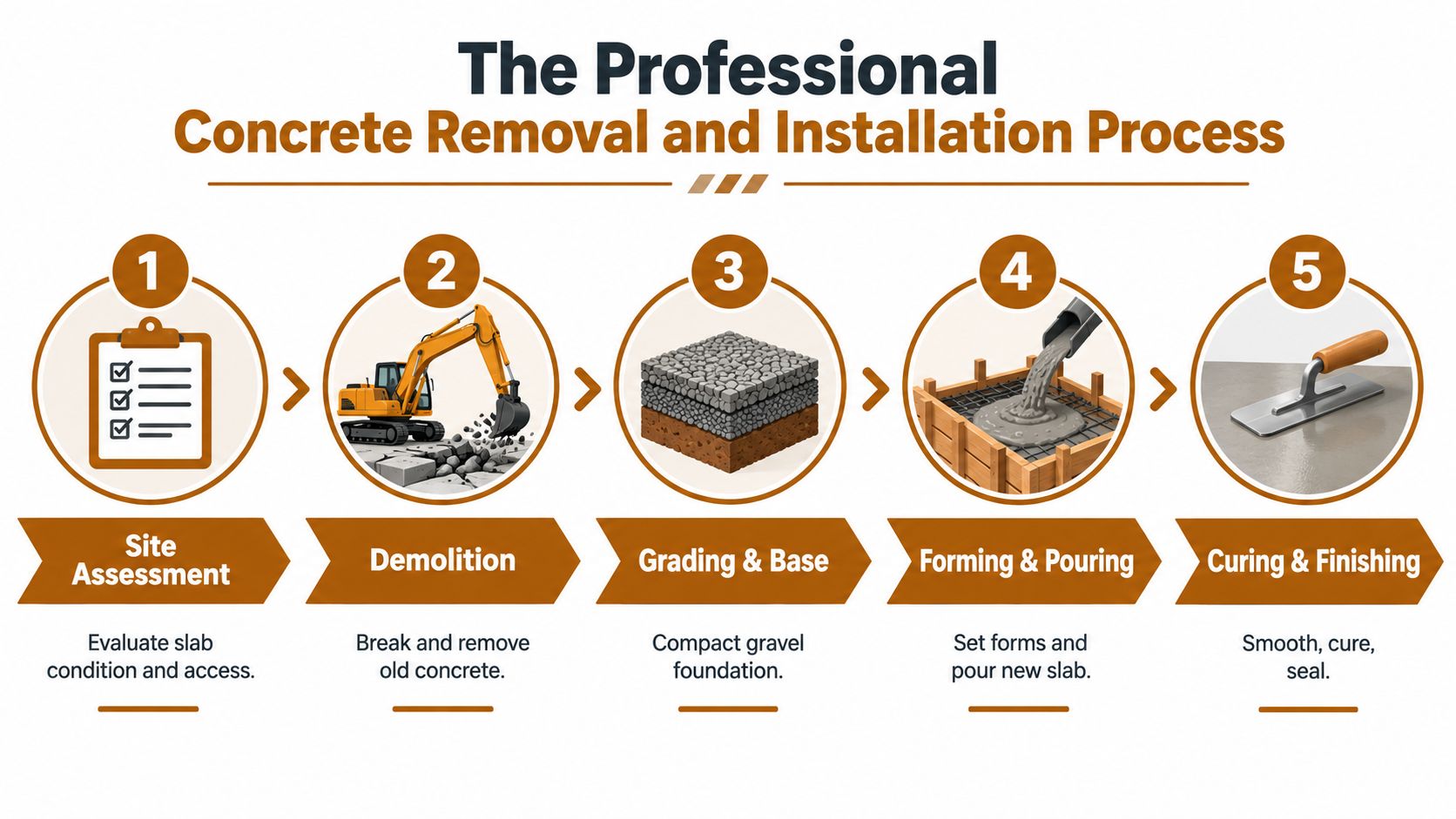
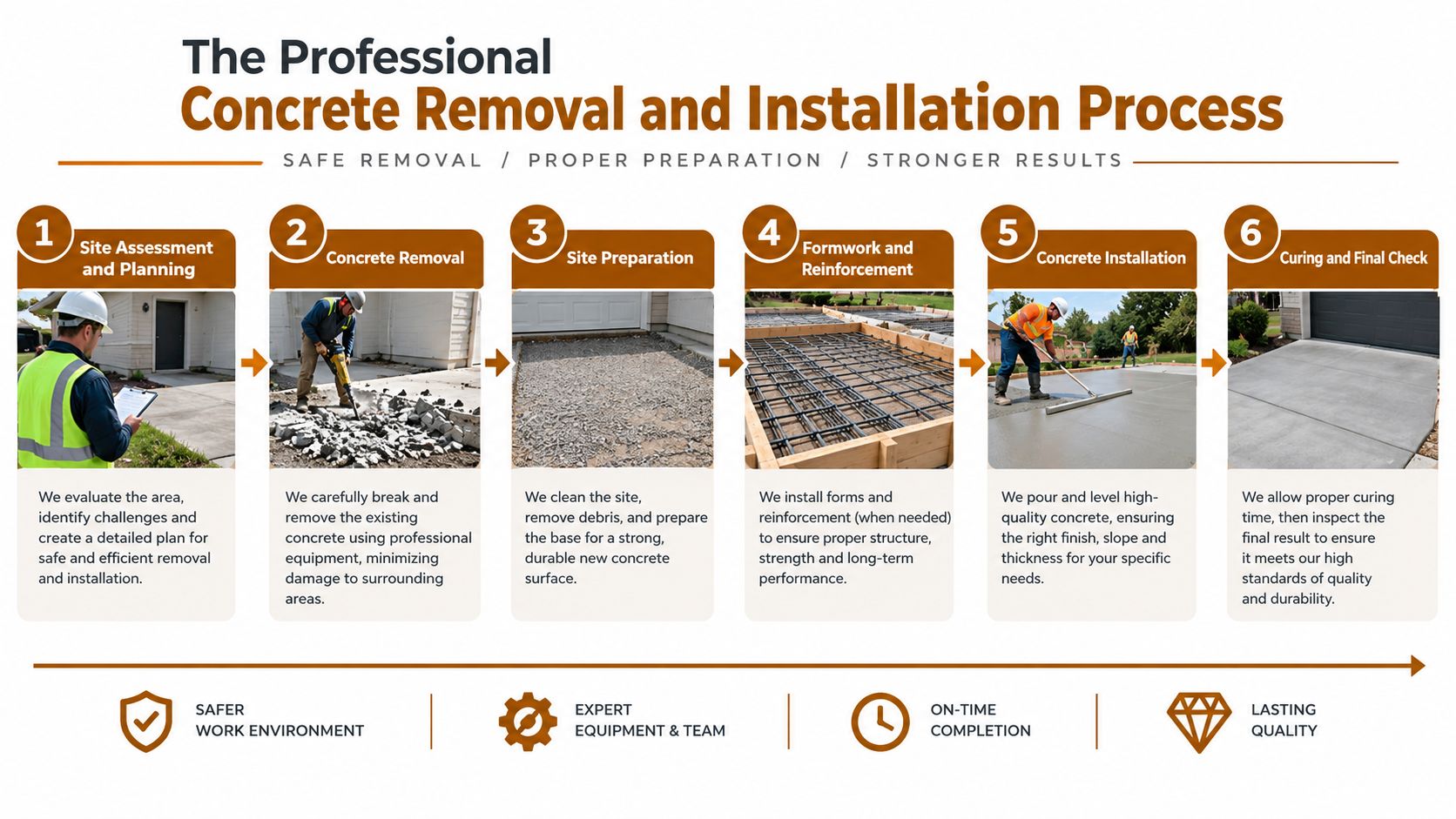
The process generally follows this sequence:
- Saw-cut the boundaries. Straight, full-depth cuts define the removal area and protect adjoining concrete. Partial cuts can leave weak edges that break during demolition.
- Remove the old concrete. The crew breaks the slab, lifts the pieces, and clears the area. This exposes conditions that weren't visible through the finished surface.
- Excavate below final grade. A well-defined workflow excavates roughly 8 to 10 inches below the finished grade. That depth creates room for the compacted base and the new slab, as outlined in a concrete driveway replacement workflow.
- Prepare and compact the subgrade. Soft spots must be corrected, and the soil needs consistent support. Compaction is especially important where rainwater has loosened the ground or vehicles repeatedly load the same path.
- Place the gravel base. Crews commonly install 4 to 6 inches of gravel in compacted lifts. A base placed without proper compaction can shift under repeated traffic.
- Set forms and reinforcement. Forms establish the finished shape and elevations. Reinforcement should remain positioned correctly during the pour rather than lying on the ground where it provides less useful support.
- Pour and finish the slab. The crew places the concrete, strikes it to grade, finishes the surface, and forms control joints to guide shrinkage cracking.
- Cure before loading. Light vehicle use commonly waits 5 to 7 days, while full cure takes about 28 days.
Why base preparation decides the outcome
Concrete is strong, but it can't compensate for unsupported soil. A driveway can crack even when the surface finish looks excellent if the subgrade contains soft pockets, the gravel wasn't compacted, or water can travel beneath the slab.
For residential driveways, common design benchmarks include a minimum 4,000 psi mix, 5% to 7% air entrainment in freeze-thaw climates, and control panels around 80 to 100 square feet to manage shrinkage cracking, according to the ICRI guidance cited earlier. The exact design should reflect the site, local requirements, drainage, and expected loads rather than a one-size-fits-all promise.
Central Florida weather makes timing and curing important. High heat and direct sun can pull moisture from the surface too quickly, while sudden rain can disrupt finishing. An experienced crew plans the pour around site conditions and protects the slab during the early curing period.
Hiring Local Concrete Experts in Marion and Citrus Counties
A search for concrete replacement near me produces plenty of names. The useful question is which contractor can explain the entire project, not just quote the concrete itself.
A responsible contractor should inspect the property in person. Photos may show cracking, but they won't reveal soft subgrade, hidden washout, difficult access, or how water moves across the lot. A site visit also lets the contractor measure the driveway, discuss thickness and reinforcement, and identify whether adjacent sidewalk or apron work needs coordination.

Questions that expose the quality of the proposal
Ask each contractor the same questions so the estimates are genuinely comparable:
- What caused the failure? The answer should address soil, drainage, base support, loads, or installation issues, not just describe the crack.
- What does removal include? Confirm whether demolition, loading, haul-away, and disposal are listed separately.
- How will the subgrade be prepared? Ask about excavation, soft spots, gravel thickness, and compaction.
- What slab design is proposed? The estimate should identify thickness, concrete mix, reinforcement, finish, and control-joint layout.
- How will water leave the property? A driveway that directs runoff toward a garage or foundation can create a bigger problem after replacement.
- What is the schedule? Reliable scheduling means a clear start window, expected work sequence, and communication if weather changes the plan.
- What warranty applies? Read what the warranty covers, what it excludes, and whether drainage or subgrade movement affects it.
- Can you provide local references? Ask about comparable work in Belleview, Summerfield, Crystal River, Lecanto, Beverly Hills, or nearby areas.
Local experience matters because a contractor working in Dunnellon, Ocala, or Inverness sees different access, drainage, and soil conditions from job to job. That experience doesn't eliminate risk, but it helps the crew recognize warning signs before they become hidden costs.
Riverside Sealing & Striping, LLC is a licensed and insured, family-owned contractor serving Marion County, FL, Citrus County, FL, and surrounding Central Florida communities. Its services include concrete demolition and replacement, new driveways, patios, slabs, and sidewalks, along with asphalt sealcoating and parking lot striping for commercial properties. Homeowners can also use this list of questions to ask a concrete contractor when comparing proposals.
Weighing Repair Against Complete Driveway Replacement
Repair makes sense when the slab is structurally stable. A localized crack, a small edge defect, or limited surface wear may respond well to the right repair method. The contractor still needs to identify why the damage occurred, but full demolition isn't automatically justified.
Replacement becomes more sensible when the slab moves, multiple panels have failed, drainage has undermined the base, or earlier repairs have broken down. In those cases, the new patch inherits the old slab's movement and may separate from the surrounding concrete.
A practical comparison
| Condition | Repair may fit | Replacement deserves serious consideration |
|---|---|---|
| Crack pattern | Isolated and stable | Widespread, connected, or structurally deep |
| Elevation | Slab remains level | Settlement, heaving, or buckling is present |
| Base | Support appears stable | Washout, soft soil, or differential movement is evident |
| Prior work | No repeated failure | Patches have failed more than once |
| Overall age | Younger slab with limited damage | Slab over 20 years old with severe deterioration |
Repair costs are commonly listed around $829 to $2,830 on average, compared with replacement averages near $6,400, according to driveway cost and lifespan guidance. The lower initial price can be reasonable when the problem is small. It becomes false economy when the repair only hides structural movement.
Florida-specific lifespan guidance commonly places properly installed concrete driveways around 25 to 30 years, while broader consumer guides report typical service life around 30 to 40 years with good maintenance. A new slab also gives the owner an opportunity to correct grade, base, joints, and drainage instead of repeatedly treating symptoms.
For homeowners considering concrete repair and resurfacing, the right question is not whether repair costs less today. Ask whether it restores safe support and buys meaningful service life. If it doesn't, replacement may provide better long-term value, curb appeal, and daily reliability.
Curing, Finishing, and Long-Term Maintenance for New Concrete
A driveway can look finished before it has developed its full strength. Surface drying happens first. Structural curing continues afterward, which is why loading instructions matter even when the concrete feels hard.
Light vehicle use typically waits 5 to 7 days, while the concrete reaches full cure at about 28 days, according to the documented replacement workflow. Keep vehicles, trailers, heavy equipment, and concentrated loads off the slab until the contractor's instructions allow them. Avoid dragging metal, placing sharp supports, or allowing water to collect along the edges during the early period.
Protecting the finish in Central Florida
Marion and Citrus counties bring strong sun, heat, sudden rain, and regular vehicle traffic. Those conditions make drainage and moisture management important from the first day. Don't wash soil against the slab, block intended runoff paths, or allow irrigation to soak one edge repeatedly.
Ask the contractor how the surface was finished and when sealing is appropriate. Concrete driveway resealing is commonly recommended every 4 to 5 years, although the right schedule depends on the finish, exposure, use, and product selected. Regular cleaning, prompt attention to small edge damage, and keeping heavy loads within the driveway's intended use can help preserve the investment.
A properly planned replacement should also include practical finishing details. Control joints give shrinkage cracking a planned location. Consistent slab thickness supports more even loading. Correct reinforcement placement and a compacted base reduce avoidable weaknesses, though no concrete contractor can promise a completely crack-free slab.
Riverside Sealing & Striping, LLC supports residential and commercial property owners with concrete removal and replacement, sidewalks, patios, slabs, asphalt sealcoating, and parking lot striping. The company offers licensed and insured service, reliable scheduling, clear timelines, free estimates, and no-pressure on-site consultations across Central Florida, including Ocala, Dunnellon, The Villages, Crystal River, Homosassa, and surrounding communities.
If your driveway in Marion County, FL or Citrus County, FL has settlement, widespread cracking, crumbling edges, or drainage trouble, request a professional evaluation before paying for another patch. Riverside Sealing & Striping, LLC can review the existing slab, explain repair versus replacement options, and prepare a clear estimate through Riverside Sealing & Striping, LLC.