
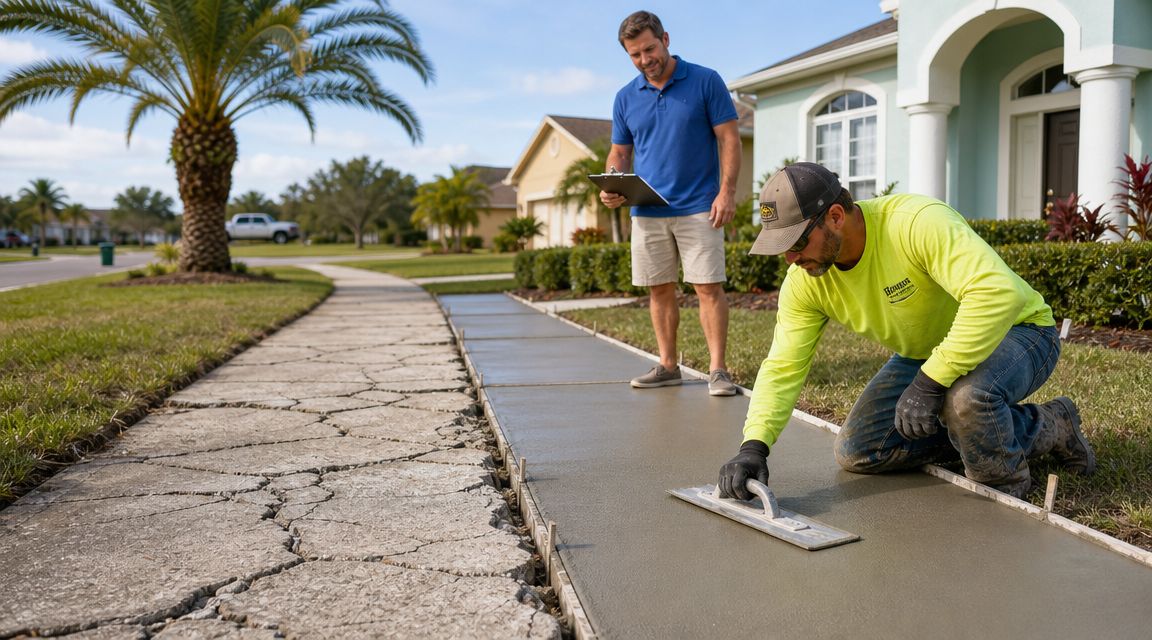
Concrete sidewalk replacement is usually priced by square foot, and a practical planning range is about $10 to $25+ per square foot, with old concrete removal often making up a meaningful part of the total cost. For concrete sidewalk replacement near me in Ocala, the main question usually isn't just price. It's whether the slab can still be repaired, who's responsible for the work, and how to avoid paying twice for the same problem.
A lot of homeowners in Ocala, Dunnellon, Belleview, Summerfield, and nearby parts of Marion County, FL don't start looking into sidewalk replacement until the damage becomes hard to ignore. Someone catches a toe on a lifted edge. Rainwater starts sitting where it never used to. The surface gets rough enough that it no longer looks like a small cosmetic issue.
The same thing happens across Citrus County, FL in places like Crystal River, Homosassa, Inverness, Lecanto, Beverly Hills, and Hernando. One bad panel turns into several. What looked like a quick patch starts to feel more like a liability issue.
That's where a local, practical approach matters. In Central Florida, sidewalk replacement isn't just a concrete job. It can involve permits, inspections, local responsibility rules, drainage concerns, and decisions about whether partial slab replacement makes more sense than tearing out the entire walk.
Table of Contents
- Introduction: That Cracked Sidewalk Won't Fix Itself
- When Sidewalk Repair Isn't Enough: Signs You Need Full Replacement
- The Professional Concrete Sidewalk Replacement Process
- Navigating Local Codes and Costs in Central Florida
- The DIY Dilemma: Why Most Sidewalk Projects Need a Pro
- How to Hire a Trusted Concrete Contractor in Marion and Citrus County
- Frequently Asked Questions About Florida Sidewalk Replacement
- Conclusion: Take the Next Step Towards a Safe and Beautiful Sidewalk
Introduction: That Cracked Sidewalk Won't Fix Itself
In Ocala, this usually starts with a sidewalk you pass every day without thinking about. One corner drops after a stretch of heavy rain. A crack opens near the joint. Then someone catches a toe, a stroller wheel hits the edge, or water starts sitting where it used to drain away.
Waiting rarely helps.
For homeowners in Marion County and Citrus County, a bad sidewalk is not just a cosmetic problem. It can turn into a trip hazard, a drainage issue, and in some cases a liability issue if someone gets hurt on a walkway you are responsible for maintaining. Local rules, right of way conditions, tree roots, and base washout all affect what the job requires.
A lot of generic sidewalk advice skips that part. In Central Florida, the concrete you see on top is only part of the story. The question is whether the slab is still stable, whether the base underneath has held together, and whether the panel can be brought back into safe condition without tearing it out.
Practical rule: If the slab is moving, sinking, lifting, or breaking apart, the problem usually goes deeper than the surface.
That is why the first step is not picking a finish or asking for a quick patch. The first step is figuring out whether you are dealing with minor surface wear or a failed panel that needs full replacement to stay safe and hold up in Florida weather.
When Sidewalk Repair Isn't Enough: Signs You Need Full Replacement
Not every damaged sidewalk needs to be torn out. Some surface issues are cosmetic. Others tell you the slab has stopped doing its job safely.
The primary trigger for replacement is usually loss of structural function. When significant spalling, settlement, or cracking shows that the slab can't safely carry foot traffic or maintain a stable walking surface, replacement becomes the better answer than patching, as outlined by the Concrete Repair Authority sidewalk repair guidance.
What damage points to replacement
A few patterns usually mean repair money won't go far:
- Major settlement or heaving: One panel sits noticeably higher or lower than the next, creating a trip point.
- Deep or widespread cracking: Not one isolated crack, but a broken panel pattern that shows the slab is failing as a unit.
- Severe spalling: The top surface is coming apart badly enough that the concrete keeps shedding material.
- Root uplift: Tree roots have pushed the slab out of plane, and the movement is still active.
- Repeat patch history: The same area has already been patched, but the defect keeps returning.
In those cases, surface patching often makes the sidewalk look better briefly without solving why it failed.
The cause matters as much as the crack
Good replacement work starts with diagnosis. Settlement can come from base movement. Uplift can come from roots. Moisture problems can weaken support under the slab. If nobody identifies that first, the new concrete may crack or shift again.
That's why slab replacement isn't just demolition and a fresh pour. It's a correction of the condition that caused the failure in the first place.
If you're dealing with lifted or sunken panels and want a better sense of the problem before replacing them, this guide on how to fix uneven concrete slabs gives useful context on when leveling helps and when it won't.
A patch can hide damage. It can't restore a slab that has already lost support underneath.
For homeowners in The Villages, Silver Springs, or Belleview, that distinction is important. Spending less on the wrong fix usually costs more when the same sidewalk has to be removed later.
The Professional Concrete Sidewalk Replacement Process
A good sidewalk replacement is built in the order it is built. If a crew rushes demolition, skimps on base work, or cuts joints late, the new panel can start showing trouble long before the concrete itself should.
Removal has to be controlled
The first step is isolating the failed panel with clean saw cuts, then removing it without breaking the slabs that stay in place. That sounds simple, but it affects both appearance and performance. Clean edges help the new work fit the existing sidewalk pattern, and they reduce the chance of random cracking at the tie-in points.
Removal and haul-off also add real labor, equipment, and dump fees to the job. In Ocala and nearby parts of Marion and Citrus County, that number moves around based on access, thickness, root intrusion, and whether the crew can replace one panel or has to open a larger section to get back to stable concrete.
Base prep decides how long the repair lasts
I see more sidewalk failures caused by poor support than weak concrete. If the soil under the slab is soft, washed out, disturbed by roots, or never compacted properly, a fresh pour only hides the problem for a while.
Professional replacement means getting down to firm support, removing unstable material, and rebuilding the base so the slab bears evenly. On some properties, that is straightforward. On others, especially where runoff crosses the walk or tree roots have been pushing from below, the crew may need to correct drainage or coordinate root work before concrete goes back in.
That matters in Central Florida because site conditions change fast from one lot to the next. A sidewalk in SW Ocala can sit on very different ground than one in Beverly Hills, Crystal River, or Dunnellon.
Forming, pouring, joints, and curing all have to be right
Once the base is ready, the replacement has to be set to the right line, grade, and slope. The forms control width and elevation. The pour has to be placed and finished on time. The surface needs enough texture for traction without tearing up the paste or leaving a rough, weak finish.
Then come the details that homeowners usually do not see at a glance but feel years later:
- Form layout: The new panel should match the sidewalk run and drain properly.
- Concrete placement: The mix has to be placed and finished before it starts tightening up in the Florida heat.
- Joint spacing: Control joints need to be cut or tooled in the right locations so the slab cracks where it is supposed to.
- Edge work and finish: Clean edges and a consistent broom finish make the walk safer and help it wear evenly.
- Curing: Fresh concrete needs moisture retention and protection while it gains strength.
A lesson from the field: a sidewalk fails from bad prep, not bad concrete. Poor joints, rushed curing, or weak base work will shorten the life of a slab years before the material itself would have worn out.
Final checks matter
Before the crew packs up, the replacement should be checked for trip-free transitions, drainage, finish quality, and safe cure time before foot traffic. If the walk sits in a right-of-way or ties into a public sidewalk, this is also the stage where inspection requirements can affect timing. In Ocala, Marion County, and Citrus County, that part is not just paperwork. It can determine whether the job closes cleanly or has to be reopened for corrections.
Navigating Local Codes and Costs in Central Florida
A common Ocala scenario goes like this. A homeowner gets a notice about a lifted or broken sidewalk panel, assumes the city will handle it, then finds out the answer depends on where the walk sits, what caused the damage, and which local office has jurisdiction.
That is why the first call should not be for concrete. It should be to confirm responsibility.
Who pays for sidewalk replacement
In Marion and Citrus County, sidewalk responsibility can fall on the adjoining property owner even if the concrete runs through public right-of-way. The only safe approach is to verify it with the city or county before work starts. In Ocala, Dunnellon, Crystal River, and Lecanto, I tell homeowners to ask three direct questions: Who owns this section, do I need a permit, and who signs off on the repair?
Many municipalities across the country use that adjacent-owner model. The City of Clinton sidewalk repair program is one example of how local governments sometimes tie sidewalk repairs to code enforcement and, in some cases, cost-sharing. The lesson for Central Florida is simple. Sidewalk replacement can become a compliance issue fast, especially when a trip hazard sits along a public route.
A few local details matter more than generic online guides usually admit:
- Right-of-way work: If the slab is in public right-of-way, permits and inspections are more likely.
- Tree-root damage: If a city tree lifted the walk, ask the city in writing how they assign responsibility before you remove anything.
- Drainage changes: In Ocala and surrounding areas, a small grade change can push water toward a driveway, garage, or low yard. That can create a new problem while fixing the old one.
- Tie-ins to public walks: If your panel connects to a city sidewalk, the replacement often has to match existing line, grade, and safe transitions.
What actually drives price in this market
Homeowners usually start with square-foot pricing. That is useful for ballpark budgeting, but it does not explain why one sidewalk quote comes in much higher than another.
For a local benchmark, this guide to concrete sidewalk installation cost gives a solid starting point. Price in Central Florida usually changes based on site conditions, not just slab size.
Here is where costs move:
| Cost factor | Why it matters in Marion and Citrus County |
|---|---|
| Saw cutting and removal | Clean demo takes time, and broken concrete has to be hauled off and disposed of properly |
| Panel count and layout | Replacing one isolated panel is different from rebuilding a long run with multiple joints and tie-ins |
| Access limits | Narrow side yards, fences, irrigation, and landscaping can turn a simple job into hand work |
| Base and subgrade repair | Sandy soils drain well, but they also reveal washout and edge erosion that need correction before a new pour |
| Inspection timing | If the city wants to inspect before or after placement, that can affect scheduling and labor |
| ADA and slope correction | Commercial sites, churches, HOAs, and multifamily properties often need tighter attention to slope and transitions |
In this part of Florida, two jobs with the same square footage can price very differently. A straight, open run in a front yard is one kind of project. A sidewalk squeezed between a building, root flare, meter box, and fence is another.
Permits, inspections, and liability questions
Permit rules are local. So are inspection procedures. That is why broad state-level advice often misses the mark for homeowners in Ocala and nearby communities.
Before work begins, confirm:
- Whether the sidewalk is private or in right-of-way
- Whether a permit is required for removal and replacement
- Whether inspection happens before the pour, after the pour, or both
- Whether the city has standards for width, slope, finish, or joint spacing
- Whether root damage, utility conflicts, or drainage concerns need separate review
Liability matters too. If someone trips on a known hazard, the fact that the slab sits near public right-of-way does not always protect the adjacent owner from a claim. That is one reason delayed replacement can cost more than the concrete work itself.
For commercial properties and HOA-managed walks in Marion County and Citrus County, ADA compliance adds another layer. The issue is not just whether the concrete looks new. The walk has to provide a safe, consistent path with acceptable slope, cross-slope, and transitions where the property type calls for it.
The practical takeaway is straightforward. In Central Florida, sidewalk replacement is part concrete job, part local code issue, and part risk management problem. Homeowners who confirm responsibility and permit requirements first usually avoid the delays, rework, and surprise costs that generic articles never mention.
The DIY Dilemma: Why Most Sidewalk Projects Need a Pro
A lot of people look at a sidewalk and think it should be a manageable weekend job. It's concrete, forms, a little grading, and a finish broom. On paper, that sounds straightforward.
On the ground, it usually isn't.
What looks simple usually isn't
Sidewalk replacement combines demolition, hauling, base work, form setting, concrete placement, finishing, jointing, and curing inside a short working window. If the grade is wrong, water may sit where it shouldn't. If the finish is rough, the surface looks poor and wears unevenly. If the joints are misplaced, the slab may crack where you don't want it to.
The work also takes tools most homeowners don't keep on hand. A clean replacement often requires saw-cutting equipment, compaction tools, finishing tools, and a plan for hauling out broken concrete safely.
Then there's timing. Concrete doesn't wait for you to figure it out after the truck arrives.
Homeowners usually don't get in trouble on the pour. They get in trouble in the prep, layout, and curing.
Mistakes that cost more than hiring a contractor
DIY sidewalk work tends to go sideways in a few predictable ways:
- Wrong diagnosis: The slab gets replaced, but the root cause stays in place.
- Poor base prep: The new panel settles because the support underneath wasn't corrected.
- Bad tie-in: The replacement doesn't line up with adjacent panels, creating new trip points.
- Code issues: Work in public-facing areas may need permits or inspection signoff.
- Surface defects: Fast drying, poor curing, or weak finishing leaves an ugly or short-lived slab.
For homeowners in Summerfield, Beverly Hills, Hernando, and The Villages, the permit side alone is enough reason to slow down and check local rules before any concrete gets removed. If the sidewalk touches right-of-way, accessibility routes, or shared property conditions, getting it wrong can create a bigger mess than the original crack.
Hiring a pro isn't only about labor. It's about getting the diagnosis, prep, placement, and compliance handled in the right order.
How to Hire a Trusted Concrete Contractor in Marion and Citrus County
A good sidewalk contractor should make the project easier to understand, not harder. If the quote is vague, the timeline is fuzzy, or nobody wants to talk about permits and disposal, keep looking.
Questions worth asking before you sign
Use a short checklist when you compare bids:
- Licensed and insured: Ask if they carry the proper Florida licensing and insurance for the work.
- Recent local work: Ask whether they've handled projects in places like Dunnellon, Homosassa, Inverness, or Belleview.
- Scope clarity: Ask what's being replaced, what's being repaired, and what happens if more failed slab is found.
- Permit handling: Ask who pulls permits if they're needed.
- Timeline: Ask how long the site will be disrupted and what the cure window looks like.
If you want a deeper screening list before calling companies, these questions to ask a concrete contractor are a solid starting point.
What a solid quote should include
A professional estimate should spell out more than the pour itself. It should address removal, disposal, base preparation, form work, finishing, and cleanup. If one contractor leaves out demolition or subgrade correction, that lower number may not be apples to apples.
Riverside Sealing & Striping, LLC is one local option for homeowners and property managers who need concrete and asphalt experts in Marion and Citrus County, including sidewalk removal and replacement, along with related site and pavement work. The important part is to choose a contractor who gives you clear scope, realistic scheduling, and a written explanation of what happens before, during, and after the pour.
A trustworthy sidewalk quote answers questions before you have to ask them twice.
Frequently Asked Questions About Florida Sidewalk Replacement
A lot of Ocala-area homeowners ask the same thing after they spot a lifted or broken panel. Who is responsible, does the city need to sign off, and can the bad section just be patched? The short answer is that sidewalk work in Marion and Citrus County often turns on location, ownership, and what caused the slab to fail.
Do I need a permit to replace a sidewalk in Ocala or nearby cities?
Sometimes. If the sidewalk is on private property, the answer may be different than if it sits in a public right-of-way, ties into a subdivision walk, or crosses a driveway apron. In Ocala, Belleview, Dunnellon, Inverness, and nearby areas, the safest move is to confirm the rule with the city or county before demolition starts.
Am I responsible if a city tree lifted the sidewalk?
Maybe, but do not assume the city automatically pays for the repair. If roots from a public tree, drainage changes, or work inside an easement contributed to the damage, responsibility can get complicated fast. I tell homeowners to sort that out first, because liability questions matter just as much as the concrete work.
Will the city inspect sidewalk replacement work?
They may, especially if the work affects public access or falls within right-of-way control. Some jurisdictions want to see forms, base, slope, or finished placement. Others only inspect after the pour. That is one reason local experience matters. A contractor who works regularly in Marion and Citrus County usually knows what a given office wants to see.
Why can't a contractor just patch the damaged area?
Because the surface crack is often the last symptom, not the first problem. If the slab moved from root pressure, poor base support, washout, or settlement, a patch only covers the evidence for a while. Full replacement gives you a chance to remove failed concrete, correct the base, and pour a panel that matches grade and drains properly.
Why are permit and inspection questions so confusing online?
Because Florida sidewalk rules are local. The answer can change from one city to the next, and even from one property line to another depending on whether the walk is private, shared, or public-facing. Generic articles tend to gloss over that. Homeowners in Ocala, Marion County, and Citrus County usually need an answer tied to the exact site, not a statewide guess.
Conclusion: Take the Next Step Towards a Safe and Beautiful Sidewalk
A damaged sidewalk usually tells you more than one thing. It tells you there's a surface problem, but it may also point to movement below the slab, a code issue, or a maintenance responsibility you didn't realize you had.
For homeowners in Ocala and across Marion County, FL and Citrus County, FL, the best results come from treating sidewalk replacement like a full site repair, not just a quick concrete patch. Good work means proper diagnosis, clean removal, solid base prep, correct finishing, and attention to local permit or inspection requirements.
If you're comparing options for concrete sidewalk replacement near me in Central Florida, focus on scope, responsibility, and long-term performance. That approach protects safety, curb appeal, and your budget.
If you need a no-pressure on-site evaluation, Riverside Sealing & Striping, LLC provides free estimates for concrete sidewalk replacement and other concrete and asphalt needs across Marion County, Citrus County, and surrounding Central Florida communities.