
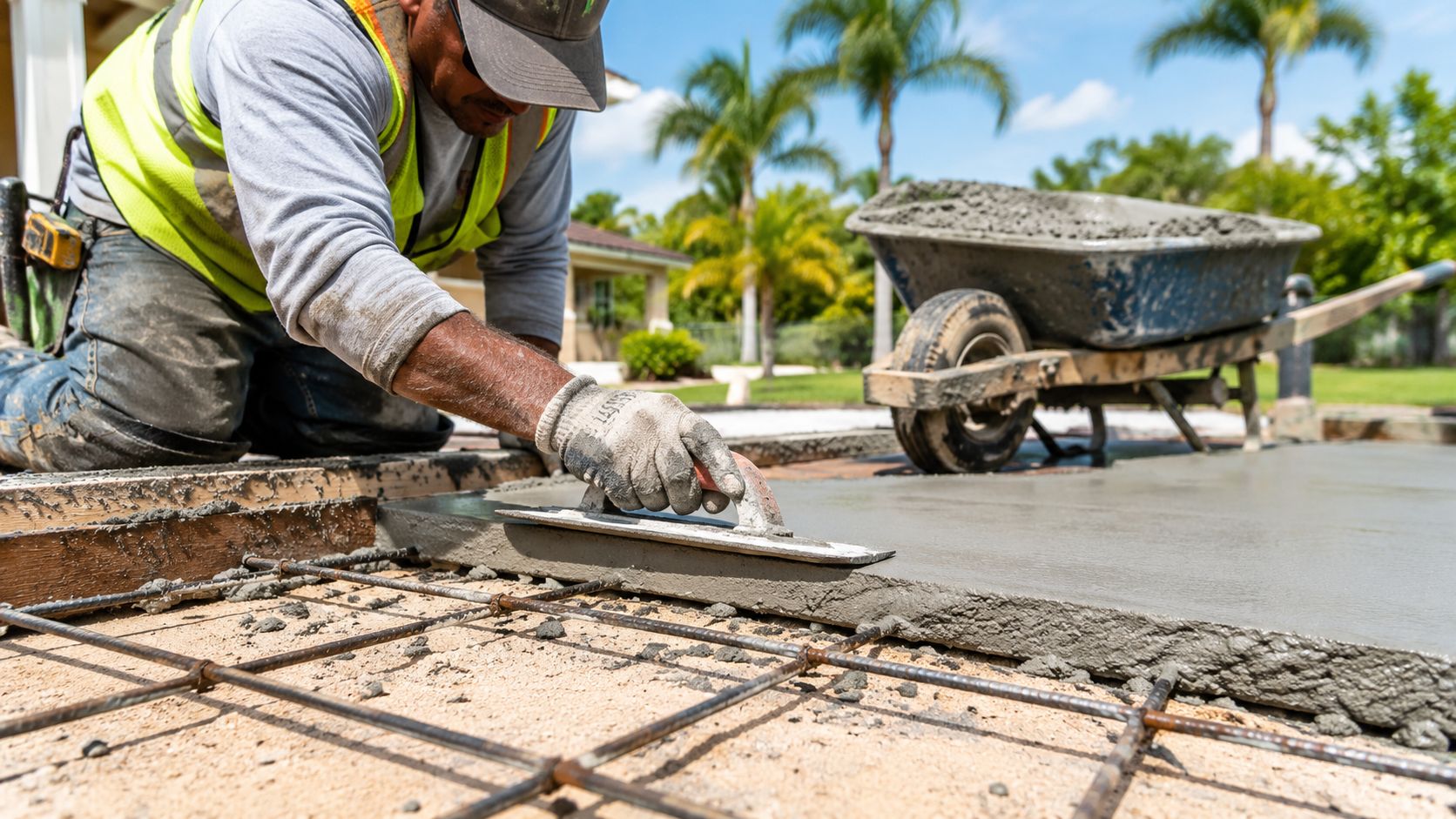
A lot of property owners in Central Florida reach the same point the same way. The driveway keeps holding water after every storm. A patio slab has sunk enough to catch a mower wheel. A sidewalk near the front entry has started breaking apart, and each quick patch lasts less time than the last one.
That's usually when the question changes from “Can this be repaired?” to “Is full concrete slab replacement the smarter move?”
In Marion County, FL and Citrus County, FL, that decision matters more than people think. Heat, heavy rain, shifting sub-base conditions, tree roots, and drainage problems can turn a repairable slab into a money pit fast. In places like Ocala, Dunnellon, Belleview, Silver Springs, Summerfield, Crystal River, Homosassa, Inverness, Lecanto, Beverly Hills, Hernando, and The Villages, the right answer isn't always to patch and it isn't always to tear out. The key is knowing the threshold where repair stops making financial and structural sense.
For property owners looking for practical guidance, this is the field view of concrete slab replacement. It covers what failure looks like, how a proper replacement is done, what local costs usually include, and where permitting can slow a job down if nobody checks it early. It also reflects the broader mindset of Concrete and Asphalt Experts in Marion and Citrus County, because concrete replacement and asphalt maintenance often overlap on the same property.
Table of Contents
- Signs It Is Time for Full Concrete Replacement
- The Concrete Slab Replacement Process Step by Step
- Typical Costs and Timelines in Central Florida
- Permitting and Local Codes in Marion and Citrus County
- Your Checklist for Hiring a Concrete Contractor
- Why a Professional Evaluation Is Your First Step
- Frequently Asked Questions About Slab Replacement
- What does a broom finish mean, and why is it so common in Florida
- Will the new concrete match the old concrete exactly
- Will slab replacement tear up my yard, irrigation, or landscaping
- Why are control joints so important in a new slab
- Can rain delay a slab replacement job after demolition has already started
- Does replacing a slab affect drainage or nearby surfaces
- What questions should I ask before approving the job
Signs It Is Time for Full Concrete Replacement
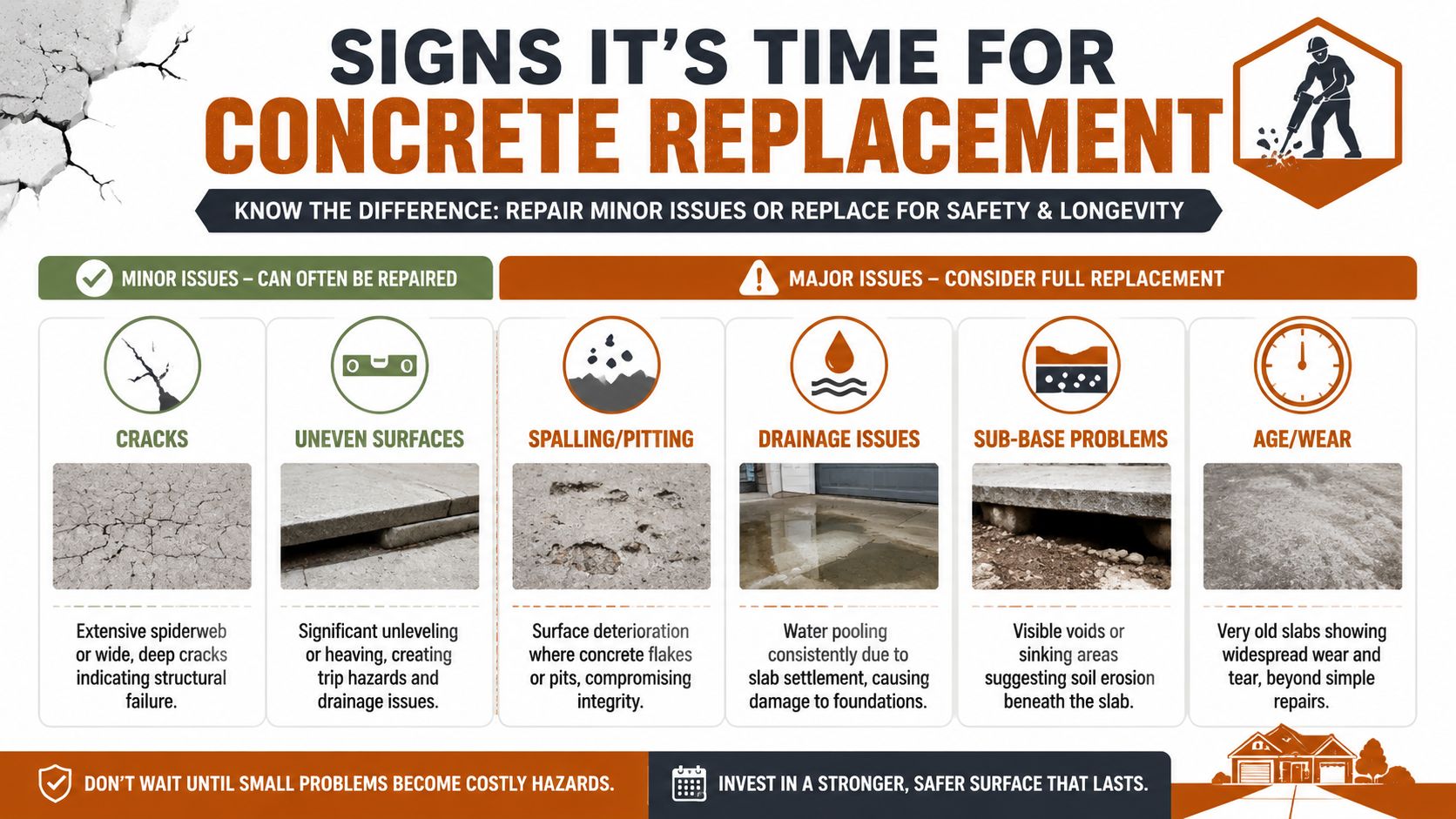
You walk out after a hard Florida rain and notice the slab is holding water, one corner has dropped, and a crack you patched last year has opened again. At that point, the question is not whether the concrete looks bad. The question is whether it still has enough structure and enough support to justify another repair.
The two inch decision point
One field threshold still helps with the first call. According to industry guidance on slab lifting versus replacement, a slab that has settled up to about 2 inches can sometimes be lifted if the concrete itself is still sound. Once correction goes past that range, replacement often becomes the better use of money.
That guideline matters in Marion and Citrus counties because soil movement, washout, irrigation leaks, and heavy summer rain can turn a small settlement issue into a repeat repair cycle. Owners often spend on patching or leveling because the slab is still in one piece. If the base keeps moving, that money rarely lasts.
Cost is part of the decision, but it should not be the only one. Slab lifting usually costs less than tearing out and replacing concrete, and slab repair method guidance notes that lifting can work well when the problem is loss of support under an otherwise usable slab. Once the slab is cracked through multiple sections, breaking down at the surface, or carrying more movement than the concrete can tolerate, replacement is usually the safer investment.
Good contractors also look below the slab before they recommend either option. Poor drainage, soft spots, tree roots, and inadequate base prep are common in this part of Florida. If you want a replacement to last, the base has to be corrected too, which is why site conditions and proper ground preparation for a concrete slab matter as much as the concrete you see on top.
Damage that usually means the slab has failed
Some slab conditions point to full replacement, not another round of repairs:
- Widespread cracking across the slab usually means the concrete is no longer acting as one solid section. In driveways, pads, and walkways, that often shows up after repeated loading or long-term loss of support.
- Differential settlement means one area has dropped while another stayed put. If the height change creates a trip hazard, drainage problem, or vehicle impact point, patching the surface does not solve the cause.
- Surface breakdown, spalling, or flaking in multiple areas means the wear layer is gone. Once that damage is spread across the slab, isolated patching tends to fail at the edges.
- Heaving from roots, moisture changes, or subgrade movement pushes sections out of plane. In Florida, that also redirects water, which creates more erosion around the slab.
- Recurring water ponding after normal rain often means the slab elevation is wrong, the support below has changed, or both.
- Voids under the slab or repeated sinking after prior repair usually mean the underlying problem was never fixed.
Florida decisions are rarely based on crack width alone. A slab with one clean crack and solid support may still be repairable. A slab with several active cracks, soft spots, drainage issues, and visible movement usually is not, even if parts of it still look decent from the street.
Crack type matters too. Structural cracks may call for bonding methods such as epoxy injection. Active joints or moving cracks are a different category, and sealants only handle water intrusion when the slab around them is still worth saving. Once the concrete has lost support and the panel keeps shifting, sealing the crack is just maintenance on a failed slab.
In Central Florida, replacement becomes the smart call when the slab has lost grade, support, and durability at the same time. That is the point where repair stops extending service life and starts delaying a job that still has to be done.
The Concrete Slab Replacement Process Step by Step
A slab replacement job usually reveals its quality before the new concrete is ever poured. In Central Florida, the make-or-break point is often the work below the slab, not the finish on top. If a crew rushes demolition, leaves loose edges, or pours over wet and unstable base material, the new slab can start showing the same failure pattern in far less time than the owner expects.
Demolition and clean edges come first
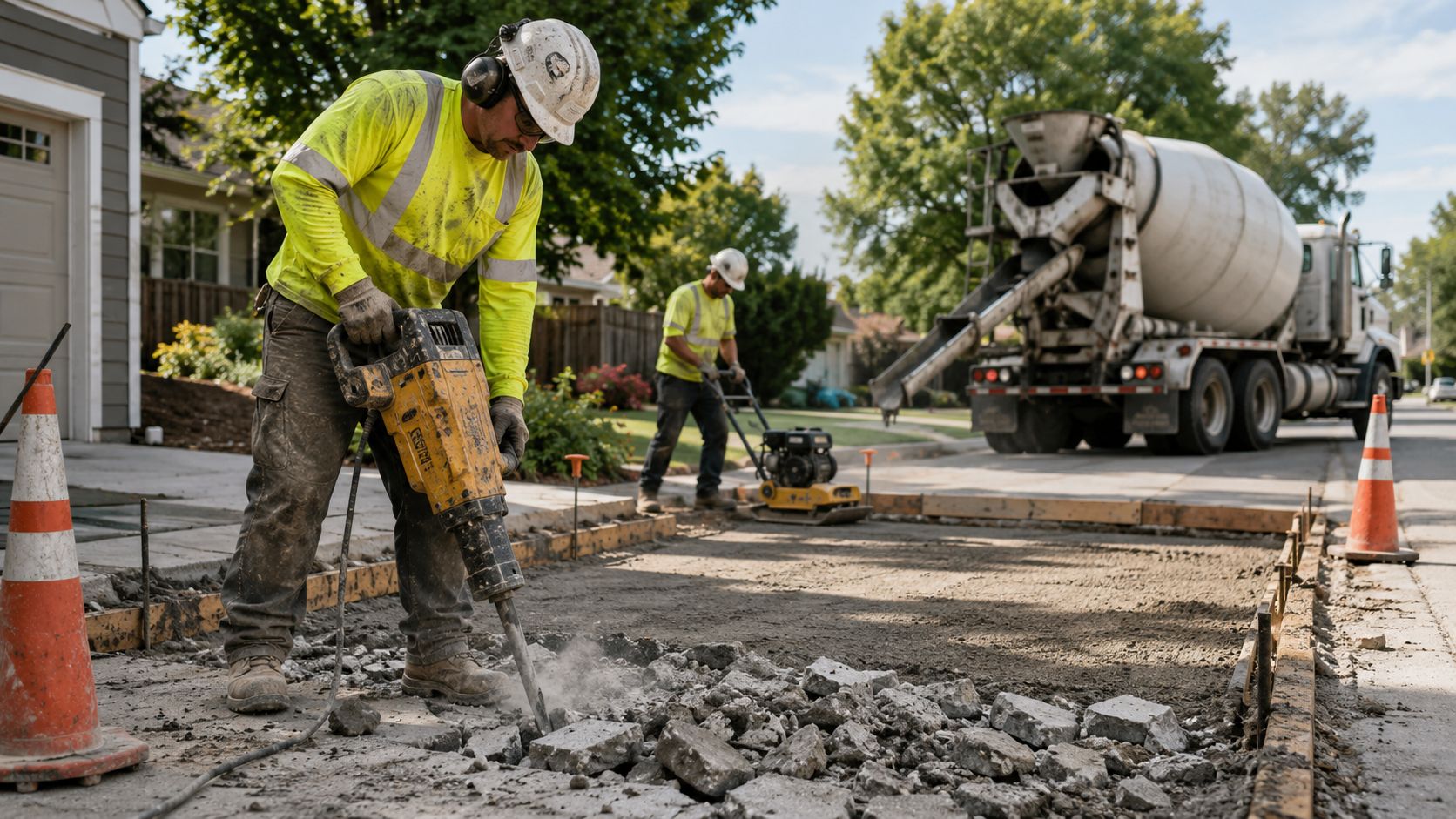
The first step is setting clear replacement limits. The crew marks the area, saw-cuts the slab to create straight vertical faces, and removes the failed concrete without beating up the surrounding sections that are staying in place. Clean edges matter because the new panel needs a defined boundary and a sound tie-in, especially on driveways and walkways where traffic loads hit the slab edge first.
This part also tells you how disciplined the contractor is. A careful crew controls debris, protects nearby structures and landscaping, and removes broken concrete completely instead of burying pieces at the edge of the site. That matters in Marion and Citrus counties, where sandy soils and frequent rain can expose shortcuts fast.
Base correction is the part that decides service life
A new slab is only as good as the support under it.
In Florida, replacement often follows washout, soft subgrade, poor drainage, or years of movement from moisture changes. If those conditions are still there after demolition, pouring new concrete only gives the property owner a fresh-looking version of the same problem. The base has to be regraded, weak material has to come out, and drainage has to make sense before forms go in.
That may mean adding compacted stone, correcting slope, or dealing with water that runs toward the slab from the yard, roof lines, or hardscape. For a plain-language look at what proper site prep involves, this guide on how to prepare ground for a concrete slab gives property owners a useful reference point.
Federal full-depth concrete repair guidance also stresses proper support, drainage bedding, compaction, and careful consolidation during repair work, all of which line up with what good slab contractors already know from field experience in wet climates like Florida (FHWA full-depth concrete repair guidance).
If water still moves under the slab area, replacement without correcting that water path is money spent twice.
Forming, reinforcement, placement, and finish have to match the slab's use
Once the base is stable, the crew sets forms to the right lines and elevation. Then they handle reinforcement, thickness, and joint layout based on what the slab is expected to carry. A backyard patio and a driveway apron should not be built the same way. In Florida, slope matters just as much as strength because a slab that holds water usually loses appearance and durability faster.
Placement day moves quickly, but several details matter. Concrete has to be placed without overworking it, consolidated properly, and finished to the right texture. Too much water in the mix or too much finishing on the surface weakens the slab and raises the chance of dusting, scaling, and shrinkage cracks.
Joint placement matters too. Control joints do not stop concrete from cracking. They control where cracking is most likely to happen. If the joint spacing is poor or the cuts are late, the slab often chooses its own crack pattern.
A quick visual helps if you've never watched a full replacement in motion:
Curing is where a good pour can still be lost
Fresh concrete needs time and moisture control to gain strength the right way. In Central Florida, heat, direct sun, and afternoon wind can pull moisture out of the surface fast. That leads to weak surface paste, extra shrinkage, and early cosmetic cracking.
A contractor who takes curing seriously will protect the slab after finishing, not just pack up and leave. The exact method can vary by slab type and site conditions, but the goal stays the same. Hold moisture, limit rapid drying, and give the concrete a fair chance to harden evenly. On many residential jobs, owners focus on how the slab looks at the end of day one. The better question is how it is being protected over the next several days.
On permitted work, there is often one more step before the job is finished. Final cleanup, inspection sign-off where required, and confirmation that drainage still works as intended after replacement. That last check matters in Florida because a slab can be structurally sound and still fail the owner if it sends water back toward the house or garage.
Typical Costs and Timelines in Central Florida
The price for slab replacement usually surprises people for one reason. They expect to pay for new concrete, but a big part of the bill is getting rid of the old problem correctly.
What the price usually includes
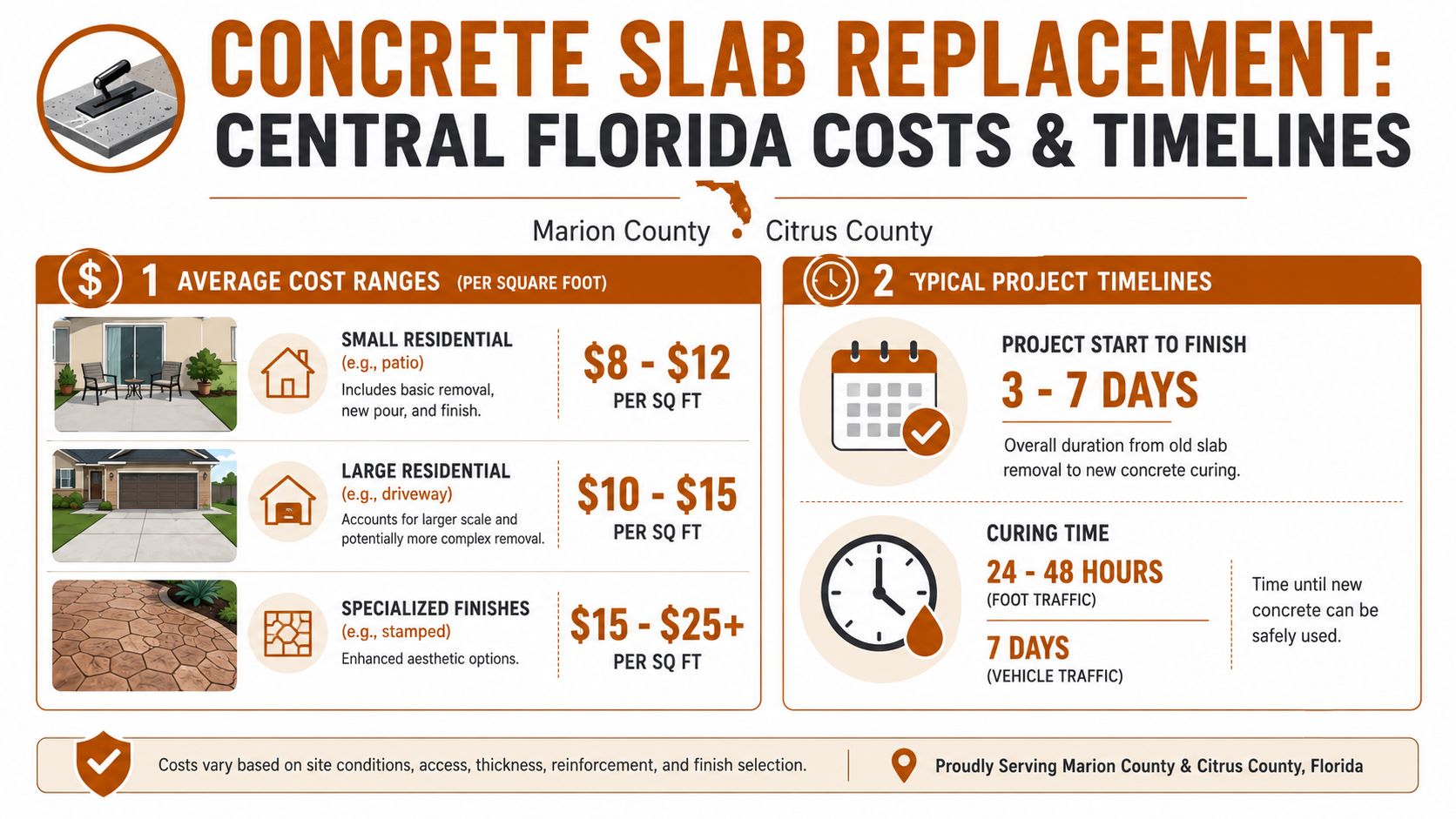
In Florida, concrete slab replacement typically costs $8 to $12 per square foot, and $2 to $4 per square foot of that is commonly tied to demolition and removal of the existing slab, according to Florida concrete driveway and slab pricing data.
That means the tear-out phase isn't a side cost. It's one of the major drivers.
A written estimate should usually account for:
- Removal and disposal of the failed slab
- Sub-base correction if washout, settlement, or soft spots are found
- Forming and placement for the new slab
- Finishing and joint work so the slab drains and controls cracking properly
- Site access issues that affect labor and equipment use
For budgeting, this overview of concrete slab cost per square foot helps property owners compare scope and finish level without guessing.
A low quote often means something has been left out. Usually it's base correction, disposal, or finish details that matter later.
Why schedules shift in Florida
Timelines in Central Florida depend less on the pour itself and more on what happens around it.
A straightforward residential slab in Belleview, Beverly Hills, or Hernando may move quickly once the project is approved and the weather cooperates. But summer storms can break up demolition windows, soften subgrade conditions, and delay placement. If a slab is being replaced in a visible front-access area, scheduling may also be shaped by traffic flow, HOA rules, or access restrictions.
Here's the practical sequence most owners should expect:
| Job phase | What affects timing |
|---|---|
| Site review and estimate | Scope clarity, access, visible sub-base concerns |
| Permit review if needed | County or city processing, project footprint |
| Demo and removal | Slab thickness, haul-off logistics, weather |
| Base prep and forms | Drainage corrections, compaction needs |
| Pour and finish | Rain timing, crew access, temperature |
| Cure period | Weather protection and intended use |
For owners in Marion County, FL and Citrus County, FL, the best way to avoid schedule frustration is to ask two questions up front. Is a permit involved, and is the drainage problem solved. If the answer to either one is unclear, the timeline is still uncertain.
Permitting and Local Codes in Marion and Citrus County
Permits don't come up on every slab replacement, but when they do, they matter early. Waiting until the crew is ready to pour is the wrong time to find out the county wants paperwork or a revised scope.
When permits usually enter the job
In Marion County, Florida, any new concrete flatwork that adds to a property's total impervious surface area requires a building permit before construction begins, according to local permitting guidance for Marion County concrete flatwork. That applies when a driveway, patio, or similar slab is expanded beyond the original footprint.
That means a like-for-like replacement may be one conversation, while an expanded driveway in Ocala, Silver Springs, or Summerfield can become a different one. Property owners often assume they're just replacing concrete, but the county may view the added area as new work.
For Citrus County projects, local requirements can differ by location and scope, so it's smart to verify before scheduling. That's especially true in places like Inverness, Lecanto, Crystal River, and Homosassa where lot layout, drainage, and access can complicate what seems like a simple slab job.
Code details that affect replacement work
Thickness and supporting layers matter as much as permits. Marion County documentation for driveway aprons specifies a minimum of 6 inches thick for reinforced concrete over 6 inches of stabilized cover, according to Marion County permit documentation showing driveway apron requirements.
That kind of detail affects replacement design, especially where a residential drive meets the street. It also shows why local experience matters. A slab that looks fine on top can still fail an inspection or underperform if the supporting section doesn't match local requirements.
Commercial owners and HOAs have another layer to think about. Sidewalks, ramps, and routes connecting parking areas can trigger accessibility concerns. This overview of ADA sidewalk requirements is a useful reference when replacement work involves public-facing walkways or common areas in places like The Villages.
The cheapest slab is the one you only build once, and code compliance is part of that.
Your Checklist for Hiring a Concrete Contractor
Hiring the right contractor protects the slab and your budget. Hiring the wrong one usually creates a clean-looking surface over the same old problem.
Questions worth asking before anyone starts demo
Start with the basics, but don't stop there.
- Ask about license and insurance. A contractor should be able to show current coverage and operate legally in Florida.
- Ask who handles permits. If the project might affect impervious area, driveway apron details, or walkway compliance, you want a clear answer before work starts.
- Ask how they evaluate the base. If the answer is mostly about the concrete mix and not about support, drainage, and compaction, that's a red flag.
- Ask for recent local examples. Work in Dunnellon isn't the same as work in Crystal River or The Villages. Local soil conditions, drainage habits, and municipal expectations matter.
- Ask for a written scope. You want demolition, disposal, sub-base work, forming, finishing, and cleanup spelled out.
A strong estimate doesn't just list a total. It tells you what happens if the crew finds voids, wet subgrade, unstable edges, or drainage issues during tear-out.
There's also a practical reputation check that owners skip too often. Watch how the contractor communicates before the job starts. If calls are slow, answers are vague, and scheduling sounds slippery during the estimate stage, the project usually won't improve once equipment arrives.
Look for contractors who are licensed and insured, have real Central Florida experience, and can explain why they'd repair one slab but replace another. That applies whether the project is a patio in Homosassa, a driveway in Belleview, or a commercial walkway in Lecanto.
Because many sites include both paved and concrete surfaces, it also helps to work with a company that understands the whole property. Concrete and Asphalt Experts in Marion and Citrus County should be able to discuss slab replacement, adjacent asphalt conditions, striping impacts, and drainage flow together instead of treating each surface like an isolated problem.
Why a Professional Evaluation Is Your First Step
A slab can look like a simple crack-and-replace job from the surface, then turn into a drainage or subgrade problem once demolition starts. In Central Florida, that distinction affects cost, scope, and whether replacement will hold up through wet seasons.
A professional evaluation gives you the answer before concrete is ordered. The point is not just to confirm that the slab looks bad. The point is to identify why it failed and whether the site conditions in Marion or Citrus County will damage the next slab the same way.
The issue under the slab matters as much as the slab itself
Moisture is one of the easiest problems to miss. Removing old concrete does not remove the moisture source below it. If the area stays wet because of runoff, irrigation, shade, or poor grading, the new slab can develop the same problems, especially if flooring or coatings will be installed later. As noted in guidance on testing old slabs for residual moisture, old concrete should not be assumed dry. For projects where moisture-sensitive finishes matter, in-situ relative humidity testing should follow ASTM F2170.

That matters even more on properties with low spots, downspouts dumping near the slab, or landscaping beds that keep water against the edge. In Florida, water management is often the difference between a slab that lasts and one that starts moving again.
A proper evaluation should answer a few direct questions:
- Has the slab failed structurally, or is there localized settlement that could still be addressed another way
- Is the base intact, or has water created voids, pumping, or soft spots
- Will new concrete trap water against the house, garage, sidewalk, or adjacent pavement
- Will the work affect drainage patterns or trigger permit review because of site changes
- Do nearby asphalt, striping, curbs, or walk paths need to be corrected at the same time so the new slab ties in properly
This step also protects owners from paying twice. I have seen replacement jobs fail early because nobody checked the slope, soil bearing, edge support, or runoff path before tear-out. The concrete was new. The problem underneath was not.
For owners who want one contractor to look at the site as a whole, Riverside Sealing & Striping, LLC handles concrete removal and replacement as well as asphalt sealcoating and parking lot striping across Central Florida. That kind of combined review helps when the slab issue affects more than one surface or when drainage corrections need to work across the entire paved area.
Frequently Asked Questions About Slab Replacement
What does a broom finish mean, and why is it so common in Florida
A broom finish is the light texture dragged across fresh concrete before it cures. It gives better traction during summer rain, afternoon storms, and the algae buildup that shows up fast in shaded areas. For driveways, walkways, and entry slabs in Marion and Citrus counties, it is usually the safest and most practical finish.
A smoother finish may look cleaner on day one, but it can get slick in wet conditions. On exterior slabs here, appearance matters, but footing matters more.
Will the new concrete match the old concrete exactly
Usually not. New concrete can be placed to match the same thickness, joint layout, and finish, but color is harder to match perfectly. Cement batch differences, sun exposure, age, and staining all change how the older slab looks.
Good contractors explain this before the pour. If exact visual consistency matters, owners sometimes replace a larger connected section instead of patching one panel so the surface looks intentional instead of pieced together.
Will slab replacement tear up my yard, irrigation, or landscaping
It can, especially if access is tight. Demolition equipment, concrete trucks, skid steers, and haul-out trailers need room to work, and that often means crossing grass, moving pavers, trimming plants, or protecting sprinkler heads near the slab edge.
This should be discussed before the job is scheduled, not after demolition starts. On many Central Florida properties, the cleanest job plan includes marking irrigation lines, identifying low-voltage lighting, and deciding which plants are worth protecting versus removing and reinstalling later.
Why are control joints so important in a new slab
Control joints give the concrete a planned place to crack as it shrinks and cures. Concrete will crack. The question is whether that crack forms where it was intended or runs randomly across the finished surface.
In Florida heat, curing happens fast, and poor joint layout shows up sooner. Joint spacing, slab shape, and tie-in points at garages, sidewalks, patios, and curbs all affect how the slab performs over time.
Can rain delay a slab replacement job after demolition has already started
Yes, and in Central Florida that is a real scheduling issue, not a rare one. Summer work often has to be planned around afternoon storms, saturated subgrade, and the risk of washout before finishing is complete.
A contractor who knows local conditions will watch the forecast and stage the work accordingly. Sometimes the smart call is to delay the pour a day and protect the base rather than place concrete on wet, unstable ground and create problems that show up later.
Does replacing a slab affect drainage or nearby surfaces
It often does, especially where the slab ties into asphalt, garage floors, sidewalks, curbs, or garden beds. Even a small height change can redirect runoff toward a building, leave a lip at a walkway, or create ponding at the edge.
That matters in Marion and Citrus counties, where heavy rain tests every slope quickly. A proper replacement plan looks at how the new slab will meet adjacent surfaces, not just how the concrete itself will be poured.
What questions should I ask before approving the job
Ask what thickness is planned, what base preparation is included, how reinforcement will be handled, what finish will be used, who is responsible for permit coordination if one is required, and what protection is planned for irrigation and nearby surfaces. Ask how joints will be laid out and how the crew will handle weather delays.
Those answers tell you a lot about the contractor. Clear, specific job details usually lead to fewer surprises once the old slab is out.
If you are comparing options for concrete slab replacement in Marion County, FL or Citrus County, FL, a site visit is still the most useful starting point. Riverside Sealing & Striping, LLC serves homeowners, HOAs, and commercial properties across Ocala, Dunnellon, Inverness, Crystal River, and surrounding Central Florida areas with evaluations, estimates, and practical recommendations for concrete and asphalt surfaces.