
You walk out onto a brand-new patio in Dunnellon or Ocala, coffee in hand, and there it is. A thin crack that wasn't there yesterday, or maybe it was, but now the morning light makes it impossible to ignore. That first reaction is normal. A fresh slab is supposed to look solid, so any line in it can feel like a mistake, especially here in Central Florida where heat, sudden rain, and sandy soil can all show up in the same week.
The good news is that not every crack in a new concrete patio means failure. Concrete shrinks as it cures, and that shrinkage can create hairline cracking even when the mix, pour, and finish were handled correctly. The right question isn't “why did this happen?” first. It's “what kind of crack is it, how wide is it, and is it still changing?”
Table of Contents
- Finding Fresh Cracks on a Brand-New Patio
- Why New Concrete Cracks in the First Place
- The Most Common Causes of Cracks in New Concrete
- How to Judge Whether a Crack Is Serious
- DIY Repairs Versus Calling a Professional
- Central Florida Climate and Prevention Tips That Work
- When to Bring in Riverside Sealing and Striping
Finding Fresh Cracks on a Brand-New Patio
The call usually comes early. A homeowner in Belleview or Summerfield steps outside, spots a line crossing the slab, and assumes the patio is already ruined. That reaction makes sense. A new pour should feel finished and permanent, not like it's already starting a conversation with gravity and weather.
Fresh cracks in new concrete patio work is where panic and reality tend to part ways. Some lines are just the slab curing, shrinking, and finding its shape. Others point to movement underneath the concrete, poor drainage, or a pour that needed better control joints. The trick is not guessing, it's reading the crack like a contractor would.
Practical rule: If it's hairline, stable, and early, it often belongs in the “watch it” category. If it's widening, offsetting, or pushing through the middle of the slab in a way that doesn't match the joints, it deserves a harder look.
Central Florida makes this more confusing because the same patio can see hot sun at breakfast, a thunderstorm by lunch, and damp ground by evening. Around Dunnellon, Crystal River, Homosassa, Inverness, and Lecanto, a sandy base can also hide small support problems until the slab settles or dries unevenly. That's why the first pass should stay simple.
Use this three-part lens. Identify the crack type, measure the width, then decide whether it's cosmetic, monitor-worthy, or serious. That framework keeps you from overreacting to normal curing marks and helps you catch the problems that do need a professional visit.
A new patio in Marion County, FL or Citrus County, FL isn't judged by whether it has any line at all. It's judged by whether the line stays narrow, stays put, and follows the slab's planned weak points instead of creating its own.
Why New Concrete Cracks in the First Place
Fresh concrete starts changing as soon as it is placed. It cures through hydration, a chemical reaction that hardens the slab while moisture leaves the mix and the surface begins to pull inward. That movement is why shrinkage cracking is normal enough to expect on new work, even when the pour itself was done correctly.
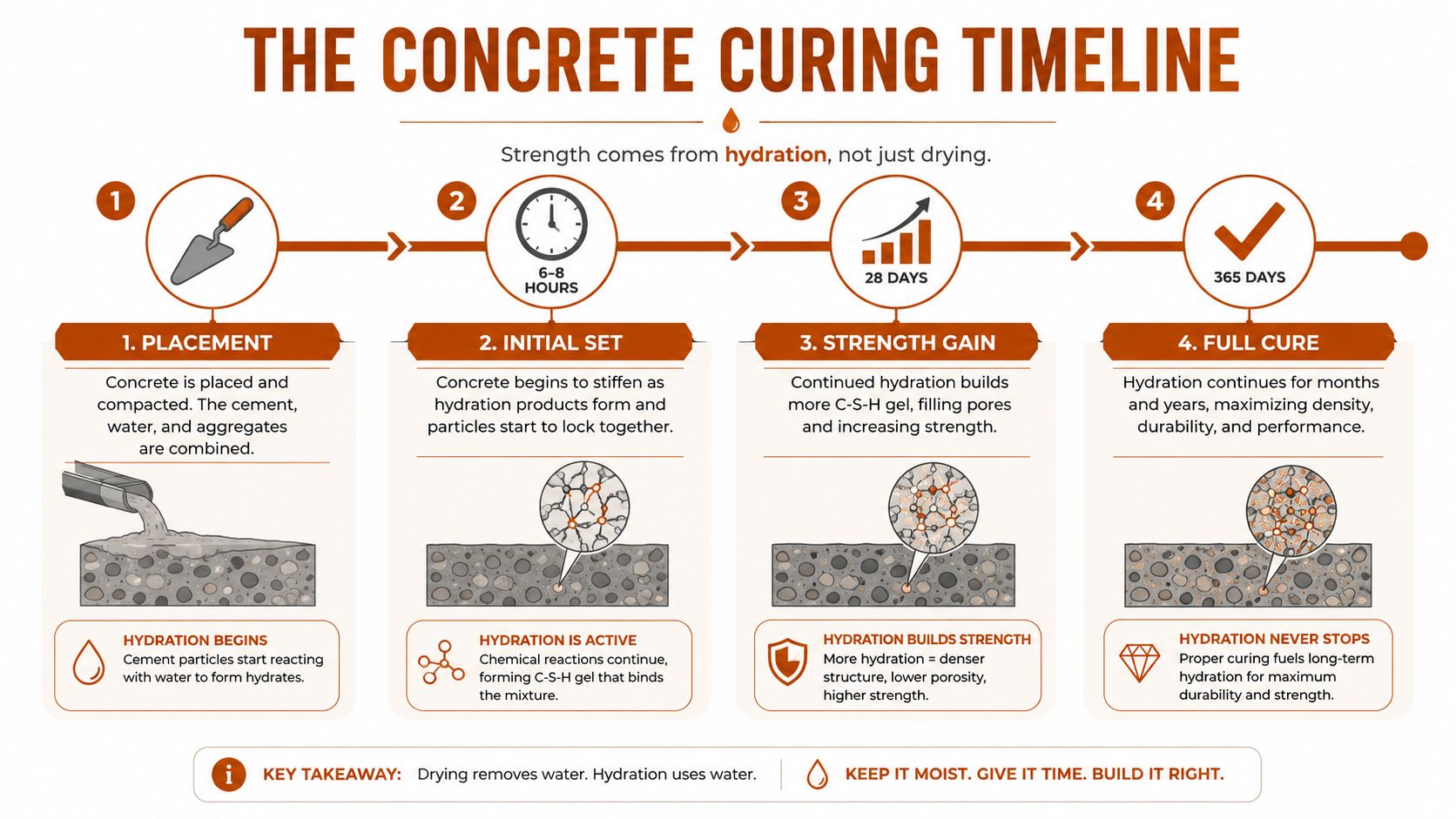
Early cracks can show up quickly. One source notes that a slab can shrink about 1/4 inch for every 100 square feet of surface area as it dries, and that cracks may appear within hours after pouring (Cesar's Concrete). In Central Florida heat, that kind of movement can happen faster than a homeowner expects, especially when the top skin dries quicker than the concrete below it. That is not the same thing as slab failure. It is the material reacting to moisture loss.
The timing matters
The first 7 days after placement are the window where early-age cracking usually shows up, although some cracks appear later because the stress started below the surface. Hairline cracks in the first 30 days are commonly treated as normal if they stay narrow and do not change, while cracks wider than 1/4 inch or cracks that keep opening need attention. The basic cure timeline in how long concrete takes to cure helps explain why the slab can still be hardening while those small lines are forming.
Practical rule: If a crack is still hairline and unchanged during the first month, monitor it. If it widens, offsets, or keeps extending, treat it as a problem.
A patio in Dunnellon, Crystal River, Homosassa, Inverness, or Lecanto can look fine in the morning and show a new line after a hot afternoon or a sudden rain. Sandy subgrade adds another wrinkle, because the slab may lose support in one spot before the rest of the patio settles the same way. When a slab has no planned weak points to relieve that movement, it opens where the stress is highest.
That is why control joints matter. They give the slab a place to crack in a cleaner, more predictable line instead of letting random cracks form across the face of the patio.
Hairline cracks inside the first month are common enough to watch instead of panic over. The key job is separating normal curing marks from movement that keeps going.
The Most Common Causes of Cracks in New Concrete
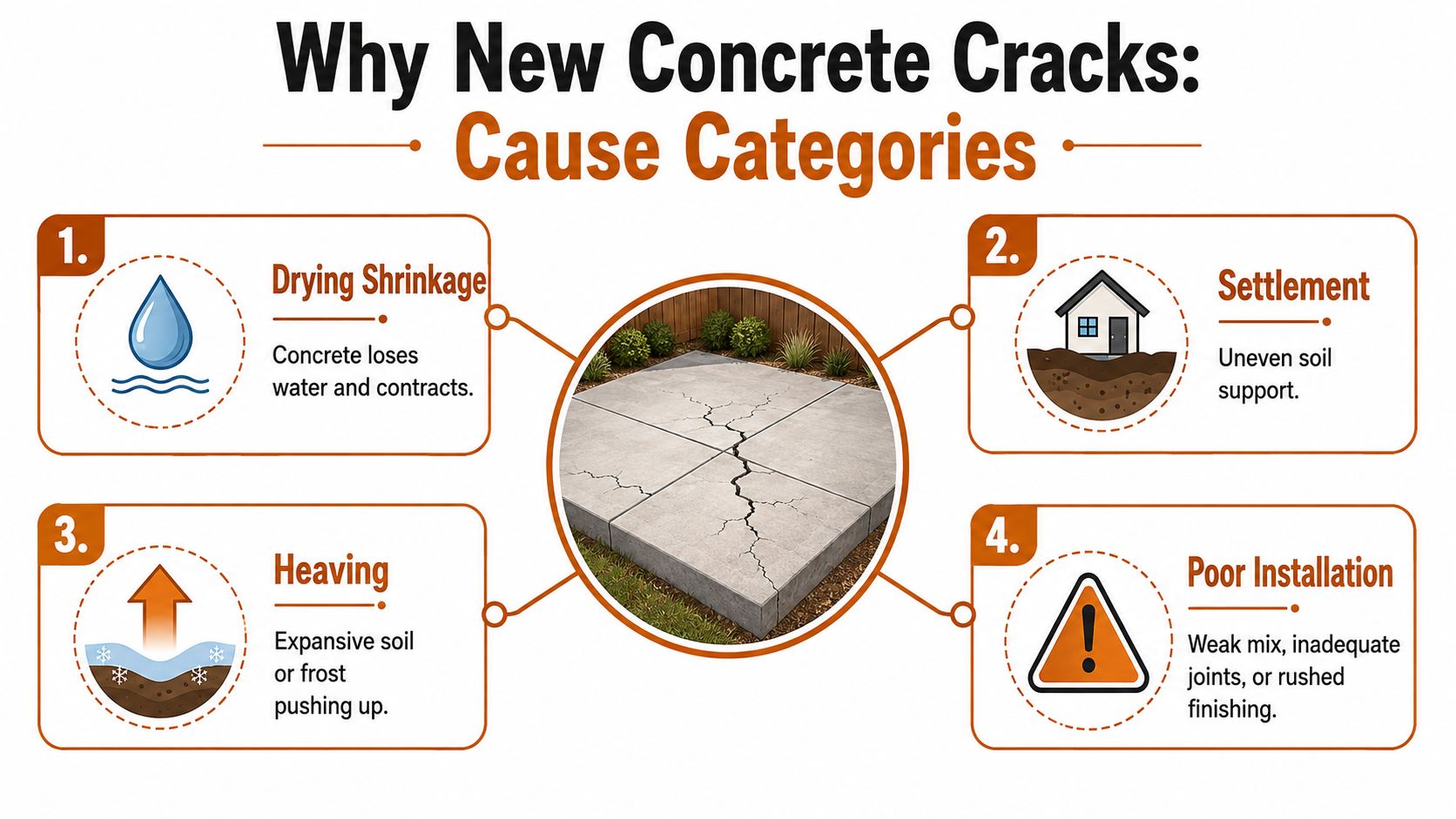
New patios crack for a handful of repeatable reasons, and the list doesn't need mystery added to it. In Marion County, FL and Citrus County, FL, the usual suspects are drying shrinkage, settlement, heaving, and poor installation techniques. Other contributors can include erosion, tree roots, and foundation movement, all of which show up in real-world inspections more often than homeowners expect (Angi).
Drying shrinkage shows up first
This is the most ordinary cause. As water leaves the cement paste during curing, the slab shortens and tensile stress builds until the surface relieves that stress with hairline cracking. If the top dries faster than the interior, which happens in hot, dry, or windy conditions, the risk goes up quickly (A1 Concrete). That's why a patio in Silver Springs during a dry stretch can crack even when the mix itself was fine.
Settlement starts below the slab
If the base wasn't compacted well or the soil support is uneven, part of the slab settles differently than the rest. You'll usually see the crack travel where the slab is being asked to bridge unsupported space. On sandy Central Florida subgrades, that support issue can stay hidden until rain, traffic, or time exposes it.
Heaving pushes from underneath
Heaving is the opposite problem. Something under the slab pushes upward, whether that's expansive soil, root pressure, or localized movement in the base. It doesn't always create a wide crack right away. Sometimes the first clue is a corner that looks slightly lifted or a joint that no longer lines up cleanly.
Poor installation leaves the slab vulnerable
Too much water in the mix, rushed finishing, skipped joints, and poor curing all make cracking more likely. A slab can look good the day it's finished and still show weakness once the surface starts to dry and stress builds. For control-joint placement and other installation details, see what a concrete expansion joint does.
A small but useful note. If a crack pattern keeps changing in ways that don't fit the slab's joints or the soil conditions, a contractor may also look for less common chemistry issues during inspection. That's not the first guess on most patios, but it belongs in the professional toolbox.
How to Judge Whether a Crack Is Serious
A homeowner does not need a lab to make a first pass on a patio crack. At first light, with a tape measure and a clear view of the slab, you can tell a lot by checking width, movement, and location or pattern. In Central Florida, that quick check matters because heat, sudden rain, and sandy subgrade can turn a harmless shrinkage line into a real service issue if the slab starts to move.
Start with width
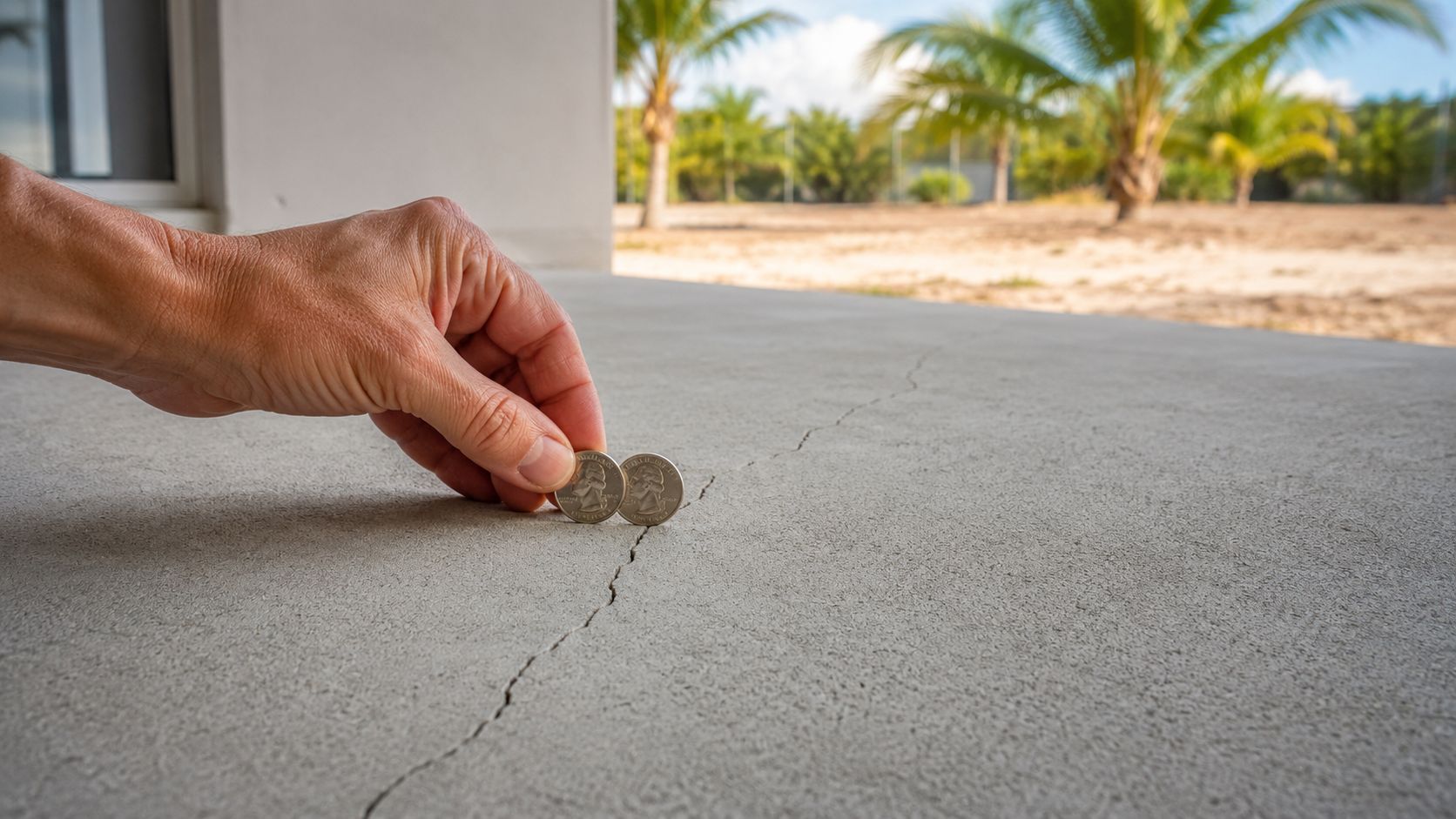
The old “two quarters” check is practical because a quarter is roughly 1/8 inch, and two quarters stacked give you a quick stand-in for the 1/4 inch warning line. Hairline cracks under 1/8 inch are commonly treated as normal shrinkage when they stay flat and do not change. Cracks that open wider than 1/4 inch deserve more concern, especially if they are fresh, active, or appear soon after the patio was poured.
On a new Dunnellon slab, timing helps the diagnosis. A fine crack that shows up while the concrete is still curing often points to shrinkage. A crack that opens later, after the first hard rain or after a dry spell followed by soaking weather, deserves a closer look.
Then look for movement
A crack that stays the same is different from one that keeps lengthening, opening, or creating a lip between one side and the other. If one edge sits higher than the other, the slab is moving, not just shrinking. That is the point where a simple patch stops being the right answer.
Pay attention after rain. In Central Florida, a crack that was flat last week and now shows a step, even a small one, often signals settling or base movement under the slab. That kind of change is a field clue, not a cosmetic issue.
Finish with pattern and placement
Control joints are supposed to guide cracking. If the line follows a joint, the slab may be doing what it was designed to do. If it runs across the middle of the patio, cuts through a corner, or tracks in a way that suggests root influence or soft support underneath, the cause is more likely tied to the base or layout.
| Quick check | What it usually means | What to do |
|---|---|---|
| Hairline, under 1/8 inch | Often normal shrinkage | Monitor it |
| Around 1/8 to 1/4 inch | Needs attention if growing | Watch closely |
| Wider than 1/4 inch or moving | More serious | Call a professional |
Practical rule: A crack that is narrow, flat, and unchanged is usually a monitoring case. A crack that is wide, offset, or still growing is a service call.
A recent video guide also reinforces the need to judge crack width and water intrusion rather than reacting to the first visible line alone. That matches what field crews see on patios in Dunnellon, Beverly Hills, Hernando, and The Villages, where the surface may look alarming long before the slab is failing.
If the crack is still hairline and the slab is otherwise level, mark it, photograph it, and check it again later. If it changes, you have your answer. If it is wider, growing, or has a lip you can feel with a fingertip, the next step is a closer inspection and, if needed, concrete crack repair.
DIY Repairs Versus Calling a Professional
Some patio cracks are fair Saturday-morning projects. Others need a contractor who can tell whether the slab itself is fine but the base is wrong. The line between those two cases is usually width, depth, and whether the crack is still active.
What a homeowner can patch
One repair guide gives a practical DIY threshold. Cracks up to 1/2 inch wide and 1/4 inch deep can be filled with a polymer-based sanded acrylic-latex filler applied with a caulking gun and smoothed with a putty knife (The Spruce). That kind of repair makes sense when the crack is stable, the slab is otherwise sound, and the goal is to keep water and debris out.
What needs a contractor
If the crack is wide, deep, growing, offset, or clearly tied to settlement, the fix changes. At that point, the issue may be under the slab, not just on top of it. A professional can route and seal active cracks, check drainage, look for base failure, and decide whether partial replacement is the safer move.
Where sealing fits in
A useful rule in Central Florida is to seal cracks wider than about 1/8 inch so water doesn't keep working into them. That matters after the first heavy rain, because water intrusion can wash fine material out of a weak line and make a minor issue worse. The repair goal is not just cosmetics. It's keeping moisture from turning a stable crack into an ongoing problem.
For homeowners comparing options, concrete crack repair is the right search when the slab needs more than filler but less than full replacement. The difference is whether the crack is a surface blemish or a symptom of movement.
A simple comparison helps:
- DIY works when the crack is narrow, shallow, and not changing.
- DIY fails when the crack is active, uneven, or tied to base movement.
- Professional service is justified when the slab is settling, heaving, or cracking in a pattern that suggests a larger structural or drainage issue.
That's the honest test. If a crack is stable and minor, patch it and keep an eye on it. If it keeps telling the same bad story every time it rains, it's time for a closer inspection.
Central Florida Climate and Prevention Tips That Work
Central Florida can punish a fresh patio if the pour is timed badly. Heat, dry wind, and a sudden afternoon storm all work against new concrete in Marion County, FL and Citrus County, FL. On a hot morning, the surface can lose moisture before the slab finishes setting, and that is where fine shrinkage cracks start. If a crack shows up within the first day and stays hairline, it usually points to drying stress. If it opens wider after rain or starts stepping at an edge, that is a different problem.
The prevention basics that hold up
The pour should start around the weather, not against it. Cooler mornings are easier on fresh concrete than hot, windy afternoons, because the surface has more time to cure before evaporation takes over. Water in the mix needs to stay controlled, since too much water weakens the slab and raises shrinkage risk. Curing matters just as much. The slab needs to stay moist enough to harden evenly instead of flashing dry on top.
Control joints need planning, not guesswork. They should guide the slab to crack in a clean line instead of forcing the stress into random places. The base matters too, especially on the sandy subgrade common in this part of Florida. If the subgrade is loose, poorly compacted, or holding water, the top can look fine while the slab starts moving underneath it.
A simple rule of thumb helps on site. Hairline cracks that stay under 1/16 inch and do not change are usually the kind to watch. Cracks that reach about 1/8 inch or start collecting water deserve sealing so moisture does not keep working into them. If the crack widens after a storm, or if one side sits higher than the other, that is more than normal shrinkage and needs a closer look.
What homeowners can ask before the next pour
- How will you handle curing in heat and wind?
- Where are the control joints going, and when will they be cut?
- How are you preparing and compacting the base?
- What drainage path keeps water off and under the slab?
Practical rule: In this climate, good concrete work depends as much on evaporation control and drainage as it does on the finish you see on day one.
Around Crystal River, Homosassa, Inverness, Lecanto, and nearby neighborhoods, early sealing helps keep a small crack from turning into a water path during the next rainy stretch. That does not erase the crack, but it reduces the chance that sand and moisture keep working the line open. If the patio is still in its early cure and the crack stays narrow and flat, that is often normal shrinkage. If it starts changing with heat, rain, or foot traffic, the slab is telling a different story.
Central Florida patios need timing, drainage, curing discipline, and a base that can carry the slab without settling.
When to Bring in Riverside Sealing and Striping
If the crack is still narrow and stable, a monitored repair may be enough. If it's wider than 1/4 inch, growing, or showing vertical movement, that's the point where a professional should walk the slab in person and explain what's cosmetic and what isn't. A good site visit should include measuring the crack, checking drainage, looking at the base conditions, and deciding whether the answer is monitoring, repair, or replacement.
Riverside Sealing & Striping, LLC works as a third- and fourth-generation, family-owned concrete and asphalt maintenance company based in Dunnellon, with service throughout Marion County, FL, Citrus County, FL, and surrounding Central Florida communities. That matters because the same crew that understands cracked patios also understands site prep, concrete work, and pavement maintenance on the same property.
A proper consultation should feel straightforward. The contractor walks the slab, checks whether the crack is active, and looks at how water moves across the site. If the patio is a candidate for repair, the recommendation should be clear. If the base has failed or the slab should be replaced, that should be stated directly, without drama.
For property owners in Ocala, Belleview, Summerfield, Dunnellon, Crystal River, Inverness, and The Villages, that kind of evaluation helps separate a surface issue from a structural one. It also keeps the conversation grounded in the actual slab, not in guesswork.
Practical rule: A good on-site visit should leave you with a measured crack, a plain explanation, and a clear next step.
If you want a straight answer on a new patio crack, a no-pressure consultation is the right move. It's the cleanest way to get a professional read before a small line turns into a larger repair.
If you're looking at cracks in a new concrete patio and you want a calm, local opinion from a crew that understands Central Florida slabs, Riverside Sealing & Striping, LLC can help. Visit Riverside Sealing & Striping, LLC to request a free on-site evaluation and get a clear recommendation for repair, monitoring, or replacement.