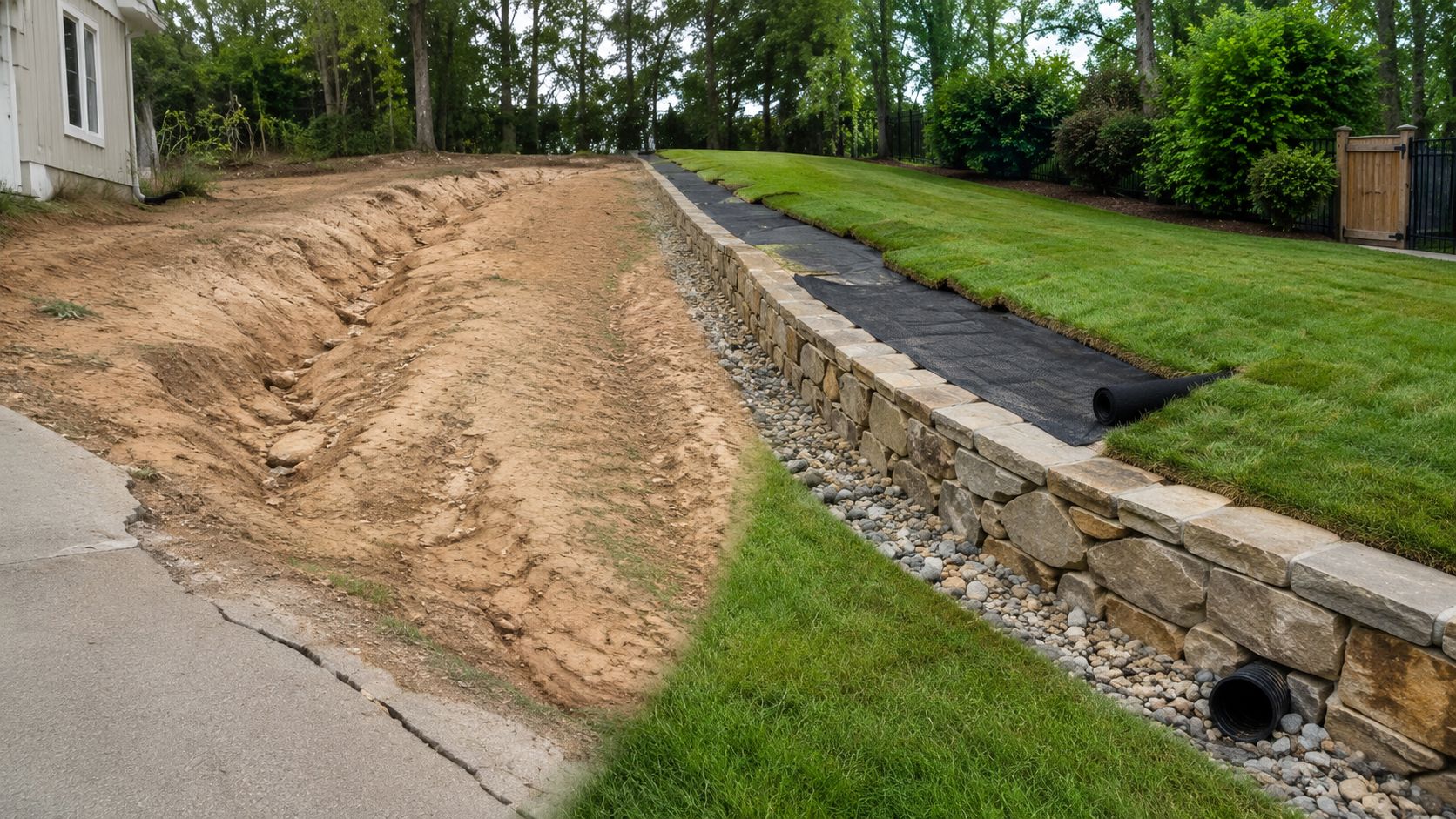
You walk outside after one of those hard Central Florida storms and see the same pattern again. Sand has washed off the shoulder of the driveway, a low spot is forming beside the slab, and muddy runoff is cutting a path toward the street. A lot of property owners in Marion County, FL and Citrus County, FL treat that as an erosion problem first.
It usually isn't.
On sites around Ocala, Dunnellon, Belleview, Silver Springs, Summerfield, Crystal River, Homosassa, Inverness, Lecanto, Beverly Hills, Hernando, and The Villages, erosion often starts in the soil but ends in the pavement. If the base under concrete or asphalt loses support, cracks, settlement, edge failure, and surface breakdown follow. That's why good erosion control measures protect more than dirt. They protect the life of your driveway, sidewalk, parking lot, and pad.
Table of Contents
- What Is Erosion and Why It Damages Pavement
- A Guide to Four Primary Erosion Control Methods
- Selecting Measures for Central Florida's Climate and Soil
- Commercial Site Requirements and Maintenance
- When to Hire a Concrete and Asphalt Expert for Erosion Issues
- Frequently Asked Questions About Erosion Control
What Is Erosion and Why It Damages Pavement
Erosion is the movement of soil by water, and in Florida it happens fast. A strong downpour can strip loose sand from a shoulder, carve small channels across a lot, and carry the supporting material away from a driveway edge before the rain even lets up.
The three forms most property owners notice are sheet erosion, rill erosion, and gully erosion. Sheet erosion is the thin, even loss of surface soil. Rill erosion shows up as small channels cut by flowing water. Gully erosion is the larger, more destructive version where runoff digs a trench.
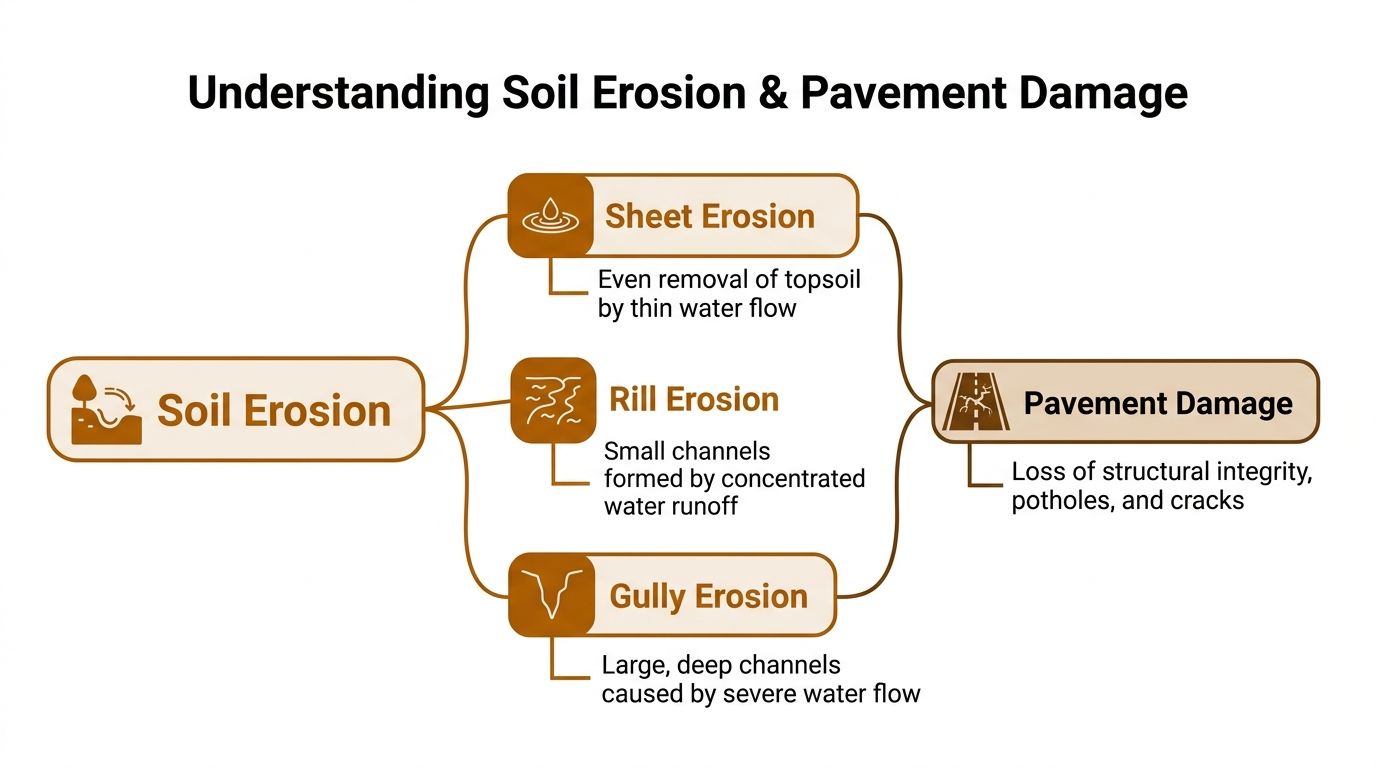
How the damage reaches the slab or asphalt mat
Concrete and asphalt both depend on stable support underneath. When runoff starts removing the shoulder material beside a driveway or parking area, water gains a path under the pavement edge. Once that happens, the base can soften, shift, or wash out.
That's when you start seeing problems such as:
- Edge cracking: The side of the pavement loses support first.
- Settlement: One section drops lower than the rest.
- Voids under slabs: Concrete bridges over empty space until it breaks.
- Base failure under asphalt: The surface may still look intact at first, but the structure underneath is already weakening.
A lot of owners first notice the symptom, not the cause. They see cracking and assume the slab mix was bad or the asphalt was old. Sometimes the underlying issue is drainage and soil loss. If you're already seeing splits or movement, this guide on why driveways crack gives a useful look at what failure often points to.
Practical rule: If water can leave a wash line beside your pavement, it can also remove the support that pavement needs to stay intact.
Why this matters in Central Florida
In places like Ocala and Homosassa, sandy soils drain quickly until runoff concentrates. That sounds like a benefit, but once water starts moving across a bare grade, it can carry that sand away fast. Heavy storms also hit fresh site work at the worst time, right after grading, trenching, or new pavement installation.
For homeowners, erosion control is part of protecting curb appeal and property value. For commercial sites, it also affects safety, appearance, and maintenance planning. Either way, if the soil under and around paved surfaces isn't held in place, the pavement won't last the way it should.
A Guide to Four Primary Erosion Control Methods
Not every site needs the same answer. The best erosion control measures depend on slope, soil, traffic, drainage paths, and whether the goal is temporary protection during construction or long-term stabilization after the project is done.
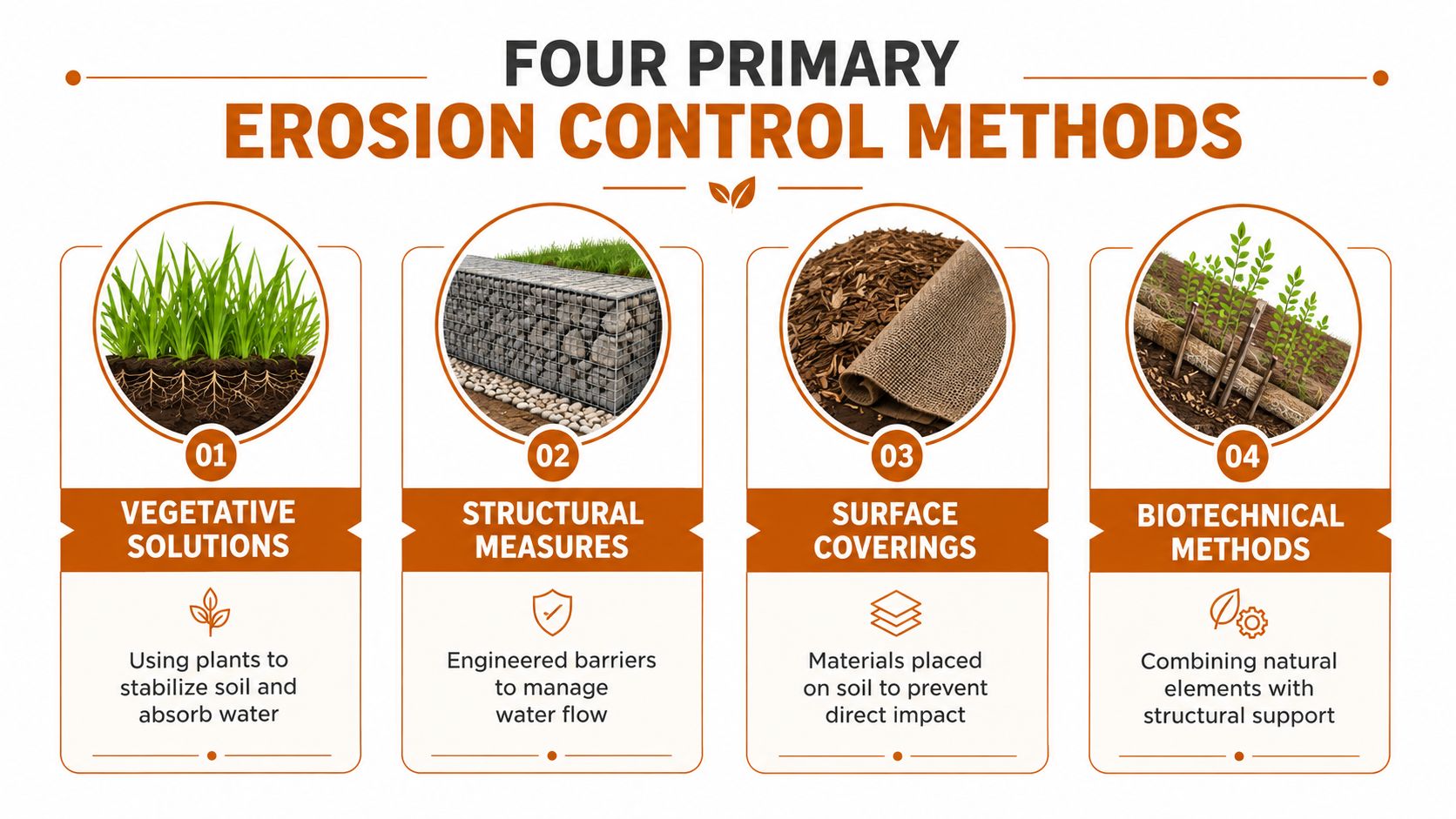
Vegetative solutions
Vegetation is the long game. Grass, ground cover, and rooted planting help hold the soil, reduce raindrop impact, and slow runoff before it starts cutting channels.
One of the strongest facts in this whole category is that properly planted and maintained vegetation can reduce soil erosion by as much as 75% on susceptible areas like hillsides and riverbanks, according to Muller EC's overview of erosion control measures. That's why permanent stabilization almost always includes plant cover somewhere in the plan.
Vegetation works best when:
- Runoff is moderate: It's good for general stabilization, not extreme concentrated flow.
- The grade can support growth: Bare sand and steep wash paths may need help first.
- You want long-term protection: Sod, seed, and native cover are part of the finished condition.
What doesn't work is treating vegetation like an instant fix. Seed alone on a raw slope right before summer rain usually isn't enough.
A separate but related issue is pavement upkeep. If runoff is already affecting a blacktop driveway, asphalt driveway maintenance matters because surface protection and shoulder stability work together.
A short visual helps show the categories side by side:
Structural measures
Structural controls physically redirect or resist water and soil movement. This category includes retaining walls, riprap, check dams, rock chutes, gabions, and similar built features.
These are the right fit where water has real force behind it. If runoff is concentrated at an outfall, near a curb opening, or down a steep swale beside a parking lot, structural solutions often outperform vegetation-only plans.
Vegetation is excellent at stabilizing soil. It isn't a substitute for hard protection where water is already moving with force.
Structural work makes the most sense when you have repeated washouts in the same place, slope failure near pavement edges, or discharge points that keep scouring the same channel.
Engineered textiles and surface coverings
This group includes mulch, matting, blankets, and geotextile-based products. These materials protect the soil surface from direct rain impact and help hold seed and topsoil in place while vegetation establishes.
The trade-off is installation quality. A blanket that isn't anchored correctly or trenched properly can fail early, and then water gets under it. On a paved site, that failure can send runoff toward the slab edge or asphalt base instead of away from it.
Best uses include fresh grading, slopes that need temporary cover, roadside shoulders, and newly disturbed areas around driveway replacement or sidewalk work.
Drainage and water management
Drainage isn't always what people think of first when they hear erosion control measures, but it's often the deciding factor. If water is allowed to gather, accelerate, and spill over an edge, every other measure is under pressure.
This category includes swales, inlets, catch areas, subsurface drainage, and outlet protection. Sometimes the smartest move isn't adding more surface cover. It's reducing the amount of water traveling across the soil in the first place.
Here's a simple comparison:
| Method | Best at | Common limit |
|---|---|---|
| Vegetation | Long-term soil holding | Slow to establish |
| Structures | High-force runoff areas | Higher cost and heavier build |
| Textiles | Temporary or transitional cover | Must be installed precisely |
| Drainage | Controlling water path | Poor layout can shift the problem elsewhere |
On most Central Florida properties, the strongest plan combines more than one method.
Selecting Measures for Central Florida's Climate and Soil
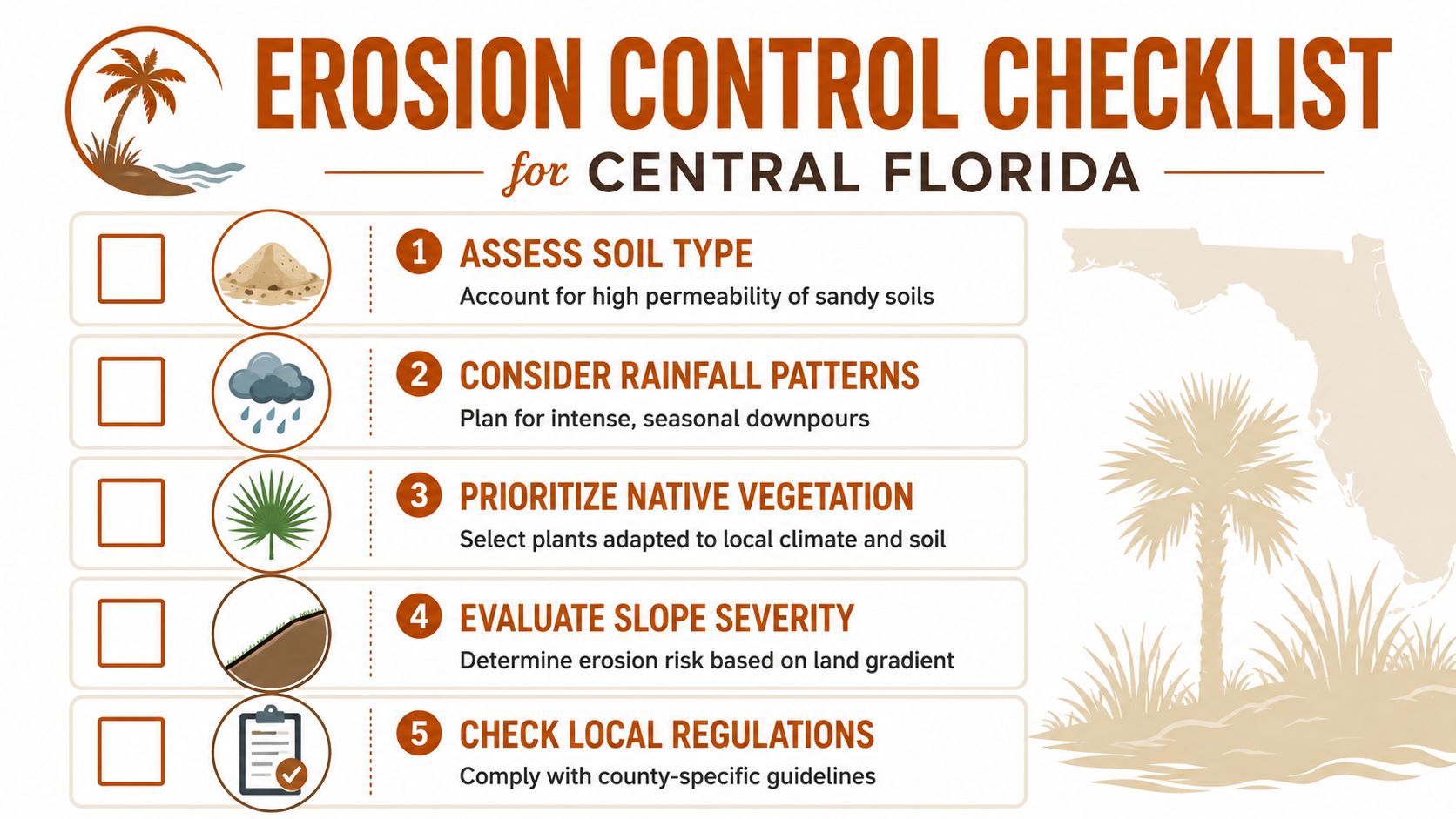
Central Florida has its own pattern. The soils around Marion County, FL and Citrus County, FL often look easy to work because they're sandy and quick-draining, but that same loose profile can move fast during repeated storms. Add summer downpours, flat lots that suddenly channel water, and sloped areas around Dunnellon or Inverness, and a generic erosion plan starts falling apart.
Why sandy soil changes the plan
Sandy soil infiltrates differently than heavier soils, but once the surface seals over or runoff concentrates, it can wash quickly. That's why bare shoulders beside concrete driveways in Belleview or Lecanto often start sloughing off after a few storms.
On flatter residential lots, a practical combination is usually:
- Vegetative cover: Sod or established ground cover to protect open soil.
- Surface stabilization: Mulch or blanket protection on newly disturbed areas.
- Clean grading: A finished grade that sheds water away from slabs and pavement edges.
On steeper ground, the standard gets stricter. For slopes steeper than a 1V:3H gradient, agencies require Erosion Control Blankets or Turf Reinforcement Mats to stabilize soil while vegetation gets established, according to Missouri DOT's erosion control measures guidance. The same guidance also stresses correct trenching at the top, placing blankets loosely instead of stretching them, lapping in the direction of flow, and driving anchor staples fully. Those details matter because a failed mat lets water undercut the slope and threaten the base near pavement lines.
What Florida rain does to unprotected grades
Central Florida rain exposes weak site prep immediately. If a new driveway in Summerfield has no protected shoulder, or a parking area in Crystal River drains toward a raw side slope, the storm is going to find the low path and widen it.
The most common field mistakes are simple:
- Leaving disturbed soil bare too long
- Sending roof or lot runoff onto a loose slope
- Trying seed alone where runoff is concentrated
- Ignoring subsurface saturation near a slab or asphalt edge
A lot of pavement damage starts below the surface. Water trapped under mats, behind curbs, or beside slabs keeps the base wet, and that weak support shows up later as settlement or cracking. Before any pour or paving job, proper grade preparation matters. Good site prep is a major reason guides on preparing ground for a concrete slab focus so heavily on base condition and drainage.
On Florida sites, the wrong drainage path can ruin a good paving job long before the surface itself wears out.
Where slope rules and permitting come into play
For many projects, erosion control isn't optional housekeeping. It's part of compliance. In Florida, an Erosion and Sediment Control Plan is a mandatory document for most construction projects, required by local permitting agencies to outline how the site will prevent sediment from contaminating waterways and neighboring properties, as explained in this Florida ESC plan overview.
That matters for homeowners adding larger hardscapes and for commercial owners improving lots, sidewalks, or drainage systems in places like Ocala, Homosassa, or Beverly Hills. If the work disturbs soil, the site needs more than a rough idea. It needs a plan that matches actual conditions.
Commercial Site Requirements and Maintenance
Commercial properties have a different level of exposure. A homeowner may be dealing with one driveway edge. A retail center, church, HOA, or office site in The Villages or Crystal River may have multiple drainage collection points, planted islands, curb openings, and outfalls that all need to work together.

What larger properties have to plan for
For disturbed areas over 1 acre, regulations often require a sediment basin designed for the 2-year, 24-hour storm, according to this stormwater and BMP guidance. That tells you how engineered commercial erosion work can get. This isn't just about dropping a few wattles on a slope and hoping for the best.
The same guidance states that advanced BMP plans are engineered to reduce total suspended solids by 80 percent compared to uncontrolled runoff and require infiltration of 10 percent of runoff from that same design storm, which is another sign that commercial planning has to be systematic and performance-based.
For managers, the practical priorities usually look like this:
- Protect entrances and exits: Soil tracking and shoulder loss spread problems beyond the site.
- Stabilize embankments and pond edges: These areas often fail before anyone notices.
- Control discharge points: Outfalls and channel ends are where scour often begins.
- Tie maintenance to pavement protection: Striping, curbs, sidewalks, and asphalt edges all last longer when water is controlled.
Why maintenance matters after installation
Installation is only half the job. Florida requires follow-through. A qualified inspector must check all erosion controls at least once every seven days and after every storm event of 0.50 inches or more, according to FDOT erosion and sediment control guidance.
That inspection schedule matters because temporary controls fail in predictable ways. Silt builds up. Rock gets displaced. Fabric lifts. Water finds a new path around the edge. Once that happens, the damage often shows up first where the pavement meets the soil.
Commercial pavement lasts longer when site managers treat erosion control like asset protection, not just permit paperwork.
For HOAs in Inverness, retail sites in Ocala, or church properties in Hernando, a maintenance calendar should include both stormwater controls and paved surface checks. That's how you catch edge loss, settlement, trip hazards, and striping deterioration before they turn into bigger repairs.
When to Hire a Concrete and Asphalt Expert for Erosion Issues
Some erosion problems are small enough to monitor and correct with basic yard work. Others are already affecting the structure of the pavement, and that's when a contractor needs to look at the whole system instead of one symptom.
Signs the problem is past a simple yard fix
If you see any of these conditions, it's time to bring in a professional:
- Pavement edges hanging over a washed-out shoulder
- Recurring rills or channels after each storm
- Concrete slabs settling at corners or along one side
- Asphalt cracking where runoff keeps crossing or undermining the edge
- Sediment repeatedly reaching sidewalks, streets, or parking stalls
Commercial owners should pay especially close attention when the site is large or recently disturbed. For disturbed areas over 1 acre, regulations often require a sediment basin designed for a 2-year, 24-hour storm, as noted in the earlier commercial discussion. That's the kind of requirement that shows when erosion control has moved beyond a basic cleanup task.
Why pavement and erosion have to be solved together
A driveway replacement that ignores runoff can fail early. A parking lot repair that leaves unstable shoulders can do the same. The right fix usually includes some mix of grading, drainage correction, slope protection, base repair, and then the concrete or asphalt work itself.
That's why owners need Concrete and Asphalt Experts in Marion and Citrus County, not a one-trade answer. The job isn't just pouring a slab or sealing a lot. It's protecting the support system that keeps those surfaces sound in Florida weather.
Licensed and insured local contractors with Central Florida experience can spot where water is entering, where soil is leaving, and whether the pavement failure is cosmetic or structural. If the issue has reached that point, a professional evaluation saves guesswork and usually prevents repeat repairs.
Frequently Asked Questions About Erosion Control
Can I handle erosion control myself?
Some light work is manageable, especially on small residential areas. Re-establishing grass, adding mulch, and correcting minor grading are often reasonable DIY jobs. Once runoff is cutting channels, washing out driveway edges, or moving toward a slab or parking area, the repair usually needs a site-prep and pavement mindset.
What affects the cost of erosion control measures?
Price depends on slope severity, soil conditions, access, runoff volume, and whether the fix is temporary or permanent. A simple residential stabilization job is very different from a commercial site that needs drainage changes, outlet protection, and ongoing inspections.
Are straw bales enough for most projects?
Not by themselves. They can help as a temporary sediment barrier, but installation and maintenance have to be right. Straw bale barriers must be trenched 4 to 6 inches into the ground, and sediment buildup behind them cannot exceed 1 foot before maintenance is required, according to this technical guidance on sediment barriers.
How does erosion control connect to a new driveway or parking lot project?
It starts before the surface goes in. If the grade, drainage path, and surrounding soil aren't stabilized, new concrete or asphalt can lose support and start failing early. That's true for a driveway replacement in Lecanto, a patio in Silver Springs, or a parking lot improvement in Belleview.
What's the best long-term approach?
The strongest long-term results usually come from combining methods. Permanent vegetation, proper drainage, and targeted stabilization around slopes, edges, and discharge points usually outperform single-product fixes.
If you're dealing with washout around a driveway, sidewalk, or parking lot in Central Florida, Riverside Sealing & Striping, LLC provides free estimates and no-pressure consultations for property owners who need real answers. As Concrete and Asphalt Experts in Marion and Citrus County, the team handles the site-prep, concrete work, asphalt maintenance, and pavement protection details that help surfaces last in Florida conditions.