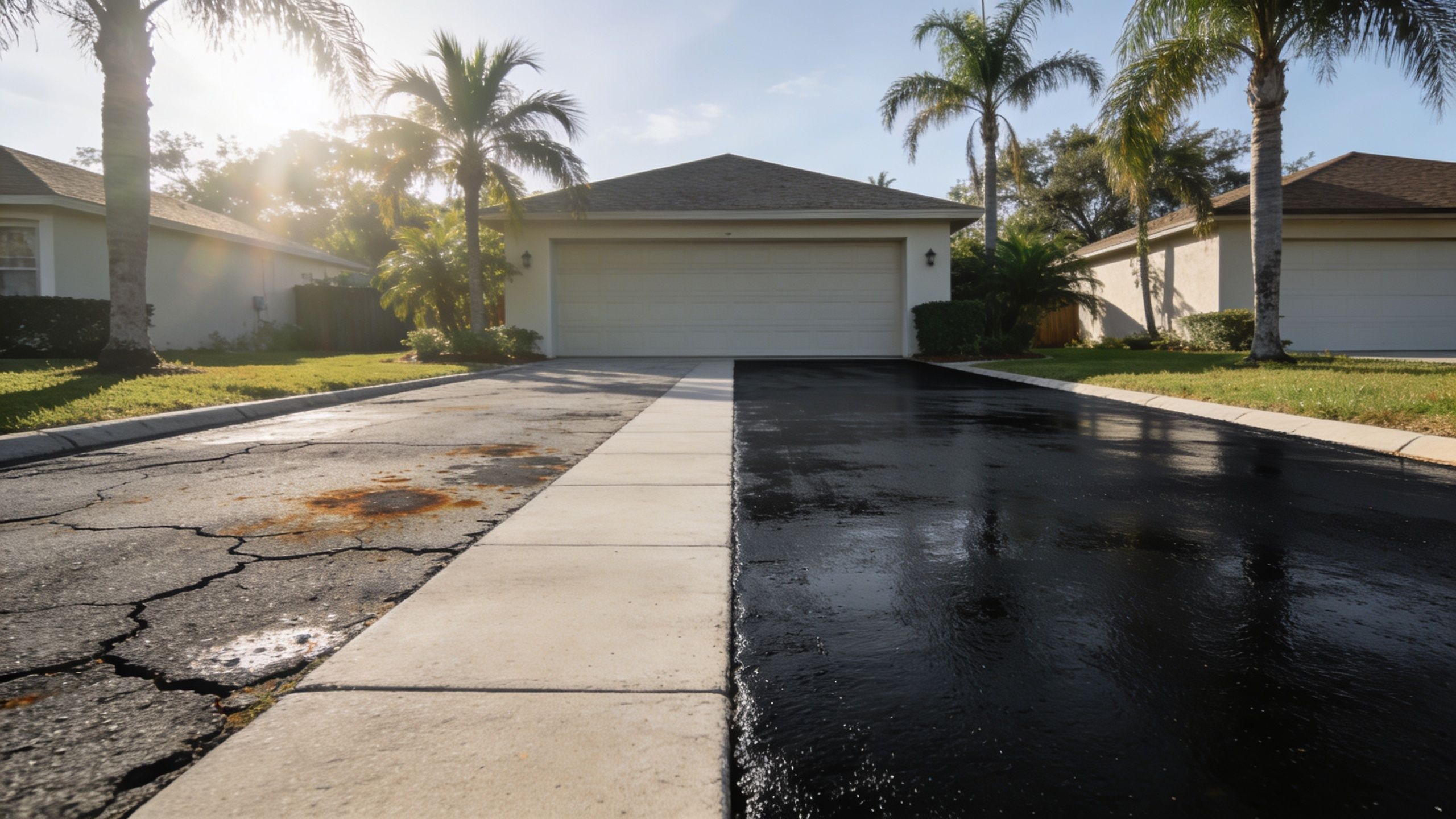
A lot of property owners start in the same place. They notice the driveway has turned dull gray, the parking lot looks tired, or the edges near the sidewalk are starting to break down after another stretch of heat and rain. Then they search for something like florida sealcoating llc and try to figure out who knows what they’re doing.
That’s a smart instinct. In Central Florida, pavement doesn’t fail all at once. It fades, dries out, opens up, and then starts costing real money. If you own a home in Ocala, manage rental property in Dunnellon, oversee an HOA near The Villages, or maintain commercial space in Marion County, FL or Citrus County, FL, waiting is usually the expensive move.
Good pavement care also isn’t just about asphalt. The best long-term decisions usually involve both surfaces on the property. A cracked asphalt drive next to broken concrete walkways still leaves you with a maintenance problem. Property owners in Belleview, Summerfield, Inverness, Crystal River, Homosassa, Lecanto, Hernando, Beverly Hills, and Silver Springs need practical guidance, not sales fluff.
Your Guide to Pavement Longevity in Central Florida
A homeowner in The Villages might notice tire marks, fading, and a few shallow cracks in the driveway. A church in Dunnellon might see ponding water in the parking lot and worn striping. A retail property in Ocala may have a decent-looking lot from a distance, but up close the surface is drying out and losing protection.
That’s how pavement trouble usually starts in this region. Not with a dramatic collapse. With neglect that looks minor until it isn’t.
The right response depends on the surface and the stage of wear. Sealcoating protects asphalt before deterioration accelerates. Concrete repair or replacement handles flatwork issues that sealcoating won’t solve. If you treat every pavement issue like a one-service job, you’ll miss the actual problem and waste money on the wrong fix.
Practical rule: If your asphalt is faded, porous, or starting to show light cracking, act early. If your concrete is heaving, broken, or separating, get it evaluated before it creates a trip hazard.
Often, owners make a poor hiring decision. They focus on the lowest bid or the fastest promise instead of asking a better question. Is this contractor equipped to protect the whole property, or are they just selling one narrow service?
That matters in Marion County, FL and Citrus County, FL. Homes and commercial sites in places like Beverly Hills, Lecanto, and Summerfield often need a mix of asphalt maintenance, striping, and concrete work over time. A full-service contractor can look at the property as a system. An asphalt-only outfit usually can’t.
What Is Sealcoating and Why Is It Essential in Florida
A driveway in Ocala can look serviceable from the street and still be one hot summer and one rainy season away from faster breakdown. That is how asphalt fails in Central Florida. The surface dries out, opens up, and starts letting in water long before owners realize they have a real maintenance problem.
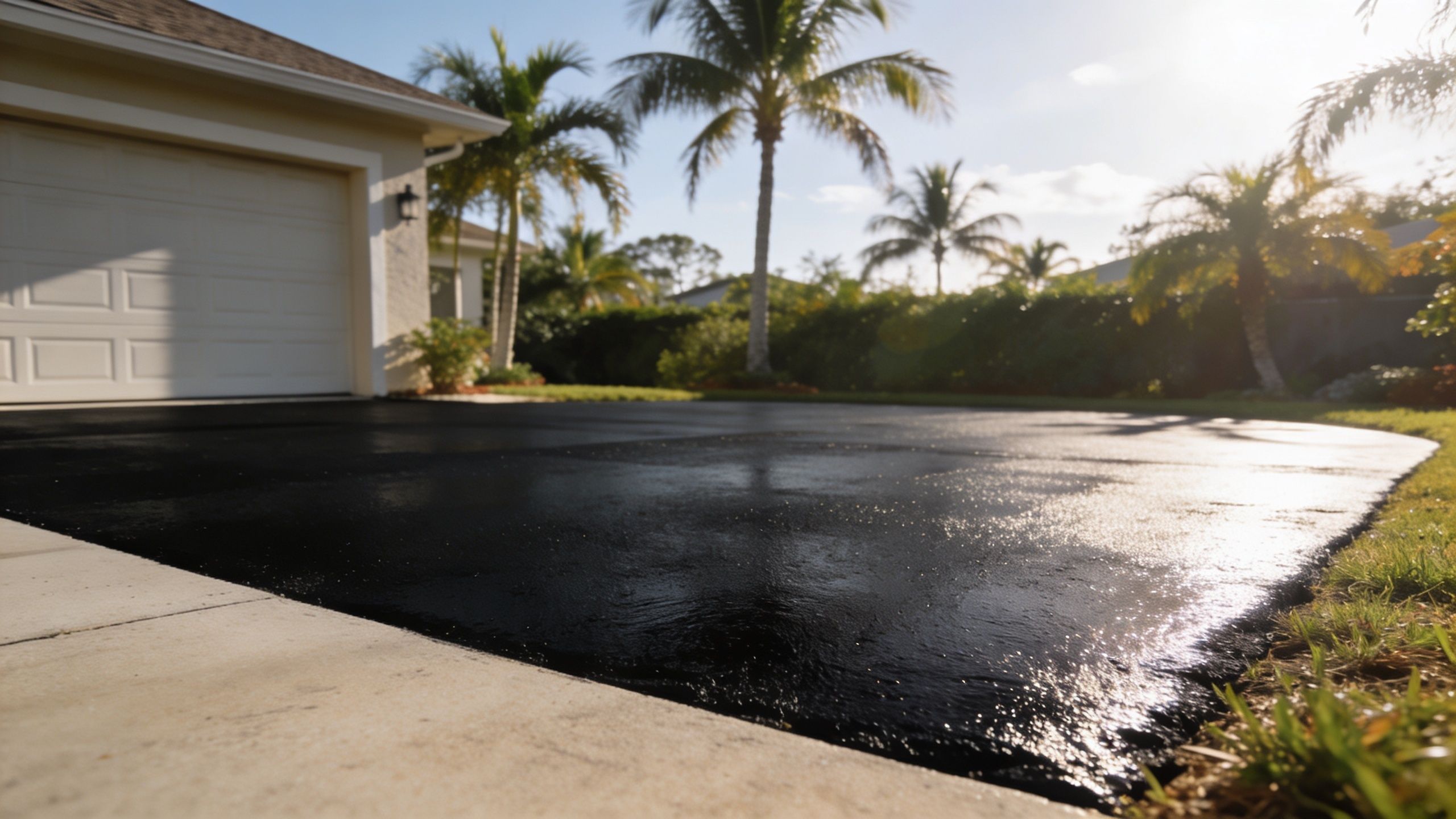
Sealcoating is a protective treatment for asphalt. It is not paving, and it will not correct structural failure. It protects the surface layer so sun, rain, traffic, and spills do less damage while the pavement is still worth saving.
What the coating does
Florida Sealcoating LLC describes sealcoating as the application of protective coal tar, asphalt emulsion, or acrylic-based sealants by spray or squeegee to create a barrier over the pavement surface, according to its company profile details.
That barrier matters because Florida asphalt takes daily abuse from several directions at once:
- UV exposure dries the binders that give asphalt flexibility.
- Rain and humidity work into weak spots and small cracks.
- Oil and fuel drips soften and stain the surface.
- Traffic wear strips away the top layer once it loses protection.
For property owners in Silver Springs and commercial sites in Inverness, this is routine wear, not a rare event.
Why sealcoating matters more in Florida
Central Florida is hard on pavement. Heat bakes the surface. Afternoon storms push water into every opening. Long periods of sun fade asphalt, then moisture exploits the weakness. If you wait until the lot or driveway looks obviously rough, you are late.
Sealcoating works best on asphalt that still has structure left. It slows oxidation, helps resist moisture intrusion, and gives you more time before larger repairs are needed. That is why smart owners treat it as scheduled maintenance, not a cosmetic add-on.
The bigger decision is not whether blacktop should be protected. It should. The bigger decision is who is qualified to do it right.
A reliable local contractor should explain surface prep, crack treatment, application method, cure time, and whether the pavement is even a good candidate for coating. A less accountable asphalt-only outfit often jumps straight to the topcoat because that is the only service it sells. That is a bad sign in Marion and Citrus County, where many properties need honest recommendations more than a quick application.
What smart owners should do
Use a simple screening standard before you hire anyone:
- Ask whether the asphalt should be repaired before sealing
- Ask how the surface will be cleaned and prepared
- Ask which sealer will be used and why it fits the site
- Ask how long traffic must stay off the pavement
- Ask what other site issues the contractor sees beyond the coating
If the answers are vague, keep looking. If you want a better sense of what professional prep and application should include, review this Central Florida sealcoating service guide.
Asphalt that looks only lightly worn is often the best candidate for sealcoating. Asphalt with major cracking, base failure, or soft spots needs repair first.
Comprehensive Concrete and Asphalt Services
Most properties don’t have just one pavement need. They have a mix of issues that show up at different times. The driveway may need sealcoating, the sidewalk may be cracked, and the parking lot may need fresh striping or ADA updates. That’s why hiring a full-service contractor is usually the better decision.
A narrow contractor fixes one symptom. A true pavement partner looks at the entire site.
Asphalt work that goes beyond a black coating
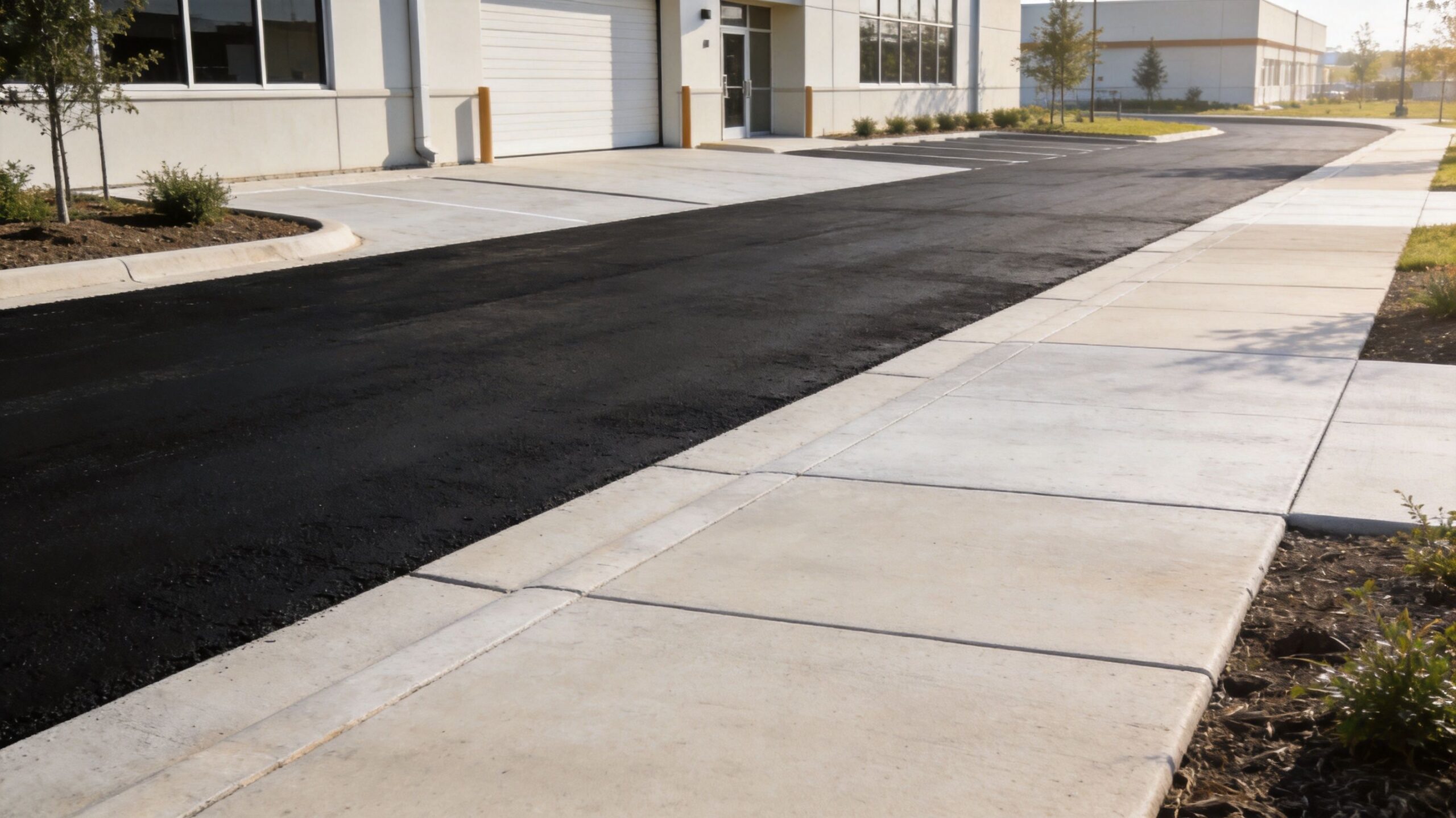
Sealcoating gets attention because the visual change is obvious. But asphalt maintenance should include more than that.
A capable contractor should be able to handle work such as:
- Surface preparation that removes debris and contamination before any coating goes down
- Crack filling and patching so water doesn’t keep working under the surface
- Parking lot striping for traffic flow, curb appeal, and safety
- Signage coordination where lot markings and traffic direction need to work together
That matters for shopping centers in Ocala, churches in Homosassa, and small office properties in Crystal River. A fresh coat over neglected damage isn’t maintenance. It’s camouflage.
Concrete work matters just as much
This is the part many owners miss. Sealcoating protects asphalt, not concrete. If your property also has a broken walkway, failing driveway apron, aging patio, or unsafe sidewalk panel, you need concrete expertise too.
That’s especially important in Marion County, FL and Citrus County, FL, where many residential and mixed-use properties have both surfaces on the same site. Homeowners in Belleview and Summerfield often need driveway replacement or patio work. HOAs and commercial managers in Lecanto or Beverly Hills may need sidewalk correction along with parking lot maintenance.
A contractor who understands both trades can keep the property consistent in appearance, function, and scheduling.
Here’s a quick visual example of the kind of integrated work property owners should expect from a serious pavement and flatwork contractor.
Why one contractor is often the smarter play
Using one reliable company for both asphalt and concrete gives you practical advantages:
- Cleaner project coordination because the schedule is managed in one place
- Better site planning when driveway edges, sidewalks, curbs, and lot markings all interact
- More consistent workmanship across the whole property
- Less finger-pointing when something needs adjustment later
If a contractor only talks about one service, ask what happens when the job exposes another issue nearby. Their answer tells you a lot.
For owners in Dunnellon, The Villages, and Inverness, that full-service capability usually means fewer headaches and better long-term upkeep.
The Project Process From Estimate to Completion
Good contractors don’t make the process feel mysterious. They inspect the site, explain the scope, prep the surface correctly, do the work in the right order, and tell you what happens next. That’s what a professional job looks like.
For homeowners and property managers, clarity matters almost as much as workmanship. You need to know what’s happening on your site and when.
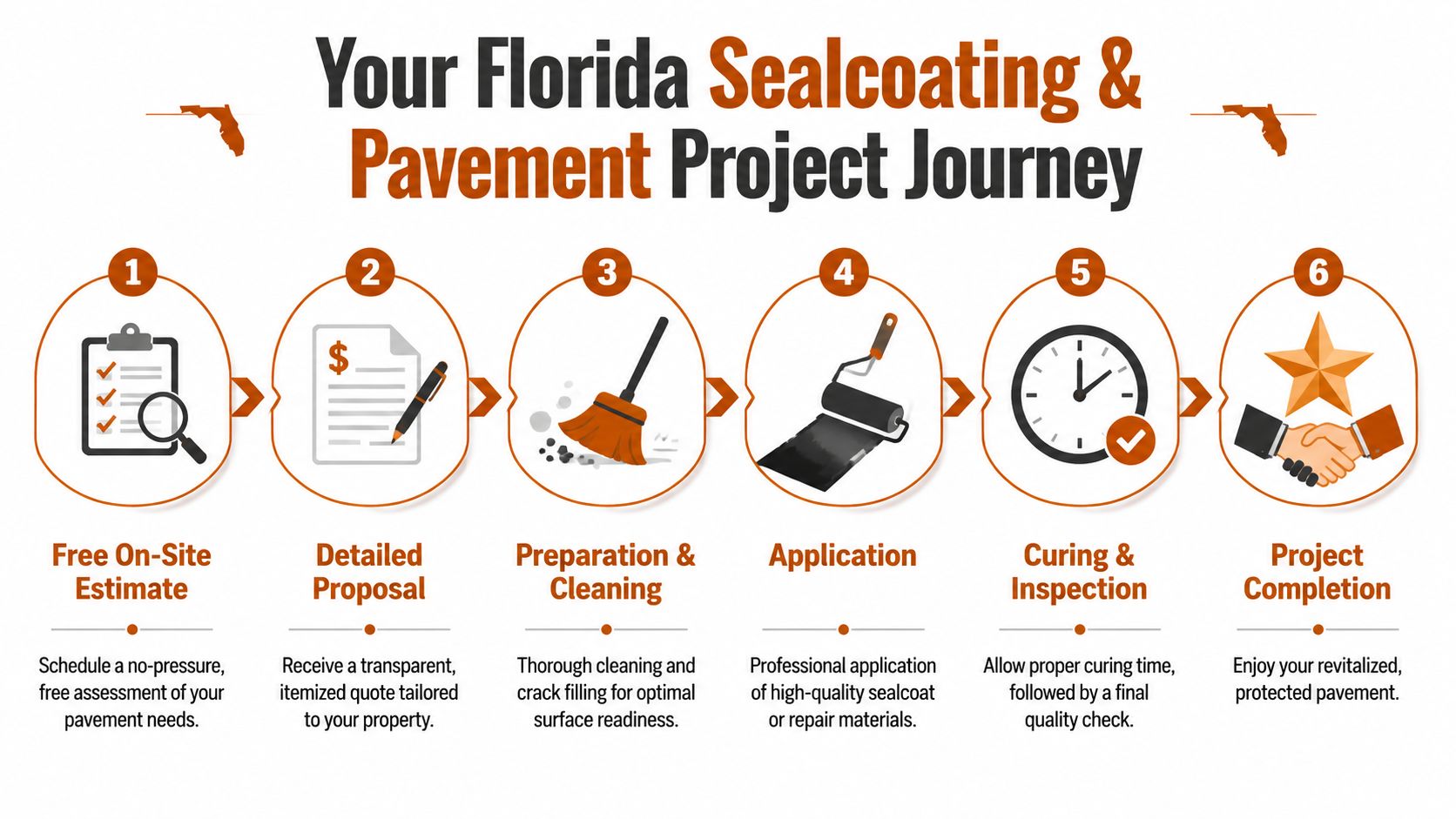
Step 1 through Step 3
The first stage is usually the easiest to judge because it reveals whether the contractor is organized.
Free on-site estimate
The contractor visits the property, looks at surface condition, notes concrete and asphalt issues, and asks how the space is used.Detailed proposal
You should get a clear written scope. Not vague promises. Real line items that show what is being cleaned, repaired, coated, striped, replaced, or excluded.Preparation and cleaning
Many cheap jobs unravel at this point. Dirt, loose material, oil spots, and vegetation have to be addressed before application. If the asphalt needs crack filling or patching, that work comes first.
Step 4 through Step 6
After prep, the visible transformation starts, but the process still matters.
Application
The crew applies the appropriate material using the chosen method for the surface and project type.Curing and inspection
Sealcoated asphalt needs time to cure. Florida Sealcoating LLC states that post-application curing requires 24 to 48 hours of non-traffic to allow proper film formation, according to its published company profile information.Project completion
The final step should include a site check, cleanup, and straightforward instructions for re-entry and maintenance.
A contractor who rushes cure time is telling you exactly how they handle quality.
What owners should expect during the job
A professional crew should communicate these basics without being asked twice:
- Access restrictions for cars and foot traffic
- Weather-related adjustments if rain threatens application
- Timing for striping on commercial work
- Final walkthrough expectations before the project is closed
For properties in Crystal River, Hernando, and Ocala, the best jobs aren’t just neat at the end. They’re predictable from day one.
How to Choose a Trustworthy Pavement Contractor
People either protect their investment or create a bigger problem. A glossy website doesn’t prove reliability. Neither does a low estimate. You need evidence that the contractor is accountable, experienced, and transparent.
If you’re evaluating florida sealcoating llc or any other company in Central Florida, stop looking only at the sales pitch. Start looking at what the company makes easy to verify.
Green flags that matter
You want a contractor who is open about how they operate and easy to check out before work begins.
Look for these signs:
- Licensed and insured operations with a real local footprint
- Clear written estimates that explain prep, application, and exclusions
- No-pressure consultations instead of pushy close-the-deal tactics
- Experience across concrete and asphalt so the whole property gets evaluated correctly
- Reliable scheduling and communication before the crew ever arrives
A helpful way to prepare is to review a practical list of questions to ask a concrete contractor before hiring. The same mindset applies to asphalt work too.
Red flags that should stop you
The biggest red flag is lack of public accountability. According to a BBB profile for Florida Sealcoating LLC, some contractors may operate for decades yet remain non-accredited by the Better Business Bureau, with no public resolution of customer complaints listed. That doesn’t automatically prove bad work, but it does mean you should ask harder questions.
Here’s my view. If a company wants your money, it should also be willing to show its standards, process, and support after the job.
Watch out for contractors who:
- Avoid specifics when you ask about prep and repair steps
- Won’t explain complaint handling or post-job follow-up
- Promise speed over process when the surface clearly needs prep
- Operate as asphalt-only sellers when your property obviously includes concrete issues too
Public accountability isn’t a luxury. It’s part of the product.
My blunt recommendation
Choose the contractor who acts like they expect to still be answering the phone after the job is done. That usually means stronger communication, clearer proposals, and less nonsense.
Property owners in Ocala, Dunnellon, Homosassa, and The Villages don’t need the cheapest bid. They need the contractor least likely to disappear when questions come up.
Understanding Project Costs and Long-Term Value
A low bid looks fine on paper until the lot starts raveling, the cracks reopen, or the striping fails early. Owners in Ocala, Dunnellon, and The Villages see this all the time. The first price is only part of the job. The main question is what you are getting for it.
Cost changes with surface condition, access, repair needs, and how complete the scope is. An asphalt area with clean edges and minor wear costs less to seal than one with oil spots, open cracks, soft spots, and broken pavement along the perimeter. Concrete work shifts fast too once demolition, grading, forming, drainage correction, or accessibility details are part of the plan.
What drives cost
Use this framework when you compare proposals.
| Factor | Impact on Cost | What a reliable contractor should explain |
|---|---|---|
| Surface size | More square footage raises total price | Unit pricing, mobilization, and whether larger areas improve efficiency |
| Existing condition | Damage increases prep and repair labor | Crack filling, patching, oil treatment, edge repair, and sections that should not be coated over |
| Surface type | Asphalt and concrete need different work methods | What applies to asphalt, what applies to concrete, and where replacement makes more sense than cosmetic work |
| Site access | Tight or active sites slow production | Phasing, traffic control, tenant access, and cure-time planning |
| Striping and markings | Layout and repainting add labor and materials | Stall counts, fire lanes, directional arrows, curbs, and accessibility markings |
| Drainage and grading issues | Water problems shorten pavement life | Whether ponding or runoff needs correction before surface work |
| Scope clarity | Vague proposals create change orders later | Exactly what is included, excluded, and recommended now versus later |
That last point matters more than owners think. A transparent local contractor will spell out prep, repairs, application limits, and follow-up items in plain language. An asphalt-only seller often prices the coating and leaves you to figure out concrete trip hazards, drainage defects, or failing markings later. That cheaper number is not better value. It is an incomplete plan.
If you want a practical pricing reference, review this guide to asphalt sealcoating cost per square foot and related pricing factors.
Long-term value comes from scope, not sales talk
The best proposal is usually not the lowest and not the highest. It is the one that matches the site.
For a small commercial lot in Marion or Citrus County, that may mean crack sealing, sealcoating, and fresh striping completed in the right order. For another property, the smart move is to skip coating failed areas, replace broken concrete, correct drainage, and phase the work so you do not waste money covering problems that will return in six months.
Ask one blunt question before you sign anything: what work are you refusing to fake? Good contractors answer that fast. They will tell you which sections need repair before coating, which concrete panels are beyond patching, and which shortcuts will make the job look good for a month and fail early.
That is long-term value. Fewer callbacks, fewer liability issues, better curb appeal, and pavement that holds up under Florida sun, rain, and traffic.
Frequently Asked Pavement Maintenance Questions
How often should asphalt be sealcoated in Central Florida
There isn’t a one-size-fits-all schedule because usage and surface condition vary. In hot, wet areas like Marion County, FL and Citrus County, FL, regular inspections matter more than guesswork. If the asphalt is fading, drying out, or becoming porous, it’s time for a professional evaluation.
Can sealcoating fix cracks or potholes
No. Sealcoating is a protective surface treatment, not a structural repair. Cracks, failing edges, and potholes need to be addressed before coating.
Is sealcoating used on concrete too
No. Sealcoating is for asphalt. Concrete driveways, patios, sidewalks, and slabs need different repair or replacement methods depending on their condition.
Why does ADA striping matter so much for commercial sites
Because accessibility markings affect both safety and legal exposure. If you manage a church, office, retail site, or HOA common area in Ocala, Inverness, or Crystal River, current compliance should be part of your maintenance planning.
How long should you stay off newly sealed asphalt
Cure time depends on conditions and the contractor’s process. The safest move is to follow the contractor’s written instructions exactly and avoid traffic until they confirm the surface is ready.
Protect Your Investment with a Professional Partner
The main point is simple. Sealcoating protects asphalt before bigger damage sets in. It’s not cosmetic fluff. It’s a maintenance decision that can save real money when done at the right time and with the right prep.
The second point matters just as much. The best contractor for most Central Florida properties isn’t an asphalt-only operator. It’s a team that understands both asphalt and concrete, can spot the full scope of site issues, and communicates clearly from estimate to completion.
If you’re in Marion County, FL, Citrus County, FL, Ocala, Dunnellon, The Villages, Belleview, Silver Springs, Crystal River, Homosassa, Inverness, Lecanto, Beverly Hills, Hernando, or Summerfield, choose the company that shows accountability, explains the process, and treats your property like a long-term asset.
If you want a no-pressure evaluation from Riverside Sealing & Striping, LLC, their team serves Central Florida as concrete and asphalt experts in Marion and Citrus County. They handle concrete work, asphalt sealcoating, parking lot striping, and ADA-focused site improvements with clear scheduling and free estimates.