

Only 36% of organizations mostly or always complete projects on time, according to Wellingtone's 2026 project management reporting. That means dependable scheduling is unusual, not automatic. For a homeowner waiting on a driveway, an HOA coordinating sidewalk work, or a property manager preparing a busy parking lot, the difference between a realistic schedule and a hopeful promise matters.
In Marion County, FL and Citrus County, FL, on time project completion depends on more than getting a crew to the site. Concrete and asphalt work must account for rain, heat, curing conditions, permits, material deliveries, equipment, traffic, inspections, and customer approvals. A contractor who manages those details before mobilization has a much better chance of finishing as promised.
Table of Contents
- Why On Time Project Completion Is Rare in Construction
- Pre-Job Planning That Prevents Schedule Slippage
- Coordinating Materials and Crews for Florida Concrete and Asphalt Work
- Managing Weather Contingencies and Permit Timelines in Central Florida
- Setting Clear Client Expectations to Protect Project Timelines
- Quality Checks and Post-Job Wrap-Up for Lasting Results
Why On Time Project Completion Is Rare in Construction
On-time completion has a straightforward definition. IBM describes the project time completion rate as the number of projects finished on or ahead of schedule divided by the total number of completed projects, with an ideal result as close as possible to 100%. The metric specifically compares actual end dates with planned end dates in IBM's project time completion rate documentation.
The industry gap is substantial. Wellingtone's reporting places the share of organizations that mostly or always complete projects on time at 36%, leaving roughly two-thirds struggling with schedule reliability. Construction shows the same pattern. Oregon's Department of Transportation reported that only 60% of its construction projects were delivered on time during state fiscal year 2024, below its 80% target, and performance had fluctuated around an average of about 75% since 2010, as summarized in construction project management statistics from Breeze.
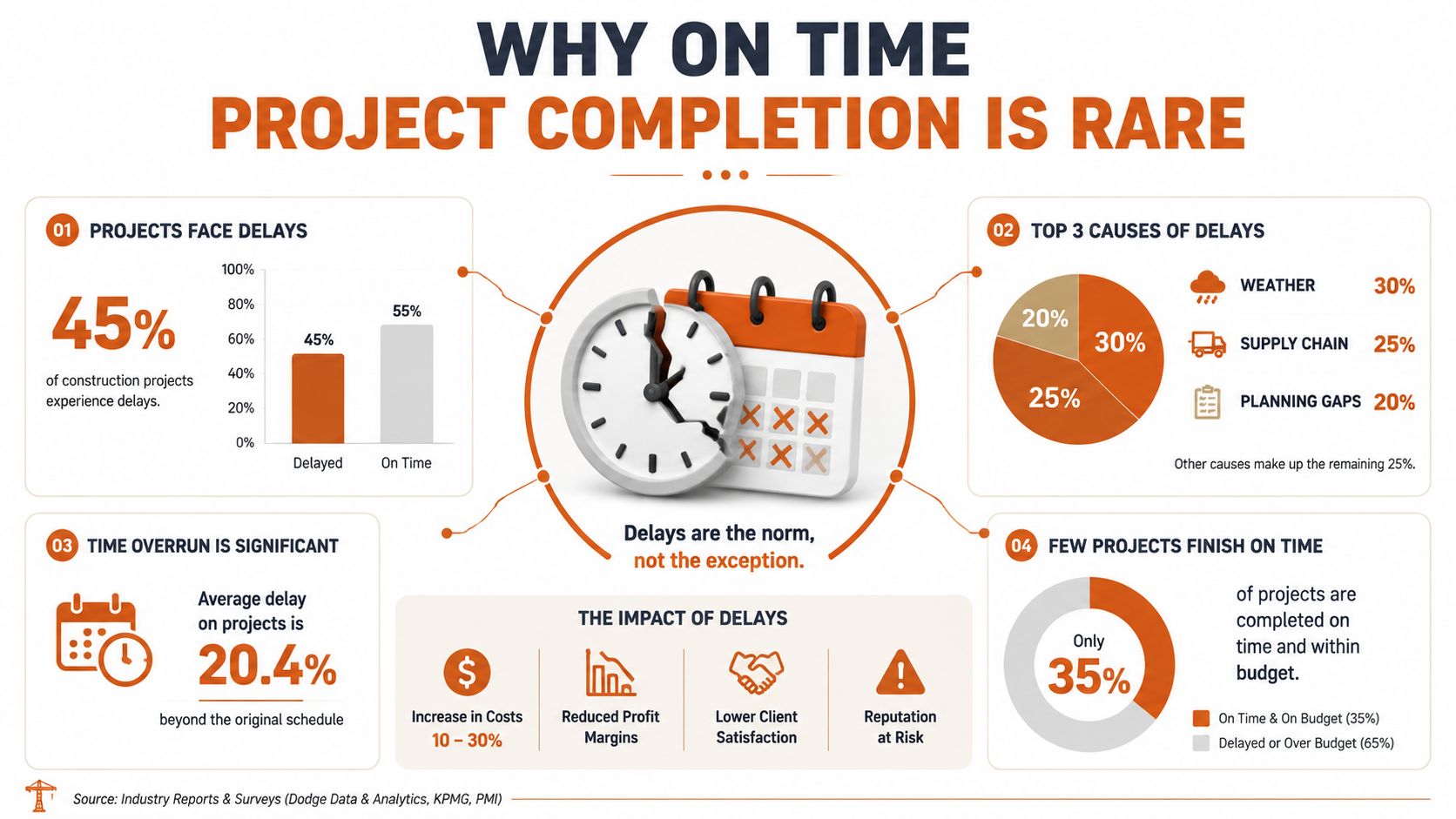
Why local projects feel every missed day
A delayed residential driveway can affect vehicle access, landscaping, deliveries, and household routines. A late commercial parking lot project can disrupt customers, employees, tenant operations, striping layouts, and required inspections. The work may be physically straightforward, but the surrounding commitments create a tight operating window.
Large-project evidence reinforces that schedule control is difficult even with formal plans. KPMG-linked reporting cited by Breeze says only 25% of large projects finish within 10% of their original deadline, while 31% finish within 10% of budget. In another construction dataset, 85.5% of large-scale projects were delivered late, nearly 60% were delayed by at least two months, and 13.4% slipped by a year or more, according to the Wellingtone press release.
Practical rule: A completion date is only dependable when the contractor has also managed the conditions that control that date.
For concrete and asphalt contractors serving Ocala, Dunnellon, Belleview, Silver Springs, Summerfield, and The Villages, schedule reliability is a competitive differentiator. It signals disciplined scope control, accurate forecasting, and coordination that protects the owner from avoidable disruption.
Pre-Job Planning That Prevents Schedule Slippage
The schedule is often won or lost before the first saw cut, excavation, concrete truck, or asphalt delivery. A 2025 analysis of 480 infrastructure projects found that 60% of identified delay drivers traced back to shortcomings in the preparation phase, including poor feasibility studies, unclear scope, and weak financial planning. The analysis also found 39% of projects had no usable delay data, making it harder for owners to understand why schedules failed. Those findings are detailed in the Infrastructure Transparency Initiative's analysis of infrastructure delays.
Start with a site-specific scope
For a driveway replacement in Ocala, planning should identify removal limits, drainage concerns, subgrade condition, access restrictions, finish requirements, and the location of surrounding improvements. A proposal that says only “replace driveway” leaves too much room for disagreement once the crew arrives.
For a commercial sealcoating or striping project in Crystal River, the scope should identify the pavement areas included, traffic-control needs, parking restrictions, marking layout, accessible spaces, directional arrows, and the reopening plan. The owner and contractor should agree on those details before materials and crews are assigned.
A practical pre-job checklist includes:
- Confirm the site: Review access, drainage, grades, utilities, existing pavement, and areas that could restrict equipment.
- Define the work: Put removal, preparation, installation, finishing, cleanup, and exclusions in writing.
- Check approvals: Identify permits, inspections, HOA decisions, property-owner approvals, and tenant notifications.
- Verify readiness: Confirm that the budget, selected materials, access window, and decision-makers are ready.
- Build the sequence: Set milestones for preparation, installation, curing or drying, inspection, and reopening.
Ground preparation deserves special attention because weak or incomplete preparation can delay the installation and undermine the finished surface. For practical guidance, review how to prepare ground for a concrete slab.
A parking lot may appear ready because the surface is visible and accessible, yet old markings, oil contamination, standing water, or unresolved layout questions can stop striping work. A residential site may have the same problem in a different form, such as a gate that limits equipment access or a drainage issue that must be addressed before placing concrete.
The most effective preparation doesn't eliminate every risk. It identifies risks early enough to give the owner a choice, solve the issue before mobilization, or adjust the schedule transparently.
Coordinating Materials and Crews for Florida Concrete and Asphalt Work
A driveway project in Summerfield can be delayed by a ready-mix delivery that arrives outside the workable sequence. A parking lot in Inverness can lose its planned sealcoating window when afternoon thunderstorms make the surface unsuitable. Neither problem is solved by telling the crew to work faster.

Concrete coordination requires a complete sequence
Concrete work depends on more than delivery. The base must be prepared, forms or edges must be ready, reinforcement must be placed where specified, finishing tools must be available, and the crew must have enough time to place and finish the material without interruption.
Florida heat can change how quickly concrete loses moisture at the surface. That makes crew readiness, delivery timing, finishing coordination, and curing protection important parts of the schedule. A contractor who books concrete before confirming the site is ready creates a preventable risk.
Asphalt and sealcoating need suitable conditions
Asphalt paving and repair work require coordination between preparation, material delivery, placement, compaction, and reopening. Sealcoating adds another condition, the pavement and coating need suitable weather and drying time before traffic returns.
Commercial properties also require traffic planning. A parking lot may need to remain partially open, so the contractor might sequence sections rather than close the entire property. That approach can reduce disruption, but it may extend the active work window compared with a full closure. The right choice depends on customer access, tenant operations, safety, and the owner's priorities.
Build communication into the logistics
Reliable contractors confirm material availability, equipment assignments, crew roles, site access, and the next decision point before work begins. They also communicate quickly when a delivery, storm, or inspection changes the sequence.
The goal isn't to create a rigid plan that fails at the first interruption. The goal is to maintain a controlled sequence with alternatives ready. If rain prevents sealcoating, preparation, layout review, or other suitable tasks may still proceed, provided the work remains safe and appropriate.
In Central Florida, material and crew coordination is what turns a calendar date into a workable production plan. It protects homeowners from unnecessary access problems and helps commercial managers keep operations moving.
Managing Weather Contingencies and Permit Timelines in Central Florida
Weather isn't an excuse for poor planning, but it is a real scheduling variable. Heat, intense sun, rain, saturated ground, and afternoon storms can affect concrete placement, curing, asphalt work, sealcoating, traffic control, and site access.
A responsible schedule separates controllable delays from conditions that require a safe pause. The contractor controls whether the crew is prepared, whether materials are ordered correctly, and whether the work sequence is organized. The contractor can't control a storm that makes coating or placement unsuitable.
Use a weather-aware sequence
For a concrete driveway in Dunnellon or Beverly Hills, the schedule should account for preparation, placement, finishing, curing protection, and the time before normal use. For asphalt maintenance in Hernando or Lecanto, the plan should include surface cleaning, repairs, application, drying, and reopening.
Useful contingency practices include:
- Watch conditions actively: Review the forecast and site conditions before dispatching crews and materials.
- Protect the sequence: Keep preparation and administrative tasks moving when installation conditions aren't suitable.
- Communicate changes early: Tell the owner whether the delay affects the workday, the reopening time, or the next milestone.
- Avoid unsafe acceleration: Never force placement, coating, or traffic reopening just to preserve an unrealistic date.
Permitting adds another layer. A project can be fully staffed and still unable to start because an approval, inspection, or jurisdictional requirement remains open. Marion County, FL and Citrus County, FL properties may also involve different local processes, so the contractor should identify the applicable authority before promising a mobilization date.
The schedule should show permit application, review, approval, inspection, and release points rather than treating permitting as an invisible assumption.
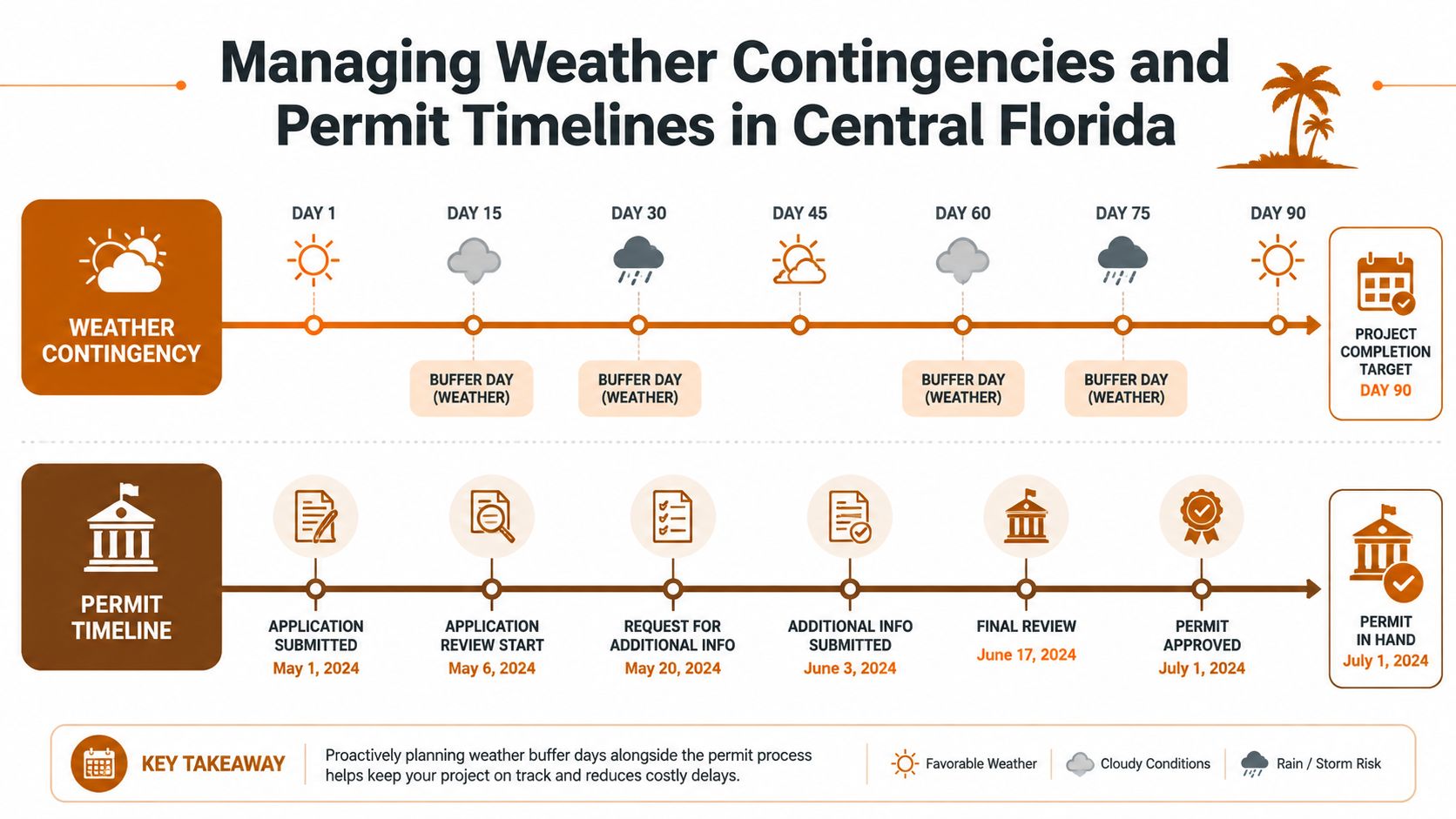
For larger or more exposed work, early planning helps the contractor choose realistic production windows and protect the owner from last-minute disruption. Property owners considering pavement work can also review asphalt paving considerations for Central Florida projects before setting a firm start date.
Setting Clear Client Expectations to Protect Project Timelines
An owner can unintentionally delay a project by changing the scope after work begins, postponing a finish decision, or failing to coordinate access. A contractor can create the same problem by giving a date without explaining the conditions attached to it. On time project completion is a shared responsibility, supported by clear decisions and documented expectations.
A detailed proposal should identify the work area, materials, preparation, finish, exclusions, access requirements, anticipated sequence, and factors that could move the schedule. That protects both sides. If a homeowner adds a new walkway after approving a driveway replacement, the contractor can explain how the change affects materials, labor, and sequencing instead of absorbing it informally.
Communication should follow the milestones
For an ADA-related sidewalk upgrade in The Villages, an HOA board may need time to review the layout and approve the work. For parking lot striping in Belleview, a property manager may need to coordinate tenant notices, delivery access, customer traffic, and a low-disruption work window.
A useful communication rhythm includes:
- Before mobilization: Confirm scope, access, approvals, and site readiness.
- At key milestones: Report completion of preparation, installation, curing or drying, and inspections.
- Before changes: Explain the reason, schedule effect, and approval required.
- At completion: Conduct a walkthrough and document remaining maintenance responsibilities.
Change orders should never be casual verbal additions. Even a small alteration can affect crew sequencing or material coordination. Written approval keeps the schedule visible and gives the owner a fair basis for deciding whether the added work belongs in the current project or a later visit.
A clear delay notice is more useful than a vague promise that the crew will somehow catch up.
This approach applies to homes, HOAs, churches, schools, shopping centers, and commercial properties across Marion and Citrus counties. Clear expectations reduce approval bottlenecks and give everyone a realistic definition of “finished.”
Quality Checks and Post-Job Wrap-Up for Lasting Results
Finishing on schedule has little value if the surface fails because the contractor rushed preparation or skipped verification. Schedule discipline and workmanship standards must operate together. A concrete driveway should be properly prepared, placed, finished, and protected. An asphalt surface should be cleaned, repaired, coated, compacted, or marked according to the actual scope.
Quality checks vary by project. Concrete work may involve reviewing the base, reinforcement, forms, placement consistency, finish, edges, joints, and curing protection. Where the specification requires it, a contractor may use concrete testing such as slump verification. Asphalt work may require checking preparation, compaction, transitions, coverage, drying, and traffic readiness.
The final walkthrough matters
A professional wrap-up should confirm more than whether the crew has left. It should address:
- Surface condition: Review the finish, edges, joints, markings, and transitions.
- Site cleanup: Remove construction debris and leave access areas orderly.
- Safety and access: Confirm that vehicles, pedestrians, tenants, and visitors can use the site safely.
- Owner guidance: Explain curing, drying, traffic restrictions, cleaning, and maintenance.
- Open items: Document anything that needs follow-up rather than leaving uncertainty.
Commercial striping requires an additional compliance review. When a parking lot is restriped, accessible parking obligations apply. The U.S. Access Board states that a standard accessible parking space must be at least 96 inches wide with an adjoining 60-inch access aisle, as explained in its parking lot restriping guidance. The same guidance identifies at least 1 accessible space for lots with 1–25 spaces and at least 2 spaces for lots with 26–50 spaces, while the referenced parking guidance notes at least 1 van-accessible space for every 6 accessible spaces in its ADA compliance guide.
Maintenance planning protects the result after completion. Industry guidance places typical commercial restriping intervals at 18 to 24 months in mild climates, with high-traffic areas sometimes needing touch-ups every 6 to 12 months, according to parking lot striping maintenance guidance.
Riverside Sealing & Striping, LLC describes its quality assurance processes as part of completing concrete and asphalt work with attention to preparation, workmanship, and final results. For property owners in Ocala, Crystal River, Homosassa, Inverness, or surrounding Central Florida communities, the practical lesson is simple: a reliable completion date should include a finished, usable, and properly reviewed project.
Riverside Sealing & Striping, LLC provides concrete driveways, patios, slabs, sidewalks, asphalt sealcoating, and professional parking lot striping across Marion County, FL, Citrus County, FL, and surrounding Central Florida areas. Visit Riverside Sealing & Striping, LLC to request a free, no-pressure consultation and discuss a clear, weather-aware project timeline.