

A driveway can look perfect when the crew packs up and still fail before the first season is over. In Dunnellon, Ocala, Crystal River, and other Central Florida communities, homeowners often judge a concrete or asphalt job by its color, smoothness, and clean edges. Those details matter, but they don't prove that the base was prepared correctly, drainage was handled, the material was placed within its working limits, or the surface received enough curing and protection.
That's where quality assurance processes earn their place. A real process gives you checkpoints, records, photographs, and corrective actions that show what happened beneath the finished surface. Whether you're replacing a driveway in Marion County, FL, maintaining a commercial lot in Citrus County, FL, or improving an HOA walkway near The Villages, you should be able to verify more than a polished final appearance.
Table of Contents
- When a Smooth Surface Hides a Bad Job
- What Quality Assurance Processes Actually Mean on a Job Site
- Standards and Inspection Checkpoints Worth Knowing
- A Sample QA Checklist You Can Hand to Any Contractor
- Residential vs Commercial Projects Different QA Demands
- How to Evaluate a Contractor Before You Sign
- Why Central Florida Climate Makes QA Non-Negotiable
When a Smooth Surface Hides a Bad Job
A Citrus County homeowner hired the cheapest driveway reseal crew serving the Dunnellon area. The surface looked dark and even when the workers left. Three weeks later, the edges began crumbling, loose sand collected at the garage entrance, and stormwater pooled beside the walkway. Calls went unanswered.
The homeowner had no progress photographs, no material delivery record, no application log, and no written explanation of how the crew prepared the pavement. There was nothing objective to compare with the failure. The disagreement became a matter of opinion, and the contractor had already moved on.
Day-one appearance isn't proof
A fresh sealcoat can hide insufficient cleaning, weak edge preparation, poor coverage, or application over asphalt that hasn't stabilized. A newly finished concrete slab can conceal a weak subgrade, misplaced forms, poor consolidation, incorrect finishing, or inadequate curing. The surface tells you what the crew left behind. It doesn't tell you whether the steps underneath were controlled.
On an asphalt driveway, a contractor should be able to explain how cracks, oil spots, loose aggregate, and edges were treated before coating. On a concrete project, the owner should know how the base was prepared, where control joints were placed, how the mix was handled, and what curing method was used.
Practical rule: A contractor who only shows you the finished surface is showing you the least informative part of the work.
Documentation turns an argument into an inspection
Good records don't need to be complicated. A homeowner may reasonably ask for dated photographs of the base and forms, delivery tickets when applicable, notes about weather and placement conditions, and a punch list identifying anything corrected before final payment. Those records help the contractor catch a problem while access and equipment are still available.
They also help the property owner distinguish normal aging from a workmanship concern. If uneven concrete is the issue, a guide to fixing uneven concrete slabs can help explain why a surface-level patch may not address settlement or drainage.
Quality assurance means the contractor verifies the work as it progresses, not after the crew has packed away the forms and rollers. The test is whether the installation can withstand rain, heat, ultraviolet exposure, and regular traffic after the job stops looking new.
What Quality Assurance Processes Actually Mean on a Job Site
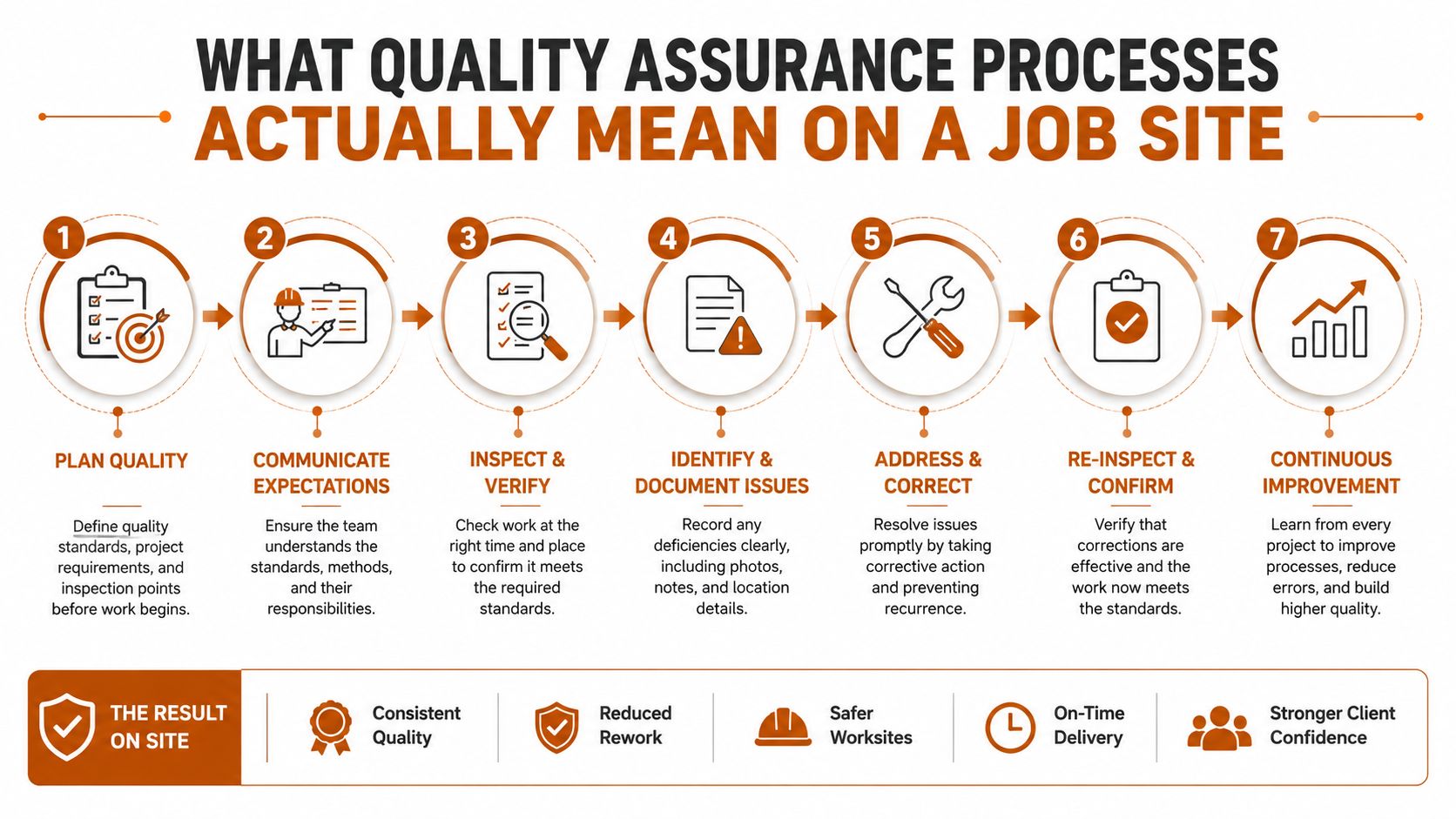
Quality assurance processes are planned controls built into the work sequence. They identify what must be checked, who checks it, what evidence gets recorded, and what happens when the result falls outside the agreed requirement. That differs from a final inspection, which may catch a visible defect but can't reliably prove why it occurred.
Consider a driveway pour in Ocala. Before concrete arrives, the crew verifies the subgrade, forms, reinforcement where specified, slope, and access route. During placement, they check the delivered material, observe consistency, place it without unnecessary delays, consolidate it properly, finish the surface, form or cut joints, and begin curing under suitable conditions.
Each checkpoint protects the next step. Poor subgrade preparation can leave a sound-looking slab vulnerable to settlement. Incorrect form elevation can send water toward a garage rather than away from it. Excessive finishing while bleed water remains at the surface can weaken the finished layer.
The same logic applies to asphalt
For a small commercial asphalt lot, the crew's checkpoints look different but follow the same pattern. They verify the existing base, clean the surface, confirm tack coat coverage where required, review the mix delivery information, monitor placement conditions, control lift thickness, and use a defined rolling sequence.
A roller pattern isn't just a matter of preference. The crew needs enough compaction while the mix remains workable, and the finished joints need attention because weak longitudinal or transverse joints often become the first visible failure points.
Inspection looks once, assurance follows the process
A useful job record may include:
- Material evidence: Delivery tickets, mix information, or concrete documentation tied to the work area.
- Progress photographs: Images of the subgrade, forms, drainage details, edges, and completed stages before they disappear beneath the next layer.
- Test records: Slump, temperature, density, or other project-specific results when the specification requires them.
- Corrective actions: A written note showing what failed, who authorized the correction, and how the corrected work was accepted.
- Final verification: A punch list covering drainage, edges, texture, joints, striping, cleanup, and owner questions.
That paper trail protects both sides. The owner gets evidence instead of reassurance, while the contractor gets a factual basis for correcting a problem before it becomes a callback.
Standards and Inspection Checkpoints Worth Knowing
Property owners don't need to become materials engineers, but they should recognize the standards and records that shape a credible quality program. ISO 9001 provides a broad management framework built around documented procedures, records, corrective action, and review. It doesn't replace the field specifications for a driveway or parking lot. It helps a contractor organize how those requirements are controlled.
The history of process-based quality management is useful here. The British Standards Institution published BS 5750 in March 1979, widely regarded as the world's first quality management systems standard, and the ISO 9000 family formalized the approach globally in 1987. ISO 9001 certificates worldwide increased from 409,421 at the end of 2000 to 1,138,155 by 2014, according to the history of the ISO 9000 family. The lesson for a local property owner is simple: quality is more reliable when it is managed through repeatable processes rather than final inspection alone.
What the field checkpoints reveal
For asphalt work, state and project specifications may address mix characteristics, compaction, layer thickness, joints, and surface tolerances. A density reading can reveal whether the crew achieved adequate compaction. A delivery record can show what material arrived and when. A thickness check can expose a thin lift that may wear prematurely under traffic.
For concrete work, ACI guidance is commonly associated with concrete construction requirements, strength, placement, finishing, and curing. The owner should ask what project-specific requirements apply and what records will be provided. A concrete testing resource covering concrete strength testing methods can help a homeowner understand why testing is different from tapping the finished slab.
| Standard | What It Catches |
|---|---|
| ISO 9001 framework | Missing procedures, weak records, unresolved corrective actions, and inconsistent management review |
| Project asphalt specifications | Material, placement, lift, joint, compaction, and smoothness problems |
| ACI 301 guidance | Concrete execution issues involving placement, finishing, curing, and acceptance requirements |
| ACI 318 provisions | Structural concrete requirements where the project design calls for them |
| AQL sampling plans | Incoming material decisions without requiring inspection of every unit |
A published AQL evaluation reported an Operating Characteristic curve value of 0.9198, AOQ of 1.916%, and ATI of 29.7 units, demonstrating how statistically designed sampling can control incoming quality without 100% inspection. Those figures come from the AQL sampling evaluation, not from ordinary driveway work, but the principle transfers: a thoughtful sampling plan is more useful than random checking.
For asphalt construction, layered verification can be especially valuable. One state specification requires verification testing at a frequency of at least 10% of the contractor's quality-control sample frequency, along with split-sample precision limits, observation of testing, and control-chart monitoring, as described in this state asphalt quality-assurance specification. A homeowner won't normally need that exact system, but they can still ask who verifies the contractor's results and how deviations are handled.
A Sample QA Checklist You Can Hand to Any Contractor
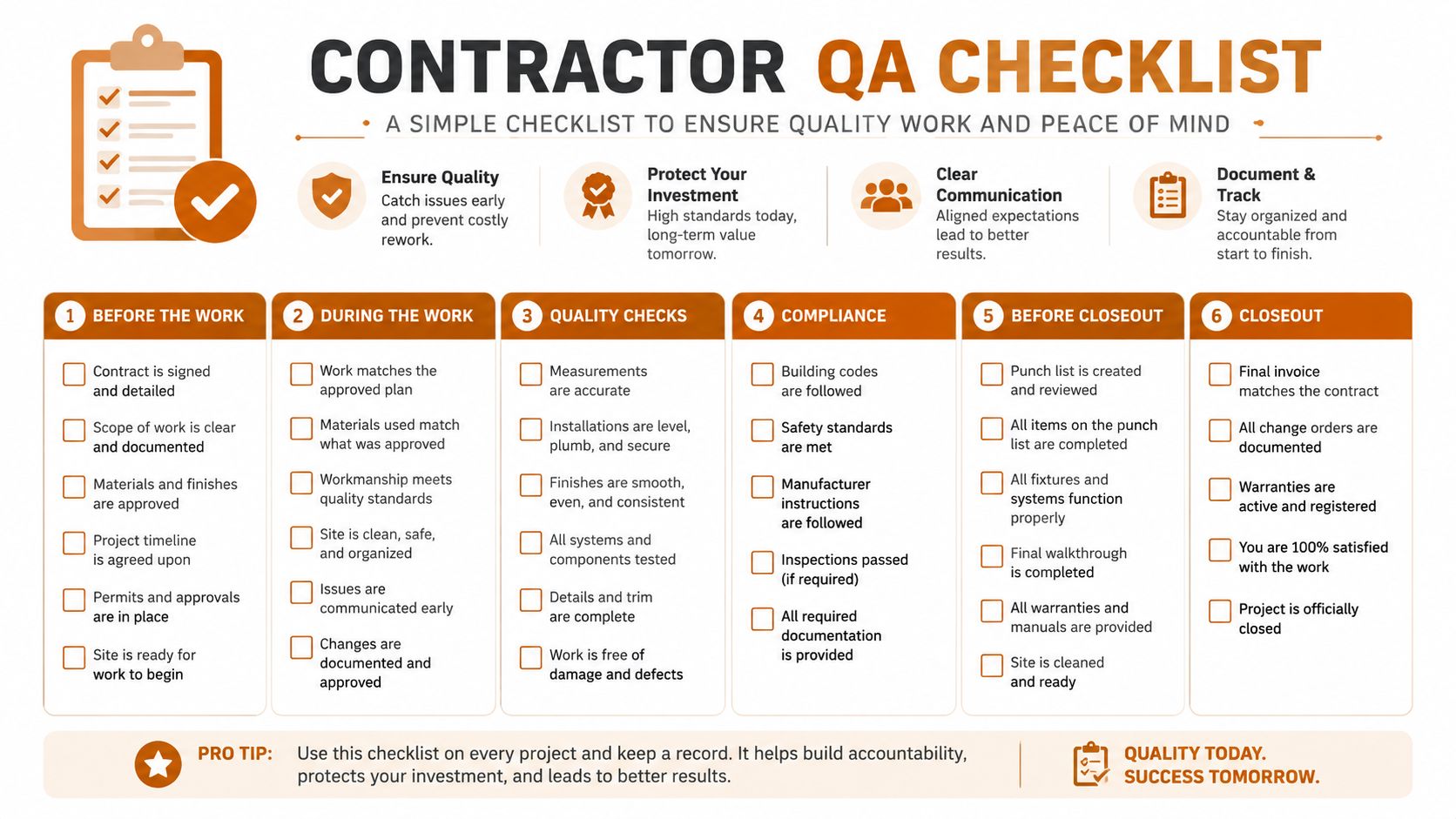
A useful checklist is a working document, not a sales brochure. It should identify the checkpoint, the person responsible, the evidence retained, and the action required if the work doesn't meet the agreed condition.
Before concrete or asphalt placement
Ask the crew to record the starting condition before anything gets covered.
- Subgrade: Confirm that soft areas, organic material, loose fill, and standing water have been addressed.
- Forms and edges: Check line, elevation, joint locations, and edge restraint. Shell or gravel borders in Citrus County deserve particular attention because unsupported edges can break away under vehicle loading.
- Drainage: Verify that the planned slope moves water away from the garage, building, walkway, or accessible route.
- Existing pavement: Photograph cracks, failed areas, oil contamination, and transitions that require separate treatment.
During placement
Some items are visible. Others require a ticket or test result.
- Concrete consistency: Ask whether slump and delivery information are recorded when the project specification calls for them.
- Asphalt temperature and delivery: Review the delivery slip and confirm that the crew is placing and compacting material within its workable range.
- Lift or slab thickness: Confirm the planned thickness and how it will be checked.
- Weather window: Note rain, extreme heat, and delays that could affect placement or curing.
Finish, cure, compact, and complete
Concrete finishing should produce the specified texture without excessive manipulation of the surface. On a residential driveway, check joint depth and layout, broom texture, transitions, and clean edges. For asphalt, look for consistent rolling, tight joints, and a surface free of obvious segregation or loose material.
Curing and compaction require records rather than guesses. Ask for the concrete curing method and timing, or the asphalt roller sequence and density documentation when specified. Sealcoating should not be applied too soon after new asphalt placement, because the pavement needs time to stabilize before receiving a protective coating.
Final checks should include sealcoat coverage, drainage, cleanup, and striping. For accessible parking, verify the layout against the applicable ADA requirements. Lots with 1 to 25 spaces require at least 1 accessible space, while lots with 26 to 50 spaces require 2, and at least 1 van-accessible space is required for every 6 accessible spaces, according to this ADA parking striping guide. The contractor should document the layout, not paint what appears convenient.
Residential vs Commercial Projects Different QA Demands
The principles don't change between a single-family driveway off County Road 484 in Dunnellon and a shopping-center lot along a busy SR 200 corridor in Ocala. The scale, traffic exposure, coordination requirements, and consequences of a missed checkpoint do change.
A residential owner usually participates directly in the walk-through. The most important records may concern the base, drainage, concrete placement, joint layout, curing, or uniform sealcoat coverage. Commercial work adds tenant access, traffic control, delivery coordination, phased construction, formal striping layouts, and acceptance documents.
| QA Element | Residential Driveway (Dunnellon) | Commercial Lot (Ocala) |
|---|---|---|
| Pre-work review | Walk the existing driveway, drainage, edges, and access | Survey lot conditions, traffic routes, tenant access, utilities, and work phases |
| Material records | Keep relevant delivery and product information | Maintain delivery tickets, testing records, and organized project documentation |
| Compaction | Check preparation and correct visibly soft areas | Use specified density testing and document results by lift or work area |
| Drainage | Confirm water moves away from the garage and walkway | Verify broader site drainage, ponding risks, accessible routes, and transitions |
| Markings | Review driveway edges or small private-area markings | Coordinate stall counts, van-accessible spaces, fire lanes, arrows, and ADA layout |
| Final acceptance | Owner walk-through and punch list | Formal sign-off packet, punch list closure, and records for the property manager |
What becomes non-negotiable
A homeowner may accept a simple photograph of prepared base material when the project is small and straightforward, provided the contractor can explain the installation. A commercial owner generally needs traceability by area, because a later failure must be tied to a particular lift, delivery, crew, or repair.
The same difference applies to striping. A residential owner wants clean, durable lines and safe transitions. A shopping center needs a coordinated layout that accounts for accessible spaces, traffic movement, fire access, pedestrian routes, and tenant operations.
A concrete driveway replacement decision also deserves a structural review. Wide cracks through the slab, vertical offset, heaved or settled areas, rocking panels, and crumbling edges point toward structural failure. Repeated repairs, widespread damage, or a driveway around 25 years old can support replacement rather than another patch, as explained in this concrete driveway repair-or-replace guide.
How to Evaluate a Contractor Before You Sign
Use the bid walk to evaluate the contractor's process, not just the proposed price. A reliable contractor should be able to explain the sequence in plain language and identify the records that will be created before, during, and after the work.
Ask direct questions:
- Who owns the QA records? Find out whether the crew lead, project manager, or office keeps photographs, tickets, test reports, and punch-list notes.
- What happens when work fails inspection? A good answer includes documentation, correction, reinspection, and approval before the next stage proceeds.
- Can the crew stop work? The person closest to the placement should have authority to pause when rain, unsuitable material, unstable base, or another field condition threatens the result.
- What will I receive at completion? Clarify whether the closeout includes photographs, product information, warranty terms, and unresolved-item status.
- How will drainage be checked? The contractor should discuss slopes, transitions, low points, and water paths rather than treating drainage as an afterthought.
Red flags during the bid
Verbal assurances such as “we always do it this way” don't substitute for a written method. Refusal to share mix tickets or delivery slips, no in-progress photographs, and no defined punch-list process indicate that the contractor may rely on appearance instead of verification.
You should also verify that the contractor is licensed and insured, check licensing information through the relevant Marion or Citrus County Building Safety resources, and request recent references for similar work. References should be for comparable scope, such as a residential concrete driveway, HOA walkway, commercial sealcoating project, or parking lot striping job.
A useful test: If the contractor can't explain the quality process on a Dunnellon or Ocala jobsite without hiding behind jargon, don't assume the paperwork exists somewhere else.
Before signing, ask for the schedule, scope, exclusions, payment stages, correction procedure, and warranty language in writing. A no-pressure consultation should leave you with clearer expectations, not a demand for an immediate deposit. For more questions to use during the meeting, review these questions to ask a concrete contractor.
Why Central Florida Climate Makes QA Non-Negotiable
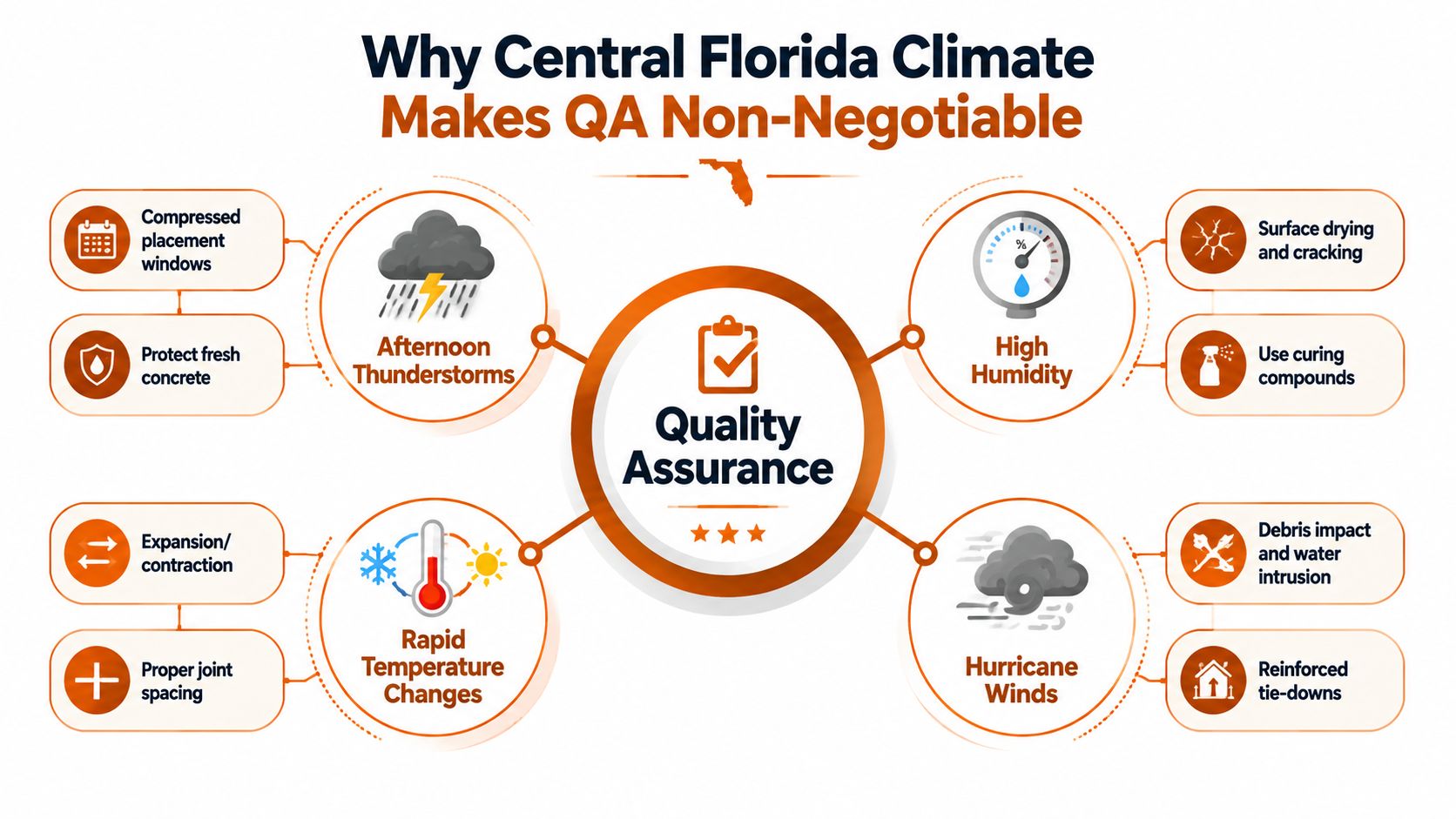
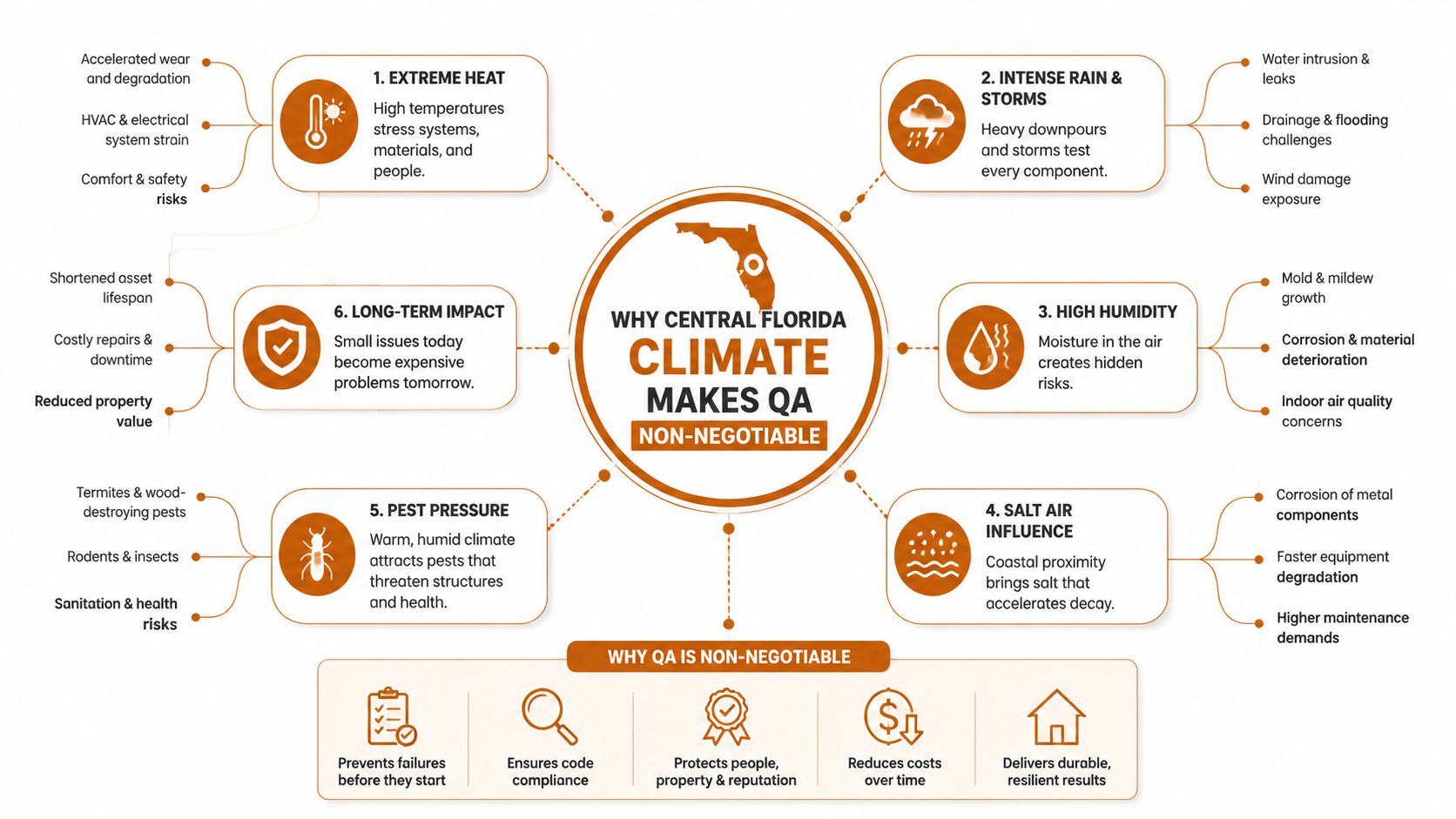
Central Florida puts several stresses on the same surface at once. Afternoon thunderstorms in Ocala and Dunnellon can compress a concrete placement window and threaten fresh finishes. High heat and ultraviolet exposure accelerate wear on asphalt binders, while sudden rain can interfere with cleaning, coating, curing, and access.
The checkpoint must match the risk. Concrete crews need to confirm placement conditions and curing protection before the weather changes. Asphalt crews need material and compaction records, clean preparation, sound edges, and a coating schedule that respects the pavement's condition.
Local conditions change the inspection plan
Sandy soils common across Marion County, FL and Citrus County, FL can shift under repeated loading when the base isn't prepared and compacted properly. That matters beneath driveways in Belleview, Summerfield, Silver Springs, and Hernando just as it matters beneath commercial pavement in Inverness, Lecanto, and Beverly Hills.
Near Inglis and Crystal River, humidity and coastal conditions add another reason to document surface preparation and coating adhesion. On properties around Homosassa, weather exposure, drainage, and traffic should be considered together rather than treated as separate maintenance concerns.
Florida maintenance timing also needs to reflect use. Guidance commonly recommends resealing asphalt every 2 to 3 years, with low-traffic residential driveways sometimes lasting 3 to 4 years and heavier-use commercial lots often needing treatment every 1 to 2 years, as outlined in this Florida sealcoating maintenance guide. Those are planning ranges, not promises. Surface condition, traffic, drainage, and prior workmanship still control the decision.
A contractor that logs weather windows, material tickets, photographs, cure times, and corrective work gives the owner a record that can support a warranty discussion or an insurance conversation if early failure appears. Riverside Sealing & Striping, LLC provides concrete work, asphalt sealcoating, and parking lot striping for homes, HOAs, and commercial properties across Central Florida, with the work evaluated through the same practical lens: preparation, placement, protection, and proof.
For a driveway, walkway, parking lot, or HOA improvement in Marion County, FL or Citrus County, FL, contact Riverside Sealing & Striping, LLC for a free, no-pressure on-site consultation and estimate. The team provides licensed and insured concrete construction, asphalt sealcoating, and professional parking lot striping, with clear scheduling and documented checkpoints that help you understand what you're paying for. Visit Riverside Sealing & Striping, LLC to arrange a professional evaluation.