
When you invest in a new concrete driveway, patio, or foundation for your home or business in Central Florida, you're buying a promise of durability. But how is that promise kept? It all hinges on the concrete's strength, measured in Pounds per Square Inch (PSI), and verified through professional concrete strength testing methods. For property owners in Marion and Citrus County, understanding this process is key to ensuring you get the lasting quality you paid for.
As the region's concrete and asphalt experts, we know that a strong foundation is everything. This guide will walk you through how professionals verify concrete strength, why it's critical in the Florida climate, and what signs indicate your existing concrete might need an expert evaluation.
Table of Contents
- Why PSI is Non-Negotiable for Your Florida Property
- The Definitive Method: Compressive Strength Testing
- Guide to Non-Destructive Testing (NDT)
- How Florida's Climate Challenges Concrete Durability
- When to Call a Pro: Connecting to Our Services
- Frequently Asked Questions
- Your Local Concrete and Asphalt Experts
Why PSI is Non-Negotiable for Your Florida Property
When you choose to install new concrete, you’re not just buying a slab of gray material. You’re investing in the safety, curb appeal, and long-term value of your property. The single most important factor guaranteeing that investment is the concrete's compressive strength.
Think of PSI as the concrete's performance guarantee. It’s a promise that the hardened slab can handle a specific amount of force before it fails. For homeowners in Marion County and business owners across Citrus County, this isn't some minor technical detail—it’s the difference between a driveway that lasts for decades and one that starts cracking after a few seasons of harsh Florida weather.
The Real-World Meaning of PSI
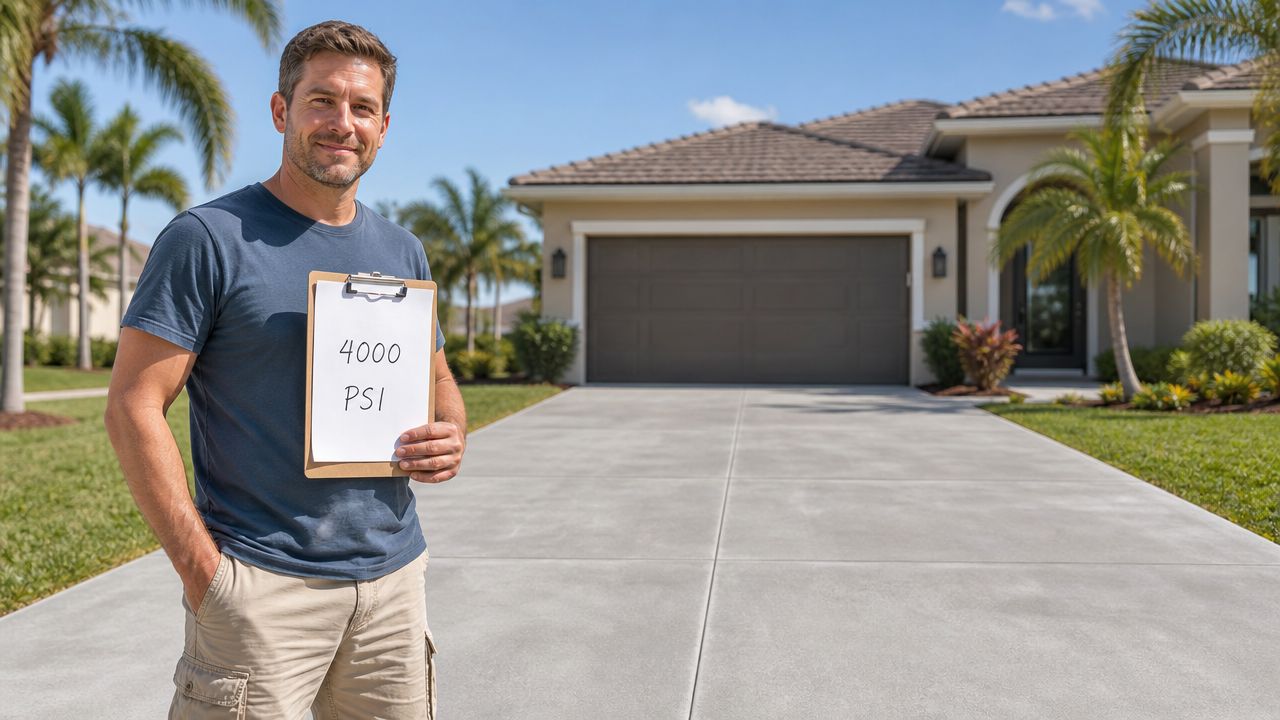
So, what does a number like 4,000 PSI actually mean for your property? It’s simpler than it sounds. Imagine stacking weights on a tiny, one-inch square of your cured concrete. A 4,000 PSI rating means that small area can support 4,000 pounds of direct pressure before it gives way.
This strength is absolutely critical for handling:
- Vehicle Loads: Everyday traffic from family cars and SUVs, or even the heavier trucks and equipment common at commercial properties in Ocala and The Villages.
- Environmental Stress: Resisting the constant expansion and contraction cycles caused by Central Florida’s blistering sun and sudden downpours.
- Long-Term Durability: Ensuring the surface stays solid and intact, preventing the premature crumbling and spalling that can plague weaker concrete.
A residential project in Crystal River might have different strength requirements than a busy commercial lot in Summerfield. As the trusted concrete and asphalt experts serving Marion and Citrus Counties, we know that hitting these targets isn't about guesswork; it's a science built on reliable testing. Without it, you’re just hoping the mix was right—a gamble property owners in Dunnellon and Homosassa shouldn't have to take.
The Definitive Method: Compressive Strength Testing
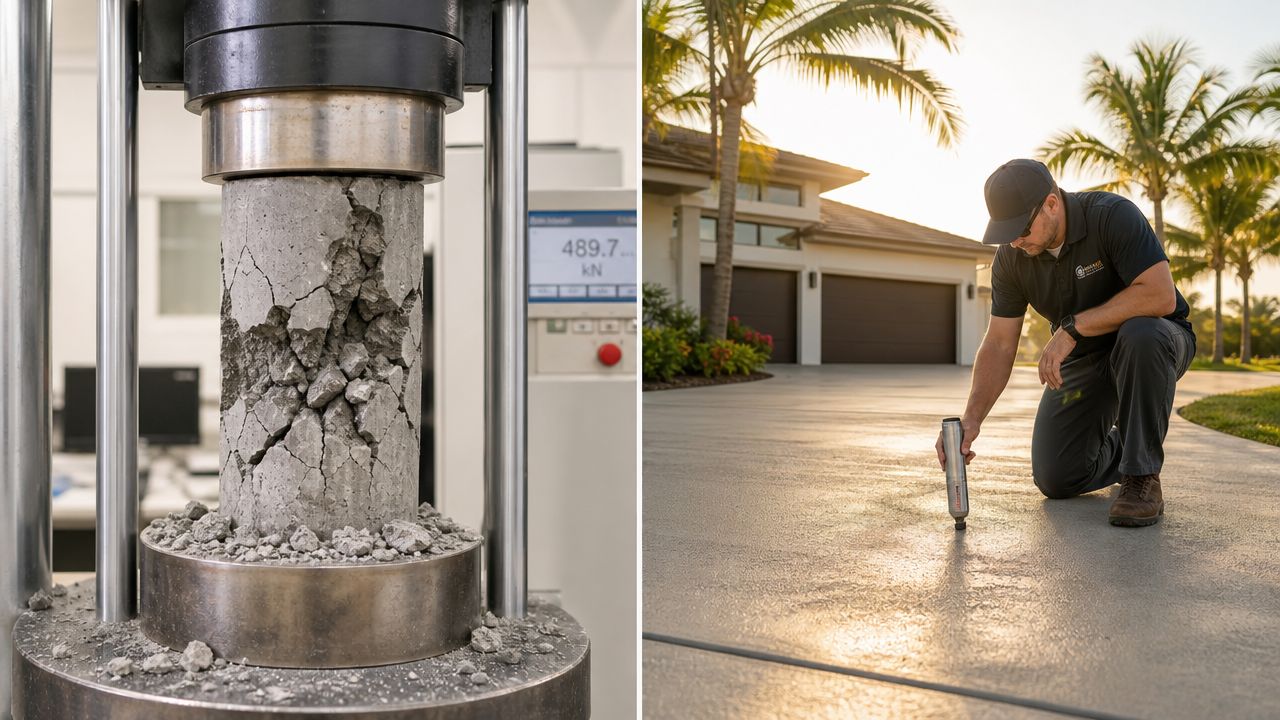
When engineers and reputable contractors need undeniable proof of concrete quality, they turn to the industry's gold standard: the compressive strength test. This is a destructive method, which means a sample is intentionally tested until it fails. It's a controlled stress test that definitively proves the concrete can handle its designed load before it becomes part of your foundation or driveway.
This very test is why we can confidently talk about specific ratings like “4,000 PSI concrete.” It gives us a precise, universally accepted measurement of strength, ensuring that projects from a residential driveway in Belleview to a commercial foundation in The Villages meet strict engineering standards. For a property owner, this process is your ultimate assurance of quality and durability.
From Fresh Pour to Lab-Proven Strength
The journey of a compressive strength test starts the moment new concrete arrives at your job site in Marion County or Citrus County. Here’s a step-by-step look at how it works:
- Creating the Samples: As the concrete is poured, a trained technician takes representative samples right from the truck. These are carefully placed into standardized cylindrical molds.
- Initial Curing On-Site: The filled cylinders are then left to cure in a protected spot on-site for the first 24 to 48 hours, mimicking the conditions of the main slab.
- Lab Curing: After this initial set, the cylinders head to a laboratory. There, they are removed from their molds and put into a controlled environment with specific temperature and humidity levels for the rest of their curing time. This precision is absolutely crucial for an accurate test.
- The Crush Test: At set intervals—usually 7 days and 28 days—the cylinders are placed into a hydraulic compression machine. This machine applies a slow, steady force, crushing the cylinder until it finally breaks. The maximum force applied right before failure is recorded and used to calculate the concrete's compressive strength in PSI.
The 28-day test result is what we consider the official design strength. It’s the final word, verifying that the concrete poured on your property in Ocala, Dunnellon, or Homosassa has achieved the durability it was promised to have.
The compressive cylinder test has long been the go-to reference because it measures exactly how much direct pressure hardened concrete can take. Most residential slabs are designed for 2,500–3,500 PSI, while commercial foundations might demand 4,000–6,000 PSI or more. The 7-day test offers a great early look, often showing about 70% of the final 28-day strength. This process depends entirely on proper curing—poor curing can slash strength by as much as 20%. For a deeper dive, see our guide on how concrete curing works.
As concrete and asphalt experts serving Central Florida, we know this level of verification is non-negotiable for delivering a product that stands up to Florida’s demanding climate.
Guide to Non-Destructive Testing (NDT)
While crushing a concrete cylinder gives you a definitive strength number, what happens when the concrete is already in place? You can't exactly start smashing up your new patio or a commercial building's support columns to see if they're strong enough.
This is exactly where Non-Destructive Testing (NDT) comes into play. Think of it as a doctor’s check-up for your concrete. These modern techniques allow us to estimate strength and find potential problems right on-site, all without taking a single chip out of the structure. For large commercial jobs in Marion County or an older driveway in Citrus County, NDT gives us the immediate feedback needed to make smart decisions.
Comparing Destructive vs. Non-Destructive Testing
Understanding the core differences between these two testing philosophies is key. One provides a conclusive answer by destroying a sample, while the other offers a fast, on-the-spot evaluation of the existing structure.
Here's a quick breakdown:
| Attribute | Destructive Testing (e.g., Compressive Strength) | Non-Destructive Testing (e.g., Rebound Hammer) |
|---|---|---|
| Accuracy | Provides a direct, highly accurate measurement of strength. Considered the "gold standard." | Gives an estimated strength value. Excellent for comparison and finding weak spots. |
| Location | Performed on samples in a controlled lab environment. | Conducted directly on the existing concrete structure (in-situ). |
| Damage | The test sample is completely destroyed. | Minimal to zero damage to the concrete surface. |
| Speed | Slow. Requires casting, curing (often 28 days), and lab processing. | Fast. Results are available almost instantly on-site. |
| Cost | Can be more expensive due to lab fees, sample preparation, and time. | Generally more cost-effective for large-scale assessments. |
| Purpose | Best for quality control during new construction and final verification. | Ideal for assessing existing structures, ensuring uniformity, and troubleshooting. |
While destructive testing gives the final word on a sample's ultimate strength, NDT provides the bigger picture, allowing for a comprehensive health check of an entire slab or structure quickly and affordably.
The Tools of the Trade: A Look at On-Site Testing Methods
An experienced technician has several tools at their disposal to "read" the concrete without breaking it.
Rebound Hammer (Schmidt Hammer): This is the most common NDT tool. A spring-loaded pin strikes the concrete, and the device measures the rebound. Harder, denser concrete produces a higher rebound number, giving us a quick idea of its surface strength.
Ultrasonic Pulse Velocity (UPV): This high-tech method is like giving the concrete an ultrasound. We send a sound wave through the slab—the faster it moves, the denser and more solid the concrete is. This is fantastic for detecting internal flaws like voids or cracks.
Penetration Resistance (Windsor Probe): This technique uses a special driver to fire a small, hardened steel probe into the concrete with a precise amount of energy. We then measure how far the probe penetrated. Stronger concrete resists the probe more, resulting in a shallower depth.
These on-site methods provide a wealth of information, as illustrated below.
While no NDT method can replace the definitive result of a core test, they are invaluable for quickly assessing large areas. You can discover more about advanced NDT methods at GiatcScientific.com to see how the technology continues to evolve.
A real-world example: A technician uses a rebound hammer on a new parking garage in The Villages. They notice one section has lower numbers. This acts as a red flag, pinpointing where a more detailed investigation is needed to ensure the entire structure is safe and uniformly strong.
How Florida's Climate Challenges Concrete Durability
Understanding the science of concrete strength is important, but local context is crucial. Here in Central Florida, concrete isn't just poured—it has to be engineered to survive a daily battle with our unique climate. As specialists serving Marion County and Citrus County, we know what it takes to build durable structures that last.
The intense Florida sun is the most obvious adversary. In communities like Summerfield and The Villages, relentless heat can cause freshly poured concrete to lose moisture too quickly. This premature drying can stop the crucial chemical hydration process, resulting in a weaker surface and a web of unsightly shrinkage cracks.
But it’s not just the heat. The entire Central Florida environment presents a gauntlet of challenges:
- Sudden Downpours: A surprise afternoon storm in Ocala or Silver Springs can wash away the top layer of cement paste from fresh concrete, weakening the surface.
- High Humidity: While it slows drying, humidity creates the perfect breeding ground for mold and algae on unsealed concrete, making it a stained, slippery mess.
- Sandy, Porous Soil: The sandy soils around Dunnellon and Inverness demand serious site preparation. Without a properly compacted subgrade, even the strongest concrete will eventually settle and crack under pressure.
Navigating these issues requires local expertise. An experienced contractor knows how to adjust the concrete mix and curing process to fight back against the Florida climate, ensuring the slab reaches its full intended strength. To see how these adjustments are made, check out our guide on choosing the best concrete mix for driveways.
When to Call a Pro: Connecting to Our Services
It’s one thing to understand the science behind concrete strength, but it's another to know when your own driveway or patio is in trouble. For homeowners and commercial property managers throughout Marion County, FL and Citrus County, FL, catching the early warning signs of concrete distress can be the difference between a simple fix and a major replacement. Not every crack signals disaster, but some issues point to deeper problems that need an expert eye.
As the go-to concrete and asphalt specialists for Central Florida, we help you figure out what’s truly going on with your pavement.
Key Warning Signs to Watch For
Take a walk around your property in Ocala, Homosassa, or Lecanto. If you notice any of these red flags, it’s time to call a professional for an evaluation.
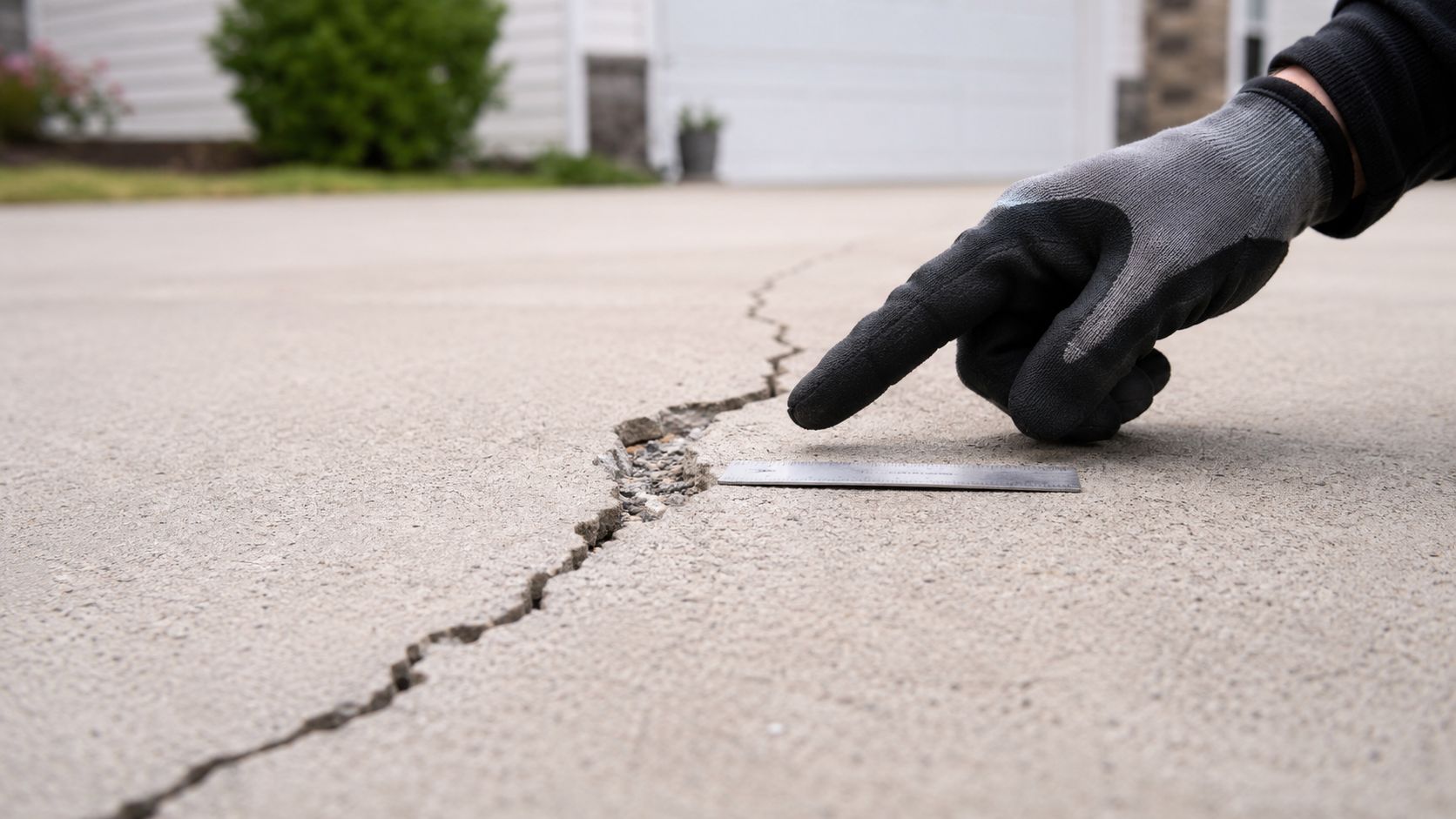
- Expanding Cracks: A crack that widens to more than the width of a credit card, deepens, or splinters is a clear sign of underlying stress.
- Uneven Settling (Heaving): One section of your driveway being higher or lower than the next is a serious trip hazard that indicates a problem with the soil base underneath.
- Surface Flaking or Spalling: When the smooth top layer chips away, exposing the rough aggregate below, it means the surface has lost its integrity. You can learn more about what concrete spalling is and how to address it.
- Pitting and Pop-Outs: Widespread crater-like pits create weak points that can compromise the entire slab over time.
Why a Professional Assessment Matters
When you spot these issues, the big question is always the same: repair or replace? A professional evaluation provides a definitive answer. We use our experience to find the root cause, not just treat the symptom. An expert assessment can tell you if a crack is cosmetic or a sign of a failing subgrade, helping you make an informed decision and avoid spending money on a short-term fix.
For property owners in Beverly Hills, Hernando, or anywhere else in our service area, getting a professional opinion provides peace of mind. As a licensed and insured contractor with deep local experience, our team offers free, no-pressure on-site consultations to assess the health of your pavement. We'll help you understand if the issue is purely aesthetic or structural and lay out the best options, whether that's a targeted repair, a durable replacement, or one of our other expert concrete work or asphalt services.
Frequently Asked Questions
Here are some common questions we get from homeowners and property managers across Marion and Citrus County.
What is a good PSI for a residential driveway in Florida?
For a typical residential driveway in areas like Ocala, Belleview, and Crystal River, a mix rated between 3,000 to 4,000 PSI is the sweet spot. This provides more than enough strength for daily cars and SUVs and is durable enough to stand up to our brutal Central Florida climate. A 4,000 PSI mix is a smart investment in long-term durability.
Can you test the strength of my old, cracked concrete?
Yes. While we can't test the original mix, we can determine its current strength. Using methods like core drilling or non-destructive testing (NDT), we can get a clear picture of your concrete's structural health. This diagnostic step is critical for deciding if a simple repair will suffice or if a full replacement is the wiser long-term investment, a common question in communities like Homosassa and Dunnellon.
Why did my new concrete patio crack so fast?
Premature cracking on new concrete almost always traces back to the installation. The most common culprits are improper curing (drying too fast in the Florida sun), a poorly compacted subgrade, or inadequate control joints to manage natural shrinkage. This is why hiring an experienced, licensed, and insured contractor who understands the demands of our local environment in Marion County, FL, and Citrus County, FL, is so important for a long-lasting job.
Your Local Concrete and Asphalt Experts
Understanding the methods behind concrete strength testing helps you appreciate what goes into a durable, high-quality installation. From the initial pour to the final cure, every step is crucial for building a surface that can withstand vehicle traffic and Florida's harsh weather.
Whether you're concerned about the condition of your existing concrete, planning a new driveway, or need a professional evaluation for your commercial property, our team is here to help. As the trusted Concrete and Asphalt Experts in Marion and Citrus County, we provide reliable workmanship and peace of mind. We offer fast turnaround times and solutions designed for long-term savings.
Contact us today for a free, no-pressure on-site evaluation and estimate.